
Best Coffee Grinders for Drip Coffee Brewing


OneHundredCoffee is reader-supported, and some products displayed may earn us an affiliate commission. Details
Good drip coffee starts before hot water touches a paper filter. The grinder determines how much surface area the water meets and how evenly the coffee bed drains. A machine that produces too much powder can slow extraction and leave a drying finish; one that delivers an excessively coarse, irregular grind can allow water to pass through too quickly. For most automatic drip brewers, I begin in the medium range, then move slightly finer or coarser to suit flavor, brew size and the filter basket. There is no universal collar number that guarantees the right result on every grinder.
Choosing the grinder is equally practical. A household making a full carafe each morning needs different bean capacity from someone preparing one cup in a compact apartment. Some people value a remembered timer; others prefer measuring one dose at a time and avoiding a full hopper. Five burr grinders illustrate those trade-offs particularly well: the full-size OXO Brew, OXO Compact, Bodum BISTRO, Ollygrin touch-panel model and Baratza Sette 30. They are not interchangeable simply because all five use burrs. Their grind ranges, controls, capacity and intended daily workflows are different.
Editor’s Picks: Three Drip Coffee Grinders Worth Buying
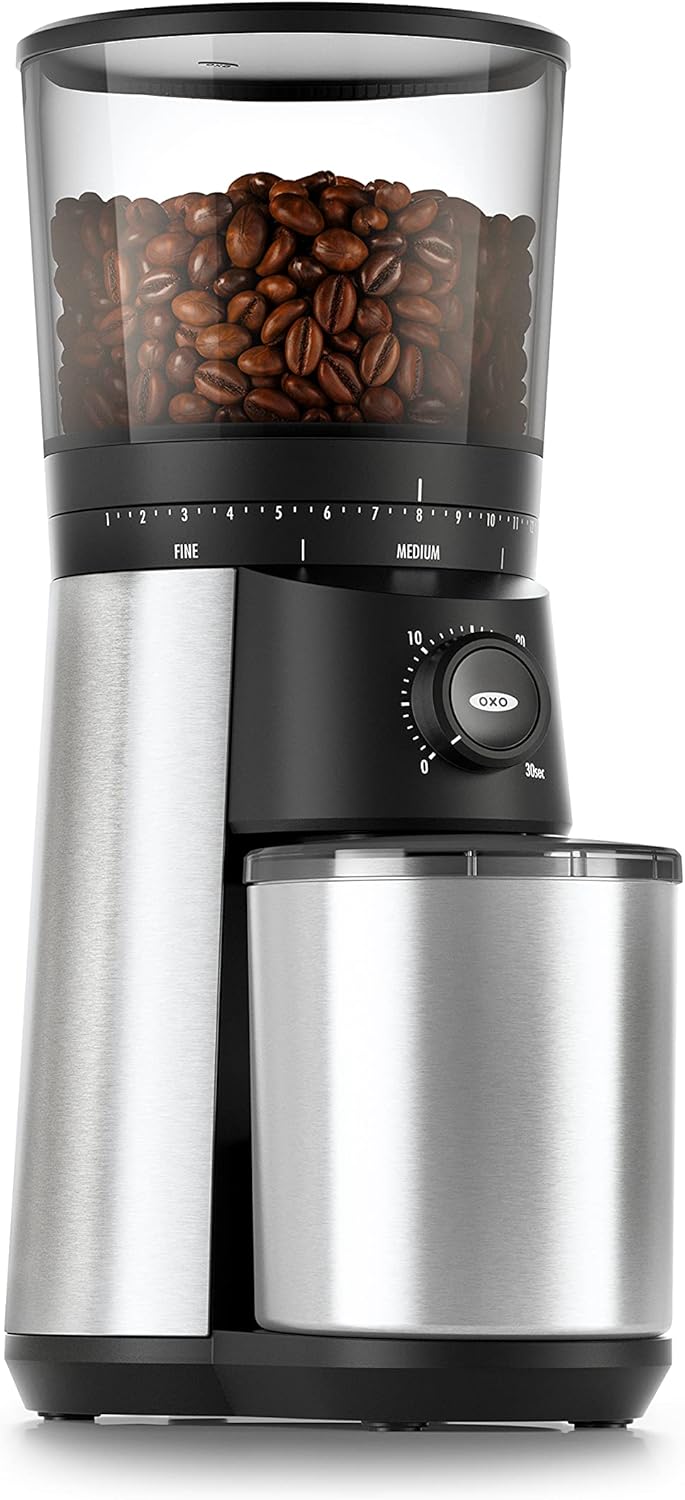
OXO Brew Conical Burr Coffee Grinder
- 15 main settings plus microsettings
- 12 oz UV-tinted bean hopper
- Remembers chosen grinding time
- Stainless static-fighting catcher
- Trap-door hopper removal
- Removable upper burr access

OXO Brew Compact Conical Burr Coffee Grinder
- 50 g bean-hopper capacity
- 15 settings and 29 microsteps
- Slim 3.75-inch-wide body
- Both burrs removable
- Chuteless cleaning access
- Grounds cup with pouring spout

Bodum BISTRO Electric Conical Burr Coffee Grinder
- 12 grind-size positions
- Borosilicate glass catcher
- Timed grinding, 5–20 seconds
- Approximately 220 g hopper
- Conical burr mechanism
- Compact color-accented design
The simplest way to improve the next brew is to control the variables separately. I measure a coffee-to-water ratio, choose a medium burr setting, and evaluate taste and drainage before moving the collar. Once a useful recipe is established, the grinder should make it easier to repeat rather than demanding constant adjustment. This guide concentrates on the traits that make that possible: dependable filter-range control, manageable grounds transfer, accessible cleaning, sensible capacity and a purchase that suits the way the kitchen actually works.
At a Glance: Compare the Five Drip Coffee Grinders
- 15 main settings plus microsettings
- 12 oz UV-tinted bean hopper
- Remembers chosen grinding time
- Stainless static-fighting catcher
- Trap-door hopper removal
- Removable upper burr access
- 50 g bean-hopper capacity
- 15 settings and 29 microsteps
- Slim 3.75-inch-wide body
- Both burrs removable
- Chuteless cleaning access
- Grounds cup with pouring spout
- 12 grind-size positions
- Borosilicate glass catcher
- Timed grinding, 5–20 seconds
- Approximately 220 g hopper
- Conical burr mechanism
- Compact color-accented design

- 30 grind-size settings
- Touch-panel selection
- 2–12-cup portion control
- Removable upper-burr access
- Brush-assisted maintenance
- Home and office drip workflow

- 40 mm S1 conical burrs
- 30 macro grind positions
- 0.1-second timer resolution
- Direct-through grounds path
- Convertible portafilter arms
- Serviceable burr adjustment ring
Quick Ranking: Which Grinder Matches Your Drip Routine?
| Rank | Grinder | Main advantage | Control | Best match |
|---|---|---|---|---|
| 1 | OXO Brew Conical Burr Coffee Grinder | Best Overall | 15 main settings + microsettings | Daily drip and shared households |
| 2 | OXO Brew Compact Conical Burr Coffee Grinder | Best Compact | 15 positions + 29 micro-adjustments | One- to two-cup drip and tight counters |
| 3 | Bodum BISTRO Electric Conical Burr Coffee Grinder | Best Value | 12 grind settings | Straightforward filter coffee and glass catcher |
| 4 | Ollygrin Conical Burr Grinder with Touch Panel | Best Digital | 30 grind settings | Digital cup-based drip portions |
| 5 | Baratza Sette 30 Conical Burr Coffee Grinder | Best Espresso Mix | 30 macro steps | Espresso-first households also making filter coffee |
The most useful distinction is the brewing routine. The full-size OXO has the larger hopper and remembered timer, while the Compact saves precious space. Bodum offers a glass catcher and simple dial, Ollygrin provides touch-panel portion selection, and Baratza is the model for a household where espresso is equally important. Each advantage matters only when it solves an everyday need.
Detailed Reviews: Five Burr Grinders for Drip Coffee
1. OXO Brew Conical Burr Coffee Grinder — Best Overall
A well-used drip grinder earns its place through repetition. Most households do not change beans or brew methods every morning; they want a medium grind that is easy to return to, a familiar dose, and a container that empties without a mess. The full-size OXO Brew Conical Burr is especially well matched to that rhythm. Its fifteen main collar positions, additional microsettings, remembered timer and generous bean hopper give a filter-focused kitchen enough control without creating an elaborate setup.
The front dial remembers the last grinding duration. That detail is more valuable than it first sounds: it keeps one part of a routine steady while leaving the collar free for taste adjustments. I regard the timer as a convenience, not a substitute for a coffee scale. The same number of seconds can produce different weights when switching from a dense light roast to a more brittle dark roast, or when changing the grind setting. A quick dose check after opening a new bag keeps the automation honest.
- 15 main settings plus microsettings
- 12 oz UV-tinted bean hopper
- Remembers chosen grinding time
- Stainless static-fighting catcher
- Trap-door hopper removal
Technical Specifications & Daily Features
OXO Brew Conical Burr Coffee Grinder: Conical burr • electric. Adjustment: 15 main settings + microsettings; dose method: 0–30-second dial with remembered duration; hopper: 12 oz / 340 g; dimensions: 6.8 × 11.8 × 14.8 in.
The grind collar carries fifteen numbered positions with finer stops between them. On the OXO dial, the middle region is intended for drip and pour-over; a change in filter shape or batch size can justify a different position. The timed start button remembers the previous running interval, which is a convenient repeat setting rather than a measurement of the actual dose in grams.
The UV-tinted hopper holds twelve ounces of whole beans and has a trap door to reduce spills when removed. The stainless steel grounds catcher addresses static, while access to the upper burr supports normal dry-brush cleaning. The machine is not dishwasher-safe, so removable pieces and the powered body require the manufacturer's specified care.
Pros & Cons After 30 Days of Use
The hopper capacity and remembered dial position support repeated household batches without a lengthy reset. The trap door also makes a bean change less awkward than tipping a full machine upside down. I keep one medium setting associated with the primary drip brewer and note a second position only when another recipe needs it.
A scale is necessary when precise grounds mass matters. Microsettings alter fineness, not a guaranteed grams-per-second feed rate. Grounds still collect around the outlet and burr area, so occasional dry brushing with the grinder unplugged remains part of ownership. The machine is not dishwasher-safe.
My Final Verdict
I recommend the full-size OXO as the most sensible default for a household preparing drip coffee most days. Its balance of adjustable burr grinding, 12-ounce hopper, remembered timer and relatively approachable maintenance fits the use case better than an espresso-focused speed grinder. Choose the Compact instead when counter space or small single doses matter more than a large hopper.
A family brewing a generous carafe gets meaningful convenience from a 12-ounce hopper. A person alternating between decaf and regular coffee throughout the day does not necessarily benefit from storing both in one chamber. I prefer weighing and loading a smaller portion when switching beans, then clearing the remaining grounds path where needed. The hopper is a workflow feature; it should never become an excuse to leave coffee exposed to heat for extended periods.
OXO pairs the larger hopper with a shutoff-style trap door and a stainless steel grounds catcher designed to fight static. These are practical features for people who fill the grinder once and make a pot most mornings. A sealed coffee bag is still a better place to keep the reserve supply; the hopper is for beans in active use. On the output side, a little dust around the chute is normal, and I value easy access for dry brushing more than claims that a machine is completely mess-free.
For paper-filter coffee, OXO gives a particularly understandable adjustment map. The brand puts pour-over and drip in the middle part of the collar, around settings six through ten on its numbered scale. That is a useful starting band, not a universal prescription. A basket brewer using a large dose can need a different position from a small cone using the same beans. A darker roast can also require another notch. The value lies in finding a setting and being able to revisit it tomorrow.
It is a substantial countertop appliance rather than a miniature grinder. Households with very little cabinet clearance may prefer the Compact, whose hopper and body are dramatically smaller. People frequently moving between manual espresso and drip also need to understand that the OXO is most comfortable in the filter range. For ordinary drip, however, its larger hopper, physical controls and moderate maintenance demands make it the most rounded recommendation of these five.
Getting the best from the remembered timer
I establish the coffee dose in grams first, then run a short grind at the intended medium setting. Once the collected grounds are close to the recipe target, I note the dial position and repeat it. The timer saves hand movements on later mornings; it does not remove the need to recalibrate with a different bean. This separation also makes troubleshooting easier. If a familiar brew turns bitter after a grind change, the burr setting and dose can be examined separately rather than changing everything together.
When a full hopper helps—and when it does not
A family brewing a generous carafe gets meaningful convenience from a 12-ounce hopper. A person alternating between decaf and regular coffee throughout the day does not necessarily benefit from storing both in one chamber. I prefer weighing and loading a smaller portion when switching beans, then clearing the remaining grounds path where needed. The hopper is a workflow feature; it should never become an excuse to leave coffee exposed to heat for extended periods.
2. OXO Brew Compact Conical Burr Coffee Grinder — Best Compact
The Compact solves a very different kitchen problem from its larger OXO sibling. A small apartment counter might hold a kettle, coffee maker, scale and toaster with almost no room left for a conventional hopper grinder. Here the body is only about 3.75 inches wide and just under eleven inches tall, but the grinding mechanism still uses stainless steel conical burrs rather than a spinning blade. For one person brewing a morning cup, that is a far more meaningful combination than adding a large menu of programs.
A 50-gram hopper is not a compromise for everyone. It holds enough beans for many single-cup and small-batch filter recipes, and it encourages a routine of weighing only what is needed. It becomes a limitation when preparing a large family carafe, especially when the owner wants to pour a whole bag into the machine. The Compact should be chosen because its portion size matches the kitchen, not with the expectation that it will function as a miniature version of the full-size hopper.
- 50 g bean-hopper capacity
- 15 settings and 29 microsteps
- Slim 3.75-inch-wide body
- Both burrs removable
- Chuteless cleaning access
Technical Specifications & Daily Features
OXO Brew Compact Conical Burr Coffee Grinder: Conical burr • compact electric. Adjustment: 15 positions + 29 micro-adjustments; dose method: One-touch operation; no full-size timer dial; hopper: 50 g; dimensions: 10.75 × 3.75 × 3.75 in.
The Compact is intentionally small: its bean chamber holds fifty grams, and the case measures approximately 10.75 inches high by 3.75 inches wide and deep. Fifteen major settings and twenty-nine micro-adjustments give a surprisingly useful adjustment range for a single-cup grinder. Its control arrangement is not the large timed front dial of the full-size model.
Both burr pieces are removable, with a short chuteless grounds path that improves access for care. The receiving container includes a pouring spout. These choices emphasize measured small doses and ease of storage. They do not create a large-batch hopper, integrated weighing system or specialized espresso micro-adjustment mechanism.
Pros & Cons After 30 Days of Use
The small bean chamber naturally encourages fresh single-dose preparation, which helps a person rotating coffees. The 15-plus-29 adjustment system makes it possible to record a medium setting and refine extraction without large jumps. The integrated spout is useful when tipping a small dose into a filter basket.
The holder tops out at 50 grams; a big drip batch may require repeated loading. Owners also need to handle the removable burr pieces carefully and keep the electrical body dry. The Compact has neither an integrated scale nor the remembered dial found on the full-size grinder.
My Final Verdict
For an apartment, dorm-style kitchenette or a one-cup drip routine, the OXO Compact is my first choice. Its narrow footprint and accessible burrs offer more everyday value than a bigger hopper that never gets filled. I favor the full-size OXO when serving several people, but I do not treat that larger model as automatically better for a small, measured dose.
The knob positions are useful only within the OXO Compact itself. I keep a separate reference for an automatic drip maker and a small pour-over cone, then judge whether the cup needs a finer or coarser grind. When the filter drains slowly, I check dose and filter placement before turning the collar. That prevents a minor preparation problem from becoming a cycle of unnecessary grinder adjustments.
The adjustment collar offers fifteen settings with twenty-nine intermediate micro-adjustments. Those extra positions matter more than an inflated marketing phrase about infinite control. A brewer working near the middle range can make small, repeatable changes when the filter bed drains too slowly or the resulting cup tastes thin. There is enough room to keep a recognizable setting for an automatic drip machine and another for an occasional cone, even though neither scale is standardized across grinder brands.
OXO makes both the upper and lower burrs removable on this model, and the short, chuteless design improves access for cleaning. That is a distinct advantage in a compact machine: narrow spaces can become frustrating when oily fines accumulate where a brush cannot reach. The clear grounds keeper has a pouring spout, another small detail that matters when transferring coffee into a paper filter without scattering it across a crowded counter.
I favor this model when storage and small doses dominate the decision. It is not the one to select for heavy back-to-back grinding or for someone whose only goal is fine espresso adjustments. It also should not be confused with the larger OXO timer grinder: the controls and capacity differ. For a minimal drip station, the Compact offers a practical way to get genuine burr adjustment while leaving the kitchen feeling open.
The compact grinder and the small-batch ratio
A 20-gram dose paired with approximately 320 grams of water provides a simple example of the scale this grinder handles comfortably. It leaves headroom in the bean chamber and gives a manageable portion to transfer to the filter. The exact coffee-to-water ratio can change with preference, but the dose should be weighed instead of guessed from the hopper fill line. Small portions also make switching between regular coffee and decaf more practical.
An adjustment map that travels between brewers
The knob positions are useful only within the OXO Compact itself. I keep a separate reference for an automatic drip maker and a small pour-over cone, then judge whether the cup needs a finer or coarser grind. When the filter drains slowly, I check dose and filter placement before turning the collar. That prevents a minor preparation problem from becoming a cycle of unnecessary grinder adjustments.
A small-space brewing station can be developed further with our guide to compact coffee grinders, which compares different storage-friendly designs beyond this five-model drip selection.
3. Bodum BISTRO Electric Conical Burr Coffee Grinder — Best Value
Bodum takes a more tactile route to daily filter coffee. The BISTRO combines twelve marked grind positions, a basic timer and a borosilicate glass catch jar. There is no elaborate screen or menu structure. A person graduating from an inexpensive blade chopper can set the middle of the burr range, choose a short running interval and start making coffee with fewer wildly different particle sizes than blade grinding typically creates.
The glass catcher is more than a styling detail. Ground coffee can cling stubbornly to some lightweight plastic bins, particularly in dry kitchens. Bodum uses borosilicate glass partly to reduce that nuisance, and the jar is convenient for transferring grounds into a large paper filter. Glass, of course, needs more careful handling than a plastic container, and it does not make the burr chute immune to retention or coffee dust.
- 12 grind-size positions
- Borosilicate glass catcher
- Timed grinding, 5–20 seconds
- Approximately 220 g hopper
- Conical burr mechanism
Technical Specifications & Daily Features
Bodum BISTRO Electric Conical Burr Coffee Grinder: Conical burr • electric. Adjustment: 12 grind settings; dose method: 5–20-second preset timer; hopper: Up to 220 g; dimensions: Approx. 17.8 × 16.3 × 28 cm.
Bodum's BISTRO uses conical burrs with twelve selectable grind positions, a hopper around 220 grams and a timed run from five to twenty seconds. Its relatively simple dial makes the filter range easy to locate. The timer controls duration, and output weight can vary with roast and grind position, so an occasional dose check still matters.
The grounds jar is borosilicate glass, a distinctive choice for reducing some static cling. It makes leftover coffee visible and is best handled carefully around a hard sink or counter edge. For multiple large runs, the machine's operating limits and cooling instructions matter. Clean the grinding parts by the approved method with the power disconnected.
Pros & Cons After 30 Days of Use
The glass grounds jar is the biggest daily convenience: it is easy to see whether yesterday’s grounds remain inside, and transfer into a large filter is simple. The twelve-position dial is also quick to return to a known medium setting. For a normal morning portion, the 5–20-second timer keeps the interface very simple.
The limited run duration and required cooling time matter for oversized batches. The jar is breakable, so its convenience requires normal care. Some components are removable for cleaning, but the powered grinder and burr assembly must be maintained exactly as the instructions prescribe. I do not equate a glass catcher with zero static or zero retention.
My Final Verdict
The BISTRO is a good fit for anyone upgrading from a blade grinder and making familiar filter coffee in modest amounts. I like its combination of conical burrs, a basic timer and a glass grounds jar. Buyers planning large consecutive batches or searching for fine-step adjustments have stronger reasons to choose an OXO model instead.
A timer range is a motor-control specification, not a promised dose weight. A full coffee maker may need more grounds than a single twenty-second cycle dispenses at a particular grind. I divide a large brew into separate portions only with the recommended cooling time between runs. This makes the machine easier to use safely and avoids treating a compact household appliance as a commercial bulk grinder.
Twelve settings leave plenty of room to find a normal drip starting point, but they offer fewer intermediate changes than either OXO grinder in this comparison. That distinction matters most when a particular light roast needs a small correction. It matters less for someone who brews a familiar medium-roast blend in the same basket machine each morning. I see the BISTRO as a straightforward way to improve a repetitive routine, not a specialist grinder designed for every possible brewing style.
Bodum specifies a grind duration of five to twenty seconds on this model. A large batch may call for a second run, with the cooling interval required by the operating instructions. This is a practical purchasing consideration for households making full pots. Short runs for a couple of cups fit its role better than repeatedly loading and grinding a very large amount without a break.
The BISTRO makes sense for a buyer drawn to a traditional dial, a comparatively tidy collection system and a pleasing countertop appearance. It is less persuasive when a very wide grind range or repeated high-volume batches are essential. For ordinary filter brewing, the combination remains approachable, provided the owner treats the timer as an approximation and checks actual grounds weight when the recipe demands consistency.
A glass jar changes the transfer, not the extraction rules
It is tempting to describe the BISTRO as automatically cleaner because the grounds fall into glass. In practice, the way coffee is poured out matters too. I remove the jar deliberately, keep the lip near the filter basket and tap lightly rather than shaking grounds everywhere. Any coffee stuck near the chute should be handled with a soft brush when the machine is unplugged. These small habits preserve the convenience that makes the jar appealing.
Twenty seconds is a limit worth remembering
A timer range is a motor-control specification, not a promised dose weight. A full coffee maker may need more grounds than a single twenty-second cycle dispenses at a particular grind. I divide a large brew into separate portions only with the recommended cooling time between runs. This makes the machine easier to use safely and avoids treating a compact household appliance as a commercial bulk grinder.
4. Ollygrin Conical Burr Grinder with Touch Panel — Best Digital
Ollygrin appeals to a household that prefers a touch panel to the physical controls on the OXO and Bodum grinders. This Ollygrin has thirty adjustment positions and electronic portion controls for two to twelve cups. That makes it an appealing choice for someone who thinks first about a small mug on weekdays and a fuller drip carafe on weekends. The interface organizes the routine, but the coffee still comes from a conventional burr mechanism rather than the touch surface itself.
The thirty settings give reasonable space around the filter-coffee range. Moving a step finer after a thin-tasting brew is easier to interpret when the adjustment has a clear number. A numbered setting is not a universal grind-size measurement, however. An Ollygrin position does not map directly to OXO’s collar or Bodum’s dial, and the target can move when the bean and water recipe change.
- 30 grind-size settings
- Touch-panel selection
- 2–12-cup portion control
- Removable upper-burr access
- Brush-assisted maintenance
Technical Specifications & Daily Features
Ollygrin Conical Burr Grinder with Touch Panel: Conical burr • touch-panel electric. Adjustment: 30 grind settings; dose method: 2–12-cup selection / touch controls; hopper: Everyday batch hopper; dimensions: Compact upright body.
Ollygrin's model B0DPY6W8T4 provides thirty grind positions alongside electronic cup selection for two to twelve servings. It has no integrated grind-by-weight feedback: the serving count is an estimate that can be calibrated against the amount required by a specific brewing recipe. A number on the touch display should not be mistaken for a measured gram value.
The upper burr and grounds path provide access for routine care, and the screen is intended for dry operation. The home-focused format can serve small or family batches, but the exact dose needs to be established from the brewer's water capacity and desired ratio. A consistent paper filter and a recorded medium grind setting make its convenient controls more meaningful.
Pros & Cons After 30 Days of Use
Thirty settings make it manageable to keep two or three brew-method reference points. The cup-selection interface can reduce setup steps for a household that regularly makes the same-sized pot, and the removable accessible pieces make normal cleaning possible.
The selected cup count is not an integrated scale reading. Owners using large travel mugs or changing beans still need a coffee-to-water recipe measured in grams. A touch panel also requires a dry, clean operating surface. Claims of saved recipe profiles or weight sensing should not be inferred from electronic controls alone.
My Final Verdict
I recommend the Ollygrin to buyers who explicitly prefer a touch-panel grinder and want a numbered burr range for daily drip coffee. Its thirty settings and cup-selection interface make sense for shared kitchens. I choose the full-size OXO for the simplest all-around recommendation and the Compact when space is the deciding factor.
A digital grinder loses its appeal if every cup requires a new round of trial and error. I keep a default medium setting for the household brewer and make grind changes only in response to flavor and drainage. The panel can then handle the convenient portion selection. After grinding, clearing the grounds container and brushing the accessible burr area prevents buildup from becoming an unnecessary daily chore.
I pay particular attention to the wording of the portion control. Two cups on the screen does not imply that the machine has weighed a specified number of grams, nor is it a guarantee that two households define a cup the same way. A coffee-maker cup and a large travel mug can represent very different water volumes. Calibrating one frequently used program against a scale turns the screen into a practical shortcut instead of a source of false precision.
Touch controls are convenient when several people share one kitchen and want to choose a number quickly. They also add another surface that collects coffee dust and fingerprints. The upper burr and bean-hopper area should be kept accessible for dry cleaning; the panel itself should never be treated as washable under a tap. An efficient grounds-transfer routine remains just as important here as on a mechanical grinder.
Ollygrin’s clearest advantage is the familiar touch-panel workflow, not an automatic leap in cup quality. Someone who dislikes screens can get an excellent filter routine from the physical OXO dial. Someone who genuinely enjoys selecting serving counts may value the Ollygrin more. The relevant question is how the household brews, not which interface looks more advanced.
A serving-number display is not a coffee recipe
A twelve-cup setting is useful as a familiar shortcut only after matching it to the intended brew volume. For a 720-gram water batch at 1:16, the starting dose is 45 grams. That is more helpful than assuming the screen always understands the strength of the drink. I prefer weighing the first batch and keeping that measurement beside the machine, especially when several people use the same control panel.
Keeping digital convenience genuinely convenient
A digital grinder loses its appeal if every cup requires a new round of trial and error. I keep a default medium setting for the household brewer and make grind changes only in response to flavor and drainage. The panel can then handle the convenient portion selection. After grinding, clearing the grounds container and brushing the accessible burr area prevents buildup from becoming an unnecessary daily chore.
5. Baratza Sette 30 Conical Burr Coffee Grinder — Best Espresso Mix
The Baratza Sette 30 approaches grinding from a different direction. It was developed around a fast, vertical, direct-through burr system, with a 40 mm conical burr set, thirty macro adjustment steps and a timer with one-tenth-second resolution. That configuration is particularly appealing beside an espresso machine, where fast grounds delivery and low retention matter every day. For a dedicated drip-coffee article, it deserves a more qualified recommendation than the other four grinders.
The Sette can grind in a range that includes single-cup pour-over, and its speed can make early-morning preparation short. But an automatic drip coffee maker—especially a large basket brewer—may need settings and a particle-size profile that are not the Sette’s main specialization. I do not equate high motor speed with better drip flavor. Coffee prepared through a paper filter benefits most from grind suitability, appropriate dose and a balanced brew time.
- 40 mm S1 conical burrs
- 30 macro grind positions
- 0.1-second timer resolution
- Direct-through grounds path
- Convertible portafilter arms
Technical Specifications & Daily Features
Baratza Sette 30 Conical Burr Coffee Grinder: 40 mm conical burr • espresso-oriented. Adjustment: 30 macro steps; dose method: Digital timer with 0.1-second resolution; hopper: 300 g; dimensions: Approx. 13 × 25 × 41 cm.
The Sette 30 is built around forty-millimeter S1 conical burrs, thirty macro grind settings and a digital timer adjusting in tenths of a second. Its three-hundred-gram hopper and approximately 120-gram grounds bin are useful for repeated doses, but the burr range is more at home with espresso and small manual filter brewing than with a full-size drip carafe.
A vertical, direct-through grounds path reduces retention, and the convertible support arms accept a grounds container or suitable portafilter. The adjustment ring is removable for cleaning and maintenance, with replacement parts and support offered for the series. Noise and coarse-end flexibility are the main considerations when choosing this fast grinder for a filter-first kitchen.
Pros & Cons After 30 Days of Use
The high-throughput burr system and direct-drop path offer a distinctly quick experience when preparing a small measured dose. The grounds fork can serve a bin or portafilter, which is genuinely useful for a household switching between espresso and filter coffee. The adjustable ring and replacement-parts ecosystem support long-term care.
The thirty macro settings and 40 mm S1 burrs are mainly directed toward espresso to single-cup manual brewing. Bulk drip use and quieter kitchens are less natural fits. The 0.1-second timer cannot measure grams, and the fast mechanical design is not especially discreet acoustically. Larger filter brews need dose and grind checks rather than assuming espresso calibration carries across.
My Final Verdict
I recommend the Sette 30 only where espresso is an important part of the household’s routine and drip coffee is secondary. Its speedy direct-through grind and maintainable design are valuable features, but a drip-only buyer gains more practical convenience from the OXO full-size or Compact. The Sette earns an honorable position for mixed brewing, not the top filter-coffee award.
Baratza’s replacement-parts support helps make the Sette a maintainable investment. A household that prepares espresso before work and a small filtered cup in the afternoon can record two burr positions, clean the chute as needed, and keep the dose measured. Repeatedly jumping from very fine to substantially coarser settings still demands some care. That makes the Sette a specialist crossover option rather than the effortless drip default.
What stands out mechanically is the straight-through grinding path. Beans pass through the burr chamber toward a grounds bin or a portafilter supported by adjustable arms. This makes it easier to move between espresso and occasional filter drinks without treating a large amount of retained coffee as normal. The hopper shutoff mechanism is also useful when changing beans. Still, low retention never eliminates the need to keep the path clean.
Thirty macro steps are simple to navigate, yet the Sette 30 does not provide the finer micro-adjustment collar found on the Sette 270 family. That matters more for espresso shot tuning than for ordinary drip, but it illustrates the model’s trade-offs. It can be a sensible gateway for someone learning espresso and preparing the occasional small paper-filter drink. It is harder to justify for a buyer who never intends to make espresso and primarily fills a drip carafe.
Noise is part of the purchase decision. A fast Sette produces a more assertive grinding sound than many traditional consumer burr machines, and its relatively tall form requires clear counter space. Baratza’s parts and support ecosystem is a meaningful ownership advantage. For someone preparing only drip coffee, the OXO or Bodum grinders offer a simpler daily match; the Sette’s distinctive features are more valuable in a mixed espresso kitchen.
Why the fastest grinder is not always the best drip grinder
Fast grounds delivery can save a few seconds while making a morning drink, but the time through the brewer matters much more to flavor. If a large drip basket drains too slowly, I examine grind fineness and dose rather than assuming that high-speed grinding has improved the coffee. The Sette’s mechanical advantages are real, yet they are strongest in a workflow close to espresso preparation.
Serviceability and switching from espresso
Baratza’s replacement-parts support helps make the Sette a maintainable investment. A household that prepares espresso before work and a small filtered cup in the afternoon can record two burr positions, clean the chute as needed, and keep the dose measured. Repeatedly jumping from very fine to substantially coarser settings still demands some care. That makes the Sette a specialist crossover option rather than the effortless drip default.
Buying Guide: How to Choose the Right Coffee Grinder for Drip
The medium grind is a starting region, not one particle size
Medium grounds suit a wide range of basket-style brewers, but the word itself is imprecise. A flat-bottom paper filter, small conical filter and commercial-size batch basket will not necessarily favor identical grind textures. I start at the middle of the grinder’s filter range, hold the dose and water steady, and judge whether the finished cup seems balanced rather than relying on a photograph of “coarse sand.”
Roast level and coffee density influence the result as well. A dense washed light roast can behave differently from a medium-dark blend, even at the same numbered collar position. That is why the grinder needs a usable range around medium instead of a single supposedly perfect drip setting.
How to identify a grind that is too fine
A brew that drains unusually slowly, leaves an excessive layer of sludge or develops a dry, gripping finish may be ground too finely for that recipe. First make sure the paper is correctly seated and the coffee dose is not unusually high. If those basics are stable, moving the burrs a little coarser is a sensible next adjustment.
Changing to a coarser grind reduces the surface area available for extraction and can encourage faster water movement. A small correction is more informative than turning the dial several steps at once. The goal is balanced flavor, not the fastest possible dripping.
How to identify grounds that are too coarse
Thin body, weak sweetness and a sharply underdeveloped finish can point toward an overly coarse grind or too little coffee. Check the water-to-coffee ratio before adjusting. If the dose is already correct and the brew finishes unusually quickly, a step finer is a reasonable experiment.
A change in grind size is not the same as changing how strong the cup is through a larger dose. Keeping those variables separate makes improvements easier to reproduce. The new grind setting should be judged across the whole drink, not only in the first hot sip.
Why a scale matters more than a fancy timer
A timed grinder repeats a motor interval. It cannot know how many grams fell into the cup unless it also has a weighing system. Different beans and grind positions feed at different rates, and a little retained coffee may affect the next dose. A small digital scale is therefore one of the most useful companions to a timer-based grinder.
I choose a target mass first and use the timer to make reaching it convenient. When the bag changes, I check output again. This applies to the full-size OXO, Bodum and Baratza, while an Ollygrin cup selection also benefits from the same calibration.
The difference between a cup selector and a recipe
Serving-count labels are often based on assumptions about coffee-maker cup size. They do not distinguish between a small five-ounce serving and a large mug filled nearly to the rim. For a 1:16 ratio, 30 grams of coffee pair with 480 grams of water, regardless of how many cup icons appear on a control panel.
A household that repeatedly brews the same carafe size can still use a cup selector conveniently. The important step is calibrating its output against a real dose once, then keeping that reference close to the machine. If the bean changes substantially, the dose deserves another check.
Batch size determines how convenient the hopper feels
An individual brewer preparing 18 to 25 grams per session may be comfortable with the 50-gram OXO Compact. The same hopper can become inconvenient when a family wants 70 grams for a large batch. Repeated refills change the workflow, particularly while the kettle or brewer is already running.
The 12-ounce full-size OXO and larger Baratza or Bodum hoppers suit people who like to load beans for several batches. There is a freshness trade-off, though: the hopper is not a substitute for storing unused coffee in a sealed, cool and dark place.
Burr geometry is only part of consistency
Both conical and flat burr grinders can make good drip coffee. The design of the complete machine, its adjustment system, alignment and grounds path matter alongside burr shape. This group uses conical burrs, so a shopper cannot conclude from this article that one burr geometry automatically wins every brewing style.
I concentrate on whether a grinder gives usable adjustments in the actual filter range. Fine espresso capability may sound impressive, but it contributes little to a person who uses the same automatic drip brewer every morning.
What static looks like and why it varies
Fine coffee particles can cling to plastic containers, the outlet and nearby surfaces. Dry air, particular roasts and the construction of the grounds cup can change how noticeable this becomes. Static-fighting metal or glass receiving containers can help, but neither eliminates all dust or retained grounds.
Good everyday handling makes a difference. I keep the catcher fully seated, allow loose particles to settle briefly after grinding, and empty the container without swinging it across the counter. A soft brush is useful around accessible dry areas, with the powered appliance unplugged.
Retention matters most when switching beans
Retention is coffee that remains in the burr chamber or exit after a grinding cycle. A little retained medium roast can enter the next light-roast dose and alter its flavor. The impact depends on how much is retained relative to the dose and how often coffees are changed.
Someone using a single favorite blend may find this a modest concern. A person alternating regular coffee and decaf needs a cleaner switch. The Sette’s direct-through path can help in that scenario, but regular inspection and cleaning still matter.
Why quiet is not simply a decibel number
Grinder noise has tone, duration and vibration. A brief high-pitched machine can feel more intrusive to a light sleeper than a lower-pitched design running longer, even without a controlled sound measurement. Product descriptions such as “quiet” or “silent” are rarely enough to establish exactly how a grinder will sound in a particular kitchen.
For a shared home, consider where the grinder sits and whether its feet transfer vibration to a hollow countertop. A small silicone mat may help with furniture vibration when allowed by the manual. Avoid blocking vents or enclosing a powered grinder to make it quieter.
Cleaning the upper burr without damaging the grinder
Coffee oils and fines build up gradually around burr surfaces and the grounds chute. Most home grinders benefit from regular dry brushing of user-accessible components. The exact disassembly steps vary by model, and removable parts should be cleaned only as the individual instructions permit.
Never immerse the electric grinder base or apply water directly to electrical burr chambers. Allow any washed removable container to dry completely before reassembly. More complex does not necessarily mean better: a grinder that is easy to keep clean may produce more satisfying daily coffee than one with many features that are difficult to maintain.
A workflow for switching from drip to pour-over
An automatic basket machine and a manual cone both use paper filters, but their water-delivery patterns differ. The manual brewer may require a slightly finer position, depending on recipe size and pouring technique. I keep separate setting notes rather than repeatedly guessing at a single universal medium number.
After switching, I check collected grounds mass and make one small taste-based adjustment. The OXO models allow useful filter-range changes, while the Ollygrin’s numbered positions can also help keep the two recipes distinct.
When an espresso-oriented grinder is the wrong upgrade
An espresso-focused machine can grind quickly and offer a direct-to-portafilter workflow, yet those strengths do not necessarily improve a full batch of drip coffee. The Sette 30 is a good example: its direct-through grinding path and timer are attractive, but its burr range and thirty macro steps are built with espresso and smaller manual brews in mind.
A drip-only shopper benefits more from familiar medium settings and easy batch dosing than from an espresso fork that never gets used. I reserve specialty crossover machines for owners who can take advantage of both sides of the design.
How the filter basket changes extraction
A deeper coffee bed can offer more resistance to water than a shallow bed of the same grind, especially when the batch amount changes. Cone filters and flat-bottom baskets distribute water differently. Some brewers also use a stop-flow mechanism that changes the contact time independently of the grinder.
If a large carafe tastes harsh while a small batch tastes balanced, the answer is not always a new grinder. Check the batch dose, filter fit and brew design, then move the grind in modest steps. This is why practical testing of one’s own brewer matters more than a universal setting chart.
Paper filters are not all alike
Different paper thicknesses and shapes can affect drainage and how much fine material reaches the cup. A dense filter can slow the brew even when the grounds are appropriate. An improperly folded or seated filter can create unwanted channels and uneven flow.
Before correcting the grind, I make sure the basket uses the intended filter and that water can pass through without the paper collapsing. Those checks prevent unnecessary dial movements and make tasting notes more useful.
Coffee-to-water ratio before changing the grind
For an approachable reference, one part coffee to sixteen parts water works for many drip preferences. A 500-gram water recipe begins with approximately 31 grams of coffee. Some people prefer stronger or lighter cups, and both are reasonable when the amount is deliberate.
A weak drink may be caused by too little coffee rather than grounds that are too coarse. I decide whether the goal is more strength or a different flavor balance before moving the burrs. A ratio change affects concentration; a grind change also alters extraction.
Freshness changes the dose and flavor
Beans lose aroma after roasting, especially when they are stored warm or exposed to air. Grinding immediately before brewing helps preserve aromatic compounds, but it does not make stale beans fresh. A sealed storage container kept away from heat and light protects the supply better than leaving every bag open beside the grinder.
Different roast levels can also grind at different rates. The same timer setting can yield another dose weight from a new coffee even when the burr collar is unchanged. Weighing the resulting grounds makes that difference visible before it affects the next pot.
How often to clean without creating a chore
The right cleaning frequency depends on use and coffee style. Oily dark beans can leave residue more quickly than some lighter roasts. Emptying the catcher after each brew and brushing the appropriate user-accessible areas periodically is a useful baseline.
More thorough care should follow the instructions for the specific grinder. Excessive disassembly can be counterproductive if parts are reinstalled incorrectly. I prefer a simple schedule that the household actually follows to an ambitious routine abandoned after a week.
Countertop clearance and storage
Dimensions on a product box do not tell the whole story. A hopper lid needs room to open beneath overhead cabinets, and the receiving container needs clearance to slide forward. The Sette is taller than the OXO Compact, while a wider glass jar can affect where the Bodum fits comfortably.
I measure the available footprint and the clearance above it before choosing a grinder. This is particularly worthwhile in a compact kitchen, where the ability to remove the hopper for cleaning may be just as important as the machine’s stated width.
Durability, support and replacement parts
A burr grinder is an appliance with moving parts. Burr wear, hopper latches, switches and grounds cups can all affect ownership after the initial purchase. Access to compatible parts and clear service instructions is therefore worth considering, particularly for a more expensive specialist grinder.
Baratza has an established support and parts ecosystem. That does not automatically make its Sette 30 the best drip grinder, but it matters for someone looking beyond the first year. For any model, maintaining it correctly is as important as the warranty language.
What actually makes an upgrade worthwhile
A blade-to-burr change is often meaningful because it introduces an adjustable grinding gap rather than relying only on chopping time. Moving from one competent burr grinder to another can bring subtler benefits: easier dosing, less mess, a smaller footprint or finer steps around a preferred brew range.
I choose an upgrade for a specific recurring frustration. A scale can solve dose inconsistency without buying a new grinder; a better collection cup can improve transfer; a different burr mechanism becomes worthwhile when the present machine cannot reach a repeatable brewing texture.
A five-minute check when your drip tastes wrong
I begin with the simple variables: are the beans fresh, is the filter seated, and is the dose correct? Next I check whether the water volume changed and whether the brewer drained unusually fast or slowly. Only then do I consider moving the grinder collar.
If a setting change helps, I record it beside the coffee name and dose. If it does not, I return to the previous setting and examine water quality, filter type or the brewer. That approach prevents the grinder from becoming the explanation for every disappointing cup.
Final Comparison: Specs, Convenience and Limitations
| Grinder | Burr type | Adjustment | Dose method | Capacity | Main limitation |
|---|---|---|---|---|---|
| OXO Brew Conical Burr Coffee Grinder | Conical burr • electric | 15 main settings + microsettings | 0–30-second dial with remembered duration | 12 oz / 340 g | Timed dosing is not weight measurement; not intended for fine espresso corrections |
| OXO Brew Compact Conical Burr Coffee Grinder | Conical burr • compact electric | 15 positions + 29 micro-adjustments | One-touch operation; no full-size timer dial | 50 g | Small hopper; not designed as a bulk grinder |
| Bodum BISTRO Electric Conical Burr Coffee Grinder | Conical burr • electric | 12 grind settings | 5–20-second preset timer | Up to 220 g | Twenty-second run cap and cooling interval; modest adjustment range |
| Ollygrin Conical Burr Grinder with Touch Panel | Conical burr • touch-panel electric | 30 grind settings | 2–12-cup selection / touch controls | Everyday batch hopper | Cup labels are estimates, not gram readings |
| Baratza Sette 30 Conical Burr Coffee Grinder | 40 mm conical burr • espresso-oriented | 30 macro steps | Digital timer with 0.1-second resolution | 300 g | Espresso-oriented burr range, noticeable noise, limited coarse/filter specialization |
My Final Recommendation for Daily Drip Coffee
For most households, I favor the full-size OXO Brew Conical Burr. The twelve-ounce hopper, familiar collar and remembered timer make it easy to establish a normal medium grind and repeat the dose. Its static-conscious collection cup and straightforward burr access also address the parts of ownership that matter after the initial excitement of a new appliance fades. The timer is not a scale, but paired with a measured recipe it makes the routine simpler.
For one person brewing a small serving in a crowded kitchen, the OXO Compact is the more logical purchase. It saves valuable counter space, holds up to fifty grams of beans and offers extra intermediate grind adjustments. Bodum’s BISTRO appeals when a simple mechanical dial and glass jar are attractive; Ollygrin is the alternative for a household specifically wanting touch-panel serving controls. The Baratza Sette 30 earns its place when espresso is also important, not as the default grinder for large drip carafes.
A thoughtful grinder choice should simplify coffee, not turn every morning into a calibration exercise. Start with a weighed dose, a suitable medium setting, clean water and an appropriately fitted filter. Change one variable at a time when the cup needs improvement. Once the recipe works, let the grinder do the repeatable part of the job.
Frequently Asked Questions About Drip Coffee Grinders
What grind size is best for automatic drip coffee?
A medium grind is a useful first setting for many automatic drip brewers. Start in the grinder’s suggested filter range and adjust in response to flavor and drainage. A small basket, large carafe and cone filter may each need a slightly different setting. There is no universal numbered collar position across brands.
Is a conical burr grinder good for drip?
Yes. Conical burr grinders can produce suitable filter coffee, and all five models compared here use a burr mechanism rather than a chopping blade. Burr shape alone does not determine a good result. The adjustment range, usable middle settings, burr alignment and the complete brewing recipe matter.
How many grind settings does the OXO Compact have?
The Compact has fifteen main positions and twenty-nine micro-adjustments. Its bean chamber holds up to fifty grams. These specifications distinguish it from the full-size OXO grinder, which has a much larger twelve-ounce hopper and a separate remembered timer dial.
Does the full-size OXO remember my previous timer setting?
Yes. Its one-touch grinding dial stays at the previously selected duration until adjusted. That saves setup time when using the same beans and brew recipe. It is still timed grinding, not grind-by-weight dosing, so measuring the collected coffee remains helpful.
Can I use the Baratza Sette 30 for drip coffee?
It can grind in a range suitable for some manual filter preparations, but the Sette 30 is principally espresso-oriented. Its thirty macro steps, fast direct-through mechanism and portafilter-compatible arms make more sense in an espresso-first kitchen. A drip-only buyer can often choose a more natural workflow from the OXO or Bodum models.
Does the Bodum BISTRO have flat or conical burrs?
The BISTRO grinder discussed here uses a conical burr mechanism and twelve grind settings. It is different from Bodum’s separate blade-grinder products. Its glass grounds catcher and short timer are important distinctions when choosing the exact model.
How long can the Bodum BISTRO grind at one time?
The standard timer range is five to twenty seconds. Large batches may require another cycle, and owners should observe the cooling intervals and other operating limits in the model instructions. A single twenty-second cycle is not a promised amount of coffee in grams.
Is the Ollygrin touch panel a built-in scale?
No. This Ollygrin uses electronic controls and a two-to-twelve-cup selection, but that does not mean it weighs ground coffee. Cup labels are portion estimates. Use a separate scale to calibrate a favorite carafe recipe, especially after switching beans.
Which grinder fits a very small kitchen?
The OXO Compact is the obvious small-space choice in this group. Its body is about 3.75 inches wide, and its fifty-gram hopper matches small daily doses. The full-size OXO is more convenient for larger households but needs more room for the hopper and grounds catcher.
How much coffee should I use for a 500 ml drip brew?
At a 1:16 coffee-to-water ratio, 500 grams of water call for about 31 grams of coffee. That is a starting point, not a mandatory strength. For a stronger or lighter drink, adjust the dose deliberately and keep the other brewing variables stable while judging the result.
Can a grinder timer replace a kitchen scale?
A timer is convenient for repeating a known running interval, but the amount dispensed depends on the beans, burr position and feed rate. It does not measure the final coffee mass. A separate kitchen scale makes ratios and dose adjustments more reliable.
Why does my drip coffee taste sour after grinding?
A sharp, thin result can suggest insufficient extraction, an overly coarse grind or a low coffee dose. Check the water ratio, filter fit and brewing time. If those factors are stable, try a small finer grind adjustment and compare the whole cup rather than reacting to one sip.
Why does my drip coffee taste bitter or dry?
Astringency and bitterness can occur when the grind is too fine for the brewing conditions or when contact time is excessive. Check for filter blockage and unusually slow drainage, then try a modest coarser position. Dark roasts can also taste naturally more intense, so the bean itself matters.
Does a glass grounds catcher eliminate static?
No. Bodum’s glass catcher can help reduce static cling compared with some plastic containers, but the outlet and other surfaces can still hold fine particles. Humidity, roast level and grounds-transfer technique also influence mess.
How much coffee fits in the OXO Compact hopper?
Up to fifty grams of beans. That is appropriate for many single-cup and small filter batches. It is not a twelve-ounce hopper, so a large carafe recipe may require more than one load.
Does the full-size OXO have a large hopper?
Yes. It holds approximately twelve ounces, or 340 grams, of beans. That is useful for households making several batches, although extra beans still store better in a sealed container away from light and heat rather than indefinitely in the hopper.
Do I need 30 grind settings for drip coffee?
Not necessarily. A clear selection of usable medium positions is more important than a large total count. Ollygrin offers thirty settings, which can be helpful when moving between recipes. A household making one familiar pot every morning may not need all of them.
Are finer micro-adjustments essential for a drip brewer?
They can help when a particular coffee sits between two noticeably different main positions, but drip brewing is typically less sensitive to tiny grind changes than conventional espresso. The Compact and full-size OXO both provide additional positions between major settings.
How do I reduce coffee grounds sticking to the container?
Keep the catcher clean and completely dry, allow loose particles to settle briefly after grinding, and pour close to the filter basket. A soft brush can remove grounds from accessible dry surfaces. Never spray water into a running electric grinder or bypass its cleaning instructions.
Can I make a large carafe with the OXO Compact?
Yes, but its fifty-gram hopper may not hold the full dose for a particularly large brew. The owner may need to reload beans. For frequent high-volume carafes, the full-size OXO or another larger hopper grinder is a more convenient fit.
Why does drip coffee sometimes drain slowly?
Too-fine grounds, excessive fines, too much coffee, a poorly fitted filter or the brewer’s water-delivery pattern can all contribute. Check those variables before turning the grind collar. A finer grind is not automatically the correct answer when the coffee tastes weak.
Should I grind fresh beans every morning?
Fresh grinding preserves more aroma than storing a large amount of coffee already ground. The beans themselves still need appropriate storage. Keeping the unused supply sealed and grinding the measured dose before brewing is a dependable starting habit.
How often should a burr grinder be cleaned?
Frequency depends on use and bean oils. Empty the grounds container after brewing and follow the model’s routine dry-cleaning instructions. A more thorough cleaning schedule may be helpful with oily dark roasts, but electrical parts should never be immersed.
Is the Sette 30 quiet enough for early mornings?
The Sette is a fast, relatively assertive-sounding grinder. Perceived noise depends on the counter surface and room, but it is not the obvious choice for a household seeking the gentlest possible acoustic profile. Its strongest advantages are speed, serviceability and espresso-oriented design.
Which grinder is easiest to clean?
The OXO Compact offers both removable burrs and a short, chuteless grounds path, which is especially practical for small doses. The full-size OXO provides upper-burr access, while the Bodum’s glass jar is easy to inspect. Each machine still requires its own care procedure.
Can one grinder handle drip and espresso?
Some grinders cover both ranges, but the ability to reach a fine setting does not guarantee the tiny increments needed for every single-wall espresso basket. The Sette 30 is more espresso-oriented; the OXO and Bodum models are most naturally considered for filter coffee. Match the grinder to whichever method dominates the routine.
Is a more expensive burr grinder always better for filter coffee?
No. A higher price may pay for finer adjustments, stronger parts support, a different interface or specialist features that a drip-only household never uses. I value an understandable medium grind range, adequate capacity and straightforward care before extras unrelated to the way the coffee is brewed.
What is the best overall choice among these five?
For a household making drip coffee most days, I favor the full-size OXO because the timer, twelve-ounce hopper and adjustable medium range work together as a convenient routine. For a single small serving and very limited counter space, the OXO Compact is the better practical choice.


