
Taylor Swoden 12-Cup Programmable Coffee Maker Review


One Hundred Coffee is reader-supported, and some products displayed may earn us an affiliate commission. Details
A programmable drip coffee maker does not need dozens of modes to earn a permanent place on the counter. It needs to handle the everyday jobs reliably: brew enough coffee for the household, start automatically when asked, make a stronger pot when preferred, let someone steal an early cup without flooding the warming plate, and shut itself down when the morning gets hectic. The Taylor Swoden 12-Cup Programmable Coffee Maker is built around exactly that kind of routine.
The 300105REU configuration combines a 1.8-liter glass carafe, a 950W heating system, 24-hour delayed brewing, regular and strong preparation, pause & serve, a visible water gauge, a warming plate, a two-hour automatic shutoff, and a dedicated CLEAN control for decalcification. It is deliberately conventional, but conventional can be an advantage when the goal is to make a full pot before work rather than manage a touchscreen full of recipes.
The capacity is especially important. This is a true 12-cup-class brewer rather than a personal four-cup machine. Taylor Swoden lists the reservoir and carafe capacity at 1.8 liters, and the operating instructions are designed around batches between roughly four and 12 coffee-maker cups. That makes the machine much more relevant to couples, families, shared kitchens, and small offices than to someone who wants a single mug and nothing more.
Its limitations are just as clear. The carafe is glass rather than thermal, the warming plate eventually switches off, there is no built-in grinder, water temperature is not user-adjustable, and Strong mode is a simple extraction adjustment rather than a complete recipe-control system. Those compromises matter, but they also keep the workflow straightforward.
This Taylor Swoden review focuses on what actually affects ownership: how useful the 24-hour programming is, when Strong mode helps, what the 12-cup capacity means in real mugs, how Pause & Serve should be used, whether two hours of warming is too long, how the CLEAN cycle fits into maintenance, how grind and coffee ratio affect the cup, and whether a budget programmable brewer like this still makes sense beside more expensive Cuisinart and established BLACK+DECKER alternatives.
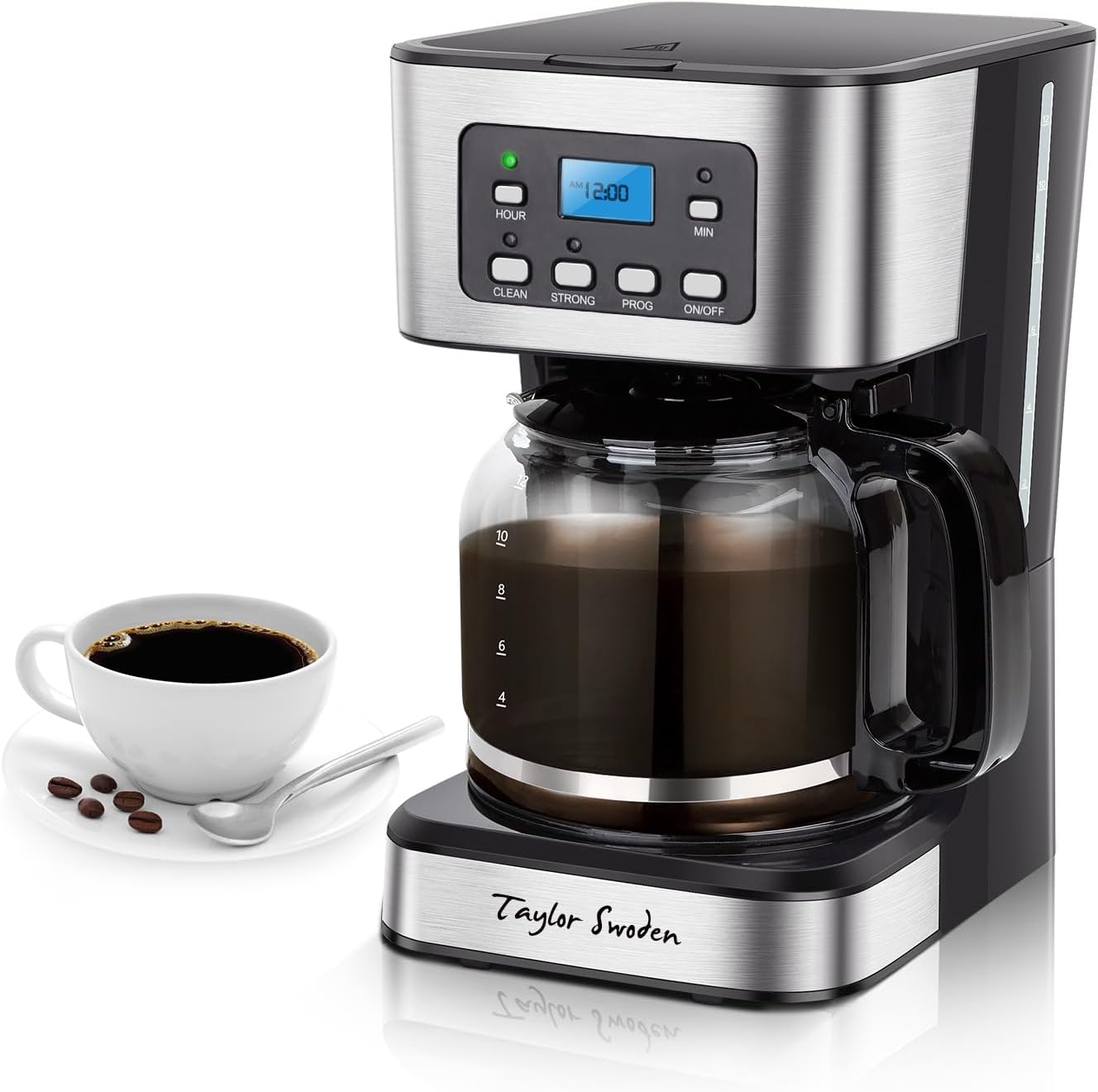
Taylor Swoden Programmable Coffee Machine
Key Features
- Programmable 24-hour brew timer
- Compact design with 4-cup capacity
- Reusable filter included
- Keep-warm function with auto shut-off
- Ideal for small kitchens or personal use
Why We Like It
It’s a compact, stylish brewer with essential features like programmability and keep-warm mode. Excellent for budget-conscious users or those with limited counter space.
Pros
- Affordable and space-saving
- Timer for morning auto-brews
- Reusable filter saves money
- Simple and easy to use
- Modern aesthetic
Cons
- Limited to 4 cups per brew
- No advanced strength settings
Bottom Line
A compact, affordable brewer with just the right features for solo coffee lovers or small households—reliable, attractive, and easy to program.
Price on AmazonCapacity clarification: the Taylor Swoden 300105REU covered in this review is the full-size 12-cup / 1.8-liter configuration. Its operating instructions are designed around approximately four to 12 coffee-maker cups per batch.
Who Is the Taylor Swoden 12-Cup Brewer? Best For?
The strongest match is a household that regularly brews several cups at once and wants the machine to start without supervision. A 24-hour timer is much more useful on a 12-cup brewer than on a tiny personal machine because one programmed cycle can cover breakfast for two people, fill several mugs, or serve a small office.
Busy professionals are an obvious audience. Water and coffee can be loaded before bed, the start time can be programmed, and the brewer takes over in the morning. The warming plate then keeps the batch available while different people move through the kitchen.
Families also fit the machine well because everyone does not need to start an individual brew cycle. A 1.8-liter carafe produces enough coffee for several standard coffee-maker servings at once, which is more efficient when multiple mugs are poured during the same breakfast window.
It is less appropriate for someone who drinks only one small cup per day. Taylor Swoden’s operating instructions do not recommend making fewer than four cups, so consistently brewing a single mug wastes the advantage of the large carafe. A true single-serve brewer would make more sense for that routine.
Design and Counter Space

The 300105REU manual lists overall dimensions of approximately 240 × 168 × 305 mm, or roughly 9.4 × 6.6 × 12 inches. That is reasonably compact for a full 12-cup machine, especially compared with models that add a built-in grinder, thermal carafe hardware, or oversized control panel.
Height deserves attention because the top lid needs room to open for water and coffee. A machine that technically fits beneath a cabinet can still become awkward if the brewer has to be pulled forward every time the reservoir is filled.
The glass carafe occupies much of the front area, while the controls sit above it. That conventional arrangement is easy to understand and keeps the interface visible without requiring a large side panel.
At roughly 3.8 pounds, the brewer is relatively light for its capacity. That makes it easy to slide forward for filling or move when the counter needs a deep clean, although a lighter body naturally feels different from a heavier premium metal coffee maker.
The 12-Cup Capacity Is Really a 1.8-Liter System
Coffee-maker “cups” can be misleading because they are smaller than the mugs most people drink from. The better specification here is the 1.8-liter maximum capacity.
A full 1.8 liters is about 60.9 US fluid ounces. That can fill several normal household mugs, but it will not produce twelve 12-ounce café mugs. The 12-cup label uses the smaller serving convention common to automatic drip brewers.
This matters when deciding whether the machine fits a household. Two people drinking large mugs may consume a substantial part of the carafe. A family pouring smaller breakfast cups may get many more servings from the same batch.
Taylor Swoden advises against making fewer than four coffee-maker cups in this configuration. That reinforces the idea that this is a batch brewer first. It is better suited to a moderate or full carafe than to a tiny one-cup brewing.
The 24-Hour Programmable Timer Is the Feature That Changes the Morning
Programming is the most meaningful convenience feature on this machine because it removes preparation from the busiest part of the morning. Set the clock, load water and coffee, choose the desired start time, and confirm the program, and the brewer can begin automatically the next day.
The evening routine is straightforward. Add fresh water to the required level, place the filter and coffee in the basket, make sure the carafe is properly seated with the lid closed, set the delayed start time, and confirm that the program indicator is active.
There is one unavoidable tradeoff: programmed brewing usually means grinding the coffee before bed unless a separate grinder with its own timer is involved. Freshly ground coffee generally preserves aroma better, so automatic morning convenience and just-ground freshness pull in opposite directions.
For many households, the convenience wins. A carefully stored bag of good coffee ground several hours before brewing can still produce an enjoyable pot, and waking to finished coffee may matter more than maximizing every volatile aroma.
Regular vs. Strong Brew: What the Button Actually Changes

The STRONG control changes the brewing behavior to increase extraction rather than simply adding more coffee automatically. The operating instructions describe it as lengthening the brewing time, which gives water more opportunity to interact with the grounds.
That can help when a normal pot tastes too light, especially with a larger water volume or a roast that benefits from additional extraction. It can also be useful when the finished coffee will be mixed with milk because a slightly more assertive brew remains more noticeable after dilution.
Strong mode cannot rescue every poor recipe. If far too little coffee is used for a full carafe, extending the contact time will not create flavor compounds that were never in the basket. If the grind is extremely coarse, water may still pass too easily through the bed.
I would begin with regular and a sensible coffee-to-water ratio, then use strong only when the cup needs more extraction. That keeps the strength button in its proper role: a useful adjustment rather than a substitute for dose and grind.
Coffee-to-Water Ratio Matters More Than the Strength Button
A drip brewer can only work with what goes into the basket. If a full 1.8-liter pot is made with a few tablespoons of coffee, no control-panel setting can create a rich cup from an underdosed recipe.
A useful starting point is roughly 55–60 grams of coffee per liter of water, then adjust according to taste. At the full 1.8-liter capacity, that points toward roughly 100 grams of coffee as a reasonable starting range rather than a fixed rule.
Coffee density varies, so tablespoons are less precise than weight. A scale makes recipes easier to repeat, especially when switching between light and dark roasts whose beans can have very different densities.
If the result tastes weak but clean, use more coffee before pushing the grind dramatically finer. If it tastes hollow and sour despite adequate coffee, a finer grind or strong mode may help. If it tastes dry, harsh, and bitter, a slightly coarser grind or regular mode may be the better direction.
Grind Size for the Taylor Swoden
Automatic drip coffee generally works best with a medium grind as the starting point. The exact setting depends on the grinder, batch size, filter, roast, and how quickly water moves through the bed.
Grinding too fine can slow drainage and increase the risk of a muddy, over-extracted cup. An excessively fine bed can also rise too high in the basket during a full batch, particularly if too much coffee is added.
Grinding too coarse lets water pass through with less resistance and can leave the coffee thin or underdeveloped. Adjust in small increments because large grinder changes make it difficult to understand which setting improved the cup.
A burr grinder is much more useful than a blade grinder for repeatable drip coffee because it lets the user return to approximately the same particle size from one batch to the next.
Pause & Serve: Convenient, but Finishing the Pot Is Better for Consistency
Pause & Serve temporarily stops coffee from dripping when the properly seated carafe is removed. It solves a familiar morning problem: the brewer is halfway through the pot, but someone wants a cup immediately.
The feature is useful, but I would not make early pouring the normal routine. Coffee concentration changes throughout the brew cycle. The first liquid leaving the basket is not chemically identical to the last portion.
When the complete batch finishes in the carafe, those different stages mix together. Removing a cup early changes the concentration of both the early cup and the coffee left behind.
Use Pause & Serve when time genuinely matters, then return the carafe promptly so brewing can continue normally. For the most representative cup, let the complete cycle finish and give the carafe a gentle swirl before pouring.
The Glass Carafe and Two-Hour Warming Plate
A glass carafe makes the remaining coffee level easy to see and keeps the brewer relatively affordable. The tradeoff is that glass itself does not preserve heat, so the warming plate becomes responsible for keeping the batch hot after brewing.
Taylor Swoden keeps the plate active for up to two hours before automatic shutoff. That provides a generous serving window for a family whose members come into the kitchen at different times.
The plate is best viewed as a convenience buffer rather than a two-hour flavor-preservation system. Continued heating changes coffee gradually. Aromatic compounds escape, water evaporates, and the remaining liquid can taste flatter or harsher as time passes.
If the entire carafe is normally consumed within 30–60 minutes, glass plus warming plate is perfectly practical. If coffee routinely needs to remain pleasant for several hours, a thermal-carafe brewer is the more appropriate design.
Auto-Off Is More Important Than It Sounds
A warming plate is a heating appliance sitting beneath glass. Automatic shutoff, therefore, does more than save electricity—it removes the need to remember whether the coffee maker was left on during a rushed departure.
The two-hour window is long enough for a leisurely breakfast but finite enough that the machine does not keep heating an almost-empty carafe all afternoon.
I still would not intentionally leave a tiny amount of coffee cooking until the timer ends. Once everyone has finished drinking, switching the machine off and cleaning the carafe preserves the glass and keeps dried coffee residue from becoming tomorrow’s cleaning job.
A Practical Programmed-Morning Workflow
In the evening, fill the reservoir only to the amount needed for the morning batch rather than automatically filling to MAX. Place the filter correctly, add the measured coffee, close the top cover, make sure the carafe is fully seated, and confirm the clock.
Set the desired brew time with the PROG, HOUR, and MIN controls. Confirm the programmed state before leaving the kitchen. A timer only works when the brewer has both water and coffee ready.
After brewing, let the complete pot finish when possible. Pour the first cup, keep the remaining coffee on the warming plate only as long as necessary, and switch the machine off early if everyone is finished before the automatic two-hour cutoff.
At the end of the serving window, discard the grounds, rinse the filter basket, rinse the carafe, and leave removable parts able to dry. That small routine prevents stale coffee oils from becoming part of the next programmed batch.
Taylor Swoden: The Ownership Equation
The brewer earns its value through batch capacity and scheduling rather than advanced coffee technology. Load it before bed, select the desired strength, and one cycle can cover the morning for several drinkers.
Daily Strength
A 1.8 L carafe, 24-hour programming, Pause & Serve, and two-hour keep-warm cycle reduce morning intervention.
Daily Limitation
Glass-carafe coffee gradually changes while it sits on heat, and the brewer is not optimized for one- or two-cup batches.
My Bottom Line
Choose the Taylor Swoden when a straightforward programmable 12-cup pot fits the household better than individual pods, manual pour-over, or a more expensive feature-heavy brewer.
What the 950W Rating Means in Practice
The brewer is rated at 950 watts on a 120V, 60Hz supply. Wattage mainly describes electrical power consumption and heating capability; it should not be treated as a direct score for coffee quality.
A more powerful heater can potentially move water through the warm-up phase faster, but brewing performance also depends on thermostat design, showerhead distribution, flow rate, batch size, and the temperature of the incoming water.
What matters to the owner is that the Taylor Swoden can heat enough water for a family-size batch using a standard North American household outlet without requiring a special circuit.
Brewing Temperature: What We Can and Cannot Control
The Taylor Swoden does not give the user direct brew-temperature adjustment. There is no temperature number to select and no PID-style control panel.
That makes the old habit of chasing exact temperature readings less useful than controlling the variables that are actually available: water quality, coffee dose, grind size, Regular versus Strong mode, and batch size.
If coffee consistently tastes too weak, increase the coffee dose or consider Strong mode before assuming the heater is at fault. If it tastes harsh, a coarser grind or slightly lower coffee-to-water ratio may help.
A user who specifically wants selectable brewing temperature should move toward a higher-end brewer designed around that capability rather than expecting an entry-level programmable machine to expose every thermal variable.
Cleaning the Carafe and Filter Area

Daily cleaning is uncomplicated. Once the warming plate and carafe are cool, remove the used filter or discard the grounds, then wash the carafe and filter components in warm soapy water according to the care instructions.
I would not assume the glass carafe or filter basket is dishwasher-safe unless the specific replacement component or manual explicitly says so. Hand washing is gentle, quick, and avoids unnecessary stress on handles, lids, or finishes.
Coffee oils accumulate even when the glass looks visually clean. Periodically washing the carafe with proper detergent rather than only rinsing it prevents a brown oily film from dulling the flavor of fresh coffee.
Wipe the warming plate only after it is cool. Spilled coffee can bake onto the surface if ignored, especially when the carafe is repeatedly removed before the last droplets have finished.
The CLEAN Button and Descaling
The 300105REU control panel includes a dedicated CLEAN button for decalcification. That is more useful than relying on a generic reminder to pour vinegar through the brewer whenever someone happens to remember.
Scale forms when dissolved minerals in water remain behind on heated surfaces. Hard water accelerates that process, so two identical brewers used in different cities can need descaling at very different intervals.
Use the cleaning procedure intended for the machine and rinse thoroughly afterward. An appropriate coffee-machine descaler provides more predictable dosing than improvising a very strong household-acid mixture.
Water quality can reduce the maintenance burden. If the tap water is extremely hard or tastes strongly chlorinated, suitable filtered drinking water may improve both flavor and scale behavior.
No Built-In Water Filter Means Water Choice Stays With You
The 300105REU operating information focuses on the reservoir, basket, water gauge, programming controls, and cleaning system; a replaceable charcoal filtration system is not a core feature of this configuration.
That is not necessarily a disadvantage. External filtered water avoids maintaining another proprietary filter inside the machine and lets the household choose the filtration method that fits local water conditions.
The important part is not to use unpleasant water and expect coffee to hide it. Brewed coffee is mostly water, so chlorine, strong mineral taste, or stale reservoir water remains noticeable in the final cup.
What Becomes More Important After the First Month
The feature most likely to gain value is the timer. Programming can look ordinary on a specification sheet because many drip brewers offer it, but reliability matters more than novelty when the feature is used every weekday.
The 12-cup capacity becomes either the second major advantage or the machine’s biggest mismatch. In a two- or three-coffee-drinker household, a large carafe prevents repeated brewing. For one light coffee drinker, the same capacity feels unnecessary.
Strong mode also becomes easier to use intelligently after several bags of coffee. Rather than leaving it permanently active, the owner learns which roast and batch sizes benefit from the longer extraction profile.
The glass carafe reveals the biggest long-term compromise. It is simple and inexpensive to replace, but it relies on the warming plate. Anyone who routinely leaves coffee for several hours may eventually prefer a thermal system.
What I Like Most About the Taylor Swoden
The strongest feature is how coherent the control set feels. Every button has a clear daily purpose. PROG schedules coffee. HOUR and MIN set the clock. STRONG changes the brewing profile. CLEAN handles the decalcification routine. ON/OFF starts or stops the machine.
I also like the relationship between the 12-cup capacity and two-hour warming period. A large batch is useful precisely because several people may drink at different times. The warming plate supports that behavior without requiring immediate transfer into another container.
Pause & Serve is another practical feature even though I would not use it for every pot. Drip coffee is a morning appliance, and mornings do not always wait politely for the full cycle to finish.
Finally, the machine avoids feature inflation. It does not add an app, touchscreen, milk system, or grinder simply to create a longer specification list. For the right user, that simplicity is an advantage.
What I Would Improve
A dedicated small-batch mode would be the most useful addition. The existing operating guidance favors batches of at least four cups, so one- or two-mug mornings are not where the machine is strongest.
A thermal-carafe version would also broaden the appeal. Thermal insulation preserves heat without continuing to cook coffee from below and would be especially useful in homes where the pot is consumed slowly.
Adjustable warming-plate temperature would add another practical layer of control. Some premium glass-carafe brewers allow the holding temperature to be changed instead of using one fixed behavior.
Finally, clearer indication of the cleaning cycle status would make maintenance more intuitive for users who rarely open the manual after setup.
Taylor Swoden vs. BLACK+DECKER CM1160B
The BLACK+DECKER CM1160B is one of the clearest alternatives because it follows the same affordable programmable 12-cup philosophy. It has 24-hour QuickTouch programming, Sneak-A-Cup, a washable brew basket, a glass carafe, a digital display, a water-level window, and an automatic shutoff.
Taylor Swoden differentiates itself with a dedicated strong function and CLEAN control. Those additions give it more direct influence over brewing strength and maintenance without moving into a significantly more complicated interface.
BLACK+DECKER has the advantage of a larger established appliance brand, a two-year limited warranty on the current CM1160B, and widely available replacement support.
For someone who only needs scheduled basic drip coffee, either architecture is straightforward. The Taylor Swoden becomes more interesting when strong brewing is used regularly.
Taylor Swoden vs. Cuisinart DCC-3200
The Cuisinart DCC-3200 is a step up in both capacity and control. It holds 14 cups rather than 12, offers Regular and Bold strength, has 24-hour programming, provides a dedicated 1–4 cup mode, allows adjustable auto-off, includes a charcoal water filter, provides three carafe-temperature settings, and uses an indicator to signal decalcification.
Those extra controls make the Cuisinart much more flexible for a household that alternates between small and large batches. The 1–4 cup function alone solves one of Taylor Swoden’s clearest limitations.
Taylor Swoden answers with simplicity and a lower-feature philosophy. Someone who brews roughly the same family-size pot each morning may not need three warming temperatures, a charcoal filter, or a 14-cup capacity.
The decision is therefore less about which machine has the longer specification list and more about how many of those additional Cuisinart controls would actually be used.
Who Should Buy the Taylor Swoden 12-Cup Coffee Maker?
Busy households are the most obvious match because the 24-hour timer can shift coffee preparation to the night before. Couples and families that regularly consume four or more coffee-maker cups can use the capacity without wasting half the batch. Small offices benefit from one large programmed pot rather than repeated single-serve cycles. Value-focused buyers who want regular/strong control but do not need adjustable temperature or smart features are another logical audience.
I would look elsewhere if the normal routine is one mug, if coffee needs to stay fresh for several hours without a warming plate, or if highly adjustable brewing temperature is important. Those are fundamental workflow differences rather than minor missing features.
How to Get Better Coffee From the Taylor Swoden
Measure water and coffee consistently. Once a ratio tastes good, repeat it by weight rather than guessing with a different scoop every morning.
Start with a medium grind. Move slightly finer if the coffee tastes thin and underdeveloped, or coarser if it becomes harsh and the basket drains too slowly.
Use Strong mode deliberately. Compare Regular and Strong using the same coffee, the same grind, and the same water volume before deciding which profile works better.
Do not leave coffee on the warming plate longer than necessary. Heat preserves temperature but gradually changes flavor.
Refresh the water. Programmed brewing is convenient, but water that has been sitting in the reservoir for days will not improve the cup.
Keep the basket and carafe free from old oils. Rinsing removes loose grounds; proper washing removes the residue that can make every roast taste stale.
Use the CLEAN function before scale becomes a flow problem. Preventive maintenance is easier than restoring a heavily scaled heater.
Taylor Swoden 300105REU Technical Specifications
| Specification | Details | What It Means in Daily Use |
|---|---|---|
| Product | Taylor Swoden Programmable Coffee Maker | Full-size automatic drip brewer for family and shared use. |
| Model | 300105REU | Identifies the 12-cup Regular/Strong programmable configuration. |
| Amazon ASIN | B085NLFY9F | Corresponds to the Amazon-linked configuration used in this article. |
| Capacity | 1.8 L / 12 coffee-maker cups | Designed for multi-cup batches rather than one personal serving. |
| Recommended Minimum Batch | 4 cups | The operating instructions do not recommend brewing fewer than four coffee-maker cups. |
| Power | 950W | Runs from a standard household electrical supply. |
| Electrical Supply | 120V / 60Hz | Matches the US-market configuration. |
| Programming | 24-hour delayed start | Allows coffee to begin automatically at a chosen morning time. |
| Brew Strength | Regular / Strong | Strong mode lengthens brewing behavior for a more assertive extraction. |
| Pause Feature | Pause & Serve | Temporarily stops dripping when the carafe is removed correctly. |
| Carafe | Glass | Makes coffee level visible but depends on the warming plate for heat retention. |
| Keep Warm | Up to 2 hours | Keeps a family-size batch hot while different users serve themselves. |
| Automatic Shutoff | After approximately 2 hours | Prevents the warming plate from remaining on indefinitely. |
| Cleaning Control | Dedicated CLEAN button | Provides a defined decalcification routine for mineral maintenance. |
| Water Gauge | Yes | Makes it easier to fill for a specific number of cups. |
| Coffee Input | Ground coffee | Pairs naturally with a separate burr grinder or pre-ground coffee. |
| Published Dimensions | Approx. 240 × 168 × 305 mm | Roughly 9.4 × 6.6 × 12 inches overall, compact for a 12-cup brewer. |
| Approx. Weight | About 3.8 lb | Light enough to reposition easily for filling or cleaning. |
| Best User | Couple, family, or small office brewing 4–12 cups | Gets the greatest value from the programmable batch workflow. |
Final Verdict
The Taylor Swoden 300105REU works because it concentrates on the features that actually matter in a conventional 12-cup drip brewer. The 1.8-liter capacity covers a family-size batch. The 24-hour timer moves preparation to the night before. Strong mode gives the recipe a useful second extraction profile. Pause & Serve accommodates rushed mornings. The warming plate gives everyone time to pour, and automatic shutoff provides a clear end to that serving window.
It is not a precision specialty-coffee platform. Brew temperature is not adjustable, the glass carafe does not preserve heat without active warming, and there is no dedicated small-batch mode for someone who wants one mug. Those limitations are important because they define the right buyer.
I would choose the Taylor Swoden for a couple, family, or small office that regularly brews at least four cups and wants a full pot ready on a schedule. In that environment, the combination of capacity, programming, strength control, and two-hour keep-warm behavior is practical rather than decorative.
I would skip it for a solo drinker who usually makes one cup, for someone who needs coffee to remain fresh for several hours, or for a specialty-coffee enthusiast who wants selectable temperature and more granular extraction control. A single-serve machine, thermal brewer, or higher-end programmable model would fit those priorities more naturally.
For its intended role, the appeal is straightforward: load coffee and water, program the morning, and let one uncomplicated machine handle the family pot. That remains a useful proposition even in a market crowded with pods, apps, grinders, and one-touch drink menus.
Frequently Asked Questions
Is the Taylor Swoden 300105REU a 12-cup coffee maker?
Yes. The 300105REU is rated for a maximum 1.8-liter / 12-cup batch.
How much coffee does 12 cups actually mean?
The full reservoir is approximately 1.8 liters, or about 61 US fluid ounces. Coffee-maker “cups” are therefore smaller than many household mugs.
Can I brew only one or two cups?
The operating instructions specifically state that brewing fewer than four coffee-maker cups is not recommended. This is primarily a batch brewer rather than a one-mug machine.
Can I program it to brew automatically?
Yes. The 24-hour programmable timer lets you set a delayed brew time so the machine can begin automatically after water, coffee, and the carafe are prepared.
Does the Taylor Swoden have a strong brew setting?
Yes. The STRONG function changes the brewing behavior by lengthening the process to produce a more assertive extraction.
Does Strong mode add more coffee automatically?
No. The user still determines how much ground coffee goes into the basket. Strong mode modifies the brewing cycle rather than physically adding coffee.
Does it have Pause & Serve?
Yes. Removing the correctly seated carafe temporarily stops dripping so an early cup can be poured before the complete batch has finished.
How long does it keep coffee warm?
The warming plate remains active for up to approximately two hours before the machine automatically switches off.
Is the carafe thermal?
No. It is a glass carafe and relies on the warming plate to maintain serving temperature.
Does it have a reusable filter?
Current retail configurations are sold with reusable filtration hardware, while the brew basket also supports normal drip-coffee filtration. Check the accessories packaged with the exact unit before discarding paper filters you already use.
Does it have a charcoal water filter?
A replaceable charcoal water-filtration system is not one of the core features documented for the 300105REU. Use suitable filtered drinking water externally if local tap-water quality calls for it.
Does Taylor Swoden tell me when to clean it?
The control panel includes a dedicated CLEAN function for decalcification. Mineral-maintenance frequency still depends on water hardness and usage.
Can the carafe go in the dishwasher?
The safest routine is to follow the care instructions supplied with the exact carafe. The 300105REU operating manual describes washing the removable pieces in warm soapy water rather than relying on an unsupported blanket dishwasher claim.
How powerful is the coffee maker?
The 300105REU is rated at 950 watts on a 120V, 60Hz electrical supply.
Does it have adjustable brewing temperature?
No user-facing temperature adjustment is provided. Regular/Strong mode, grind size, coffee dose, water quality, and batch size are the practical variables available to the user.
Can I use whole coffee beans?
The machine does not include a grinder. Whole beans need to be ground separately before they are added to the filter basket.
What grind size should I use?
A medium drip grind is the best starting point. Adjust slightly finer if the coffee tastes thin and slightly coarser if drainage is slow or the cup becomes harsh.
Is it good for an office?
Yes, particularly for a small office where several people drink coffee within the same morning window. A single 12-cup batch can be more practical than repeated individual pod cycles.
Who should skip the Taylor Swoden 12-Cup Coffee Maker?
It is a weaker fit for solo one-cup drinkers, people who need several hours of heat retention without a warming plate, or users who want adjustable brewing temperature and a dedicated small-batch mode.


