
Best Espresso and Coffee Maker Combo for Home


OneHundredCoffee is reader-supported. Product images and “Price on Amazon” buttons may earn us a commission at no extra cost to you.
The awkward thing about owning both a coffee maker and an espresso machine is not the coffee—it is the counter. One appliance wants room for a carafe and filter basket, the other wants a grinder, portafilter, tamper, milk pitcher, and knock box, and suddenly a simple morning drink has taken over an entire wall. A good espresso and coffee maker combo should solve that space problem without quietly turning both drinks into compromises.
I have tested and compared traditional pump machines, bean-to-cup automatics, Ninja coffee systems, De’Longhi combinations, Bosch super-automatics, Nespresso milk machines, and pod brewers before, and this category is more complicated than its name suggests. Some models are true dual brewers with a drip side and a pump-espresso side. Others make fresh espresso and longer coffee from the same brew group. Capsule machines cover espresso-size and full coffee-size cups, while Keurig models create concentrated coffee shots rather than true espresso. The best choice depends on which of those workflows actually matches the way your home drinks coffee.
Top 3 Espresso and Coffee Maker Combos — Editors’ Picks

Ninja AutoBarista AE1001
- Drink range: 10 one-touch hot and iced presets
- Coffee styles: espresso, drip-style coffee, cold brew, flat white, latte, and related milk drinks
- Grinder: integrated burr grinder
- Grind adjustment: 50 settings with Grind iQ support
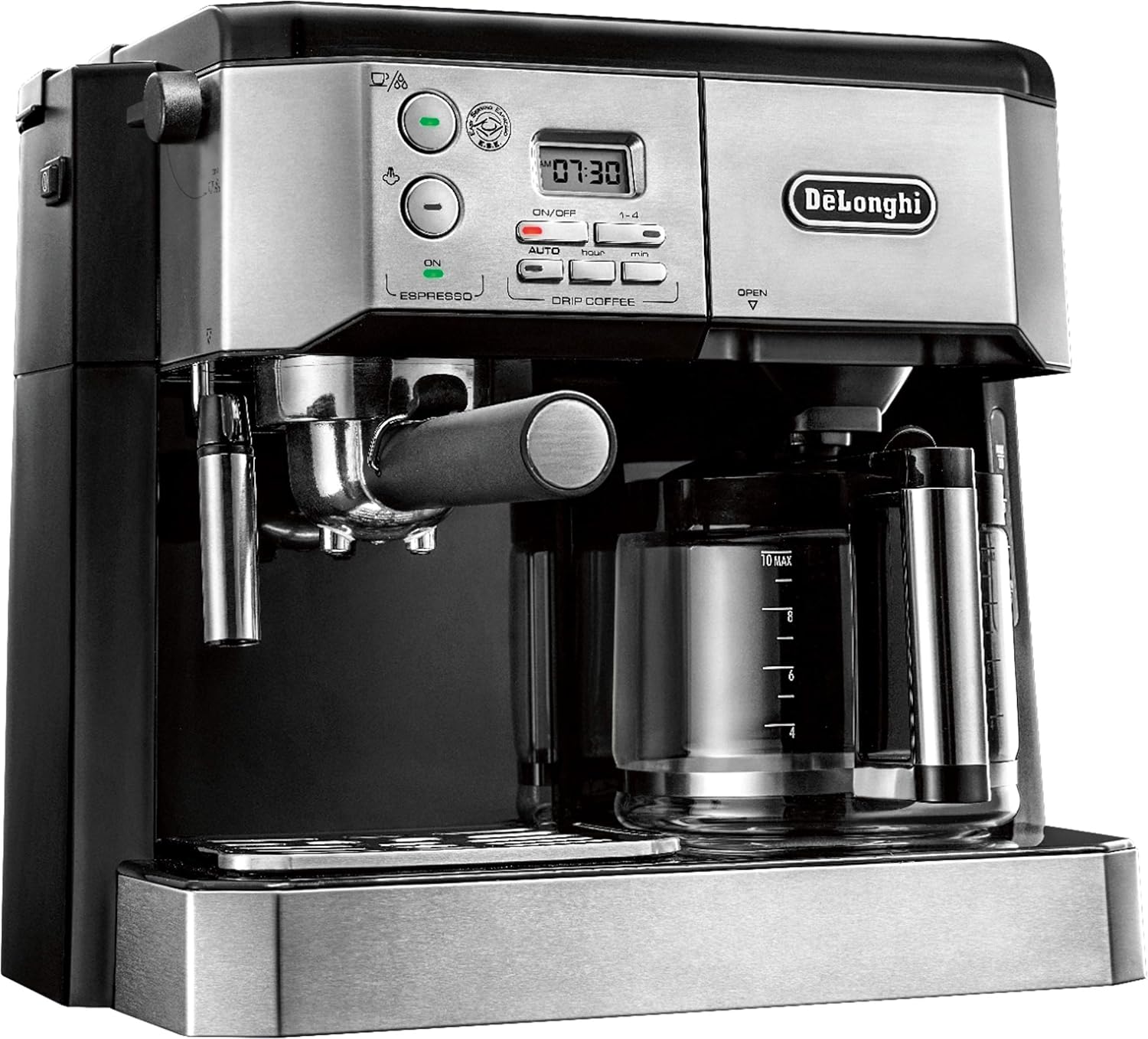
De’Longhi BCO430
- Drip capacity: 10-cup glass carafe
- Espresso pressure: 15-bar pump
- Espresso reservoir: removable 40-ounce water tank
- Programming: 24-hour programmable drip timer

Ninja CFN601 Barista System
- Ground-coffee sizes: nine sizes from cup to 12-cup carafe
- Ground-coffee styles: Classic, Rich, and Over Ice
- Capsule styles: espresso, lungo, and over ice
- Capsule pressure: 19-bar Barista Plus system
The ten machines here therefore compete on more than drink count. The Ninja AutoBarista tries to turn whole beans into espresso, longer coffee, cold brew, and milk drinks automatically. The De’Longhi BCO430 and Espressione EM-1040 keep drip and espresso physically separate. Bosch, Miele, and Tchibo use one automatic brew group for espresso and coffee-size drinks. Ninja’s CFN601 combines ground coffee with Original-style capsules, Nespresso combines capsule espresso and coffee with two very different milk systems, and Keurig builds café-style drinks around concentrated K-Cup coffee.
I evaluated the complete home routine: whether the machine makes a true carafe or one cup at a time, how it defines espresso, whether it grinds beans or depends on pods, milk texture, water and bean capacity, programming, cleanup, counter depth, noise, simultaneous service, recurring capsule cost, access to the brew unit, and how easily another person can make a good drink without asking for instructions.
My overall winner is the Ninja AutoBarista because it gives a modern home the broadest fresh-bean one-touch range. The De’Longhi BCO430 is the better answer when a real ten-cup pot and a separate espresso side are essential, while the Ninja CFN601 is the value pick for households that prefer a full carafe and capsule espresso. The important thesis is simple: the best espresso and coffee maker combo for home is not the machine that claims the most drinks—it is the one that replaces the two appliances you would otherwise use.
1. Ninja AutoBarista AE1001 Fully Automatic Espresso Machine
Best for: Homes that want fresh-ground espresso, regular coffee, cold brew, and automatic milk foam without learning a portafilter routine.
The Ninja AutoBarista is the rare new machine that actually fits the phrase “espresso and coffee maker combo” without making me mentally add an asterisk. It grinds whole beans, tamps internally, brews espresso, makes a longer drip-style coffee, handles cold-brew-style drinks, and froths milk without asking the user to move a pitcher under a manual steam wand. In a mixed household, that breadth matters more than a specification sheet because the machine can move from a short morning espresso to a larger coffee and then to an iced latte without changing appliances.
Its hardware centers on an integrated burr grinder with 50 settings, Grind iQ automatic adjustment, an internal tamping system, 10 one-touch presets, and hands-free FrothPerfect with steamed, thin, thick, and cold-foam choices. The most important ownership fact is that this is not a carafe drip machine. It makes coffee-style cups from fresh beans, so it suits a home that wants one mug at a time rather than a full pot waiting on a warming plate. The body is also substantial, so I would measure cabinet clearance and front access before assuming it will replace a small coffee maker.
In daily use, the appeal is how little the drink changeover disrupts the morning. There is no portafilter to dose, no separate grinder to purge, and no milk wand to learn. I would still expect the owner to empty the drip tray, clear the grounds container, rinse milk-contact parts, and follow automatic cleaning prompts, but the actual brewing sequence is unusually coherent. My broader SharkNinja coffee-maker guide explains why this model is more than another Ninja multifunction appliance: it is the brand’s most direct attempt at a true whole-bean, one-touch coffee station.
Best fully automatic home combo for fresh-ground espresso, drip-style coffee, cold brew, and hands-free hot or cold foam
The Ninja AutoBarista AE1001 combines a 50-setting integrated burr grinder, Grind iQ adjustment, an integrated tamper, 10 one-touch drinks, and four FrothPerfect milk programs in one fully automatic platform designed for households that rotate between espresso, longer coffee, iced drinks, and milk-based favorites.
Technical Specifications & Daily Workflow
- Machine type: fully automatic whole-bean espresso and coffee system
- Drink range: 10 one-touch hot and iced presets
- Coffee styles: espresso, drip-style coffee, cold brew, flat white, latte, and related milk drinks
- Grinder: integrated burr grinder
- Grind adjustment: 50 settings with Grind iQ support
- Tamping: integrated automatic tamper
- Milk system: hands-free FrothPerfect
- Milk programs: steamed, thin, thick, and cold foam
- Coffee input: whole beans ground for each drink
- Controls: one-touch drink selection with automated calibration
- Approximate dimensions: 14.6 inches wide, 21.7 inches deep, and 19.4 inches high
- Best workflow: one fresh cup at a time for households that want maximum drink variety
What to Expect During the First 30 Days
Pros
- It covers espresso, longer coffee, cold drinks, and milk foam without separate appliances.
- The 50-setting grinder provides far more adjustment than most one-touch machines.
- Grind iQ and internal tamping remove the most error-prone manual steps.
- Four milk programs make both hot and iced milk drinks genuinely practical.
- Fresh whole-bean brewing gives it a higher flavor ceiling than capsule and K-Cup combos.
- The drink workflow is easy for several household members to repeat.
Cons
- It is a large, deep, and heavy countertop appliance.
- It does not brew a traditional multi-cup glass carafe.
- The newer platform has less long-term service history than older De’Longhi, Miele, or Bosch systems.
Who Should Buy, Who Should Skip & My Final Verdict
Buy it if: Buy it when one machine needs to cover fresh-ground espresso, regular coffee-size drinks, cold brew, and automatic milk for several different drinkers.
Skip it if: Skip it when you need a full carafe, prefer a compact appliance, or want direct manual control over puck preparation and steaming.
My final verdict: The AutoBarista is my best overall choice because its idea of “combo” is the most complete for a modern home. It does not merely place two unrelated brewers in one cabinet; it creates one fresh-bean workflow that can move across espresso, coffee, cold drinks, and milk with very little retraining.
2. De’Longhi BCO430 All-in-One Coffee and Espresso Maker
Best for: Families that want a programmable 10-cup drip pot and a separate pump-espresso side that can operate as a traditional two-station coffee center.
The De’Longhi BCO430 is the machine I picture when someone uses “combo” in the old-school sense: a full drip coffee maker on one side and a separate pump espresso machine on the other. That physical separation is both its strength and its compromise. You can program a pot for the morning, brew up to ten cups for several people, and still pull a single or double espresso later without owning two separate appliances. It feels more like a compact coffee center than a super-automatic.
The drip side uses front loading, which is a surprisingly practical detail under cabinets, and includes a 24-hour timer, an Aroma function for smaller batches, a gold-tone reusable filter, and a warming plate that can hold the pot for up to two hours. The espresso side uses a 15-bar pump, one- and two-cup baskets, ESE-pod compatibility, a removable 40-ounce reservoir, a cup-warming area, and a manual cappuccino system. De’Longhi also designed the two sides so coffee and espresso service can overlap, a useful feature when guests want different drinks.
My realistic expectation is not café-level control. The pressurized, convenience-oriented espresso setup is friendlier than a serious 58 mm machine but offers less control over dose, temperature, and extraction. Milk frothing also demands a little patience, especially if several large lattes are being made. Still, the daily logic is excellent for a home that drinks pots of filter coffee but wants espresso and cappuccino available occasionally. I also discuss this style of machine in my coffee-maker and espresso equipment guide, where the BCO platform stands out specifically because it solves two real service needs in one body.
Best traditional dual-brewer combo for a programmable 10-cup pot, 15-bar espresso, manual milk frothing, and simultaneous coffee service
The De’Longhi BCO430 pairs a front-loading 10-cup drip brewer with a separate 15-bar pump espresso section, a 40-ounce removable espresso reservoir, manual cappuccino frother, 24-hour programming, reusable gold-tone coffee filter, and a warming function that keeps the carafe hot for up to two hours.
Technical Specifications & Daily Workflow
- Machine type: separate drip coffee maker and pump espresso machine in one chassis
- Drip capacity: 10-cup glass carafe
- Espresso pressure: 15-bar pump
- Espresso reservoir: removable 40-ounce water tank
- Programming: 24-hour programmable drip timer
- Small-batch support: Aroma function for fewer than six cups
- Coffee filter: reusable gold-tone filter included
- Milk system: manual cappuccino frother
- Espresso inputs: ground coffee and compatible ESE pods
- Heating and service: cup warmer plus up to two-hour carafe warming
- Power: 1500 watts
- Approximate dimensions: 11.0 inches wide, 14.5 inches deep, and 12.8 inches high
What to Expect During the First 30 Days
Pros
- It is one of the clearest true drip-and-espresso combinations available.
- The 10-cup carafe works for family mornings and entertaining.
- Front loading reduces the need to pull the machine out from beneath cabinets.
- The programmable timer makes the drip side useful before work.
- A separate espresso reservoir keeps the two workflows logically organized.
- Manual frothing allows cappuccinos, lattes, and hot chocolate without another appliance.
Cons
- The espresso side is convenience-focused rather than enthusiast-grade.
- There are many parts to clean: carafe, basket, portafilter, wand, drip tray, and two water systems.
- The long-running design feels less modern than touchscreen and automatic machines.
Who Should Buy, Who Should Skip & My Final Verdict
Buy it if: Buy it when a full pot of drip coffee is the daily priority but espresso, cappuccino, and latte capability still needs to live on the same counter.
Skip it if: Skip it when you want one-touch bean-to-cup drinks, automatic milk, or the extraction control of a dedicated prosumer espresso machine.
My final verdict: The BCO430 is the best traditional combo here because it does not blur the distinction between drip coffee and espresso. It gives each drink style its own hardware and asks the owner to accept extra cleaning in exchange for genuine two-station versatility.
3. Espressione EM-1040 Stainless Steel Combination Espresso and Coffee Maker
Best for: Buyers who want a substantial stainless-steel dual machine with a stronger pump specification, ESE-pod support, programmable drip coffee, and manual milk work.
The Espressione EM-1040 follows the same two-machine idea as the De’Longhi, but it presents it in a more substantial stainless-steel body and gives the espresso side a different personality. I notice the extra weight immediately because this is not a lightweight pod brewer disguised as a premium appliance. The machine feels designed for someone who expects regular drip coffee during the week and wants a more involved ground-coffee espresso routine on weekends.
Its espresso section uses a 19-bar Italian ULKA pump, thermoblock heating, electronic temperature control, programmable one- and two-cup volumes, 7-gram and 14-gram baskets, ESE-pod compatibility, and a steam nozzle for cappuccino and latte milk. The removable 1.5-liter water tank includes level detection, while the height-adjustable drip tray helps with espresso cups and taller glasses. The drip side produces up to ten larger cups, includes pause-and-serve, and keeps the glass carafe warm for up to two hours.
The important limitation is that the two sides share the appliance’s power and heating logic; the startup instructions note that only one side is used at a time. That means it is not the same simultaneous entertaining tool as the De’Longhi. In my use pattern, I would program or brew the pot first, then switch attention to espresso and milk. The reward is stronger espresso-side hardware and a more premium-feeling case. The penalty is a heavier machine, more surfaces to wipe, and a workflow that still requires a capable espresso grinder if you want to make the most of the pump.
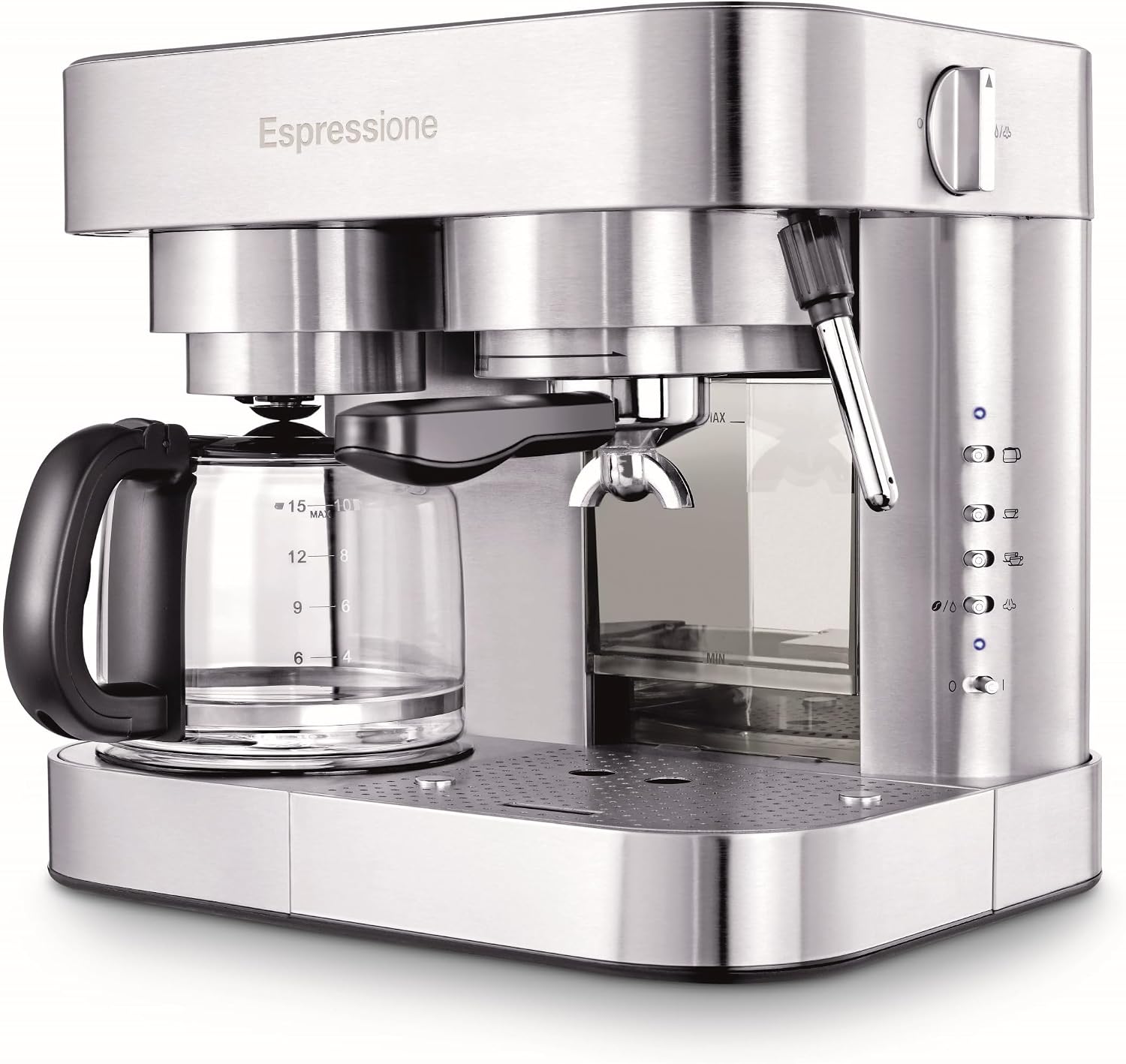
Best stainless-steel traditional combo for 19-bar espresso, thermoblock heating, 10-cup drip coffee, ESE pods, and adjustable manual brewing
The Espressione EM-1040 combines a 19-bar Italian ULKA pump, thermoblock espresso heater, ground-coffee and ESE-pod compatibility, programmable single and double espresso volumes, a 1.5-liter tank, steam wand, and a separate 10-cup drip coffee maker with pause-and-serve and a two-hour warming plate.
Technical Specifications & Daily Workflow
- Machine type: stainless-steel espresso and drip coffee combination
- Espresso pump: 19-bar Italian ULKA pump
- Espresso heater: thermoblock with integrated stainless-steel tube
- Power: 1250 watts
- Water tank: removable 1.5-liter transparent tank
- Espresso inputs: ground coffee, compact ESE pods, and soft paper pods with the proper basket
- Portafilter: die-cast aluminum holder with two-cup outlet
- Preset dosing: programmable one- and two-cup espresso volumes
- Milk system: manual steam tube with stainless-steel nozzle
- Drip side: up to 10 large cups with removable cone filter basket
- Carafe support: pause-and-serve plus warming plate for up to two hours
- Approximate dimensions and weight: 14.6 x 11.4 x 13 inches; about 19.4 pounds
What to Expect During the First 30 Days
Pros
- The 19-bar ULKA pump and thermoblock give the espresso side a serious foundation.
- Ground coffee and ESE-pod support offer useful flexibility.
- Programmable one- and two-cup volumes reduce button holding.
- The stainless-steel body looks more appliance-like than many plastic combos.
- A 10-cup drip side covers family and guest coffee.
- The adjustable tray and two baskets make cup-size changes straightforward.
Cons
- The two brewing sides are not intended to run at the same time.
- It is heavy and requires meaningful counter depth.
- Good espresso still depends on a separate grinder and practiced dosing.
Who Should Buy, Who Should Skip & My Final Verdict
Buy it if: Buy it when you want a premium-looking dual brewer and will actually use ground coffee, ESE pods, manual steaming, and the full drip carafe.
Skip it if: Skip it when simultaneous coffee and espresso service, automatic milk, or one-touch whole-bean brewing matters more than traditional control.
My final verdict: The EM-1040 is the strongest traditional stainless combo for someone who wants to participate in the espresso side. It asks more of the user than automatic machines, but the pump, thermoblock, baskets, pod support, and steam wand make that involvement meaningful rather than decorative.
4. Bosch 800 Series VeroCafe TPU60309 Fully Automatic Espresso Machine
Best for: Homes that treat “coffee and espresso” as a large one-touch menu rather than a glass-carafe requirement and want premium customization, smart control, and automatic milk.
The Bosch 800 Series interprets “combo” very differently from the De’Longhi and Espressione machines. It does not brew a ten-cup drip pot. Instead, it treats espresso, coffee, americano, café crema, cold coffee, and milk drinks as variations produced by one bean-to-cup brewing system. That distinction matters. For a home that drinks individual cups and values variety over carafe volume, the Bosch is far more convenient. For a family that wants six mugs from one batch, it is the wrong tool.
Bosch gives the TPU60309 more than 35 drink options, a ceramic grinder, a large color touchscreen, automatic milk drawn through a hose, double-cup preparation on supported drinks, and space for up to ten favorite recipes. Home Connect extends the menu, supports remote drink selection, sends maintenance prompts, and can work with voice control. The machine’s approximately 12.2-inch width is manageable, though its 18.4-inch depth means cabinet and refill access still need planning.
What impresses me is how clearly the interface manages complexity. A machine with this many recipes can become a scrolling nuisance, but saved favorites and visual drink selection make it practical for several users. I would still keep the milk hose and dispenser on a disciplined rinse schedule, and I would not buy the machine merely because it connects to an app. In my Bosch 300 vs 500 vs 800 Series guide, the 800 earns its position because the extra menu, favorites, connected features, and premium interface change daily use rather than simply adding marketing labels.

Best premium bean-to-cup combo for 35-plus drinks, ceramic grinding, automatic milk, double-cup service, favorites, and Home Connect control
The Bosch 800 Series VeroCafe TPU60309 offers more than 35 coffee and espresso recipes, a ceramic grinder, large touchscreen, automatic milk hose, double-cup preparation, up to 10 saved favorites, and Home Connect features for remote control, recipe discovery, alerts, and voice assistance.
Technical Specifications & Daily Workflow
- Machine type: premium fully automatic bean-to-cup coffee and espresso machine
- Recipe menu: more than 35 drink options
- Grinder: integrated ceramic grinder
- Milk system: automatic external milk hose
- Display: large color touchscreen
- Favorites: save up to 10 preferred drinks
- Double cup: simultaneous two-cup preparation on supported drinks
- Connectivity: Home Connect app and compatible voice control
- Cleaning: guided programs plus removable/rinseable beverage dispenser components
- Coffee input: whole beans with automatic dosing and grinding
- Approximate dimensions: 12.17 inches wide, 18.4 inches deep, and 15 inches high
- Best workflow: individual customized coffees and milk drinks rather than a multi-cup carafe
What to Expect During the First 30 Days
Pros
- The 35-plus drink menu covers almost every mainstream hot and cold preference.
- A ceramic grinder supports durable, repeatable whole-bean preparation.
- Ten favorites make the large menu manageable for a household.
- Automatic milk and double-cup service reduce hands-on work.
- Home Connect adds recipes and alerts without replacing the touchscreen.
- The machine feels appropriate as a shared premium kitchen coffee station.
Cons
- It does not make a traditional drip carafe.
- The milk hose needs immediate, consistent cleaning.
- The premium price is difficult to justify for espresso-and-americano-only drinkers.
Who Should Buy, Who Should Skip & My Final Verdict
Buy it if: Buy it when several people want individual espresso, coffee, and milk drinks with saved preferences, premium controls, and minimal technique.
Skip it if: Skip it when a full pot, manual espresso control, or a simple offline appliance matters more than a large connected menu.
My final verdict: The Bosch 800 is the premium automatic combo for a home that defines coffee by cup style rather than brew method. Its strength is not one headline feature; it is the way the grinder, menu, milk system, favorites, and interface work together for repeated multi-user service.
5. Miele CM 5310 Silence Automatic Coffee Maker
Best for: Design-focused homes that want refined bean-to-cup espresso and coffee, quieter grinding, two drinks at once, and a premium appliance-style ownership experience.
The Miele CM 5310 Silence is not the machine I would choose by counting drinks or comparing prices per preset. Its appeal is quieter and more appliance-like. The controls, grinder sound, central spout, two-cup routines, and automatic cleaning programs feel designed for someone who wants a calm, refined coffee corner rather than a feature demonstration every morning. It can prepare espresso and longer coffee, but it does so one or two cups at a time instead of brewing a conventional drip pot.
Miele’s AromaticSystem expands the brew chamber as water enters, while the selectable conical grinder, programmable coffee quantity, water quantity, temperature, pre-brewing, milk, and milk-foam amounts let the owner tune familiar drinks. OneTouch for Two can prepare two coffees or supported milk drinks together, and the coffee-pot function produces multiple cups in sequence for guests. A pre-ground chute allows an occasional decaf dose without emptying the bean container.
After the first week, the real ownership question becomes whether the service network and maintenance philosophy fit you. The CM 5310 uses guided cleaning programs and expects the owner to follow milk-rinse, brew-unit, tablet, and descaling instructions closely. I like it most in a home that values low noise, design, and repeatable hot drinks more than iced menus or app control. My broader coffee equipment roundup reaches the same conclusion: Miele makes sense when the polish of the full routine matters as much as the number of beverages.

Best quiet premium automatic for OneTouch-for-Two coffee, espresso, cappuccino, programmable recipes, and refined low-noise operation
The Miele CM 5310 Silence combines a selectable conical grinder, AromaticSystem brewing, OneTouch and OneTouch for Two, programmable coffee and milk quantities, a coffee-pot function, pre-ground bypass, automatic cleaning programs, and a 1.3-liter water tank in a polished countertop platform.
Technical Specifications & Daily Workflow
- Machine type: premium fully automatic countertop bean-to-cup machine
- Core drinks: ristretto, espresso, coffee, long coffee, cappuccino, latte macchiato, hot milk, and milk foam
- Grinder: integrated conical grinder with selectable grind grade
- Brewing system: Miele AromaticSystem
- Two-cup support: OneTouch for Two
- Guest function: sequential coffee-pot preparation
- Programming: coffee amount, water, temperature, pre-brewing, milk, and milk-foam quantity
- Alternative coffee: pre-ground coffee chute
- Water capacity: approximately 1.3 liters
- Controls: DirectSensor button-based panel
- Cleaning: automatic rinse and guided maintenance programs
- Best workflow: premium hot coffee and milk drinks with low noise and disciplined care
What to Expect During the First 30 Days
Pros
- The quieter grinder suits early mornings and open-plan kitchens.
- OneTouch for Two is genuinely useful for couples.
- AromaticSystem and extensive programming support consistent hot drinks.
- The coffee-pot function helps when several guests want black coffee.
- Pre-ground bypass makes occasional decaf practical.
- The design and control feel are more refined than many plastic-heavy automatics.
Cons
- It is expensive relative to its menu size.
- It lacks dedicated cold coffee and cold-foam programs.
- Service access and repair cost should be checked before purchase.
Who Should Buy, Who Should Skip & My Final Verdict
Buy it if: Buy it when quiet operation, premium design, hot coffee quality, two-drink service, and a polished appliance experience matter more than novelty features.
Skip it if: Skip it when you want a large cold menu, very easy milk-carafe cleanup, or the lowest cost per drink option.
My final verdict: The CM 5310 is the refined choice rather than the obvious value choice. I recommend it to buyers who will notice the quieter grinder, thoughtful two-cup routine, programmable parameters, and calm design every day—and who are prepared to maintain a premium automatic properly.
6. Ninja CFN601 Espresso and Coffee Barista System
Best for: Mixed households that want a 12-cup carafe and multiple ground-coffee sizes alongside Original-style espresso capsules and a fold-away frother.
The Ninja CFN601 is one of the easiest combo machines to recommend when budget and flexibility matter more than fresh-ground espresso. It handles regular ground coffee from a single cup to a 12-cup carafe, then switches to Original-style espresso capsules for short espresso, lungo, and over-ice pours. The machine does not pretend the two coffee formats are identical; it simply gives each one a practical route through the same countertop system.
For ground coffee, there are nine serving sizes and three brew styles—Classic, Rich, and Over Ice. For capsules, the 19-bar system offers 1.35-ounce espresso, 3.75-ounce lungo, and a concentrated over-ice option. A fold-away frother handles hot or cold milk without permanently widening the machine, and the carafe side makes it useful for weekends, visitors, or anyone who wants several mugs ready at once. There is no built-in grinder, which keeps cost and complexity lower but means fresh results depend on the coffee or grinder you provide.
I like the CFN601 most as a bridge machine. It works for a household where one person wants a normal pot, another wants a quick capsule espresso, and someone occasionally wants a latte without learning a steam wand. Capsule cost and recycling remain real considerations, and the frother creates foam rather than café steam-wand microtexture. Still, the workflow is unusually honest and versatile. My SharkNinja coffee-maker comparison makes the same distinction: choose this model for format flexibility, not because it replaces the flavor control of a grinder-driven espresso setup.
Best-value home combo for ground coffee from cup to 12-cup carafe, Original-style espresso capsules, 19-bar brewing, and fold-away milk frothing
The Ninja CFN601 brews ground coffee in nine sizes with Classic, Rich, and Over Ice modes, prepares Original-style espresso capsules as espresso, lungo, or over ice through a 19-bar system, includes a 12-cup carafe, and adds a built-in fold-away frother for cappuccinos, lattes, and flat whites.
Technical Specifications & Daily Workflow
- Machine type: ground-coffee carafe brewer plus Original-style capsule espresso system
- Ground-coffee sizes: nine sizes from cup to 12-cup carafe
- Ground-coffee styles: Classic, Rich, and Over Ice
- Capsule styles: espresso, lungo, and over ice
- Capsule pressure: 19-bar Barista Plus system
- Carafe: 12-cup glass carafe
- Milk system: built-in fold-away frother
- Milk compatibility: hot or cold milk and many alternatives
- Coffee input: ground coffee plus Original-style espresso capsules
- Power: approximately 1550 watts
- Approximate dimensions: 11.9 inches wide, 14.8 inches deep, and 17.4 inches high
- Best workflow: households mixing full-pot coffee, single cups, and quick capsule milk drinks
What to Expect During the First 30 Days
Pros
- It makes both single cups and a real 12-cup carafe from ground coffee.
- The capsule side offers three useful espresso formats.
- A 19-bar system gives capsules a consistent, crema-topped presentation.
- The fold-away frother adds milk drinks without a separate countertop tool.
- Nine ground-coffee sizes reduce waste when a full pot is unnecessary.
- Its price is accessible compared with premium automatics and Nespresso Creatista models.
Cons
- There is no built-in grinder.
- Capsule espresso has a lower freshness and control ceiling than whole-bean brewing.
- The frother does not create the same texture as an automatic steam wand.
Who Should Buy, Who Should Skip & My Final Verdict
Buy it if: Buy it when the household needs a carafe, single cups, capsule espresso, and casual milk drinks at a sensible price.
Skip it if: Skip it when fresh-ground espresso, automatic milk texture, or a compact single-format machine matters more than maximum format flexibility.
My final verdict: The CFN601 is my best-value combo because every major function has a clear household purpose. It will not satisfy an espresso purist, but it can replace a drip brewer, capsule machine, and basic frother while remaining easy for guests and family members to understand.
7. Nespresso Vertuo Creatista by Breville
Best for: Capsule users who want both larger Vertuo coffees and espresso sizes but care enough about milk texture to pay for an automatic steam wand.
The Vertuo Creatista is the pod machine in this roundup that feels least transactional. It still gives you the speed and consistency of a barcode-read Vertuo capsule, but the automatic steam wand adds a more deliberate milk routine. That combination makes sense for someone who wants both larger coffee cups and espresso-size pours without grinding beans, yet still notices the difference between bubbly froth and silkier steamed milk.
Vertuo brewing covers six sizes: single and double espresso plus 5-, 8-, 12-, and 18-ounce coffee formats, with hot and over-ice possibilities depending on the capsule. The Breville steam wand works with the included stainless jug and lets the user select milk temperature and texture. A removable two-liter, 67.6-ounce tank reduces refills, while the used-capsule container holds roughly ten small or six large capsules before emptying.
The tradeoff is ecosystem cost and physical width. You are buying Vertuo capsules rather than beans, and the machine is wider than a basic Vertuo brewer because the steam system occupies real space. Milk steaming also takes a little longer than pressing an integrated carafe button, although cleanup is simpler because the wand purges and the jug can be rinsed separately. In my pod-and-milk espresso-machine guide, the same principle explains why Creatista machines stand out: they preserve pod convenience while making the milk side feel like part of the drink rather than an afterthought.

Best premium pod combo for six Vertuo coffee and espresso sizes, automatic steam-wand milk texture, large water capacity, and polished stainless design
The Nespresso Vertuo Creatista uses Vertuo capsules to brew six sizes from single espresso through 18-ounce coffee, pairs them with an automatic Breville steam wand and stainless milk jug, provides adjustable milk temperature and texture, and uses a removable 67.6-ounce water tank.
Technical Specifications & Daily Workflow
- Machine type: Vertuo capsule coffee and espresso machine with automatic steam wand
- Cup sizes: 1.35, 2.7, 5, 8, 12, and 18 ounces
- Brewing technology: Vertuo barcode-guided Centrifusion system
- Milk system: automatic Breville steam wand
- Milk vessel: stainless-steel jug included
- Milk control: selectable temperature and texture
- Water tank: removable 2-liter / 67.6-ounce reservoir
- Used capsule capacity: about 10 small or 6 large capsules
- Coffee input: Nespresso Vertuo capsules only
- Approximate dimensions: 16.4 inches wide, 9.0 inches deep, and 12.6 inches high
- Best workflow: premium capsule coffee plus textured milk without grinding or tamping
- Important limitation: not compatible with Nespresso Original capsules
What to Expect During the First 30 Days
Pros
- It covers both espresso-size and genuinely large coffee formats.
- The automatic steam wand produces more refined milk than a simple whisk frother.
- The large water tank suits frequent coffee and milk-drink use.
- Barcode-based brewing keeps capsule preparation consistent.
- The stainless finish and separate milk jug feel premium.
- Milk cleanup is easier to inspect than a hidden tube-and-carafe system.
Cons
- Vertuo capsule cost becomes significant with daily use.
- It is wider than many capsule machines.
- The brewing system does not provide bean, grind, dose, or extraction control.
Who Should Buy, Who Should Skip & My Final Verdict
Buy it if: Buy it when Vertuo convenience and larger coffee sizes are non-negotiable but milk texture and premium feel still matter.
Skip it if: Skip it when you want the lowest drink cost, whole-bean freshness, one-touch carafe milk, or compatibility with Original capsules.
My final verdict: The Vertuo Creatista is the premium capsule combo I would choose for someone who genuinely drinks both coffee and milk-based espresso drinks. It costs more because the steam system changes the experience—not because the machine merely adds decorative settings.
8. Nespresso Vertuo Lattissima by De’Longhi
Best for: Vertuo households that prioritize quick cappuccinos and lattes and would rather press one button than texture milk in a separate pitcher.
The Vertuo Lattissima is easier than the Creatista in the exact place where the Creatista is more satisfying. Instead of pouring milk into a metal jug and choosing steam settings, you connect the carafe, press a milk-drink button, and let the machine combine coffee and foam. For a rushed morning or a household that does not care about milk-pouring technique, that convenience can be more valuable than finer texture control.
It uses the same Vertuo ecosystem for six coffee sizes, including single and double espresso and larger coffee formats up to 18 ounces. The integrated carafe adds direct cappuccino and latte macchiato recipes, and the milk assembly can be detached and refrigerated between uses . The machine is relatively narrow at about 7.5 inches, though its 16-inch depth still demands clear space in front and behind.
I would choose it over the Creatista for a household where several people want quick, repeatable milk drinks and nobody wants to manage a jug. I would choose the Creatista when milk quality and the pleasure of a more café-like routine matter more. Either way, Vertuo capsule cost and recycling need to be included in the budget. My Nespresso-compatible machine guide shows why Lattissima designs remain popular: their strength is not ultimate espresso control, but the fact that a latte can become a realistic weekday habit.

Best one-touch Vertuo combo for six coffee and espresso sizes, integrated fresh-milk cappuccino and latte recipes, and a narrow daily workflow
The Nespresso Vertuo Lattissima brews six Vertuo coffee and espresso sizes, adds one-touch cappuccino and latte macchiato recipes through a detachable fresh-milk carafe, uses barcode-guided capsule extraction, and fits the complete milk routine into a body about 7.5 inches wide.
Technical Specifications & Daily Workflow
- Machine type: Vertuo capsule coffee and espresso machine with integrated milk carafe
- Cup sizes: six Vertuo formats from espresso to 18-ounce coffee
- Milk recipes: one-touch cappuccino and latte macchiato
- Milk system: detachable fresh-milk carafe
- Brewing technology: barcode-guided Vertuo Centrifusion
- Coffee input: Nespresso Vertuo capsules only
- Approximate width: 7.5 inches
- Approximate depth and height: 16 inches deep and 12.4 inches high
- Weight: about 14 pounds
- Cleaning: rinse prompt and removable milk components
- Best workflow: fast one-touch coffee and milk drinks with minimal technique
- Important limitation: milk components require immediate hygiene attention
What to Expect During the First 30 Days
Pros
- One-touch cappuccino and latte routines are easy for any household member.
- It brews both espresso-size capsules and larger coffee formats.
- The narrow body helps on crowded counters.
- The milk carafe can be removed between drinks.
- Capsule brewing is fast and consistent.
- There is less milk technique to learn than with the Creatista steam wand.
Cons
- Milk texture is less adjustable than on the Creatista.
- The carafe has more milk-contact parts to rinse.
- Vertuo capsules create ongoing cost and ecosystem dependence.
Who Should Buy, Who Should Skip & My Final Verdict
Buy it if: Buy it when the household wants Vertuo coffee sizes plus the easiest direct route to cappuccinos and lattes.
Skip it if: Skip it when you prefer manual or automatic steam-wand texture, whole beans, lower consumable cost, or a true drip carafe.
My final verdict: The Vertuo Lattissima is the one-touch pod specialist. It is not the most nuanced machine here, but it turns coffee, espresso-size drinks, cappuccino, and latte into one simple routine—and that simplicity is exactly what many homes are trying to buy.
9. Keurig K-Café SMART Single-Serve Coffee Maker
Best for: K-Cup users who want regular coffee, concentrated coffee shots, hot and cold milk frothing, app recipes, and household-friendly customization.
The K-Café SMART belongs in this article only when the word “espresso” is used carefully. It does not generate traditional pump espresso. Its 2- and 4-ounce shot settings create concentrated K-Cup coffee designed to stand up to milk in lattes and cappuccinos. For a K-Cup household, that can be exactly the right solution. For someone expecting the body and crema of espresso from finely ground beans, it is not.
Keurig gives the brewer six sizes, five strength settings, six temperature settings, MultiStream saturation, Brew Over Ice, a removable 60-ounce reservoir, and a built-in frother with three hot-foam levels plus cold foam. BrewID can recognize supported pods and suggest settings, while the app provides Café Creations, Barista Mode instructions, scheduling, remote control, voice support, and up to ten saved favorites. The brewer and frother do not operate at the same time, so the milk step and coffee step are queued rather than simultaneous.
In real use, the K-Café makes the most sense when convenience, pod variety, and milk drinks matter more than espresso authenticity. The frother is not dishwasher-safe and should be cleaned immediately, but its open cup design is easier to inspect than some tube systems. I would budget honestly for K-Cups and ignore app features I would not use. The machine is a very capable coffee-and-froth station; it simply needs to be described accurately as a concentrated-coffee latte maker rather than a true espresso machine.

Best K-Cup coffeehouse combo for six brew sizes, concentrated coffee shots, hot and cold frothing, BrewID, strength and temperature control, and app recipes
The Keurig K-Café SMART uses K-Cup pods for 2- and 4-ounce concentrated coffee shots plus 6-, 8-, 10-, and 12-ounce cups, includes a hot-and-cold frother with three hot settings, offers five strengths and six temperatures, and adds BrewID, saved favorites, and app-guided Café Creations.
Technical Specifications & Daily Workflow
- Machine type: connected K-Cup single-serve coffee and milk-frothing system
- Brew sizes: 2, 4, 6, 8, 10, and 12 ounces
- Shot sizes: concentrated 2- and 4-ounce coffee shots
- Strength control: five settings
- Temperature control: six settings
- Brewing: MultiStream Technology and Brew Over Ice
- Milk system: separate built-in hot and cold frother
- Froth settings: three hot levels plus cold
- Reservoir: removable 60-ounce water tank
- Smart features: BrewID, app recipes, scheduling, remote control, and saved favorites
- Approximate dimensions: 11 inches wide, 12.1 inches deep, and 12.7 inches high
- Important limitation: concentrated coffee shots are not pump espresso
What to Expect During the First 30 Days
Pros
- It is familiar and easy for an existing K-Cup household.
- The concentrated shot modes work well as milk-drink bases.
- Hot and cold frothing broadens the drink menu.
- Five strengths and six temperatures offer meaningful cup control.
- The 60-ounce reservoir reduces daily refills.
- App recipes and ten favorites help several users repeat drinks.
Cons
- It does not make true espresso.
- The frother is not dishwasher-safe and cannot run simultaneously with brewing.
- K-Cup cost and waste remain part of ownership.
Who Should Buy, Who Should Skip & My Final Verdict
Buy it if: Buy it when you already prefer K-Cups and want a more capable latte, cappuccino, iced-coffee, and personalized single-serve routine.
Skip it if: Skip it when espresso authenticity, fresh beans, a full carafe, or a completely offline appliance is important.
My final verdict: The K-Café SMART is a good coffeehouse-style combo when judged on its own terms. It makes customizable K-Cup coffee and convincing milk drinks with very little mess, but I would never rank it above true espresso machines for a buyer whose priority is espresso itself.
10. The Tchibo Fully Automatic Coffee and Espresso Machine Bundle
Best for: Black-coffee drinkers who want fresh whole-bean espresso and 6- or 8-ounce coffee from a very narrow machine and do not need milk frothing.
The Tchibo is the simplest machine in this roundup conceptually: beans go in, fresh espresso or a longer black coffee comes out. There is no milk carafe, steam wand, capsule adapter, drip pot, app, or huge recipe screen. That restraint is exactly why I like it for a specific home. A black-coffee drinker can get a 2-ounce espresso, 6-ounce coffee, or 8-ounce coffee without pods and without dedicating the counter to a large premium automatic.
Tchibo uses a stainless-steel grinder with an adjustable grind grade, a 19-bar pump, intensity adjustment through the Boost function, automatic rinsing, and a removable brew unit that the manufacturer recommends cleaning weekly with daily use. The machine accepts whole beans only—no pre-ground coffee—and has one bean compartment. That means regular and decaf switching is inconvenient, but it also keeps the workflow focused and reduces the number of chutes and controls that can collect residue.
I would pair it with a separate frother only if milk drinks are occasional. Anyone making cappuccinos every day should choose a machine with an integrated milk solution. For straight coffee, the narrow body and no-pod system are appealing, though the grinder is audible and the smaller servings mean it will not replace a family carafe brewer. My Tchibo coffee-maker guide goes deeper into the same ownership appeal: freshness, compactness, and a deliberately short menu are the reasons to choose it.
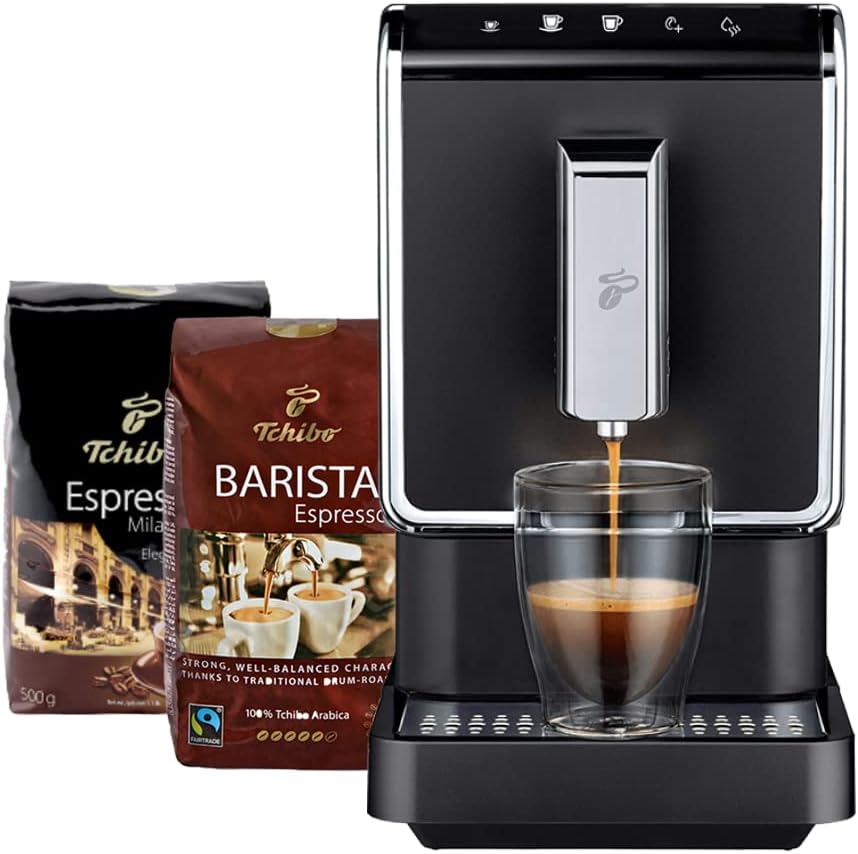
Best compact bean-to-cup combo for fresh espresso and regular coffee sizes, stainless-steel grinding, adjustable intensity, no pods, and minimal counter width
The Tchibo Automatic grinds whole beans with an adjustable stainless-steel grinder, brews 2-ounce espresso plus 6- and 8-ounce coffee, offers a Boost strength function, uses a 19-bar pump, includes automatic rinse and a removable brew unit, and avoids capsules entirely in a body roughly seven inches wide.
Technical Specifications & Daily Workflow
- Machine type: compact fully automatic bean-to-cup coffee and espresso machine
- Serving sizes: 2-ounce espresso plus 6- and 8-ounce coffee
- Pump: 19-bar system
- Grinder: integrated adjustable stainless-steel grinder
- Strength control: Boost function and adjustable intensity
- Coffee input: whole beans only
- Bean compartments: one
- Milk system: none included
- Cleaning: automatic rinse plus removable brew unit
- Approximate dimensions: about 7.1 inches wide, 15.7 inches deep, and 12.4 inches high
- Bundle contents: machine plus two 12-ounce bags of whole-bean coffee
- Best workflow: compact fresh black coffee and espresso without capsules
What to Expect During the First 30 Days
Pros
- The narrow body is excellent for apartments and crowded counters.
- Whole-bean brewing avoids capsule cost and waste.
- Three practical serving sizes cover espresso and everyday black coffee.
- The removable brew unit supports direct weekly cleaning.
- The short control panel is easy to learn.
- It is usually less expensive than premium super-automatics.
Cons
- There is no milk frother.
- One bean hopper makes frequent regular-to-decaf switching inconvenient.
- It cannot brew a multi-cup carafe or accept pre-ground coffee.
Who Should Buy, Who Should Skip & My Final Verdict
Buy it if: Buy it when you want fresh black coffee and espresso from beans in the smallest practical automatic footprint.
Skip it if: Skip it when milk drinks, a carafe, multiple user profiles, cold coffee, or easy bean switching are central to the household routine.
My final verdict: The Tchibo finishes the ranking because it is less of a universal combo, not because it is a poor machine. For the right black-coffee drinker, its narrow size, fresh grinding, simple controls, and pod-free workflow can be more satisfying than a much larger machine with features that never get used.
Buying Guide: How to Choose the Best Espresso and Coffee Maker Combo for Home
A combo machine only saves space when both sides of the combination suit your routine. Buying the wrong type can leave you with a large appliance that still needs a separate grinder, frother, carafe brewer, or capsule machine. I would make the decision in this order rather than starting with price or pump pressure.
Decide whether you need a real carafe
Choose the De’Longhi BCO430, Espressione EM-1040, or Ninja CFN601 when several mugs need to be brewed together. Automatic Bosch, Miele, Tchibo, Ninja AutoBarista, and Vertuo machines make individual cups or sequential servings rather than a traditional pot on a warming plate.
Define what espresso means to you
De’Longhi and Espressione use pump espresso hardware with ground coffee. Bosch, Miele, Tchibo, and AutoBarista grind beans automatically. Ninja CFN601 and Nespresso use capsules. Keurig creates concentrated coffee shots, not traditional espresso. The flavor, crema, control, and cost differ significantly.
Choose beans, grounds, or pods
Whole beans offer the best freshness and lowest long-term consumable waste. Ground coffee supports a carafe and traditional baskets but may require a grinder. Capsules are clean and fast but create recurring cost and lock the owner into a format. K-Cups are the broadest convenience ecosystem but are not espresso capsules.
Match the milk system to your patience
AutoBarista automates milk and foam. Bosch and Miele draw milk through hoses. Vertuo Lattissima uses a detachable carafe. Vertuo Creatista uses an automatic steam wand and jug. De’Longhi and Espressione use manual steam wands. Ninja CFN601 and Keurig use whisk-style frothers.
Measure width, depth, and height
Combo machines are often deeper than they look because they hold two systems, a large tank, or a milk module. Measure cabinet clearance and the room needed to remove tanks, hoppers, carafes, portafilters, drip trays, and brew groups. A narrow machine can still be nearly 16 to 22 inches deep.
Plan the cleaning sequence
A dual brewer has a carafe, filter basket, portafilter, steam wand, and drip tray. A super-automatic has rinses, grounds bins, brew-unit care, milk cleaning, filters, tablets, and descaling. A pod machine reduces coffee mess but still needs needle, capsule-bin, tank, and milk-system cleaning.
Consider simultaneous service
The BCO430 can support coffee and espresso workflows together. The Espressione is designed for one side at a time. Most automatics prepare drinks sequentially, although Bosch and Miele support two-cup functions for selected recipes. Keurig queues brewing after frothing rather than running both processes simultaneously.
Calculate recurring drink cost
Beans are usually the most flexible long-term option. Ground coffee is economical for carafes. Vertuo, Original-style capsules, and K-Cups add a fixed consumable cost per drink. Include filters, descaler, cleaning tablets, milk-cleaning solution, and replacement parts rather than comparing machine prices alone.
Traditional dual brewer or bean-to-cup automatic?
A traditional dual brewer is best when drip coffee is a genuine batch beverage in your home. The carafe can be programmed, shared, and kept warm, while the espresso side remains available for stronger drinks. The cost is extra cleaning and a more manual espresso workflow. A bean-to-cup automatic is better when everyone drinks individual cups and values one-touch convenience. It makes a longer coffee by changing dose and water volume through the same brew group, so the result is not identical to filter drip coffee even when it fills a regular mug.
Capsule combo or fresh-bean combo?
Capsule machines win on speed, cleanliness, and consistency. Vertuo machines make the broadest capsule coffee sizes, while the Ninja CFN601 separates regular ground coffee from Original-style capsule espresso. Fresh-bean machines have a stronger aroma and lower packaging burden, but grinders create noise and require care. I would choose capsules for predictable one- or two-drink convenience and beans for better long-term flavor flexibility.
Which combo is best for milk drinks?
The Ninja AutoBarista is the broadest automatic answer because it integrates fresh grinding and four foam programs. Vertuo Creatista is the best capsule choice for more refined milk texture, while Vertuo Lattissima is easier for one-touch cappuccinos and lattes. Bosch and Miele suit premium bean-to-cup households willing to clean a milk hose. Manual-wand machines are better when the owner enjoys learning but slower when several drinks are required.
Do pump-pressure numbers determine espresso quality?
No. A 19-bar label does not mean the coffee puck is extracted at 19 bars or that the machine automatically produces better espresso than a 15-bar model. Bean freshness, grind uniformity, dose, basket design, water temperature, flow, puck preparation, and recipe programming matter more. Pump ratings mainly describe available system pressure, not the pressure you should use as a ranking shortcut.
How much should you spend?
Spend according to the appliances the combo truly replaces. A BCO430 or CFN601 can be excellent value when it replaces a drip brewer, pod machine, and basic frother. A Bosch, Miele, or AutoBarista makes more sense when it replaces a grinder, espresso machine, coffee maker, and milk system used every day. Premium capsule machines are rational only when the convenience and milk workflow justify both the purchase price and ongoing capsule cost.
Frequently Asked Questions
What is the best espresso and coffee maker combo for home?
The Ninja AutoBarista AE1001 is my best overall choice for a home that wants fresh-ground espresso, coffee-size drinks, cold brew, and automatic milk from one machine. Choose the De’Longhi BCO430 when a real 10-cup drip carafe is essential.
Which combo makes both true drip coffee and pump espresso?
The De’Longhi BCO430 and Espressione EM-1040 use separate drip and pump-espresso sections. The Ninja CFN601 also makes a real carafe from grounds, but its espresso side uses Original-style capsules rather than a ground-coffee portafilter.
Is coffee from a super-automatic the same as drip coffee?
Not exactly. A super-automatic generally pushes water through a compact coffee puck using its espresso-style brew group, then changes dose and water volume for a longer cup. Filter drip coffee uses gravity flow through a larger bed of grounds and has a different body and flavor profile.
Does the Keurig K-Café SMART make real espresso?
No. It makes concentrated 2- or 4-ounce K-Cup coffee shots designed for lattes and cappuccinos. They are convenient milk-drink bases but are not pump-extracted espresso from finely ground coffee.
Which combo is best for a full pot of coffee?
Choose the De’Longhi BCO430 or Espressione EM-1040 for a 10-cup pot with a separate espresso side. The Ninja CFN601 is the strongest value option when a 12-cup carafe and capsule espresso are acceptable.
Which machine is easiest for lattes and cappuccinos?
Ninja AutoBarista is easiest among fresh-bean machines because grinding, brewing, tamping, and foam are automated. Vertuo Lattissima is easiest among pod machines because its milk drinks are one touch. Vertuo Creatista offers better milk control but requires a jug.
Which combo is best for a small kitchen?
The Tchibo Automatic is the narrowest fresh-bean choice at roughly seven inches wide, but it has no milk frother or carafe. Vertuo Lattissima is another narrow option for capsule coffee and one-touch milk. Always measure depth as well as width.
Can I make coffee and espresso at the same time?
The De’Longhi BCO430 is designed around two separate sides and can support overlapping service. The Espressione EM-1040 instructions indicate using one side at a time. Automatic and capsule machines generally prepare drinks sequentially, though some support two cups together.
Which machine has the lowest ongoing drink cost?
Whole-bean machines such as the Tchibo, AutoBarista, Bosch, and Miele usually avoid the per-cup premium of capsules. Traditional ground-coffee carafe brewers are also economical. Capsule and K-Cup costs vary by brand but should be calculated over several years.
Do I need a separate grinder?
You need one for the De’Longhi BCO430 and Espressione EM-1040 if you want freshly ground espresso and drip coffee. Ninja CFN601 uses ground coffee and capsules. AutoBarista, Bosch, Miele, and Tchibo include grinders. Nespresso and Keurig use pods.
Which combo is best for iced coffee?
Ninja AutoBarista is the most complete because it includes cold-brew-style drinks and cold foam. Ninja CFN601 has Over Ice modes for grounds and capsules. Keurig can brew over ice, while Vertuo offers over-ice capsules and larger cold coffee formats.
Are combo machines harder to clean?
Usually. Two brewing formats mean more contact parts. Traditional combos add carafes, baskets, portafilters, and steam wands. Automatics add brew-unit and milk-system care. Pod machines are cleaner around coffee grounds but still require capsule-bin, needle, water, and milk maintenance.
Which machine is best for guests with different preferences?
Bosch 800 Series offers the largest one-touch menu and saved favorites. AutoBarista covers fresh-bean hot, cold, and milk drinks. BCO430 and CFN601 are better when guests need a full pot plus separate espresso-style choices.
Should I buy one combo or two separate machines?
Buy a combo when counter space and shared convenience matter more than maximizing each brew method. Buy separate machines when you want high-end filter coffee and high-control espresso, because a specialist brewer and dedicated espresso setup usually provide more control and easier future replacement.
Final Verdict
The Ninja AutoBarista AE1001 is the best espresso and coffee maker combo for home when the goal is one fresh-bean machine for espresso, longer coffee, cold drinks, and automatic milk. Its grinder, Grind iQ system, internal tamping, ten presets, and four foam programs create the most complete single-cup workflow in this group.
The De’Longhi BCO430 is the better choice when “coffee maker” specifically means a programmable 10-cup drip pot. Its separate 15-bar espresso side and manual frother make it a genuine two-station machine. The Espressione EM-1040 offers a heavier stainless-steel alternative with a 19-bar ULKA pump and stronger traditional espresso-side specifications.
Choose the Ninja CFN601 for the best balance of price, 12-cup coffee, capsule espresso, and casual milk drinks. Choose the Bosch 800 Series for the broadest premium bean-to-cup menu, the Miele CM 5310 Silence for quieter refined hot drinks, the Vertuo Creatista for premium pod coffee with better milk texture, and the Vertuo Lattissima for one-touch capsule milk convenience.
The Keurig K-Café SMART is the right answer only when K-Cup convenience matters more than true espresso, while The Tchibo Automatic is the compact black-coffee specialist for fresh espresso and regular coffee without pods or milk hardware. The best purchase is the one that replaces the exact two machines your household would otherwise keep—not the one with the longest feature list.


