
Best Automatic Espresso Machine with Grinder for Home


OneHundredCoffee is reader-supported, and some products displayed may earn us an affiliate commission. Details.
The best automatic espresso machine with a grinder for home use should make a rushed Tuesday easier than a capsule brewer without turning Sunday coffee into a dull, unchangeable routine. That sounds simple until the category is unpacked. Some machines hide grinding, dosing, brewing, and milk inside a one-touch sequence. Others automate the difficult parts but still expect a portafilter to be moved, locked in, emptied, and rinsed. Both can reduce technique, yet they create entirely different mornings.
My overall pick is the De’Longhi Eletta. Explore because it serves the widest household: hot espresso, automatic milk, cold extraction, cold foam, saved profiles, and travel-mug recipes all belong to one coordinated system. Magnifica Evo offers the sharper value, Philips 3200 makes milk cleanup unusually easy, and JURA E8 gives coffee quality greater priority than menu spectacle. The right choice depends less on the number of icons than on who makes the drinks, how often beans change, whether cold coffee matters, and how much cleanup still feels reasonable after the last cup.
Top 3 Automatic Espresso Machines with Grinders — Editor’s Picks

De’Longhi Eletta Explore
- 50+ drink recipes
- Hot and cold foam
- Cold extraction mode
- 13 grinder settings
- Four user profiles
- Travel-mug function
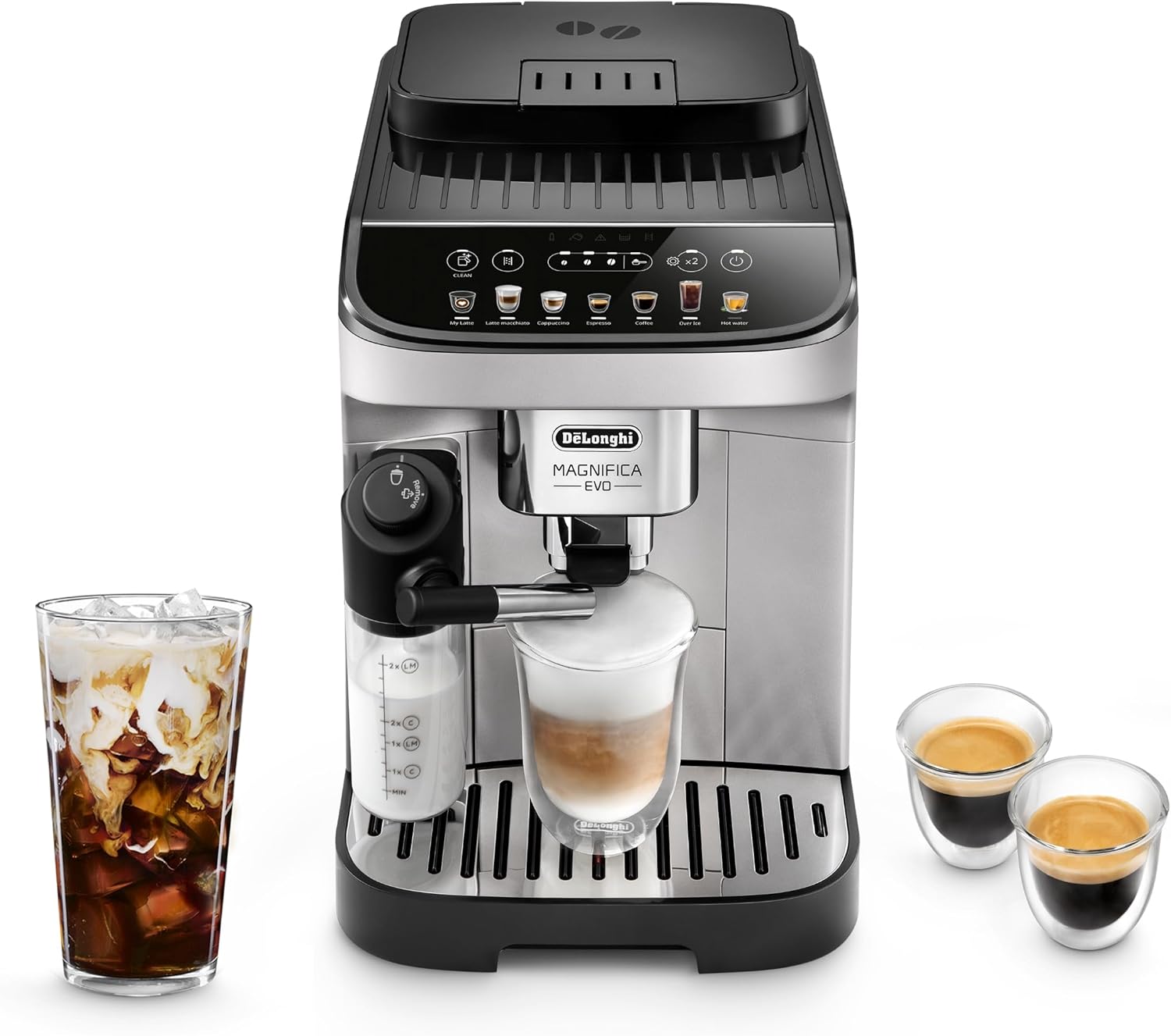
De’Longhi Magnifica Evo
- Seven drink choices
- Automatic LatteCrema milk
- Iced coffee program
- 13 grinder settings
- Removable brew group
- Compact touch controls

JURA E8
- 17 coffee specialties
- P.A.G.2 grinder
- 3D brewing unit
- Fine Foam Frother
- 64-ounce water tank
- 3.5-inch color display
The first decision is whether ‘automatic’ should mean one touch or guided participation. Magnifica Evo, Philips 3200, Eletta Explore, Rivelia, JURA E8, KitchenAid KF8, Gaggia Cadorna Prestige, and Dinamica Plus prepare the puck inside a removable or sealed brew unit. Barista Touch Impress and Oracle Jet grind and tamp into an exposed portafilter. Those Breville machines can create a fuller café-style espresso workflow, but they cannot deliver a finished cappuccino while the user walks away.
Homes comparing these approaches may also find the distinction clearer in my guide to super-automatic espresso machines. A true bean-to-cup model trades puck access for repeatability and speed. An assisted portafilter retains more control over basket preparation, extraction yield, and milk texture, while asking for more counter space around the machine and more cleaning after every drink.
The grinder matters even when the user never sees the grounds. Wider adjustment ranges make it easier to adapt to a new roast, but useful spacing and consistent dosing matter more than the printed count. Super-automatic grinders also respond slowly to changes because coffee remains in the chute. Move one step, prepare several cups, and judge flavor only after the new setting has reached the brew unit. Repeatedly turning the dial produces confusion rather than faster dialing in.
Milk hardware deserves equal attention. Philips LatteGo minimizes hidden tubing. De’Longhi carafes add adjustable automatic texture, while Eletta Explore separates hot and cold milk into dedicated systems. KitchenAid supports varied milk routines and several users. JURA relies on an external hose and guided cleaning. Breville uses an automatic steam wand, which produces a pitcher of microfoam but still expects the owner to pour the drink. The easiest system is the one the household will clean immediately.
Capacity should be judged during the busiest ten minutes, not across an entire day. A large water tank helps when automatic rinses and several milk drinks happen together. A large hopper is useful only when beans are consumed before they lose aroma. Rivelia deliberately moves in the other direction: two removable hoppers make regular and decaf switching practical. KitchenAid KF8 and JURA E8 suit more active homes, whereas Rivelia rewards a smaller routine with greater bean flexibility.
My ranking therefore weighs the whole ownership pattern: cup concentration, grinder adjustment, milk result, multi-user support, service access, cleaning burden, cold-drink usefulness, working clearance, and the amount of participation required. Eletta Explore wins on range, but a household making two cappuccinos and one espresso each day may be better served by Magnifica Evo or Philips 3200. Paying for unused variety is not premium ownership; it is simply extra maintenance.
Best Automatic Espresso Machines with Grinders for Home — At a Glance
De’Longhi Magnifica Evo ECAM29084SB
- Seven drink choices
- Automatic LatteCrema milk
- Iced coffee program
- 13 grinder settings
- Removable brew group
- Compact touch controls

Philips 3200 Series LatteGo EP3241/54
- Five coffee presets
- Tube-free LatteGo milk
- Ceramic burr grinder
- 12 grind positions
- Removable brew group
- AquaClean compatibility
De’Longhi Eletta Explore ECAM450.86.T
- 50+ drink recipes
- Hot and cold foam
- Cold extraction mode
- 13 grinder settings
- Four user profiles
- Travel-mug function

De’Longhi Rivelia EXAM440.55.W
- Bean Switch System
- Two removable hoppers
- 18 one-touch recipes
- Four user profiles
- 13 grinder settings
- Guided Bean Adapt
JURA E8 Chrome 15646
- 17 coffee specialties
- P.A.G.2 grinder
- 3D brewing unit
- Fine Foam Frother
- 64-ounce water tank
- 3.5-inch color display

KitchenAid KF8 KES8558PL
- 40+ recipe options
- Six user profiles
- Dual drink delivery
- Plant-milk settings
- 74.4-ounce water tank
- Removable bean hopper
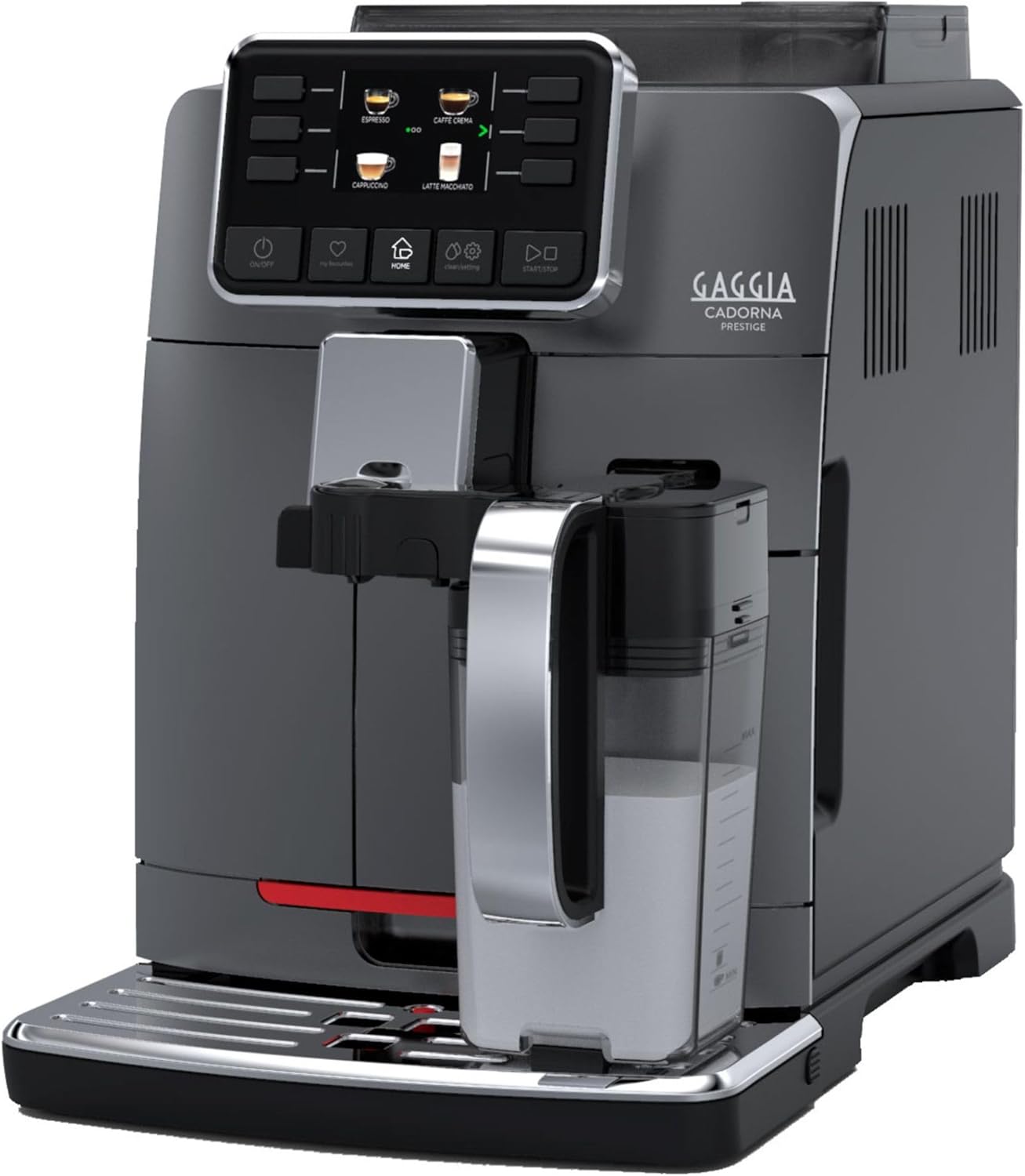
Gaggia Cadorna Prestige RI9604/47
- 14 beverage choices
- Four user profiles
- Ceramic burr grinder
- 10 grind settings
- Integrated milk carafe
- Removable brew group

De’Longhi Dinamica Plus ECAM38085SB
- 24+ one-touch recipes
- Four user profiles
- Full-color touchscreen
- 13 grinder settings
- LatteCrema Hot milk
- Front-access service

Breville Barista Touch Impress BES881BSS
- Step-by-step touchscreen
- Assisted dose and tamp
- 54 mm portafilter
- Auto MilQ steaming
- Fast ThermoJet heat
- Cold extraction recipes

Breville Oracle Jet BES985BSS
- 58 mm portafilter
- Auto grind-dose-tamp
- 45 grinder settings
- Auto MilQ steaming
- ThermoJet heating
- Cold espresso options
Quick Ranking: Best Automatic Espresso Machine with Grinder for Home
| Rank | Machine | Best For | Workflow | Ideal Buyer | Amazon |
|---|---|---|---|---|---|
| 1 | De’Longhi Magnifica Evo | Best Value | One-touch super-automatic | Homes wanting uncomplicated cappuccinos and dependable daily coffee | Price on Amazon |
| 2 | Philips 3200 LatteGo | Easiest Cleaning | One-touch super-automatic | Milk-drink households that prioritize quick rinsing and simple controls | Price on Amazon |
| 3 | De’Longhi Eletta Explore | Best Overall | Hot-and-cold super-automatic | Homes that regularly switch among espresso, hot milk, iced coffee, and cold foam | Price on Amazon |
| 4 | De’Longhi Rivelia | Best Bean Swap | Compact super-automatic | Households switching regularly between regular, decaf, or contrasting roasts | Price on Amazon |
| 5 | JURA E8 | Best Coffee Quality | Premium super-automatic | Coffee-first buyers seeking refined extraction and polished automatic operation | Price on Amazon |
| 6 | KitchenAid KF8 | Best for Families | High-capacity super-automatic | Multi-user homes needing large capacity, profiles, and broad milk customization | Price on Amazon |
| 7 | Gaggia Cadorna Prestige | Best Italian Menu | Milk-carafe super-automatic | Espresso-oriented homes wanting profiles and a traditional Italian drink menu | Price on Amazon |
| 8 | De’Longhi Dinamica Plus | Best Touchscreen | Personalized super-automatic | Homes wanting a modern one-touch menu without cold-foam hardware | Price on Amazon |
| 9 | Breville Barista Touch Impress | Best Guided Control | Assisted portafilter machine | Home baristas wanting tactile espresso with strong screen guidance | Price on Amazon |
| 10 | Breville Oracle Jet | Best Assisted Premium | Premium assisted portafilter | Enthusiasts wanting 58 mm espresso with automated grinding, dosing, tamping, and milk | Price on Amazon |
One-Touch Convenience Versus Assisted Espresso
A super-automatic compresses the routine into a drink selection, but it also fixes the basket geometry, dose range, and brewing sequence inside the cabinet. That consistency suits a shared home and leaves less loose coffee on the counter. The price is reduced access to extraction variables. Strength and volume can move the cup meaningfully, yet the owner cannot distribute the puck, alter a manual pre-infusion, or stop the shot by watching a scale in the same way a portafilter user can.
Breville’s assisted machines reverse that exchange. Grinding, dosing, tamping, heating, and milk texture receive substantial automation, while the 54 mm or 58 mm portafilter keeps the coffee bed visible. The Touch Impress is a learning bridge; Oracle Jet is a premium espresso station. Neither belongs in a home that wants completely unattended drinks. Their advantage appears when automation is expected to reduce inconsistency without removing the physical act of making espresso.
Cleaning follows the same divide. One-touch machines collect pucks internally and rinse themselves, so the larger chores arrive after several drinks. Portafilter machines need a small cleanup after every extraction but give immediate access to the basket and group seal. Neither approach is inherently cleaner. The better system is the one whose maintenance rhythm matches the owner: brief intervention after each cup or periodic work around internal containers, brew groups, filters, and milk paths.
The 10 Best Automatic Espresso Machines with Grinders for Home
1. Best Value: De’Longhi Magnifica Evo ECAM29084SB
A home automatic earns its counter space by making the ordinary cup easier, not by hiding dozens of rarely used recipes behind a large screen. Magnifica Evo understands that distinction. Its front controls cover the drinks most households repeat—espresso, coffee, long coffee, milk-based favorites, hot water, and an iced-coffee option—without turning breakfast into menu navigation. Beans are ground for each cup, milk is dispensed through the LatteCrema carafe, and the used puck drops into an internal container. The sequence is simple enough for several people to share without maintaining separate techniques.
The integrated conical-burr grinder provides 13 positions, which is sufficient to move from a quick, thin extraction toward a more concentrated cup in measured steps. I would begin near the middle rather than moving immediately to the finest setting. A super-automatic uses a compact internal brew unit, so choking the flow rarely improves flavor. Medium-roast beans with a relatively dry surface suit the grinder and brewing path better than glossy, heavily flavored coffee. Strength and volume adjustments then do more useful work than repeatedly turning the grind dial.
LatteCrema is the main reason to choose this version over a black-coffee Magnifica. The removable carafe can stay refrigerated between uses and finishes a cappuccino without manual steaming. That convenience comes with a firm condition: the milk lid, pickup path, and spout need prompt rinsing. The brew group can be removed from the side for periodic cleaning, which gives an owner direct access to loose grounds and coffee oils. Magnifica Evo is less glamorous than the premium machines below, yet its modest interface, accessible brew unit, and familiar drink set make it one of the easiest recommendations for a normal two-person kitchen.
Magnifica Evo concentrates the most useful bean-to-cup functions into a straightforward home routine.
De’Longhi Magnifica Evo ECAM29084SBA focused drink menu, automatic milk carafe, adjustable grinder, and removable brew group create excellent everyday value.
Price on AmazonTechnical Specifications & Daily Features
- Machine type: Fully automatic bean-to-cup espresso machine
- Drink approach: Direct controls for core coffee, milk, hot-water, and iced choices
- Grinder: Integrated conical-burr grinder with 13 positions
- Milk system: Removable LatteCrema automatic carafe
- Coffee adjustment: Selectable strength and programmable drink volume
- Cleaning access: Removable internal brew group and front service containers
- Daily strength: A short path from beans to a finished cappuccino
- Main caution: Milk convenience still requires immediate carafe care
Pros & Cons After 30 Days of Use
Pros
- Simple direct drink controls
- Automatic textured milk
- Useful iced coffee option
- Accessible removable brew group
Cons
- Limited profile support
- Smaller menu than premium models
- Milk lid needs careful rinsing
The easiest first month begins with one familiar medium roast and conservative strength settings. Let several cups pass after a grinder adjustment before judging the result, because coffee already inside the chute and brew path delays the full effect of a change.
Daily care is brief when it happens on time: run the milk-clean setting, rinse the contact parts, empty the damp puck container, and let the drip tray dry. A weekly brew-group rinse prevents stray grounds from becoming stale residue inside the cabinet.
My Final Verdict
Choose Magnifica Evo when one-touch milk, easy controls, and sensible maintenance matter more than a huge recipe library.
Move higher in the range when multiple profiles, cold foam, extensive personalization, or premium screen guidance will be used every day.
Value is strongest for households with a stable routine. Someone who alternates between espresso, coffee, cappuccino, and an occasional iced drink receives nearly everything needed without paying for elaborate software.
The machine also makes its compromises easy to understand. It is not the most configurable option, but the grinder, milk carafe, and removable brew unit form a coherent ownership system rather than a collection of headline features.
2. Easiest Cleaning: Philips 3200 Series LatteGo EP3241/54
Milk systems usually determine whether a bean-to-cup machine remains pleasant after the honeymoon period. Philips designed the 3200 around a short, tube-free LatteGo path instead of a carafe lid filled with hidden channels. Milk and air mix inside the detachable container, foam drops directly into the cup, and the main pieces separate for rinsing. That architecture does not make the machine maintenance-free, but it removes the task most likely to discourage a weekday cappuccino.
Five coffee selections keep the touch panel legible: espresso, coffee, americano, cappuccino, and latte macchiato are joined by hot water. Strength, cup volume, and milk quantity can be adjusted without building a complicated custom profile. The ceramic grinder offers 12 positions and is designed for long service without the heat sensitivity often attributed—too broadly—to metal burrs. In the cup, the more important limitation is the compact automated dose. Shorter coffee volumes usually taste more focused than asking one puck to deliver a very large mug.
Philips also provides a removable brew group, so the wet internal chamber can be rinsed rather than left entirely to automatic cycles. AquaClean filtration can extend the interval between descaling when installed, activated, and replaced correctly; it does not cancel cleaning or water-hardness setup. The 3200 feels older and less polished than the 5500-class interface, but that maturity can be an advantage for a buyer who wants familiar parts, abundant operating knowledge, and no dependence on an app. I favor it for cappuccino drinkers who regard a two-minute cleanup as acceptable and a ten-minute milk-system teardown as a deal breaker.
Philips 3200 makes milk cleanup unusually approachable for a fully automatic machine.
Philips 3200 Series LatteGo EP3241/54LatteGo’s short milk path, a removable brew group, and direct drink buttons keep daily ownership refreshingly manageable.
Price on AmazonTechnical Specifications & Daily Features
- Machine type: Fully automatic espresso and milk-drink machine
- Coffee menu: Five coffee presets plus hot water
- Grinder: Ceramic burr system with 12 adjustment positions
- Milk system: Detachable LatteGo container without a long internal tube
- Personalization: Adjustable aroma strength, coffee volume, and milk quantity
- Water care: AquaClean filter compatibility with hardness programming
- Service access: Removable brew group behind the side door
- Main caution: Automatic foam offers convenience rather than latte-art control
Pros & Cons After 30 Days of Use
Pros
- Very quick milk cleanup
- Clear icon-based operation
- Durable ceramic grinder format
- User-rinseable brew group
Cons
- No named user profiles
- Foam texture has limited control
- Large coffees can taste diluted
The adjustment period is easier when espresso volume is kept short and strength is raised before the grinder is pushed extremely fine. That order protects flow while revealing how much concentration the brew unit can deliver from a familiar bean.
LatteGo should be rinsed after each session, not left with a milk film until evening. Once a week, rinse the brew group with cool water, allow it to air-dry, and brush loose grounds from the compartment before reinstalling it.
My Final Verdict
Pick the Philips 3200 when easy milk hygiene and low-effort daily drinks outweigh deep recipe storage.
Choose a De’Longhi or KitchenAid when the household needs profiles, more drink formats, or finer control over the automatic milk result.
A simple interface can be more valuable than a larger screen in a shared kitchen. The 3200 asks each person to understand only strength, volume, milk amount, and the selected drink; there is little software hierarchy to memorize.
Its best cups come from accepting the machine’s scale. Espresso, cappuccino, and moderate coffee volumes suit the internal dose better than repeatedly extending one extraction into an oversized serving.
3. Best Overall: De’Longhi Eletta Explore ECAM450.86.T.
Most automatic machines can pour coffee over ice; far fewer change both extraction and milk treatment for a genuinely cold-focused menu. Eletta Explore combines a lower-temperature cold-extraction program with separate LatteCrema Hot and Cool carafes. That gives iced cappuccinos and cold-foam drinks their own workflow instead of presenting them as hot recipes with ice added at the end. For a household that continues making chilled coffee throughout the year, the extra hardware solves a real problem rather than decorating the menu.
The color display organizes more than 50 hot and cold recipes, and profiles keep preferred strength and volume choices from being overwritten by another user. A 13-setting conical grinder provides meaningful room to tune flow, while Bean Adapt guidance helps coordinate bean style with grind and brewing choices. I still recommend changing one variable at a time. A large touchscreen can make several simultaneous adjustments feel harmless, yet espresso remains easier to improve when grind, strength, and cup volume are isolated.
Breadth creates the ownership tradeoff. Two milk carafes occupy refrigerator space, the travel-mug function encourages larger water use, and more drink paths mean more rinse water reaching the drip tray. The front-access grounds bin and removable brew group make internal care manageable, but Eletta Explore is not the model for someone who wants only two espressos each morning. I place it first overall because its grinder, hot milk, cold milk, true cold extraction, profiles, and to-go capacity serve the widest range without asking the owner to handle a portafilter.
Eletta Explore is the most complete one-touch answer for a household divided between hot and cold drinks.
De’Longhi Eletta Explore ECAM450.86.TTrue cold extraction, two automatic milk systems, profiles, and a wide recipe library give this machine unmatched household range.
Price on AmazonTechnical Specifications & Daily Features
- Machine type: Fully automatic hot-and-cold espresso system
- Recipe range: More than 50 hot and cold drink combinations
- Grinder: Integrated conical-burr grinder with 13 positions
- Hot milk: LatteCrema Hot automatic carafe
- Cold milk: LatteCrema Cool carafe for cold foam
- Cold coffee: Dedicated low-temperature cold-extraction program
- Household use: Four profiles and a travel-mug-oriented To-Go function
- Main caution: The broad menu multiplies milk parts and rinse-water use
Pros & Cons After 30 Days of Use
Pros
- Exceptional hot-and-cold range
- Useful household profiles
- Adjustable automatic milk texture
- Real travel-mug capability
Cons
- Two carafes need storage
- Large premium investment
- Busy routine fills drip tray faster
During the opening weeks, save only the drinks that genuinely improve the routine. A small personalized favorites screen is faster than scrolling through every possible recipe, and it gives each household member a stable starting point.
Alternate carafes should never become an excuse to postpone cleaning. Run the dial-clean step immediately, disassemble the active lid on schedule, refresh the water tank, and inspect the brew-group chamber before stray grounds accumulate around the drive mechanism.
My Final Verdict
Eletta Explore is the strongest all-round choice when hot coffee, cold coffee, milk variety, and several users share one machine.
A simpler Magnifica or Philips makes more sense when the menu will collapse to the same two drinks after the first week.
Its premium is justified by different processes, not merely extra icons. Cold extraction and cold foam expand what the machine can make, while profiles and To-Go settings make the expansion usable by more than one person.
The right owner will exploit that range throughout the week. A narrow espresso-only routine would leave much of the Eletta’s cost, refrigerator footprint, and cleaning work without a purpose.
4. Best Bean Swap: De’Longhi Rivelia EXAM440.55.W
Changing beans is awkward on a normal hopper-fed automatic. Coffee remains above the burrs, purging wastes a dose, and the next cup often tastes like both roasts at once. Rivelia’s removable Bean Switch containers make that habit far more practical. Two hoppers can hold regular and decaf coffee, or a familiar medium roast and a weekend specialty bean. The machine guides the transition so changing the bean supply becomes part of the interface rather than a messy workaround.
Compact width does not mean stripped-down control. Rivelia combines 18 drink choices, four profiles, a 13-position grinder, and Bean Adapt guidance on a color touchscreen. LatteCrema Hot handles milk automatically, and preferences can be saved without forcing every user into the same strength and volume. The machine’s smaller visual presence suits a deliberate coffee corner, although its depth still needs to be measured. A narrow body pushed too far beneath a cabinet can make tank, hopper, and brew-group access frustrating.
I view Rivelia as a lifestyle-specific premium rather than a miniature Eletta Explore. It does not offer the same cold-foam and cold-extraction range, but it handles daily bean variety much better. The water tank also asks for more frequent attention than the large reservoirs on KitchenAid KF8 or JURA E8. Buyers who keep one bean in the hopper for months gain little from the exchange system. For a couple split between regular and decaf, however, this machine removes a compromise that most competitors never address.
Rivelia solves bean switching more elegantly than most compact super-automatic machines.
De’Longhi Rivelia EXAM440.55.WInterchangeable hoppers, guided bean setup, profiles, and automatic milk make Rivelia unusually flexible for its width.
Price on AmazonTechnical Specifications & Daily Features
- Machine type: Compact fully automatic espresso machine
- Bean switching: Two removable Bean Switch containers
- Drink menu: 18 one-touch coffee and milk recipes
- Grinder: Built-in conical-burr grinder with 13 positions
- Milk system: LatteCrema Hot automatic carafe
- Personalization: Four user profiles with guided bean adaptation
- Counter fit: Narrow frontage with substantial front-to-back depth
- Main caution: Smaller reservoir increases refills in a busy home
Pros & Cons After 30 Days of Use
Pros
- Genuinely useful bean swapping
- Compact premium styling
- Four separate profiles
- Guided roast adjustment
Cons
- Modest water capacity
- No dedicated cold foam
- Premium price for niche flexibility
A sensible setup gives each hopper a clear role instead of changing beans impulsively. Label one for the everyday roast and another for decaf or a contrasting origin, then save separate drink baselines so the change produces a predictable cup.
Removable hoppers need dry care; moisture or condensation near beans creates feeding problems. Clean the milk lid promptly, rinse the removable brew group on schedule, and refill the tank with fresh water rather than repeatedly topping off an old reserve.
My Final Verdict
Rivelia is the most logical premium choice for homes where bean switching happens several times each week.
Skip the extra mechanism when one roast dominates the routine or when a large water tank matters more than compact width.
The design turns a maintenance nuisance into a usable feature. That is more meaningful than adding another small variation of latte to a long menu, because it changes how the owner can buy and enjoy beans.
Rivelia remains a compact appliance, not a high-volume machine. Its strengths appear in a thoughtful one- or two-person routine rather than during a queue of oversized milk drinks.
5. Best Coffee Quality: JURA E8 Chrome 15646
A premium automatic should make black coffee taste more deliberate, not merely make the screen feel more expensive. JURA E8 centers its value on the path from grinder to brew unit. The P.A.G.2 grinder rests between preparations to reduce unnecessary wear, while the eighth-generation brewing unit distributes water through the coffee bed in three dimensions. The pulse extraction process changes the flow pattern for short specialties. Together, those systems aim at aroma and concentration before the machine adds milk or visual polish.
Seventeen specialties cover espresso, coffee, americano-style drinks, and milk-based classics without producing an exhausting catalog. The 3.5-inch color display uses buttons beside the screen rather than a full touch interface, which may feel conservative but remains quick once favorites are arranged. The 64-ounce water tank supports an active home better than compact premium models, and the Fine Foam Frother G3 creates an airy, even milk result. Coffee strength, volume, and temperature can be adjusted to keep a preferred recipe consistent.
Ownership follows JURA’s sealed-system philosophy. The brew group is not intended for routine owner removal, so cleaning tablets, programmed rinses, filter management, and milk-system cleaner become non-negotiable. Some buyers value that guided care; others want to lift out the brew unit and rinse it themselves. The milk hose also lacks the refrigerator-ready simplicity of a self-contained carafe. I recommend the E8 when straight espresso and coffee quality lead the decision, and the owner is comfortable following a structured maintenance program.
JURA E8 puts extraction refinement ahead of novelty while preserving one-touch convenience.
JURA E8 Chrome 15646A refined grinder-and-brew system, focused menu, generous reservoir, and fine-foam capability make E8 the coffee-first premium pick.
Price on AmazonTechnical Specifications & Daily Features
- Machine type: Premium fully automatic coffee and espresso machine
- Specialties: 17 selectable coffee and milk preparations
- Grinder: P.A.G.2 grinder with rest-state design
- Brewing: Eighth-generation 3D brewing unit with pulse extraction for short drinks
- Milk system: Fine Foam Frother G3 with external milk connection
- Interface: 3.5-inch TFT color display with physical controls
- Water tank: 64-fluid-ounce removable reservoir
- Main caution: Internal brew care relies on programmed cleaning rather than owner removal
Pros & Cons After 30 Days of Use
Pros
- Strong short-coffee focus
- Refined grinder behavior
- Generous home reservoir
- Polished guided operation
Cons
- High purchase price
- External milk hose
- Proprietary cleaning routine
The first weeks reward restraint. Set espresso volume shorter than a typical mug drink, raise strength gradually, and allow the grinder to settle before making another change. JURA’s broad strength range can shape the cup without forcing extreme grind positions.
Milk preparation should always finish with the prompted cleaning sequence. Replace filters when required, use the specified tablets, and keep the drip tray contacts dry and clean; ignoring small prompts undermines the convenience that defines the machine.
My Final Verdict
Choose JURA E8 when coffee quality, quiet polish, and a focused premium menu matter more than cold-drink breadth.
Prefer a removable-brew-group machine if direct mechanical access or lower ongoing consumable cost is central to ownership.
E8 feels premium because the daily actions are coherent: grind, select, brew, rinse, and receive clear care prompts. The experience does not depend on scrolling through dozens of theatrical recipes.
Its price is hardest to justify for households dominated by sweet milk drinks, where differences in espresso extraction may be masked. Straight-coffee drinkers are more likely to appreciate where the budget went.
6. Best for Families: KitchenAid KF8 KES8558PL
Shared machines become frustrating when each new drink erases the previous person’s settings. KitchenAid KF8 approaches the home as a multi-user environment, offering six profiles and more than 40 recipe options on a large color touchscreen. Each profile can preserve preferred strength, length, and temperature, so the machine does not need to be reprogrammed between an early espresso, a partner’s latte, and an afternoon decaf-style recipe made through the bypass route.
Capacity supports that software. The 74.4-ounce water reservoir and 9.5-ounce hopper reduce interruptions, while a removable hopper makes emptying beans less awkward than it is on a fixed bin. Seven grinder positions are fewer than the 13 steps available on several De’Longhi models, so the KF8 depends more heavily on its brew settings and dosing logic once a useful grinder range is established. The advantage is a calmer, relatively quiet grinding and rinsing routine rather than enthusiast-level adjustment resolution.
Milk flexibility is unusually thoughtful. Automatic frothing works through the supplied container and hose, dual drink delivery can prepare paired servings in compatible modes, and a dedicated plant-based setting changes the approach for alternative milks. Results still vary with protein, fat, temperature, and brand; no menu label can make every oat or almond milk behave alike. KF8 is a substantial investment, but it earns a clear role for families who will use the profiles, large tank, paired output, and diverse milk controls instead of treating them as occasional extras.
KitchenAid KF8 is built for a busy household where several people expect their own saved drinks.
KitchenAid KF8 KES8558PLSix profiles, a broad drink menu, large capacities, dual delivery, and plant-milk settings make KF8 the strongest shared-home machine.
Price on AmazonTechnical Specifications & Daily Features
- Machine type: Fully automatic espresso and milk-drink system
- Recipe library: More than 40 coffee and milk options
- Profiles: Six personalized user spaces
- Grinder: Integrated conical-burr grinder with seven positions
- Water tank: Approximately 74.4 fluid ounces
- Bean hopper: Approximately 9.5 ounces and removable for easier emptying
- Milk system: Automatic container, hose, dual delivery, and plant-milk mode
- Main caution: Limited grind steps shift more adjustment work to recipe controls
Pros & Cons After 30 Days of Use
Pros
- Six useful profiles
- Large water capacity
- Thoughtful plant-milk mode
- Quiet polished workflow
Cons
- Only seven grinder positions
- Large premium purchase
- Milk hose still needs cleaning
Profile setup should begin with one or two dependable drinks per person rather than a crowded favorites list. Once strength, length, and temperature are stable, additional recipes can be added without making the home screen feel like another appliance to manage.
The removable hopper is useful during bean changes, but coffee below the hopper still needs to clear through the grinder. Rinse the milk hose and container immediately, monitor the large drip tray, and refresh reservoir water instead of relying on capacity alone.
My Final Verdict
KF8 is the best fit when several users, varied milks, and frequent drinks make profiles and capacity genuinely valuable.
A smaller automatic offers better value for one user who drinks the same espresso every morning and rarely prepares milk.
KitchenAid’s strongest achievement is not the recipe count; it is the way profiles, screen design, tank size, and milk options support a shared appliance. Those features reduce negotiation around one machine.
The grinder is the specification I would weigh most carefully. Seven positions can handle a stable bean routine, but frequent roast changes give De’Longhi’s wider adjustment range an advantage.
7. Best Italian Menu: Gaggia Cadorna Prestige RI9604/47
Gaggia approaches automatic coffee from an espresso-machine heritage rather than a cold-beverage platform. Cadorna Prestige offers 14 drinks that cover ristretto, espresso, espresso lungo, coffee, americano, hot water, and several milk recipes. The menu is broad enough for a household without turning cold foam or app connectivity into the center of the machine. Four profiles preserve individual adjustments, making the interface easier to share than a single global favorites page.
The ceramic burr grinder has 10 settings and works with the Optiaroma strength system to vary how much coffee reaches the removable brew group. For short drinks, I would prioritize a concentrated dose and controlled volume before chasing the finest grinder position. Espresso Boost can add a second grinding cycle for selected recipes, which is useful when a stronger base must stand up to milk. The resulting workflow feels more coffee-led than novelty-led, though the color display is not as fluid as the newest touchscreens.
Milk preparation uses an integrated carafe that can be removed and refrigerated. It completes cappuccino-style drinks automatically, then asks for the usual attention around its lid and dispensing path. The brew group can be taken out for rinsing, giving owners direct access that sealed premium machines do not offer. Cadorna Prestige suits someone who wants a recognizable Italian menu, ceramic grinding, profile support, and hands-on internal cleaning. Buyers expecting plant-milk programs, cold extraction, or a highly animated interface should look elsewhere.
Cadorna Prestige balances an Italian-style drink menu with practical household profiles and owner-accessible maintenance.
Gaggia Cadorna Prestige RI9604/47Four profiles, a 14-drink menu, ceramic grinding, automatic milk, and a removable brew group create a practical Italian alternative.
Price on AmazonTechnical Specifications & Daily Features
- Machine type: Fully automatic espresso machine with milk carafe
- Beverages: 14 selectable coffee, water, and milk preparations
- Profiles: Four personalized user menus
- Grinder: Ceramic burr system with 10 settings
- Strength control: Optiaroma adjustment with Espresso Boost on compatible drinks
- Milk system: Removable integrated automatic carafe
- Cleaning access: Owner-removable brew group
- Main caution: Interface polish trails newer touchscreen competitors
Pros & Cons After 30 Days of Use
Pros
- Espresso-focused drink menu
- Four household profiles
- Ceramic grinder durability
- Direct brew-group access
Cons
- Older interface style
- No cold-drink specialization
- Carafe lid needs thorough care
New owners often improve milk drinks by correcting the coffee base first. Shorten the espresso volume, raise aroma strength, and use Espresso Boost only when the normal dose disappears beneath milk; sweetness in the bean should remain visible rather than replaced by bitterness.
Remove the brew group for a regular water rinse and allow it to dry outside the damp chamber. The carafe’s quick-clean step handles immediate residue, while periodic disassembly reaches surfaces that a short rinse cannot fully clear.
My Final Verdict
Select Cadorna Prestige for a traditional hot-drink menu, four profiles, and maintenance access without luxury pricing.
Pass when cold recipes, modern software, or the simplest possible milk assembly is more important than Gaggia’s espresso emphasis.
This machine appeals through balance. It offers enough recipes and personalization for a family, yet its main controls still relate clearly to coffee dose, length, and milk rather than lifestyle features.
Its age shows in screen behavior and styling more than in the core ownership logic. The grinder, carafe, profiles, and removable brew group remain a capable combination for hot-drink households.
8. Best Touchscreen: De’Longhi Dinamica Plus ECAM38085SB
Dinamica Plus sits between simple button-driven automatics and the expansive hot-and-cold Eletta Explore. Its color touchscreen presents more than 24 recipes, including espresso, doppio+, coffee, americano, cortado, flat white, cappuccino, and latte variations. Four profiles let the machine learn separate preferences rather than asking a family to negotiate one global setting. The result feels modern without requiring a second cold-milk carafe or a refrigerator shelf dedicated to accessories.
A 13-setting conical-burr grinder feeds De’Longhi’s removable brewing unit, while five strength levels and editable volumes shape the drink after a sensible grind baseline is established. The doppio+ option is particularly useful for someone who wants a more concentrated coffee base than a long automatic recipe normally provides. I would not treat the menu count as the main advantage. What matters is that the screen makes strength, length, temperature, and milk choices legible enough to repeat.
LatteCrema Hot produces automatic foam through a refrigerator-ready carafe and includes a dial-clean position for immediate rinsing. The grounds bin, drip tray, and water reservoir use front or side access suited to counters beneath cabinets, though every automatic rinse consumes tank space and fills the tray even when no coffee spills. Dinamica Plus is the balanced premium choice for hot-drink families: more personal than Magnifica Evo, less specialized than Eletta Explore, and easier to understand than a portafilter-based assisted machine.
Dinamica Plus provides a mature touchscreen-and-carafe workflow for households centered on hot espresso drinks.
De’Longhi Dinamica Plus ECAM38085SBA broad hot-drink library, four profiles, intuitive touchscreen, and adjustable LatteCrema carafe make this a polished daily all-rounder.
Price on AmazonTechnical Specifications & Daily Features
- Machine type: Fully automatic espresso and hot-milk machine
- Recipe range: More than 24 one-touch and customizable drinks
- Profiles: Four individual user spaces
- Grinder: Integrated conical-burr grinder with 13 positions
- Coffee control: Five strengths with editable volume and temperature
- Milk system: LatteCrema Hot removable carafe
- Service design: Removable brew group with convenient container access
- Main caution: Simple espresso routines may not use its menu premium
Pros & Cons After 30 Days of Use
Pros
- Clear color touchscreen
- Four useful profiles
- Strong hot-milk range
- Accessible maintenance layout
Cons
- No dedicated cold foam
- Premium over basic Magnifica
- Frequent rinses use water
Build each profile around a reliable espresso recipe before saving milk variations. When the base coffee is balanced, cappuccino and flat-white settings become easier to judge; changing coffee and milk volumes together obscures the source of a weak drink.
The carafe clean position belongs after every milk session, while deeper lid cleaning belongs on a regular schedule. Empty the drip tray proactively because startup and shutdown rinses add water even when the countertop remains spotless.
My Final Verdict
Dinamica Plus is the polished choice for families wanting hot drink variety, profiles, and readable customization in one machine.
Eletta Explore is worth the step up for serious cold-drink use, while Magnifica Evo is the better value when profiles are unnecessary.
Dinamica Plus succeeds by making customization approachable. It offers enough control to correct a weak or oversized recipe without forcing the owner into the exposed variables of a portafilter.
For a hot-drink household, that middle ground is persuasive. The machine remains easy for a guest, yet regular users can save a stronger, shorter, and more personal cup.
9. Best Guided Control: Breville Barista Touch Impress BES881BSS
Barista Touch Impress belongs in this comparison because it reduces labor, but its automation stops at the edge of the portafilter. The machine grinds into a 54 mm basket, guides dose correction, and uses a lever-assisted tamp. The owner still removes the portafilter, locks it into the group, starts extraction, knocks out the puck, and rinses the basket. That physical sequence creates more involvement than a super-automatic and gives the user direct access to the coffee bed.
The touchscreen turns that involvement into a guided lesson. Real-time feedback suggests grind changes when flow falls outside the target, while the Impress Puck System aims for a repeatable dose and level tamp. ThermoJet heating shortens the wait, and Auto MilQ textures dairy, oat, almond, or soy milk to selected temperature and foam levels with the pitcher resting on a sensor. Updated drink software adds cold-extraction recipes, widening the menu without converting the machine into a cold-foam carafe system.
This is the better path for someone who wants café-style microfoam and a more substantial espresso puck but does not want to master every variable alone. It is the wrong interpretation of ‘automatic’ for a person expecting a cappuccino after one tap. Cleanup also happens after every cup rather than after several drinks: wipe the group, knock the puck, purge the basket, and clean the wand. I recommend the Touch Impress as a guided home barista machine, not as a direct substitute for Magnifica, Philips, or KitchenAid.
Barista Touch Impress automates the error-prone steps while keeping espresso visibly inside a real portafilter.
Breville Barista Touch Impress BES881BSSGuided grinding, assisted tamping, rapid heat, and hands-free microfoam bridge the gap between convenience and portafilter control.
Price on AmazonTechnical Specifications & Daily Features
- Machine type: Touchscreen-assisted semi-automatic espresso machine
- Coffee format: 54 mm portafilter with visible puck preparation
- Grinder: Integrated Baratza burr system with fine adjustment
- Puck assistance: Dose correction and lever-guided tamping
- Heating: Fast ThermoJet system
- Milk system: Hands-free Auto MilQ wand with milk-type settings
- Guidance: On-screen extraction feedback and step sequencing
- Main caution: Every drink still requires portafilter handling and cleanup
Pros & Cons After 30 Days of Use
Pros
- Strong beginner guidance
- Repeatable assisted tamp
- Fine automatic microfoam
- More espresso control
Cons
- Not one-touch bean-to-cup
- Portafilter creates more cleanup
- Integrated grinder limits upgrades
Early progress is fastest when the screen’s grind advice is followed one step at a time. Keep dose, basket, and bean stable, then use shot feedback to settle on a repeatable flow before changing milk temperature or building custom drinks.
The guided routine cannot prevent stale residue. Knock out pucks while they are still easy to remove, rinse and dry the basket, brush the grinder cradle, and wipe the steam wand before milk bakes onto its surface.
My Final Verdict
Choose Barista Touch Impress when espresso preparation should remain visible but beginner errors need intelligent support.
Choose a true super-automatic when anyone in the household should be able to finish a milk drink without touching a portafilter.
Breville makes a persuasive argument that automation can teach rather than conceal. The machine removes much of the guesswork around dose, tamp, heat, and milk while leaving extraction visible enough to understand.
That advantage only matters if participation is welcome. Buyers trying to escape grounds, baskets, tamping, and wand wiping will be happier with an internal brew group and automatic carafe.
10. Best Assisted Premium: Breville Oracle Jet BES985BSS
Oracle Jet automates a professional-style workflow rather than replacing it. Beans are ground, dosed, and tamped directly into a 58 mm portafilter through the integrated mechanism. The user moves that portafilter to the group, starts the guided recipe, and empties it afterward. This distinction matters because the wider basket, larger coffee dose, and exposed puck create an espresso experience closer to a conventional machine than a one-touch internal brew unit can offer.
A Baratza-developed grinder supplies 45 settings, giving the system enough resolution to respond to different roasts without relying entirely on dose changes. Barista Guidance evaluates extraction and recommends the next grind move, while ThermoJet heating brings the machine into service quickly. Auto MilQ then steams dairy or alternative milk to selectable temperature and texture. The touchscreen coordinates those stages, saves drinks, and includes cold espresso and rapid cold-brew-style recipes for a broader seasonal routine.
Convenience is extensive but not absolute. The station is large, the grounds still appear around the portafilter, and every puck must be knocked out. Automatic tamping reduces mess and technique, yet the group head, basket, steam wand, grinder outlet, and drip tray still need direct attention. Oracle Jet earns its premium for the drinker who can taste and value the difference between a 58 mm portafilter workflow and compact bean-to-cup extraction. It is unnecessary for a household whose priority is the shortest possible walk from button to cappuccino.
Oracle Jet delivers the deepest automation here without hiding espresso inside a compact brew chamber.
Breville Oracle Jet BES985BSSA 58 mm basket, 45-step grinder, automatic puck preparation, rapid heat, and Auto MilQ create the most capable assisted system in the group.
Price on AmazonTechnical Specifications & Daily Features
- Machine type: Premium touchscreen-assisted espresso station
- Portafilter: Professional-style 58 mm format
- Grinder: Integrated Baratza burr system with 45 settings
- Puck preparation: Automatic grinding, dosing, and tamping
- Heating: Rapid ThermoJet platform with guided extraction
- Milk system: Hands-free Auto MilQ steam wand
- Cold menu: Cold espresso and fast cold-brew-style drink options
- Main caution: Large premium machine still requires hands-on portafilter care
Pros & Cons After 30 Days of Use
Pros
- 58 mm espresso format
- Fine grinder resolution
- Automated puck preparation
- Excellent milk customization
Cons
- Very high purchase cost
- Large counter commitment
- Not one-touch bean-to-cup
The first month should establish one dependable bean and let Barista Guidance settle the grind before custom recipes multiply. Forty-five settings are useful because small corrections exist; they are not an invitation to change the dial after every imperfect cup.
Automatic tamping keeps the puck station cleaner than a conventional grinder, but the basket rim and group seal still need a quick brush. Purge and wipe the wand, rinse the portafilter, and empty the tray before the guided convenience becomes a deep-cleaning project.
My Final Verdict
Oracle Jet is the premium choice for buyers who want full-size portafilter espresso with most technical steps handled automatically.
A one-touch super-automatic is more rational when minimal handling matters more than puck format, microfoam control, or extraction guidance.
No other machine in this lineup combines this much automation with a 58 mm portafilter. That makes Oracle Jet less comparable to JURA or Eletta Explore than its touchscreen and built-in grinder initially suggest.
Its value rests on preserving espresso architecture while reducing technical friction. If that architecture is not important to the buyer, the same budget can purchase a simpler machine and many months of excellent coffee.
Buying Guide: Choosing an Automatic Espresso Machine with a Grinder for Home
Define the Amount of Labor the Machine Should Remove
Begin with the least enjoyable part of the current coffee routine. A true super-automatic removes grinding into a basket, distribution, tamping, group locking, puck disposal after every cup, and manual milk steaming. An assisted Breville removes much of the judgment but leaves the portafilter and pitcher in the owner’s hands. That difference matters more than whether both machines use a touchscreen.
Picture the person in the home who cares least about espresso technique. If that person must use the machine confidently, direct one-touch controls and an internal brew group deserve priority. When every regular user enjoys preparing a puck and pouring milk, assisted automation can improve the cup without making the routine feel clinical.
Use Short Coffee Volume to Judge Espresso Potential
Automatic machines can produce balanced concentrated coffee, but their compact brew groups usually work with smaller doses than a 58 mm café basket. Oversized coffee settings often pass too much water through the same puck and taste hollow or bitter. A stronger, shorter recipe followed by clean hot water generally protects flavor better than extending one extraction.
Start with espresso or a moderate coffee volume, raise strength until the cup has enough structure, and adjust the grinder only when flow and taste still point in the same direction. Milk drinks need a base strong enough to remain present, which is why doppio-style or boosted recipes can matter more than the total number of latte icons.
Treat Grinder Settings as a Range, Not a Score
Thirteen positions on a De’Longhi provide more room than seven on the KitchenAid KF8, while Oracle Jet’s 45 settings suit its exposed 58 mm basket. A higher number is useful only when neighboring positions create controlled changes in the relevant brewing range. Burr alignment, dosing behavior, retention, and bean condition still shape the result.
Never sweep through several positions between drinks. Move one step while the grinder is operating when the machine requires it, then allow the retained coffee to clear. A medium roast with a dry surface is normally easier to feed than a glossy dark roast, and flavored beans should stay out of automatic grinder paths unless the machine explicitly permits them.
Choose the Milk System by Its Cleaning Path
LatteGo has a short, visible path and separates quickly. De’Longhi LatteCrema offers adjustable automatic texture through a more involved lid. KitchenAid uses a container and hose, Gaggia integrates a carafe, and JURA pairs an external hose with programmed cleaning. Breville steams in a pitcher, which produces flexible microfoam but still leaves the owner to pour and wipe the wand.
The best milk result is irrelevant if the system is avoided because cleaning feels burdensome. Count contact points, refrigerator storage, rinse steps, and the depth of periodic disassembly. Plant-based drinkers should also look for milk-type controls, while remembering that two cartons bearing the same label can foam differently because their protein and stabilizer formulas vary.
Separate Iced Recipes, Cold Extraction, and Cold Foam
An iced recipe may brew hot coffee at a strength designed for melting ice. Cold extraction changes water temperature and flow, while cold foam changes the milk side of the drink. Eletta Explore addresses all three categories with dedicated systems. Oracle Jet and the updated Touch Impress add cold coffee recipes through a portafilter workflow, but they do not imitate Eletta’s detachable cold-foam carafe.
Pay for cold functions only when they replace a real summer routine. Someone satisfied with espresso poured over ice may need no special program. A household making cold cappuccinos, rapid cold brew, and travel-mug drinks several times a week can justify the additional hardware and cleaning.
Match Profiles to Real Household Differences
Profiles matter when users disagree about strength, volume, temperature, milk ratio, or menu order. KitchenAid KF8 stores six user spaces; Eletta Explore, Rivelia, Cadorna Prestige, and Dinamica Plus support four. A simple shared machine remains perfectly workable when everyone drinks the same cappuccino and changes only cup size.
A profile cannot solve a disagreement about beans unless the machine also makes switching practical. Rivelia’s removable hoppers are the strongest answer for regular versus decaf. Most other machines rely on a pre-ground bypass chute for occasional decaf, which is convenient for one cup but less elegant as a daily two-bean system.
Measure Service Access, Not Just Cabinet Width
A narrow machine can still be deep enough to collide with a wall outlet or cabinet lip. Add clearance for lifting a hopper lid, sliding out a side tank, removing a brew group, attaching a milk carafe, and pulling the drip tray fully forward. Assisted portafilter machines also need lateral space for the handle, a knock box, pitcher, and temporary basket storage.
Make a paper or cardboard footprint, place it on the intended counter, and rehearse each refill and cleaning movement. Rivelia saves width but needs front-to-back room. KF8 carries a large reservoir inside a relatively considered shape. Oracle Jet requires a full workstation even though several technical tasks are automated.
Decide Between Removable and Sealed Brew Groups
Philips, De’Longhi, KitchenAid, and Gaggia let the owner remove the brewing unit for rinsing. That access makes loose grounds and coffee oils visible, but the group must be handled correctly and allowed to dry. JURA seals the brew mechanism and relies on programmed rinsing, cleaning tablets, filters, and service procedures.
Neither philosophy removes maintenance. Removable access suits owners who want to inspect the chamber and perform regular rinses. A sealed design suits someone willing to follow every prompt and use the specified consumables. Skipping care is expensive on both systems because warm moisture and coffee oil do not disappear simply because the process is automatic.
Plan for Water, Rinses, and Consumables
Automatic machines use water before and after drinks to warm and rinse internal paths. A 60- to 75-ounce tank therefore supports fewer finished cups than its headline capacity suggests, and the drip tray can fill without a visible spill. Larger households should favor generous tanks and easy front access rather than assuming a once-daily refill.
Water hardness also affects taste, scale, filter life, and descaling frequency. Use the included hardness test or a reliable local measurement, program the machine correctly, and follow its filtration limits. Cleaning tablets, milk cleaner, filters, lubricant where applicable, and descaler belong in the ownership budget from the beginning.
Final Comparison: Automatic Espresso Machines with Grinders for Home
| Machine | Workflow | Grinder | Milk System | Main Tradeoff | Amazon |
|---|---|---|---|---|---|
| De’Longhi Magnifica Evo | One-touch super-automatic | 13-setting conical-burr grinder | LatteCrema automatic carafe | The button interface offers less recipe depth than a full touchscreen | Price on Amazon |
| Philips 3200 LatteGo | One-touch super-automatic | 12-setting ceramic grinder | Tube-free LatteGo container | Foam texture is convenient rather than finely adjustable | Price on Amazon |
| De’Longhi Eletta Explore | Hot-and-cold super-automatic | 13-setting conical-burr grinder | LatteCrema Hot and Cool | The broad menu brings two milk carafes and a larger cleaning routine | Price on Amazon |
| De’Longhi Rivelia | Compact super-automatic | 13-setting conical-burr grinder | LatteCrema Hot carafe | Compact width is paired with a deep body and a smaller water reserve | Price on Amazon |
| JURA E8 | Premium super-automatic | P.A.G.2 grinder | Fine Foam Frother G3 | Sealed brew-group care and milk-line cleaning demand commitment to JURA’s system | Price on Amazon |
| KitchenAid KF8 | High-capacity super-automatic | Seven-setting conical-burr grinder | Automatic milk container and hose | Seven grinder positions provide less fine adjustment than several rivals | Price on Amazon |
| Gaggia Cadorna Prestige | Milk-carafe super-automatic | 10-setting ceramic grinder | Integrated automatic carafe | The interface and carafe feel less modern than newer premium systems | Price on Amazon |
| De’Longhi Dinamica Plus | Personalized super-automatic | 13-setting conical-burr grinder | LatteCrema Hot carafe | The broad hot menu overlaps with cheaper models for simple routines | Price on Amazon |
| Breville Barista Touch Impress | Assisted portafilter machine | Integrated Baratza burr grinder | Hands-free Auto MilQ steam wand | The user must move, lock, and empty the portafilter for every drink | Price on Amazon |
| Breville Oracle Jet | Premium assisted portafilter | 45-setting Baratza burr grinder | Automatic Auto MilQ steam wand | Premium cost and a large hands-on station despite extensive automation | Price on Amazon |
My Final Recommendation
De’Longhi Eletta Explore is my best overall recommendation because its breadth comes from genuinely different processes. It prepares concentrated hot coffee, automatic hot milk, cold extraction, cold foam, and travel-mug recipes while preserving profiles for a shared household. The machine is expensive, and its two carafes require care, but few alternatives can cover the same year-round drink routine without adding another appliance.
Magnifica Evo is the value choice for a home built around familiar hot drinks, while Philips 3200 earns its place when milk cleanup is the first concern. Rivelia is the clear specialist for regular bean switching. JURA E8 makes the strongest case for coffee-first premium ownership, and KitchenAid KF8 is the better shared machine when six profiles, large capacity, and varied milk preferences are used daily.
Dinamica Plus offers the most balanced touchscreen experience for hot-drink households, and Cadorna Prestige remains appealing for four-profile personalization with a removable brew group and an Italian menu. Barista Touch Impress should be chosen as a guided home-barista machine, not as a one-touch appliance. Oracle Jet is the premium endpoint for buyers who want a 58 mm portafilter, fine grinder control, and automatic puck preparation without surrendering the physical espresso workflow.
Best Automatic Espresso Machine with Grinder for Home — FAQ
What is the best automatic espresso machine with grinder for home use?
Eletta Explore is the strongest overall option for a home that uses both hot and cold drinks because it combines adjustable grinding, automatic hot and cold milk, cold extraction, profiles, and travel-mug recipes. Magnifica Evo is the better value when the routine centers on familiar hot coffee and cappuccino.
Which machine is easiest to clean after a cappuccino?
Philips 3200 has the simplest milk path in this group. LatteGo avoids a long internal tube and separates quickly for rinsing. The brew group is also removable. Every machine still needs tray, puck-bin, grinder-path, filter, and descaling care in addition to milk cleaning.
Can a super-automatic make café-quality espresso?
A well-adjusted super-automatic can produce aromatic, balanced concentrated coffee with excellent consistency. Its internal dose and compact brew group differ from a 58 mm café portafilter, so the body and control are not identical. Short volume, suitable strength, fresh beans, and a sensible grind make the largest improvements.
Is JURA E8 worth more than De’Longhi Magnifica Evo?
E8 makes sense when short-coffee refinement, grinder behavior, interface polish, and a premium ownership system lead the decision. Magnifica Evo delivers more straightforward value and owner-removable brew access. Milk-heavy households may notice less benefit from JURA’s extraction advantages than dedicated espresso drinkers.
Which automatic machine is best for regular and decaf beans?
Rivelia handles frequent switching most cleanly through two removable Bean Switch containers and guided transitions. For occasional decaf, a pre-ground bypass chute on another machine is usually sufficient. Two fixed hoppers are useful only when both coffees are consumed often enough to remain fresh.
Do more grinder settings always improve the coffee?
Additional positions create useful adjustment room, but the count cannot guarantee burr alignment, low retention, or consistent dosing. A stable bean may settle easily within seven well-spaced steps, while a portafilter machine benefits from much finer resolution. Judge the grinder inside the machine’s brewing architecture.
Which model works best for a family?
KitchenAid KF8 is especially strong for a family because six profiles, a large reservoir, a broad recipe menu, dual delivery, and varied milk settings reduce conflicts between users. Eletta Explore is the better family choice when hot and cold variety matters more than the maximum profile count.
Are Barista Touch Impress and Oracle Jet fully automatic?
They automate grinding, dosing assistance, heating, extraction guidance, and milk texturing, but the user still handles a portafilter. Oracle Jet also tamps automatically into its 58 mm basket. Neither operates like a one-touch super-automatic that moves the puck internally from grinding through disposal.
Which machine makes the best cold drinks?
Eletta Explore covers the widest cold menu because it combines cold extraction with a dedicated cold-foam carafe and travel-mug recipes. Oracle Jet offers compelling cold espresso and fast cold-brew-style drinks in a portafilter workflow. An ordinary iced setting may simply adjust hot coffee for dilution over ice.
How should I adjust the grinder on a super-automatic?
Make a single small change, normally while the grinder is running when the manual specifies that procedure. Then prepare several cups before evaluating the result because retained grounds delay the effect. Use strength and cup volume alongside grind rather than forcing the burrs to the finest possible position.
Can oily or flavored beans go into the hopper?
Glossy beans can cling to hopper walls and leave heavy residue through the chute and burr chamber. Sugar-coated or flavored coffee is riskier because additives can gum the system. Medium-roast beans with a dry surface are generally the safer routine for an internal grinder.
What is the difference between LatteGo and LatteCrema?
LatteGo emphasizes a short, tube-free milk path and fast rinsing. LatteCrema uses a more involved carafe lid and provides adjustable automatic foam across several De’Longhi drinks. Ease favors Philips; texture control and menu integration often favor De’Longhi. Both require immediate cleaning after milk.
Is a removable brew group better?
A removable group gives the owner direct access for rinsing coffee oils and loose grounds. Philips, De’Longhi, KitchenAid, and Gaggia follow that approach. JURA relies on a sealed brewing system and programmed tablet cleaning. The better choice depends on whether direct access or guided proprietary care feels more sustainable.
How large should the water tank be for a home machine?
One or two daily drinks can fit comfortably around a smaller tank. A family making several milk drinks benefits from 60 ounces or more because startup, shutdown, and milk-system rinses also consume water. Easy removal and refill access matter as much as the stated capacity.
How long can an automatic espresso machine last?
Useful life depends on water hardness, prompt milk hygiene, grinder cleanliness, brew-group care, filter use, descaling, workload, and parts support. Automated rinsing is helpful but cannot replace the full maintenance schedule. A carefully maintained midrange machine can outlast a premium model whose prompts are routinely ignored.


