
Best Budget Espresso Machine with Grinder in 2026


OneHundredCoffee is reader-supported, and some products displayed may earn us an affiliate commission. Details.
The best budget espresso machine with a grinder in 2026 is not simply the cheapest appliance with a bean hopper. Real value appears when the grinder can dial in the coffee, the brewing workflow suits the household, the milk system matches the drinks, and daily cleaning does not defeat the convenience. A low sticker price can become expensive when the grinder is frustrating or the machine’s operating style never fits the person using it.
This guide spans three distinct approaches: hands-on semi-automatic machines, assisted portafilter systems, and super-automatic bean-to-cup models. The Breville Barista Express offers the strongest balance for learning espresso, Ninja’s Luxe Café Premier serves mixed coffee preferences, and the Philips 2200 provides the easiest low-effort cappuccino routine. My central advice is to choose the least expensive complete workflow you will genuinely enjoy—not the machine with the longest feature list.
Top 3 Budget Espresso Machines with Grinders — Editor’s Picks

Breville Barista Express
- Integrated burr grinder
- Dose control dial
- 54 mm portafilter
- Pressure gauge
- Manual steam wand
- Removable water tank

Ninja Luxe Café Premier
- Espresso and drip modes
- Cold coffee setting
- Barista Assist guidance
- Weight-based dosing
- Assisted tamping
- Hands-free milk frothing

Philips 2200 LatteGo
- Ceramic burr grinder
- 12 grind settings
- One-touch cappuccino
- LatteGo milk system
- Removable brew group
- AquaClean compatibility
An integrated grinder saves space and simplifies shopping, but it also ties two wear components together. If the grinder eventually feels limiting, it cannot be replaced as cleanly as a standalone unit. That compromise is reasonable for a first setup when the built-in grinder covers the beans and baskets you use. It becomes less attractive to an enthusiast who already expects to change burr geometry, single-dose several coffees, or make minute espresso adjustments.
The most important divide is responsibility. A semi-automatic asks you to grind into a portafilter, distribute, tamp, start the shot, and usually texture milk. Assisted machines keep that ritual while helping with dose, grind choice, or tamping. Super-automatics move the puck preparation inside the cabinet and replace technique with strength, volume, and recipe controls. Readers weighing those paths can also use our budget grinder-machine guide for beginners to narrow the learning curve they actually want.
Milk changes the decision just as much as espresso. A manual wand takes practice but gives control over temperature and texture. Assisted frothing reduces technique while preserving a pitcher-based routine. LatteGo automates milk delivery and makes cleanup unusually direct, but the machine decides much of the foam character. There is no universally superior system; there is only the system that still feels acceptable before work and after the final drink.
Budget also needs context. A machine near the top of this list can still be economical if it replaces a separate grinder, drip brewer, cold-coffee appliance, and frother. Conversely, an inexpensive all-in-one loses value when broad grinder steps force an early standalone-grinder purchase. Measure the total station, including a scale, water care, cleaning supplies, and any missing milk tools, before treating the appliance price as the full cost.
Established platforms offer another kind of value. The Breville Barista Express ownership guide reflects a mature accessory and learning ecosystem, while newer Gevi and CASABREWS machines compete with aggressive hardware packages. A lower-cost newcomer can be a rational choice, but service access and replacement parts deserve space in the decision beside grinder settings and pump ratings.
For most hands-on beginners, I would start with the Barista Express because it teaches the whole process without requiring two major purchases. Choose Ninja when several brewing formats must share one counter, Philips 2200 when one-touch milk convenience is nonnegotiable, or La Specialista Arte Evo when compact size and cold coffee matter together. The reviews below explain where each machine saves money, time, effort, or counter space—and where that apparent saving becomes a compromise.
Best Budget Espresso Machines with Grinders in 2026 — At a Glance
Breville Barista Express BES870XL
- Integrated burr grinder
- Dose control dial
- 54 mm portafilter
- Pressure gauge
- Manual steam wand
- Removable water tank
Ninja Luxe Café Premier ES601
- Espresso and drip modes
- Cold coffee setting
- Barista Assist guidance
- Weight-based dosing
- Assisted tamping
- Hands-free milk frothing

Gevi 20-Bar Espresso Machine with Grinder ECMI0-SS0A1
- 30 grinder settings
- 58 mm portafilter
- Single-wall baskets
- Dual-wall baskets
- Manual steam wand
- Removable 2.3 L tank

Breville Barista Pro BES878BSS
- ThermoJet heating
- LCD guidance
- Integrated burr grinder
- 54 mm portafilter
- Manual steam wand
- Volumetric shot buttons

Breville Barista Express Impress BES876BSS
- Impress Puck System
- Intelligent dosing
- Assisted tamp lever
- Integrated burr grinder
- 54 mm portafilter
- Manual steam wand
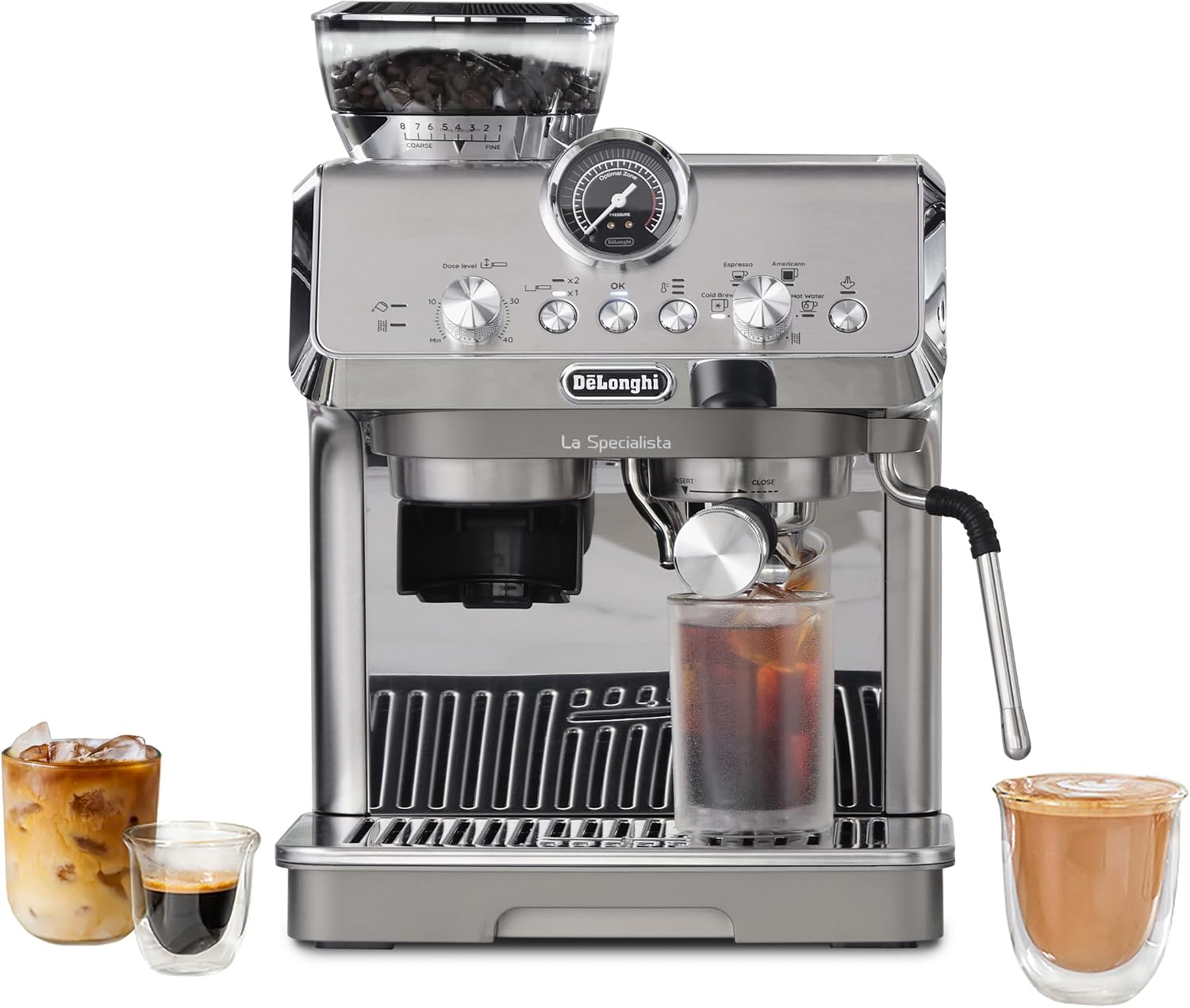
De’Longhi La Specialista Arte Evo EC9255M
- Eight grind settings
- Cold Brew preset
- Active temperature control
- Four drink presets
- My LatteArt wand
- Compact 11-inch-class width
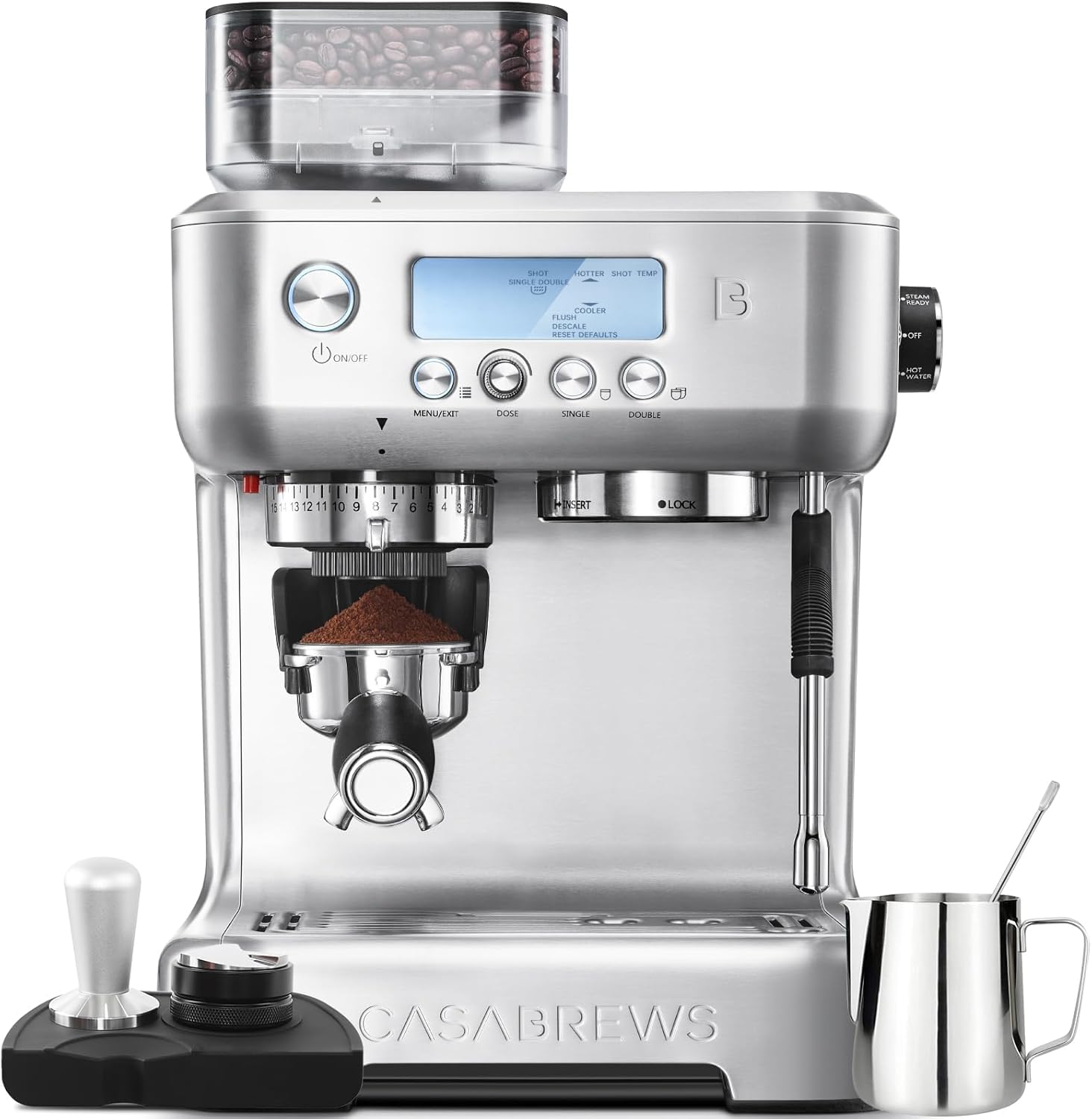
CASABREWS 5700Pro Espresso Machine
- LCD workflow display
- 15 grinder settings
- Integrated dosing cradle
- Manual steam wand
- Large 91 oz reservoir
- Distributor and tamper tools
Philips 2200 LatteGo EP2230/14
- Ceramic burr grinder
- 12 grind settings
- One-touch cappuccino
- LatteGo milk system
- Removable brew group
- AquaClean compatibility

Philips 3200 LatteGo EP3241/54
- Five coffee varieties
- 12-step ceramic grinder
- LatteGo milk system
- Three aroma levels
- Adjustable drink volume
- Removable brew group

De’Longhi Magnifica Evo ECAM29043SB
- Five coffee recipes
- 13 grinder settings
- Three strength levels
- Manual milk frother
- Removable brew unit
- Narrow 9.45-inch-class width
Quick Ranking: Best Budget Espresso Machine with Grinder in 2026
| Rank | Machine | Best For | Workflow | Ideal Buyer | Amazon |
|---|---|---|---|---|---|
| 1 | Breville Barista Express | Best Overall | Hands-on semi-automatic | New home baristas who want control without assembling a two-appliance setup | Price on Amazon |
| 2 | Ninja Luxe Café Premier | Best Versatility | Assisted multi-format machine | Mixed-drink households that alternate among espresso, drip coffee, and cold coffee | Price on Amazon |
| 3 | Gevi ECMI0-SS0A1 | Best Value | Budget semi-automatic | Cost-conscious buyers who want a 58 mm workflow and integrated grinding | Price on Amazon |
| 4 | Breville Barista Pro | Best Fast Heat | Fast-heating semi-automatic | Hands-on espresso drinkers who dislike long warm-up and transition delays | Price on Amazon |
| 5 | Breville Barista Express Impress | Best Assisted Prep | Assisted semi-automatic | Beginners who want a portafilter but need help with dosing and tamping | Price on Amazon |
| 6 | De’Longhi La Specialista Arte Evo | Best Cold Brew | Compact semi-automatic | Small-kitchen buyers who want hot espresso and a dedicated cold-brew preset | Price on Amazon |
| 7 | CASABREWS 5700Pro | Best Display | Display-guided semi-automatic | Visual learners who want timed dosing and extraction feedback on a large screen | Price on Amazon |
| 8 | Philips 2200 LatteGo | Best Automatic Value | Entry super-automatic | Households prioritizing one-touch cappuccino and easy milk cleanup | Price on Amazon |
| 9 | Philips 3200 LatteGo | Best Milk Convenience | Expanded-menu super-automatic | Families wanting one-touch espresso, coffee, Americano, cappuccino, and latte macchiato | Price on Amazon |
| 10 | De’Longhi Magnifica Evo | Best Manual Frothing | Automatic coffee with manual milk | Buyers who want one-touch black coffee but prefer to texture milk themselves | Price on Amazon |
What ‘Budget’ Should Mean for a Grinder-Espresso Machine
A built-in grinder changes the budget equation because grind quality determines whether the espresso side can perform. Counted settings are only a rough clue. The useful questions are whether neighboring steps create meaningful flow changes, whether the dose remains stable, and whether the chute retains enough coffee to make yesterday’s setting behave differently today. A machine with fewer well-spaced positions can be easier to manage than one with a long dial that concentrates little resolution in the espresso zone.
Workflow value depends on the labor you want to keep. Breville, Gevi, De’Longhi La Specialista, and CASABREWS expect a prepared portafilter. Ninja assists several stages but still keeps the basket visible. Philips and Magnifica Evo handle the puck internally. Paying less for the wrong responsibility level is not economy; it is a direct path to an unused appliance.
Finally, consider the ownership system around the machine. Water hardness, grinder cleaning, milk residue, removable brew parts, accessory availability, and service access determine whether convenience survives beyond the first month. I give established platforms an advantage when two machines otherwise appear equal, but a newer model can still win when its capacity or guidance solves a specific household problem.
The 10 Best Budget Espresso Machines with Grinders for 2026
1. Best Overall: Breville Barista Express BES870XL
The Barista Express has endured because it gives a beginner enough structure to start while leaving the important espresso decisions visible. Beans move from the hopper into a portafilter, the pressure gauge responds to puck preparation, and the steam wand demands a real milk-texturing technique. Nothing is hidden behind a drink icon. That makes this Breville more educational than a one-touch machine, yet far tidier than buying a separate entry grinder, espresso machine, tamper, and dosing station all at once.
Its conical-burr grinder is built around a dose-control dial and adjustable grind range rather than the finer resolution of a dedicated espresso grinder. I would treat it as a strong starting point: keep the hopper reasonably fresh, weigh the output while learning, and use the razor tool only as a rough puck-height reference. The 54 mm portafilter and low-pressure pre-infusion create a forgiving path into extraction, but the grinder still needs small, deliberate changes when beans age or the roast changes.
The heating system moves from brewing to steaming rather than doing both simultaneously. A single cappuccino fits naturally; four milk drinks in succession expose the waiting and purging. The machine also rewards immediate care because loose grounds gather around the cradle and milk dries quickly on the wand. Buyers who enjoy that interaction receive unusually broad capability for the money. Anyone wanting coffee by pressing one button should begin with the Philips or De’Longhi automatic models instead.
The Barista Express remains the most complete value for learning real espresso with one coordinated machine.
Breville Barista Express BES870XLAn integrated grinder, pressure gauge, 54 mm portafilter, and manual steam wand create a balanced entry into hands-on espresso.
Price on AmazonTechnical Specifications & Daily Features
- Machine type: Semi-automatic espresso machine with integrated grinder
- Grinder: Adjustable conical-burr system with direct portafilter dosing
- Portafilter: 54 mm format with single- and dual-wall basket options
- Heating: Thermocoil system with PID-guided temperature control
- Extraction feedback: Analog pressure gauge
- Milk system: Manual steam wand
- Daily strength: A cohesive bean-to-cup learning platform
- Main caution: Brewing and steaming happen sequentially
Pros & Cons After 30 Days of Use
Pros
- Proven all-in-one design
- Visible extraction feedback
- Useful beginner baskets
- Capable manual steam wand
Cons
- Grinder steps can feel broad
- Mess collects below cradle
- No simultaneous brew and steam
The first month goes more smoothly when one medium roast stays in the hopper and every dose is weighed. That routine separates grinder changes from tamping changes, so the pressure gauge and shot time become useful feedback rather than competing signals.
A short purge before grinding clears stale fragments, while a dry brush around the chute and cradle keeps the counter manageable. Wipe and purge the steam wand immediately after milk, empty the drip tray before its float rises, and follow the cleaning-cycle prompt instead of postponing it.
My Final Verdict
Choose the Barista Express when learning dose, tamp, extraction, and milk texture is part of the appeal.
Skip it when the household expects one-touch drinks or regularly needs several milk beverages without pauses.
Value here comes from how well the parts support one another. The grinder is not an enthusiast endpoint, but it is capable enough to teach the variables that make a later upgrade worthwhile. The machine remains useful even after technique improves because the portafilter workflow never becomes purely automatic.
I would spend the first weeks chasing repeatability rather than maximum pressure or an arbitrary shot time. A stable dose, level puck, sensible yield, and clean steam routine reveal more about the machine than constant adjustments.
2. Best Versatility: Ninja Luxe Café Premier ES601
Some kitchens do not need a purist espresso machine; they need one counter appliance that can satisfy incompatible drink habits. The Ninja Luxe Café Premier addresses that reality with espresso, drip coffee, and cold-coffee modes tied to an integrated grinder and guided preparation system. A straight-shot drinker still handles the portafilter, while another household member can choose a longer cup without imitating an Americano. That breadth is the machine’s central value.
Barista Assist reduces the most common beginner errors by coordinating grind recommendations, dose measurement, and brewing choices. The scale-driven dosing approach is especially useful because it responds to the basket and drink rather than asking the user to memorize a grinder timer. An assisted tamper then lowers the odds of a visibly uneven puck. These supports do not eliminate bean freshness or recipe judgment, but they shorten the path from setup to a drinkable result.
Milk is handled by a hands-free frothing system with options for dairy and plant-based alternatives. That makes a weekday latte less technical than it is on a manual wand, although the pitcher and whisk still need prompt cleaning. The larger question is whether the household will use all three brewing formats. If espresso is the only priority, a Breville offers a more conventional path. When drip, cold coffee, and milk drinks share the week, Ninja can prevent several separate purchases.
Ninja’s Luxe Café Premier earns its place by replacing several morning appliances rather than refining only one espresso ritual.
Ninja Luxe Café Premier ES601Guided dosing, assisted tamping, multi-format brewing, and hands-free frothing make Ninja the broadest all-in-one choice in this group.
Price on AmazonTechnical Specifications & Daily Features
- Machine type: Assisted portafilter machine for espresso, drip coffee, and cold coffee
- Grinder: Integrated conical-burr grinder with guided adjustment
- Dose system: Weight-based dosing matched to the chosen drink
- Puck preparation: Integrated assisted tamper
- Milk system: Hands-free Dual Froth pitcher and whisk
- Interface: Barista Assist recommendations and drink controls
- Daily strength: One machine covers several household coffee styles
- Main caution: Feature breadth adds size and cleaning touchpoints
Pros & Cons After 30 Days of Use
Pros
- Exceptional drink range
- Helpful guided workflow
- Consistent dose assistance
- Hands-free milk texturing
Cons
- Large countertop presence
- More removable parts
- Less traditional espresso feel
Early success comes from accepting the guidance before overriding it. Let the machine establish a sensible grind and dose for each basket, then change one variable only when flavor clearly points in a direction. That keeps the broad menu from becoming a maze of simultaneous experiments.
The frothing whisk, pitcher, portafilter, and coffee basket form separate cleaning zones. Rinsing them as soon as the drink is finished takes less effort than removing dried milk or oily grounds later. A dedicated drawer or tray for the accessories also prevents the flexible format from becoming countertop clutter.
My Final Verdict
Buy the Luxe Café Premier when espresso, drip coffee, cold drinks, and easy milk all matter in the same household.
Choose a narrower machine if espresso technique, a smaller footprint, or fewer removable accessories matters more than versatility.
Ninja changes the value calculation by bundling functions that are usually compared separately. The machine can cost more than a simple entry semi-automatic, but the relevant comparison is the combined grinder, brewer, frother, and guidance system it replaces.
Its strongest buyer is not indecisive; it is genuinely multi-format. A person who wants a long drip cup on weekdays and a cappuccino on weekends will use the architecture more fully than someone who only pulls double shots.
3. Best Value: Gevi 20-Bar Espresso Machine with Grinder ECMI0-SS0A1
Gevi takes the direct route to value: a wide 58 mm portafilter, built-in burr grinder, manual steam wand, and generous removable tank are combined in one stainless-finished body. The format resembles a compact home barista station rather than a simplified appliance. That makes it attractive to someone who wants familiar café-style dimensions but cannot justify buying a grinder and machine separately.
Thirty grind positions provide more labeled room than several established entry machines, yet the useful espresso range matters more than the headline count. Start near the finer side, weigh what reaches the basket, and judge the shot by flow and taste. Both single-wall and dual-wall baskets widen the learning path: freshly roasted beans can move toward the single-wall basket, while the pressurized option is more forgiving of supermarket coffee and imperfect dialing in.
The uncertainty is long-term refinement rather than basic capability. Controls, grinder calibration, replacement parts, and service history do not carry the same familiarity as Breville’s older platforms. I would choose Gevi for a careful budget build only if the 58 mm format and larger tank have practical value. A buyer who wants extensive tutorials, accessories, and years of accumulated community knowledge may find the Barista Express easier to grow with.
Gevi offers an unusually ambitious hardware package for buyers trying to keep the complete setup cost low.
Gevi 20-Bar Espresso Machine with Grinder ECMI0-SS0A1A 58 mm portafilter, 30 grinder settings, generous tank, and manual steam wand deliver substantial capability for the initial outlay.
Price on AmazonTechnical Specifications & Daily Features
- Machine type: Semi-automatic espresso machine with integrated grinder
- Model: ECMI0-SS0A1
- Grinder: Built-in burr grinder with 30 positions
- Portafilter: 58 mm format
- Basket flexibility: Single-wall and dual-wall options
- Water tank: Removable 2.3-liter reservoir
- Milk system: Manual steam wand
- Main caution: Shorter platform and parts-support history
Pros & Cons After 30 Days of Use
Pros
- Wide 58 mm workflow
- Thirty grind positions
- Large removable tank
- Strong initial feature value
Cons
- Newer support ecosystem
- Dialing still needs a scale
- Fit and finish trail premium rivals
A disciplined break-in period matters more than exploring every control. Use the dual-wall basket for the first few drinks if needed, learn the dosing behavior, and move to the single-wall basket once the grinder can deliver a repeatable fresh dose.
The large tank reduces refills but should not become an excuse to leave old water sitting for long periods. Empty loose grounds from the cradle, backflush or clean as directed, and clear milk from the wand immediately so inexpensive hardware is not burdened by preventable buildup.
My Final Verdict
Consider Gevi when a 58 mm portafilter, integrated grinder, and larger reservoir must fit within a tight equipment budget.
Look elsewhere when established service, accessory depth, or a highly polished guided interface carries more weight than raw feature value.
The machine’s appeal is strongest at the system level. Adding a capable standalone grinder to a low-cost espresso machine can quickly erase the apparent savings, whereas Gevi puts every essential station in one footprint.
I would still reserve part of the budget for a compact scale and cleaning supplies. Those modest additions do more for consistency and useful life than another decorative accessory.
4. Best Fast Heat: Breville Barista Pro BES878BSS
Waiting changes how often an espresso machine gets used. The Barista Pro tackles that friction with a ThermoJet heating system that becomes ready quickly and shifts between extraction and steaming with far less delay than the older Barista Express. The result is not simultaneous brewing and steaming, but a morning rhythm that feels lighter when one or two drinks must be finished before leaving the house.
The front LCD turns grind time, extraction progress, and maintenance prompts into visible information. It is not a touchscreen recipe menu; the user still grinds into a 54 mm portafilter, distributes, tamps, locks in, and textures milk manually. I prefer that balance for a learner who wants guidance without surrendering puck preparation. The broader grinder adjustment range also gives more room to react when a bean needs a finer move than the Express can comfortably offer.
Budget shoppers should ask whether speed is worth the premium. Cup potential is not separated from the Barista Express by the same amount as the price, and both machines remain limited by an integrated grinder that cannot be upgraded independently. The Pro becomes sensible when warm-up and milk-transition time repeatedly disrupt the routine. If those delays are tolerable, the older Express leaves more money for beans, a scale, and water care.
The Barista Pro makes a traditional grinder-and-portafilter routine feel faster without automating away the craft.
Breville Barista Pro BES878BSSThermoJet heating, an informative LCD, a broader grind range, and manual milk control create the quickest Breville workflow here.
Price on AmazonTechnical Specifications & Daily Features
- Machine type: Semi-automatic espresso machine with integrated grinder
- Heating: Fast ThermoJet system
- Grinder: Adjustable conical-burr grinder with direct dosing
- Portafilter: 54 mm format
- Interface: LCD with grinding, extraction, and maintenance information
- Milk system: Manual high-temperature steam wand
- Daily strength: Short wait between startup, brewing, and steaming
- Main caution: Speed premium does not create one-touch drinks
Pros & Cons After 30 Days of Use
Pros
- Very quick startup
- Clear LCD feedback
- Responsive steam transition
- More grind adjustment
Cons
- Costs more than Express
- Integrated grinder limits upgrades
- Still requires full puck prep
Fast readiness can encourage rushed puck preparation. Keep the speed where it belongs—heating and transitions—while weighing the dose, leveling the bed, and tamping carefully. That preserves the reason for buying a hands-on machine in the first place.
The display makes cleaning reminders difficult to ignore, which is useful only when they are acted upon. Brush the grinder outlet, rinse the portafilter, purge the group, and wipe the wand as small daily habits instead of waiting for a deep-cleaning day.
My Final Verdict
Choose the Barista Pro when a fast start and short brew-to-steam transition materially improve a hands-on morning routine.
Stay with the Barista Express if a slower thermocoil is acceptable and maximum value matters more than display guidance.
Speed is this machine’s practical luxury. It does not pull the shot or texture the milk on the user’s behalf; it simply removes much of the waiting around those actions. That distinction keeps the Pro engaging rather than appliance-like.
For a household making two cappuccinos each morning, the saved transition time accumulates. For one weekend espresso, the advantage is pleasant but unlikely to justify stretching the budget.
5. Best Assisted Prep: Breville Barista Express Impress BES876BSS
Uneven dosing and crooked tamping can make a first espresso setup feel more mysterious than it needs to be. The Barista Express Impress focuses directly on those points. Its dosing logic learns whether the previous basket was underfilled or overfilled, while the lever-driven tamp applies a repeatable compression and finishing twist. Grounds stay more contained, and the user begins with a puck that is less likely to fail for purely mechanical reasons.
Assistance does not mean automatic correction of every extraction. Beans still age, grind size still determines flow, and the 54 mm basket still responds to distribution. The machine reduces dose and tamp variability so those remaining decisions are easier to read. I see that as a better teaching tool than a fully hidden brew group for someone who genuinely wants to learn but has been intimidated by scattered grounds and inconsistent pressure.
Milk remains manual, and brewing still occurs before steaming. The Express Impress, therefore, suits a beginner who wants participation, not a household seeking push-button cappuccinos. It also occupies more counter depth than its tidy puck system might suggest. Compared with the standard Express, the extra cost buys repeatability and cleanliness rather than faster heating. That can be a wise expense when puck preparation is the specific barrier.
The Express Impress removes the messiest beginner steps while preserving the feel of making espresso through a portafilter.
Breville Barista Express Impress BES876BSSIntelligent dosing and lever-assisted tamping control the two beginner variables most likely to create mess and inconsistency.
Price on AmazonTechnical Specifications & Daily Features
- Machine type: Assisted semi-automatic espresso machine
- Grinder: Integrated conical-burr grinder with dose adjustment
- Puck system: Intelligent dosing with assisted tamping
- Portafilter: 54 mm format
- Extraction: Low-pressure pre-infusion followed by controlled brewing
- Milk system: Manual steam wand
- Daily strength: Cleaner and more repeatable puck preparation
- Main caution: The machine guides preparation but still needs dialing in
Pros & Cons After 30 Days of Use
Pros
- Repeatable assisted tamp
- Adaptive dose support
- Cleaner grinder area
- Good learning bridge
Cons
- Slower than Barista Pro
- Manual milk technique required
- Larger than basic machines
During the learning period, the dosing memory works best when basket type and bean remain stable. Switching everything at once can make the correction logic appear inconsistent even though the machine is responding to a new target.
Brush stray grounds from the tamping area before they compact around the mechanism. The lever reduces loose coffee, but it does not eliminate grinder residue; a clean chute and dry basket keep the assisted system predictable.
My Final Verdict
Pick the Express Impress when dose control and level tamping are the biggest obstacles to enjoying a manual portafilter routine.
Avoid paying extra for the assistance if tamping already feels comfortable or if rapid heating is the more important upgrade.
This Breville is a narrow solution executed well. It does not attempt to brew drip coffee like Ninja or finish milk automatically like Philips. Its purpose is to make a real espresso puck easier to prepare repeatedly.
That focus gives the machine lasting relevance for beginners. As skill grows, the assistance remains useful on hurried mornings, while grind size, yield, and milk texture still leave room for judgment.
6. Best Cold Brew: De’Longhi La Specialista Arte Evo EC9255M
Cold coffee is often treated as an afterthought on an espresso machine: pull a hot shot, add ice, and accept rapid dilution. La Specialista Arte Evo takes a different route with a dedicated cold brew preset that uses a lower-pressure extraction and completes the drink in minutes. It will not replace an overnight immersion concentrate for every recipe, but it gives an iced-coffee household a second reason to keep the machine active through warm weather.
The hot side stays intentionally compact. An eight-position conical-burr grinder doses toward the portafilter, three active temperature settings help accommodate different roast styles, and four front presets cover espresso, Americano, hot water, and cold brew. The included dosing and tamping tools create a more organized work area without building the tamper into the machine. That manual approach provides control, although it asks for more care than Breville’s Impress lever.
Eight grinder steps are the decisive limitation. They simplify the dial, yet a demanding single-wall basket may need a setting between two clicks. Dose and yield adjustments can bridge a small gap, but buyers who change beans frequently may prefer a grinder with more resolution. The Arte Evo makes the best case when compact width, cold drinks, and a polished steam wand matter together—not when espresso experimentation alone drives the purchase.
La Specialista Arte Evo brings a genuinely useful cold-coffee mode to a compact, tactile espresso workflow.
De’Longhi La Specialista Arte Evo EC9255MA compact body, eight-setting grinder, three brewing temperatures, and fast Cold Brew preset make this the most seasonal all-rounder.
Price on AmazonTechnical Specifications & Daily Features
- Machine type: Semi-automatic espresso and cold-coffee machine
- Model: EC9255M
- Grinder: Integrated conical-burr grinder with eight settings
- Temperature: Three active brewing-temperature choices
- Drink controls: Espresso, Americano, Cold Brew, and hot water
- Milk system: Manual My LatteArt steam wand
- Daily strength: Compact footprint with hot and cold flexibility
- Main caution: Coarse grinder steps may require dose compensation
Pros & Cons After 30 Days of Use
Pros
- Useful Cold Brew mode
- Compact countertop width
- Three temperature options
- Capable latte-art wand
Cons
- Only eight grind settings
- Manual tamping remains
- Cold preset is not concentrate
The first few weeks should establish separate references for hot espresso and cold extraction. Keep notes for grind position, dose, and cup size because the cold preset changes the brewing objective rather than simply cooling a normal shot.
A compact body stays pleasant only when accessories have a home. Store the dosing funnel, tamper, and baskets together, brush the grinder outlet after use, and purge the wand before milk residue reaches the narrow steam holes.
My Final Verdict
Choose the Arte Evo for a narrow counter, regular iced drinks, and manual milk texturing within one coordinated station.
Pass if fine grinder resolution or fully assisted tamping matters more than cold-coffee convenience.
The Cold Brew control is not a decorative menu addition because it changes how the machine approaches the drink. That makes the Arte Evo more relevant to an iced-coffee routine than a standard hot espresso setup with an extra button.
Its grinder is the compromise I would evaluate most carefully. A consistent medium roast can settle comfortably into one of eight positions, whereas frequent bean changes reveal the spaces between them.
7. Best Display: CASABREWS 5700Pro Espresso Machine
A screen is useful when it clarifies an action rather than burying it in menus. CASABREWS uses the 5700Pro display to show grinding and extraction progress, which helps a new user connect dose time, shot flow, and the next cleaning step. The portafilter remains central, so the machine feels closer to a guided barista station than to a beverage appliance.
Its integrated conical grinder offers 15 positions, enough to establish a practical espresso zone without the intimidating scale of a highly granular grinder. The dosing cradle keeps the portafilter beneath the chute, while the included distributor and tamper support a repeatable puck routine. A scale is still valuable because timer-based grinding can shift as bean density and hopper level change. The screen makes the process visible; it does not weigh the coffee.
A 91-ounce reservoir is generous for a home semi-automatic and reduces interruptions in a multi-drink household. It also contributes to the machine’s physical presence. Measure cabinet clearance for the hopper and tank, not only the footprint printed on a specification sheet. CASABREWS is most convincing for someone who values display guidance and capacity enough to accept a newer support ecosystem than the established Breville or De’Longhi platforms.
The 5700Pro turns a manual espresso sequence into a more legible routine through its large status display.
CASABREWS 5700Pro Espresso MachineAn LCD, 15-step grinder, large reservoir, and complete puck-preparation kit make this a readable, high-capacity budget station.
Price on AmazonTechnical Specifications & Daily Features
- Machine type: Semi-automatic espresso machine with integrated grinder
- Grinder: Conical-burr system with 15 settings
- Interface: LCD with grinding and extraction progress
- Water tank: Large 91-fluid-ounce reservoir
- Puck tools: Distributor and tamper support the manual workflow
- Milk system: Manual steam wand
- Daily strength: Clear visual prompts and fewer water refills
- Main caution: Large body and newer service network
Pros & Cons After 30 Days of Use
Pros
- Helpful status display
- Large water capacity
- Useful puck tools
- Straightforward grinder range
Cons
- Tall countertop profile
- Timer dosing can drift
- Limited long-term ecosystem
For consistent timed dosing, refill the hopper before it becomes nearly empty and recheck the output whenever the bean changes. The display gives a repeatable duration, but coffee density determines how many grams that duration produces.
The larger reservoir should be refreshed regularly rather than topped up indefinitely. Clear grounds from the cradle, rinse the portafilter, and keep the distributor dry so the extra tools improve the station instead of adding maintenance clutter.
My Final Verdict
Choose the 5700Pro when clear visual feedback, a large tank, and an included puck-preparation set solve real daily problems.
Skip it for a shallow counter, low cabinets, or a buyer who prioritizes the broadest service and accessory network.
The display gives this machine a distinct place without pretending to automate expertise. It can make the sequence easier to follow, but taste still determines whether the grind and yield need to change.
Its capacity makes more sense for two or three regular users than for an occasional weekend shot. A solo drinker may prefer a smaller body and simply refill the tank more often.
8. Best Automatic Value: Philips 2200 LatteGo EP2230/14
The Philips 2200 starts from a different idea of value. Instead of helping the user prepare a portafilter, it grinds, doses, tamps internally, brews, and delivers milk foam through the LatteGo container. Morning effort shifts from technique to keeping beans, water, and milk available. For a shared household, that predictability can matter more than the control offered by a similarly priced semi-automatic.
A ceramic grinder with 12 steps gives enough adjustment to respond to roast level, though changes should be made gradually while the grinder is operating. The front controls cover espresso, coffee, and cappuccino, with strength and volume options available through My Coffee Choice. The drink menu is modest beside the Philips 3200, but fewer choices make the interface quick to learn and help keep this model near the value end of automatic machines.
LatteGo’s two-piece, tubeless design is the ownership advantage. Milk-contact surfaces separate quickly and can be rinsed without cleaning a long hose. The tradeoff is control: foam texture is determined largely by the system, and the internal brew group offers less direct experimentation than a basket and tamper. Choose the 2200 for speed and shared usability, not for recreating a manual café workflow.
Philips 2200 is the simplest route here from whole beans to a milk drink with almost no barista technique.
Philips 2200 LatteGo EP2230/14A ceramic grinder, removable brew group, and easy-rinsing LatteGo system create the lowest-effort milk routine in the value tier.
Price on AmazonTechnical Specifications & Daily Features
- Machine type: Super-automatic bean-to-cup espresso machine
- Model: EP2230/14
- Grinder: Ceramic burr grinder with 12 settings
- Coffee controls: Three strength levels with adjustable drink volume
- Core beverages: Espresso, coffee, and cappuccino
- Milk system: Two-piece LatteGo container without milk tubes
- Maintenance: Removable brew group and AquaClean compatibility
- Main caution: Limited manual control over extraction and foam
Pros & Cons After 30 Days of Use
Pros
- Very easy daily operation
- Quick milk-system rinsing
- Ceramic grinder
- Removable brew group
Cons
- Small preset menu
- Foam control is limited
- Internal brewing hides technique
The machine benefits from an adjustment period because the brew group and grinder settle over the first series of cups. Make small grinder changes, let several drinks pass before judging the result, and use strength and volume before chasing the dial constantly.
LatteGo should be rinsed after every milk session even though it lacks tubes. Remove the brew group on a regular schedule, let it air-dry before reinsertion, empty the puck bin before damp grounds accumulate, and follow water-care prompts for the local hardness level.
My Final Verdict
Buy the Philips 2200 when effortless cappuccino, simple cleanup, and consistent household operation outrank manual espresso control.
Choose a portafilter machine when milk texture, dose, distribution, and shot yield are skills you want to shape personally.
Automatic value is measured in avoided labor. The 2200 does not make the most customizable drink here, but it asks far less of an early morning user and remains approachable to everyone in the kitchen.
Its compact beverage menu is also a form of discipline. Buyers who mainly drink espresso, coffee, and cappuccino are not paying for a long screen of recipes that repeat the same basic ingredients in different ratios.
9. Best Milk Convenience: Philips 3200 LatteGo EP3241/54
A longer menu is valuable only when the household drinks it. The Philips 3200 adds Americano and latte macchiato to the familiar espresso, coffee, and cappuccino choices, giving black-coffee and layered-milk drinkers their own direct controls. The machine keeps grinding, dosing, brewing, and milk delivery inside one sequence, so the added variety does not create a new barista lesson for each person.
Its ceramic grinder uses 12 positions, supported by three aroma-strength levels and adjustable volume. Those controls work best as layers: establish a grind that produces balanced coffee, choose strength for the dose, then save a suitable liquid volume. Making all three changes together obscures what improved the cup. The espresso will not offer the syrupy control of a carefully dialed portafilter, yet the consistency is persuasive for households that value repetition over experimentation.
The LatteGo carafe remains easy to disassemble because there is no internal milk tube. That encourages actual cleaning rather than reliance on an automatic rinse alone. Compared with the 2200, the decision turns on the extra drink buttons and how often they will be used. Cappuccino-only homes can save with the smaller menu. Mixed coffee and milk preferences make the 3200 easier to justify.
The Philips 3200 expands the automatic drink menu while keeping the same low-fuss milk and maintenance philosophy.
Philips 3200 LatteGo EP3241/54Five direct coffee varieties, ceramic grinding, adjustable strength, and tubeless LatteGo frothing suit mixed-preference households.
Price on AmazonTechnical Specifications & Daily Features
- Machine type: Super-automatic bean-to-cup machine with automatic milk
- Model: EP3241/54
- Grinder: Ceramic burr grinder with 12 settings
- Beverage range: Espresso, coffee, Americano, cappuccino, and latte macchiato
- Personalization: Three aroma levels and adjustable drink volume
- Milk system: Two-piece LatteGo carafe
- Maintenance: Removable brew group and guided care prompts
- Main caution: Preset convenience limits hands-on milk and puck control
Pros & Cons After 30 Days of Use
Pros
- Useful five-drink menu
- Simple automatic milk
- Ceramic grinder
- Approachable shared controls
Cons
- Costs more than 2200
- Milk texture is preset
- Espresso body is automatic-style
A household with several users should agree on a base grinder position before each person changes strength and volume. That protects the mechanical setting from daily swings while still allowing individual cups to feel different.
Empty and rinse LatteGo after milk, refresh the water tank, and remove the brew group for routine rinsing. The machine automates beverage preparation, not ownership; a clean internal path is essential to keeping the convenience worthwhile.
My Final Verdict
Choose the Philips 3200 when several one-touch black and milk drinks need to remain equally accessible to different users.
Save with the 2200 if cappuccino covers the milk requirement, or choose a semi-automatic when texturing milk is part of the pleasure.
The 3200 succeeds as a household appliance more than a hobby machine. Its drink icons lower the cost of participation: nobody needs to learn distribution or steaming before making coffee.
I would pay the difference over the 2200 only for repeated use of Americano and latte macchiato. Extra buttons that remain untouched do not improve espresso or simplify cleaning.
10. Best Manual Frothing: De’Longhi Magnifica Evo ECAM29043SB
Not every automatic-machine buyer wants automatic foam. Magnifica Evo handles bean grinding, dosing, internal tamping, and black-coffee brewing, then leaves milk to a traditional frother. That split removes portafilter mess while preserving the ability to decide whether a latte needs thin microfoam or a cappuccino needs more aeration. It is a distinctive fit for someone who enjoys steaming but not puck preparation.
Five coffee recipes cover espresso, coffee, Americano, iced coffee, and long coffee, with three intensity levels available from the touch panel. A 13-setting conical grinder offers slightly more adjustment than the Philips ceramic system. The internal brewing unit remains removable for rinsing, an important ownership feature in an automatic machine where grounds and oils collect beyond the visible spouts.
The hybrid routine does require two kinds of care. The brew group and puck bin need automatic-machine maintenance, while the steam wand needs immediate manual purging and wiping. A user hoping to touch one icon and walk away with a cappuccino should choose LatteGo. The Magnifica Evo is more compelling for black-coffee convenience plus deliberate milk work, especially where its narrow body fits between other appliances.
Magnifica Evo creates a useful middle ground: automatic grinding and brewing paired with milk texture controlled by hand.
De’Longhi Magnifica Evo ECAM29043SBAutomatic bean-to-cup black coffee, 13 grinder settings, and a manual frother create a rare convenience-and-control compromise.
Price on AmazonTechnical Specifications & Daily Features
- Machine type: Super-automatic coffee and espresso machine with manual milk
- Model: ECAM29043SB
- Grinder: Integrated conical-burr grinder with 13 settings
- Coffee recipes: Espresso, coffee, Americano, iced coffee, and long coffee
- Strength control: Three selectable intensity levels
- Milk system: Traditional manual frother
- Maintenance: Removable brewing unit and accessible puck container
- Main caution: Milk drinks are not one-touch
Pros & Cons After 30 Days of Use
Pros
- Convenient black coffee
- Manual milk control
- Thirteen grind settings
- Relatively narrow body
Cons
- Two cleaning routines
- No one-touch cappuccino
- Less puck control than semi-auto
Settle the grinder with a consistent bean before tailoring the five recipes. Once the espresso base tastes balanced, adjust each drink’s intensity and volume; this order avoids masking a grind problem with a larger or smaller cup.
Remove and rinse the brewing unit regularly, empty the puck bin before damp coffee sits for days, and wipe the frother while milk is still fresh. The machine stays convenient when those internal and external routines remain brief and predictable.
My Final Verdict
Choose Magnifica Evo when automatic black coffee and hands-on milk texture form the ideal split of labor.
Choose LatteGo for one-touch milk, or a Breville when puck preparation and shot control should also remain manual.
This De’Longhi does not fit neatly into the usual automatic-versus-manual argument. It automates the repetitive coffee side and preserves the creative milk side, which can be exactly the right compromise for a latte drinker with limited morning patience.
The narrow cabinet width is another real advantage, though front and top access still need room. Measure the working area for removing the tank and bean lid rather than judging width alone.
Buying Guide: Choosing a Budget Espresso Machine with a Grinder
Begin With the Operating Style, Not the Brand
A semi-automatic machine gives direct influence over the puck and milk, which creates more cup control and more opportunities for inconsistency. It suits a buyer who wants espresso preparation to become a skill. Assisted machines reduce the most repetitive errors without hiding the portafilter. Super-automatics suit people who want dependable access for several users and would rather adjust a strength icon than weigh a basket.
Imagine the least energetic morning of the week. If grinding into a portafilter still sounds satisfying, a Breville or De’Longhi La Specialista remains realistic. If that sequence sounds like a barrier, Philips offers better value even when its purchase price is higher. The useful machine is the one that survives ordinary motivation.
Judge the Grinder by Its Espresso Zone
A built-in grinder should make a controlled change to shot flow when moved one step. Very broad spacing can produce a frustrating choice between a fast shot and a choked basket. Wider ranges from Gevi, Breville Pro, Ninja, and the automatic machines create more reference points, but the number on the dial cannot guarantee particle uniformity or low retention.
Use dose and yield as secondary tools when the ideal setting falls between steps. A slightly smaller dose can rescue a slow extraction; a modestly larger dose can add resistance to a fast one. Those adjustments should remain small. When every new bag demands large compensation, the grinder—not the recipe—is setting the ceiling.
Decide How Much Puck Preparation You Want
Manual dosing, distribution, and tamping offer the most feedback, yet they also create mess and variation. The standard Barista Express leaves each task visible. Express Impress controls dose and tamp more firmly, while Ninja adds guidance and weight-based assistance. Philips and Magnifica remove the puck from view entirely.
A beginner does not automatically need maximum assistance. Some people enjoy learning with a scale and pressure gauge, while others become discouraged after three uneven shots. Match the support to temperament. Paying for assistance is worthwhile when it prevents abandonment, not merely because the mechanism looks sophisticated.
Match the Milk System to the Drink Schedule
Manual steam wands reward practice and can create finer texture for latte art. They also require immediate wiping, a purge, and enough attention to stop at the right temperature. Hands-free frothing on Ninja removes much of that technique. LatteGo goes further by dispensing milk automatically, then separates it into two parts for rinsing.
Frequency matters. Someone making a flat white every afternoon may enjoy a manual wand, while a family producing four cappuccinos before school may value automatic milk more. Magnifica Evo offers a useful split for black-coffee convenience and manual milk control, but it does not finish a cappuccino without participation.
Look Beyond Pump Pressure
Large pump numbers dominate inexpensive-machine marketing, yet espresso depends on controlled pressure at the coffee bed, sensible temperature, correct grind, and even puck preparation. A 20-bar label does not mean the shot should extract at 20 bars. Pressure regulation and resistance in the basket determine what reaches the puck.
Prioritize grinder behavior, temperature management, basket quality, and workflow feedback before treating a pump rating as a deciding advantage. The pressure gauge on the Barista Express is useful because it shows the brewing response; it is not a target that should be forced to the highest region.
Count Water, Beans, and Back-to-Back Drinks
Reservoir and hopper size influence interruptions, but larger is not always fresher. A generous tank helps a shared household, especially when steam and rinse cycles consume water. A large hopper is convenient only when its beans are used promptly. Leaving coffee exposed above a warm machine can sacrifice aroma for fewer refills.
Back-to-back milk drinks expose heating architecture more quickly than daily totals. A fast-transition Barista Pro feels different from an older thermocoil during two cappuccinos, while a fully automatic machine repeats the same internal sequence for each cup. Estimate the busiest ten-minute period, not just the number of drinks across the entire day.
Measure Working Clearance
Counter width is only the beginning. The hopper needs space above it, rear tanks need room to lift, side tanks need a clear path, and a portafilter swings beyond the machine body. Add a knock box, milk pitcher, scale, and tamping area when evaluating a semi-automatic station.
A narrow automatic machine can fit between appliances yet still require front access for its brew group and puck container. Make a cardboard footprint and rehearse refilling water and beans beneath the cabinet. That simple exercise reveals conflicts that a dimension list cannot.
Reserve Money for Water and Maintenance
The complete budget should include a scale, cleaning tablets or powder, descaling supplies, a suitable water strategy, and milk-cleaning tools. Hard water accelerates scale, while extremely pure water can create its own extraction and sensing problems. Follow the machine’s filtration guidance and test local water rather than guessing from taste alone.
Daily cleaning is inexpensive; neglected cleaning is not. Grounds around a grinder chute become rancid, milk residue blocks steam paths, and damp pucks encourage odor inside automatic machines. The best long-term value often comes from the machine whose cleaning routine feels obvious enough to perform.
Final Comparison: Best Budget Espresso Machines with Grinders
| Machine | Workflow | Grinder | Milk System | Main Tradeoff | Amazon |
|---|---|---|---|---|---|
| Breville Barista Express | Hands-on semi-automatic | Integrated conical-burr grinder | Manual steam wand | Thermocoil workflow requires a pause between brewing and steaming | Price on Amazon |
| Ninja Luxe Café Premier | Assisted multi-format machine | Built-in conical-burr grinder | Hands-free Dual Froth system | Large feature set creates a wider footprint and more parts to manage | Price on Amazon |
| Gevi ECMI0-SS0A1 | Budget semi-automatic | 30-setting built-in burr grinder | Manual steam wand | Newer platform has a shorter ownership and support history | Price on Amazon |
| Breville Barista Pro | Fast-heating semi-automatic | Integrated conical-burr grinder | Manual steam wand | Higher price than the Barista Express without one-touch automation | Price on Amazon |
| Breville Barista Express Impress | Assisted semi-automatic | Integrated conical-burr grinder | Manual steam wand | Assistance simplifies puck prep but does not automate milk or dialing in | Price on Amazon |
| De’Longhi La Specialista Arte Evo | Compact semi-automatic | Eight-setting conical-burr grinder | My LatteArt steam wand | Eight grinder settings provide less dialing room than wider-range rivals | Price on Amazon |
| CASABREWS 5700Pro | Display-guided semi-automatic | 15-setting conical-burr grinder | Manual steam wand | Large reservoir and tall body demand more counter clearance | Price on Amazon |
| Philips 2200 LatteGo | Entry super-automatic | 12-setting ceramic grinder | Two-piece LatteGo system | Less control over puck preparation and milk texture than portafilter machines | Price on Amazon |
| Philips 3200 LatteGo | Expanded-menu super-automatic | 12-setting ceramic grinder | Automatic LatteGo system | More recipes raise the price without adding manual milk control | Price on Amazon |
| De’Longhi Magnifica Evo | Automatic coffee with manual milk | 13-setting conical-burr grinder | Traditional manual frother | Hybrid workflow is less effortless than automatic milk and less tactile than a portafilter | Price on Amazon |
My Final Recommendation
The Breville Barista Express BES870XL is my best overall recommendation because it turns a limited budget into a complete espresso education. The grinder, pressure gauge, forgiving basket options, and manual wand cover the essential skills without forcing an immediate second-appliance purchase. It asks for attention, but that attention produces knowledge that carries into any later upgrade.
Choose the Ninja Luxe Café Premier when one appliance must make espresso, drip coffee, cold coffee, and hands-free milk drinks. Its higher initial cost can still represent strong system value in a mixed-preference home. The Philips 2200 LatteGo is the better answer when minimum labor and easy cappuccino cleanup matter most, while De’Longhi La Specialista Arte Evo has the clearest advantage for compact hot-and-cold versatility.
Gevi and CASABREWS compete through hardware value, but their appeal depends on accepting newer platforms and less mature support ecosystems. Barista Pro is the speed upgrade for committed hands-on users, Express Impress is the puck-preparation upgrade for hesitant beginners, Philips 3200 earns its premium through a broader automatic menu, and Magnifica Evo is the hybrid choice for automatic coffee with manually textured milk.
Best Budget Espresso Machine with Grinder in 2026 — FAQ
Is an espresso machine with a built-in grinder cheaper than buying two appliances?
For a first setup, an integrated grinder usually lowers the complete entry cost and saves counter space. A separate grinder costs more initially but can offer finer adjustment and an independent upgrade path. The all-in-one route is economical when its grinder remains capable for the beans and basket you use.
Which machine is best for a complete beginner?
Breville Barista Express suits a beginner who wants to learn the full portafilter routine. Express Impress adds dosing and tamping support, Ninja supplies broader guidance, and Philips 2200 removes most technique. The best beginner choice depends on whether learning or convenience is the priority.
Can a built-in grinder produce real espresso?
Yes. A capable integrated grinder can grind finely enough and adjust closely enough for a non-pressurized basket. It may offer less resolution, lower speed, or more retention than a dedicated espresso grinder, but a stable dose and carefully chosen setting can produce balanced shots.
Do I still need a scale with an integrated grinder?
A small espresso scale remains one of the most useful accessories. It shows whether timed grinding delivers the intended dose and whether the shot reaches a repeatable yield. Assisted weight-based systems reduce that burden, but weighing occasionally still helps detect drift.
Is the Breville Barista Pro worth more than the Barista Express?
The Pro justifies its premium when rapid startup, quick transitions, LCD feedback, and a wider grinder range improve a daily hands-on routine. The Express offers similar core involvement at a lower cost. Occasional users may not benefit enough from the Pro’s speed.
What is the difference between the Barista Express and Express Impress?
The standard Express leaves dosing and tamping largely to the user. Express Impress monitors the dose and uses a lever-assisted tamping system to improve repeatability and reduce scattered grounds. Both retain a portafilter and manual steam wand.
Which option is easiest to clean after milk drinks?
Philips LatteGo is especially straightforward because its milk container separates into two main pieces and has no long milk tube. A manual steam wand is also simple when it is wiped and purged immediately, but dried milk makes delayed cleaning much harder.
Can the Ninja Luxe Café replace a drip coffee maker?
Its dedicated drip-coffee mode is designed for longer brewed coffee rather than merely diluting espresso. That makes it the strongest single-appliance option here for households alternating between espresso and regular coffee. Buyers devoted only to espresso may prefer a more focused machine.
Is the Cold Brew setting on La Specialista Arte Evo the same as overnight cold brew?
No. The machine uses a faster low-pressure cold extraction, while traditional immersion cold brew steeps coarse coffee for many hours and often produces a concentrate. Both can make cold coffee, but the body, strength, and recipe behavior differ.
Are super-automatic machines good for espresso?
They produce consistent bean-to-cup espresso with very little work, but the cup usually emphasizes convenience over the syrupy body and fine control of a carefully prepared portafilter shot. Strength, volume, grind, and bean choice still make meaningful differences.
How often should the grinder setting be changed?
Change it when shot flow or taste shows a clear need, not for every cup. Beans often need a finer setting as they age, and different roast styles may require new calibration. Make one small move at a time and allow an automatic grinder several cycles to reveal the effect.
Can oily beans be used in these built-in grinders?
Very oily beans can cling inside hoppers and chutes, increasing residue and inconsistent feeding. A medium roast with a relatively dry surface is usually easier on an integrated grinder. If dark beans are preferred, use small hopper loads and clean the path more frequently.
Which machine is best for several users?
Philips 3200 is easy for several people because direct drink icons and automatic milk require little shared technique. Ninja also works well when users want different coffee formats. Manual portafilter machines can serve a household, but results depend more heavily on each person’s preparation skill.
How long should a budget all-in-one espresso machine last?
Useful life depends on water quality, cleaning, grinder care, milk hygiene, component availability, and daily workload. Regular descaling alone is not enough; the grinder path, group, brew unit, seals, and steam system also need attention. A modest machine maintained well can outlast a neglected premium one.
What should I buy first with the machine?
Start with a compact scale, suitable fresh beans, a milk pitcher if none is included, clean cloths, and the correct cleaning supplies. Add accessories only after the daily workflow reveals a real need. Consistent water, dose, yield, and cleaning matter more than decorative upgrades.


