
OXO Brew Conical Burr Grinder vs Bodum Bistro


One Hundred Coffee is reader-supported, and some products displayed may earn us an affiliate commission. Details
A coffee grinder rarely gets the same attention as the brewer sitting beside it, but it quietly controls almost everything that happens in the cup.
I can use the same beans, the same kettle, the same water temperature, and the same pour-over recipe, yet a small change in grind consistency can make the coffee taste sweeter, thinner, harsher, or unexpectedly flat. That is why choosing between two seemingly simple burr grinders deserves more thought than comparing the number of markings around a dial.
The OXO Brew Conical Burr Coffee Grinder takes the practical appliance approach. It gives you a large hopper, 15 numbered grind positions with extra adjustment steps between them, a one-touch timer that remembers its previous setting, and a stainless-steel grounds container intended to keep static and countertop mess under better control.
The Bodum Bistro Electric Conical Burr Coffee Grinder feels more like a piece of modern coffee design. Its white body, glass grounds catcher, preset timer, stainless-steel conical burrs, and compact proportions give it a distinctive personality that looks especially natural beside a French press or pour-over setup.
Both grinders are built for people moving beyond blade grinding, but they solve everyday problems differently. OXO is focused on capacity, repeatability, and convenience. Bodum is focused on straightforward grinding, reduced static through glass, and a smaller, more visually expressive countertop presence.
The better choice depends on whether you want the grinder that feels easiest to live with every morning or the grinder that makes a smaller brewing corner feel more deliberate and stylish.
OXO Brew Conical Burr Grinder vs Bodum Bistro
Ten important grinding and ownership factors scored side by side to determine whether OXO’s practical multi-brew grinder or Bodum’s compact glass-catcher grinder is the better everyday purchase.
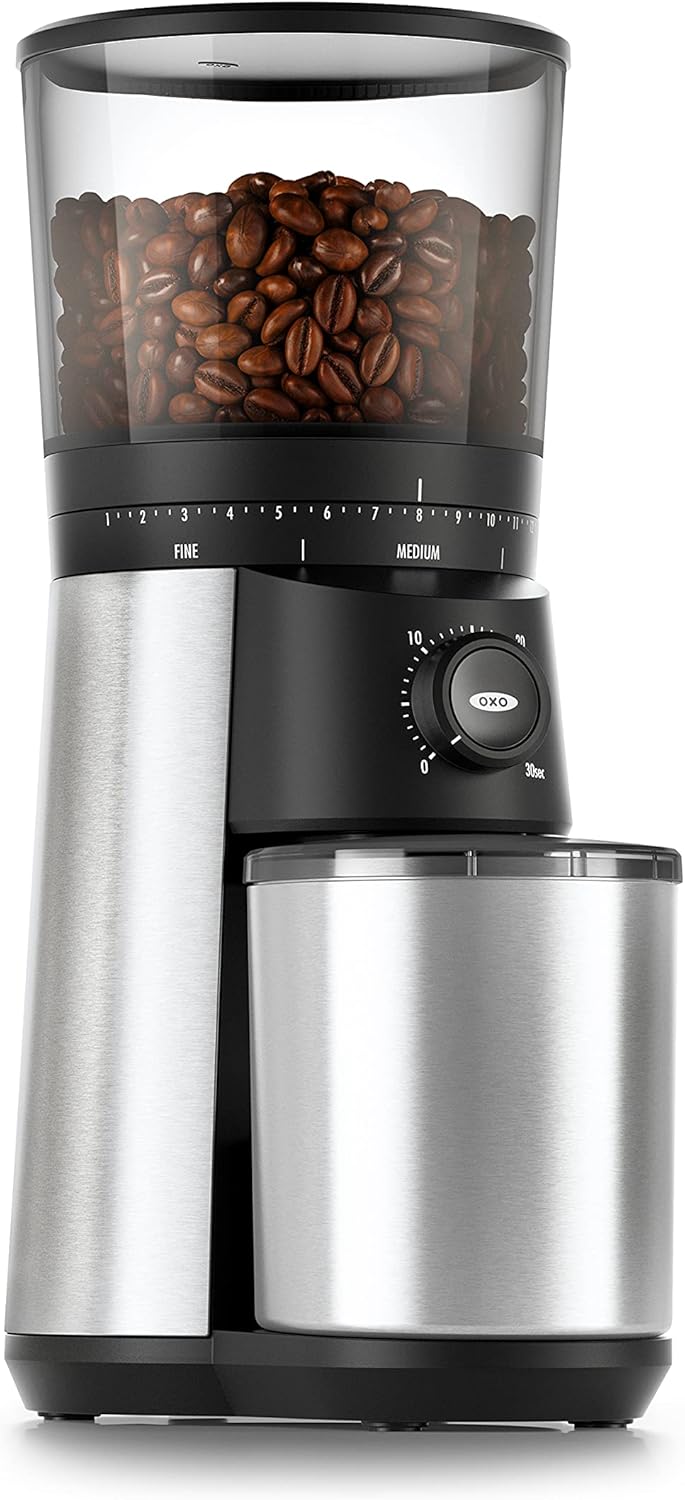
OXO Brew Conical Burr Coffee Grinder
out of 100
- Fifteen numbered grind settings
- Additional micro-adjustment positions
- Large 12-ounce tinted hopper
- Timer remembers the previous dose
- Bean-retaining hopper trap door
10-Factor Buying Score
Each category scored out of 10 points
Brew
Bistro
OXO Brew Wins Overall
The OXO Brew is the stronger recommendation for most households because its wider adjustment range, timer memory, larger hopper, bean-retaining trap door, and durable steel grounds cup create a more convenient and versatile daily grinding workflow.
Choose the Bodum Bistro instead when compact size, visual character, and a transparent glass catcher are more important than maximum grind flexibility or hopper capacity. It remains an attractive match for French press and straightforward filter-coffee routines.

Bodum Bistro Electric Conical Burr Grinder
out of 100
- Twelve primary grind settings
- Low-static borosilicate glass catcher
- Compact cabinet-friendly body
- Simple preset grinding timer
- Protective friction-clutch system
These results are reported by our editors after 30 days of comparative review using our practical home-coffee buying criteria.
How I review and compare coffee grinders in real daily use
I do not judge a grinder by turning it on once, looking at the grounds, and deciding whether they appear uniform. The practical differences become clearer after switching between brewing methods, changing beans, grinding several batches, cleaning the chute, and discovering how much coffee ends up beside the container instead of inside it.
I start with grind adjustment and repeatability.
A useful grinder should let you return to a successful setting without guessing. I pay attention to:
- How clearly the grind positions are marked
- Whether the adjustment steps are close enough for common brewing methods
- How easily I can move from French press back to pour-over
- Whether the grinder produces a repeatable dose after the timer is set
Then I judge the grind in the cup—not only on the counter
Perfectly uniform grounds are difficult at this price level, so I focus on the practical outcome. Does the coffee drain evenly? Does a French press cup contain too much sludge? Does a drip brew taste balanced without requiring constant adjustment? Does the grinder provide enough control to correct a sour or bitter cup?
Mess, static, and container design matter more than they seem
A grinder can perform well and still become irritating if fine grounds cling to the walls, jump onto the counter, or collect around the chute. I compare:
- How cleanly the grounds leave the chute
- How easily the container slides into position
- Whether static becomes worse with dry, light-roast beans
- How much brushing and wiping the grinder needs after use
I also test the morning workflow
The grinder has to make sense before I am fully awake. A timer should be easy to understand. The hopper should not spill beans when removed. The grounds catcher should not feel awkward to carry. The machine should also be easy enough for another person in the household to use without receiving a five-minute lesson.
Finally, I consider long-term fit.
I look beyond the first week and ask which grinder is likely to suit the owner after the excitement wears off. A larger hopper is helpful for one household and unnecessary for another. A glass catcher may feel premium to one person and fragile to someone else. The right grinder is the one whose small compromises match the way you already make coffee.
Overview
OXO Brew Conical Burr Grinder—the practical everyday workhorse
Best burr grinder for an easy multi-brew coffee routine
OXO Brew Conical Burr Coffee GrinderThis is the grinder I would choose for a household that regularly moves between drip coffee, pour-over, AeroPress, French press, and cold brew. Its larger hopper, remembered timer, and additional adjustment positions make it unusually easy to live with.
Price on AmazonTechnical Specifications & Features
- Grinder type: Electric conical-burr coffee grinder
- Burr material: Stainless-steel conical burrs
- Grind adjustment: 15 numbered positions with additional intermediate steps
- Grinding range: Fine through coarse home-brewing settings
- Primary control: Push-to-start timer dial
- Timer memory: Remembers the previous grinding duration
- Bean hopper: Approximately 12-ounce capacity
- Hopper design: UV-blocking tint
- Bean retention: Trap door closes when the hopper is removed
- Grounds container: Static-fighting stainless-steel cup
- Cleaning access: Removable hopper and upper burr
- Best for: Drip, pour-over, AeroPress, French press, and cold brew
Pros & Cons After 30 Days of Use
Pros
- The timer memory becomes genuinely useful: after finding the correct duration for a regular batch, the next morning becomes a simple one-button routine.
- It handles several brewing methods comfortably: the wider adjustment range makes switching between pour-over, automatic drip, AeroPress, French press, and cold brew less frustrating.
- The hopper door prevents unnecessary spills: removing a hopper that still contains beans is much easier than it is on grinders without a closing mechanism.
- The large hopper suits shared kitchens: it holds enough coffee for several brewing sessions without demanding constant refilling.
- The steel catcher feels durable: it is less worrying to handle over tile or stone than a glass container.
- The controls remain easy to understand: there is no menu, app, or complicated dosing system to learn.
- It is a major upgrade from blade grinding: coffee becomes easier to adjust, more repeatable, and generally cleaner in flavor.
Cons
- It is fairly tall: the hopper may not fit comfortably beneath every kitchen cabinet.
- It is not an espresso specialist: traditional espresso baskets usually need finer adjustment increments.
- Some chute retention remains: brushing around the exit path is still part of ownership.
My Final Verdict
After a month, the OXO Brew stands out less for one dramatic feature and more for how smoothly everything works together. The timer remembers the usual batch, the hopper holds a practical amount of coffee, and the trap door makes cleaning or bean changes far less messy.
I would buy it for someone who wants better filter coffee without turning grinding into a separate hobby. I would skip it only when serious non-pressurized espresso is the main goal, because that demands a more specialized adjustment system.
The OXO Brew Conical Burr Coffee Grinder is designed around an uncomplicated routine. Fill the hopper, rotate it to the desired grind range, set the timer, and press the central button. Once you find the right grinding time for your usual batch, the grinder remembers it, which removes one small decision from the next morning.
Its 15 numbered positions are supplemented by intermediate adjustment steps, giving it more practical room for tuning than the main numbers suggest. The 12-ounce hopper is generous for a home grinder, and the trap-door mechanism helps keep beans from spilling when the hopper is lifted away.
The OXO feels best suited to households that make drip coffee, pour-over, AeroPress, French press, or cold brew regularly and want one grinder that can move between them without becoming complicated.
Bodum Bistro—the compact, design-led grinder
Best compact burr grinder for French press and low-static dosing
Bodum Bistro Electric Conical Burr Coffee GrinderThis is a strong pick for someone who wants a shorter grinder with a more decorative personality. Its glass grounds catcher, easy 12-setting adjustment, and compact proportions suit French press and simple filter-coffee stations particularly well.
Price on AmazonTechnical Specifications & Features
- Grinder type: Electric conical-burr coffee grinder
- Burr material: Stainless-steel conical burrs
- Grind adjustment: 12 primary grind positions
- Grinding range: Fine through coarse home-brewing settings
- Primary control: Preset grinding timer
- Motor: Approximately 160 watts
- Bean hopper: Approximately 7.75 ounces or 220 grams
- Grounds container: Borosilicate glass
- Container grip: Rubberized silicone band
- Protection system: Friction clutch
- Countertop profile: Shorter and lighter than the OXO
- Best for: French press, drip coffee, and straightforward pour-over
Pros & Cons After 30 Days of Use
Pros
- The glass catcher feels genuinely useful: grounds remain visible, and static cling is generally easier to manage than with a lightweight plastic bin.
- It fits smaller coffee stations: the shorter body works better beneath cabinets and in apartments with limited counter space.
- The adjustment system is approachable: 12 positions cover the main brewing ranges without overwhelming a new user.
- It pairs naturally with French press: the coarse range, Bodum styling, and glass catcher create a simple, coordinated workflow.
- The white finish has personality: it looks more intentional beside a white kettle, ceramic dripper, or modern French press.
- The timer makes familiar batches repeatable: once the duration is set, daily grinding requires little thought.
- The friction clutch adds reassurance: it provides protection if unusual resistance reaches the grinding mechanism.
Cons
- The glass catcher needs care: dropping it onto tile remains a real concern.
- There are fewer adjustment steps: demanding pour-over recipes may need more precise control.
- The smaller hopper needs refilling sooner: larger households may prefer OXO’s capacity.
My Final Verdict
The Bodum Bistro is the grinder I would choose for a compact French-press or filter-coffee station where appearance and grounds handling matter. The glass catcher is pleasant to use, the body fits into tighter spaces, and the basic adjustment system remains approachable.
I would not choose it over the OXO for a large household or someone who frequently changes brewing methods. But for a lighter-volume coffee routine where design, glass, and compact placement matter, it remains the more characterful option.
The Bodum Bistro Electric Conical Burr Coffee Grinder has a more distinctive presence. The white finish, contrasting silicone grip, transparent hopper, and borosilicate-glass catcher make it look like part of a coordinated coffee station rather than a neutral kitchen appliance.
It offers 12 primary grind settings, a timed grinding control, stainless-steel conical burrs, and a friction clutch intended to protect the grinding mechanism if a hard object causes resistance. Its hopper holds less coffee than the OXO, but its shorter body may fit more comfortably beneath cabinets or within a compact brewing area.
The glass catcher is a meaningful part of its appeal. Glass generally avoids some of the cling associated with lightweight plastic bins, and the rubberized band makes the container easier to hold. The trade-off is obvious: glass must be handled with more care than a steel container.
Which is better?
Pick the OXO Brew Conical Burr Grinder if…
You want the easier all-round grinder for a busy kitchen. Its larger hopper, wider adjustment range, remembered timer setting, bean-retaining hopper door, and durable steel grounds container make the daily workflow feel more settled.
It is also the stronger choice if you frequently alternate between drip coffee, pour-over, cold brew, and French press. The additional intermediate positions give you more room to refine a recipe without jumping too far between settings.
Pick the Bodum Bistro if…
You want a compact grinder with more visual character and like the idea of collecting grounds in glass. The Bodum feels especially natural beside a French press, Chemex-style brewer, or minimalist pour-over station.
It is also appealing if you prefer filling the hopper with a smaller quantity of beans, grinding timed batches, and keeping the grinder beneath a lower cabinet. Its 12 positions cover the major home-brewing ranges without presenting a complicated interface.
OXO vs. Bodum—quick personality snapshot
OXO Brew: “Give me a dependable grinder that remembers my routine and keeps the counter reasonably clean.”
Bodum Bistro: “I want fresh grinding, a compact shape, and something that looks good beside my French press.”
OXO feels like the grinder most people can use without thinking about it. Bodum feels like the grinder someone chooses because the brewing corner itself matters to them.
| Key Feature | OXO Brew Conical Burr Grinder | Bodum Bistro Burr Grinder |
|---|---|---|
| Grinder Image |
|
|
| Grinder type | Electric conical-burr grinder | Electric conical-burr grinder |
| Burr material | Stainless steel | Stainless steel |
| Primary grind positions | 15 numbered settings | 12 primary settings |
| Intermediate adjustment | Additional micro-adjustment positions | Adjustment through the marked range |
| Adjustment method | Rotate the bean hopper | Rotate the upper bean hopper |
| Fine-range control | More small adjustment opportunities | Simpler, broader adjustment steps |
| Medium-range control | Excellent for drip and pour-over | Good for everyday filter coffee |
| Coarse-range control | Suitable for French press and cold brew | Suitable for French press brewing |
| Best overall brewing range | Drip, pour-over, AeroPress, press, and cold brew | Drip, pour-over, and French press |
| Traditional espresso dialing | Limited compared with espresso-focused grinders | Limited compared with espresso-focused grinders |
| Drip coffee suitability | Excellent everyday fit | Very good |
| Pour-over suitability | Better tuning flexibility | Good, straightforward adjustment |
| French press suitability | Very good | Very natural pairing |
| Cold-brew suitability | Strong coarse-range choice | Capable for smaller batches |
| AeroPress suitability | Flexible across several recipes | Good for standard recipes |
| Moka-pot suitability | Usable with careful fine adjustment | Usable near the finer range |
| Grinding control | Timer dial with push-to-start button | Preset timer with start button |
| Timer memory | Remembers previous duration | Timer remains at its dialed position |
| One-touch repeatability | Excellent once calibrated | Good once the timer is set |
| Manual stopping | Press the button to stop early | Quick stop-and-start control |
| Bean-hopper capacity | Approximately 12 ounces | Approximately 7.75 ounces or 220 grams |
| Best hopper use | Multi-day household bean supply | Smaller quantities or regular refilling |
| UV protection | UV-blocking tinted hopper | Transparent hopper |
| Bean-spill protection | Trap door closes during hopper removal | More care needed when removing the hopper |
| Hopper removal convenience | Better with beans still inside | Best when mostly empty |
| Grounds-container material | Stainless steel | Borosilicate glass |
| Static-control approach | Static-fighting steel container | Glass catcher reduces cling |
| Container durability | Less vulnerable to breakage | Glass requires careful handling |
| Grounds visibility | Limited through steel walls | Easy to see through glass |
| Container grip | Simple steel cup | Rubberized grip band |
| Countertop mess control | Very practical overall system | Glass helps, although chute residue remains possible |
| Motor design | Flavor-conscious DC motor workflow | Approximately 160-watt motor |
| Gear protection | Standard home-grinder protection | Friction clutch |
| Heavy batch use | Better suited to larger home batches | Better for moderate timed batches |
| Single-dose friendliness | Usable, although designed around hopper storage | Usable with smaller hopper loads |
| Timer learning curve | Easy after one or two trial batches | Simple analog-style adjustment |
| Grind-setting learning curve | Easy, with more room to experiment | Very simple 12-position workflow |
| Beginner friendliness | Excellent overall | Very good |
| Household sharing | Easy for several users | Easy once preferred settings are known |
| Switching brew methods | Better reference points and range | Simple but less finely graduated |
| Cleaning access | Removable hopper and upper burr | Removable hopper and accessible upper burr |
| Chute maintenance | Occasional brushing required | Occasional brushing required |
| Oily-bean tolerance | Best with routine chute cleaning | Best with routine burr and chute cleaning |
| Counter-footprint feel | Deeper, full-size appliance | Smaller and more compact |
| Approximate height | Approximately 14.8 inches | Approximately 10.8 inches |
| Approximate weight | Approximately 5.6 pounds | Approximately 3.5 pounds |
| Visual style | Neutral stainless appliance design | Distinctive Scandinavian-inspired styling |
| Best color impact | Blends into most kitchens | White model becomes part of the décor |
| Best for low cabinets | Measure carefully because of its height | Shorter body is easier to place |
| Best for larger households | OXO Brew | Better for lighter-volume use |
| Best for design-focused buyers | Clean and understated | Bodum Bistro |
| Best for brewing versatility | OXO Brew | Good for core brewing methods |
| Best for French-press stations | Very capable | Bodum Bistro |
| Best overall convenience | OXO Brew | Simple but more specialized |
| Overall recommendation | Best choice for most buyers | Best compact design alternative |
| Price on Amazon | Price on Amazon | Price on Amazon |
OXO Brew Conical Burr Coffee Grinder
OXO Brew Conical Burr Coffee Grinder
The OXO Brew is built for people who want noticeably better coffee without turning grinding into a complicated project. Its stainless conical burrs, broad adjustment range, remembered timer, large hopper, and bean-retaining trap door make it especially practical for drip, pour-over, AeroPress, French press, and cold brew.
- Stainless conical burrs: more controlled grinding than blade chopping.
- 15 numbered settings: plus intermediate adjustment positions.
- Timer memory: repeats the previous grinding duration.
- 12-ounce hopper: useful for households and larger batches.
- Bean trap door: keeps beans contained during hopper removal.
- Pros: versatile range; easy controls; large hopper; durable catcher; repeatable dosing.
- Cons: tall body; not ideal for serious espresso; some chute retention remains.
- The timer memory removes one decision from the morning routine.
- The hopper door makes cleaning and bean changes much less messy.
- The adjustment range handles several brewing methods comfortably.
- The steel grounds cup feels safer than glass over hard floors.
- A shorter body would fit beneath low kitchen cabinets more easily.
- Espresso users need smaller adjustment increments.
- The steel container does not show the grounds level from the side.
| Grinder type | Electric conical-burr grinder |
| Burr material | Stainless steel |
| Grind range | 15 numbered settings with intermediate positions |
| Bean hopper | Approximately 12 ounces |
| Grounds catcher | Static-fighting stainless-steel container |
| Approximate height | 14.8 inches |
| Burr grinder | Yes — stainless conical burrs |
| Timer | Yes — remembers the previous duration |
| Manual stop | Yes — press the control to stop |
| Hopper removal | Bean-retaining trap-door system |
| Cleaning access | Removable hopper and upper burr |
| Best brew methods | Drip, pour-over, AeroPress, French press, and cold brew |
Who is this for? Home coffee drinkers who want one approachable grinder for several brewing methods, repeatable timed batches, and a low-friction daily workflow. Skip it if your main goal is dialing in traditional non-pressurized espresso. LEARN MORE
OXO Brew Conical Burr Grinder—detailed review
The OXO Brew Conical Burr Coffee Grinder is easy to underestimate because almost nothing about it is dramatic. There is no digital screen, no built-in dosing scale, no complicated menu, and no espresso portafilter cradle. It is a hopper grinder with a timing dial, an adjustment ring, and one large button. That simplicity is precisely why it works so well as an everyday home grinder.
The front control becomes intuitive very quickly. You choose how long the grinder should run and press the center of the dial. Once the correct duration produces the amount of coffee you normally use, the grinder remembers it. The next morning becomes a one-touch routine unless you change the batch size or switch beans.
Timed dosing is not as exact as weighing every dose because different beans move through the burrs at slightly different rates. A light roast may grind differently from an oily dark roast, and coarse settings can produce a different weight during the same number of seconds. Still, for a household making the same pot of drip coffee each morning, timer repeatability is often more valuable than laboratory-level precision.
The grind adjustment is another reason the OXO feels more capable than its uncomplicated appearance suggests. The hopper is marked from 1 to 15, with the finer range at the lower end and the coarser range toward the top. Between the numbered settings are additional positions, so you are not limited to only 15 meaningful choices.
Those intermediate positions matter most around the medium range. Pour-over coffee can react noticeably to a small change in grind size. If the brew drains too quickly and tastes sharp, moving slightly finer may bring more sweetness and body. If it stalls and becomes dry or bitter, a small move coarser can restore balance. The OXO provides enough room to make those corrections without turning the process into a complicated hobby.
For automatic drip coffee, the grinder is especially comfortable. The large hopper means you can keep a useful supply of beans ready, select a medium setting, and repeat the same grinding duration each day. Coffee enthusiasts often prefer storing beans in an airtight container and weighing every dose immediately before grinding, but many ordinary households value convenience more. The OXO supports either style reasonably well.
The hopper’s trap door is a small feature I appreciate more every time I clean a grinder. Removing a conventional hopper while beans remain inside can turn into a rescue operation involving a bowl, a spoon, and several beans rolling beneath an appliance. The OXO closes the bottom of the hopper as it is removed, keeping most of the beans contained.
The steel grounds cup also makes the grinder feel more durable than models using thin plastic bins. It is intended to fight static rather than eliminate it, which is realistic. Dry weather, freshly roasted beans, and fine grinding can still create cling. The container nevertheless does a respectable job of keeping the workflow controlled, particularly compared with lightweight plastic cups that send chaff across the counter.
There is one trade-off to the steel container: you cannot easily see the amount of coffee from the side. With a glass catcher, the level is obvious. With OXO, you either learn the timer setting, look down from above, or weigh the finished grounds. This becomes a minor issue once a routine is established.
Grind quality is strongest in the range where most owners will use the machine: drip, pour-over, AeroPress, and coarser immersion brewing. It is a substantial improvement over chopping beans with a blade grinder because the burrs create a more controlled particle range. The resulting coffee is easier to extract evenly and easier to adjust deliberately.
At the coarse end, the OXO is suitable for French press and cold brew, although no affordable conical burr grinder eliminates every fine particle. You may still see some sediment in a press cup. The important question is whether the cup becomes cleaner and more balanced than it would with randomly chopped grounds, and the answer is generally yes.
At the fine end, the grinder can produce fine coffee, but that does not automatically make it the ideal companion for a serious espresso machine. Espresso dialing often requires extremely small changes in grind size. One step can make a shot run too quickly while the next makes it choke. The OXO is better treated as a versatile brew grinder that can support pressurized-basket espresso, moka pot experiments, and occasional fine grinding—not as a dedicated espresso specialist.
Noise is present, as expected from an electric conical-burr grinder, but the machine does not feel unnecessarily aggressive. The deeper practical concern is duration: grinding only what you need keeps the operating period short. The timer helps because the machine stops by itself instead of continuing while you search for a scoop or prepare the brewer.
Cleaning is straightforward but should not be ignored. Coffee dust accumulates around the upper burr and chute, especially when using dark, oily beans. Removing the hopper and upper burr gives you access for brushing. I would avoid washing the burr assembly or introducing moisture into the grinding chamber. A dry brush and occasional grinder-cleaning pellets are the safer routine.
The OXO is fairly tall, so measuring the space beneath kitchen cabinets is sensible. It is not enormous, but its height and deep body give it more visual presence than the compact Bodum. If it fits the intended location, however, the larger size pays for itself through hopper capacity and a stable, planted feel.
What makes this grinder easy to recommend is not one spectacular feature. It is the way several modest conveniences work together: enough grind control, a remembered timer, a useful hopper size, bean-spill protection, a durable grounds catcher, and controls that never require opening a manual after the first day.
For most buyers comparing these two grinders, that combination makes the OXO the safer long-term choice. It asks less from the owner, handles more brewing situations, and fits more naturally into a shared household routine.
Bodum Bistro Electric Conical Burr Coffee Grinder
Bodum Bistro Electric Conical Burr Coffee Grinder
The Bodum Bistro is a compact conical-burr grinder with a more distinctive countertop personality. Its 12 grind positions, timed operation, friction clutch, and borosilicate-glass catcher make it a particularly appealing partner for French press and straightforward filter-coffee brewing.
- Stainless conical burrs: more consistent than blade grinding.
- 12 grind settings: covers the main home-brewing ranges.
- Preset timer: supports repeatable everyday batches.
- Glass catcher: improves visibility and helps reduce static cling.
- Friction clutch: protects the mechanism from unusual resistance.
- Pros: compact; attractive design; glass catcher; easy controls; good French-press fit.
- Cons: smaller hopper; fewer adjustment steps; fragile catcher; less convenient hopper removal.
- The transparent catcher makes the amount of coffee easy to see.
- The shorter body fits beneath cabinets more comfortably.
- The rubberized grip makes the glass container easier to handle.
- The white finish gives a coffee station more visual personality.
- More intermediate grind positions would improve pour-over tuning.
- A bean-retaining hopper door would make cleaning easier.
- The glass catcher remains vulnerable if dropped onto hard flooring.
| Grinder type | Electric conical-burr grinder |
| Burr material | Stainless steel |
| Grind range | 12 primary grind settings |
| Bean hopper | Approximately 7.75 ounces or 220 grams |
| Grounds catcher | Borosilicate glass with rubberized grip |
| Motor | Approximately 160 watts |
| Burr grinder | Yes — stainless conical burrs |
| Timer | Yes — preset timed grinding |
| Gear protection | Friction-clutch mechanism |
| Container visibility | Excellent through transparent glass |
| Countertop fit | Shorter, lighter, and cabinet-friendly |
| Best brew methods | French press, drip coffee, and casual pour-over |
Who is this for? Coffee drinkers who want a shorter, decorative burr grinder with straightforward settings and a transparent glass grounds catcher. Skip it if you need maximum grind adjustment, a large hopper, or a container that can tolerate rough handling. LEARN MORE
Bodum Bistro Burr Grinder—detailed review
The Bodum Bistro Electric Conical Burr Coffee Grinder is one of those products whose personality is obvious before it is switched on. The white finish, transparent bean hopper, contrasting grip material, and glass grounds container make it look unmistakably different from the mostly black and stainless grinders that dominate the category.
That appearance is not only decorative. Bodum has always been closely associated with French presses and visibly simple coffee tools, and the Bistro follows the same idea. The beans remain visible in the hopper, the grounds remain visible in the catcher, and the controls explain themselves without a screen.
The grinder uses stainless-steel conical burrs rather than spinning blades. This gives it the fundamental advantage that matters most when upgrading from a cheap blade grinder: the beans are crushed through a controlled gap instead of being randomly chopped for an arbitrary amount of time.
The difference is easy to taste in immersion brewing. With a blade grinder, a French press batch often contains large pieces and powder at the same time. The large pieces under-extract while the powder over-extracts and passes through the mesh, creating a cup that can taste weak, bitter, and muddy simultaneously. Bodum’s burr system gives you a more deliberate coarse setting and a more predictable extraction.
The 12-setting adjustment range is simple. You rotate the hopper to move from fine toward coarse. It does not offer the same number of intermediate tuning opportunities as the OXO, but the reduced choice can feel welcoming to someone who has no interest in recording tiny recipe changes.
For a French press, the adjustment system makes sense. Select a coarse position, brew, and then make a broader correction if the cup needs more or less extraction. For automatic drip coffee, the middle settings provide a useful starting range. For pour-over, the Bodum can produce enjoyable results, although demanding brewers may eventually wish for smaller steps between positions.
The timer adds convenience, particularly after you discover how many seconds produce the dose needed for your normal brewer. As with the OXO, timed grinding is approximate rather than weight-based. Changing the bean, roast, or grind size can alter the amount delivered during the same time. A scale remains the better tool when consistency matters most.
The glass grounds catcher is the feature that separates the Bistro most clearly from ordinary entry-level grinders. Borosilicate glass does not behave like a thin plastic bin, so fewer grounds cling stubbornly to the sides. The transparent walls also let you watch the dose accumulate and stop the grinder if the amount looks excessive.
The rubberized band around the catcher is more useful than it looks. Fresh grounds can make a container dusty, and a smooth glass beaker would be easy to mishandle. The grip gives your fingers a more secure area while transferring the coffee into a brewer.
The obvious concern is breakage. A steel grounds cup may dent or scratch, but a glass catcher can crack if dropped onto tile. This does not make the Bodum poorly designed; it simply means the owner has to accept a different kind of trade-off. The glass improves visibility and static behavior, while metal offers greater physical durability.
The smaller hopper can also be either an advantage or a limitation. It holds enough coffee for normal household brewing but substantially less than the OXO’s 12-ounce hopper. People who prefer storing most of their beans in an airtight bag may like this because they are encouraged to add only a modest amount. Households making several large pots may find the additional refilling unnecessary.
The friction clutch is a thoughtful mechanical detail. Coffee can occasionally contain a small hard foreign object, or the burrs can meet unusual resistance. The clutch is intended to protect the grinding gears rather than forcing the mechanism to continue under that load. It is not a feature you interact with daily, but it contributes to the grinder’s practical design.
Counter placement is where the Bodum gains a clear advantage. Its shorter body can fit beneath cabinets that may not accommodate the taller OXO comfortably. The compact footprint also suits apartments, office kitchens, or small coffee carts where each inch matters.
The styling is more opinionated, though. OXO’s neutral stainless appearance blends into almost any kitchen. The white Bodum asks to be noticed. Some buyers will love how it coordinates with a white kettle, French press, or ceramic dripper. Others may prefer a grinder that visually disappears.
Cleaning requires the same sensible habits as most burr grinders. Remove the hopper when it is nearly empty, lift out the accessible burr components, brush away retained coffee, and keep water away from the motor and grinding chamber. Dark, oily beans create more residue and may require more frequent attention.
The hopper-removal process is less forgiving than OXO’s trap-door system. If beans remain inside, plan the removal carefully. This matters most when switching from one coffee to another or cleaning before the hopper is empty. It is a manageable inconvenience, but it is one of the reasons OXO feels more polished in everyday use.
Like the OXO, the Bodum should not be confused with a grinder built specifically for dialing in espresso. The finest setting can grind coffee finely, but true espresso control depends on extremely narrow adjustment increments and repeatable low-retention dosing. The Bistro is more convincing as a general homebrew grinder.
The Bodum’s greatest strength is that it makes an upgrade from blade grinding feel approachable and visually satisfying. It does not ask the owner to learn a digital interface or navigate dozens of settings. It grinds with conical burrs, provides the main brewing ranges, times the batch, and deposits the coffee into a glass container that feels pleasant to use.
I would choose it over the OXO for a small French-press station, a design-focused kitchen, or a counter with limited vertical clearance. I would choose the OXO for a larger household, frequent switching between brew methods, and the easiest overall maintenance routine.
My Final Verdict
For most buyers, the OXO Brew Conical Burr Coffee Grinder is the stronger overall choice.
Its advantage is not based only on having more marked settings. It combines a larger hopper, additional adjustment positions, remembered timing, a bean-retaining hopper door, a durable grounds cup, and a workflow that adapts easily to several brewing methods.
- Choose the OXO Brew if you make drip coffee, pour-over, AeroPress, French press, or cold brew and want the easiest grinder to share with the household.
- Choose the Bodum Bistro if you want a shorter, visually distinctive grinder with a glass grounds catcher and mainly brew French press, drip coffee, or straightforward pour-over.
The Bodum remains the more appealing specialist choice for the right kitchen. Its glass catcher is pleasant, the white finish has more personality, and its shorter body solves a real placement problem beneath cabinets.
But when I consider the full ownership experience—changing brew methods, repeating doses, removing the hopper, handling the grounds cup, cleaning the machine, and accommodating more than one coffee drinker—the OXO is easier to recommend.
Overall winner: OXO Brew Conical Burr Coffee Grinder.
FAQ
1) Is the OXO better than the Bodum Bistro?
For most households, yes. The OXO provides more adjustment flexibility, a larger hopper, timer memory, a bean-retaining hopper door, and a less fragile grounds container. The Bodum is better when compact size, white styling, and a glass catcher matter more.
2) Which grinder is better for pour-over?
The OXO is the stronger pour-over choice because its additional intermediate grind positions give you more room to adjust drawdown time and extraction. The Bodum can still make good pour-over coffee, but its adjustment steps are broader.
3) Which is better for a French press?
Both work well. OXO offers more versatility if French press is only one of several methods you use. Bodum is especially attractive for a dedicated French-press station because of its compact body, coarse range, and glass catcher.
4) Can either grinder handle espresso?
Both can grind finely, but neither is the ideal choice for repeatedly dialing in traditional espresso with a non-pressurized basket. Espresso-focused grinders offer smaller adjustment increments and more precise dose handling.
5) Which grinder creates less static?
Both use container materials intended to reduce the problem. OXO uses a static-fighting stainless-steel cup, while Bodum uses borosilicate glass. Actual static varies with humidity, roast level, bean freshness, and grind fineness.
6) Is the Bodum glass container easy to break?
Borosilicate glass is designed for practical kitchen use, but it is still glass and should be handled carefully around stone or tile floors. The rubberized grip improves handling, while the OXO steel cup remains the safer option for rougher daily use.
7) Which grinder is better for a large household?
The OXO is better for larger households because its 12-ounce hopper holds more beans and its remembered timer makes repeated batches easier. The Bodum is better suited to moderate quantities and more frequent refilling.
8) Do I still need a coffee scale?
A scale is recommended when you want the most consistent recipe. Timers repeat grinding duration, but the resulting weight can change when you switch beans, roast levels, or grind settings.
9) Which one is easier to clean?
The OXO has the more convenient overall cleaning workflow because its hopper trap door helps contain remaining beans during removal. Both grinders require occasional dry brushing around the upper burr and grounds chute.
10) Which one should a first-time burr-grinder buyer choose?
The OXO is the safest first choice because it is versatile, easy to understand, and forgiving when you begin experimenting with different brewing methods. Choose the Bodum instead when compact size and the glass-catcher design are the features you value most.


