
Best Coffee Grinders for Dark Roast Beans


OneHundredCoffee is reader-supported, and some products displayed may earn us an affiliate commission. Details
There is a particular comfort to dark-roast coffee: toasted nuts, cocoa, a dense body and a low-acid profile that can feel made for a cold morning. The grinder can support those qualities or turn them into a harsh cup full of sediment. The issue is not that dark beans need an exotic grinding mechanism. It is that roast development changes their physical behavior, and your choice of grind and cleaning routine should respond to that.
Dark-roasted beans are often more brittle than light roasts, and the darkest examples can carry visible surface oils. Brittle beans may break quickly, but that does not guarantee consistent particle sizes. A spinning blade can produce both very small dust and larger fragments. Burr grinding offers a more defined target gap, although lower-cost burrs still create fines and every machine retains some coffee. Residue from oily beans can gradually build up if neglected.
My ranking favors honest suitability over the largest marketing number. The Cuisinart is the best overall for repeatable dark-roast drip and French press, even though it is not an espresso specialist. The Hario is the most appealing manual choice. The KRUPS Silent Vortex focuses on gentler household noise and easy handling. The other two blade appliances suit simpler routines and lower commitment. None of the blade grinders should be described as a precise espresso burr machine.
Editor’s Picks: Dark-Roast Grinders Worth Shortlisting
If your goal is a reliable everyday grinder, begin with the Cuisinart for electrically powered burr grinding. Choose Hario for a quiet hand-crank ritual or the Silent Vortex if your highest priorities are a manageable sound profile and an easy-to-remove bowl. The rankings identify different strengths rather than implying that all three produce identical grounds.

Cuisinart One-Touch Automatic Burr Grinder (DBM-8CGP1)
18-setting electric burr
- 18-position stepped grind selector
- One-touch automatic start/stop
- Removable bean hopper and grounds bin
- Cup-quantity dosing control
- Good for drip, press and cold brew
- Burrs versus blade chopping
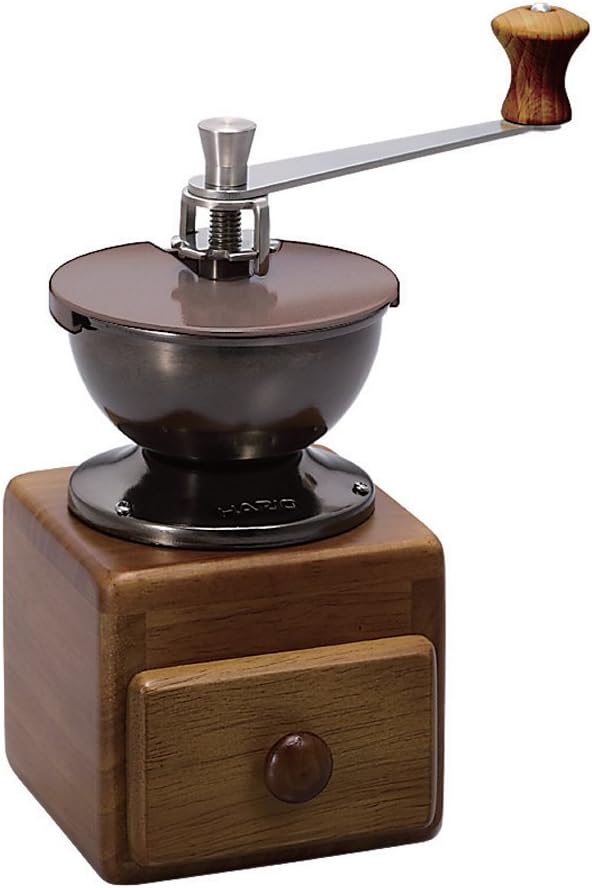
Hario Small Wood Ceramic Coffee Mill (MM-2)
Manual ceramic burr
- Hand-powered ceramic burr mill
- Natural-wood drawer design
- Approximately 24 g ground capacity
- Manually adjustable grind gap
- No motor or mains power required
- Best for occasional small doses

KRUPS Silent Vortex Electric Blade Grinder
Quiet-design removable-bowl blade
- Vortex Spin blade-grinding mechanism
- Removable stainless grinding bowl
- Lid-activated push grinding
- Bowl and lids designed for cleaning
- Coffee and permitted dry spices
- Quiet-design, not truly silent
For non-pressurized espresso, I would look beyond this particular original selection and choose a grinder with genuinely fine, repeatable burr adjustment. Dark roast can be somewhat forgiving of extraction in other ways, but an inconsistent blade grind remains a real limitation.
Best Coffee Grinders for Dark Roast Beans — At a Glance
All five original products appear below in the same source order. The grind mechanism and how the bowl is cleaned matter more than whether a label says adjustable, quiet or professional.
Hario Small Wood Ceramic Coffee Mill (MM-2)
- Hand-powered ceramic burr mill
- Natural-wood drawer design
- Approximately 24 g ground capacity
- Manually adjustable grind gap
- No motor or mains power required
- Best for occasional small doses
Cuisinart One-Touch Automatic Burr Grinder (DBM-8CGP1)
- 18-position stepped grind selector
- One-touch automatic start/stop
- Removable bean hopper and grounds bin
- Cup-quantity dosing control
- Good for drip, press and cold brew
- Burrs versus blade chopping
KRUPS Silent Vortex Electric Blade Grinder
- Vortex Spin blade-grinding mechanism
- Removable stainless grinding bowl
- Lid-activated push grinding
- Bowl and lids designed for cleaning
- Coffee and permitted dry spices
- Quiet-design, not truly silent

KRUPS One-Touch 3 oz / 200 W Electric Blade Grinder
- 200 W electric blade motor
- Approximately 3 oz / 85 g capacity
- One-touch lid-controlled grinding
- Compact fixed grinding chamber
- Coffee and permitted dry ingredients
- Best for convenience, not precision
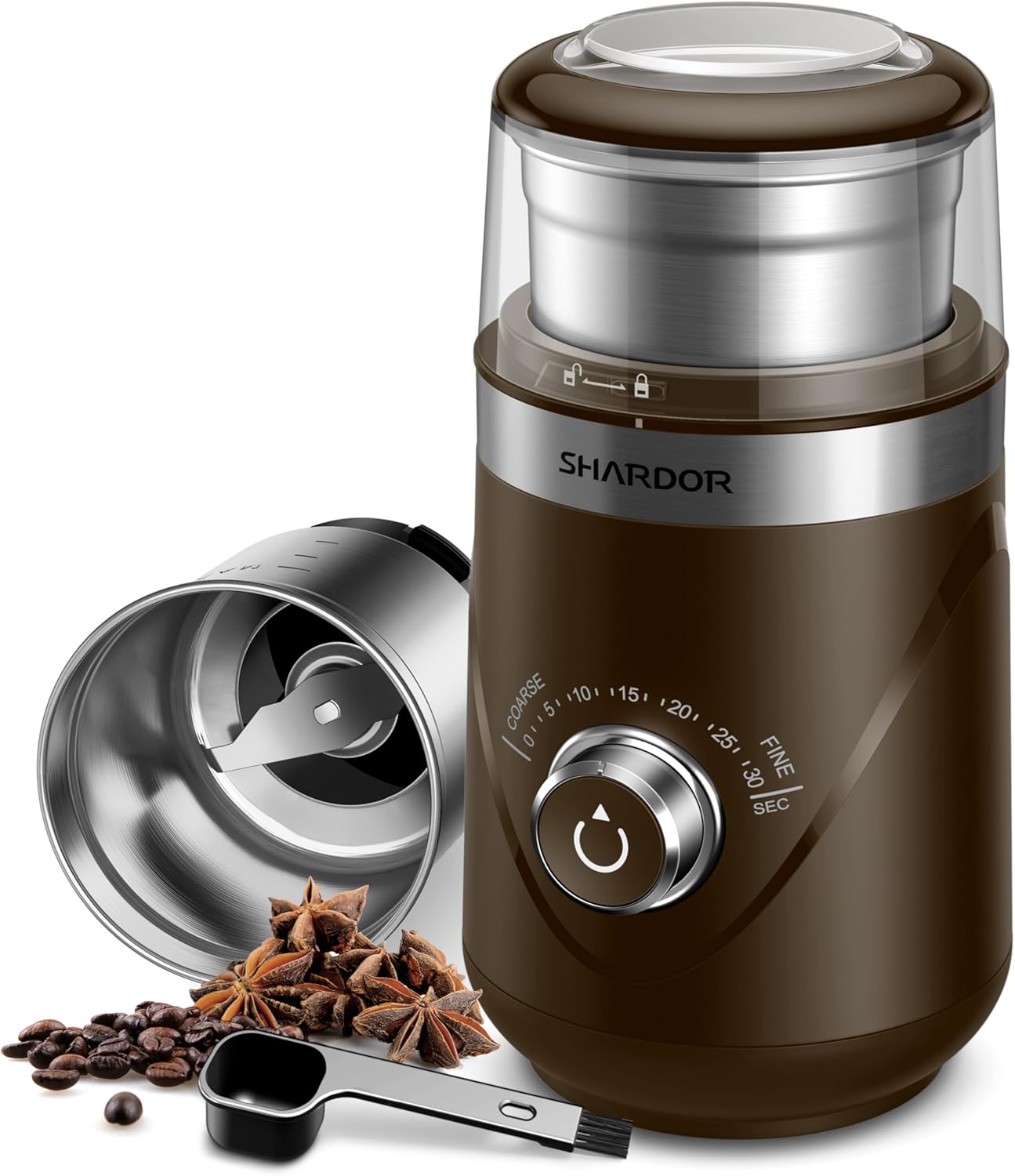
SHARDOR CG638B Timed Electric Blade Grinder
- SHARDOR CG638B linked model
- Timed rotary control for coarseness
- Removable stainless grinding bowl
- Electric blade mechanism
- Approximately 2.5 oz capacity
- Not a stepped burr grinder
Quick Comparison: Burrs, Blades and Daily Convenience
| Original grinder | Mechanism | Best for | Control style | Main limitation |
|---|---|---|---|---|
| Hario Small Wood Mill | Manual ceramic burr | Single-cup ritual, drip, moka | Adjustable manual gap | Small volume, slower grinding |
| Cuisinart DBM-8CGP1 | 18-setting electric burr | Dark-roast drip, press, cold brew | Numbered grind positions | Limited espresso fine adjustment |
| KRUPS Silent Vortex | Removable-cup electric blade | Quiet-design quick brews | Push lid, time and texture | Blade distribution still inconsistent |
| KRUPS 3 oz One-Touch | Fixed-cup electric blade | Basic budget brewing | Lid press, duration | Difficult cleanup and no grind dial |
| SHARDOR CG638B | Timed electric blade | Small simple batches | Rotary timer controls run length | No burr-gap adjustability |
Five Detailed Dark-Roast Grinder Reviews
1. Hario Small Wood Ceramic Coffee Mill (MM-2)
A decorative, genuinely hand-operated ceramic-burr option for measured small batches. Choose it for a deliberate French press, drip or moka-style ritual—not rapid espresso service.
What makes the Hario different from a modern electric grinder
The Hario Small is not a fashionable espresso machine accessory dressed in wood. It is a simple manual ceramic-burr mill, with a natural-wood cabinet, metal hopper, turning handle and a drawer where the ground coffee collects. That design slows the routine down in an appealing way, but the advantage for dark roast is practical as well: there is no motor to run, no timed blade to guess around and no electrical appliance to store beside the kettle.
The manufacturer describes the Small family at roughly 24 grams of ground-coffee capacity. That is enough for a modest single mug, a small moka pot or a carefully measured filter preparation. It is not generous enough for a big French press or a cold-brew pitcher without emptying the drawer and grinding more than once. A reader choosing it primarily for appearance should know about the size before buying.
Ceramic burrs and oily dark beans
Dark-roasted beans tend to be more fragile and can carry visible oils onto grinding surfaces. In a hand mill, a small amount of old coffee stuck to the ceramic burr or hidden in the wooden drawer can change the aroma of the next dose. I would brush the mill promptly after using very glossy beans, empty the drawer completely and avoid leaving fine dark-roast dust in its corners.
The ceramic material does not magically keep the coffee cold or prevent bitterness. Friction still occurs, and extraction quality comes mainly from particle size, brewing recipe and bean freshness. The benefit here is a grinding gap that can be adjusted instead of an uncontrolled blade chamber. Compared with premium modern hand grinders, the Hario may require more patience and may generate a less uniform output, especially when adjusted toward the fine end.
How I would brew with it
For a one-cup pour-over, I would begin with about 15 grams of coffee and 240 grams of water, then adjust the burr opening until the paper filter drains at a sensible pace. With an especially oily, smoky roast, I would often keep water slightly cooler than my light-roast recipes, perhaps around 90–93 °C, and judge whether the result is sweet or drying. The grinder setting should change only after the dose and pouring pattern are reasonably stable.
For moka pot, I would choose a fine-but-not-powdery texture and fill the basket level without tamping. Do not expect this grinder to support effortless, highly repeatable non-pressurized espresso shots. Espresso requires close adjustment and repeatable distribution; a vintage box mill is better bought for the pleasure of small-batch hand brewing than as an inexpensive shortcut to café equipment.
The lifestyle decision and maintenance trade-off
I would choose the Hario when the grinder itself is part of the morning ritual. The noise comes mostly from bean crushing and the crank rather than an electric motor, and the wooden form is attractive enough to leave on display. It also makes a pleasant gift for someone whose coffee is primarily drip, small French press or moka pot.
The compromises are real. Hand grinding requires time, the small drawer interrupts larger brews, and the wood must not be treated like a dishwasher-safe metal bowl. Wipe the cabinet, brush the grinding parts as instructed and dry everything thoroughly. For convenience-led households, the Cuisinart is easier to recommend.
Hario Small Wood Ceramic Coffee Mill (MM-2)
A decorative, genuinely hand-operated ceramic-burr option for measured small batches. Choose it for a deliberate French press, drip or moka-style ritual—not rapid espresso service.
- No electrical motor or wall outlet
- Ceramic burr gap is adjustable
- Beautiful wooden drawer and compact footprint
- Good for a mindful single-cup routine
- Manual labor for every dose
- Limited roughly 24 g collection capacity
- Coarse/fine adjustment is not micrometric espresso
- Wooden housing needs careful dry maintenance
Technical Specifications & Daily Features
- Linked ASIN B004QWMAII: Hario Small wooden mill
- Hand-operated ceramic burr mechanism
- Wood box and drawer grounds catcher
- Adjustable grind via mechanical adjustment
- Manufacturer Hario lists approximately 24 g for Small mill MM-2/MMR-2 family
- Reference dimensions: approximately 160 × 100 × 185 mm
- Do not immerse wood or metal mechanism in water
Product specifications are tied to the linked model; exact accessories, color and voltage can differ by selected variation. Use the instructions and product label for setup and cleaning.
Pros & Cons After 30 Days of Use
First-month ownership checklist: these are conditions I would monitor, not a claim that I personally used this exact grinder for thirty days. Record the same coffee and dose, the grind routine, cleanup time and whether the cup is consistent before assigning a long-term performance verdict.
Strengths to evaluate: no electrical motor or wall outlet; ceramic burr gap is adjustable; beautiful wooden drawer and compact footprint. Trade-offs to watch: manual labor for every dose; limited roughly 24 g collection capacity; coarse/fine adjustment is not micrometric espresso.
My Final Verdict
A decorative, genuinely hand-operated ceramic-burr option for measured small batches. Choose it for a deliberate French press, drip or moka-style ritual—not rapid espresso service.
My recommendation: choose this model when its manual ceramic burr design matches your usual coffee method, and do not expect a blade grinder to match a precision burr grinder for espresso.
Before ordering, confirm that the selected product variant has the same bowl, adjustment method and electrical rating described above. Dark-roast oils make correct cleaning just as important as choosing a grinding mechanism that suits your brewer.
2. Cuisinart One-Touch Automatic Burr Grinder (DBM-8CGP1)
The strongest all-round choice among these five for repeatable dark-roast drip, French press and cold brew. A burr mechanism and a numbered dial offer more real grind control than the blade alternatives.
Why the Cuisinart gets Best Overall in this particular group
The Cuisinart is the only electric burr model among the five original selections. That alone gives it a useful advantage for someone who buys dark-roast coffee and wants reproducible grind sizes across multiple brew methods. Instead of asking a spinning blade to run for more or fewer seconds, you select one of 18 positions. That does not make it a precision espresso machine, but it is a more coherent approach to controlling the particle range for ordinary filter and immersion coffee.
One-touch operation is also easier when more than one person shares a kitchen. A family member can return to the same marked position for a morning drip pot instead of trying to remember whether yesterday’s blade-grinding run lasted 12 or 17 seconds. The quantity setting remains a time or cup-based estimate, so measuring beans in grams is still worthwhile for meaningful repeatability.
How dark roast changes the burr-grinder maintenance schedule
Dark roast frequently leaves more residue on the burrs and ground-coffee path than a light roast that looks dry. The practical response is cleaning, not assuming the grinder is defective. Empty the hopper regularly, brush removable burr-access components only as instructed and do not leave oily beans exposed to kitchen warmth for weeks. A clean chute also reduces the amount of old, bitter-smelling coffee that can mix into the next dose.
Another dark-roast concern is static. Dry air may make grounds cling to the container or fly when the lid opens. Let the grinder finish, tap the grounds container gently and avoid opening it while particles are still moving. Some brewers use a tiny amount of moisture on beans to reduce static, but appliance guidance takes priority. Do not apply liquid directly to the motor base or burr housing.
Dialing in drip, French press and cold brew
For a drip maker, start around the middle of the selector and note the dose for your usual water volume. A simple baseline is 30 grams of coffee with 480 grams of water, then change grind and ratio according to taste. If the cup tastes harsh and overly smoky, check whether the grind is too fine and whether the brewer is running too hot. If it tastes weak, adjust the dose or grind before blaming the roast.
For French press, use a coarser position and a consistent steep. For cold brew, do not blindly select the coarsest possible setting; you want a controlled, filterable grind, not large pieces that barely extract. A dark roast already brings strong toast and cocoa flavors, so excess fines can make the final drink muddy. A burr grinder makes it simpler to compare two neighboring settings and determine which one filters cleanly.
Where the 18 settings cease to be enough
I would not buy this model for someone whose main hobby is changing a non-pressurized espresso shot from a 22-second extraction to a 28-second one. With only 18 overall positions, two adjacent fine-end steps can move too far for comfortable espresso dial-in. If you use a pressurized portafilter, it may be workable for espresso-like drinks. For a standard single-wall basket, a purpose-built espresso grinder is the safer choice.
For the everyday dark-roast drinker, though, a sensible burr mechanism and simple cleaning routine are more important than an elaborate touchscreen. The Cuisinart earns its ranking here for practical repeatability and convenience, not for being the best grinder on the whole market.
Cuisinart One-Touch Automatic Burr Grinder (DBM-8CGP1)
The strongest all-round choice among these five for repeatable dark-roast drip, French press and cold brew. A burr mechanism and a numbered dial offer more real grind control than the blade alternatives.
- Burr-based grind adjustment rather than blade timing
- 18 clear steps simplify repeatable recipes
- Useful hopper-fed workflow for family brews
- Automatic grinding operation
- 18 steps may be too broad for standard-basket espresso
- Dark roast oils still demand regular cleaning
- A large hopper is not ideal for long-term bean storage
- Coffee weight needs separate measurement
Technical Specifications & Daily Features
- Linked ASIN B0D51D8B9R: Cuisinart DBM-8CGP1
- 18-position selector from relatively fine to coarse
- Burr grinding system; one-touch operation
- Quantity selection is a cup estimate, not a built-in scale
- Removable hopper and grounds container
- Better suited to everyday filter and immersion than exacting espresso
- Confirm electrical rating of the chosen US-region model
Product specifications are tied to the linked model; exact accessories, color and voltage can differ by selected variation. Use the instructions and product label for setup and cleaning.
Pros & Cons After 30 Days of Use
First-month ownership checklist: these are conditions I would monitor, not a claim that I personally used this exact grinder for thirty days. Record the same coffee and dose, the grind routine, cleanup time and whether the cup is consistent before assigning a long-term performance verdict.
Strengths to evaluate: burr-based grind adjustment rather than blade timing; 18 clear steps simplify repeatable recipes; useful hopper-fed workflow for family brews. Trade-offs to watch: 18 steps may be too broad for standard-basket espresso; dark roast oils still demand regular cleaning; a large hopper is not ideal for long-term bean storage.
My Final Verdict
The strongest all-round choice among these five for repeatable dark-roast drip, French press and cold brew. A burr mechanism and a numbered dial offer more real grind control than the blade alternatives.
My recommendation: choose this model when its 18-setting electric burr design matches your usual coffee method, and do not expect a blade grinder to match a precision burr grinder for espresso.
Before ordering, confirm that the selected product variant has the same bowl, adjustment method and electrical rating described above. Dark-roast oils make correct cleaning just as important as choosing a grinding mechanism that suits your brewer.
3. KRUPS Silent Vortex Electric Blade Grinder
The best convenience pick when noise and cleanup matter more than perfect particle uniformity. Its removable bowl is particularly useful for managing oily coffee residue.
Why the removable bowl matters for dark-roast beans
The KRUPS Silent Vortex uses spinning blades and a vortex-style circulation pattern, not a burr mechanism. It therefore cannot promise a narrow, predetermined particle size. But it does have a feature that makes dark-roast ownership genuinely easier: the stainless-steel grinding bowl lifts free of the motor base. If a glossy bean leaves an oily film, that removable bowl is simpler to empty and wash than a fixed blade chamber.
You can also carry the whole bowl to a brewer instead of tipping a plugged-in appliance. The manufacturer describes removable washable components, but the motor base stays dry and never belongs in the sink. If you alternate coffee with strong spices, a second approved bowl or dedicated grinder is preferable. Coffee can absorb lingering aromatic residues even when a metal cup looks clean.
What quiet really means
Silent Vortex is a product name and a noise-reduction design, not a promise that the grinder makes no sound. There is still an electric motor and a blade chopping hard seeds. In a shared home, it may be a more considerate choice than a particularly piercing old blade mill, but I would not quote a precise decibel improvement without comparable measured test conditions.
The short running time suits someone preparing one pot of drip coffee or a quick French press. Because it grinds by duration, the user should watch the grounds texture and remember that repeated runs can keep reducing some particles while leaving larger fragments behind. A relatively quiet blade grinder is still a blade grinder.
Short pulses beat a long uninterrupted grind
I would begin with a small, weighed dose, secure the lid as directed and use controlled short runs rather than automatically holding the switch for a long burst. Between pulses, allow the contents to settle; use only the handling or redistributing motions permitted by the appliance manual. The goal is to reduce extremes in the particle distribution, not to create an illusion of espresso precision.
For a dark-roast French press, I would favor a shorter process and careful filtration. For drip, I would grind a little longer and observe the bed after brewing. Overprocessing dark, brittle beans can generate more powdery fines, increasing sediment and muddy flavor. If the brew tastes unpleasantly dry, shortening the grinding run may help, but lowering the brew temperature or changing the coffee-to-water ratio may be just as important.
Who should spend more and who should not
Choose the Silent Vortex if you want a compact, relatively low-noise electric appliance and care about easy cleanup. It is an understandable purchase for everyday drip, French press and occasional cold brew when the dark-roast coffee itself is not an expensive microlot you are trying to analyze sip by sip.
I would pay for a burr grinder instead if repeatable pour-over, minimizing sediment or dialing in espresso is central to your routine. The comparison is not that one brand is trustworthy and the other is not. It is a difference in the physics of chopping versus grinding through a controlled gap.
KRUPS Silent Vortex Electric Blade Grinder
The best convenience pick when noise and cleanup matter more than perfect particle uniformity. Its removable bowl is particularly useful for managing oily coffee residue.
- Removable bowl makes transferring grounds easier
- Designed to reduce perceived noise
- Multipurpose dry-ingredient use
- Washable removable parts per instructions
- Blade operation produces mixed particle sizes
- Quiet design still creates audible sound
- No reproducible burr-gap settings
- A dedicated spice bowl is preferable for aroma-sensitive coffee
Technical Specifications & Daily Features
- Linked ASIN B08C37BY5L: KRUPS Silent Vortex
- Electric stainless-steel blade grinding system
- Vortex-style circulation in removable metal bowl
- Push activation with lid safety interlock
- Bowl and lids can be washed as instructed; motor base cannot
- Noise-reduction design, not zero-decibel operation
- Coffee and permitted dry herbs/spices
Product specifications are tied to the linked model; exact accessories, color and voltage can differ by selected variation. Use the instructions and product label for setup and cleaning.
Pros & Cons After 30 Days of Use
First-month ownership checklist: these are conditions I would monitor, not a claim that I personally used this exact grinder for thirty days. Record the same coffee and dose, the grind routine, cleanup time and whether the cup is consistent before assigning a long-term performance verdict.
Strengths to evaluate: removable bowl makes transferring grounds easier; designed to reduce perceived noise; multipurpose dry-ingredient use. Trade-offs to watch: blade operation produces mixed particle sizes; quiet design still creates audible sound; no reproducible burr-gap settings.
My Final Verdict
The best convenience pick when noise and cleanup matter more than perfect particle uniformity. Its removable bowl is particularly useful for managing oily coffee residue.
My recommendation: choose this model when its quiet-design removable-bowl blade design matches your usual coffee method, and do not expect a blade grinder to match a precision burr grinder for espresso.
Before ordering, confirm that the selected product variant has the same bowl, adjustment method and electrical rating described above. Dark-roast oils make correct cleaning just as important as choosing a grinding mechanism that suits your brewer.
4. KRUPS One-Touch 3 oz / 200 W Electric Blade Grinder
An inexpensive, compact way to grind dark-roast beans immediately before basic drip or immersion brewing. Its fixed bowl and blade operation trade precision for straightforward speed.
An inexpensive tool that does only what it promises
The classic KRUPS One-Touch is a straightforward compact blade grinder, sold around a 3-ounce/85-gram chamber and 200-watt motor. Add beans, close the lid and press as instructed. The low-friction operation appeals to people who want a fresh grind rather than preground coffee from a bag, without taking up space with a large burr appliance.
Its limitations are mechanical, not a hidden flaw: there is no calibrated grind selector. The coarseness of the batch depends on how long you run the blades, how full the chamber is and how the beans circulate. Two batches of dark roast may look different if you overfill one or hold the switch longer. Those realities matter when you try to repeat a recipe.
Fixed chamber, darker oils and routine cleaning
Unlike the Silent Vortex, the one-touch KRUPS has a fixed metal grinding chamber in the common linked configuration. You cannot remove that chamber to wash it at the sink. Unplug the grinder first, then use a dry brush or care method specifically approved in its instructions to remove clinging grounds and oil film. Never pour soapy water into the base or immerse the unit.
With dark roast, that cleaning discipline is especially helpful. Old oil can oxidize, and a grinder that seems clean from a distance may still smell stale under the lid. If the grinder also handles spices, remember that chili, cumin or cloves can perfume subsequent coffee. Dedicating a small grinder to coffee may be better than trying to eliminate every trace of strong culinary aromas.
Making basic drip or press coffee more dependable
For an ordinary drip brewer, use a measured dose—perhaps 25 grams of beans for 400 grams of water—and establish a repeatable sequence of brief grinding bursts. When the coffee looks approximately medium rather than powdery, brew and taste. If it runs through too quickly and tastes weak, you may need a somewhat finer texture or a higher dose. If the filter clogs and the drink tastes chalky, your blade-produced fines may be part of the problem.
For French press, settle for a relatively coarse texture and pour carefully to avoid disturbing the sediment at the bottom of the vessel. Some coffee drinkers will find that result perfectly enjoyable, particularly with rich dark roasts. Others will be bothered by grit. No amount of pulsing turns a fixed blade into a controlled burr gap, so personal expectations should match the price and mechanism.
Should this be used for dark-roast espresso?
The answer is no if the goal is reliable classic espresso using a non-pressurized basket. Espresso requires a fine, narrow and adjustable grinding distribution. This KRUPS can make very small coffee particles, but it cannot select a consistent fine gap or make tiny repeatable changes to regulate shot flow. Apparent fineness is not the same as useful espresso capability.
For a beginner who drinks simple drip coffee and occasionally makes cold brew, it can be a reasonable starting point. If the buyer already knows that precise V60 or espresso is the destination, buying a burr grinder first avoids a predictable later upgrade.
KRUPS One-Touch 3 oz / 200 W Electric Blade Grinder
An inexpensive, compact way to grind dark-roast beans immediately before basic drip or immersion brewing. Its fixed bowl and blade operation trade precision for straightforward speed.
- Fast uncomplicated lid-press operation
- Compact enough for a small kitchen
- Affordable entry into freshly ground coffee
- Accepts a convenient larger batch
- Uneven distribution of fine and coarse grounds
- No true grind size selector
- Fixed chamber is less convenient to clean
- Can overprocess oily beans if held too long
Technical Specifications & Daily Features
- Linked ASIN B099XZLGKD: KRUPS One-Touch
- Electric blade coffee/spice mill
- Nominal 200 W motor and 3 oz / 85 g capacity
- Lid-controlled power switch
- Fixed grinding cup compared with removable-bowl Silent Vortex
- No fixed numbered grind selector; duration determines texture
- Follow recommended grind and cooling cycles
Product specifications are tied to the linked model; exact accessories, color and voltage can differ by selected variation. Use the instructions and product label for setup and cleaning.
Pros & Cons After 30 Days of Use
First-month ownership checklist: these are conditions I would monitor, not a claim that I personally used this exact grinder for thirty days. Record the same coffee and dose, the grind routine, cleanup time and whether the cup is consistent before assigning a long-term performance verdict.
Strengths to evaluate: fast uncomplicated lid-press operation; compact enough for a small kitchen; affordable entry into freshly ground coffee. Trade-offs to watch: uneven distribution of fine and coarse grounds; no true grind size selector; fixed chamber is less convenient to clean.
My Final Verdict
An inexpensive, compact way to grind dark-roast beans immediately before basic drip or immersion brewing. Its fixed bowl and blade operation trade precision for straightforward speed.
My recommendation: choose this model when its compact fixed-bowl blade design matches your usual coffee method, and do not expect a blade grinder to match a precision burr grinder for espresso.
Before ordering, confirm that the selected product variant has the same bowl, adjustment method and electrical rating described above. Dark-roast oils make correct cleaning just as important as choosing a grinding mechanism that suits your brewer.
5. SHARDOR CG638B Timed Electric Blade Grinder
A timed electric blade grinder with a removable bowl and a rotary duration control. Good for quick dark-roast batches when automation and easy handling matter more than calibrated coarseness.
Understand the adjustment dial before buying
The SHARDOR unit linked in this source is the CG638B family, identified with ASIN B0F5WBM65D. Its product description refers to a rotary timed-grind control and an adjustable coarse-to-fine result. That sounds superficially like the steps of a burr grinder, but the mechanical system is different: it uses a blade and changes the grinding duration. There is no indexed burr gap corresponding to a specific particle size.
This distinction is important for readers who see an adjustment dial and assume the grinder has espresso-grade control. The dial helps make a chosen time more repeatable than freehand button pressing, but a dark-roast bean still breaks unpredictably inside the bowl. The benefit is workflow convenience, not a transformation into a specialty burr mill.
How the bowl handles oily beans and daily mess
A removable stainless bowl makes the SHARDOR easier to empty and maintain than a fixed cup design, particularly after glossy dark-roast coffee. You can pour grounds directly into a filter or a dosing container and inspect the metal cup for residue. Check the exact bowl configuration of the selected product variant, since nearby listings can show different colors or one-bowl versus two-bowl packages.
Do not assume that all removable bowls can be washed the same way. Follow the manufacturer’s specific cleaning guidance, fully dry the bowl before reattaching it and never wash the motor base. When the blender-like blade hub or underside collects coffee oil, use the recommended brush and avoid exposing wiring or moving parts.
Choosing a useful dark-roast grind duration
For basic drip coffee, start with a modest weighed dose and the shortest timed setting that produces a medium-like texture. Brew, observe the filter bed and adjust the next batch by a small duration increment. For French press, shorten the run to avoid turning the most brittle pieces to powder. With cold brew, do not mistake coarse-looking chunks for a uniformly useful grind; a mix of boulders and fines makes filtering and extraction less consistent.
With dark beans, short repeated pulses or the product’s recommended timed mode often make more sense than sustained overprocessing. If the result tastes bitter and smoky, the beans may be heavily roasted to begin with, but the grind distribution and brewing temperature can make those qualities harsher. Reduce variables one at a time and write down the duration that produces the least sediment for your brewer.
Who gets the strongest value
I would choose SHARDOR for someone who wants a compact electric grinder with a removable bowl and an easy duration dial, particularly if they share a kitchen and dislike remembering manual pulse counts. It is not my recommendation for precise dark-roast espresso or pour-over analysis. Those buyers need a burr mechanism.
The strengths are clearly practical: quick small batches, a portable grinding bowl and a simple routine. The shortcomings are similarly clear: imperfect particle distribution and a limited batch size. Once those boundaries are accepted, the SHARDOR has an understandable role in the lineup.
SHARDOR CG638B Timed Electric Blade Grinder
A timed electric blade grinder with a removable bowl and a rotary duration control. Good for quick dark-roast batches when automation and easy handling matter more than calibrated coarseness.
- Timed dial adds repeatability versus freehand pulsing
- Removable stainless bowl is convenient to empty
- Compact all-purpose configuration
- Useful for quick non-espresso coffee preparation
- Timed dial is not a burr grind-size selector
- Blade particles vary across the batch
- Capacity and duty cycle limit large volumes
- Model variants differ in bowl count and finish
Technical Specifications & Daily Features
- Linked ASIN B0F5WBM65D: SHARDOR CG638B
- Timed rotary adjustment; this is a blade grinder
- Removable stainless grinding cup
- Nominal 2.5 oz working capacity reported for linked model
- 110 V model configuration noted in listing details
- Not an espresso-grade burr adjustment system
- Check selected variant for bowl count and cleaning details
Product specifications are tied to the linked model; exact accessories, color and voltage can differ by selected variation. Use the instructions and product label for setup and cleaning.
Pros & Cons After 30 Days of Use
First-month ownership checklist: these are conditions I would monitor, not a claim that I personally used this exact grinder for thirty days. Record the same coffee and dose, the grind routine, cleanup time and whether the cup is consistent before assigning a long-term performance verdict.
Strengths to evaluate: timed dial adds repeatability versus freehand pulsing; removable stainless bowl is convenient to empty; compact all-purpose configuration. Trade-offs to watch: timed dial is not a burr grind-size selector; blade particles vary across the batch; capacity and duty cycle limit large volumes.
My Final Verdict
A timed electric blade grinder with a removable bowl and a rotary duration control. Good for quick dark-roast batches when automation and easy handling matter more than calibrated coarseness.
My recommendation: choose this model when its timed removable-bowl blade design matches your usual coffee method, and do not expect a blade grinder to match a precision burr grinder for espresso.
Before ordering, confirm that the selected product variant has the same bowl, adjustment method and electrical rating described above. Dark-roast oils make correct cleaning just as important as choosing a grinding mechanism that suits your brewer.
Buying Guide: What Matters for Grinding Dark-Roast Coffee
1. Why oily, brittle beans behave differently
Dark roasting changes the bean structure. A deeply roasted bean is often less dense and breaks more easily than a lightly roasted example. Some dark roasts show shiny surface oils that transfer readily to hoppers, burrs and collection cups. That oil is not automatically a quality defect, but it can become stale on equipment, and fresh ground coffee can mix with residue that has been sitting in a chute for days.
A more consistent grinding mechanism helps the brewer avoid a mixture of dust and large pieces. Yet an expensive grinder is not a substitute for sensible brewing temperature, dose and freshness. Some very dark beans taste smoky because of roast character, not because the grinder failed. Start by choosing the right brew method, then adjust the amount and fineness of the coffee.
2. Burr versus blade: the most consequential choice
Burrs control the gap through which coffee passes. A blade grinder chops beans repeatedly as they move inside a chamber. Both can make coffee small enough to brew, but the blade design generally produces a wider spread of particle sizes. That matters because the finest pieces release flavor differently from large fragments. Filter brewing, especially, can become simultaneously bitter and weak when too much powder mixes with coarse pieces.
From these five products, the Cuisinart and Hario offer a true burr mechanism. The KRUPS Silent Vortex, classic KRUPS One-Touch and linked SHARDOR are all blade grinders. No timed dial can give a blade mill the exactness of a physical burr-gap adjustment. Choose blades for compactness and price; choose burrs for grind consistency.
3. Dark-roast espresso is a different job from dark-roast drip
An espresso machine with a standard non-pressurized basket is highly sensitive to particle size. A dark-roast bean may extract more readily than a light roast, but dialing in still requires small controlled changes. An 18-position general burr grinder may be able to make espresso-like coffee with a pressurized basket while leaving insufficient resolution for a traditional basket. A blade grinder is even less appropriate.
For automatic drip, French press or immersion methods, the requirements are generally less demanding. The Cuisinart becomes a pragmatic choice. For a small moka pot or a careful one-cup filter brew, the Hario can be satisfying. If the user mainly pulls repeated espresso shots, buying a dedicated espresso grinder—not mislabeling one of these five—is the responsible advice.
4. Static, clumping and oily residue
Static is affected by grinding, humidity and the coffee itself. Oiliness is not identical to static, but both can make cleanup feel awkward. Grounds can cling to the receiving cup, collect around a chute, or form small clumps. In a blade chamber, powder may accumulate near the blade hub and under the lid. In a burr machine, fines may stay around the grinding path.
Brush removable parts according to the maker’s instructions, keep electrical components dry and empty the grounds receiver promptly. Moisture techniques used by some specialty brewers should never override an appliance warning. The purpose of cleaning is not cosmetic perfection; it is to prevent stale material and avoid accidental contamination of the next measured batch.
5. Why removable bowls matter, and what not to wash
The KRUPS Silent Vortex and this SHARDOR use removable bowls, which can simplify pouring grounds into a brewer and inspecting oil buildup. The classic KRUPS One-Touch commonly uses a fixed chamber, which demands more careful brushing. The Cuisinart has a removable hopper and collection chamber, whereas the Hario has a separate wooden drawer and manual grinding assembly.
Never wash the electric motor base in water. A stainless bowl is not automatically dishwasher-safe across all brands; check each manual. Wood should not be soaked or put in a dishwasher. A clean dry brush and appropriate wiping technique will do more for grinder longevity than harsh detergents or forced disassembly.
6. How to compare convenience with long-term value
A fast blade grinder can feel ideal during the first week because it grinds in seconds and costs less than many burr machines. If you later become enthusiastic about filter clarity, however, the inconsistent grind may be the first limitation you notice. An affordable burr grinder usually makes better sense for a person who plans to keep experimenting with coffee recipes.
Noise, storage and dose size also deserve attention. A hand grinder is quiet in a different way from a quieter electric motor. A larger hopper is useful for several cups but exposes stored beans if you leave them inside for long periods. A small grinder can fit the kitchen better, as long as you do not need to grind a large cold-brew batch in one run.
7. Voltage, cleaning safety and product variants
Products connected to Amazon.com often have North American electrical specifications. Check the rating plate and the manual of the exact item shipped; an American plug adapter alone does not convert a 120 V appliance for a 220–240 V outlet. A manual grinder such as the Hario avoids that compatibility issue.
Product families sometimes include near-identical bowls, colors and accessory packs under different variation names. The source article’s SHARDOR is the CG638B blade configuration, and the two KRUPS appliances have different cup arrangements. Preserve the exact product identifier when ordering and do not replace it with a superficially similar grinder solely because the photograph looks familiar.
Dark-Roast Brewing Playbook: Four Useful Recipes
A recipe is a starting point rather than proof that one coffee needs one exact setting. Use a scale, make a simple tasting note, and change a single variable each time. These ratios are common household baselines, not instructions to ignore the guidance supplied with your brewer.
Chocolate-Forward Drip Coffee
Try 30 grams of dark-roast coffee with about 480 grams of water. With a Cuisinart burr grinder, begin around a middle setting suited to your filter brewer. For very dark beans, start near 90–93 °C when you control temperature; darker roasts may taste smoother with slightly cooler water. If the drink is sharply bitter or drying, try a slightly coarser grind and check whether the machine is overextracting.
Balanced French Press
Try 24 grams coffee with 360–390 grams of water and a coarse grind. Steep around four minutes as an initial experiment, break the crust carefully and pour gently to keep sludge in the vessel. A blade grinder may generate enough fines to make the last sip muddy, so pour into a separate server and avoid stirring the settled grounds at the bottom.
Moka Pot without Ashy Harshness
Fill the basket level with a fine-to-medium-fine grind that is not espresso powder, and never tamp it. Follow the moka pot manufacturer’s water and safety instructions. Keep heat moderate and stop extraction once the characteristic strong flow changes; prolonged sputtering can amplify bitterness. The Hario is a reasonable small-dose manual companion in this original group.
Dark-Roast Cold Brew
Start with a measured coarse grind and a coffee-to-water ratio that suits your intended concentrate or ready-to-drink recipe. Brew covered in the refrigerator and filter thoroughly. The exact extraction period is adjustable to taste and method; do not assume every darker roast requires the same steep. A burr grinder is more useful than a blade unit when preventing fine sludge is your priority.
Dark-Roast Troubleshooting
| Problem | Likely contributors | What to try next |
|---|---|---|
| Bitter, ashy coffee | Roast darkness, excessive extraction, very fine grounds | Try a coarser grind, slightly cooler water, shorter contact |
| Thin body with weak flavor | Too little coffee or very coarse grind | Weigh coffee, then move modestly finer |
| French press has gritty sludge | Excessive fine particles or disturbed sediment | Use burrs or filter and decant carefully |
| Grinder smells stale | Oil and grounds residue in bowl or chute | Unplug and clean approved removable surfaces |
| Static scatters grounds | Dry air and charged particles | Brush and control grounds transfer; follow product care advice |
| Dark-roast espresso flows too fast | Grind too coarse or inconsistent puck | Use an espresso-capable burr grinder, adjust gradually |
| Espresso shot chokes | Too fine, too much dose, uneven puck | Adjust grind or dose; maintain consistent prep |
| Blade grinder gives mixed sizes | Chopping instead of burr gap | Smaller batches and measured duration, or upgrade to burr |
| Motor sounds strained | Excess load or prolonged operation | Stop, unplug, follow duty-cycle and maintenance instructions |
Final Comparison and Rankings
| Ranked product | Why it earns its badge | Best brew method | Important caveat |
|---|---|---|---|
| Cuisinart DBM-8CGP1 — Best Overall | Repeatable electric burr selection | Drip, French press, cold brew | Not an exacting espresso grinder |
| Hario Small — Best Manual | Manual adjustable ceramic burrs | Small moka, drip, one-cup press | 24 g capacity and manual effort |
| KRUPS Silent Vortex — Best Quiet | Noise-conscious design and removable bowl | Quick drip or French press | Still blade, audible, uneven particles |
| KRUPS One-Touch — Best Budget | Simple compact appliance | Casual drip and immersion | Fixed blade chamber and no grind adjustment |
| SHARDOR CG638B — Best Timed | Duration dial and removable bowl | Small quick drip batches | Timer controls chopping duration, not burr gap |
Frequently Asked Questions About Dark-Roast Coffee Grinders
Do dark-roast beans require a special coffee grinder?
No. They reward a grinder with consistent adjustment and a maintenance routine that addresses oil buildup. A capable burr grinder is a useful first choice.
Why do dark-roast beans look shiny?
Some darker roasts develop visible surface oils after roasting. Shine varies by coffee and age, and surface oil is not alone a reliable indicator of quality.
Are oily beans bad for burr grinders?
Not automatically, but residue can accumulate on burrs, hoppers and chutes. Clean only the components approved in the maker’s instructions.
Is a burr grinder better than a blade grinder for dark roast?
Generally yes for repeatable particle size. A blade grinder can be convenient for basic coffee but creates more mixed fine and coarse particles.
Which of these five is the best everyday electric burr grinder?
The Cuisinart DBM-8CGP1 is the only electric burr model in this original group, making it the most practical daily filter-coffee choice here.
Can the Hario Small grind dark roast for espresso?
It can make relatively fine coffee, but it is not my preferred choice for precisely dialing in traditional non-pressurized espresso. Small moka-style brews fit it better.
How much coffee does the Hario Small hold?
Hario specifies about 24 g of ground coffee for its Small MM-2/MMR-2 family. Expect to grind in multiple rounds for larger recipes.
Is the KRUPS Silent Vortex actually silent?
No electric blade grinder is literally silent. The name describes a noise-reduction design; the motor and grinding process remain audible.
Is KRUPS Silent Vortex a burr grinder?
No. The linked B08C37BY5L is a blade grinder with a removable bowl and vortex-style grinding action.
Can the KRUPS Silent Vortex bowl go in the dishwasher?
The relevant manual identifies its removable bowl and selected lids as washable/dishwasher-safe. The motor base must never be immersed.
What is different about the KRUPS 200 W One-Touch model?
The linked B099XZLGKD is a basic fixed-chamber blade grinder, not the same removable-bowl design as the Silent Vortex.
Is SHARDOR CG638B a burr grinder?
No. The B0F5WBM65D model is an electric blade grinder; its rotary control regulates timed grinding rather than moving burrs.
Does a timed SHARDOR grind setting guarantee even particles?
No. Timing can help repeat a routine, but a blade mechanism still creates a mixture of particle sizes.
Which grinder should I use for a large cold-brew batch?
The Cuisinart burr grinder is the more consistent option here. For large volumes, watch hopper and grounds-bin capacities and follow the duty cycle.
Should dark-roast coffee be ground finer or coarser?
It depends on the brewing method. Very dark roast sometimes benefits from slightly coarser grinding or cooler water to avoid harsh extraction, but taste should decide.
What temperature is best for dark-roast filter coffee?
A starting range around 90–93 °C often works for very dark coffee, but medium-dark roasts may benefit from different temperatures depending on taste and brewer.
Why does my dark-roast coffee taste burnt?
The roast itself may be very developed. Fine grounds, excessive contact time or very hot brewing water can intensify harshness.
Can I grind dark-roast beans for French press with a blade grinder?
Yes, though the resulting grind may contain extra fines. Use a measured dose, avoid overprocessing, and pour carefully to reduce sediment.
How often should I clean a grinder used for oily beans?
Inspect it regularly and brush out grounds as directed after use. A more thorough maker-approved clean is useful when residue or stale smells appear.
Can I wash coffee-grinder burrs with water?
Do not assume so. Ceramic and steel burr assemblies have different cleaning requirements; consult the precise manual and protect motor and bearings from moisture.
Will a grinder with ceramic burrs always keep coffee cooler?
No. Ceramic properties do not guarantee a cooler or better-tasting grind. Dose, friction, speed and overall grinder design matter.
Does dark roast create more fines?
Darker beans often fracture more readily, but fine generation depends on grinder geometry and settings as well. Judge the result in the brewer.
What is the easiest way to repeat a dark-roast recipe?
Weigh your coffee, record the grinder adjustment and use a consistent brewing method. Change one variable at a time.
What grinder is best for dark-roast espresso among these?
None is an ideal precision espresso specialist. The Cuisinart is a general-purpose burr grinder; a dedicated espresso grinder is preferable for non-pressurized baskets.
Should I store dark-roast coffee beans in a hopper?
For daily convenience, a small quantity is reasonable, but a sealed container away from light, heat and air is better for longer storage.
Does a removable grinding bowl help with dark roast?
It can make oily residue easier to inspect and the grounds easier to transfer, provided it is cleaned using approved instructions.
My Final Verdict
A useful dark-roast grinder does not have to be elaborate, but its mechanism has to fit the coffee you actually brew. If you want cocoa-rich French press and a repeatable morning drip pot, the Cuisinart is the clearest practical choice among the original five. If you want a hands-on single-cup ritual, the Hario delivers a satisfying design and a true adjustable ceramic burr gap.
The KRUPS Silent Vortex earns its place through ease of cleaning and a quieter-design workflow. The standard KRUPS one-touch and the timed SHARDOR are reasonable budget or convenience appliances when treated honestly as blade grinders. They are not automatic shortcuts to the narrow grind distribution that modern espresso requires.
No grinder can rescue a roast that is simply too dark for your taste. Start with coffee you enjoy, keep the grinding chamber clean, weigh the dose, and make small recipe changes. The best result is a cup you can reproduce tomorrow without battling oil, noise or guesswork.


