
Best Coffee Grinders for Espresso Beans


OneHundredCoffee is reader-supported, and some products displayed may earn us an affiliate commission. Details
A dark, syrupy espresso shot depends on something that happens before the machine builds pressure: coffee particles ground small enough, and consistently enough, to resist water in a controlled way. Fresh beans help, but freshness alone does not solve a puck that runs in eight seconds, chokes the machine, or tastes sharp and hollow. The grinder needs to make fine adjustments repeatable. That distinction is easy to miss when two products both say “fine coffee grind” yet use completely different mechanisms.
These five grinders vary dramatically in what they can do. Breville Smart Grinder Pro is the clear espresso-oriented burr machine. Dualit uses real conical burrs, though its various generations require care when comparing adjustment claims. SHARDOR, Amazon Basics and Brentwood are blade grinders: useful for freshly ground coffee and some forgiving brewing routines, but not genuine replacements for a precision espresso mill. I make that distinction before anyone spends money, rather than promising that every blade can create the controlled resistance a standard espresso basket requires.
Editor’s Picks: Three Coffee Grinders for Different Priorities

Breville Smart Grinder Pro BCG820BSSXL
- 60 grind adjustments
- 0.2-second time control
- Espresso-oriented burr system
- LCD dosing interface
- 50–54 mm / 58 mm cradles
- 18 oz locking hopper
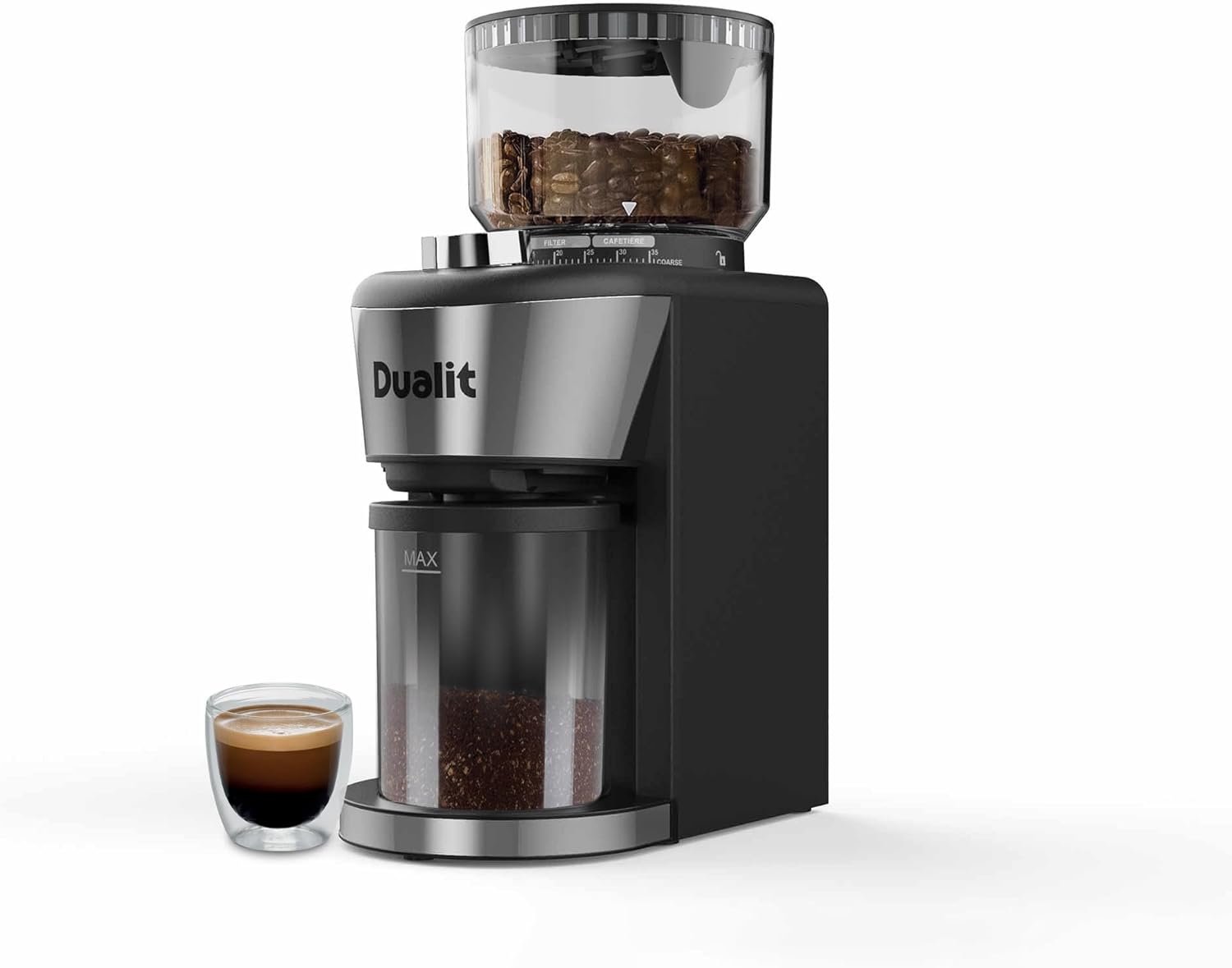
Dualit Burr Coffee Grinder
- Genuine conical burr system
- Repeatable stepped grind dial
- Removable bean hopper
- Simple portion selection
- Traditional countertop styling
- Useful for several brew methods

SHARDOR Electric Coffee & Spice Blade Grinder
- Removable stainless cups
- Simple press-top operation
- 200 W motor family
- Useful for ground-coffee freshness
- Convenient separate bowl use
- Best as a budget backup
For an owner of a conventional home espresso machine with a non-pressurized basket, my first choice here is the Breville. It has a real stepped burr adjustment, a familiar LCD interface, portafilter cradles and fine timing control. Dualit deserves attention from a shopper who alternates between filter coffee and espresso-style drinks, but the precise version and grind range should be confirmed before ordering. SHARDOR is included among the picks for its removable-cup convenience, not because its blades suddenly perform like burrs.
The two remaining blade models have narrower roles. Amazon Basics is an affordable tool for freshly grinding a small portion, and Brentwood is a compact one-touch alternative with a safety lid. Neither should be selected solely because someone describes an “espresso-capable” grind. A more defensible question is which grinder suits your actual basket and brewing habits. A pressurized basket gives you considerably more margin than a standard basket, while a proper burr machine gives you far more useful control.
Best Coffee Grinders for Espresso Beans — At a Glance
The five machines below represent two different grinding mechanisms. I compare the burr models for espresso adjustment, while judging the blade models by their simpler roles as small, low-cost coffee grinders.
Breville Smart Grinder Pro BCG820BSSXL
- 60 marked grind adjustments
- Hardened stainless conical burrs
- Digital timer adjusts by 0.2 second
- Two portafilter cradle sizes
- 18 oz locking bean hopper
- Espresso and filter coffee modes
Dualit Burr Coffee Grinder
- Conical steel burr mechanism
- Stepped adjustment collar
- Cup-based grinding controls
- Removable bean hopper
- Brushed classic Dualit styling
- UK voltage and import terms matter
SHARDOR Electric Coffee & Spice Blade Grinder
- High-speed stainless steel blades
- 200 W motor on removable-cup model family
- Removable stainless-steel cups
- Press-to-grind operation
- Can handle selected kitchen spices
- Not a stepped espresso burr grinder

Amazon Basics Stainless Steel Electric Blade Coffee Grinder
- Stainless-steel blade assembly
- About 30 g / 1 oz coffee dose
- Transparent safety lid
- One-touch grinding control
- Designed for simple drip grinding
- No espresso grind adjustment

Brentwood CG-158BL 4 oz Coffee and Spice Blade Grinder
- 4 oz capacity listed by maker
- 150 W blade motor
- Clear viewing lid
- One-touch operation
- Safety-lock mechanism
- Blue-and-silver model finish
Quick Ranking: Espresso Suitability Comes First
| Rank | Grinder | Grinding mechanism | Suitability | Best reason to choose |
|---|---|---|---|---|
| 1 | Breville Smart Grinder Pro | Electric conical burr | Espresso-focused | Espresso dialing in non-pressurized baskets |
| 2 | Dualit Burr Grinder | Electric conical burr | Conditional burr alternative | Traditional burr workflow and occasional espresso-style brewing |
| 3 | SHARDOR Removable-Cup Blade Grinder | Electric blade | Blade: not precise espresso | Fresh beans for pressurized espresso-style drinks or filter coffee |
| 4 | Amazon Basics Blade Grinder | Electric blade | Blade: not precise espresso | Occasional freshly ground beans at a low starting cost |
| 5 | Brentwood CG-158BL Blade Grinder | Electric blade | Blade: not precise espresso | Basic coffee grinding and compact storage |
Why Espresso Beans Need a Different Grinding Approach
Espresso is not defined by a particular bean variety or roast. Coffee sold as “espresso beans” may be a dark blend, a balanced medium roast, or a lively single-origin coffee. The grinder still has to deliver particles that work with the basket, dose, brewing pressure and desired yield. A change from a fresh, dense light roast to an older dark roast may demand a completely different dial position. That is why a numerical grind setting should always be treated as a starting point, not a universal recipe.
Burrs and blades solve different problems. A burr grinder moves whole beans through a controlled gap between two cutting surfaces. Reducing that gap typically shifts the particle-size distribution finer. A blade grinder spins knives through a chamber, progressively breaking some pieces while leaving others relatively large. Longer grinding can create more dust but does not give the same predictable relationship between an adjustment setting and extraction. The difference becomes especially important in a standard single-wall basket, where the coffee bed itself supplies much of the resistance.
There is also an important distinction between pressurized and non-pressurized baskets. A dual-wall basket builds resistance through a small exit opening, so it can be more tolerant of pre-ground coffee and a somewhat inconsistent grinder. A single-wall basket depends more directly on particle size, distribution and puck preparation. If you want to learn espresso dialing in, start with a proper burr grinder. If you mainly use a pressurized entry-level machine, a blade grinder can occasionally produce a drink, but expect less repeatability and less control over a disappointing shot.
Five Coffee Grinder Reviews: Espresso Control and Everyday Trade-Offs
1. Breville Smart Grinder Pro BCG820BSSXL
My espresso grinder has one non-negotiable job: produce a grind fine enough for the basket and make a small, predictable correction when the shot runs too fast or too slowly. The Breville Smart Grinder Pro offers that control through stainless-steel conical burrs and sixty marked positions. Unlike a blade mill, it changes the gap through which the beans pass. That gives a home barista a useful adjustment to make rather than guessing whether a longer spin will turn mixed coffee fragments into a workable espresso bed.
The portafilter cradles and digital Dosing iQ timer make the Breville practical as well as adjustable. The grinder handles an espresso-oriented routine without pretending that a timer weighs coffee: the number of grams delivered still changes with roast, setting, and feed rate. I rank this model first because it supports an understandable process—set the grind, measure the grounds, prepare the puck, pull the shot, and make a deliberate correction. It also has a place in a mixed-brewing kitchen, although switching between very different grind sizes involves resetting the dose and clearing retained grounds.
Breville Smart Grinder Pro BCG820BSSXL
The most persuasive grinder in this selection for a home espresso machine with a standard basket. Its real advantages are controllable burr size, direct portafilter dosing and programmable grinding time; a separate scale still matters.
- Burr adjustment supports a meaningful espresso dial-in
- 60 marked settings plus internal calibration options
- Two cradles and an LCD reduce preparation fuss
- Grind-time settings can be saved and repeated
- Timed dosing is not automatic weighing
- Retention and clumping still require attention
- Not an unlimited stepless espresso specialist
- Taller and more expensive than the blade units
Technical Specifications & Daily Features
- Breville Smart Grinder Pro model BCG820BSSXL
- Stainless-steel conical burrs; 60 marked grind settings
- Dosing iQ digital timer changes in 0.2-second increments
- 18 oz / approximately 510 g bean hopper
- 50–54 mm and 58 mm portafilter cradles supplied
- Grinding container with lid and sealing cap, cleaning brush
- Dimensions for the US version about 8.5 × 6.3 × 15.3 inches
- US electrical rating 110–120 V, 165 W
A scale remains the reliable check on actual output after changing roast or grind size.
Pros & Cons After 30 Days of Use
The central ownership advantage is controlled adjustment. For a standard espresso basket, the grind collar gives a genuine mechanical response when a shot is too fast or restricted. Dosing iQ can repeat the chosen time in 0.2-second steps, and the included cradles keep a normal portafilter-oriented workflow within reach. The LCD presents grind time and shot or cup selection without demanding a separate app.
The limitations become important when coffee changes. The grinder measures time, not grounds weight; retention and bean differences alter actual dose. The eighteen-ounce hopper suits a household using the same coffee regularly but is less convenient for someone who changes beans every shot. Over a month, practical checks include weighing output after grind changes, brushing retained grounds, and confirming both cradles fit the handles in use.
My Final Verdict
Breville is the clear espresso choice among these five. Sixty marked burr adjustments, direct portafilter support, and controllable dose time make it an appropriate tool for learning conventional espresso extraction. It is not a grind-by-weight machine, nor does it eliminate puck preparation or occasional chute cleaning. For a daily espresso station built around a single-wall basket, its advantages are substantial enough to justify choosing it over every blade alternative here.
Why Breville Leads This Particular Lineup
The Smart Grinder Pro earns its place without relying on extravagant claims. Sixty marked grind settings, a stainless-steel conical burr system and a digital timer designed around espresso shots give me several ways to adjust the coffee bed deliberately. When a shot runs too quickly, I can move the grinder finer and actually understand what changed. That is the central capability missing from the three blade machines in the roundup.
The display makes daily use approachable, too. I can see the selected grind region, choose shot-oriented dosing and use the correct cradle for a 50–54 mm or 58 mm portafilter. These are small conveniences individually, but together they encourage a measured routine. I still need to level the grounds, distribute them carefully and weigh the finished dose; the grinder makes those tasks easier rather than making them unnecessary.
Sixty Settings, Burr Calibration and Espresso Reality
Sixty main settings are generous for a household that moves between espresso, pour-over and French press. Breville also documents additional upper-burr calibration on this family, but I do not touch it simply to chase an arbitrary internet setting. I start from the espresso range shown in the user guide, use the coffee in front of me, and adjust while observing the shot. The correct number changes with the bean, basket, dose and machine.
The presence of a conventional grind dial matters far more to me than the biggest number. I want a clear response when I make the grind one step finer. If an eighteen-gram dose yields thirty-six grams in a watery sixteen-second shot, a finer setting may help. If the machine barely produces drops, moving coarser is a reasonable adjustment. Grind is only one cause of these symptoms, but controlled changes let me test a sensible hypothesis.
The Dosing iQ Timer Is Useful, Not a Scale
The digital timer advances in 0.2-second increments. This can be a genuine advantage after I find a dose that works, because I can save the approximate run time and avoid manually holding a button on every morning. It does not mean each grind cycle dispenses exactly the same number of grams. Different roasts, hopper levels and settings can change the amount that passes through the burrs in the allotted time.
For serious espresso I still set a small scale beside the machine. I weigh the delivered coffee, correct the timer if necessary, and distribute the grounds before tamping. The benefit of Breville is a consistent and intelligible workflow. It should not be sold as a machine with automatic integrated grind-by-weight measurement, and it is not immune to residual coffee that may linger in the chute.
Cleaning, Retention and Daily Counter Space
A large hopper can be convenient for a household drinking the same beans every day. It is less attractive to a person who changes varieties every shot, because some beans and grounds can remain in the feed path. I store most beans away from heat and light, add a practical amount to the hopper, and brush the burr area according to the manual. Heavy oils and fines deserve attention before they affect flow or cleanliness.
The grinder is tall enough that under-cabinet clearance should be checked. The receiving container, portafilter cradles and locking hopper also deserve a predictable place on the counter. If I spend every morning hunting for an attachment, even a good grinder becomes less pleasant to own. A carefully planned coffee station makes the electronic controls feel genuinely useful.
Who Should Choose It and What to Expect After a Month
I choose Breville for someone stepping from pressurized espresso toward a standard basket or who already owns a conventional pump machine. A measured month of coffee with one bean would teach more than switching between a dozen coffees on the first day. Useful notes include grind position, measured dose, output weight, time, and flavor.
I do not promise perfect crema or café-grade shots merely because the machine costs more than a blade grinder. Bean age, water chemistry, brew temperature, basket geometry and puck preparation still matter. The purchase earns its value by reducing one major source of uncontrolled variation. Among these five grinders, that makes it the strongest espresso investment.
For a deeper discussion of fine-grind control, the separate espresso-level grinder guide looks at how micro-adjustments affect traditional espresso preparation.
2. Dualit Burr Coffee Grinder
Dualit belongs above the three blade grinders because a genuine adjustable burr mechanism creates useful separation between grind size and grind duration. That matters when alternating between filter coffee and espresso-style drinks. Its traditional controls suit someone who wants to turn a dial, make coffee, and clean the receiving container without learning an elaborate digital interface. Yet an espresso recommendation depends on how closely spaced the adjustment steps are where the grinder reaches its fine range.
The challenge is product identity. Dualit has produced several conical-burr models, including earlier machines with fewer steps and newer versions with more adjustment and different accessories. I cannot treat those specifications as interchangeable. This Dualit option is sold through a UK storefront, which also changes the purchase decision for a US audience: voltage, shipping, warranty, and the particular unit matter. Dualit earns the burr-alternative position here, not a blanket promise of specialist espresso precision.
Dualit Burr Coffee Grinder
A legitimate alternative to blade grinding, with mechanical adjustment and a straightforward daily routine. Dualit has sold multiple burr-grinder generations, so I match the physical controls to the exact unit before assuming a particular setting count.
- Real conical burrs rather than rotating blades
- Stepped grind dial makes returning to a setting easy
- Hopper and container allow larger batches
- Useful when espresso is only part of a mixed brewing routine
- Dial precision may limit demanding non-pressurized espresso
- Several Dualit generations have different controls
- UK retailer shipping and voltage require checking
- Capacity and accessory specifications depend on version
Technical Specifications & Daily Features
- Dualit UK-market burr grinder
- Dualit conical-burr grinder product family, not flat burr
- Dualit documentation includes an older 10-setting model and a newer 35-setting model
- The older Dualit model has a 250 g hopper and mechanical dose selector
- The newer 75017 model has a 250 g hopper, 35 steps and 52 mm cradle
- Check the precise Dualit retail model number before ordering
- Inspect voltage, grind count and included accessories on the purchase page
- Confirm the exact UK-market version, voltage and retail terms
For espresso, the number of usable fine-end adjustment steps matters more than the widest advertised grind range.
Pros & Cons After 30 Days of Use
The essential benefit is a real stepped burr adjustment rather than a spinning blade. A setting can be recorded and revisited after switching to another brewer, and a hopper-fed system supports more than a tiny single-cup portion. That is a meaningful step toward repeatable filter and espresso-style drinks.
The ownership risk lies in choosing the wrong Dualit generation for the desired basket. A ten-setting machine and a more recent thirty-five-setting version cannot be assumed to offer the same espresso resolution, cradle, or accessories. Before relying on the dial as an espresso solution, the exact model, electrical rating, and local service coverage must fit the kitchen. For US buyers the UK destination adds voltage and import considerations.
My Final Verdict
Dualit takes second place because burr-based adjustment is more appropriate for espresso than blade chopping. It makes the most sense for someone using multiple brew methods and comfortable with a traditional dial. It is not a guaranteed solution for fine single-wall espresso corrections: the exact generation and adjustment granularity decide that. The Breville remains the stronger choice when conventional espresso is the primary daily goal.
Why a Real Burr Grinder Ranks Above a Blade Grinder
Dualit deserves a different conversation from the inexpensive blade models because the beans travel through burrs rather than being chopped in an open cup. An adjustable burr gap produces a more intentional change in texture, which makes sense for espresso and for filter brewing. It also gives me a realistic chance to return to the same setting after making a weekend French press.
The main caution is model identity. Dualit offers an older ten-setting burr machine as well as a more recent thirty-five-setting model. They are not interchangeable specifications. The Dualit option here is sold through a UK storefront, and I check the photographed dial, retailer’s model number, voltage and supplied accessories before assuming that the exact machine matches either manufacturer page in every detail.
What I Want From Its Adjustment Dial
For a standard espresso basket, the essential test is whether the dial steps are fine enough to land on a good extraction. A broad range from very fine to very coarse sounds impressive, yet the few positions near espresso fineness are the ones that matter most. If one step produces a restricted shot and the next step creates a fast, thin pour, the machine may be better suited to a dual-wall basket and general-purpose brewing.
I keep the coffee dose and target yield fixed while learning its finest usable range. If the machine repeatedly requires an odd compromise between two grind positions, I consider that a limitation of the adjustment system, not a defect in my beans. Step size is only part of the story—burr geometry, alignment and how cleanly the chute dispenses coffee affect the practical result as well.
A Larger Hopper and Traditional Daily Routine
The Dualit family uses a hopper-fed grinding routine. This is convenient when making drinks for more than one person. I fill it with enough coffee for the day rather than leave a large quantity sitting in warm light for weeks. If I alternate espresso and filter, I write down the two settings and grind a small purge when necessary so fragments from the previous position do not confuse the next dose.
The earlier design has a two-hundred-fifty-gram hopper and straightforward portion controls. The newer 75017 grinder lists that capacity too, but has a different settings count and included accessories. It is worth checking the model label and photographed controls before ordering. What matters to my recommendation is that this Dualit model is a burr-based Dualit grinder, not a flat-burr model with a guaranteed sixteen-step dial as a superficially similar model might suggest.
Espresso Performance Versus Mixed-Brewing Value
I am comfortable recommending the Dualit to someone making French press, filter coffee and occasional espresso-style drinks. A decent burr adjustment provides a clear practical advantage over the Brentwood, SHARDOR or Amazon Basics blades in this article. Whether it is refined enough for demanding single-wall espresso depends on which generation is actually sold and what the basket requires.
Shopping region deserves attention. Dualit is available through a UK retailer here, so a US buyer should check voltage, shipping, returns, import costs and service coverage carefully. A UK-market electrical appliance should not be assumed to work safely on a US supply just because a plug adapter fits.
First-Month Lessons and My Verdict
During the first week I use one roast and establish a reference setting. In weeks two and three I compare a pressurized and standard basket only if I owned both and understood the manufacturer’s instructions. By the fourth week I know whether the adjustment granularity was sufficient for my machine and whether switching to filter coffee caused too much re-dialing.
Dualit is second in this particular ranking because it offers actual burr control. I buy it for flexibility and a traditional workflow, but I do not describe it as an espresso specialist without verifying the exact unit and showing how its fine-step adjustment works with a conventional basket.
3. SHARDOR Electric Coffee & Spice Blade Grinder
The removable cups are the persuasive part of this SHARDOR. It serves a different purpose from the Breville or Dualit: a small batch of coffee or spices can be ground in a stainless bowl that lifts away from the powered base. Transfer and cleaning are more straightforward than on many fixed-chamber blade grinders. For someone preparing occasional drip coffee, that simplicity has value, particularly when kitchen space is limited.
The limitation is not subtle. Rotating blades keep striking some bean fragments while others escape contact, creating a mixture of coarse pieces and powder even after a long grind. There is no calibrated adjustment ring to make an espresso shot slightly finer or coarser. A pressurized basket can tolerate imperfect grounds better than a conventional single-wall basket, but neither basket transforms this into a precision espresso mill. I recommend SHARDOR as an easy-clean general grinder or backup, not as the first purchase for espresso dialing-in.
SHARDOR Electric Coffee & Spice Blade Grinder
A convenient blade machine with removable cups, especially useful when cleaning is the daily priority. It can create powdery fines, but it cannot dial in a controlled espresso puck in the way a burr grinder can.
- Removable cups simplify transfer and cleaning
- One-touch pressing makes small batches straightforward
- The removable-cup configuration supports general kitchen grinding
- Lower cost and smaller body than a specialist espresso grinder
- Blade cutting creates a broad particle-size mixture
- No repeatable micrometric burr adjustment
- Not appropriate for precision non-pressurized espresso
- Wet/dry bowl accessories vary by package
Technical Specifications & Daily Features
- SHARDOR removable-cup blade configuration
- Stainless-steel blade grinding, not a conical or flat burr
- 200 W motor specified for the removable-cup product family
- Two removable stainless-steel cups on the removable-bowl configuration
- Press-top control; grind duration changes particle breakdown
- Removable cups may be dishwasher-safe per the specific manufacturer guide
- No calibrated espresso settings or portafilter dose mechanism
- Use dedicated coffee bowl to avoid spice aromatics affecting beans
The removable bowl helps with cleaning and transfer, but blade grinding has no calibrated espresso-size control.
Pros & Cons After 30 Days of Use
The removable stainless cup makes the SHARDOR easier to empty than a blade grinder with a fixed grinding chamber. On configurations that include separate bowls, keeping coffee and spices apart also helps avoid unwanted aromas. Press-top operation makes short batches straightforward, and removable cups are easier to wash when the model instructions allow it.
The recurring compromise is grind uniformity. Blade duration affects the mix of fines and larger fragments, but there is no measured burr spacing or repeatable espresso step. Long operation can create more powder without providing reliable extraction resistance. The correct maintenance routine is to unplug the base, clean only removable components as authorized, dry them thoroughly, and keep the electrical body out of water.
My Final Verdict
SHARDOR wins its place as an easy-clean, multipurpose blade grinder rather than an espresso grinder. It is suitable for occasional coffee, spices, or a kitchen needing compact removable bowls. A pressurized basket may tolerate its imperfect grind, but anyone who wants to correct single-wall espresso shots by changing particle size needs a real burr adjustment instead. The removable-cup convenience does not compensate for that mechanical difference.
The Appeal Is the Removable Grinding Cup
SHARDOR is easy to understand as a kitchen appliance. Press the top, let the blades spin for a short interval, and lift the cup away to transfer the contents. This SHARDOR removable-cup design has stainless bowls and a powered blade motor. For someone who occasionally grinds spices and wants a simple coffee grinder in a small kitchen, that can be a useful design.
The temptation is to mistake this convenience for espresso precision. A removable cup does not make the particles uniform, and spinning for longer does not produce calibrated burr spacing. Even if the coffee looks visually fine at the surface, a mixture of very small powder and larger particles may remain. A standard espresso basket exposes that inconsistency quickly.
Blade Speed Is Not a Grind Setting
SHARDOR sells other grinders with adjustable conical burrs and electronic timers, but this removable-cup machine is not one of them. Here, texture is influenced by blade running time and how the beans move within the cup. It cannot independently choose an espresso grind step the way Breville can.
I use short bursts rather than attempt a continuous marathon of grinding. That makes it easier to monitor the contents and reduces the chance of overheating a small batch. But I do not claim that carefully pulsing creates the same distribution as a properly adjusted burr set. More processing may produce more fine dust without fully eliminating larger fragments.
Pressurized Baskets, Moka Pots and Sensible Expectations
Some entry-level espresso machines use pressurized baskets. In those machines, the basket mechanism contributes to resistance, so imperfectly ground coffee may still brew. That makes an inexpensive blade grinder possible as a temporary compromise. It does not mean the same grounds will work smoothly in a standard basket. I follow the espresso-machine instructions and avoid treating a stalled or erratic shot as a reason to grind indefinitely.
For households that mostly make drip coffee and only occasionally brew Moka pot or pressurized espresso, this tool may feel adequate. I look at dose, taste and ease of cleaning rather than claim it can match the Breville. If my priority shifts toward learning the effect of a half-step change on a traditional espresso shot, I know it is time for a different grinder mechanism.
Why the Two-Bowl Setup Matters
Separate bowls can be useful when one person makes coffee and another grinds pungent spices. I keep the coffee cup dedicated to beans rather than try to wash away a strong garlic or cumin aroma before each morning brew. Removable vessels also help transfer coffee without tipping a powered base upside down.
I read the exact cleaning instructions carefully. Some cups are approved for dishwashing, but the motor housing is never treated as a dishwasher item. Dry reassembly is essential. If fine grounds pack around the blade spindle, I use the cleaning method prescribed for the model, not poke a metal utensil into the chamber while the appliance is connected to power.
My Bottom Line for Espresso Buyers
I choose SHARDOR when the value I care about most is a compact multiuse grinder with removable stainless cups. I do not buy it on the promise of espresso dosing precision or fine-stepped control, because those are features of a different SHARDOR grinder family.
A pressurized espresso basket gives this machine its best argument in the context of the article. For non-pressurized espresso, the honest recommendation is to save for a true burr grinder and use the blade unit for other everyday coffee preparation. The distinction is more useful than overstating its ability to pull a beautiful shot.
4. Amazon Basics Stainless Steel Electric Blade Coffee Grinder
The Amazon Basics blade grinder occupies the simplest position in this lineup: a small grinding chamber, a transparent lid, and push-to-run operation. It can turn whole beans into fresh grounds without occupying much counter space or requiring a complicated setup. That is appealing for occasional coffee in a rental, office, or modest kitchen, especially when the alternative is a bag of pre-ground coffee sitting open for weeks.
Espresso is where the design reaches its limits. The one-ounce batch size and blade mechanism offer no repeatable burr gap, fine adjustment dial, or portafilter support. Longer grinding can increase powder without eliminating larger fragments. For forgiving immersion or drip recipes, that compromise can be manageable. For a standard non-pressurized espresso basket, inconsistent particle size makes shot correction difficult and frustrating. I put this grinder in the budget-backup category and keep the distinction explicit.
Amazon Basics Stainless Steel Electric Blade Coffee Grinder
A straightforward blade grinder that freshens beans without a complicated setup. Its appeal is price and simplicity; the lack of adjustable burr spacing makes it a poor match for anyone learning to tune a standard espresso basket.
- Few controls to learn
- Small one-ounce dosing suits short batches
- Compact body and visible lid
- Useful as a backup for drip or pressurized systems
- Chopping produces varied particle size
- Does not have a removable 3.5 oz chamber
- No repeatable grind-size dial
- Not a replacement for a dedicated espresso burr grinder
Technical Specifications & Daily Features
- Amazon Basics model CG9402-UL
- Amazon Basics CG9402-UL product family
- Stainless-steel blade, not a burr mechanism
- Approximately 30 g / 1 oz nominal coffee grinding batch
- Transparent safety lid and push-to-operate grinding
- Suitable for grinding selected dry herbs and spices when used as directed
- No display, independent grind adjustments or dosing scale
- Follow model-specific cleaning directions; never immerse the motor base
The compact blade chamber is useful for small amounts; it cannot provide repeatable burr-size adjustment.
Pros & Cons After 30 Days of Use
A small chamber, clear safety lid, and simple button make the Amazon Basics practical for occasional whole-bean grinding. The roughly thirty-gram nominal coffee load favors one small preparation at a time and avoids a large hopper sitting on the counter. It is easy to understand and can be kept as a spare when a primary grinder is unavailable.
The limitation remains the fixed blades. Running another few seconds changes chopping time, not an indexed grind setting, so two similar-looking batches can contain different blends of dust and coarse pieces. Fine coffee collected near the blades also requires careful cleaning after unplugging the unit. The powered base is not washable or immersible. For daily single-wall espresso, the absence of burr adjustment quickly becomes the decisive disadvantage.
My Final Verdict
Amazon Basics is the budget backup, not a dedicated espresso recommendation. It makes sense when cost, compact storage, and occasional fresh-ground coffee matter more than detailed grind control. Pressurized espresso systems can be more forgiving, but a conventional single-wall basket needs much more predictable particle-size adjustment. Moving to a true burr grinder is the meaningful upgrade; buying another blade machine does not solve that problem.
What a One-Button Grinder Can and Cannot Do
Amazon Basics offers an uncomplicated way to grind freshly roasted coffee beans without buying a full hopper-fed appliance. The blade chamber is small, the lid lets me see the beans breaking apart, and the entire process is driven by a simple press. For someone who primarily buys pre-ground coffee but wants a fresh aroma on occasional weekends, this can be a reasonable first step.
It is not an adjustable burr grinder. Its approximately one-ounce capacity is modest, and the cutting system has no separate, calibrated burr adjustment. For an espresso reader, the more important correction is that the machine offers no measured adjustment to control water flow through a standard basket.
The One-Ounce Batch and Its Practical Implications
The grinder is described around a thirty-gram dose of coffee, close to one ounce. That amount is enough to prepare one or perhaps two espresso-style servings, depending on the machine’s basket, but the result is not a guarantee of a precise extraction. I avoid overfilling the chamber because blade grinders rely on room for the beans to circulate.
If a pressurized machine recommends a particular fineness, I aim for the best approximation the blade unit can make without running it excessively long. The clear lid lets me monitor texture, but visual inspection does not reveal the full particle distribution. Two apparently similar batches may still extract quite differently. That is an expected limitation of the mechanism.
Espresso Versus More Forgiving Brewers
I see more natural uses for this model in drip coffee, immersion brewing or as a backup grinder in a holiday rental. These methods do not ask the grounds bed to build the same narrow hydraulic resistance as a standard espresso basket. A somewhat uneven grind may still make a satisfying cup, especially after a person adjusts brew ratio and steep time.
A Moka pot is another possibility, but it should not be treated as espresso just because the coffee is concentrated. The Moka basket needs a different grind and should never be tamped in the same way as an espresso puck. If the instructions call for a particular particle range, I follow those instructions rather than grind everything to powder.
Cleaning and Countertop Life
A small blade grinder does not require a large clearing space around a hopper. That is appealing in a compact kitchen. After unplugging it, I wipe the chamber according to the manufacturer instructions, take care around the blades and ensure every part is dry before using it again. Strongly flavored spices can linger, so I do not casually switch between coffee and aromatic ingredients in the same cup.
The question after a month is whether this simplicity offsets the lack of precision. For someone who makes one casual coffee every few days, perhaps it does. For anyone making two non-pressurized espresso shots each morning, I recognize that lack of control to become frustrating long before the appliance stops working.
When This Budget Grinder Makes Sense
I recommend Amazon Basics as a low-cost way to grind a small portion of beans at home, with honest limitations. I do not put it in front of Breville merely because its blades can create powder. It has no grind-size clicks, portafilter cradle or repeatable espresso-oriented dose control.
If the budget absolutely requires starting with a blade grinder, I spend time learning the espresso machine’s basket requirements before buying. Sometimes using good pre-ground coffee for a pressurized basket until a suitable burr grinder becomes affordable is a better path than buying a blade machine and expecting it to perform an impossible adjustment.
5. Brentwood CG-158BL 4 oz Coffee and Spice Blade Grinder
The blue Brentwood CG-158BL is a compact coffee-and-spice blade grinder, not the brand’s separate black CG-2021BK burr mill. Its four-ounce nominal bowl, one-touch control, visible lid, and safety lock make it a straightforward appliance for household chopping. For someone with limited storage and only occasional grinding needs, a small machine like this is easier to accommodate than a tall hopper-fed grinder.
The distinction between grinding coffee and dialing in espresso remains decisive. The Brentwood blades cannot create calibrated particle-size changes between shots, and a longer press does not reproduce a neighboring burr setting. That limits its role in a conventional espresso workflow. It is more credible as a basic kitchen grinder for filter coffee, a pressurized-basket stopgap, or a backup. The main reasons to choose it are size and uncomplicated handling—not any claim that it produces specialist espresso grounds.
Brentwood CG-158BL 4 oz Coffee and Spice Blade Grinder
A colorful, compact blade grinder that keeps preparation simple. The blue CG-158BL is a different machine from Brentwood’s black CG-2021BK burr mill, and its spinning blades are not suitable for precision espresso dialing in.
- Simple low-effort operation
- Official manufacturer identifies a four-ounce bowl
- Transparent lid helps monitor the chopping cycle
- Safety interlock and rubber feet
- Blade chopping is not grind-size calibration
- Not designed to tune non-pressurized espresso
- Grounds can be irregular even after careful pulsing
- Blue CG-158BL differs from the black burr grinder
Technical Specifications & Daily Features
- Brentwood CG-158BL configuration
- Exact model CG-158BL, blue/silver finish
- 4 oz nominal coffee/spice capacity
- 150 W powered stainless-steel blades
- Clear viewing lid and safety lock
- Single-button grinding control
- Slip-resistant rubber feet
- Separate CG-2021BK is an 8 oz automatic burr grinder, not this product
The safety-lock blade grinder has no fine-adjustment ring and is distinct from Brentwood’s burr models.
Pros & Cons After 30 Days of Use
The CG-158BL provides a larger nominal bowl than the small Amazon Basics unit, along with a clear lid, one-touch control, a safety lock, and non-slip feet. The simple physical controls are appropriate for occasional general kitchen grinding. That is a useful role for a compact appliance with few parts to learn.
It does not have the burr spacing or stepped adjustments required for repeatable espresso dialing-in. Small blade-ground batches can look fine while containing particles of widely different sizes. Cleaning around the blade after unplugging matters, and strong spice odors can linger when the same bowl is used for coffee. The safety lock must be left intact; never operate it with an exposed blade.
My Final Verdict
Brentwood is a practical compact blade grinder for coffee-and-spice use, not an espresso-first purchase. The four-ounce bowl, 150-watt motor, and protective lid explain the value of the blue CG-158BL. None provides calibrated espresso fineness. For a household preparing daily shots in a conventional non-pressurized basket, I strongly favor the Breville or another dedicated burr grinder.
Brentwood CG-158BL Versus the Separate CG-2021BK Burr Mill
The blue Brentwood CG-158BL is a compact blade grinder with four ounces of nominal capacity and a one-touch safety-lid design. The CG-2021BK is a separate black automatic burr mill in Brentwood’s lineup. Conflating them changes the reader’s buying decision, so I treat the blue CG-158BL according to what its manufacturer actually makes.
Its appeal is modest: a small footprint, simple operation and the ability to grind coffee without learning a control panel. It may make a kitchen feel more welcoming than another large appliance. It does not have adjustable burr spacing, though, and therefore cannot be selected as the best precise espresso grinder.
150 Watts, Clear Lid and Safety Controls
Brentwood specifies a 150-watt motor, stainless-steel blades and a clear safety lid on the CG-158BL. I appreciate a safety mechanism that discourages running an exposed blade. The transparent top also allows a quick visual check of how the beans are moving. Those are meaningful everyday features for a general kitchen grinder.
The drawback is that the spinning blade keeps hitting some coffee fragments more often than others. A finer-looking cup of grounds may contain both dust and pieces still relatively large. I do not claim that a particular number of pulses equals an espresso grind setting or that the four-ounce chamber delivers a prescribed number of espresso doses without weighing them.
A Realistic Role Beside an Espresso Machine
I can imagine using Brentwood as a backup for someone who occasionally makes a drink with a forgiving pressurized basket, but I check the espresso-machine instructions first. A non-pressurized portafilter needs control over the actual particle distribution, not just the overall appearance of ground coffee. If an espresso shot gushes or chokes, the blade grinder leaves few reliable levers to correct it.
In a household where drip coffee or a French press is more common, this blade machine has a stronger case. I use freshly weighed beans, short pulses and a repeatable brewing method. It may improve the aroma of a cup compared with long-stored ground coffee, even if it is not an especially precise grinder.
Maintenance and What the Blade Chamber Means
The compact bowl is convenient until grounds cling to the edges after a dark roast. I unplug the appliance, clean around the blades carefully and avoid submerging the electrical base. If I also use it for spices, I recognize that some odors may persist even after cleaning, so dedicating it to coffee would make sense for flavor consistency.
I do not assume that the nominal bowl capacity should be filled to its brim with beans. A smaller batch gives the pieces more space to circulate under the blades. The safety-lock feature also means I never attempt to defeat the lid mechanism just to observe the grinding action more closely.
Who Gets the Most Value From Brentwood
Brentwood suits someone who values a compact general-purpose grinder, perhaps for a dorm room, a vacation kitchen or a very occasional fresh-coffee routine. It also makes sense as a backup when a larger machine needs service. Its price and simplicity are much more persuasive than any claim about espresso precision.
For a person who intends to enjoy daily espresso from a single-wall basket, I choose a burr grinder instead. The CG-158BL can grind coffee, but that does not make it the appropriate tool for dialing in espresso. A straightforward recommendation should leave a reader with a clearer buying decision, not just a longer list of positive adjectives.
Buying Guide: How to Choose a Grinder for Espresso Beans
First, Identify Your Espresso Basket
A pressurized basket usually has a second wall with a restricted exit and may be supplied with beginner machines. It can produce pressure and a crema-like layer even when the coffee is not dialed in as precisely. A non-pressurized basket has a conventional open hole pattern and relies much more heavily on the ground coffee bed to restrict flow. That is why I decide what basket I own before choosing a grinder. The best purchase for a pressurized appliance is not necessarily the best purchase for a serious single-wall setup.
If I am unsure which basket is installed, I consult the espresso-machine manual rather than decide from the brand alone. Some machines ship with both styles. For anyone transitioning to a standard basket, it is sensible to buy a burr grinder that offers reproducible fine adjustments rather than choose a blade grinder on the theory that longer grinding creates more espresso-like powder.
The Difference Between Burr Geometry and Blade Chopping
Burr grinders feed coffee through a controlled gap. The adjustment mechanism moves one burr relative to the other, changing the particle distribution in a way I can test in my espresso machine. Blade grinders spin sharp knives in a cup. Some particles become fine quite quickly while others stay large until hit again. This mixture may be acceptable for less demanding brewing methods, but it becomes a nuisance when the puck itself controls water flow.
I do not assume that all burr grinders are equally suited to espresso, either. Burr size, alignment, speed, grind range and adjustment step size all matter. A general-purpose burr grinder may reach fine coffee yet make adjustments too coarse for a demanding basket. That is why Breville leads this specific lineup and why the exact Dualit version is worth identifying.
How Small Should Espresso Grind Adjustments Be?
Espresso rewards controllable increments. A single position change should be small enough that I can correct a slightly fast shot without suddenly choking the machine. A stepless grinder offers continuous movement, while a stepped grinder provides repeatable stops. Neither design is automatically better in every home. A well-chosen range of narrow steps may be easier to learn than an extremely sensitive stepless dial with no reference marks.
When shopping, I ask whether the product offers meaningful adjustments in its espresso region. Sixty broadly spaced steps and sixty very small espresso-appropriate steps are not the same thing. I also pay attention to whether the manual describes upper-burr adjustment or serviceability, but I never modify burr spacing beyond the manufacturer’s instructions just to achieve a number mentioned online.
Why a Timer Does Not Replace a Coffee Scale
Timed grinders are convenient, especially when I have one familiar roast and a repeated morning routine. But the timer measures seconds, not grams. A coffee bean’s density, roast level, freshness and the selected burr gap can change how much coffee is ground in that duration. Even a display with tenths of a second is not a built-in weighing instrument.
I prefer to learn dosing with a small scale. If I want eighteen grams in the basket, I weigh eighteen grams in the basket. Once a timer is close, I can use it as a shortcut and check the result periodically. That makes a programmable grinder a genuine convenience without confusing repeatability of duration with accuracy of mass.
A Sensible Starting Espresso Recipe
For a double basket intended for around eighteen grams, I begin with eighteen grams of freshly ground coffee and target around thirty-six grams of beverage in the cup. A shot time near twenty-five to thirty seconds is a familiar starting framework, but it is not a universal standard. Machine pre-infusion, roast, basket geometry and preferred taste may make a shorter or longer extraction better. The cup decides whether the baseline works.
I change the grind only after checking that dose, tamp, distribution and basket choice are consistent. A fast, thin, sour shot might suggest grinding finer. A slow, dry, harsh shot might suggest moving coarser. If flavor improves but the timing remains unusual, I trust repeated taste more than a stopwatch alone. This process depends on a real burr setting; it is hard to recreate with blade duration.
Portafilter Size and Grinding Directly Into the Basket
A portafilter cradle is a nice benefit when it holds the handle securely and keeps grounds off the counter. Breville provides cradle options for two common size families, which is useful in a shared household. I still confirm the actual handle fits rather than assume that every fifty-eight-millimeter basket has the same fork clearance. Dosing into a separate cup can also be worthwhile when I want to weigh the grounds precisely.
Blade grinders generally require tipping a grinding cup or appliance to transfer the coffee. That is not automatically a problem for ordinary brewing, but it adds mess and makes exact espresso distribution more awkward. For a normal single-wall espresso workflow, I give a deliberate weight to ease of transfer, grounds clumping and the space available for a dosing funnel or WDT tool.
Roast Level, Freshness and the Myth of Universal Settings
A dark roast can be more porous and brittle than a dense light roast. Coffee also changes as it ages and releases gas after roasting. One grinder setting may be perfect for a particular bean one week and slightly wrong later. That is not necessarily a failure of the grinder. It is part of working with a changing agricultural product.
I save a simple note for each bag: bean, roast date if known, dose, grind position, yield and whether the cup tasted balanced. When I switch between coffees, I recognize to dial in again. That is much more reliable than asking for one magical grind number for every espresso bean available.
Which Grinder Upgrades Actually Matter?
A more expensive grinder may buy a finer adjustment mechanism, better alignment, quieter gears, less retained coffee or more convenient dosing. Not every added feature improves the drink. For a person making one pressurized cappuccino each day, a full professional grinder might be overkill. For someone running several espresso tests with a non-pressurized basket, the adjustment system can matter more than the polished housing.
Within this set of five, the meaningful step up is not from one blade machine to another. It is from blade chopping to a real burr mechanism and, for espresso in particular, to a burr grinder designed for fine adjustment. The Breville has the clearest evidence for that goal. The Dualit may suit a mixed-brewing routine when its exact version and local availability are confirmed.
Cleaning, Oil Buildup and Retained Grounds
Coffee oils slowly coat grinding chambers and burrs. Residue can change aroma and create clumping if the machine is neglected. I unplug the grinder, follow the manual for upper-burr removal where applicable and clean accessible areas with an approved brush. Water should not go near powered assemblies or burr mechanisms unless the instructions explicitly allow it.
Blade grinders have fewer burr passages but their cups still collect residue around the blades. Removable bowls are a convenience, not a license to put every part in the dishwasher. If spices are also prepared in a grinder, I ideally keep a separate bowl for coffee to prevent aromatic cross-contamination.
US Electricity, UK Retail Links and Product Identification
Before ordering from an overseas retailer, I check voltage, plug format, shipping costs, returns and warranty coverage. The Dualit shopping destination here is in the UK, not the US, so I do not assume local stock or a domestic warranty. I only use an imported appliance when the exact electrical rating and support terms meet my needs.
Model identity also matters. Brentwood CG-158BL is a blade grinder, while CG-2021BK is a separate burr product. SHARDOR sells burr models too, but its removable-cup blade machine has different capabilities. A good buying decision depends on the actual mechanism and controls, not a familiar-looking brand name.
Final Comparison: Espresso Control, Daily Use and Trade-Offs
| Grinder | Grinding design | Dose control | Conventional espresso basket | Price on Amazon |
|---|---|---|---|---|
| Breville Smart Grinder Pro | Electric conical burr | Electronic timer, 0.2-second steps | Recommended first choice | Price on Amazon |
| Dualit Burr Grinder | Electric conical burr | Portion / manual controls vary by generation | Conditional; check exact model and grind steps | Price on Amazon |
| SHARDOR Removable-Cup Blade Grinder | Electric blade | Press-button duration; not weighed | Not recommended for precise dialing-in | Price on Amazon |
| Amazon Basics Blade Grinder | Electric blade | Press-button duration; not weighed | Not recommended for precise dialing-in | Price on Amazon |
| Brentwood CG-158BL Blade Grinder | Electric blade | Press-button duration; not weighed | Not recommended for precise dialing-in | Price on Amazon |
My Final Recommendation
If espresso is genuinely the main reason I am buying a grinder from this particular group, I choose the Breville Smart Grinder Pro. Its marked burr settings, direct portafilter dosing and repeatable electronic timer fit the workflow of a pump machine with a conventional basket. I also keep a small scale, use fresh beans and approach each new roast with patient, measured adjustments. A grinder can make the process learnable, but it cannot compensate for every other variable in brewing.
Dualit is my second choice for a different kind of buyer: someone who likes classic countertop appliances and brews several coffee styles, provided that the exact version and UK purchase conditions make sense. The three blade grinders are honest alternatives for everyday coffee freshness, kitchen convenience or an emergency backup. I do not recommend Brentwood, Amazon Basics or the SHARDOR as an espresso-first purchase when a non-pressurized basket is the goal. That distinction matters more than ranking all five as if they offered equivalent precision.
Frequently Asked Questions About Espresso Coffee Grinders
Which grinder on this list is best for espresso?
Breville Smart Grinder Pro is the clear espresso-focused choice among these five grinders. It has adjustable burrs, sixty marked settings and portafilter-oriented dosing. Dualit also uses burrs but its specific generation and adjustment range require verification.
Can a blade grinder make real espresso?
A blade grinder can produce small coffee particles, but it cannot control their distribution in the same way as adjustable burr spacing. It may occasionally work with a forgiving pressurized basket; I do not recommend it for reliable non-pressurized espresso.
What is the difference between pressurized and non-pressurized espresso baskets?
A pressurized or dual-wall basket creates some resistance through its restricted outlet. A non-pressurized or single-wall basket relies much more on the ground-coffee bed itself. Consequently, a standard basket typically requires more precise, repeatable grind adjustments.
Is the Brentwood CG-2021BK the same grinder as the blue CG-158BL?
No. Brentwood CG-158BL is a blue four-ounce 150-watt blade grinder. The black CG-2021BK is a separate automatic burr mill with a different mechanism and capacity.
How much coffee can the Brentwood CG-158BL hold?
The manufacturer identifies the CG-158BL as a four-ounce coffee-and-spice grinder. That is a nominal chamber capacity, not a recommendation to fill it to the brim for every brewing method.
Does the Dualit grinder have 10, 16 or 35 settings?
Dualit offers different generations. An older burr grinder has ten settings, while the newer 75017 model has thirty-five. Check the model number and dial of the particular machine offered before relying on either figure.
Is the Dualit burr grinder flat or conical?
Dualit’s Burr Coffee Grinder family uses conical burrs. Confirm the particular retail generation and its grind controls before ordering.
Does the Dualit product link go to a US store?
No. The Dualit shopping destination is Amazon UK. US shoppers should check delivery, plug, electrical voltage, warranty and final pricing before deciding whether an imported grinder is appropriate.
What type of grinder is Amazon Basics B07SYTRPSG?
It is a compact electric blade grinder with a stainless-steel cutting blade. It does not offer a burr gap, numbered espresso settings or a built-in dose scale.
How much coffee does the Amazon Basics grinder hold?
The Amazon Basics CG9402-UL family is designed around roughly thirty grams, or one ounce, of coffee. It is a small, one-touch blade machine rather than a larger removable-chamber grinder.
Does SHARDOR B07LG33LV3 have conical burrs?
No. This removable-cup SHARDOR uses stainless-steel blades, not conical burrs. SHARDOR makes other grinder types, so it is important to identify the exact model.
Does the SHARDOR grinder have 16 precise grind settings?
No. This removable-cup SHARDOR uses spinning blades and time-based operation, not a sixteen-position burr adjustment ring.
Can the SHARDOR cups go in a dishwasher?
This removable-cup SHARDOR has dishwasher-safe bowls under its prescribed cleaning instructions. Follow the exact manufacturer instructions for your package, and never place the powered motor base in the dishwasher.
What is the Breville Smart Grinder Pro model number?
The referenced model is Breville BCG820BSSXL. Its manufacturer documents sixty grind settings, stainless-steel conical burrs, portafilter cradles and 0.2-second timer increments.
Does the Breville Smart Grinder Pro weigh my dose?
No. Its Dosing iQ interface measures and programs grinding duration, not the actual mass of grounds. A separate coffee scale is the right tool when an exact gram dose matters.
How many Breville grind settings are suitable for espresso?
Breville provides a range of settings for espresso, but the correct starting position varies with beans, basket, dose and machine. Its manual divides the overall sixty-step range among brewing methods; taste and measured shot flow should guide the final selection.
What does a 0.2-second timer adjustment change?
It changes the length of a grinder cycle by a small time increment. That is useful when approximating a repeated dose, but the actual grams dispensed may change with grind setting or roast.
Do espresso beans require a special roast?
No. Espresso is a brewing method. Many beans can be used, including light, medium and dark roasts, although each may need different grind adjustment and extraction conditions.
What coffee dose should I use for a double espresso?
A common baseline is eighteen grams when the basket is designed for that amount, with a beverage yield around thirty-six grams. Follow the basket and machine guidance, then adjust according to flavor rather than treating one number as universal.
Is a 25–30 second espresso shot always ideal?
No. It is a familiar reference interval, not a law. Some excellent shots run shorter or longer depending on pre-infusion, roast, ratio, basket and taste.
Why is my espresso shot running too quickly?
Possible causes include coffee ground too coarsely, a low dose for the basket, uneven distribution or poor puck preparation. With a proper burr grinder, try a modest finer adjustment while keeping other variables consistent.
Why is my espresso machine choking?
The grind may be too fine, the basket may be overdosed, or puck preparation and other restrictions may be impeding flow. A slightly coarser burr setting and careful dose verification are reasonable first checks.
Can I grind coffee for Moka pot using these products?
Many can grind beans for Moka pot, although the blade grinders have less repeatable particle distribution. Moka pot uses a different basket and pressure profile from espresso and generally should not use an espresso-style tamp.
Do I need a portafilter cradle on my grinder?
No, but a properly sized cradle can make dosing tidier. Breville supplies cradles for common 50–54 mm and 58 mm portafilter families; always check the physical fit of your handle.
How often should I clean an espresso grinder?
That depends on coffee oils, workload and grind retention. Brush accessible areas with the machine unplugged, and follow the product manual for deeper cleaning. Never immerse motor or electrical components.
Is a 60-setting grinder automatically better than a 35-setting grinder?
Not necessarily. Adjustment resolution where you actually brew, burr design, serviceability and everyday dose handling are more important than a headline setting count.
Can I use a grinder made for UK electricity in the United States?
Only if the exact appliance voltage and power requirements are compatible. Changing the plug alone does not change electrical voltage. Confirm the actual product rating before using imported equipment.
Which grinder should I choose for both espresso and drip coffee?
For daily conventional espresso I choose Breville. For mixed filter and occasional espresso-style coffee, Dualit is worth considering once its version is confirmed. The three blade models suit simpler brewing and backup duties.


