
Best Simple Use Coffee Grinders: Tested & Reviewed


OneHundredCoffee is reader-supported, and some products displayed may earn us an affiliate commission. Details
Coffee grinders can make a simple recipe feel unnecessarily complicated. A dial marked one through fifteen ought to help me repeat tomorrow’s brew, not send me searching for a different chart every time the beans change. For most kitchens, the useful question is not how many settings exist in theory. It is whether the dial makes enough sense to return to yesterday’s pour-over, move coarser for French press, and clean the machine without dismantling half the countertop.
I favor obvious controls for that reason. A numbered ring is easy to share among roommates, a cup-based selector can make early mornings simpler, and a smaller hopper can be an advantage when the kitchen is short on space. Yet I do not confuse a convenient interface with precision that the grinding mechanism cannot supply. A sixteen-gram espresso dose and a thirty-gram French press require different kinds of control. The best grinder for one is not automatically the best grinder for the other.
My Three Best Coffee Grinders for Simple Adjustments

OXO Brew Compact Conical Burr Coffee Grinder
- 15 main settings + 29 micro-adjustments
- 50 g whole-bean capacity
- Stainless-steel conical burrs
- Chuteless grounds path
- Both burrs removable for care
- About 11 inches tall

KRUPS Precision Electric Burr Coffee Grinder
- 12 main grind-size positions
- Intermediate micro-adjustment range
- Flat burr grinding discs
- Cup-selection dose control
- Filter, press and pour-over use
- Removable hopper and cup

Mr. Coffee Automatic Burr Mill Grinder
- 18 distinct grind positions
- Automatic quantity selector
- Removable bean hopper
- Separate grounds collection cup
- Electric burr mill, not blade
- Straightforward home dosing
The five machines here illustrate those differences clearly. OXO Brew Compact is deliberately small and gives fifteen main adjustments plus twenty-nine intermediate points. KRUPS combines twelve major grind sizes with micro-adjustments around a flat-burr system. Mr. Coffee uses eighteen familiar stops and a basic quantity control. Gaggia MDF 55 belongs to a different, espresso-focused category with continuous stepless adjustment. The Cuisinart Supreme Grind family remains a recognizable example of easy batch-coffee controls and an old-fashioned cup slider.
This comparison is about decisions at the counter: whether I can change grind size without guessing, prepare the dose my brewer needs, and deal with ordinary maintenance. I do not regard a high setting count as a tasting score, or treat a timer as a hidden scale. I also distinguish a model’s current configuration from similarly named older products. With those basics settled, the right machine is much easier to choose.
Best Coffee Grinders for Simple Adjustments — At a Glance
Compare six everyday details for each grinder: adjustment, mechanism, dosing, capacity, cleaning, and suitability for the brews most people make at home.
OXO Brew Compact Conical Burr Coffee Grinder
- 15 main settings + 29 micro-adjustments
- 50 g whole-bean capacity
- Stainless-steel conical burrs
- Chuteless grounds path
- Both burrs removable for care
- About 11 inches tall
KRUPS Precision Electric Burr Coffee Grinder
- 12 main grind-size positions
- Intermediate micro-adjustment range
- Flat burr grinding discs
- Cup-selection dose control
- Filter, press and pour-over use
- Removable hopper and cup
Mr. Coffee Automatic Burr Mill Grinder
- 18 distinct grind positions
- Automatic quantity selector
- Removable bean hopper
- Separate grounds collection cup
- Electric burr mill, not blade
- Straightforward home dosing
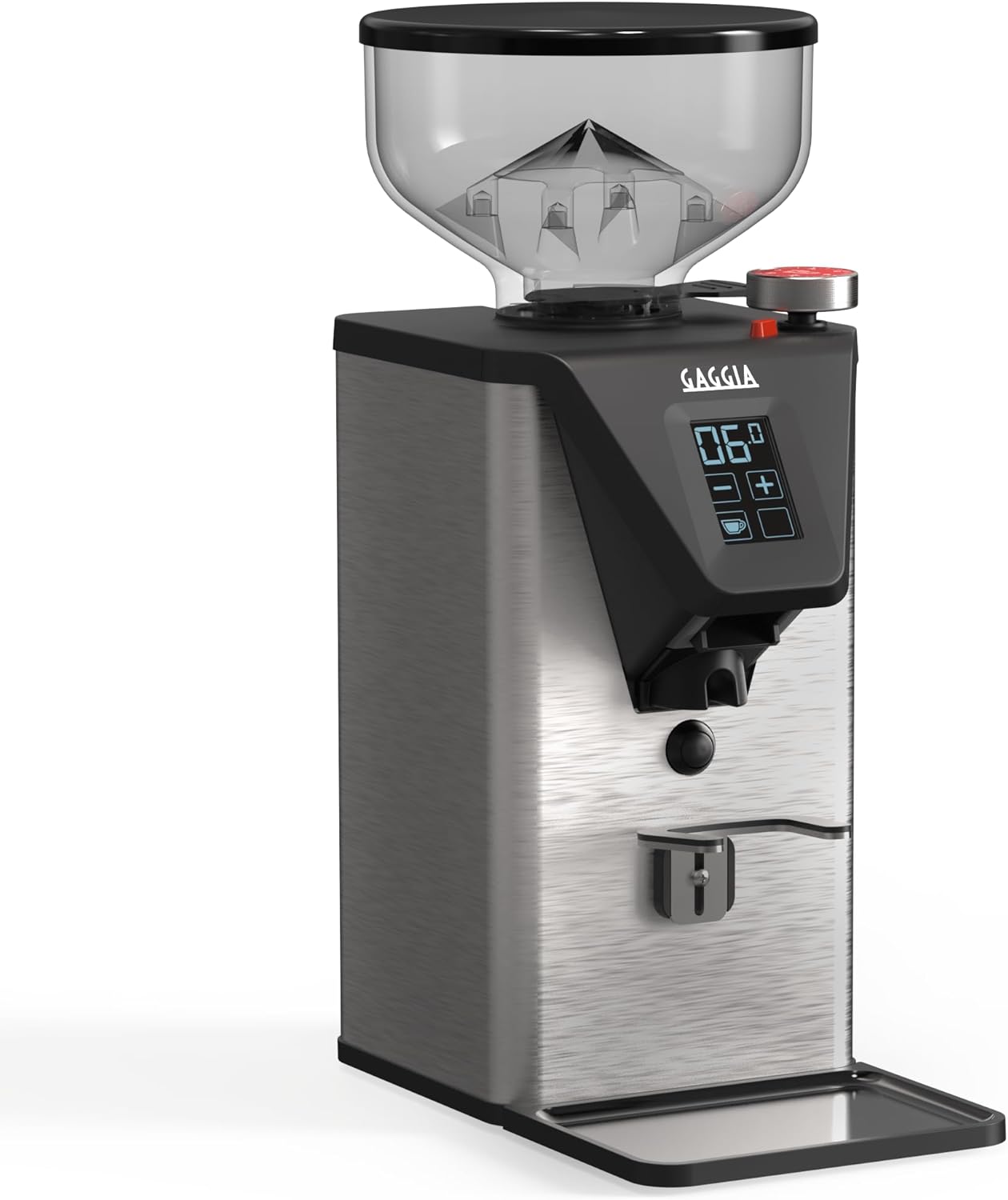
Gaggia MDF 55 Espresso & Coffee Grinder
- 55 mm flat hardened-steel burrs
- Stepless micrometric grind dial
- Touchscreen single/double dosing
- Adjustable portafilter fork
- Approx. 250 g bean hopper
- Italian aluminum construction

Cuisinart One-Touch Automatic Burr Grinder (DBM-8BKSP1)
- 18-position grind selector
- 4–18-cup slide quantity dial
- One-touch start/automatic stop
- Removable 8 oz bean hopper
- Grounds bin rated to 32 cups
- DBM-8BKSP1 retail variant
A glance at the adjustment column gives away the central difference. The OXO, KRUPS, Mr. Coffee, and Cuisinart offer repeatable marked positions; the Gaggia is stepless. That is not a flaw in Gaggia. Espresso often benefits from the ability to move continuously between two points where a click-based grinder may give only one jump. The same freedom can feel inconvenient when a family wants to switch from espresso to French press and back without rechecking the setting.
Two other distinctions matter before buying. The fifty-gram OXO hopper is intentional compactness, while the larger receiving and bean compartments of the Cuisinart are geared toward a different daily volume. Cup and timer controls simplify operation but do not tell you exactly how many grams ended up in the brewer. A small kitchen scale is still the easiest way to keep a recipe repeatable.
Quick Ranking: How Simple Is Each Grinder to Adjust?
| Rank | Grinder | Mechanism | Adjustment | Best buyer |
|---|---|---|---|---|
| 1 | OXO Brew Compact Conical Burr Coffee Grinder | Stainless-steel conical burrs | 15 main settings + 29 micro-adjustments | The best simple-adjustment choice for drip, pour-over, and French press when counter space is limited: a compact manual dial on an electric burr grinder, a 50 g hopper, and easy access to both burrs. |
| 2 | KRUPS Precision Electric Burr Coffee Grinder | Flat burr grinding discs | 12 major positions + micro-adjustments | A flat-burr option that balances familiar cup-based operation with intermediate adjustment, making it an approachable choice for households alternating between drip and pour-over. |
| 3 | Mr. Coffee Automatic Burr Mill Grinder | Electric burr mill | 18 stepped grind settings | A straightforward eighteen-position burr mill for people moving beyond blade chopping and making conventional drip, press, or cold-brew coffee without expensive controls. |
| 4 | Gaggia MDF 55 Espresso & Coffee Grinder | 55 mm flat hardened-steel burrs | Stepless micrometric control | A genuinely espresso-first grinder with 55 mm flat burrs, touchscreen timed dosing, and an infinitely variable micrometric dial—not the stepped system described in some older comparisons. |
| 5 | Cuisinart One-Touch Automatic Burr Grinder (DBM-8BKSP1) | Electric burr mill | 18-position stepped selector | A familiar eighteen-step one-touch grinder with a slide-based quantity control and a generous grounds receiver; an approachable design that deserves careful model-version naming. |
What Makes a Coffee Grinder Easy to Adjust?
An easy grinder is not necessarily the one with the fewest available settings. It is the one with a control system that matches the brewing method. I find a numbered or clicked collar more approachable for the average drip and French press household. Small intermediate adjustments matter more to people who frequently tune pour-over. Espresso brings a different requirement: a tiny change in grinding resistance can dramatically change shot flow, making continuous stepless control attractive even though it is harder to return to an exact previous position.
Bean type and brew recipe remain part of the picture. A medium-roast coffee can taste thin at a setting that works beautifully for a darker roast. Grind position, dose, water temperature, and brew time interact. I establish one repeatable recipe before changing a grinder setting and then alter one variable at a time. A clear dial helps me observe that change. It does not make every coffee taste identical or replace the need to brew carefully.
Five Detailed Coffee Grinder Reviews
1. OXO Brew Compact Conical Burr Coffee Grinder
The OXO Compact makes one of the strongest arguments for buying less grinder, not more. Its slim body leaves the kettle and brewer room on a crowded counter, while its adjustment dial still covers the everyday movement from a finer paper-filter recipe to a coarse French press. I rank it first because a clear dial, a modest hopper, and convenient maintenance matter more to most households than an intimidating display. This is the choice that makes changing brewers feel like a small adjustment rather than a new hobby.
The important distinction is that this is the Compact OXO, not the larger Conical Burr model with the remembered digital timer and twelve-ounce hopper. Here the bean capacity is fifty grams, both burrs can be removed, and the mechanism is arranged without the conventional discharge chute. Those differences have consequences for storage, cleaning, and how much coffee can be prepared in one cycle. The interface stays deliberately straightforward.
What fifteen settings plus micro-adjustments really offer
The fifteen main numbers serve as landmarks. A housemate can return to the familiar drip position without remembering a complicated adjustment ritual, and the twenty-nine intermediate points make it possible to change the result when one large step seems excessive. That combination is useful for pour-over, where a subtle change in grind may alter the way the bed drains. The numbers are not calibrated to a universal particle size, so a recipe from another grinder cannot be copied by using the same printed value.
The fifty-gram capacity is more deliberate than restrictive
Fifty grams is plenty for many everyday brews, especially a twenty-gram dripper or a thirty-gram French press. It does not turn the OXO into a high-volume batch appliance. A household preparing a very large carafe may need another fill or a different grinder. The small hopper also encourages reasonable bean storage habits: I prefer keeping the bulk of the coffee in a sealed container instead of leaving half a bag in a plastic hopper exposed to kitchen warmth.
Why its cleaning access matters
The compact construction has no conventional extended grounds chute, and both burrs are removable. That makes the coffee path more accessible than designs where old grounds disappear into a narrow hidden passage. Accessible is not the same as maintenance-free. Fine coffee dust can still gather around the burr carrier, and a receiving container still needs emptying and wiping. I focus on dry brushing with the appliance disconnected and follow its manual for any parts approved for washing.
OXO Brew Compact Conical Burr Coffee Grinder
The best simple-adjustment choice for drip, pour-over, and French press when counter space is limited: a compact manual dial on an electric burr grinder, a 50 g hopper, and easy access to both burrs.
- A genuine compact electric burr grinder
- Repeatable marked settings with finer intermediate control
- Removable upper and lower burrs simplify cleaning
- 50 g capacity suits most single or two-person brews
- Not designed for precise unpressurized espresso dialing
- A 50 g hopper is small for large family batches
- No electronic saved-dose timer on this compact model
- Some fines and static are still possible
Technical Specifications & Daily Features
- OXO Brew Compact Conical Burr Grinder
- Stainless-steel conical burr grinding mechanism
- 15 numbered positions with 29 additional micro-adjustments
- 50 g whole-bean capacity; separate grounds container with pouring spout
- Chuteless construction; removable upper AND lower burrs
- Approximate dimensions 10.75 × 3.75 × 3.75 inches
- Approximate listed weight 2.95 pounds
- Electric countertop device; no integrated weight scale
- Compact model uses a direct electric control rather than the larger model’s remembered timer
Pros & Cons After 30 Days of Use
The first-month priorities are remembering the settings for two brewing methods and observing whether the extra micro-adjustments make those recipes easier to fine-tune. The small hopper works well with measured single doses, but it creates an extra refill step for large carafes. That is a capacity trade-off, not a grind-quality defect.
The removable upper and lower burrs also change the cleaning equation. Owners can inspect more of the coffee path instead of relying on guesswork about hidden grounds. The meaningful drawbacks to monitor are static, the ease of emptying the receiver, and whether switching beans leaves small residues behind. Those details matter more than sweeping claims about uniformity.
My Final Verdict
OXO Brew Compact is my best overall recommendation for simple everyday adjustment. Its fifteen main positions, twenty-nine micro-adjustments, and small cleanable grinding assembly make sense for filter-coffee households. It is not my choice for someone seeking espresso-specific fine tuning or a large automatic batch system.
A clear fit for filter coffee, with an espresso limitation
Pour-over, drip, AeroPress, and French press are the practical strengths of this grinder. There is ample reason to expect useful changes in those brewing regions without pretending it is a dedicated espresso machine accessory. Espresso with a traditional single-wall basket can require much smaller, precisely calibrated changes than a general-purpose grinder comfortably provides. For an espresso-first home, the Gaggia farther down this article is a more logical machine despite being much more complex.
Handling grounds without decorating the counter
A grounds cup with a built-in pouring spout makes it easier to move a weighed dose into a paper dripper or French press. I still approach the pour slowly, because freshly ground coffee can cling to any plastic surface in dry weather. The most sensible anti-mess routine is simple: place the receiver fully, allow the grinder to stop, tap it gently, and clean loose particles after each session. I do not recommend introducing moisture to a powered grinder unless its instructions allow that technique.
The compact counter-space advantage
At roughly eleven inches tall and four inches wide, this is a machine that can remain beside a brewer in an apartment, dorm kitchenette, or small family kitchen. Storage and daily access are easier than with a large espresso-focused grinder. The compromise is worth making when most drinks are filter coffee and the household prepares one or two portions at a time. There is little benefit in buying a towering hopper and professional portafilter fork for a morning paper filter.
The useful first-month ownership checkpoints
A new owner benefits from noting one reference setting for a familiar coffee and leaving the water and dose unchanged while making small adjustments. In the first month, the most revealing questions are whether the dial returns to a repeatable point, whether the fifty-gram capacity matches the typical batch, and whether both removable burrs make ordinary cleaning manageable. They are useful ownership checks that complement the brewing results in the cup.
Who gets the most value
OXO Compact belongs in a kitchen where ease of adjustment means every member of the household can change from drip to French press without creating confusion. It is a stronger fit for that job than Gaggia’s stepless espresso control and a more space-conscious option than the older entry-level burr mills. The most obvious reason to pass is a daily espresso routine demanding fine incremental calibration, followed by genuinely large batches that exceed the small hopper’s comfortable volume.
2. KRUPS Precision Electric Burr Coffee Grinder
KRUPS fills the space between a basic eighteen-step burr mill and a professional grinder built around espresso. The Precise model uses flat burr discs and a set of twelve major grind-size positions with finer adjustments between them. It has a familiar household interface rather than a digital workstation. Its strongest audience is someone who brews pour-over on weekends, drip during the week, and French press when guests are visiting.
There is some confusion about the setting count, so I separate the main marked steps from the intermediate positions. Calling it a twelve-position grinder alone misses the extra tuning available; calling it thirty-nine independent large stops obscures the underlying adjustment design. For buyers, the distinction matters much more than the headline number. A repeatable range around the filter settings is more useful than a large count with no clear reference.
Understanding the twelve main grind positions
The major marks act as landmarks for common brewing methods. Starting at a central filter setting and moving one numbered stop is easy enough for beginners to understand. Additional micro-adjustments between those marks support finer correction when a dripper drains too quickly or a press produces a heavy layer of sediment. The useful habit is to record the major position and the intermediate offset together. That keeps a repeatable recipe from becoming a vague memory.
Flat burrs are not an automatic flavor guarantee
The machine uses flat grinding discs, which differ mechanically from the conical systems in the OXO and Gaggia’s competitor categories. Burr shape alone does not promise more clarity, body, or sweetness in every cup. Alignment, bean density, roast level, and brew technique affect the finished result. What the KRUPS gives the user is deliberate adjustment and a burr mechanism instead of random blade chopping. That is enough to make a meaningful everyday recommendation without treating every roast as if it produced the same cup.
Where filter-coffee refinement is useful
A pour-over recipe can change noticeably when the coffee bed drains thirty seconds differently from the previous attempt. Moving slightly finer may improve a thin underextracted cup; moving coarser can help when a bitter or slow-draining brew suggests excessive fines or long contact time. With the KRUPS, the intermediate adjustment is the feature that makes these small corrections practical. I still keep dose, water, and pouring method steady during the comparison so a change in grind has a clear purpose.
KRUPS Precision Electric Burr Coffee Grinder
A flat-burr option that balances familiar cup-based operation with intermediate adjustment, making it an approachable choice for households alternating between drip and pour-over.
- A useful middle ground between basic and specialist controls
- Flat burrs support deliberate brewing adjustments
- Intermediate adjustment helps tune filter recipes
- More than one everyday brewing style fits its range
- Not a touchscreen or a weight-based dosing grinder
- Retail counts of total positions differ from major stops
- Dedicated espresso dialing remains a separate task
- Grinding chamber still needs periodic brushing
Technical Specifications & Daily Features
- KRUPS Precise Coffee Grinder, GX550850 family
- Flat burr grinding discs rather than a conical burr mechanism
- 12 major grind sizes with intermediate micro-adjustments
- Main steps plus intermediate selection points; total counts may be described differently
- Electric cup-selection grinding control
- Intended use: drip, French press, cold brew, pour-over, and fine brewing experiments
- Removable hopper/collection components for routine care
- No integrated gram scale; no touchscreen or automatic weight dosing
- Follow model-specific brush and dry-care directions
Pros & Cons After 30 Days of Use
A useful first-month check is the ease of returning to a setting after changing from press to pour-over. Recording major positions and intermediate offsets prevents avoidable recipe confusion. A timed or cup-oriented run should be compared with the actual grounds weight rather than taken as a laboratory dose.
The other ownership priorities are manageable static, cleaning near the flat-burr surfaces, and whether the extra control provides a meaningful advantage over a basic dial. This is an everyday mixed-brewing machine, not a substitute for Gaggia’s espresso-centered stepless mechanism.
My Final Verdict
KRUPS Precision is my choice for a household that regularly changes brewing methods and benefits from filter-coffee tuning. Twelve major positions with intermediate adjustment are easy to learn yet sufficiently flexible for drip, press, and pour-over. It is less compelling as a dedicated single-wall espresso grinder.
The difference between setting a dose and weighing it
The cup selector offers convenience for a familiar volume of coffee. It does not identify how many grams reached the bin, nor can it compensate perfectly for a new roast. I use a separate kitchen scale when precision matters and consider the grinder’s automated cycle a way to save repeated button presses. This matters especially when different household members describe a cup very differently: a four-ounce serving is not the same as a fourteen-ounce travel mug.
What this model does not replace
KRUPS can reach fine grind regions, but a devoted espresso owner should examine whether its adjustments are fine enough for a particular machine and basket. Traditional espresso asks for small repeatable changes around the point where water flow becomes sensitive. Gaggia’s stepless control is designed around exactly that challenge. KRUPS offers much stronger value as a mixed-method family grinder than as a substitute for every specialist espresso machine accessory.
Cleaning the flat-burr path
A grinder with a removable hopper and accessible burr area is easier to maintain than one with no serviceable access. That does not mean loose grounds never collect near the chute or around the receiving cup. I brush accessible parts with the machine disconnected, wipe the bin, and avoid unapproved liquids in the grind chamber. Changing from an oily dark roast to a delicate lighter bean makes the value of a clean coffee path especially obvious.
How it fits a shared kitchen
The reason to choose KRUPS is that several brewing methods can share a single electric machine without requiring a complex learning process. One person can leave a note for drip, another for pour-over, and the grinder can be returned to the previous range. That is easier than learning a stepless espresso collar, even if the latter gives theoretically finer control. KRUPS is more of a practical brewing partner than a precision instrument demanding attention.
The question that decides its value
The meaningful test of ownership is whether those intermediate positions are being used to improve a familiar brew. If the household never moves away from one drip setting, the simpler Mr. Coffee may be enough. If the brewer frequently tries different beans and pour-over recipes, the additional control earns its place. I favor the KRUPS as the all-rounder for exactly that mixed-method home rather than pretending it wins every single brewing category.
3. Mr. Coffee Automatic Burr Mill Grinder
Mr. Coffee offers the kind of adjustment scheme that never needs an explanation longer than a minute. Eighteen marked positions are visible at the hopper, the collection bin is separate, and the grinder stops after a selected quantity cycle. Its value is strongest for people replacing an inconsistent blade grinder who mainly make drip or press coffee. A practical burr grinder at an approachable level can have a bigger impact on a household’s morning than a prestige machine loaded with options nobody uses.
It is important to separate clear controls from specialist precision. An eighteen-step dial helps repeat the same coarse or medium grind, but it does not provide the exceptionally small fine-end changes demanded by unpressurized espresso. The cup selector is a convenience label rather than an integrated balance. This machine makes sense when basic repeatability and a familiar workflow are the priorities.
A simple dial that a whole household can share
The most useful feature is the ability to return to the same grind region. Someone who brews French press can turn toward coarse, while a drip-coffee drinker can choose the middle of the range and remember the position for tomorrow. That is a practical improvement over blades, where grinding for a few extra seconds changes a mixture of coarse fragments and fine powder without a mechanical reference point. Marked adjustments do not guarantee perfection, but they make controlled learning possible.
Where an eighteen-position grinder performs most naturally
The comfortable brewing territory is drip, press, and similar methods where the user can make a small number of clear changes and judge the resulting flavor. At the fine extreme, the grinder still needs to produce grounds that flow appropriately for a specific brewer. Espresso shots made with a demanding nonpressurized basket may expose a limitation of the coarse step spacing. An advertised fine label is not evidence that the machine can dial a fifteen-second change in shot flow with the delicacy of a specialist espresso grinder.
Cup settings do not measure coffee by grams
A quantity selector can start the machine for a familiar amount of coffee, but a manufacturer cup may be much smaller than the mug used in a modern kitchen. Roast density and grind setting affect how much coffee passes through the burrs during a cycle. A basic scale remains a useful companion for a repeatable pour-over recipe. I treat the automatic stop as an ergonomic benefit rather than as a guarantee of a precisely weighed dose.
Mr. Coffee Automatic Burr Mill Grinder
A straightforward eighteen-position burr mill for people moving beyond blade chopping and making conventional drip, press, or cold-brew coffee without expensive controls.
- Obvious grind adjustment without complex menus
- Practical entry to burr grinding for everyday brewing
- Cup-oriented quantity control suits basic household routines
- Removable pieces offer accessible everyday cleaning
- Coarse and medium brewing are its clearest strengths
- Cup selection is not a weight measurement
- Entry-level burr geometry produces some fines
- Static and grinder noise can be noticeable
Technical Specifications & Daily Features
- Mr. Coffee Automatic Burr Mill, BVMC-BMH23-RB-1 model family
- Household electric burr grinder with removable bin
- 18 custom grind settings covering fine through coarse
- Powered burr mill; not a blade chopper
- Cup-oriented grinding selection and automatic stop
- Removable bean hopper and collecting chamber
- Household filter and French press focus
- No built-in gram scale or espresso micrometric control
- Unplug before cleaning; use dry burr-care methods specified for this model
Pros & Cons After 30 Days of Use
Over the first month, the valuable ownership habits are recording the settings for one drip and one press recipe, weighing several cup-selector outputs, and watching for grounds that cling to the receiver. The cup selector simplifies the routine but does not replace a scale.
The likely friction points are the static-prone collecting chamber, cleaning around the burr area, and the limited resolution at espresso-fine settings. Those are more useful to understand than an unsubstantiated claim that every grind is identical.
My Final Verdict
Mr. Coffee Automatic Burr Mill is the budget pick for uncomplicated drip and French press routines. Eighteen visible settings and automated cycle control give newcomers a sensible step up from a blade grinder. Espresso-focused households should choose a machine with finer and more deliberate adjustment.
Static, noise, and the ordinary mess
Plastic receiving chambers can gather static, especially in dry kitchens. A little loose coffee may appear when removing the container, so a small brush is a useful countertop companion. The motor also makes the normal mechanical sound of a burr mill; this is not the quietest route to an early-morning brew. The manual JavaPresse-style solution is quieter but requires more effort, while this electric machine makes multiple servings with less physical work.
Cleaning without damaging the burr mechanism
The hopper and collecting cup can be handled separately, which helps when loose grounds build up. Burr surfaces and the motor housing should never be treated like ordinary washable dishes. Before cleaning, power must be disconnected and any accessible grind mechanism brushed according to its instructions. Coffee oils from dark roasts can gather more quickly than expected, so maintenance depends on use and the beans rather than an inflexible once-a-month schedule.
Why this is a real upgrade over a blade grinder
A blade appliance continuously chops beans at unpredictable sizes. A burr mill makes the grind size a setting instead of a guess about chopping duration. That changes how easy it is to learn what a particular coffee needs. It does not eliminate fines or guarantee a café-grade cup by itself, but it gives a regular household brewer a clearer path to better extraction. For many beginners, that is the precise improvement worth paying for.
The biggest thing to monitor after purchase
After several weeks, ease of operation is likely to matter more than the full breadth of the eighteen positions. A daily drip user may settle on just two or three. The meaningful ownership questions are whether the bin empties neatly, the selected quantity produces a useful amount of coffee, and the coarse/medium stops are easy to revisit. Those points tell the owner whether a budget grinder is earning its counter space.
Best buyer and reason to look elsewhere
Choose this model for an uncomplicated household coffee maker, regular French press, or casual weekend cold brew. Those recipes reward a deliberate grind setting without demanding tiny espresso adjustments. The OXO Compact is a better use of space for especially small kitchens. The Gaggia is the obvious step up for serious espresso work. There is no reason to turn the Mr. Coffee into a tool for a brewing method it was not designed to specialize in.
4. Gaggia MDF 55 Espresso & Coffee Grinder
The Gaggia MDF 55 stands apart because it solves a different problem. The first three grinders are designed for recognizable positions and uncomplicated household brewing. Gaggia adds professional-style control for people whose espresso extraction changes dramatically with a tiny movement of the grind dial. Its fifty-five-millimeter flat steel burrs, touchscreen, and adjustable portafilter fork make sense next to a capable espresso machine. Those are substantial benefits, but they do not make it the simplest choice for an occasional French press.
The biggest factual distinction is its adjustment mechanism. MDF 55 is stepless, not stepped. The dial moves micrometrically through a continuous range, which is excellent for matching grind resistance to an espresso basket but less obvious for a family sharing one grinder and frequently switching between distant methods. This is an important exception inside a simple-adjustment guide: the interface is organized, yet the grind control favors precision over memorizing clicks.
Why stepless control is important for espresso
Espresso is highly sensitive to grind distribution because the ground coffee forms a compact bed resisting pressurized water. A small adjustment can change how a shot flows, even when the coffee mass and preparation remain constant. A continuous micrometric knob gives the barista room to make those small changes without jumping between predefined steps. The advantage is control, not guaranteed cup quality. The machine still needs good beans, a suitable basket, sensible dosing, and consistent distribution.
The simple-adjustment trade-off
Continuous control has an obvious drawback for people who regularly switch between French press and espresso: there are no discrete clicks to count back. A marked dial can help, but the best method is to note reference positions and accept that moving away and returning may require fine correction. For a household primarily making drip and press, the OXO’s visible stepping is easier to teach. Gaggia earns its position as the espresso specialist, not as the least complicated grinder on the counter.
What fifty-five-millimeter flat burrs change
The large flat hardened-steel burrs provide a serious grinding mechanism for an espresso-oriented machine. Burr diameter affects grinding geometry and potential throughput, but it does not prove that every shot tastes brighter or has a precise concentration of fines. Real extraction depends on the coffee and the complete setup. The meaningful reason to value the burrs here is their integration with fine adjustment and a motor intended for repeated grinding. It is a cohesive espresso workflow rather than an isolated specification.
Gaggia MDF 55 Espresso & Coffee Grinder
A genuinely espresso-first grinder with 55 mm flat burrs, touchscreen timed dosing, and an infinitely variable micrometric dial—not the stepped system described in some older comparisons.
- Very fine continuous control for espresso dialing
- Touchscreen timed single/double-dose workflow
- Adjustable portafilter fork and anti-clumping path
- Useful range extends beyond espresso to other methods
- It is stepless, not a click-by-click grinder
- Returning to an exact position takes careful note-taking
- Substantially larger and more expensive than the simple models
- Timed settings still do not weigh the dose
Technical Specifications & Daily Features
- Gaggia MDF 55 espresso and coffee grinder
- 55 mm hardened-steel flat burrs
- TRUE STEPLESS micrometric adjustment; infinitely variable setting rather than clicked stops
- Touchscreen single-shot, double-shot, and on-demand modes
- Adjustable portafilter fork with protective covering
- Approximate 250 g hopper capacity in Gaggia technical information
- Aluminum body; approximate weight 5.5 kg
- Approximate dimensions 135 mm W × 340 mm H × 225 mm D
- 310 W motor design; electrical variant must match local mains
- Timed dosing, without an integrated weighing scale
Pros & Cons After 30 Days of Use
The relevant first-month ownership considerations are micrometric dialing, timed output versus actual weight, adjustment consistency as beans age, and the ease of using the portafilter fork. The resulting routine is about measured dose, careful adjustments, and keeping the machine clean.
Switching repeatedly to coarse coffee and back can be less convenient than on a click-based grinder. This is not a defect in the Gaggia. It is the direct trade-off of a continuous espresso adjustment, and it deserves attention before deciding that this is the best grinder for every home.
My Final Verdict
Gaggia MDF 55 is the espresso specialist among these five, not the most intuitive click-adjustment grinder. Its stepless micrometric control, 55 mm flat burrs, and timed portafilter workflow are persuasive for a serious espresso setup. OXO remains the easier all-purpose everyday pick.
Touchscreen dosing and a portafilter fork
The display supports single and double timed portions, while the adjustable fork helps position a portafilter under the grind outlet. That saves awkward transfer steps when preparing espresso in a compatible basket. The same timing caution applies here as in less expensive grinders: selecting a duration does not mean an exact gram weight has been delivered. I keep a scale nearby for dialing in shots and treat the touchscreen presets as repeatable starting points that may need adjustment when beans change.
A grinder built for the espresso station
A machine around 5.5 kilograms with an aluminum housing is not meant to be put away after each cup. It belongs on a stable countertop beside the espresso machine, with room to reach the hopper and clean the fork. That changes how I judge value. Counter space and operating noise matter, but precision and daily convenience for espresso users matter more. A small apartment occupied by a single pour-over brewer has little reason to make this investment.
Maintenance of a more elaborate grinding path
A more capable espresso grinder carries a more deliberate cleaning routine. Fine grounds can collect around the discharge path and portafilter fork; darker roasted oils can complicate the movement of old coffee through the chamber. I keep the area dry, brush accessible surfaces in accordance with the manual, and avoid claiming that anti-clumping features eliminate retention completely. The goal is to reduce stale carryover and keep daily dosing predictable, not to create the impossible promise of a perfectly spotless grinder.
What the first month teaches an espresso owner
The useful ownership record is not the number of shots produced but how quickly the grinder can be adjusted when a bean ages or a roast changes. Small changes in flow, dose, and shot time become easier to diagnose when the barista adjusts only one variable at a time. The touchscreen reduces repeated input, while the stepless collar provides the fine control. Owners should also monitor grounds retention, fork fit, and whether the machine occupies a sensible amount of counter space.
An excellent grinder for a narrower buyer
I recommend Gaggia MDF 55 to the home espresso enthusiast who values continual refinement and accepts the attention a stepless adjustment demands. It can grind for other methods, but someone switching daily from a coarsest press setting back to exact espresso may find that movement less convenient than using separate equipment. The machine’s strongest selling point is the quality of the adjustment system for espresso, not a claim that more expensive always means easier.
5. Cuisinart One-Touch Automatic Burr Grinder (DBM-8BKSP1)
The Cuisinart Supreme Grind family has remained recognizable for years because the operating idea is so simple: turn the grind selector, move a slider for quantity, and press the power bar. That layout is a reasonable fit for someone preparing a full drip carafe before work. This retail variation is labeled DBM-8BKSP1, and I keep that identity separate from the original DBM-8 model. Similar photographs and almost identical model names should not lead to unsupported claims about the age or exact contents of every retail package.
The original DBM-8 is discontinued, while the DBM-8P1 appears as a separately marketed newer Supreme Grind version. Both follow the same broad concept of eighteen grind positions and a familiar cup-oriented control. That makes the family relevant to a simple-adjustments comparison, but it also makes precise model matching important when buying replacement parts or comparing older reviews.
The selector makes the operating sequence obvious
The Cuisinart does not ask users to choose between half a dozen menus. One part of the interface sets coarseness and the other selects a rough cup quantity. The power bar starts the cycle, and automatic stopping finishes it. Someone making drip coffee at six in the morning can remember the routine without consulting a screen. Its appeal is not a rare technical innovation. It is that the everyday sequence has very few opportunities to become confusing.
Why the eighteen steps are appropriate for filter coffee
The numbered grind positions cover a wide range from finer coffee to relatively coarse brewing. Drip and French press need a repeatable region, not endless espresso adjustments. I favor starting at a middle or coarse setting and changing it only after checking flavor and extraction. A dial marker gives the household a shared point of reference. The limit is in the fine end: small corrections to an unpressurized espresso shot may exceed what its broad steps offer.
A large hopper is not a freshness system
The eight-ounce bean reservoir is convenient when several people drink coffee each day. It eliminates constant refilling, but it also makes it tempting to leave whole beans exposed to oxygen, light, and warmth. I prefer storing most beans properly and adding what the current brewing routine needs. The roomy grounds receiver is more useful for handling several cups, although ground coffee should still be brewed promptly instead of being stored in the collection bin.
Cuisinart One-Touch Automatic Burr Grinder (DBM-8BKSP1)
A familiar eighteen-step one-touch grinder with a slide-based quantity control and a generous grounds receiver; an approachable design that deserves careful model-version naming.
- Very straightforward stepped selector and sliding dose control
- Eight-ounce hopper supports family coffee routines
- Large grounds chamber is useful for batch brewing
- A classic layout with removable collection pieces
- Not built for precise espresso micro-adjustments
- Can generate fines and static during grinding
- Original DBM-8 generation is discontinued; variants differ
- Cup markings do not indicate grams of coffee
Technical Specifications & Daily Features
- Cuisinart DBM-8BKSP1 retail variation
- Cuisinart Supreme Grind family with eighteen grind positions
- 4–18-cup quantity slide dial and one-touch start
- Automatically ends timed grinding cycle
- Removable approximately 8 oz bean hopper
- Removable collecting chamber rated for grounds equivalent to up to 32 cups
- Original DBM-8 is discontinued; newer DBM-8P1 family is separately sold
- Burr grinding mechanism; not a blade grinder
- Not a micrometric espresso-focused model and no built-in scale
Pros & Cons After 30 Days of Use
The practical first-month priorities are learning what the quantity slide delivers in grams, finding the grind setting for the family coffee maker, and keeping the large grounds chamber clean. The capacity helps regular batch brewing but also means more surfaces can accumulate stale fragments.
A second issue is model clarity. The original DBM-8 and newer family variants should not be treated as automatically identical when replacement parts are needed. In daily use, automatic stop and visible grind settings are genuine conveniences, while fine espresso precision remains outside the machine’s strongest role.
My Final Verdict
Cuisinart Supreme Grind DBM-8BKSP1 is a sensible classic for basic batch coffee and no-nonsense stepped settings. Its 18-position selector and slide-based quantity control serve drip and press routines well. Buyers should distinguish the exact retail variant from the discontinued original DBM-8 and should not expect specialist espresso control.
The slide is a quantity guide, not a precision balance
Choosing four, ten, or eighteen cups gives the machine a sensible operating target. It does not calculate the exact weight of the coffee flowing into the bin. Roast level, grind setting, and hopper condition may change how much ground coffee results from a cycle. The best habit is to learn the actual dose for the household coffee maker using a scale once, then use the slide to simplify the routine. Convenience and precision can coexist without pretending they are the same thing.
How the Cuisinart and Mr. Coffee differ
Both grinders make their biggest argument through familiar stepped controls. Mr. Coffee occupies the budget-upgrade end of the comparison, while the Cuisinart has a pronounced cup slider and large collecting chamber. Neither should be described as a specialist espresso device. The stronger decision criterion is the actual space available, the typical batch size, parts support for the exact model, and whether the grounds receiver is comfortable to empty without scatter.
Static and grounds retention deserve realistic expectations
Like other entry-level mills, the Cuisinart can leave loose coffee near the outlet and attract fine dust to the container. Static changes with humidity, roast, and the material of the receiving chamber. I do not promise that a quick tap eliminates every fragment. A small brush and a dry wiped container help keep an ordinary household counter manageable. Adding moisture to beans or burr chambers should not be treated as universal advice for any electrical grinder.
The difference between old and newer DBM-8 names
Buying the correct replacement hopper or collecting chamber depends on the exact model and variant. The original DBM-8 is listed as discontinued, while the DBM-8P1 family remains separately marketed. A retail identifier such as DBM-8BKSP1 may appear alongside similar styling and specifications. It is sensible to match the label on the appliance when sourcing parts. A broad family resemblance does not guarantee every accessory is interchangeable.
Best fit for a batch-brewing home
This is the grinder for a household that makes familiar drip coffee and only occasionally changes to a press. The controls are obvious and the collecting chamber is generous. A single-cup pour-over enthusiast may prefer OXO’s finer intermediate settings and smaller footprint. An espresso-first owner should look at Gaggia or a dedicated espresso grinder. Cuisinart is valuable when plain predictable operation is more important than advanced control.
Buying Guide: How to Choose a Grinder with Truly Simple Adjustments
1. Find the adjustment system that matches your brew
A stepped adjustment offers marked places to return to; a stepless system lets the grinding surfaces move through a continuous range. For drip and French press, a sensible set of clear stops is usually enough. Espresso can be more demanding because a small grind movement may substantially change extraction flow. The OXO and KRUPS emphasize approachable filter control, while Gaggia provides stepless precision. There is no universal ranking of these mechanisms; the brewing method and the user’s tolerance for small adjustments decide which is better.
2. Understand major settings and micro-adjustments
A main stop is not always the smallest available change. The OXO Compact has fifteen main positions alongside twenty-nine micro-adjustments, and the KRUPS has twelve major grind choices plus intermediate control. Reading only the number printed most prominently on the box hides that distinction. For a pour-over brewer, the extra points can be useful when a recipe is close to correct but still runs too fast or too slowly. I prefer a dial whose positions I can record clearly over a large, confusing count.
3. Do not assume a brew label guarantees espresso performance
Espresso asks the grinder to regulate resistance in a compacted coffee bed. A label that says espresso at the fine end is a suggestion about the range, not a guarantee that every basket can be dialed in with enough resolution. Traditional unpressurized espresso usually benefits from dedicated fine-end control. Gaggia MDF 55 is built around that need. The simpler burr mills in this roundup make more obvious sense beside drip machines, pour-over drippers, and French presses.
4. Weigh coffee even if the grinder has a cup selector
A selection marked four cups or eight cups is not the same as a measured coffee mass. Different roasts fracture differently, and a finer setting may dispense a different amount in the same time. I use a scale for the first few doses of a repeatable recipe, note the resulting weight, and then use automatic controls as a convenience. This habit is particularly important when the household’s mugs are much larger than the coffee-maker cups assumed by appliance markings.
5. Pay attention to how grounds leave the machine
A grinder can have excellent adjustment while still creating an untidy countertop if the chute retains coffee or the receiver develops static. I look for a container that seats properly, a clear way to pour the grounds, and surfaces accessible for routine cleaning. OXO’s compact chuteless layout and removable burrs are convenient in this respect. The traditional collection bins in Mr. Coffee and Cuisinart have their own everyday advantages but require regular emptying.
6. Choose the right hopper size rather than the largest
A larger hopper is helpful when brewing a carafe for the family, but it is not a sealed long-term coffee-storage system. The OXO Compact holds up to fifty grams and therefore suits measured household batches. The Cuisinart Supreme Grind family has an eight-ounce bean reservoir and a large grounds chamber for more coffee at once. These are different design priorities. I keep the main coffee supply in a suitable container rather than leave beans exposed to heat and kitchen light for long periods.
7. Expect ordinary grinding noise
Every electric burr grinder makes mechanical noise. The sound depends on the motor, burr geometry, bean type, countertop, and room. I avoid numerical comparisons that have not been measured under the same conditions. A quiet early-morning routine may depend more on a short measured dose and a stable countertop than on an isolated sound claim. For especially noise-sensitive spaces, a manually powered grinder can be more suitable, though it adds physical work.
8. Treat cleaning as a real buying feature
Removable components are useful when coffee dust and oils build up, but their presence does not mean every part belongs in a dishwasher. Burrs and motor housings must be cared for according to the exact machine’s instructions. Regular dry brushing, an emptied grounds receiver, and occasional attention to the hopper help avoid stale residue. Beans that are particularly oily may require more frequent care. I do not recommend random liquids or cleaning products inside a powered burr chamber.
9. Think about household sharing
A grinder in a shared home benefits from an adjustment that can be explained in one sentence. A numbered medium setting on the Cuisinart or OXO is easy to remember, even if it still needs fine tuning after a bean change. A stepless espresso grinder can be more capable but asks users to pay attention to the reference mark and shot response. The best household tool is the one every regular brewer can use responsibly, not the one with the longest technical description.
10. Consider repair parts and version names
The original Cuisinart DBM-8 is discontinued, while newer Supreme Grind versions have their own identifiers. A similar-looking product does not guarantee interchangeable hoppers or collection bins. The same caution applies to OXO’s Compact and standard versions, which differ considerably in bean capacity and controls. Keep the exact model number when ordering parts or comparing product manuals; a family name alone can hide important differences.
11. Match size to where the grinder stays
A compact burr grinder used every morning deserves a space where it can be reached and cleaned comfortably. The OXO Compact can fit where a bigger hopper grinder would dominate the counter. Gaggia’s heavy aluminum espresso machine companion works best as a permanent station fixture. Smaller is not always better; a family brewing several cups may prefer a generous receiving bin over saving a few inches. The relevant dimension is the entire routine, not just the device footprint.
12. Budget for the rest of a repeatable coffee routine
A capable grinder is essential, but a scale, suitable brewer, fresh beans, and consistent water matter too. A household spending most of its budget on complex grinding controls may be better served by a modest burr grinder plus a reliable scale and a good kettle. I prefer investing where the brew will actually improve. The recipe should be simple enough to repeat; the grinder exists to support that habit, not turn a morning drink into a calibration exercise.
A Practical Two-Brewer Setting Routine
I find it easier to evaluate a grinder by preparing two familiar coffees than by touring the entire adjustment range at once. For a paper-filter brewer, begin with twenty grams of coffee and three hundred grams of water. Choose a reasonable medium setting, keep pouring technique consistent, and note the final drawdown time. If the cup is thin and sour, a slightly finer adjustment is one possibility; if it drains painfully slowly and tastes harsh, a move coarser may help. Coffee dose, water temperature, and the bean itself must remain part of the diagnosis.
For a French press, try thirty grams of coffee and five hundred grams of water with a starting coarse-to-medium-coarse grind. An ordinary four-minute steep is a useful baseline, but longer settling methods also work. The key is to avoid moving every variable simultaneously. A little sediment is normal with a metal filter; a thick unpleasant layer may respond to a grind change, gentler agitation, or a more patient pour. That comparison teaches more about the grinder than simply counting how many dial positions it has.
Keep a small note of the two starting settings. The OXO and KRUPS can record main marks and intermediate offsets; Mr. Coffee and Cuisinart have numbered or stepped references; Gaggia demands careful attention to its continuous dial position. If a new bag of coffee behaves differently, start from the familiar reference and make one deliberate correction. A good grind-setting routine is a memory aid, not a rigid rule applied to every roast.
Common Grind-Adjustment Problems and Practical Fixes
The grinder returns to the mark, but the coffee tastes different
A change in roast, freshness, bean density, water, or dose can alter the cup even when the dial is untouched. Keep a consistent recipe and move grind one small step only after deciding what needs improvement.
The pour-over drains too quickly
A slightly finer adjustment can increase contact time, but check whether the coffee bed was evenly wetted and the coffee dose was correct. Make one change at a time so the next brew gives useful feedback.
A French press has excessive sediment
Some fine particles are normal through mesh. Adjust toward a suitable coarse range, reduce aggressive agitation, allow grounds to settle, and pour gently without disturbing the bottom of the brewer.
The cup selector produces different gram weights
Duration and portion estimates are not gravimetric measurements. Beans and grind size affect throughput. Weigh the output, adjust the selected quantity if needed, and keep a short recipe note.
Ground coffee clings to the collecting cup
Static depends on humidity, roast, and contact surfaces. Make sure the receiver is seated, tap gently after grinding, empty carefully, and brush residue away. Do not add liquids unless the appliance instructions permit them.
The dial is difficult to move after changing beans
Check the exact grinder instructions. Some adjustments should be made with the motor running or the hopper empty to avoid binding. Never force a stiff adjustment or open an energized burr chamber.
Espresso shot flow changes too much between clicks
A clicked grinder may not have fine enough spacing for a traditional single-wall basket. An espresso-oriented stepless machine or a grinder with dedicated fine adjustment is more appropriate than repeatedly forcing a broad-step dial.
An older Cuisinart part does not fit a newer model
The DBM-8, DBM-8P1, and retail suffix variants should be identified by their complete appliance label before buying hoppers, lids, or grounds containers. Similar styling does not establish parts interchangeability.
Final Comparison: Burr Type, Adjustability, and Buyer Fit
| Grinder | Burrs | Control | Best fit | Price |
|---|---|---|---|---|
| OXO Brew Compact Conical Burr Coffee Grinder | Stainless-steel conical burrs | 15 main settings + 29 micro-adjustments | OXO Brew Compact is my best overall recommendation for simple everyday adjustment. Its fifteen main positions, twenty-nine micro-adjustments, and small cleanable grinding assembly make sense for filter-coffee households. It is not my choice for someone seeking espresso-specific fine tuning or a large automatic batch system. | Price on Amazon |
| KRUPS Precision Electric Burr Coffee Grinder | Flat burr grinding discs | 12 major positions + micro-adjustments | KRUPS Precision is my choice for a household that regularly changes brewing methods and benefits from filter-coffee tuning. Twelve major positions with intermediate adjustment are easy to learn yet sufficiently flexible for drip, press, and pour-over. It is less compelling as a dedicated single-wall espresso grinder. | Price on Amazon |
| Mr. Coffee Automatic Burr Mill Grinder | Electric burr mill | 18 stepped grind settings | Mr. Coffee Automatic Burr Mill is the budget pick for uncomplicated drip and French press routines. Eighteen visible settings and automated cycle control give newcomers a sensible step up from a blade grinder. Espresso-focused households should choose a machine with finer and more deliberate adjustment. | Price on Amazon |
| Gaggia MDF 55 Espresso & Coffee Grinder | 55 mm flat hardened-steel burrs | Stepless micrometric control | Gaggia MDF 55 is the espresso specialist among these five, not the most intuitive click-adjustment grinder. Its stepless micrometric control, 55 mm flat burrs, and timed portafilter workflow are persuasive for a serious espresso setup. OXO remains the easier all-purpose everyday pick. | Price on Amazon |
| Cuisinart One-Touch Automatic Burr Grinder (DBM-8BKSP1) | Electric burr mill | 18-position stepped selector | Cuisinart Supreme Grind DBM-8BKSP1 is a sensible classic for basic batch coffee and no-nonsense stepped settings. Its 18-position selector and slide-based quantity control serve drip and press routines well. Buyers should distinguish the exact retail variant from the discontinued original DBM-8 and should not expect specialist espresso control. | Price on Amazon |
My Final Recommendation
For a household that wants its grinder to remain simple, OXO Brew Compact is my overall pick. Its small footprint, obvious fifteen-position scale, intermediate adjustment choices, and easy-to-access grinding mechanism all support the daily preparation of drip, pour-over, and French press coffee. A fifty-gram capacity is enough for many household batches and avoids an oversized hopper on a crowded counter. This is the model I favor when the grinder is a useful appliance rather than the centerpiece of an espresso hobby.
KRUPS Precision is the strongest mixed-brewing alternative if intermediate filter adjustment and a familiar larger countertop format are more attractive. Mr. Coffee Automatic Burr Mill gives beginners a straightforward budget route away from blade grinding. Cuisinart Supreme Grind has the clearest batch-coffee simplicity, provided the buyer distinguishes the exact retail version from the discontinued original. Each of those machines is appropriate to an ordinary coffee-maker routine without pretending to supply specialist espresso micrometric control.
For serious espresso, Gaggia MDF 55 is the correct specialist choice of the five. The stepless micrometric dial provides a level of fine control the simpler stepped designs cannot promise. That same feature makes it less convenient as a shared everyday grinder when family members constantly change between very coarse and very fine brewing. Choosing well means deciding which inconvenience is acceptable: learning espresso control or sacrificing precision you genuinely need.
Frequently Asked Questions About Simple-Adjustment Coffee Grinders
Which coffee grinder is easiest to adjust for beginners?
OXO Brew Compact is my first choice for a small kitchen using drip, pour-over, or French press. Fifteen main positions and intermediate adjustments offer a clear reference without a complicated control screen.
Is the Gaggia MDF 55 stepped or stepless?
It is stepless. Its micrometric knob provides continuous adjustment instead of numbered click stops. That is particularly useful for dialing in traditional espresso, but requires more care when returning to a previous setting.
How many settings does OXO Brew Compact have?
The compact grinder has fifteen main settings and twenty-nine micro-adjustments. It is not the same machine as the larger OXO Brew Conical Burr Grinder with a remembered timing control.
How many grams fit in the OXO Compact?
Up to fifty grams of whole beans. That suits many single-cup or two-person brews but can require a second batch for a very large carafe.
Does the OXO Compact have a saved electronic timer?
No saved electronic timer is established for this compact model. The remembered timer belongs to a different, larger OXO Conical Burr Grinder design. Keep the two versions distinct.
Can I remove both burrs from OXO Compact?
Yes. Its upper and lower burrs are removable, and the compact machine uses a chuteless grinding path. Follow the applicable instructions for cleaning and reassembly.
Does the KRUPS Precision model have twelve or thirty-nine settings?
It has twelve major grind positions with intermediate micro-adjustment. Some retail descriptions count the additional choices together as thirty-nine. The useful distinction is main landmarks versus finer in-between control.
Are KRUPS Precision burrs flat or conical?
The GX550850 Precision model uses flat burr grinding discs. Do not confuse it with other KRUPS models that use different mechanisms or controls.
Is the Mr. Coffee Automatic Burr Mill a blade grinder?
No. The BVMC-BMH23 family uses a powered burr mill with eighteen custom grind settings, making it more controllable than a spinning blade chopper.
Can Mr. Coffee grind for French press?
Yes. Coarser positions are suited to French press and similar immersion brewing. A small amount of sediment remains normal with a metal-filter press, and grind size should be adjusted alongside brewing technique.
Can an eighteen-step grinder make espresso?
It may produce fine coffee, but traditional espresso can need smaller repeatable adjustments than a general-purpose eighteen-step burr mill supplies. For espresso-first use, a more specialized grinder is safer to recommend.
Why does a cup selector not guarantee the dose weight?
It estimates a portion or controls an operating cycle rather than weighing the ground coffee. Bean density, grind size, and how beans feed through the machine affect the output.
How many burrs does the Gaggia MDF 55 have?
It uses a matched pair of fifty-five-millimeter flat hardened-steel burrs. The more important espresso feature is the continuous micrometric adjustment that controls their working relationship.
Does Gaggia MDF 55 have a touchscreen?
Yes. It provides programmable timed single and double doses and an on-demand option, alongside the stepless physical grind control knob.
Does Gaggia MDF 55 weigh coffee automatically?
No built-in grind-by-weight system is described for the MDF 55. Its programmable dispensing is timed. A separate scale is useful for dialing espresso doses and monitoring extraction.
Can Gaggia MDF 55 also grind for French press?
Its adjustment range covers multiple brewing methods, including coarser coffee. Frequent switching back to exact espresso fineness may take more work than on a grinder with clearly numbered stops.
Is the original Cuisinart DBM-8 discontinued?
Yes. The original DBM-8 is marked discontinued by Cuisinart. A separately marketed DBM-8P1 version exists, and this retail variation is labeled DBM-8BKSP1. Match the exact model before ordering parts.
Does Cuisinart Supreme Grind have eighteen grind settings?
The Supreme Grind DBM-8 family uses an eighteen-position selector along with a four-to-eighteen-cup quantity slide and one-touch start.
What is the Cuisinart grounds chamber capacity?
The DBM-8 family grounds chamber is described as holding enough ground coffee for up to thirty-two appliance cups. That refers to the chamber, not the separate eight-ounce whole-bean hopper.
Which grinder is best for a full drip carafe?
Cuisinart is convenient for larger familiar batches thanks to its hopper and grounds chamber. Mr. Coffee is another simple option. OXO Compact is a stronger fit when the usual dose is small.
Which grinder is best for pour-over adjustments?
OXO Compact and KRUPS Precision offer intermediate control that makes small changes to pour-over extraction easier than on a simple broad-step dial.
Is flat burr always better than conical burr for flavor?
No. Burr geometry alone cannot predict cup quality. Burr profile, alignment, roast, grind distribution, water, and brewing technique all influence the result.
Is grinding time the same as grind size?
No. Grind size depends on the position of the grinding mechanism. A timing or portion control changes how long the grinder operates or approximates a dose. These are separate variables.
What is the simplest way to record a grinder setting?
Write down the bean, main dial mark, any intermediate adjustment, dose, water weight, and approximate brew time. That is enough to return to a useful recipe when the coffee or brewing method changes.
Should a French press always use the coarsest setting?
Not necessarily. Extremely coarse coffee can taste weak or thin. Start in a suitable coarse region, keep the dose and steep routine stable, and move slightly finer or coarser according to the result.
How often should I clean a burr grinder?
Remove loose grounds frequently, brush accessible burrs and outlets according to the manual, and clean sooner when oily beans build residue. There is no universal interval that works for every machine and usage pattern.
Can I wash the burrs in the dishwasher?
Do not assume so. Electric burrs and motor housings generally need dry care unless the particular manufacturer specifically allows washing a detachable part. Follow the model instructions.
Will coffee static disappear if I use a burr grinder?
No. Burr grinders can still generate static, particularly in dry air. A fitted grounds cup, gentle emptying, regular cleaning, and an appropriate workflow help manage scattered particles.
Is OXO Compact good for espresso?
It is primarily a versatile compact filter grinder. Someone using a demanding single-wall espresso basket will usually benefit from a grinder intended for fine micrometric adjustment.
How can I tell whether my grinder is set too fine?
In pour-over, an excessively slow drawdown and unpleasantly harsh cup may be clues. In French press, excessive sediment can be a sign. Check water, roast, dose, and agitation before blaming the grind alone.


