
5 Best Coffee Grinders for Cold Brew Coffee


OneHundredCoffee is reader-supported, and some products displayed may earn us an affiliate commission. Details
A cold-brew jar can be wonderfully forgiving about the clock, yet surprisingly revealing about the grind. I want a drink with rounded sweetness, enough body to stand up to ice, and a clean finish after filtering. When the grounds contain too much fine powder, the filter may clog and the finished brew can pick up a muddier texture. When the grind is excessively coarse, a short steep can taste thin. A reliable grinder helps me control those variables without forcing every batch into the same rigid recipe.
What matters most is not a giant settings count or a label promising “cold brew.” It is whether a grinder can produce a practical medium-coarse or coarse range, return to a setting predictably, and handle the amount of coffee I actually need. Some people prepare one small bottle before work; others mix a large concentrate for the week. Those are two very different grinder workloads. I also pay attention to the grounds catcher, cleanup, and the distinction between a machine that is merely capable of grinding coffee and one that makes repeated cold-brew batches pleasant. I also distinguish between a grinder that produces grounds for a 25-gram jar and one that stays pleasant when a batch requires four times as much coffee. Cold brew takes patience in the jar, not necessarily at the grinder. Avoiding a tedious grinding routine is part of choosing the right appliance.
Editor’s Picks for Cold Brew Coffee

Baratza Encore Classic
- 40 stepped grind positions
- 40 mm conical steel burr system
- Separate pulse and on/off controls
- Removable upper burr for cleaning
- Brew-focused, not espresso-specialist
- Baratza support and parts ecosystem

Bodum Bistro Premium
- 12 stepped grind positions
- Conical burr mechanism
- Borosilicate-glass grounds catcher
- Timed grinding control
- Approx. 220 g bean hopper
- Compact home countertop design

Handground Precision
- 40 mm ceramic conical burr
- 15 adjustment positions
- Side-mounted aluminum crank
- Up to 100 g hopper per maker
- Glass grounds catcher
- Stabilizing grip pad under base
My first choice among these five is the classic Baratza Encore because it strikes a useful balance between brew-range adjustment and everyday practicality. The Bodum Bistro is especially appealing when clean transfer matters, and the Handground offers a thoughtful manual experience. JavaPresse has its place in a backpack, while the Cuisinart DBM-8 remains a reasonable legacy option for someone who already owns one. They are not interchangeable recommendations: the better choice depends on dose size, how often you brew, and whether you want to grind any coffee besides cold brew.
There is one important product detail in this lineup: the Baratza grinder featured here is the standard white Encore, not the Encore ESP. Those are different models with different strengths. Likewise, the Cuisinart DBM-8 is officially discontinued, which is relevant when buying new equipment. I prefer to make those distinctions clear than let a familiar product name do the work of the recommendation.
Five Cold Brew Grinders at a Glance
Baratza Encore Classic
- 40 stepped grind positions
- 40 mm conical steel burr system
- Separate pulse and on/off controls
- Removable upper burr for cleaning
- Brew-focused, not espresso-specialist
- Baratza support and parts ecosystem
Bodum Bistro Premium
- 12 stepped grind positions
- Conical burr mechanism
- Borosilicate-glass grounds catcher
- Timed grinding control
- Approx. 220 g bean hopper
- Compact home countertop design

JavaPresse Manual
- Ceramic conical burr mechanism
- 15+ marked adjustment positions
- Manufacturer’s coarse starting band: 13–18 clicks
- Slim stainless-steel body
- No outlet or battery required
- Small-batch hand-crank operation
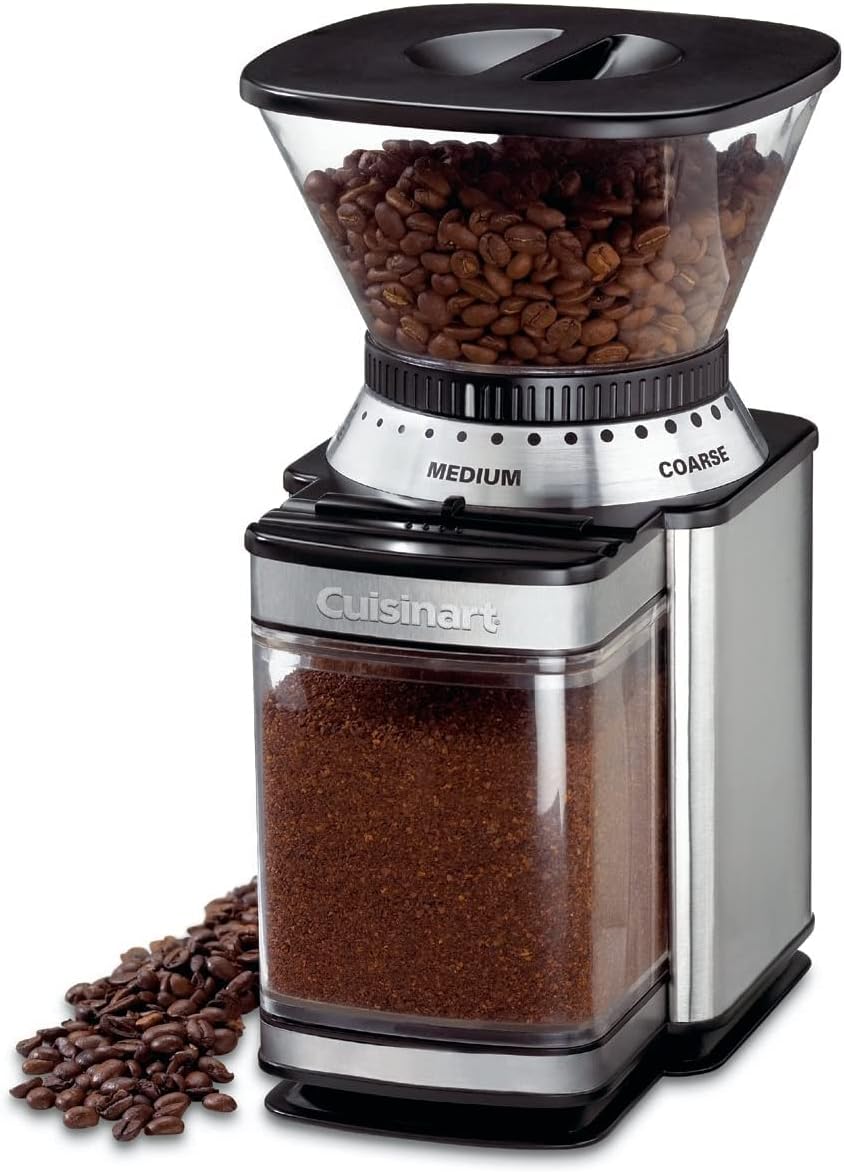
Cuisinart DBM-8
- 18 grind positions
- 4–18 cup quantity slider
- Removable 8 oz bean hopper
- Grounds bin sized for multiple servings
- Automatic shutdown after grinding
- Discontinued model—check availability
Handground Precision
- 40 mm ceramic conical burr
- 15 adjustment positions
- Side-mounted aluminum crank
- Up to 100 g hopper per maker
- Glass grounds catcher
- Stabilizing grip pad under base
Quick Ranking: Which Grinder Fits Your Cold Brew Routine?
| Rank for cold brew | Model | Main advantage | Meaningful tradeoff |
|---|---|---|---|
| 1 — Overall | Baratza Encore Classic | 40 steps and simple brew workflow | No timed or weighed dose |
| 2 — Clean transfer | Bodum Bistro Premium | Glass grounds catcher | 12 settings and fragile glass |
| 3 — Manual control | Handground Precision | External dial and side handle | Manual effort for larger loads |
| 4 — Travel | JavaPresse Manual | Slim, lightweight electricity-free setup | Small-batch hand grinding |
| 5 — Legacy value | Cuisinart DBM-8 | 18 positions and large chamber | Discontinued by manufacturer |
How I Judge a Cold Brew Grinder
I judge the grinder and the brewing setup together. A coarse setting that looks beautiful in a clear bin is not necessarily the one that tastes best after twelve hours in the refrigerator. I look for a grind range that lets me make small, repeatable changes, then keep the bean, coffee-to-water ratio, steeping time, and filtration the same while I evaluate a new position. That prevents me from blaming a grinder for a bitter or thin batch caused by some other change.
The other test of ownership is whether it still feels reasonable once the coffee is ready. A simple 20-gram morning dose tells me little about grinding 100 grams for concentrate, brushing the chute, transferring grounds into a jar, and cleaning the grinder afterward. Those less glamorous details determine whether a tool becomes a trusted part of the kitchen or ends up in a cabinet. I give them at least as much weight as an impressive specification.
1. Baratza Encore Conical Burr Grinder (Classic, White) — Best Overall
The original Baratza Encore is the grinder I place at the front of a cold-brew shortlist because it gives ordinary home brewers a clear route from inconsistent grounds to a reasonably repeatable coarse grind. Its appeal is not that every particle comes out identical—no home grinder can promise that—but that the numbered collar gives you a sensible reference when the next batch tastes different. I like a grinder whose controls help me identify the variable I changed. The Encore makes that process straightforward without adding a bright screen, unnecessary presets, or an espresso-first learning curve.
Why the classic Encore fits a repeatable cold-brew recipe
The Encore earns the strongest all-round recommendation here because its adjustment is uncomplicated and usable for several types of brewed coffee. Forty stepped positions offer a predictable route back to a workable coarse setting. The controls demand little attention, and its replaceable components are an advantage for anyone planning several years of home coffee. I see the tradeoffs clearly too: this is not a grind-by-weight appliance, its chute needs cleaning, and a large batch still takes careful weighing and transfer. Its appeal is dependable everyday control rather than a promise that every batch emerges perfectly clear.
Getting coarse enough without going blindly to the last click
Cold brew has a reputation for needing the coarsest grind a machine can make. I resist treating the highest Encore number as the automatic answer. In a cloth-filtered immersion jar, an aggressively coarse grind can leave the finished coffee surprisingly hollow unless the steep and ratio compensate. I begin in the coarser portion of the scale, compare the particles with coarse sea salt, and make one change at a time. A mesh brewer that lets silt pass will reward a different compromise from a paper-filtered setup. The useful feature here is the stable series of marked steps, not any magic number.
Why an uncomplicated workflow matters
The original Encore uses straightforward physical controls. That sounds ordinary, but cold brew typically calls for significantly more beans than a quick morning espresso shot. I weigh the total coffee first, divide it into manageable batches, run the grinder without forcing beans through the chute, and tap the bin gently before transferring the grounds. There is no built-in scale to tell you what actually arrived in the vessel. That is why a small kitchen scale remains more useful than a cup-count estimate, especially when you want to repeat the same concentrate ratio next weekend.
What I prioritize before choosing the Encore
My deciding questions are practical: how much ground coffee fits the collection bin before I need to empty it, how easily does the chute brush clear, and is a forty-step collar enough control across my cold-brew and hot-filter recipes? The Encore offers a sensible response to all three. It does not dispense weighed portions, so I keep dose control with a separate scale. The benefit is that its mechanical settings are easy to return to after cleaning or changing beans.
Baratza Encore Classic
The strongest all-round starting point for most home cold-brew makers who want clear adjustment and serviceable construction.
- Good range for immersion brewing
- Simple adjustment and familiar layout
- Practical for other filter brew methods
- No programmed dose timer or scale
- Static and retained grounds need attention
- Not the newer Encore ESP model
Technical Specifications & Daily Features
- Model: original/classic Encore, white
- Mechanism: approximately 40 mm conical steel burrs
- Adjustment: 40 numbered grind positions
- Operation: front-mounted pulse switch and side-mounted on/off switch
- Dosing: manual, not grind-by-weight or timed presets
- Hopper: approximately 8 oz / 227 g, subject to regional variant
- Espresso: not designed as a high-resolution espresso specialist
Choose a grind position based on the finished beverage and your filtration method. The advertised number of settings is not a measurement of particle uniformity, nor is a cup-based control a gram scale.
Pros & Cons After 30 Days of Use
Consistency: The Encore’s 40-position adjustment is the primary advantage for cold brew. I favor a repeatable coarse range over pushing every batch to the last click. Changing one setting is more informative when the bean, ratio, and filtering stay the same.
Handling and maintenance: A separate grounds bin and straightforward switch are easy to understand, but coffee can cling in the chute and needs regular dry brushing. Large concentrate batches may need more than one transfer. There is no automatic gram measurement, so a scale completes the workflow.
Ownership limitation: The classic Encore is built around brewed-coffee ranges rather than the very small adjustments demanded by nonpressurized espresso. Those tradeoffs leave it the most balanced cold-brew choice in this comparison.
My Final Verdict
My pick for regular cold brew. The classic Encore makes sense because the adjustment collar gives a usable coarse range and allows a household to reproduce recipes without guessing at the grind each week. The serviceable design is valuable for long-term use.
I prefer the Bodum when catching and transferring grounds neatly is the dominant priority, and a manual grinder only when portability or quiet, electricity-free grinding matters more. For most mixed-method home coffee routines, Encore offers the clearest overall value.
Cup clarity starts before filtration
A grinder can help lower the amount of fine dust, but even an excellent setting will not eliminate sediment if the grounds are stirred aggressively or poured through a wide mesh. With the Encore I look at what collects at the bottom of the grounds bin, whether the coarser particles still show a lot of dust, and how the finished brew behaves after filtering. If the final cup feels gritty, I start with better second-stage filtration rather than automatically turning the collar as coarse as it can go. Grind and filtration solve related—but different—problems.
The limitation I accept
The classic Encore makes more sense as a brew grinder than as a precision espresso machine. Its stepped adjustment is welcome for cold brew, pour-over, and drip, but the same steps can feel too far apart when dialing in a demanding espresso basket. It also needs periodic burr-chamber brushing and a little patience with static. For a household making cold brew every week and hot filter coffee between batches, those tradeoffs are quite reasonable. I do not pay extra for the more espresso-oriented ESP When buying solely for coarse immersion coffee.
The Encore buyer I recommend it to
I recommend the classic Encore for a household making cold brew once or twice a week and drip or pour-over on other days. Its best feature is the ability to find a useful coarse position and reliably return to it. I steer shoppers toward other models when they specifically need a compact hand grinder, a built-in weight display, or very fine espresso adjustments.
2. Bodum Bistro Burr Coffee Grinder with Glass Catcher — Best Glass Catch
The Bodum Bistro earns its place here for a detail that can genuinely change a cold-brew routine: the borosilicate-glass grounds catcher. Anyone who has poured a big dose of dry coffee from a staticky plastic container knows the frustration of grounds clinging to every corner and scattering over the counter. Glass is not an absolute cure, but it is a thoughtful choice. Paired with a familiar dial and a conical burr mechanism, the Bistro offers a manageable way to prepare a jar of concentrate without turning coffee grinding into a separate cleanup project.
The Bodum choice comes down to the catcher
The Bistro is the natural alternative when grounds transfer is the annoyance you most want to eliminate. The borosilicate-glass catcher is pleasant to pour from and offers a different handling experience from common plastic bins. Twelve stepped positions cover ordinary immersion work, although the limited adjustment range is less attractive for a kitchen that alternates between many precise recipes. Glass can break, and the timed control does not measure mass. I recommend the Bistro for modest home batches and an orderly counter—not as a substitute for a kitchen scale or careful filtering.
The glass catcher is helpful, not miraculous
A smooth transfer matters for cold brew because the dose is often larger than a daily drip serving. I like the idea of tapping the catcher once, removing its lid, and pouring steadily into the steeping vessel. The glass reduces one source of static trouble, but it does not remove every fine particle or guarantee a spotless countertop. Dry air, bean roast, and the state of the chute still make a difference. It is also a breakable component; I am more careful setting it next to the sink than with a plastic bin.
Twelve choices can be enough
The Bistro’s 12 settings are less impressive on a specification sheet than a grinder with forty or fifty positions. For cold brew that is not automatically a disadvantage. Most immersion recipes need only a usable medium-coarse to coarse band and a repeatable way to return there. I test two adjacent coarse settings with the same beans and record the one giving the best balance of sweetness and clarity. Someone experimenting with espresso every morning will probably find this adjustment range limiting; someone making straightforward cold brew may not.
The one thing the Bistro owner must be comfortable handling
Before spending money on the Bistro, I pay attention to the glass catcher. It is the reason to choose this grinder and the part most vulnerable to a careless knock. The catcher suits a normal home batch, but a large concentrate may need several fills. The twelve-position dial is more than adequate for someone using one settled recipe; a buyer with several brewers may prefer broader adjustment. That makes the decision about handling and flexibility, not an automatic contest of setting counts.
Bodum Bistro Premium
The glass grounds catcher is useful, but does not make static or silt disappear. A smart design for smaller home doses.
- Convenient glass grounds container
- Simple timer and dial
- Suitable coarser grind range
- Only 12 main grind positions
- Glass requires care when handling
- Timer does not weigh your coffee
Technical Specifications & Daily Features
- Product: Bodum Bistro burr grinder linked as B0043095WW
- Burr system: conical burr grinder
- Settings: 12
- Hopper capacity: approximately 220 g
- Grounds vessel: borosilicate glass with grip sleeve
- Operation: timed grinding with push-button start
- Not a scale: dose output must be checked by weight
Choose a grind position based on the finished beverage and your filtration method. The advertised number of settings is not a measurement of particle uniformity, nor is a cup-based control a gram scale.
Pros & Cons After 30 Days of Use
Day-to-day advantage: The glass collection vessel is the Bistro’s standout feature. It can be easier to empty than a dry plastic bin, though it does not eliminate static or prevent all fine particles from reaching a cold-brew filter.
Control: Twelve burr settings are straightforward and likely sufficient for somebody who keeps one reliable immersion recipe. Their narrower choice of increments gives less scope to experiment across several brewing styles than the Encore’s broader adjustment system.
Ownership cautions: Handle the glass gently, brush the chute, and measure the finished dose separately. A timed cycle measures motor run time, not grams of coffee.
My Final Verdict
Best for a tidy home-brewing station. I recommend the Bistro for people who make modest cold-brew batches and want the tactile simplicity of a glass grounds catcher. A clean transfer is a genuine daily advantage, and the burr dial is easy to understand.
Anyone needing especially broad grind adjustments, unusually large batch throughput, or a container that can be dropped without concern gets a better match from another grinder. The Bistro wins on its workflow rather than on maximum settings.
Understanding the timer
Timed grinding is convenient, but the amount of coffee produced in a given number of seconds is not a fixed mass. Bean density, roast, remaining hopper contents, and grind selection can change the output. When preparing 100 grams for a concentrate recipe, I do not assume a certain timer position equals exactly 100 grams. I place the finished catcher on a scale, check the actual mass, and finish the dose as needed. That small step protects repeatability far better than treating a timer as precision weighing.
A simpler test for a glass-catcher grinder
I compare the Bistro’s value by how little mess the catcher creates for a normal cold-brew batch. The important observations are how completely grounds leave the jar, whether the glass vessel is comfortable to handle, and how frequently the exit path needs brushing. That is a different measure of ownership quality from fine-grind precision. A stable, easy transfer routine earns the Bistro its place even with fewer grind settings than the Encore.
Where I choose something else
The Bodum is an appealing home appliance, not a specialized commercial batch grinder. A very large concentrate recipe may require more than one grind cycle, and the relatively short adjustment scale offers limited fine-tuning for multiple brewing styles. Anyone preparing cold brew by the liter every few days should consider how often the grounds bin must be emptied and whether that interrupts the workflow. For a kitchen with a broad range of pour-over recipes, the forty-step Encore provides more room to experiment.
Who gets the most from the Bodum Bistro
The Bistro suits somebody brewing cold brew at home in manageable volumes who dislikes messy transfer from lightweight plastic containers. Its glass catcher is the differentiator. Buyers who regularly drop equipment into the sink or want dozens of fine adjustments have stronger options elsewhere in the list.
3. JavaPresse Manual Coffee Grinder — Best for Travel
The JavaPresse manual grinder is the option I take seriously for a travel cold-brew kit, especially when the goal is a small jar to drink the next day rather than a refrigerator full of concentrate. Its appeal is simple: no cord, no need to find an outlet, and a grind adjustment that is much more useful than the guessing game of a basic blade grinder. I like how a manual tool lets me prepare coffee without waking everyone in the next room. But I am careful with the words “best for cold brew.” For big-batch grinding, the hand crank is a genuine limitation, not a charming detail to overlook.
Portability is JavaPresse’s reason to exist
JavaPresse makes sense when the grinder has to travel with the brewing kit. A slim body, ceramic burr mechanism, and manual click adjustment serve a few small cold-brew doses without a power source. The same design becomes demanding when a pitcher requires 100 g or more of beans: capacity and turning effort matter more than how attractive a travel grinder looks on a shelf. I favor it for hotel rooms, camping, and a personal overnight jar. For repeated large concentrates, an electric grinder better suits the workload.
Why the coarse clicks matter
JavaPresse’s grind guide gives 13–18 clicks as a coarse starting range suitable for French press and cold brew. That is a helpful manufacturer reference, but it is not an instruction to use exactly the same setting in every brewer. A fine filter bag, a long steep, and a darker roast can call for a different compromise from a wide-mesh jar and a lighter bean. I note the click count from a repeatable reference point and compare grounds before filling the water. Counting consistently is much better than relying on where the adjuster happens to sit.
A portable grinder is not automatically quick
For an AeroPress or a single cup, grinding by hand can be part of a pleasant routine. Cold brew often changes the mathematics. A recipe that needs 80 or 120 grams may require several hopper fills and many minutes at the crank. I prefer to be upfront about that than describe the task as effortless. For a weekend camping trip, the extra effort is easier to justify. For the same jar prepared twice each week at home, an electric grinder saves the hands-on work and becomes the more comfortable choice.
A realistic batch size for the JavaPresse
The JavaPresse makes most sense when one hopper load or a small number of fills completes the job. A travel jar containing a modest dose fits that purpose. A weekend pitcher demanding repeated refills is far less appealing, especially when several people expect coffee for the week. I judge this grinder on portable control and compact storage. I do not recommend it as the quickest way to produce 150 grams of coarse grounds.
JavaPresse Manual
A sensible travel-sized tool for personal cold brew, with the major compromise being time and manual effort for larger batches.
- Easy to pack for travel
- Very quiet manual operation
- Controls coarseness better than a blade grinder
- Tiring for a large concentrate dose
- Small hopper and grounds section
- Coarse consistency depends on calibration
Technical Specifications & Daily Features
- Model: JavaPresse Manual Coffee Grinder
- Mechanism: ceramic conical burrs
- Adjustments: more than 15 click positions; brand guide covers 13–18 for coarse
- Motor and wattage: not applicable; hand-powered
- Body: slim stainless-steel cylinder
- Dose: small personal batches; capacity depends on how filled
- Maintenance: dry brushing and checking the adjustment knob
Choose a grind position based on the finished beverage and your filtration method. The advertised number of settings is not a measurement of particle uniformity, nor is a cup-based control a gram scale.
Pros & Cons After 30 Days of Use
Where it shines: JavaPresse is slim, manual, and independent of power sockets. Click-based coarseness adjustment provides a reference point that a one-button blade grinder lacks, and the ceramic burr mechanism suits a portable brewing kit.
Capacity tradeoff: A personal cold-brew jar is manageable; a large pitcher involves more hopper refills and sustained turning. I regard that effort as the decisive limitation for somebody making concentrate repeatedly.
Care and repeatability: Keep the adjustment reference consistent, brush the grounds catcher and burr access dry, and protect the grinder from moisture while traveling. Its quiet operation comes with deliberate manual work.
My Final Verdict
My compact travel recommendation. JavaPresse fits a portable cold-brew setup because it packs easily and operates without electricity. Its click adjustments are useful when a travel recipe needs a consistently coarse starting point.
I do not recommend it for large family pitchers on a fixed weekly schedule. An electric burr grinder saves effort, while Handground is better suited to a deliberate, larger manual setup on the kitchen counter.
Ceramic burrs and ground texture
The conical ceramic burrs offer genuine controlled grinding without dependence on electricity. That does not mean the coarser output will rival a much more expensive electric grinder in laboratory particle analysis. The useful expectation is greater control than a blade device and a repeatable click setting you can adjust by taste. I check for visible dust in the grounds catcher, especially after going coarser, and follow with careful filtration. A good cold brew can still emerge from a modest manual grinder when the recipe is consistent.
The person I steer away
For a full family pitcher every Sunday, JavaPresse is not my first recommendation. Its compact build is excellent for a packable kit; the same compactness becomes a disadvantage when the brew calls for a large dose. A small hand grinder also has more parts to remove and reassemble than a one-touch electric bin. It works for deliberate brewing, not maximum throughput. That tradeoff is perfectly acceptable as long as the buyer knows it before ordering.
Who benefits from JavaPresse most
JavaPresse belongs in the small-batch traveler’s kit: a quiet grinder, a jar, and no expectation of a power outlet. It is less persuasive as the only grinder for weekly family-sized concentrate. The limitation is effort and capacity, not a failure to make suitably coarse coffee.
4. Cuisinart DBM-8 Supreme Grind Automatic Burr Mill — Budget Burr Pick
The Cuisinart DBM-8 has the straightforward feel of an older kitchen appliance, with a sliding quantity control and 18-step burr adjustment rather than a complicated dosing interface. For cold brew, that simplicity can still be useful: I want to choose a coarse setting, grind a measured amount, and empty the collection bin without fiddling with six menus. The important qualification is availability. Cuisinart now identifies the DBM-8 as a discontinued product, so I do not treat it as a newly developed current-generation alternative. That does not erase what existing owners can get from it, but it changes the buying decision.
A capable older grinder with a present-day purchasing caveat
The DBM-8 still offers usable burr adjustment for cold brew, particularly when the machine is already in the kitchen. Eighteen steps, a large collection chamber, and familiar controls are more relevant to a coarse weekly batch than sophisticated screens. Its disadvantage is age: the original DBM-8 is discontinued, so price, condition, replacement parts, and return terms deserve more weight than they do for an actively supported model. I regard an intact, reasonably priced DBM-8 as useful; I do not make it the first choice for somebody buying a long-term grinder from scratch.
A large chamber can be more useful than a fancy timer
Cold brew is not a single-shot method. When I am preparing concentrate, the first practical question is where the grounds will go while I complete the dose. The DBM-8’s removable chamber and hopper are welcome for this reason. The maker describes the chamber as capable of holding grounds for up to 32 cups, but that is a household serving convention rather than a precise gram limit. I check the actual mass of coffee produced and avoid packing or overfilling the container in an attempt to reach a target as fast as possible.
What 18 grind settings buy you
This burr mill has enough steps to move from finer everyday brewing to a visibly coarse grind. For a simple cold-brew jar, I start in the coarser positions and assess whether the finished beverage has enough weight after proper filtration. Eighteen positions give fewer choices than the Encore but far more practical repeatability than judging a blade grinder by sound. I do not assume “extra-coarse” means ideal in every case: the grind should match the filter, steeping time, and beans.
The DBM-8 purchase decision is partly about support
With the DBM-8, the important comparison is not between eighteen settings and forty settings alone. I also consider whether its grounds chamber is present and undamaged, whether it feeds cleanly at the coarse end, and whether its age changes the economics of repair. The collection capacity is useful for concentrate. The discontinued status gives a new buyer a concrete reason to inspect alternatives with current parts support before committing.
Cuisinart DBM-8
A practical legacy model with a useful 18-step range, but Cuisinart now lists the DBM-8 as discontinued.
- Easy-to-understand controls
- Convenient for repeated home batches
- Burr grinding at a budget-oriented level
- Officially discontinued
- Static, noise and retained fines are possible
- Cup selector does not measure exact grams
Technical Specifications & Daily Features
- Model: Cuisinart Supreme Grind DBM-8
- Current status: discontinued on Cuisinart’s official website
- Adjustment: 18 positions
- Hopper: removable 8 oz bean container
- Grounds chamber: removable, advertised up to 32 cups
- Portion control: 4–18 cup slider
- Auto-stop: yes, at end of selected grind cycle
Choose a grind position based on the finished beverage and your filtration method. The advertised number of settings is not a measurement of particle uniformity, nor is a cup-based control a gram scale.
Pros & Cons After 30 Days of Use
Practical strengths: Eighteen marked adjustments, a familiar quantity slider, and a removable grounds chamber make the DBM-8 a serviceable tool for brewing a batch of cold-brew coffee. Its grind settings provide more repeatability than a blade grinder.
Daily compromises: A large plastic bin may collect static and fines, and the cup selector controls a grinding cycle rather than measuring dose by mass. Dry brushing and a scale remain part of a careful routine.
Long-term concern: This model is discontinued. Condition, the presence of intact removable pieces, and the cost or availability of replacement parts affect its value more than a small difference in grinder settings.
My Final Verdict
A useful grinder to keep, not an automatic new purchase. I recommend continued use for owners whose DBM-8 is operating properly and meeting their coarse-brew needs. It remains straightforward to operate, and its larger collection chamber can be convenient.
For a first purchase at comparable pricing, I favor an actively supported grinder. That is a practical ownership judgment rather than a dismissal of the DBM-8’s burr mechanism.
A cup dial is not a coffee scale
The 4–18 cup slider provides a convenient operating cycle. It does not know the density of the beans or how much ground coffee the recipe requires. When I want to make a 1:5 concentrate, every gram matters more than an approximate cup number. I weigh the dose in advance, collect the finished grounds, and note whether more grinding is required. It is perfectly possible to make good cold brew with a cup-based grinder—just do not mistake its control language for a laboratory dosing system.
Who should pause before buying
I am cautious recommending the DBM-8 as a brand-new purchase without checking stock, condition and warranty support. Older models can still appear for sale after factory production ends. If a buyer already owns one and it grinds cleanly, there is no need to replace it merely because it is discontinued. If someone is shopping from scratch, however, I consider the Encore or another supported current burr grinder before committing to an older model. I also do not call it quiet or dust-free: modest burr mills still need sensible expectations.
Who can still justify a Cuisinart DBM-8
An existing DBM-8 owner with an intact hopper, workable burr adjustment, and normal performance has a good reason to keep using it. A newcomer comparing similar prices should lean toward a supported current design. That preserves the DBM-8’s legitimate use without pretending its discontinued status is irrelevant.
5. Handground Precision Manual Coffee Grinder — Best Manual Control
The Handground Precision is a manual grinder with a very different physical personality from the slim JavaPresse. Instead of a small top-mounted crank, it has a side-mounted handle, a broad stabilizing base, and an external numbered grind ring. That can make it more enjoyable when you want to stand at the counter and prepare a deliberate dose for a cold-brew jar. It also has a genuine technical story: Handground describes a 40 mm ceramic conical burr and a three-point supported axle designed to limit wobble. I value the combination of visible adjustments and steadier handling more than grand promises of “professional” output.
A hand grinder designed for the counter rather than the backpack
Handground appeals to someone who enjoys deliberate manual preparation at a stable workstation. The side-mounted crank, broad base, glass catcher, and external ring give it a different feel from narrow travel grinders. Fifteen positions are enough to explore practical coarse recipes, and a hopper capable of holding up to 100 g reduces the need to refill during a larger batch. It does not remove the effort required to process that amount by hand. I favor it over JavaPresse for a stationary manual routine, and favor JavaPresse when bag space matters.
Fifteen positions, not an imaginary stepless scale
Handground has numbers from 1 to 8, with a position between each whole number. That produces 15 adjustment positions in total. It is an unusually readable system for a hand grinder because the control is external rather than hidden beneath the burr. I start nearer the coarse end for immersion cold brew, then decide whether to move inward by half a step after tasting. The best position is not fixed: a long steep can make the same grind taste very different from a shorter chilled extraction.
The 100-gram hopper deserves context
The hopper holds up to about 100 grams, which sounds especially helpful for cold brew. Loading capacity, however, is not the same thing as effortless processing of that entire amount. Turning a hand crank through a large coarse dose still takes time and physical effort. The broad body and side crank may help with leverage, but I want to know whether a family-sized recipe feels reasonable before making this my only grinder. One large hopper fill can reduce refilling interruptions without eliminating the work of grinding.
The Handground question: grip comfort versus volume
Handground can hold a relatively large load of beans, yet the side crank still needs to process every gram. I look at the size of a normal batch, the effort needed at the coarser positions, and whether the wide body is comfortable to stabilize on a dry counter. A separate glass catcher deserves careful handling. For one deliberate home brew, the mechanism is appealing; for repeated large batches, electric grinding has the advantage.
Handground Precision
A thoughtful manual design with easy-to-repeat settings and a generous hopper; heavier and bulkier than a slim travel grinder.
- Easy external adjustment ring
- Stable base and side handle
- Larger hopper than many slim hand grinders
- Manual time for large coffee batches
- Bulkier than JavaPresse for travel
- Glass catcher needs careful handling
Technical Specifications & Daily Features
- Product: Handground Precision Manual Grinder, B01GQOZH8I
- Mechanism: 40 mm conical ceramic burr
- Grind settings: 15 positions, from 1 to 8 with half steps
- Hopper: manufacturer specifies up to 100 g beans
- Handle: side-mounted, solid aluminum with wood grip
- Grounds container: glass catcher with anti-slip pad
- Power: fully manual; no electric motor
Choose a grind position based on the finished beverage and your filtration method. The advertised number of settings is not a measurement of particle uniformity, nor is a cup-based control a gram scale.
Pros & Cons After 30 Days of Use
Adjustment and feel: The Handground provides fifteen distinct positions on an external numbered ring and a side crank that can be steadied using its broad body. The forty-millimeter ceramic conical burrs make it a genuine adjustable manual grinder.
Capacity and effort: A hopper capable of taking up to 100 grams is generous for a hand grinder, but a larger load still means many turns of the handle. This is an ergonomic consideration, not a promise of fast processing.
Care: Its glass catcher and wider stance suit a stable kitchen surface. Brush the grinding path clean and follow the instructions for removing components. It is less convenient than JavaPresse when pack size is the main concern.
My Final Verdict
Best for deliberate manual grinding at home. I recommend Handground to readers who enjoy a side-mounted handle, visible adjustment ring, and stable setup rather than a compact travel cylinder. It offers meaningful control without plugging in an appliance.
It is not a shortcut around the effort of hand-grinding a full concentrate batch. I choose JavaPresse for minimal packing and Encore when regular large-batch convenience matters most.
The glass catcher changes how I work
A transparent glass catcher lets me monitor collected grounds and pour them into a brewer neatly. I put it on a dry countertop, avoid twisting the glass against hard surfaces, and keep the rubber grip pad clean. I do not describe glass as unbreakable or perfectly static-free; it is simply a deliberate material choice. The wider form also makes the grinder better suited to a stable kitchen location than to slipping into a jacket pocket for a hike. It is portable in the sense that it needs no electricity, but it is not my first choice for minimal pack weight.
Where it beats and loses to the JavaPresse
The Handground wins on an easy-to-read adjustment ring, a broad stance, and a larger loading capacity. The JavaPresse wins when packing space, simple transport, and smaller personal batches are the priority. Both use ceramic burr mechanisms, yet neither automatically replaces a good electric grinder for preparing a large batch every week. For two-grinder ownership, I keep Handground beside a home brewing station and take JavaPresse traveling. When buying only one manual grinder, I choose based on where I planned to use it most often.
Who gets the best experience from Handground
Handground is for a brewer who likes a stable countertop ritual, an accessible numbered dial, and enough hopper space for a deliberate cold-brew dose. I favor a slimmer grinder for travel and an electric one for large, frequent concentrate batches. Its personality is manual control with a bit of heft.
Cold Brew Grinder Buying Guide: The Decisions That Change Your Cup
Coarse versus medium-coarse: why there is no single correct setting
I usually begin with medium-coarse to coarse grounds, not because the words themselves promise good extraction but because they create a useful starting point for immersion brewing and easy filtration. The final grind depends on the brewer. A bag with a fine fabric mesh can hold back many particles that a simple kitchen strainer will pass straight into the drink. A longer steep can extract more from coarser pieces; a shorter steep sometimes benefits from slightly smaller particles. I set aside assumptions about the “largest click,” make a sensible first batch, and change only one variable after tasting. The grinder needs enough range to let me do that confidently. If a cup is thin, the solution may be a little more coffee, a longer contact time, or a modestly finer grind. If it is harsh or muddy, better filtering or a coarser setting may be more effective than changing the bean.
How much coffee you actually need to grind
A 20-gram pour-over and a jar of concentrate are completely different tasks. Before choosing between these five grinders, I decide the number of servings I want and write the dose on a piece of paper. A 1:5 concentrate made with 100 grams of beans and 500 grams of water, for example, needs a grinder capable of processing that much coffee comfortably, even if it takes more than one load. A manual grinder is pleasant for small amounts, but several hundred turns of the handle quickly changes the experience. Equally, a large hopper does not mean the motor should be run nonstop. I follow the machine’s operating instructions and give it breaks where appropriate. Useful capacity means the workflow fits the recipe; it does not mean the box carries the biggest cup-number claim.
Burr style matters less than practical particle distribution
Conical burrs are common in this shortlist, while the Cuisinart uses a different burr-mill arrangement. I care much more about how cleanly each grinder handles the chosen coarse setting than about treating one burr shape as inherently superior for cold brew. Two conical burr grinders can produce quite different mixtures of large fragments and fine powder. Burr alignment, wear, feed rate, and adjustment system all influence the result. There is no responsible way to claim “zero fines” without measurement. At home, I inspect the grounds, filter the cold brew carefully, and assess sediment in the finished cup. That is a realistic level of comparison for ordinary buyers.
Grind retention, stale grounds and weekly maintenance
Grinding cold-brew doses only once or twice a week changes how I think about retention. Coffee left in a chute for seven days can make the first grams of the next dose smell stale. I brush the exit path after each large grind, empty the catcher fully, and remove old particles from accessible burr surfaces according to the manufacturer’s directions. A few taps may help dislodge loose grounds, but striking a glass container or shaking an electric machine vigorously is unnecessary. If I switch from a dark oily bean to a light roast, I clean before judging how the new bean tastes. A clean grinder supports clear brewing decisions even without fancy “low-retention” marketing.
Static electricity and why glass is not a magic cure
Static depends on environmental humidity, bean characteristics, grinder materials and the path the grounds travel. Bodum’s glass catcher is a thoughtful choice that can make pouring easier, but no product deserves an unconditional claim that it eliminates static. The Encore and Cuisinart collection bins can sometimes hold fine particles against their sides, especially in dry conditions. I prefer a gentle tap over aggressive scraping, and a soft brush over water inside electrical components. If a grinder manufacturer permits a small misting technique, I follow that guidance; otherwise, I do not introduce moisture near a motor or burr chamber. The goal is a predictable transfer, not a spotless result at any cost.
What a cup selector and timer can—and cannot—tell you
The number of cups printed on a slider is a convenience estimate. It does not know my brew concentration, the density of my beans, or whether I am making a small steeped coffee or a concentrate to dilute over ice. A timer is similarly useful for repeatability, but the grind rate can change. If I choose a cold-brew ratio by weight, I use a scale to weigh the beans and water. I compare what goes into the grinder with the mass recovered after grinding, especially on an unfamiliar machine. That habit makes more difference to the next batch than memorizing a particular motor speed.
How I think about availability and long-term repair
Buying a grinder is partly a decision about owning it in two years. Baratza has a reputation for available service parts, which matters if a burr carrier or switch needs attention. Bodum’s glass vessel deserves a careful look at replacement availability because glass can break. Handground publishes cleaning and calibration instructions, an advantage for a manual mechanism with removable pieces. The Cuisinart DBM-8’s discontinued status does not make every existing unit bad, but it should influence the price, return policy and expectation of manufacturer support. I do not pay a premium merely because an older model is hard to find. Long-term satisfaction comes from manageable maintenance as much as from the first cup.
Matching the grinder to an immersion jar, pitcher or filter bag
A mesh steeping bag is convenient when removing a batch from a refrigerator, while a jar followed by a separate paper filter can produce a cleaner finish. These arrangements favor slightly different grind choices. With a cloth bag, I check whether fine grounds escape during stirring and whether the coffee becomes cloudy near the end. With a paper-filter finish, I look for a slower filtration stage when the grind carries more dust. The grinder choice should account for that practical work. Someone who values a fast morning pour may prefer a coarser, easier-to-filter recipe even if another setting produces slightly more extraction. No single model fixes every filtration problem.
Counter space, sound and when manual grinding wins
Electric grinders simplify a large dose, but they introduce sound, a power cable, and a bin to clean. Manual grinders remove the electrical burden but increase physical effort. For a small apartment and one overnight bottle, JavaPresse is perfectly suitable. For several jars each weekend, the Encore or Bodum spares manual effort. Handground sits between those lifestyles: its side crank and larger hopper make deliberate hand grinding comfortable, but it still cannot change the fact that a human supplies the power. The better choice is whichever fits the number of grams I grind, not the one with the most romantic description.
Grind adjustments for a filter bag versus a paper-finished jar
A woven immersion bag, a metal mesh filter, and a second-stage paper filter do not treat suspended grounds equally. Coarse pieces generally stay behind in a strainer, while some fine powder escapes with the liquid and settles later. With a paper-finished jar, the same fines tend to accumulate on the paper and slow the draining stage. That is why I do not treat filtration as an afterthought when comparing grinders: the complete system determines how much grit reaches the glass.
For a reusable mesh bag I prefer a coarse setting with enough extraction time to develop body, then a gentle lift that avoids squeezing sediment through the fabric. For a jar followed by paper filtration, a medium-coarse grind can work well, but the coffee may take longer to filter if the grinder produces a lot of fine powder. In either setup, an aggressive grind change is not the first response to one muddy batch. I assess the filter material, how much the brew was disturbed, and whether the last sediment-heavy portion was poured into the drink.
Why the largest hopper is not necessarily the best for concentrate
Large hoppers look attractive when a cold-brew recipe calls for 100 grams of coffee, but hopper capacity tells only part of the story. The grounds bin has its own limit, the chute can collect residue, and the grinder may have recommended duty intervals for heavier work. I find a comfortable sequence more important than trying to force every gram through in one uninterrupted cycle. Two orderly portions with a scale and a clean collection bin can be easier than loading to the maximum and losing control of the transfer.
This is also where manual grinders divide sharply. Handground can load a generous quantity of beans, but I still turn its handle for the full batch. JavaPresse needs more refills, though its compact shape makes storage and travel easier. On an electric grinder, a bigger bean hopper does not remove the need to monitor the collection chamber. I use the actual recipe dose, not a marketing capacity number, to decide how much equipment I need.
Cold-brew concentrate and ready-to-drink coffee need different decisions
A strong concentrate prepared at 1:5 and a ready-to-drink jar closer to 1:10 should not be judged solely by the same sip straight from the refrigerator. The concentrate is intended to be diluted; its initial density and intensity are part of the design. A ready-to-drink brew needs to taste balanced without extra water, which may lead to a slightly different grind, extraction time, or filtration approach. Before changing grinders, I confirm what the finished beverage is supposed to be.
This distinction also changes the dose a grinder has to process. A jar containing 600 grams of water needs 120 grams of coffee at 1:5, but only 60 grams at 1:10. The brewer can make very different demands on the same appliance without changing the jar. I choose a repeatable ratio first and then evaluate whether the grinder handles that batch efficiently, so I do not confuse brewing strength with grinding capacity.
A Cold Brew Recipe I Can Repeat Without Guesswork
I like to work by grams rather than measuring scoops. For a small concentrate, a useful starting recipe is 100 g coffee to 500 g water, or 1:5 by weight. That produces a concentrated beverage to dilute before drinking. For a ready-to-drink jar, I experiment with a weaker ratio such as 1:8 to 1:12, depending on the beans and how much ice I plan to use. These are starting ratios rather than universal instructions; a dark roast, light roast, and different filters can all change the perception of strength.
- Weigh 100 g of coffee beans and 500 g of filtered water.
- Grind medium-coarse to coarse; avoid assuming the widest setting is automatically best.
- Combine coffee and cool water in a clean covered vessel, ensuring all grounds are wetted.
- Steep roughly 12–18 hours, preferably refrigerated; begin tasting around 12 hours.
- Strain gently, then paper-filter if you want a cleaner finish.
- Refrigerate the filtered concentrate promptly and dilute with water or milk to taste.
I make the first batch without constantly stirring or moving the vessel. Heavy agitation can suspend more fine particles, making filtration slower and the cup cloudier. A gentle initial stir is enough to wet dry pockets of coffee. When it is time to filter, I prefer letting gravity do its work; squeezing a bag hard may push more fine sediment into the concentrate. Then I taste a small serving diluted over ice before deciding whether the next batch needs a stronger ratio or different steep.
Cold brew commonly uses cool water and a long steep, with twelve hours a useful starting point. Concentrate ratios around 1:4 to 1:5 are also familiar starting points. Neither figure guarantees a particular flavor; the beans, grind, water temperature, and filter affect the finished drink. I keep those variables consistent between batches so a successful result is easy to repeat.
Dialing in Cold Brew: Five Problems and What I Change First
The concentrate is thin after dilution
Check whether it was brewed as a ready-to-drink ratio rather than a concentrate. Reduce dilution, increase the coffee dose or steep slightly longer before assuming the grinder is at fault. If the grind is very coarse, move a little finer and compare.
The filtered coffee feels muddy
Allow grounds to settle, use a finer second filter, and avoid squeezing a filter bag. If sediment remains excessive, try a coarser grind or a more even burr-grinder setting.
The cup tastes harsh despite a coarse grind
Check the bean, roast level, water quality, steep duration and storage before blaming the grinder. Excess agitation and fine particles can contribute, but harsh flavors have more than one cause.
The grinder scatters grounds across the counter
Clean the chute and grounds vessel, inspect whether the catcher seats properly, and avoid overfilling it. Static varies with humidity. Handle Bodum’s glass catcher carefully rather than trying to shake it aggressively.
The same setting tastes different a week later
Use the same ratio by weight, water, steep time and filtration. Freshness and roast variation also matter. Brush out retained coffee and make sure the burr adjustment was not bumped while cleaning.
Final Comparison: Which of the Five Makes the Most Sense?
| Grinder | Adjustment and burr type | Best ownership fit | Main caution |
|---|---|---|---|
| Baratza Encore Classic | 40 stepped positions; Electric conical burr | Regular cold brew and multi-method brewing | No programmed dose timer or scale |
| Bodum Bistro Premium | 12 grind positions; Electric conical burr | A tidy home cold-brew station | Only 12 main grind positions |
| JavaPresse Manual | 15+ adjustable clicks; Manual ceramic burr | Travel, small jars and electricity-free brewing | Tiring for a large concentrate dose |
| Cuisinart DBM-8 | 18 settings; Electric burr mill | Budget-focused home brewers who can still source the model | Officially discontinued |
| Handground Precision | 15 positions (1–8 plus half steps); Manual ceramic burr | Deliberate manual grinding and occasional cold-brew batches | Manual time for large coffee batches |
My Final Recommendation for Cold Brew Coffee
For a typical home kitchen, I choose the classic Baratza Encore. It offers a broad numbered brew range, simple operation and a convincing reason to keep using it for drip or pour-over between cold-brew batches. I pair it with a basic kitchen scale and a good filter rather than spend money expecting the grinder alone to remove every trace of sediment.
The Bodum Bistro is the appealing alternative when the glass catcher and easy transfer matter most. For quiet, compact travel grinding, JavaPresse makes sense at modest batch sizes. When I want the tactile pleasure of a dedicated manual setup at home, I take Handground more seriously than a slim travel grinder. The Cuisinart DBM-8 is best treated as an older model worth using when already owned or carefully sourced; its official discontinued status changes how I shop for it.
The principle I carry into every recipe is simple: choose a grinder that makes it easy to repeat a sensible grind, then let the coffee-to-water ratio, steep duration and filter do their share of the work. Smooth cold brew is a result of several good decisions rather than one heroic dial setting.
Frequently Asked Questions About Cold Brew Grinders
Which grinder in this roundup is best for cold brew?
For most home users, I favor the original Baratza Encore. Its forty adjustment positions make it easy to return to a workable coarse setting, and it can also serve pour-over and drip brewing. The best choice changes if you primarily want quiet manual travel grinding or a glass catcher.
Is the linked Baratza an Encore ESP?
No. The linked white model is the classic white Baratza Encore. It is a different model from the Encore ESP. The classic machine is the one assessed here, and its brew-focused adjustment is well suited to the needs of most cold-brew recipes.
How coarse should the coffee be for cold brew?
Start medium-coarse to coarse and make a small test batch. The ideal texture depends on the filter, the amount of coffee, and steeping time. Starting at the absolute coarsest position can produce a thin result when extraction is insufficient.
Can I use a fine grind for cold brew?
You can, but fine grounds tend to make filtering slower and can leave more sediment. If you use them deliberately, change the steeping time and filtration method accordingly. There is no need to force every cold-brew recipe into a single grind size.
What is the best cold-brew coffee-to-water ratio?
A 1:5 ratio by weight is a convenient concentrate starting point. If you want coffee ready to drink without much dilution, experiment around 1:8 to 1:12. Taste and adjust rather than treating either number as an absolute standard.
How long should cold brew steep?
Around twelve hours is a common starting point. Depending on beans, temperature, grind and desired strength, some recipes benefit from a longer steep. Compare results under consistent conditions before changing several variables at once.
Does the Bodum glass catcher eliminate static?
No. Borosilicate glass may help reduce cling compared with some plastic bins, but static depends on air, beans and the grinder’s grounds path. I look for to brush loose grounds and handle the catcher gently.
How many grind settings does the Bodum Bistro have?
The linked Bistro variant has twelve grind settings. That is usually enough to locate a useful coarse range for basic cold brew, although it provides fewer adjustment choices than the forty-setting Encore.
Is JavaPresse suitable for a large concentrate batch?
It can grind coffee for cold brew, but hand-cranking a large dose requires time and effort. I consider it more practical for small batches, travel and quiet preparation than for weekly family-size concentrate production.
How many settings are on the JavaPresse grinder?
JavaPresse describes more than fifteen adjustment positions and offers a coarse guideline of roughly 13–18 clicks. Those are starting positions; the right click count depends on the burr reference point and the recipe.
Why does Handground have a side-mounted handle?
The side crank is designed to let you stabilize the wider body while grinding. It creates a different hand position from compact top-crank grinders and may feel more natural at a kitchen counter.
Does Handground hold 100 grams of beans?
Handground states that its hopper can hold up to 100 grams. That does not mean the full dose can be ground without effort. It remains a hand-powered device, and the glass catcher and counter grip deserve careful handling.
Is the Cuisinart DBM-8 still made?
Cuisinart lists the original DBM-8 as discontinued. Existing stock or secondhand units may still appear, so the condition and availability of replacement parts matter if you are considering it now.
Can the Cuisinart cup slider replace a scale?
No. A cup selector sets an approximate grind cycle rather than measuring the mass of coffee. For repeatable concentrate recipes, weigh the beans and water in grams.
What causes sludge at the bottom of cold brew?
Very fine coffee particles can pass through a coarse filter, especially after agitation. A second paper filter or a better-fitting mesh can improve clarity. Grinding coarser sometimes helps, but it should not be the only change considered.
Which is better for camping: JavaPresse or Handground?
For a compact pack I lean toward JavaPresse. Handground has a wider body, glass catcher, and side crank, which suit stable counter use more than minimizing luggage volume.
Do burr grinders always beat blade grinders for cold brew?
A burr grinder offers a much more controllable route to repeatable particle size. A blade grinder can make drinkable cold brew, but pulse time does not provide the same consistent coarseness. Good filtration still matters with either.
Should I store beans in the hopper all week?
Freshness depends on how airtight and light-protected the container is. I prefer storing most beans in a suitable sealed container and filling the grinder with what I need, particularly if the machine is used only on weekends.
What should I clean after grinding oily beans?
Empty the catcher, brush the chute, and clean accessible burr surfaces following the maker’s instructions. Avoid putting water into electrical components or leaving damp parts assembled. Oily residue can affect the flavor of a later batch.
Is cold brew less acidic than hot coffee?
Cold brewing often tastes softer and less sharp, but perceived acidity is different from directly measured acidity, and bean choice and ratio influence both. I never promise that any specific grinder or cold-brew recipe produces a particular health effect.
Can I use these grinders for French press too?
Yes, all five offer coarse settings intended for immersion-style coffee. A French press may require a different compromise between body and sediment because its mesh filter and steeping routine differ from a cold-brew jar.
Do I need a grinder with fifty settings?
Not necessarily. I prefer a grinder with a handful of usable coarse positions and reliable adjustment over a larger number that does not improve daily use. Coarse-grind quality matters more than marketing counts.
What if my cold brew keeps tasting weak?
Check the ratio and dilution first. If the drink is still weak at a consistent ratio, compare a modestly finer grind or longer steep. Also consider whether the beans are stale or the filter is allowing too much loss during preparation.
How can I make one good batch repeatable?
Write down bean name, dose, water mass, grinder setting, steep time, temperature and filter. Weigh ingredients and change one factor at a time. The resulting notes are more dependable than remembering that a dial seemed to be at the right place.
The Bottom Line
Cold brew rewards a repeatable process: appropriately coarse grounds, fresh beans, a measured recipe and patient filtration. Of these original five products, the classic Baratza Encore offers the strongest everyday balance. Bodum makes ground transfer easier, JavaPresse and Handground invite different forms of manual brewing, and the discontinued Cuisinart is a reasonable legacy machine when its condition and support are considered. I buy for the batch size I actually make and the routine I want to repeat—not for the biggest number printed on a box.


