
Best Budget Coffee Grinders Under $100 (Top Picks)


OneHundredCoffee is reader-supported, and some products displayed may earn us an affiliate commission. Details
Cheap coffee beans and bad coffee are not synonyms. A modestly priced blend can make an enjoyable daily cup when the roast is reasonably fresh, the dose suits the brewer and the grind is appropriate for the extraction. What a grinder cannot do is put missing aroma back into stale coffee or correct damaged beans. What it can do is make the size of the grounds more deliberate, help a brewer repeat a recipe and reduce the amount of coffee wasted during trial and error. That is where the equipment decision begins.
I rank five existing choices with those limits in mind: the Ollygrin thirty-setting conical burr, the SHARDOR forty-eight-setting professional burr grinder, Breville Smart Grinder Pro, COSORI removable-bowl blade grinder and SHARDOR Super Silent timed blade model. The list contains three genuine burr grinders and two blade grinders, so the products do not deserve identical promises about uniformity. My first concern is finding an accessible way to improve everyday filter coffee; a mixed espresso household has a different set of priorities.
Editor’s Picks: Three Coffee Grinders Worth Considering for Budget Beans

Ollygrin BG702S-PG Conical Burr Coffee Grinder
- 30 stepped grind settings
- Conical steel burr mechanism
- 2–12-cup selector
- Approx. 10 oz bean hopper
- Removable grounds container
- Practical medium-range control

SHARDOR CG203B Professional Conical Burr Grinder
- 48-position burr adjustment
- Stainless conical burrs
- Electronic precision timer
- Anti-static grounds handling
- Drip-to-press grind range
- Removable accessible parts

Breville Smart Grinder Pro BCG820BSSXL
- 60 adjustable grind positions
- 0.2-second timer increments
- 18 oz coffee bean hopper
- LCD shots and cups interface
- 50–54 mm and 58 mm cradles
- 165-watt motor
A useful starting point is a weighed portion of whole beans and a recipe with a known water amount. I use a medium region for ordinary drip and adjust the grinder in response to taste and filter flow. For a darker, brittle bag, a coarser correction may tame harshness. For a light or medium roast that tastes hollow, going slightly finer may help when the water ratio and brewing temperature are otherwise sensible. The best upgrade is the grinder that makes this process repeatable without costing more than the household needs.
At a Glance: Five Coffee Grinders for Affordable Whole Beans
- 30 stepped grind settings
- Conical steel burr mechanism
- 2–12-cup selector
- Approx. 10 oz bean hopper
- Removable grounds container
- Practical medium-range control
- 48-position burr adjustment
- Stainless conical burrs
- Electronic precision timer
- Anti-static grounds handling
- Drip-to-press grind range
- Removable accessible parts
- 60 adjustable grind positions
- 0.2-second timer increments
- 18 oz coffee bean hopper
- LCD shots and cups interface
- 50–54 mm and 58 mm cradles
- 165-watt motor
- 200-watt motor
- 2.5 oz removable metal bowl
- Press-to-grind operation
- Lid safety interlock
- Small 3.55-inch footprint
- Suitable for occasional dry spices

- Blade grinding mechanism
- Rotary timed grind control
- 70 g bowl capacity
- Safety-locked lid
- Compact coffee-and-spice use
- Designed for reduced noise
Quick Ranking: Best Grinder for Each Budget-Bean Routine
| Rank | Grinder | Award | Adjustment | Best for |
|---|---|---|---|---|
| 1 | Ollygrin BG702S-PG Conical Burr Coffee Grinder | Best Overall Value | 30 grind settings | Drip, French press and pour-over on a modest equipment budget |
| 2 | SHARDOR CG203B Professional Conical Burr Grinder | Best Digital Value | 48 grind settings | Filter drinkers wanting more steps and an electronic timer |
| 3 | Breville Smart Grinder Pro BCG820BSSXL | Best Multi-Brew | 60 grind settings | Mixed espresso and filter households prioritizing control |
| 4 | COSORI CCG-U011-KUS Electric Blade Coffee Grinder | Best Compact Blade | No calibrated grind-size settings | Small kitchens, simple immersion brewing and occasional spices |
| 5 | SHARDOR CG0802 Super Silent Timed Blade Grinder | Best Quiet Routine | Rotary timed grinding; no burr steps | Shared kitchens that value a repeatable timed blade cycle |
I prioritize genuine burr grinding when the point of the purchase is repeatable filter-coffee extraction. Ollygrin is the most direct value choice, SHARDOR CG203B adds more steps and electronic timing, and Breville earns its higher-cost place in a mixed espresso and filter household. COSORI and the timed SHARDOR CG0802 remain blade alternatives for small, simple batches. They serve different needs and should not be sold as equal substitutes for an adjustable burr grinder.
Detailed Reviews: Five Grinders for Budget Coffee Beans
1. Ollygrin BG702S-PG Conical Burr Coffee Grinder — Best Overall Value
There is a point in most coffee budgets where spending more on the grinder begins to make more sense than buying another expensive bag of beans. The Ollygrin BG702S-PG sits near that point for a household that drinks ordinary filter coffee. It has real conical burrs and thirty stepped positions. That adjustment system gives the brewer a usable way to change extraction rather than chopping beans for a longer or shorter time and hoping the texture improves.
The choice makes particular sense for supermarket medium roasts and dependable dark-roast blends. I start with a medium setting for paper-filter coffee, then move slightly finer when a cup tastes hollow or coarse when a slow-draining brew feels drying. The printed numbers are reference points rather than universal particle measurements. A successful medium setting on the Ollygrin is not equivalent to the same number on another machine, and roast freshness changes how coffee behaves through a filter.
- 30 stepped grind settings
- Conical steel burr mechanism
- 2–12-cup selector
- Approx. 10 oz bean hopper
- Removable grounds container
Technical Specifications & Daily Features
Ollygrin BG702S-PG Conical Burr Coffee Grinder: Electric conical burr. Adjustment: 30 grind settings; dose: 2–12-cup selector; not weight-based; bean capacity: 10 oz / approximately 283 g; dimensions: 5.4 × 7 × 12 in.
The model is BG702S-PG. Its thirty grind steps are mechanical positions on a conical-burr adjustment rather than thirty programmable recipes. The bean hopper is approximately ten ounces, and its portion control is expressed as two to twelve cups.
The machine does not contain a documented internal gram scale. The collection chamber, hopper and accessible burr components need dry, manufacturer-approved cleaning. A separate digital scale is the simplest way to check whether a familiar cup selection still matches a new bag of coffee.
Pros & Cons After 30 Days of Use
The first-month advantage is an easier way to repeat a familiar drip recipe. A successful medium setting can be noted and returned to after preparing a coarser French press. The hopper and grounds bin are large enough for ordinary multi-cup brewing, while the burr design provides meaningful fineness adjustment that a blade mill lacks.
The ongoing work is calibration and cleaning, not complicated programming. More oily dark-roast grounds can cling around the outlet; after unplugging the unit, a soft dry brush helps clear user-accessible areas. The cup selector remains an estimate, so weighing output matters after changing beans or making a large adjustment to the collar. These are the routine ownership priorities that make the cup setting useful over time.
My Final Verdict
I recommend Ollygrin first for shoppers whose beans are inexpensive and whose usual coffee is drip, pour-over or French press. Its true conical burr adjustment has more direct value than the timed blade features of the two least expensive-looking options. I move to Breville when espresso is a substantial part of the routine, and to the SHARDOR 48-setting burr model when electronic timing is worth the different workflow.
This recommendation rests on the ordinary filter-coffee workflow: a real adjustable burr mechanism, a modest set of familiar controls, and enough capacity for the daily recipe. Its strongest value appears after the chosen medium setting becomes part of a simple, weighed routine. It does not promise to restore stale beans or eliminate the need to judge taste.
Its two-to-twelve-cup selection provides familiar household language. A single person brewing one mug can select a small portion, while a family preparing a carafe can use a larger setting. I do not treat those cup numbers as a measured coffee dose. A 500-gram water recipe built around roughly 31 grams of coffee needs the actual weight checked when the bean or grinder setting changes. Once a consistent portion has been established, the selector is a convenient shortcut.
The ten-ounce hopper is useful if the same bag is being brewed every day, but it is not an invitation to store several weeks of beans above the burrs. Coffee freshness matters more when a budget bag has already spent time on a supermarket shelf. I keep the reserve beans in a sealed container, load only what the household will use soon, and empty the receiving cup after grinding. That habit also makes oil buildup and static easier to notice.
For pure drip and press brewing, Ollygrin earns its value award by offering the feature that matters—repeatable burr spacing—without adding a sophisticated LCD menu. The trade-offs are ordinary: more capacity takes counter space, the cup selector needs calibration, and the fine end is not the ideal solution to demanding non-pressurized espresso shots. These limitations are acceptable when the job is making affordable everyday beans more consistent in a filter basket.
Thirty settings and the real meaning of an adjustable grind
A numbered adjustment is useful because it turns taste into a controllable decision. If the last pot tasted thin, I can move one or two positions finer while keeping dose, water and filter unchanged. When a darker roast drains slowly, a slightly coarser setting may reduce harshness. The benefit is not that every bag needs constant tinkering; it is the ability to find a setting that suits one everyday coffee and repeat it with less guesswork.
What the serving dial can and cannot control
A two-to-twelve-cup scale belongs to the appliance interface, not to any universal brewing standard. Coffee machines often call a small volume one cup, while a favorite mug may hold two or three such portions. A dose determined by water weight is more dependable. I measure the ground output once at the chosen setting, associate the selection with the household recipe, and repeat the calibration after a substantial bean or roast change.
Using inexpensive dark roasts without harshness
Affordable dark blends can include brittle beans that break readily and extract quickly. Their strong aroma is not a reason to grind them into flour. I prefer an ordinary medium setting for a paper filter and check the finished cup before increasing contact time. A smaller adjustment can retain chocolate or roasted-nut character while avoiding the particularly dry finish that can develop when fine particles dominate a slow brew.
Who benefits from the larger hopper
A family making one morning carafe can appreciate having beans ready above the burrs; someone alternating decaf and regular coffee may prefer a weighed-dose approach. Leaving coffee exposed to air and kitchen heat for many days undermines the point of buying whole beans. The decision therefore depends on batch size and how many bags are in rotation, not simply on the advertised capacity.
Choosing whole beans is just as important as choosing the grinder. My guide to how to choose the best coffee beans explains how roast, buying volume and freshness affect everyday value.
2. SHARDOR CG203B Professional Conical Burr Grinder — Best Digital Value
SHARDOR sells several grinders that look similar in a product thumbnail but use completely different mechanisms. The CG203B is the genuine conical-burr option in this group. It gives the home brewer forty-eight grind positions and an electronic timer, so its main appeal lies in separating grind size from grind duration. That is a meaningful advantage for someone preparing a different coffee each week or regularly changing between paper-filter and immersion brewing.
For lower-cost beans, I value the extra steps most when moving between medium and medium-coarse. A darker bag in a basket filter may need a different position than a brighter medium roast in a small cone. Forty-eight marks give the owner a route to revisit those working regions. They do not guarantee that all beans will taste good, and there is no reason to assume this model produces the same results as a larger premium grinder.
- 48-position burr adjustment
- Stainless conical burrs
- Electronic precision timer
- Anti-static grounds handling
- Drip-to-press grind range
Technical Specifications & Daily Features
SHARDOR CG203B Professional Conical Burr Grinder: Electric conical burr. Adjustment: 48 grind settings; dose: Precision electronic timer; not a scale; bean capacity: Bean hopper; capacity not confirmed for this exact unit; dimensions: 4.6 × 13.8 × 7 in (reported listing dimensions).
The CG203B is a conical-burr model with forty-eight settings, with useful coarse-to-fine reference positions. It offers an electronic precision timer and anti-static technology. Its exact hopper capacity should not be inferred from a different SHARDOR grinder.
The anti-static components reduce—not eliminate—mess. Clean user-accessible areas with the unit unplugged. Follow the actual model instructions for removing the hopper or upper burr; do not immerse the motor body or attempt to lubricate the grinding path.
Pros & Cons After 30 Days of Use
Forty-eight reference points help a household keep one coarser press position and one medium filter position without treating every session as an experiment. The electronic timer can simplify a known portion after the output has been weighed and calibrated. For regular dark-roast coffee, consistency of setting is the main benefit.
The important ongoing checkpoints are retained coffee near the chute, dry dust around the collection chamber and whether a timed portion still matches the recipe after changing beans. I keep the focus on controllable dose and cleaning rather than unsupported performance measurements. The independent scale remains important because the display controls motor running time rather than coffee mass.
My Final Verdict
I favor this SHARDOR when the household wants forty-eight mechanical fineness positions paired with electronic time control, particularly for a mixture of drip, pour-over and immersion recipes. It is a stronger choice than the same brand’s Super Silent blade grinder for anyone prioritizing cup consistency. The price of its added flexibility is a little more setup and routine cleaning; a scale remains necessary for accurate doses.
The forty-eight steps and precision timer are worth paying for when different household members use more than one brewer. I prefer an understandable medium reference for the everyday blend and a separate coarse reference for immersion coffee. Its additional control is useful only when someone actually makes those changes rather than leaving the machine at one position indefinitely.
The electronic timer is a second adjustment axis. Once the burr collar has reached an extraction-friendly setting, the timed cycle can repeat a useful duration. Ground weight still varies with beans and feed rate, so I keep a small scale nearby. Changing the collar alters how quickly coffee exits the burrs; an unchanged number of seconds can therefore deliver a different amount into the bin. This makes the timer a workflow helper rather than a measuring instrument.
The anti-static design targets a frustration that can make inexpensive coffee equipment unpleasant to use. Very dry beans and low indoor humidity encourage grounds to cling to plastic and scatter during transfer. A well-designed collector can limit that problem, but no domestic grinder stays free of residue at every roast level. I favor removable, accessible parts and a short dry-brushing routine over any claim of total mess elimination.
I place the CG203B second because it offers a useful middle step between Ollygrin’s simple household controls and Breville’s more elaborate espresso-and-filter station. The buyer pays for a more involved electronic routine and many grind positions. That trade makes sense when several brewers share one machine, but for a single familiar drip recipe the simpler Ollygrin is easier to justify.
More settings help only when they connect to a recipe
Forty-eight numbered positions can create the impression of unlimited control, but most filter drinkers use a small section of the collar. I find a workable medium position for the household’s normal coffee and change it only when taste or brew behavior calls for a correction. Recording the bean and position is enough to stop the next bag from becoming a guessing exercise. The larger adjustment range becomes valuable when the machine also handles French press or moka pot.
The electronic timer is not a weight sensor
Time and mass answer different questions. The timer controls how long the motor runs; a scale tells the brewer how much ground coffee is collected. I use the scale to check the selected interval after switching between a dense light roast and a brittle dark roast. Once a repeatable setting is established, the timer saves a small task each morning, but it never replaces the coffee-to-water ratio.
Keeping the anti-static system useful
A grounds bin that handles static well still needs to be emptied and cleaned. Oils from dark-roast coffee hold on to fines, and dust near the outlet can change grounds transfer. After disconnecting power, I brush the accessible dry path and wipe the collection area under the recommended cleaning procedure. The resulting routine is more sustainable than waiting until buildup becomes obvious or treating the housing as washable.
Where an espresso upgrade becomes rational
The CG203B reaches finer settings than an ordinary blade mill, but espresso has its own demands. A conventional single-wall basket can require tiny adjustments to control flow. The number forty-eight does not prove the spacing at the fine end is suitable for every basket. A person whose daily goal is espresso benefits from examining the burr mechanism, portafilter workflow and dose stability together instead of counting settings alone.
3. Breville Smart Grinder Pro BCG820BSSXL — Best Multi-Brew
Breville’s Smart Grinder Pro belongs in a roundup about budget beans for a slightly surprising reason: improving inexpensive coffee does not always mean buying inexpensive equipment. A household drinking the same affordable espresso blend each day can get meaningful value from dose repeatability and a grinder that covers the relevant fineness range. The BCG820 provides sixty grind settings, an LCD interface and Dosing iQ time adjustments in 0.2-second steps. It is far more elaborate than a one-button blade mill, and that extra equipment needs a genuine use case.
The appeal is strongest where espresso and filter coffee share a counter. Breville includes portafilter cradles for fifty-to-fifty-four-millimeter and fifty-eight-millimeter handles plus a grounds container for other brew methods. A person making espresso before work and French press on weekends can move between those destinations without changing appliances. I still regard it as a compromise compared with separate specialist grinders when the beans or brew methods change constantly.
- 60 adjustable grind positions
- 0.2-second timer increments
- 18 oz coffee bean hopper
- LCD shots and cups interface
- 50–54 mm and 58 mm cradles
Technical Specifications & Daily Features
Breville Smart Grinder Pro BCG820BSSXL: Electric conical burr with LCD. Adjustment: 60 grind settings; dose: Dosing iQ digital timer; 0.2-second increments; bean capacity: 18 oz / approximately 510 g; dimensions: 8.5 × 6.3 × 15.3 in.
Technical specifications: 60 adjustable grind settings; Dosing iQ time changes of 0.2 seconds; 18 oz bean capacity; stainless conical burrs; 165 W; 110–120 V US version; dimensions 8.5 × 6.3 × 15.3 inches.
The LCD displays grind setting, time and selected shots/cups. The package includes two portafilter cradles and a grounds container. The adjustable upper burr is an additional service procedure described in the manual, not a routine setting to move casually after every coffee.
Pros & Cons After 30 Days of Use
The most practical daily benefit is a clear separation between grind size, selected shots or cups, and the timer. A household can establish a repeatable dose for an affordable espresso blend and keep another coarse-region reference for filter coffee. The portafilter support reduces transfer steps when the fitting is correct.
The ownership costs are counter height, cleaning and the possibility of retained grounds during recipe changes. A large hopper is convenient only when fresh beans are used promptly. The timer does not compensate for weight variation; a scale and careful dry burr cleaning remain important. These priorities matter to a mixed-brew household after the initial setup.
My Final Verdict
Breville is the most capable mixed-brewing option in this five-model group, but it is not the default purchase for someone seeking the lowest cost per cup. I recommend it when espresso is a frequent part of the household routine and the sixty-setting collar, LCD and portafilter workflow will be used. For ordinary supermarket beans brewed only through a paper filter, Ollygrin or the 48-setting SHARDOR usually matches the equipment goal more economically.
The portafilter cradles make the choice particularly sensible beside a semi-automatic espresso machine. A household drinking only paper-filter coffee has less reason to own the large display and extra accessories. I prioritize the Breville when both grind range and shot workflow matter enough to justify the additional counter space and investment.
The Smart Grinder Pro has an eighteen-ounce hopper, stainless conical burrs and a 165-watt motor. The sixty settings describe the adjustment range, not the diameter of the burrs. The useful specification is the selection of grind positions paired with precise timer control, not an exaggerated burr-size claim.
For inexpensive blends, I want to prevent a familiar mistake: assuming time control makes a grinder accurate to fractions of a gram. A 0.2-second change is a small change in motor duration, not a measured weight of coffee. With espresso, I establish the intended basket dose, weigh the result, observe the extraction and then adjust fineness or time in a deliberate order. For a paper-filter brew, the same principle applies at a less demanding resolution.
This is the premium selection rather than my first value pick. It has features many filter-only households will rarely use, requires more vertical clearance, and may keep beans exposed in a large hopper if the owner does not manage storage. But when the same kitchen uses a semi-automatic espresso machine and a drip brewer, the flexibility is genuine. The grinder does not repair stale beans; it makes the measurable parts of the brewing workflow easier to control.
The cheapest coffee setup is not always the cheapest grinder
A grinder is a durable piece of equipment, while beans are purchased again and again. Someone grinding a large amount of modestly priced coffee can rationally choose more durable controls if the machine serves several brewing methods. That does not mean expensive electronics create flavor that is absent from the beans. I evaluate whether the extra features reduce wasted doses, make a recipe repeatable or eliminate a second appliance; anything beyond those benefits is a luxury rather than a necessary upgrade.
Calibrating Dosing iQ for a medium-roast espresso blend
I start with the desired basket weight rather than selecting a time at random. After finding a plausible fine setting, I weigh the grounds delivered by a short cycle and adjust the duration. The first brewed shot determines whether the burr spacing needs a change. Only then does it make sense to save a useful time for the current coffee. After opening a new bag, I recheck the result because bean density and feed behavior can move the actual dose.
Why sixty settings are not sixty recipes
A numbered collar controls mechanical spacing; the display and shots/cups selection control time. Each position remains only a reference inside this grinder. The range can cover a French press at one end and espresso-style fine settings at the other, but using both methods introduces carryover from retained coffee. A measured dose and sensible purge or cleaning routine are better responses than assuming the timer memorizes everything about a successful cup.
Managing a large hopper with inexpensive coffee
An eighteen-ounce bean chamber fits a busy shared station but can encourage leaving beans exposed for too long. Budget coffee sometimes arrives without a recent roast date; adding extended hopper exposure makes the freshness problem worse. I prefer storing the bulk supply in a tightly closed bag or container and loading an amount appropriate for regular use. The capacity is a convenience feature, not an improvement in the storage life of coffee.
4. COSORI CCG-U011-KUS Electric Blade Coffee Grinder — Best Compact Blade
The COSORI CCG-U011-KUS solves a different problem from the three burr grinders ahead of it. It makes whole-bean coffee accessible to someone with little counter space, very simple brewing needs and limited funds for equipment. Its 200-watt motor powers a stainless-steel blade inside a removable bowl holding around 2.5 ounces of coffee. The bowl is the distinguishing convenience: it can be lifted away for pouring and for the cleaning procedures allowed by the manual.
Blade chopping must be judged by the correct standard. It does not use a burr gap to regulate the size of the particles. Some fragments may remain large even after a portion of the beans has become fine dust. A longer run can change the average texture, but there is no way to make a reproducible one-step correction for an espresso shot. I consider this a practical option for occasional immersion or drip coffee, not a true espresso grinder despite the words that appear in some retail titles.
- 200-watt motor
- 2.5 oz removable metal bowl
- Press-to-grind operation
- Lid safety interlock
- Small 3.55-inch footprint
Technical Specifications & Daily Features
COSORI CCG-U011-KUS Electric Blade Coffee Grinder: Electric blade with removable bowl. Adjustment: No calibrated grind-size settings; dose: Press-to-grind; duration controlled by user; bean capacity: 2.5 oz / approximately 70 g removable bowl; dimensions: 3.55 × 3.55 × 7.49 in.
The CCG-U011-KUS is a 200 W blade grinder with a nominal 2.5 oz / approximately 70 g bowl. It has a compact 3.55 × 3.55 × 7.49-inch body, removable stainless grinding cup and protective lid.
There is no numbered burr setting, precision dose timer or integrated scale. The bowl must be safely seated before operation and handled in accordance with its cleaning instructions. Stop the motor before moving the unit; never reach into or bypass the blade safety system.
Pros & Cons After 30 Days of Use
Removing the bowl makes it straightforward to pour a single portion and inspect leftover coffee. The small footprint suits a kitchen where counter space is shared with a kettle, bread toaster or compact coffee maker. A simple press control is easy to learn even for a household that does not want to keep track of settings.
The compromise appears when the same batch needs to be recreated tomorrow. Pulse duration cannot ensure the same distribution of fine and coarse fragments. Coffee oils accumulate around the blade and lip of the bowl, so careful, unplugged cleaning matters. The safety lid is essential, and the grinding base must stay dry. Careful cleaning and realistic expectations remain important over time.
My Final Verdict
COSORI is my pick for occasional small-batch blade grinding when removable-cup cleaning and storage convenience come first. It is not a replacement for a burr grinder and should not be bought for regular non-pressurized espresso. A person using French press or a forgiving drip recipe can make reasonable coffee with measured beans and careful pulsing; anyone seeking repeatable fine adjustments should save for Ollygrin or the true-burr SHARDOR instead.
The removable chamber is the practical reason to choose this compact appliance. It makes the difference between a machine that gets used for occasional fresh coffee and one that stays in a cabinet because handling it is inconvenient. When grind-size control becomes the main frustration, changing to burr equipment is the correct next step.
For a basic French press, I start with a modest dose and use short operating intervals rather than one extended grinding session. Between pulses, I let the motor stop before moving the appliance gently to redistribute beans. The transparent lid helps observe the general texture, but appearance alone cannot reveal particle uniformity. Excessive fine material may produce sludge in a press or slow a paper-filtered brew. The goal is a workable compromise rather than the precision of the Ollygrin.
The removable cup offers a practical benefit when inexpensive dark beans leave oily residue. Unlike a fixed chamber that forces brushing around a permanently attached body, the separated component is easier to inspect. It still must be cleaned only in ways approved for the exact component and completely dried before assembly. I keep the powered base away from water and use a different bowl for aromatic spices when flavor transfer is a concern.
COSORI takes fourth place because fresh grinding is still useful even without premium equipment, and a small bowl can be easier to live with than a tall hopper. Its limits are substantial for filter clarity, fine adjustments and consistency between bags. Once the user is ready to improve extraction systematically, a genuine burr grinder offers a more important change than adding another blade model with more motor power.
The removable bowl makes a genuine daily difference
It is easier to pour coffee into a filter when the whole metal cup can be carried to the brewer. That is particularly convenient in a crowded kitchen with a kettle and a small coffee maker already occupying the counter. The same design also makes residue easier to see after a dark roast. The bowl is removable, but that does not mean the electrical base is washable or that every component is dishwasher-safe.
Pulsing is a compromise, not a grind setting
A short pulse changes chopping time, not the geometry of an adjustable grinding mechanism. I stop the blade before redistributing beans and inspect the coffee before repeating. Longer operation may produce more fine powder without eliminating large fragments. A pressurized espresso basket can tolerate a wider range than a normal single-wall basket, but there is no reliable step-by-step espresso adjustment to be made on this machine.
Using the grinder for spices without spoiling coffee
The compact motor and removable bowl make the appliance attractive for dry herbs or spices. Strong aromas such as cumin, clove or cardamom can remain in a used chamber and transfer into the next coffee portion. A separate compatible bowl—or a dedicated coffee-only use—is sensible when flavor purity matters. Grinding oily or wet ingredients also needs the exact manual’s approval; coffee equipment is not automatically a general-purpose blender.
When a budget burr upgrade becomes worthwhile
A buyer who makes two or three cups every morning may spend more time managing irregular grind texture than the low purchase price saves. When the same paper-filter recipe tastes notably different between batches, the limitation may be the blade design rather than the coffee. A burr grinder allows a small deliberate fineness correction. That is the meaningful next purchase, especially for lighter roasts and carefully brewed pour-over.
5. SHARDOR CG0802 Super Silent Timed Blade Grinder — Best Quiet Routine
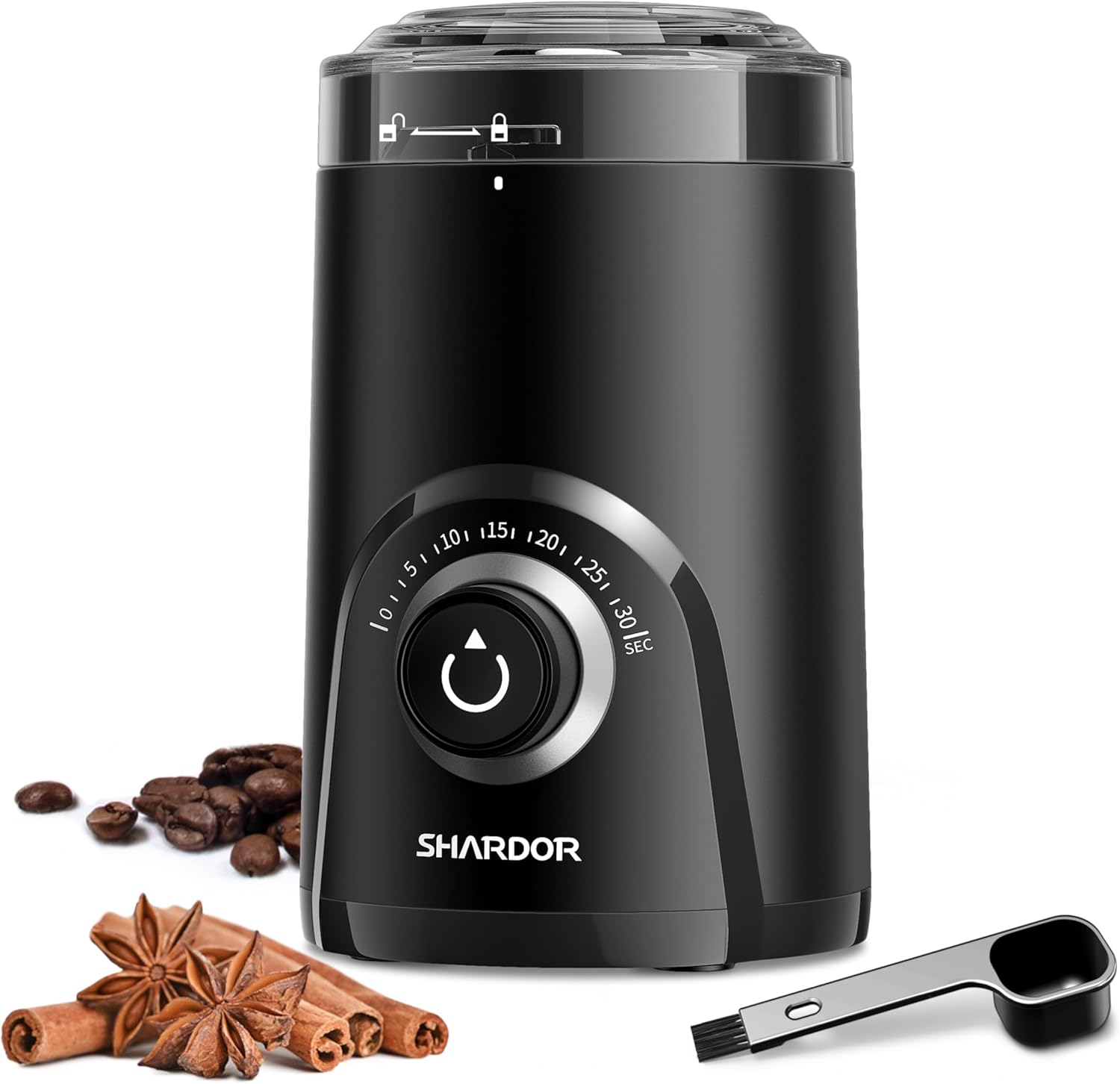
SHARDOR’s CG0802 Super Silent grinder illustrates why an electronic-looking control does not necessarily indicate a burr grinder. It uses rotating blades and a timed rotary knob. The ability to stop automatically after a selected duration is useful when a household repeats the same simple coffee preparation, but the motor does not change the spacing between two burrs because there are no burrs in this appliance.
That distinction is particularly important for inexpensive dark roasts. Brittle beans can become dusty quickly; a timer can help avoid accidentally running the blades for far longer than intended. It does not prevent a mixture of fines and larger particles. For a forgiving immersion brew, this variability may be tolerable, especially if the grinder is used only occasionally. For a carefully measured pour-over or conventional espresso basket, there is no calibrated route to correct a grind that is slightly too coarse.
- Blade grinding mechanism
- Rotary timed grind control
- 70 g bowl capacity
- Safety-locked lid
- Compact coffee-and-spice use
Technical Specifications & Daily Features
SHARDOR CG0802 Super Silent Timed Blade Grinder: Electric blade with timed rotary control. Adjustment: Rotary timed grinding; no burr steps; dose: Timed knob; does not measure coffee weight; bean capacity: About 2.46 oz / 70 g bowl; dimensions: Compact countertop appliance; published dimensions vary.
The CG0802 has a blade mechanism, timed rotary control and approximately 70 g capacity. It is not the SHARDOR Professional conical-burr CG203B. No number of burr settings, digital scale or portafilter cradle is associated with this unit.
The timed setting repeats a running interval, not a defined particle size or dose weight. Keep the lid interlock intact, unplug before cleaning and keep the powered base dry. Grind only materials permitted by the exact user manual.
Pros & Cons After 30 Days of Use
A settable rotary timer gives two household members an easy way to use approximately the same running interval for a familiar morning recipe. The compact bowl can be emptied after a small portion, and the controls are simple enough to learn without reading an elaborate interface.
Blade-generated dust remains the main ownership compromise. Long cycles may create more fines and warmer coffee, and the timer cannot correct the imbalance. The grounds chamber needs careful residue removal, while the interlocked lid and dry motor base require safe handling. Neither quiet claims nor timed operation provide evidence of precise brew-to-brew particle uniformity.
My Final Verdict
I recommend the timed SHARDOR only when a simple, quiet-leaning blade grinder is already the right equipment category for the kitchen. The rotary timer is convenient, but it cannot match the adjustable burr mechanism of the Ollygrin or the SHARDOR CG203B. For budget beans and daily paper-filter brewing, investing in actual burr control is the more productive upgrade.
A timed blade cycle offers convenient automatic stopping, not a way to refine the particle-size distribution with calibrated steps. It suits a household that prizes brief simple use more than deliberate extraction control. For regular filter coffee and a meaningful improvement in grind consistency, the Ollygrin or the burr-based SHARDOR is the better purchase.
I consider the rotary timer the most compelling feature here. A simple time interval is easier for different household members to repeat than relying entirely on the length of a finger press. That gives the user a consistent process, even though the actual particle distribution remains more variable than on the Ollygrin, Breville or conical-burr SHARDOR. A scale is still necessary for dose control because running time is not a weight measurement.
The name Super Silent describes a design objective rather than an assurance of no noise. The blade motor and beans still make sound; the perceived level depends on the countertop and the room. I assess its value against other small blade grinders, where convenience and brief operation matter more than demanding extraction control. Its approximately 70-gram bowl and blade mechanism make it fundamentally different from a large-capacity burr grinder with marked adjustment steps.
I rank this fifth because a repeatable timed blade cycle adds less brewing control than the removable-bowl COSORI for the target reader, who is trying to improve uneven inexpensive beans. The SHARDOR remains useful as a simple kitchen accessory for occasional coffee or spices, particularly where brief hands-off timing is appreciated. It is not the right choice for a person hoping to solve grind-related bitterness or inconsistency through precise burr adjustment.
A timer and a burr dial solve different problems
The timed knob turns the motor off after a chosen interval, which can make a basic routine easier to repeat. A burr dial physically changes the target particle size. Those two tasks should never be described as equivalent. If a pot tastes overly bitter because the blades created too much fine powder, selecting a slightly shorter interval may help somewhat, but there is no adjacent burr position to use as a controlled experiment.
Why quieter operation matters to some households
Grinder noise is a kitchen ownership issue rather than a flavor measure. A brief grinding session may be welcome in a shared apartment or early-morning kitchen, but sound levels depend on the counter and the room. A rubber mat that does not obstruct ventilation can sometimes reduce vibration transmitted to the worktop. I do not assume this model is silent or quote decibel measurements without a documented test.
The 70-gram bowl and realistic portion sizes
A bowl of approximately seventy grams can hold enough beans for several small filter cups, but loading all of that coffee at once does not guarantee an even chop. Small, manageable batches are easier to redistribute and inspect. I favor measuring the desired coffee dose first and keeping unused beans sealed. The bowl capacity is a maximum volume or mass reference, not a recommendation to grind a full chamber before every brew.
Knowing when the feature has stopped being useful
The timer is valuable when a buyer needs a repeatable simple cycle. Once the goal changes to careful V60 adjustments, espresso flow correction or comparing two closely related grind textures, the absence of burrs becomes unavoidable. I regard a true burr grinder as the next investment rather than paying for another blade model with more timer options or a brighter display.
Buying Guide: Getting More Flavor from Budget Whole Beans
Start with the coffee you actually buy
A large bag of medium-roast supermarket beans behaves differently from a small bag of very dark espresso blend. Read the roast level, look for a credible freshness indication and note whether the coffee is intended for everyday black coffee or milk drinks. The grind decision follows those facts rather than a generic promise that every inexpensive bean needs the same treatment.
I separate value from lowest price. A slightly smaller fresh bag can make better financial sense than a huge stale bag that forces more coffee into every recipe to recover lost character. No grinder repairs flat aroma. Before spending money on new hardware, I check storage, freshness and dose.
Understand what burrs change—and what they do not
A burr grinder sets the gap through which coffee passes. That gives it a more controllable particle-size range than a blade mill, although no grinder produces one perfectly identical particle size. For filter coffee, the ability to return to a workable medium setting is the practical advantage.
Particle uniformity is not the only ingredient of extraction. Water distribution, filter design, brew temperature, dose and roast level matter. I avoid promises that purchasing a burr grinder automatically removes bitterness from any coffee bag.
Decide whether the budget should favor a grinder or fresher beans
A household that owns no grinder may notice a meaningful improvement by moving from stale pre-ground coffee to an affordable real burr model. But spending heavily on a grinder while continuing to buy very old beans is an uneven investment.
I compare the cost per brewed cup and the number of days a bag remains open. When funds are limited, a serviceable grinder and consistently fresh, affordable whole beans are a better pair than an elaborate control station and an exhausted bulk supply.
Choose a realistic brew method before counting settings
Drip and pour-over generally need a controllable medium region. French press asks for coarser adjustments, while moka pot usually sits finer than ordinary filter coffee. Conventional espresso is more sensitive to small grind changes and basket resistance.
The Ollygrin and 48-setting SHARDOR offer ways to change grind size for those methods. Breville adds a clearer portafilter-oriented workflow. The two blade grinders change chopping time instead of adjusting burr spacing and must be judged separately.
Read a cup selector as a shortcut, not a dose scale
A grinder marked two to twelve cups is not using an international definition of one drinking mug. Coffee-maker serving marks can be substantially smaller than a household mug. The number on the dial estimates a convenient portion, not the exact grams called for by a recipe.
I determine the coffee mass with a small kitchen scale, then compare it with the output of the selected cup control. Once that result is close, the dial can save effort. Opening a new roast bag is a reason to calibrate again.
Understand grind-time settings without mistaking them for mass
A twenty-second timer and a 0.2-second increment are measurements of motor activity. Different beans break and move through the mechanism at different rates. Changing the grind collar can alter feed speed too.
Breville and the electronic SHARDOR use timers for convenience; the timed SHARDOR blade model uses a running interval with a very different grinding mechanism. I keep a scale beside every timed grinder when a reliable brew ratio matters.
Match grinder capacity to the actual morning batch
A small blade bowl is convenient for one measured portion, and a ten-ounce hopper is useful for repeated household drip batches. Breville’s eighteen-ounce hopper is attractive in a busy mixed-brew kitchen. Larger does not necessarily mean fresher.
I consider how quickly the coffee will be used and whether the household switches between regular and decaf. A single-dose approach helps frequent bean switching; a loaded hopper helps a family using the same beans daily.
Find the right medium grind for a basic drip machine
Medium grinding is not one standardized particle size. Paper basket shape, brew amount and water delivery all affect the ideal setting. A 300-gram cone and a 1-liter basket can respond differently even with identical beans.
Start with the maker’s suggested filter range. If the cup is thin and runs fast, adjust finer modestly; if the bed drains slowly and the drink is drying, adjust coarser. Keep the coffee dose and water amount unchanged during that comparison.
Use a darker roast without automatically grinding finer
Dark-roasted beans are generally more brittle and can produce fines readily. They may also extract quickly, creating a heavy cup when the grind is too fine for the brewer. A dark supermarket blend can be perfectly enjoyable with a slightly coarser filter setting.
I resist the temptation to make every affordable dark coffee taste stronger by adding more powder. A measured ratio and a small fineness adjustment offer more insight than changing coffee quantity, temperature and grind at once.
Handle oily beans and residues cautiously
Dark roast oils accumulate around burr chambers, ground exits and container rims. When that residue picks up fine coffee dust, the next batch can carry stale flavors even though the beans are fresh.
Empty the bin after brewing, disconnect power and brush the user-accessible dry path. Follow each model’s specific instructions; water in the electric burr assembly or motor housing is not an acceptable cleaning shortcut.
Watch the filter rather than following one magic setting
A slow-draining brew can arise from too much powder, too high a dose, a poorly seated filter or an unusual water-delivery pattern. A short brew can result from coarse grounds, low coffee mass or a different filter shape.
I evaluate the finished cup and the behavior of the brewer together. Making the grinder finer is not automatically the answer to weak coffee, and making it coarser is not always the answer to bitterness.
Reduce static without introducing a new hazard
Very dry roasted coffee can become statically charged as it moves through the grinder, and the effect varies with indoor humidity. Grounds can cling to the receiver even when the machine advertises anti-static features.
I first use the normal dry-handling approach: an empty clean bin, a short settling pause and a soft brush. I only consider water-droplet techniques where the grinder maker explicitly permits them; spraying liquid into an electric appliance is not a safe generic instruction.
Choose the grounds container as carefully as the burr dial
A grounds collector that slides smoothly into place and empties close to the filter can prevent more mess than another electronic preset. The COSORI removable cup is convenient for a small single batch; a larger grinder bin supports family-sized filter doses.
I value easy access for dry cleaning and containers that stay seated during grinding. Anti-static materials may reduce clinging, but even a well-designed bin can collect oils and fines over time.
Weigh budget coffee for consistency and cost control
Using more coffee than necessary can erase the financial advantage of an inexpensive bag. At a 1:16 ratio, 30 grams of coffee pair with 480 grams of brewing water; a slightly stronger 1:15 recipe uses 32 grams for the same water.
Both recipes are valid starting points, and taste is the deciding factor. A scale can also show whether a cup selector or timer dispenses too much, helping avoid small daily amounts of waste that accumulate across a month.
Pay attention to bean fragments and damaged batches
Broken bean fragments are not automatically defective, but unusually inconsistent roasting, old aromas or visible foreign material are reasons to reconsider the bag. The grinder cannot make every fragment behave identically or reverse stale coffee oils.
I inspect beans before loading them, especially bulk or discount purchases. Hard foreign objects can damage burrs and should never enter the machine. When the coffee itself is poorly stored, buying a better bag often matters more than upgrading another appliance.
Avoid treating an espresso label as an espresso guarantee
Product titles often contain the word espresso even when the grinder uses blades or broad steps. Conventional single-wall baskets require a controllable fine grind and an appropriate dose. Blade texture can be powdery yet uneven.
The Breville is designed to serve an espresso workflow, while the burr Ollygrin and SHARDOR can be evaluated against the actual basket and required adjustment resolution. I do not recommend either blade model for a daily standard espresso station.
Consider noise without believing absolute silence claims
Every powered grinder makes some noise when beans strike the grinding mechanism. A quiet-leaning model can suit roommates, but the perceived sound depends on counter material, walls and the surrounding room.
The SHARDOR Super Silent blade grinder is intended to soften the experience, yet it offers no controlled burr spacing. For a brewing enthusiast, quieter blade chopping may be a less meaningful improvement than a slightly louder burr grinder with usable adjustments.
Do not overload small motors for a large carafe
A small removable grinding bowl may hold enough coffee for several cups by volume, but loading it to maximum capacity does not necessarily produce the most uniform chop. Excessive continuous use can warm the motor and trigger protective mechanisms.
I work within the duty-cycle and filling limits in the exact manual. For regular family carafes, a larger hopper-fed burr grinder may simplify preparation and reduce the temptation to run repeated full-bowl blade cycles.
Make manual cleaning part of the purchase decision
Burr grinders can be relatively simple to maintain when the top burr and grounds path are accessible. Blade grinders may have removable bowls or narrow blade chambers that require more careful handling.
The cleaning procedure has to match the model. I do not wash motorized components, force an adjustment collar with trapped beans or assume all removable parts can go into a dishwasher. Regular gentle care is better than aggressive occasional cleaning.
Budget for a scale before a second grinder upgrade
A scale gives direct information about the one variable a timer and cup selector cannot measure: actual collected coffee. It can be useful with any of the five models, from the simple COSORI to the Breville Smart Grinder Pro.
I establish a coffee dose, add the intended water mass and note the approximate grind position. That little record often improves repeatability more than buying a second machine with a longer settings list.
Keep a one-page brewing note for successive discount bags
Affordable whole-bean coffee changes with origin, processing, roast and storage. A setting that suits this month’s blend may not suit the next. A simple record of bean name, roast, setting, dose, water and impression keeps comparisons meaningful.
When a new bag tastes flat, I check freshness and recipe first, then adjust grind deliberately. The written note is a more durable form of memory than hoping everyone in the house remembers where the dial stood last week.
Know when a blade grinder has served its purpose
A blade mill can introduce someone to whole-bean coffee for little equipment cost. Its strength is accessibility and compact size. Its ceiling appears when a brewer wants to reproduce a precise particle size for espresso or cleaner paper-filter extraction.
The right upgrade is a true burr mechanism, not necessarily a higher-power blade motor or a more elaborate timer. For daily drip, even a modest 30-position conical-burr grinder provides a more useful adjustment than another chopping interval.
Compare the total ownership value, not the advertised discount
Retail prices change; a deal badge alone is not evidence of long-term value. Look at parts, useful adjustability, available countertop space, cleaning effort and whether the accessories match the brew method.
I weigh the extra purchase price against how often the grinder will be used. Breville can be justified for mixed espresso households; Ollygrin offers the more economical default for filter coffee. The cheapest blade model is a different compromise rather than the same product at a lower price.
Finish with a repeatable recipe rather than endless experimentation
A grinder becomes valuable when it makes tomorrow’s coffee easier, not when it invites perpetual settings changes. Choose a suitable grind, weigh coffee and water, then judge taste after the brew settles into a familiar routine.
If the cup is good, leave the collar alone. When a new bag behaves differently, adjust one meaningful variable at a time. This helps a modest whole-bean coffee purchase remain enjoyable instead of turning into a daily equipment experiment.
Final Comparison: Mechanisms, Settings, Dosing and Limits
| Grinder | Mechanism | Adjustment | Dosing | Capacity | Limitation |
|---|---|---|---|---|---|
| Ollygrin BG702S-PG Conical Burr Coffee Grinder | Electric conical burr | 30 grind settings | 2–12-cup selector; not weight-based | 10 oz / approximately 283 g | Cup setting does not weigh coffee; not a specialist espresso grinder |
| SHARDOR CG203B Professional Conical Burr Grinder | Electric conical burr | 48 grind settings | Precision electronic timer; not a scale | Bean hopper; capacity not confirmed for this exact unit | Higher control complexity; fine-end adjustment still depends on the basket |
| Breville Smart Grinder Pro BCG820BSSXL | Electric conical burr with LCD | 60 grind settings | Dosing iQ digital timer; 0.2-second increments | 18 oz / approximately 510 g | Higher equipment cost; larger kitchen footprint; timer does not weigh |
| COSORI CCG-U011-KUS Electric Blade Coffee Grinder | Electric blade with removable bowl | No calibrated grind-size settings | Press-to-grind; duration controlled by user | 2.5 oz / approximately 70 g removable bowl | Mixed particle sizes; not recommended for conventional espresso |
| SHARDOR CG0802 Super Silent Timed Blade Grinder | Electric blade with timed rotary control | Rotary timed grinding; no burr steps | Timed knob; does not measure coffee weight | About 2.46 oz / 70 g bowl | Blade motor and timer cannot produce burr-level uniformity |
My Final Recommendation for Budget Coffee Beans
I favor the Ollygrin BG702S-PG for everyday drip, French press and pour-over when the main goal is getting good, repeatable results from inexpensive whole beans. The thirty-position burr adjustment, manageable hopper and simple serving selector offer what a filter-focused kitchen actually needs. I pair it with a small scale and fresh, correctly stored beans. Those basic tools provide a more useful path to consistency than a feature-filled display that is not needed for the normal recipe.
The SHARDOR CG203B is my next choice for a family that changes brew methods and appreciates electronic time control. Its forty-eight burr settings are a meaningful distinction from the brand’s CG0802 Super Silent model, which uses blades. When espresso is genuinely part of the daily routine, Breville’s Smart Grinder Pro becomes the strongest all-around station of these five, thanks to its portafilter support, sixty positions and Dosing iQ control. Its larger purchase price makes less sense for drip-only coffee.
The COSORI removable-bowl blade grinder is a reasonable compact first machine when simplicity, cleaning and storage dominate every other concern. The timed SHARDOR CG0802 is a separate blade alternative for someone who values a repeatable running interval. Neither gives the physical grind adjustment necessary to fine-tune coffee reliably. No appliance can rescue beans that are badly stale, so I also choose a sensible bag size, protect the coffee from heat and air, and change only one brewing variable at a time.
Frequently Asked Questions About Grinding Budget Coffee Beans
Can a grinder really improve inexpensive coffee beans?
A good burr grinder can provide more deliberate particle-size control, making extraction more repeatable than with blade chopping or old pre-ground coffee. It cannot restore lost aroma to stale beans, undo poor roasting or guarantee a sweeter flavor. Freshness, dose, water and brewing method still matter.
Which grinder is the best value for budget coffee beans?
For drip, pour-over and French press, I favor the 30-setting Ollygrin BG702S-PG. It offers genuine conical burr adjustment and a familiar household cup selector. Breville is better suited to espresso-plus-filter households that will use its added controls.
Is the SHARDOR Super Silent a conical-burr grinder?
No. The CG0802 is a blade grinder with a timed rotary knob. It does not have a calibrated burr gap. The SHARDOR CG203B in the same comparison is the actual 48-setting conical-burr product.
How many settings does SHARDOR CG203B offer?
The CG203B has 48 grind settings, rather than a forty-step configuration. It also has electronic time control and an anti-static design. It is distinct from the Super Silent blade model.
Does the Breville Smart Grinder Pro have 60 mm burrs?
Breville specifies 60 grind settings, stainless conical burrs, an 18-ounce bean hopper and a 165-watt motor. The 60 figure describes adjustment positions, not a documented burr diameter. Grind-setting count and burr dimensions are different specifications.
Is a blade grinder acceptable for French press?
It can be used for French press, especially when the budget is extremely limited, but the particles will generally be more irregular than with a burr grinder. Short controlled pulses may keep the grind from becoming excessively powdery. A burr mill is preferable when the goal is repeatability and less sediment.
Can COSORI CCG-U011-KUS grind real espresso?
It can chop beans finely, but fine-looking coffee is not the same as a controlled espresso particle distribution. The grinder has blades, no burr adjustment and no portafilter-focused dosing. I do not recommend it for daily conventional single-wall espresso preparation.
How large is the COSORI removable bowl?
This model has a nominal 2.5-ounce, approximately 70-gram stainless-steel removable bowl. That fits small household coffee doses and provides convenient transfer. The motorized base must remain dry, and cleaning must follow the exact bowl and appliance instructions.
Does Ollygrin measure coffee in grams?
No built-in gram scale is documented for the BG702S-PG. Its 2–12 cup selection provides an approximate portion, not a measured dose weight. Use a separate kitchen scale after selecting a grinder setting or changing beans.
How much coffee should I use for 500 g of water?
At a 1:16 coffee-to-water ratio, use about 31 grams of ground coffee for 500 grams of brewing water. This is an approachable filter-coffee starting point, not a rule for every roast or palate. Adjust strength deliberately after tasting the finished drink.
Which is better for budget dark-roast beans?
A conical-burr grinder with a usable medium region is a dependable starting point for ordinary drip brewing. Dark roasts often extract readily, so slightly coarser grinding may improve a harsh cup. I favor Ollygrin for value and Breville for households also preparing espresso.
Will expensive grinders turn stale beans into fresh-tasting coffee?
No. Grinding immediately before brewing helps preserve the aroma remaining in whole beans, but a grinder cannot replace flavors already lost during long storage. Start by checking roast freshness, the package seal and storage conditions before spending more on a grinder.
Is a 0.2-second dose adjustment accurate to 0.2 grams?
No. On the Breville Smart Grinder Pro, the 0.2-second increment changes motor run time. The mass dispensed depends on the beans, burr setting and feed rate. Weigh the collected coffee to check actual dose.
Can I use the SHARDOR CG203B for pour-over?
Its 48 burr settings provide useful flexibility through the medium and medium-fine regions used by many paper-filter recipes. Start with the brewer-appropriate range and adjust in response to flavor and drawdown. A precise outcome still depends on the entire brewing recipe.
Which grinder works for a one-cup student kitchen?
The COSORI blade grinder is very compact and has a removable bowl, making it suitable for occasional coffee where storage dominates. For better control over medium grind size, a small real burr grinder is a more useful long-term purchase even if it takes more counter space.
How can I reduce static when grinding dry beans?
Keep the receiving container clean and dry, let coffee settle briefly and use a soft brush on accessible surfaces. Static varies with roast and humidity. Avoid spraying water into the grinder or using moisture techniques unless the manufacturer specifically allows them.
Should I use the hopper to store a large bag?
A hopper is convenient for actively used coffee but is not ideal as long-term storage. Keep reserve whole beans sealed and protected from heat, air and light. This is especially important for inexpensive bulk coffee that may already have spent time in distribution.
How often should I clean a burr grinder?
Empty the receiver after use and dry-brush user-accessible areas as needed. Frequency depends on roast oils and how often the grinder runs. Follow the exact manual for deeper maintenance; never immerse the powered grinder or force inaccessible parts apart.
Do more settings always mean better filter coffee?
No. A few clear, useful medium positions matter more than a very high total settings count. A household preparing the same drip recipe every day may use only one or two positions. Additional settings become useful when changing beans, brewing methods or extraction targets.
Can a timer eliminate coffee waste?
A timer can reduce accidental over-running and make the workflow more predictable, but it does not measure final grounds mass. A scale is the best way to establish a dose, then the timer can repeat approximately that cycle for the same beans and setting.
Why does my budget coffee taste bitter?
Possible reasons include an inherently dark roast, overly fine grounds, long contact time or excessive coffee dose. Change one variable at a time. With dark blends, a modest coarser grind or slightly less coffee may help; the roast itself still defines much of the flavor.
Why does my coffee taste thin after grinding fresh?
Fresh grinding alone cannot correct a coarse grind, weak ratio, cool brewing water or stale beans. Verify the dose and water quantity first. A small finer adjustment is useful when the coffee drains rapidly and the finished cup tastes underextracted.
Is the Breville worth the premium for supermarket beans?
It can be worth it for a household using both espresso and filter coffee, because of its 60 settings, LCD and portafilter support. For filter-only drinkers, the features may be unnecessary. Ollygrin or the SHARDOR CG203B can be more proportionate purchases.
Are all SHARDOR adjustable grinders the same?
No. The CG203B is a 48-setting conical-burr grinder. The CG0802 Super Silent is a timed blade grinder. Similar brand names and marketing language are not proof of the same mechanism, hopper capacity or dose controls.
Can the COSORI bowl be used for herbs and spices?
The model is marketed for dry coffee and spice use. Strong aromas can transfer into later coffee, so using a separate compatible bowl or limiting it to coffee is reasonable. Follow the instructions on which bowl components can be washed and keep the motor base dry.
How should I calibrate a 2–12 cup grinder setting?
Prepare the amount of water your household actually uses, calculate a starting coffee mass and weigh the collected output of a chosen cup setting. Adjust the selection to match the recipe. Recheck when changing bean roast or grinding fineness.
Which grinder is best for an affordable daily drip routine?
I choose the Ollygrin 30-setting conical-burr model for everyday value. Its physical grind adjustment can handle an ordinary paper-filter recipe without the complexity or price of a mixed-espresso station. A separate scale completes the workflow.
What is the best single upgrade after a blade grinder?
Move to a real burr grinder with repeatable positions. A scale and fresher beans complement that upgrade. Replacing one blade appliance with another that has more timer controls does not create the mechanical adjustment needed for controlled grind-size corrections.


