
Best AeroPress Coffee Grinders (2026 Guide)


OneHundredCoffee is reader-supported, and some products displayed may earn us an affiliate commission. Details
Best Coffee Grinders for AeroPress Consistency (2026)
An AeroPress can be forgiving about contact time and filter choice, but it tells you very quickly when a grinder is producing too much dust. The plunger may become difficult to push, the cup can turn harsh, or two seemingly identical recipes produce different results. I look for a grinder that lets me return to a sensible medium or medium-fine texture without guessing how long a cutting blade happened to run. That does not require specialist espresso equipment. It requires a usable grind range, a measured dose, steady brewing variables and a cleaning routine that prevents stale particles from mixing with the next batch.
This group contains two genuine adjustable burr grinders and three compact blade options. De’Longhi Dedica KG521M combines eighteen grind positions with LCD-controlled portions and an adaptor for other brewing equipment. KRUPS GVX212 gives a simpler seventeen-step burr approach. SHARDOR CG638S and Kaffe offer removable chopping cups, while the Bodum BISTRO uses a compact fixed chamber. Their differences matter more than an unsupported ranking based on imagined taste tests. I recommend the burr models first for AeroPress consistency, then describe where the smaller blade grinders remain useful.
Editor’s Picks: Three Grinders for Different AeroPress Priorities
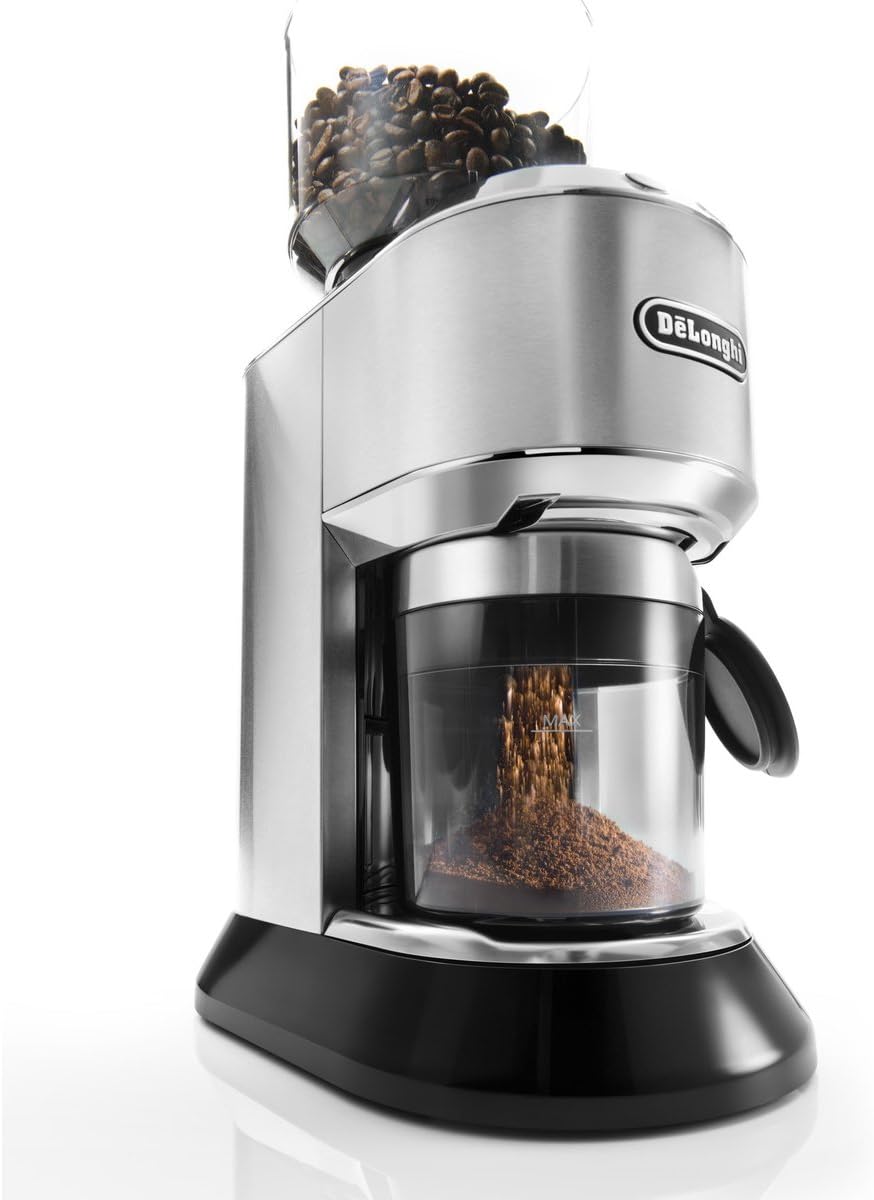
De’Longhi Dedica KG521M Conical Burr Grinder
- 18 grind settings
- LCD and strength selection
- 1–14-cup selection
- Portafilter adaptor
- Grounds container
- Removable upper grinding wheel

KRUPS GVX212 Burr Mill Grinder
- 17 grind settings
- Adjustable burr mechanism
- Cup-selection control
- Removable grounds bin
- Compact countertop body
- Practical filter-brew range

SHARDOR CG638S Adjustable Blade Coffee Grinder
- Adjustable grinding duration
- Removable stainless bowl
- Approx. 2.5 oz chamber
- Blade-cutting mechanism
- Coffee and spice utility
- Compact quiet-focused design
My first decision is whether the grinder actually has burrs. For a medium-fine AeroPress recipe, that mechanism gives the brewer a repeatable size setting; a chopping blade cannot provide the same feedback. The Dedica wins the overall position because it is usable across several coffee methods and displays its controls clearly. KRUPS earns the value award through a more basic adjustable burr mill. SHARDOR takes the third Editor’s Pick position for its removable cup and compact cleaning routine, with an explicit reminder that it remains a blade grinder rather than a close substitute for either burr option.
Consistency is not a promise that two brews will taste identical regardless of roast, water and technique. An AeroPress recipe can begin with around sixteen to eighteen grams of coffee and a medium-fine grind, but the desired cup might need a slightly coarser setting, a different temperature or a longer infusion. I use a scale to set the coffee dose, and I make small changes one at a time. That keeps the buying advice practical and prevents a specification count from becoming a substitute for actual brewing decisions.
Five Coffee Grinders for AeroPress Consistency at a Glance
De’Longhi Dedica KG521M Conical Burr Grinder
- 18 grind settings
- LCD and strength selection
- 1–14-cup selection
- Portafilter adaptor
- Grounds container
- Removable upper grinding wheel
KRUPS GVX212 Burr Mill Grinder
- 17 grind settings
- Adjustable burr mechanism
- Cup-selection control
- Removable grounds bin
- Compact countertop body
- Practical filter-brew range
SHARDOR CG638S Adjustable Blade Coffee Grinder
- Adjustable grinding duration
- Removable stainless bowl
- Approx. 2.5 oz chamber
- Blade-cutting mechanism
- Coffee and spice utility
- Compact quiet-focused design

Kaffe Electric Coffee Grinder with Removable Cup
- Removable stainless grinding cup
- One-touch grind control
- Clear lid
- Cleaning brush included
- Compact body
- Coffee and dry-spice versatility

Bodum BISTRO Electric Blade Coffee Grinder
- Stainless-steel cutting blade
- Up to 60 g bean chamber
- Pulse or continuous operation
- Transparent lid
- Cord storage
- Compact fixed-chamber body
Quick Ranking: Grind Control, AeroPress Fit, and Ownership Trade-Offs
| Rank | Grinder | Mechanism | Best for | Main trade-off |
|---|---|---|---|---|
| 1 | De’Longhi Dedica KG521M Conical Burr Grinder | Conical burr | AeroPress and mixed espresso/filter household | Larger footprint and cup dosing rather than grams |
| 2 | KRUPS GVX212 Burr Mill Grinder | Burr mill | Entry-level AeroPress and everyday drip | 17 stepped positions and more potential grounds cling |
| 3 | SHARDOR CG638S Adjustable Blade Coffee Grinder | Blade with removable cup | Quick grinding and simple cleaning | No burr-gap adjustment; wide particle-size spread |
| 4 | Kaffe Electric Coffee Grinder with Removable Cup | Blade with removable cup | Small kitchens and convenient daily cleanup | No repeatable indexed grind settings |
| 5 | Bodum BISTRO Electric Blade Coffee Grinder | Fixed-chamber blade | Occasional whole-bean coffee on a tight budget | Nonremovable powered chamber and no burr adjustment |
Five Detailed AeroPress Grinder Reviews
1. De’Longhi Dedica KG521M Conical Burr Grinder
An AeroPress lets me change dose, water temperature, contact time and pressure in a matter of minutes. A grinder should make those adjustments understandable rather than adding another mystery. The De’Longhi Dedica KG521M earns the first position because its stainless conical burrs have eighteen repeatable settings, and the LCD makes the selected strength and portion easier to read. A medium or medium-fine grind can be revisited after brewing a darker roast, and the separate grounds container suits a simple AeroPress workflow without touching the espresso adaptor.
The important distinction is between the machine’s convenience and the extraction it can actually control. An electronic cup setting is not a scale, the portafilter attachment does not improve an AeroPress cup on its own, and eighteen steps cannot guarantee an ideal adjustment for every espresso basket. For the brewer in this guide, however, the broad burr range and readable interface make it a sensible long-term option when French press, drip or occasional espresso-style preparation shares the kitchen.
The eighteen settings and the AeroPress sweet spot
I begin in the medium region and judge the result against the recipe, not against a copied dial number. AeroPress can accommodate several useful grind sizes, but fine dust can make pressing unusually difficult. The Dedica’s adjustment is a physical reference that can be recorded alongside a coffee dose. That allows a light roast to have its own starting point and a dark roast another, without treating every bean as though it extracts identically. The eighteen marked steps suit normal AeroPress exploration well; they remain coarser increments than the extremely small changes sought by demanding espresso specialists.
LCD quantity controls versus measured grams
A displayed cup count offers convenience, but it is a poor substitute for knowing the weight of coffee entering a brewer. For AeroPress, I set a recipe in grams and use the grinder’s portion control only after comparing a normal run with that target. Beans of different density can pass through the burrs at different rates, and changing the grind position can alter throughput. A scale is the simplest companion to this De’Longhi, whether the owner makes a concentrated short cup or a lighter, longer AeroPress drink. The display is worthwhile because it organizes a routine, not because it independently measures the finished dose.
When a portafilter adaptor earns its space
The Dedica includes a portafilter-oriented attachment, which is excellent for a household that also makes espresso-style coffee. For AeroPress alone, I prefer the regular grounds container: it keeps the coffee together for a weighed transfer and avoids scattering a small dose around a basket. Switching between brewing styles is possible, although retained grounds should be cleared before a radically different grind setting is used. A portafilter accessory adds flexibility, not an automatic improvement to medium-fine AeroPress grounds. Buyers with no espresso equipment can ignore that accessory without sacrificing the main reason to choose this grinder.
De’Longhi Dedica KG521M Conical Burr Grinder
Best balance of grind adjustment, straightforward dosing, and AeroPress-friendly brewing flexibility.
- More repeatable burr settings than blades
- Wide general-purpose brewing range
- Readable electronic controls
- Higher price and larger footprint
- Cup selection does not weigh the dose
- Specialist espresso may need finer adjustment
Technical Specifications & Daily Features
- Mechanism: Conical burr
- Best suited to: AeroPress and mixed espresso/filter household
- Main limitation: Larger footprint and cup dosing rather than grams
- 18 grind settings
- LCD and strength selection
- 1–14-cup selection
- Portafilter adaptor
- Grounds container
- Removable upper grinding wheel
Use the chosen grinding control together with a measured AeroPress dose; keep the receiving container and accessible parts clean as directed in the model instructions.
Pros & Cons After 30 Days of Use
For the first month of ownership, the relevant checks are the ease of returning to an AeroPress grind position, the amount collected under an ordinary cup setting, and the maintenance needed around the upper grinding wheel. The Dedica's LCD and eighteen settings make those tasks manageable. The grounds container works for normal AeroPress dosing; a portafilter adaptor is additional flexibility rather than a necessity. The hopper takes counter space, and the electronic cup estimate still needs scale calibration.
My Final Verdict
I recommend the Dedica as the strongest all-round AeroPress option here. It has real burr adjustment, a clear interface and the capacity to serve more than one brewing method. A dedicated hand grinder is better for travel and a specialist espresso grinder may offer smaller fine-end increments, but for home AeroPress consistency this De’Longhi provides the most useful combination of features.
Maintenance around the upper grinding wheel
The removable upper grinding wheel gives a clear path for normal cleaning. Power should be disconnected before opening accessible parts, and a soft brush should remove dry dust as the manual directs. Grinding coffee and storing ground coffee are different tasks: the collecting bin is best emptied rather than treated as a long-term canister. In an AeroPress setup, stale fines from a previous grind can accumulate in the same paper filter and change the resistance felt during pressing. A consistent cleaning habit makes a meaningful difference to the use of any stepped burr grinder, including this one.
Who benefits from the larger electric setup
The De’Longhi makes the most sense on a counter where coffee is brewed frequently and more than one method is in use. Its hopper-fed arrangement handles repeated portions efficiently, while the control panel reduces the chance that a household member forgets the current setting. In a tiny travel bag it makes no sense; the AeroPress itself is portable, but that does not require its grinder to be. I recommend this machine for home-based brewing where repeatable adjustment, clear controls and the option to grind into a filter holder outweigh the extra footprint.
Where the price premium becomes practical
The higher cost is justified chiefly by combining a proper burr grinder with an electronic interface and a broad household workflow. Someone making a single occasional AeroPress with supermarket beans can save money with the KRUPS. Someone carefully evaluating light roasts, alternating brewing methods or sharing a coffee station gains more from the Dedica’s controls. I do not attribute a guaranteed percentage improvement in flavor to its specification sheet. What it offers is a more structured way to prepare and reproduce a recipe, which is exactly what a curious AeroPress brewer needs.
The ownership decision
I recommend the Dedica as the strongest all-round AeroPress option here. It has real burr adjustment, a clear interface and the capacity to serve more than one brewing method. A dedicated hand grinder is better for travel and a specialist espresso grinder may offer smaller fine-end increments, but for home AeroPress consistency this De’Longhi provides the most useful combination of features.
2. KRUPS GVX212 Burr Mill Grinder
The KRUPS GVX212 is the option I favor when someone is moving from a small blade grinder to a controllable burr mill without wanting a large display. Its seventeen grind settings provide useful coarse-to-fine positions, and the cup selector reduces the number of separate controls to manage in the morning. An AeroPress recipe becomes easier to understand when changing the setting changes the distance through which beans travel, rather than merely chopping them for a little longer.
There is a trade-off in that simple design. A cup selector estimates quantity and must be checked against the actual dose. The grounds container needs emptying and brushing, and a seventeen-step collar cannot make infinitely small changes. I still prefer this predictable burr mechanism to the three blade models below for regular AeroPress brewing. Its advantage is not a claimed laboratory particle-size measurement; it is the practical ability to return to a useful medium-fine region.
Seventeen steps make experimentation approachable
The KRUPS gives a beginner enough reference positions to learn how grind texture influences contact time, while avoiding an overwhelming menu. I recommend writing down the current setting together with the coffee dose and a short taste note. When a cup tastes thin, a modest move finer can be worth trying; when the press becomes uncomfortably resistant or the result turns harsh, I check for excessive fines, agitation and the state of the filter before changing everything at once. The stepped adjustment makes those comparisons easier to follow than visually timing a blade grinder.
A cup selector is a convenience, not a digital scale
AeroPress recipes commonly use small doses, so measuring the coffee matters more than an abstract serving label. The KRUPS cup selector stops grinding after an estimated amount, but the mass produced can vary with roast, bean size and grinder setting. I calibrate one useful setting with a kitchen scale and repeat only when the beans are similar. When the grinder is adjusted finer, I check the output again rather than assuming an equal number of cups means an equal dose. This is a simple extra step, not a reason to dismiss the convenience of the selector.
What the burr mill improves over inexpensive blades
A burr mill directs coffee through a chosen gap. That is the critical distinction from the Bodum, Kaffe and SHARDOR options, whose blades can strike a mixture of large and small pieces in the same cycle. A more predictable grind helps distinguish recipe changes from grinder variability. I avoid promising that every particle will be identical, because real burr grinders still produce some fines and larger fragments. The point for AeroPress is that the owner can set a useful target and return to it without guessing which pulse length happened to work last week.
KRUPS GVX212 Burr Mill Grinder
Accessible burr grinding for a household that wants a reliable medium-fine starting point.
- True indexed burr adjustment
- Easy-to-learn batch controls
- Useful upgrade from blade grinding
- Less refined fine adjustment than specialists
- Cup count is an estimated dose
- Dry cleaning remains necessary
Technical Specifications & Daily Features
- Mechanism: Burr mill
- Best suited to: Entry-level AeroPress and everyday drip
- Main limitation: 17 stepped positions and more potential grounds cling
- 17 grind settings
- Adjustable burr mechanism
- Cup-selection control
- Removable grounds bin
- Compact countertop body
- Practical filter-brew range
Use the chosen grinding control together with a measured AeroPress dose; keep the receiving container and accessible parts clean as directed in the model instructions.
Pros & Cons After 30 Days of Use
The first month with the GVX212 centers on whether a favorite medium-fine setting is easy to recall and whether its cup selector delivers an acceptably close portion after initial calibration. The hopper and receiving bin need periodic brushing, and the seventeen-step adjustment does not eliminate fines. It nevertheless supplies a practical burr-controlled routine that helps separate recipe changes from arbitrary pulse duration.
My Final Verdict
KRUPS is my value choice for AeroPress consistency. It provides the most important mechanical upgrade over a blade grinder at a relatively simple level of complexity. I rank it ahead of every blade option because an indexed burr gap supports more repeatable experimentation. The De’Longhi offers a richer interface and broader household accessories, but both are credible AeroPress grinders.
Static, retention and small-dose brewing
The receiving chamber needs attention because an AeroPress dose may be modest. A few grams left in a chute are a larger share of a sixteen-gram brew than of a full carafe. This KRUPS can collect fines around the outlet and on the grounds bin walls, so I favor emptying the bin promptly and brushing dry surfaces after the machine is unplugged. A small-scale calibration also exposes when a nominal output has changed. Nothing about a seventeen-setting grinder makes it zero-retention, and the purchase should not be framed that way.
A dependable setup for daily medium roasts
The KRUPS is especially sensible when the same coffee is brewed on most mornings. A reference setting and familiar measured dose remove much of the daily decision-making, while the AeroPress itself permits small changes in water temperature or steep time. For someone who enjoys chocolate-forward medium roasts or a simple milk-friendly concentrate, this level of control is usually sufficient. Light-roast experimenters who change recipes constantly may appreciate finer steps, but buying a more elaborate grinder is not necessary for every satisfying cup.
When to spend more than the KRUPS costs
An upgrade becomes worthwhile when the existing collar cannot make the particular adjustment a recipe needs, the collection workflow is consistently messy, or the household wants controls shared across several brewing methods. The Dedica can answer some of those needs with its display and accessories, while a separate hand grinder can solve the portability problem more cheaply. I see the KRUPS as a real starting point, not a disposable stepping stone. It deserves its place because a controlled burr gap is a tangible advantage over the three budget blade alternatives.
The ownership decision
KRUPS is my value choice for AeroPress consistency. It provides the most important mechanical upgrade over a blade grinder at a relatively simple level of complexity. I rank it ahead of every blade option because an indexed burr gap supports more repeatable experimentation. The De’Longhi offers a richer interface and broader household accessories, but both are credible AeroPress grinders.
3. SHARDOR CG638S Adjustable Blade Coffee Grinder
The SHARDOR CG638S belongs in a different category from the two burr mills. Its removable steel bowl is an authentic everyday convenience, and the adjustable time-based operation can handle coffee or dry spices without a tall hopper taking up counter space. A short cycle, inspection through the lid and careful redistributing of the beans can move a batch toward a texture that works in an AeroPress. That makes it more versatile than a single-use grinder with a permanently fixed cup.
Its main weakness remains the way the coffee is cut. The rotating blade strikes some pieces repeatedly while larger pieces circulate away from it. Even when the visible texture looks medium-fine, dust and fragments of different sizes are still mixed together. For an AeroPress using a paper filter, that can cause greater variation in plunge resistance. I recommend this model to someone who prioritizes a lift-out bowl, not to a buyer searching for precise and repeatable brewing adjustments.
The lift-out cup changes the cleaning routine
The most persuasive part of the SHARDOR is the removable steel vessel. It allows grounds to be poured without tipping the motor base and makes the inside easier to inspect after preparing spices or coffee. That is a genuine improvement over an electrical unit whose chopping chamber remains fixed. The powered base should never be immersed, and removable components should only be washed as permitted by the instructions for the exact bowl. Drying everything before reassembly is essential. Easy cleaning is a sound reason to buy the model, when the buyer understands its different grinding mechanism.
Adjustable time is not an adjustable burr gap
A duration dial can produce a broadly finer or coarser mixture by changing how long the blades rotate. It cannot separate particles through a predetermined gap. That difference matters most when an AeroPress recipe is being refined one variable at a time. A timed blade cycle may be convenient for a favorite coffee, but a new roast or loading amount can change how evenly the beans circulate. I describe the SHARDOR as adjustable in operation, not a precision grinder with stepped particle settings. Its advertising language should not erase that basic mechanical limitation.
Using a blade batch without needless dust
The safest improvement in repeatability is to keep the initial dose similar, stop the motor fully between short operating intervals, and use the lid as directed. Inspect the result before extending the cycle. Excessively fine dust is especially troublesome with paper filters, where the plunger can become harder to depress. If the grind is uneven, a slightly longer infusion or careful filtering can make the drink more pleasant, but that does not transform chopping into burr grinding. I regard technique as a useful workaround, not as proof that the results match a true burr mill.
SHARDOR CG638S Adjustable Blade Coffee Grinder
Useful compact removable-bowl grinder, but a budget compromise for consistent AeroPress extraction.
- Removable bowl simplifies transfer
- Straightforward time-based operation
- Compact multipurpose appliance
- Cannot calibrate particle size with a burr ring
- Fines can impede AeroPress pressing
- No verified grind-by-weight dosing
Technical Specifications & Daily Features
- Mechanism: Blade with removable cup
- Best suited to: Quick grinding and simple cleaning
- Main limitation: No burr-gap adjustment; wide particle-size spread
- Adjustable grinding duration
- Removable stainless bowl
- Approx. 2.5 oz chamber
- Blade-cutting mechanism
- Coffee and spice utility
- Compact quiet-focused design
Use the chosen grinding control together with a measured AeroPress dose; keep the receiving container and accessible parts clean as directed in the model instructions.
Pros & Cons After 30 Days of Use
SHARDOR's removable steel bowl and time-oriented adjustment reduce cleanup and operating fuss during ordinary ownership. The compromise appears whenever an AeroPress recipe needs a small, repeatable change in particle size: duration cannot substitute for burr adjustment. Coffee dust must be cleaned from the cup and any lid components as the manual permits, with the motor base kept dry. Even with a repeatable timer setting, the bowl cannot provide the indexed size changes that a burr grinder supplies.
My Final Verdict
I recommend SHARDOR when the buyer explicitly prefers a removable grinding bowl and occasional multipurpose use. It is a useful appliance with genuine cleaning advantages, but it should not be sold as a conical-burr grinder. Someone buying primarily for AeroPress uniformity gains much more from the KRUPS or De’Longhi.
Why a mixed spice-and-coffee bowl needs care
Multi-ingredient use is attractive because the SHARDOR can handle dry spices as well as beans. Strong spice oils and aromas, however, can persist when the same bowl is used for coffee. The removable cup makes washing easier, but the owner should follow the model-specific materials instructions and avoid scented residues before preparing a delicate single-origin brew. Some households are better served by reserving one cup for coffee and a separate compatible cup for spices where such an accessory is available. This keeps convenience from becoming a flavor problem.
How much grind uniformity is actually required
AeroPress is more tolerant than a traditional non-pressurized espresso basket. A wide distribution can still make a drink with satisfying body when the ratio and immersion time are sensible. The limitation becomes noticeable when a brewer wants to compare two similar recipes with precision. Uneven blade particles complicate interpretation: harshness might reflect fines rather than a long steep, and weak flavor may come from larger fragments. I keep the SHARDOR in a practical budget category and avoid giving it a fake precision score unsupported by controlled testing.
Best fit for the SHARDOR on a small counter
The ideal owner prioritizes a tidy removable-cup appliance and uses a simple AeroPress or drip routine rather than intensive dialing-in. A quiet-oriented body and adjustable timing can make preparation less disruptive, although actual sound changes with the beans and kitchen. The key decision is whether cleanup matters more than particle consistency. When it does, SHARDOR is the most distinctive blade option here. When consistent medium-fine grinding is central, either burr choice deserves the higher position, despite the extra space it occupies.
The ownership decision
I recommend SHARDOR when the buyer explicitly prefers a removable grinding bowl and occasional multipurpose use. It is a useful appliance with genuine cleaning advantages, but it should not be sold as a conical-burr grinder. Someone buying primarily for AeroPress uniformity gains much more from the KRUPS or De’Longhi.
4. Kaffe Electric Coffee Grinder with Removable Cup
The Kaffe removable-cup grinder has a straightforward purpose: fresh coffee quickly, without a permanent container of grounds stuck to an electrical base. The steel cup lifts away for pouring, while a clear lid and uncomplicated control let the owner see roughly how the beans are being chopped. An included cleaning brush is a helpful practical accessory. This design fits an office, dormitory or small kitchen where the grinder is stored between brews.
It does not make the Kaffe into a burr grinder. The particle size depends on contact with a moving blade, loading, movement and operating time. That makes two nominally similar pulses different from two neighboring numbered burr positions. It can still supply a reasonable drink when the AeroPress recipe is forgiving and the owner filters carefully. I place it fourth because the removable cup is useful, but SHARDOR offers a more clearly defined adjustable-time workflow.
One-touch grinding and the AeroPress learning curve
Kaffe removes decisions about menus and hopper controls. Add a small portion of beans, secure the transparent lid, and operate the grinder as its instructions describe. That simplicity can be reassuring to someone making an AeroPress drink for the first time. It also creates a limitation: the machine has no indexed grind setting to return to after a change in coffee or recipe. The user can record a duration and starting dose, but blade circulation changes between batches. I recommend treating the resulting texture as an approximation instead of advertising mechanical repeatability the product does not possess.
Why the removable cup helps a narrow countertop
A removable container is a practical feature when the AeroPress, kettle and scale share a small surface. For other compact coffee grinder choices, storage and usable clearance matter just as much. It lets ground coffee be transferred without lifting the motor base, and it provides easier access to the corners where fine dust tends to remain. The included brush is useful for keeping dry particles out of crevices, with the appliance disconnected from power. For a kitchen that uses its grinder only occasionally, those handling conveniences can matter more than a complex control panel. They are the strongest reasons to consider Kaffe, not claims of premium extraction quality.
Small doses and a clear lid
A transparent cover lets the owner monitor gross changes in particle size, but it cannot reveal the true distribution of the smallest fragments. With an AeroPress portion, even a small amount of excessive fine powder can affect the feel of pressing. I encourage keeping the load consistent and checking the ground coffee before brewing. Longer operation may increase fines rather than solve every coarse fragment. This is a limitation of blade geometry, not a defect unique to Kaffe. It explains why the affordable KRUPS is my preferred upgrade for regular brewing.
Kaffe Electric Coffee Grinder with Removable Cup
A practical removable-cup option when counter space and cleanup outweigh grind-size precision.
- Cup lifts away for easier emptying
- Simple one-touch routine
- Included brush aids cleaning
- Blade output is less uniform than burr output
- Dose and fineness are manual judgments
- Repeated pulsing requires attention
Technical Specifications & Daily Features
- Mechanism: Blade with removable cup
- Best suited to: Small kitchens and convenient daily cleanup
- Main limitation: No repeatable indexed grind settings
- Removable stainless grinding cup
- One-touch grind control
- Clear lid
- Cleaning brush included
- Compact body
- Coffee and dry-spice versatility
Use the chosen grinding control together with a measured AeroPress dose; keep the receiving container and accessible parts clean as directed in the model instructions.
Pros & Cons After 30 Days of Use
The Kaffe's removable vessel and supplied brush simplify the routine of transferring a single dose and clearing residual coffee. Its compactness suits cabinets and shared counters. Regular ownership also exposes the fundamental limitation: a blade grinder has no numbered burr position, so medium-fine results vary when beans or loading change. Careful pulsing can moderate that variability but cannot remove it.
My Final Verdict
Kaffe is a compact convenience recommendation rather than a precision award winner. Its easy transfer and cleaning routine are valuable for budget kitchens and occasional AeroPress brewing. For readers seeking more predictable plunge resistance from one recipe to the next, my recommendation remains to buy an adjustable burr grinder.
Cleaning without confusing removable and washable
The metal grinding cup separates from the machine, but removability alone never establishes that every piece is dishwasher-safe. The exact lid, blade assembly and cup require their own approved care instructions. Keep the power base dry and use the supplied brush carefully around sharp metal parts. A freshly cleaned cup also prevents last week’s coffee oils from giving a new roast an unwanted stale edge. Owners who switch between coffee and strong spices should be especially attentive to residue, even if the visible chamber looks spotless.
What flavor differences can the grinder explain
An AeroPress drink can taste richer or lighter depending on bean origin, roast, grind, contact time and water. A blade grinder adds extra variability, so it is unwise to credit every change to one variable. When a cup tastes dull, I first examine the dose and water ratio, then the overall grind texture and steep method. A small inexpensive grinder can provide fresh-ground coffee, but it cannot promise the flavor separation of a carefully calibrated burr system. The Kaffe is a useful convenience option within that truthful expectation.
The sensible Kaffe buyer
Kaffe belongs in a compact, budget-conscious kitchen where the main objective is a fresher cup than old pre-ground coffee and cleanup needs to be quick. It is also a reasonable secondary grinder if the main burr grinder is unavailable. Someone learning AeroPress with one familiar medium roast can enjoy it, when the limitations are understood. A brewer focused on repeating a precise light-roast recipe, however, is better served by a burr grinder with a numbered collar and a scale. That distinction defines its ranking without dismissing the value of simplicity.
The ownership decision
Kaffe is a compact convenience recommendation rather than a precision award winner. Its easy transfer and cleaning routine are valuable for budget kitchens and occasional AeroPress brewing. For readers seeking more predictable plunge resistance from one recipe to the next, my recommendation remains to buy an adjustable burr grinder.
5. Bodum BISTRO Electric Blade Coffee Grinder
The Bodum BISTRO blade grinder is the familiar compact starting point: load a modest portion of beans, secure the transparent lid, then use short bursts to move toward a workable texture. Its sixty-gram capacity is generous for a single AeroPress dose, and the fixed chamber avoids the larger footprint of a hopper-fed electric grinder. Bodum’s straightforward controls are easy to understand without a learning curve.
For precision AeroPress brewing, its limitations are plain. The stainless cutting blade does not create an adjustable burr gap. Operating longer can make more dust without eliminating coarse fragments, and the grinding chamber remains attached to the powered body for cleaning. I keep it in the comparison as the inexpensive fallback for occasional fresh-ground coffee; anyone brewing every morning and changing recipes deliberately benefits more from either of the burr mills higher in the ranking.
The fixed bowl is the defining compromise
Bodum’s blade chamber is part of the powered grinder rather than a separate removable cup. That keeps the small appliance simple and leaves fewer pieces to store, but it also makes cleaning less convenient than the SHARDOR or Kaffe alternatives. Bodum instructs owners to unplug the machine and clean the metal container with a brush or damp cloth, never by immersing the electrical body. The transparent lid helps show approximate grind progress, but any coffee stuck beneath the cutting blade still needs careful attention before the next brew.
Pulse control is useful but not measured grinding
Short operating bursts give some control over how long coffee is chopped. They cannot provide the same repeatable adjustment as a burr ring, and a clear lid cannot identify the finest particles accumulating in the batch. For AeroPress, those fines can make a paper-filter plunge unusually resistant. I avoid treating a particular number of seconds as a guaranteed medium-fine result. The bean load, roast and circulation all matter. An uncomplicated pulse grinder remains practical when cost and storage dominate, but I do not recommend it as the best route to precise experimentation.
Sixty grams is more than a single AeroPress needs
Bodum specifies a bean capacity of up to sixty grams, which covers several ordinary AeroPress doses. The capacity does not mean the grinder automatically meters each portion; it simply describes how much coffee can fit in the chamber. I favor using an appropriately small weighed portion rather than filling the chamber simply because there is room. Keeping the amount comparable between sessions makes the results easier to judge. Anyone preparing multiple recipes in succession will still need to empty and clean the bowl between coffees to prevent stale material from influencing the next cup.
Bodum BISTRO Electric Blade Coffee Grinder
A basic blade backup for casual AeroPress use, not a precision grinder.
- Simple compact design
- Direct pulse control
- Useful economical backup
- Nonremovable grinding chamber
- Inconsistent fineness compared with burrs
- No numbered settings or integrated scale
Technical Specifications & Daily Features
- Mechanism: Fixed-chamber blade
- Best suited to: Occasional whole-bean coffee on a tight budget
- Main limitation: Nonremovable powered chamber and no burr adjustment
- Stainless-steel cutting blade
- Up to 60 g bean chamber
- Pulse or continuous operation
- Transparent lid
- Cord storage
- Compact fixed-chamber body
Use the chosen grinding control together with a measured AeroPress dose; keep the receiving container and accessible parts clean as directed in the model instructions.
Pros & Cons After 30 Days of Use
Bodum's compact case, one-button controls and sixty-gram capacity suit basic household coffee. The chamber is attached to the electrical base, so cleanup calls for careful brushing and wiping rather than washing the whole appliance. Over time, owners need to watch for persistent oils and fine dust, and to recognize that a longer blade run does not deliver a finely calibrated grind setting.
My Final Verdict
The BISTRO blade grinder is my budget backup here, not a competing burr grinder. Its simplicity and modest footprint are worthwhile for casual coffee, but it is the least appropriate choice for a buyer prioritizing repeatable AeroPress particle size. Save toward the KRUPS if predictable adjustment is the central goal.
The best realistic role for a blade backup
The most convincing use for this Bodum is occasional grinding for an unfussy medium-roast drink, or as a small backup to a primary grinder. Its recognizable one-button design suits someone who has never adjusted a burr mechanism. The problem arises when marketing makes it sound equal to a true burr mill in particle consistency. Blade output varies, and that variation becomes frustrating when the brewer is trying to repeat a precise AeroPress recipe. The machine remains a legitimate basic appliance, but its place in the ranking is last because this comparison emphasizes consistency.
What the simple motor cannot change
The rotating stainless-steel blade can make beans smaller, but it cannot keep every particle within a selected size band. Over-grinding may increase dust, while stopping very early leaves visible coarse fragments. Neither behavior is a fault that cleaning or a different lid fixes. A paper filter and a sensible steep can still produce a pleasant drink despite the variability. I recommend being clear about the trade-off, because someone buying the grinder primarily to solve clogged plunges could reasonably be disappointed without that explanation.
When a better grinder becomes the next purchase
If the budget is tight, fresh beans and a consistent AeroPress recipe are more urgent than an expensive control panel. Once the user wants to compare grind settings deliberately, however, a burr mechanism becomes a worthwhile upgrade. The KRUPS offers a direct step toward indexed adjustments; the De’Longhi adds further control and handling conveniences. Keeping the Bodum as a spice or backup grinder remains practical if it is cleaned appropriately. There is no need to call the original purchase a mistake; it simply occupies a different stage of the home brewing routine.
The ownership decision
The BISTRO blade grinder is my budget backup here, not a competing burr grinder. Its simplicity and modest footprint are worthwhile for casual coffee, but it is the least appropriate choice for a buyer prioritizing repeatable AeroPress particle size. Save toward the KRUPS if predictable adjustment is the central goal.
Buying Guide: How to Choose an AeroPress Grinder That Actually Helps
An AeroPress can reward very different grind choices. The key is not copying one universally correct number; it is understanding what changes when the brewer moves from a medium setting toward medium-fine and keeps the remaining variables steady. I consider the grinder, the recipe, the filter and the maintenance routine as parts of one system. The following choices matter to both beginners and experienced home brewers.
The grind is part of the recipe, not the entire recipe
AeroPress recipes vary enormously because the brewer combines immersion and pressure. One person uses a medium grind with a short contact time; another prefers medium-fine for a more concentrated drink. The grinder's job is to make each choice repeatable. I recommend recording the dose, water amount, temperature, filter, steep time and grind setting together. A grinder cannot compensate for two other variables changing unpredictably. That is why a basic burr mill and a careful recipe can outperform a much more expensive machine used without measurements.
The official AeroPress guidance offers medium and medium-fine starting points depending on the model and preparation. I treat those as practical regions, not laws. With a light roast, a modest move finer may improve sweetness; with a darker roast, slightly coarser coffee can soften a harsh finish. The key is measuring the brewing result rather than assuming the finest powder extracts best. A plunger that feels unusually difficult is a warning to inspect the filter and fines, not an invitation to press harder.
Why burr design takes the first two ranking positions
A burr grinder guides beans through a mechanical gap so the operator can select a repeatable grind region. Both the Dedica and GVX212 provide that basic control. A blade grinder instead chops whatever beans happen to meet its moving cutter. Some pieces receive many impacts and become powder while others remain relatively large. The result can still produce a drink, but it makes it harder to know whether changing a brewing variable caused an improvement. For an article centered on consistency, the burr machines deserve priority.
No consumer burr grinder makes every particle identical. Burr alignment, sharpness, coffee density and the selected setting all affect the distribution. The distinction is between having an adjustment mechanism and not having one. I value seventeen useful steps more than a claimed hundred functions that do not actually change burr spacing. When a setting can be returned to tomorrow, the AeroPress experiment becomes more informative and less reliant on remembering how the grinder sounded during a particular pulse.
Understanding the medium-fine starting point
Medium-fine is not a universal dimension stamped on a coffee bag. Two grinders with the same numbered setting can produce entirely different grounds. A useful visual starting point is finer than ordinary batch drip but not as powdery as traditional espresso; the precise texture depends on the brew. I start with a small dose, a paper filter and a normal gentle plunge to see whether the coffee passes through comfortably. If it moves too quickly and tastes weak, I examine dose and contact time before making a small finer change.
If the plunger becomes very resistant, I stop forcing it. Extra fines, dense settling from excessive stirring, or an incorrectly fitted filter may be contributing. Coarsening slightly is reasonable, but the problem should be diagnosed rather than solved by brute force. The most useful grinder is not the one that makes the smallest particles; it is the one that places the coffee reliably in the part of the range a favorite recipe actually uses.
Water temperature and roast level
Temperature changes extraction independently of grind. AeroPress suggests about 185°F for many medium and light roast recipes, with cooler 175°F water as a starting point for darker roasts. Those recommendations are not limits. Some light roasts benefit from higher temperatures, and a concentrated recipe may behave differently from a long diluted cup. I hold temperature steady when assessing a grinder setting because varying heat and particle size at the same time makes the result difficult to interpret.
Roast also changes how beans break and how quickly their flavor extracts. Dark beans can be more brittle and may leave more oily material in a grinder, while dense light beans can require more careful extraction. The same timed run does not necessarily produce the same grams of each roast. A small scale is a more useful companion to a new grinder than a list of generic settings copied from someone else's kitchen.
A realistic dose and ratio for one cup
The starting point I prefer is a clearly measured portion rather than a cup count on the grinder. About sixteen to eighteen grams of coffee fits several official AeroPress recipes. The water amount depends on the chamber size and whether the drink is intended as a concentrate or a full cup. Once the ratio has been chosen, weigh the coffee and use a repeatable water measure. Do not compare two grind settings while quietly increasing the dose in the second brew.
An accurate coffee scale can be inexpensive and is helpful whether the grinder has an LCD or a single button. Weighing before grinding works especially well for small batches. Weighing the collected grounds afterward identifies retention when using a hopper-fed machine. A consistent ratio does not guarantee good flavor, but it removes a major source of confusion and gives the grind adjustment a fair chance to prove useful.
Pressing gently and handling a stalled brew
AeroPress instructs users to push with gentle, steady force. Hard pressure is not a substitute for a suitable grind. If the plunger becomes almost impossible to move, inspect whether the paper filter is seated correctly and whether unusually fine powder has blocked it. Strong agitation or too much coffee can also increase resistance. Excessive force risks unstable handling and is unnecessary for a satisfying cup.
A narrow, slow plunge is not automatically proof that the grinder is defective. Finer coffee, a larger dose and a longer steep can all change the feel. I recommend first holding the recipe steady, then making a modest grind adjustment if the resistance consistently remains uncomfortable. With blade grinders, the fines fraction can vary between runs, so it is especially important not to interpret a single stalled cup as a complete measure of the machine.
Standard versus inverted brewing
The standard AeroPress method rests the chamber on a sturdy mug with the filter cap at the bottom. Some brewers prefer the inverted approach to reduce early drips before pressing. The grinder choice should be driven by the intended dose and extraction rather than by whether the device is turned upside down. Both approaches benefit from measured grounds and a repeatable medium or medium-fine setting.
If using the inverted method, the equipment must be handled carefully to avoid spills or burns when turning it over. A grind adjustment is rarely the first solution to a handling problem. For most beginners I favor learning the standard method with a stable mug and gentle press, then experimenting with other techniques after the basic recipe becomes consistent. The same burr grinder can support both.
Paper filters, metal filters and fines
A paper filter generally gives a cleaner cup because it holds back a greater share of oils and small particles. A metal filter allows more texture and suspended material through. Neither style erases the underlying grind distribution, but a paper filter may make an uneven blade-ground batch feel less gritty. The trade-off is that excessive fine powder can accumulate against paper and slow the plunge.
I suggest using the same filter type when comparing grinders. Switching from paper to metal at the same time as changing grind size changes mouthfeel and flow, making the comparison less useful. A brewer who likes a heavy-bodied drink can use a metal filter intentionally; someone chasing clarity should begin with paper and a burr setting that presses comfortably.
Grinder retention and small AeroPress doses
Retention means ground coffee remaining inside the machine instead of arriving in the receiving container. A little retention matters more when only sixteen grams are being prepared than when a large batch is ground. A hopper-fed burr grinder may keep some coffee around the outlet, while a blade grinder can leave dust clinging inside the cup and beneath the cutter. The best maintenance design is the one that makes these places accessible without unsafe disassembly.
I favor emptying the collector after each dose and following the product's dry-brush instructions regularly. If the measured output becomes inconsistent, check for retained grounds before adjusting the brewing recipe. An anti-static label can help with transfer mess but is not an assurance of zero retention or consistent particles. These are separate properties that deserve separate attention during a buying decision.
Cup selectors and automated stopping
KRUPS and De’Longhi allow a user to select an estimated portion. That is useful if the household repeatedly makes the same drink. It is not equivalent to a grinder with integrated weighing. Coffee throughput changes with the burr setting, roast and condition of the hopper, so the same selection can deposit a different amount after beans change. For a small AeroPress cup, that shift can be noticeable.
I recommend calibrating one common portion against a scale, then checking again when a new bag is opened. A cup selector saves work once the owner knows what it actually produces. Without that calibration, the interface can create an illusion of precision. The blade grinders here do not offer measured portion selection at all; their output depends more directly on load and operating time.
A small kitchen versus a shared home coffee station
AeroPress is compact, but a grinder may not be. The Dedica includes a tall hopper-fed arrangement and portafilter hardware that can be valuable when several brewing methods use one counter. KRUPS reduces the control complexity while still needing its own space for a hopper and collector. SHARDOR, Kaffe and Bodum are smaller devices better suited to being stored between brews.
The trade-off is clear: the smaller blade machines are easier to put away but offer less consistent grind adjustment. A cramped kitchen does not automatically demand a blade grinder. Before purchasing, measure the available counter and cabinet space and consider how often the grinder will be moved. A frequently used burr grinder deserves a stable place that allows the hopper to open and the grounds bin to be removed comfortably.
When noise matters more than the display
A grinder used at dawn can disturb others even if it runs for only a short time. Noise depends on the motor, bean density, countertop and room acoustics. Marketing terms such as super silent do not provide a universal, standardized comparison across the five machines. An actual decibel claim for one product is not proof that it is quieter than every competitor under different testing conditions.
I focus on practical habits: grind a measured small dose, use a stable counter and avoid unnecessary repeated cycles. If noise is the highest priority, a quality manual burr grinder is another option outside this selection. Among these five, I do not assign sound rankings unsupported by comparable measurements. That approach gives readers a better basis for choosing than a dramatic adjective.
Cleaning a burr grinder safely
Disconnect power before accessing a burr chamber. Use a suitable dry brush on user-removable components and avoid introducing water into the motor, burr housing or electrical connections. The precise removal instructions differ between the KRUPS and the De’Longhi, so the matching manual controls the procedure. The accessible upper grinding wheel on the Dedica helps with maintenance, while a grounds bin that lifts out makes routine emptying manageable.
Cleaning is not just cosmetic. Old ground coffee contains oils that can linger and alter flavor, especially when the next bag has a lighter or more delicate profile. Maintaining a reasonable schedule is more valuable than claiming the grinder remains completely free of fines. If a part resists removal, stop rather than force it; coffee particles may be caught around a locking ring.
Cleaning removable blade cups safely
SHARDOR and Kaffe are attractive partly because their bowls can be detached from the motor. That improves emptying and gives better access for ordinary cleaning. It does not mean the entire grinder is washable or that every attached component belongs in a dishwasher. The blade remains sharp, and the power base must stay away from sinks and running water. Follow the exact instructions for the lid and removable bowl.
Bodum's chamber is fixed to the electrical appliance. Its manufacturer directs owners to clean the metal container with a soft brush and wipe it with a damp cloth, without immersing the grinder. I favor cleaning after grinding oily beans or aromatic spices rather than waiting for stale deposits. A freshly cleaned blade cup still does not turn into a burr machine, but it prevents an avoidable flavor problem.
A seven-cup calibration plan that does not waste beans
I begin with a consistent dose, water amount, temperature and paper filter. On the first two cups, keep the burr setting unchanged to establish a normal reference. On the next cup, make one modest finer adjustment and note the flavor and resistance. If the result becomes harsh or difficult to press, restore the previous position. The purpose is not to use seven bags of coffee but to accumulate observations gradually during ordinary brewing.
Over the remaining cups, keep the same setting with a different roast or vary steep time while recording that change separately. A short list of successful combinations is more useful than chasing an imagined universal grind number. For blade models, record the load and operating pattern instead, recognizing that it is only an approximation. The discipline of changing one factor at a time is the real improvement.
Why a premium machine is not always the right answer
A more expensive grinder can offer better adjustment, cleaner transfer or multiple brewing features, but the AeroPress itself remains forgiving. Someone making one familiar coffee with a simple paper filter may find the KRUPS entirely satisfactory. Someone who also prepares espresso-style drinks and wants an LCD-controlled hopper grinder has a stronger argument for the Dedica. The SHARDOR or Kaffe may suit a person who prizes compact cleaning convenience above precision.
Value depends on the job being purchased. I do not recommend paying a premium solely for a portafilter adaptor that never gets used, nor do I present a blade grinder as equal to a burr model for medium-fine consistency. An excellent purchase is the one that makes the preferred recipe easy to produce repeatedly without paying for irrelevant features.
Troubleshooting a weak or sour cup
A weak cup can result from too little coffee, excessive water, a short steep or insufficient extraction. Sourness can also reflect roast character rather than a single brewing mistake. First check the ratio and whether the chosen amount of coffee actually reached the AeroPress. Then, with the other variables held steady, move the burr slightly finer or extend contact time and taste again.
I avoid making several changes at once because the improvement becomes impossible to interpret. With blade grinders, a very coarse mixed batch may be the source of weak extraction, but simply running the motor for a long uninterrupted period can create dust. A burr upgrade becomes especially valuable for someone who wants to correct this problem in measured, repeatable steps.
Troubleshooting bitterness and a resistant plunge
A bitter or drying cup can follow excessive extraction, a dark roast brewed aggressively or a high proportion of fines. When the plunger is difficult to press, forcing it is not advisable. Check the paper filter, coffee mass and stirring technique. Coarsening slightly or reducing steep time can help, depending on the recipe. I also inspect whether old coffee has collected in the grinder's outlet or receiver.
The diagnosis should stay grounded in the actual cup. A full-bodied AeroPress is not automatically overextracted, and a slow plunge is not a guarantee of better flavor. Good grinder adjustment lets the owner distinguish these effects without changing the entire preparation process. That is the real meaning of consistency in this guide.
Final buying priorities for AeroPress owners
My priority order is simple: a mechanism that can repeatedly reach a suitable medium or medium-fine range, controls that are easy to return to, a dose that can be measured, and a cleaning routine the owner will actually follow. The Dedica is the most versatile combination in this group. KRUPS provides the main burr advantage for less complex needs. SHARDOR, Kaffe and Bodum have legitimate compact or cleaning strengths but remain blade options.
I consider accessories only after the basics. A brush can help, a clear lid can simplify inspection and a portafilter adaptor can serve a second brewing method. None of those additions substitutes for the grinding mechanism itself. The best grinder is the one whose strengths align with how the AeroPress is used every morning.
Final Comparison: Five AeroPress Grinder Options
| Grinder | Grind mechanism | Control | Daily cleaning | My recommendation |
|---|---|---|---|---|
| De’Longhi Dedica KG521M Conical Burr Grinder | Conical burr | 18 stepped + LCD | Removable burr and container | Best balance of grind adjustment, straightforward dosing, and AeroPress-friendly brewing flexibility. |
| KRUPS GVX212 Burr Mill Grinder | Burr mill | 17 stepped + cups | Grounds bin and burr brushing | Accessible burr grinding for a household that wants a reliable medium-fine starting point. |
| SHARDOR CG638S Adjustable Blade Coffee Grinder | Blade with removable cup | Time / blade | Removable steel bowl | Useful compact removable-bowl grinder, but a budget compromise for consistent AeroPress extraction. |
| Kaffe Electric Coffee Grinder with Removable Cup | Blade with removable cup | Push-button / blade | Removable steel bowl | A practical removable-cup option when counter space and cleanup outweigh grind-size precision. |
| Bodum BISTRO Electric Blade Coffee Grinder | Fixed-chamber blade | Pulse / blade | Brush fixed metal chamber | A basic blade backup for casual AeroPress use, not a precision grinder. |
My Final Recommendation: Two Burr Grinders Lead
For a household brewing AeroPress most mornings, I recommend De’Longhi KG521M first and KRUPS GVX212 second. Both give the ability to return to a numbered burr setting. The Dedica adds an LCD, multiple dispensing controls and a portafilter adaptor for a more varied home coffee station. KRUPS keeps the essential grind adjustment at a simpler level. Neither automatically weighs the ground coffee, so a scale remains part of my recommended setup. The additional functions on the Dedica are worthwhile when they solve an existing routine, not merely because they look premium.
SHARDOR, Kaffe and Bodum serve a different buyer. Their blades can produce fresh coffee for an AeroPress, but their adjustment is based on how the beans are chopped rather than an indexed burr gap. SHARDOR stands out for its removable bowl and operating-time control, Kaffe for its easy-transfer cup and cleaning brush, and Bodum for compact low-cost simplicity. I place them below the true burr grinders without dismissing their legitimate strengths. If the goal is to fix inconsistent AeroPress plunges by reliably changing grind size, purchasing a burr grinder is the clearest improvement.
Frequently Asked Questions About AeroPress Grinders
What grind size works best for AeroPress?
Medium-fine is a reliable starting point, but AeroPress also offers official recipes using a medium grind. Use brew time, filter behavior and the final taste to adjust. One grinder's numerical setting cannot be transferred directly to another. A true burr mechanism makes returning to a useful setting easier, but the recipe remains the final guide.
Does AeroPress require an espresso-fine grind?
No. Espresso-fine coffee can create excessive resistance under a paper filter and turn the plunge into a struggle. AeroPress can produce concentrated espresso-style drinks, but that does not require a traditional nine-bar espresso-machine grind. I start with medium-fine, then move gradually to suit the contact time and drink concentration.
Can a blade grinder make good AeroPress coffee?
Yes, especially with a forgiving recipe and a medium or dark roast. Blade grinders still produce a broader mixture of particles than burr grinders, so they are less reliable when repeating an exact recipe. Use short controlled operation, keep the portion consistent, and avoid pushing aggressively against a clogged filter. The distinction is convenience versus calibration, not drinkable versus undrinkable coffee.
Is the SHARDOR B0CYZ9KTRZ a conical-burr model?
No. The linked CG638S belongs to SHARDOR's removable-cup blade range. It is capable of grinding beans and other dry ingredients, but its duration adjustment does not establish a physical burr gap. Treat it as a simple blade alternative with a cleaning advantage rather than as a precision conical-burr competitor.
How many settings does KRUPS GVX212 provide?
KRUPS documents seventeen grind settings on the GVX212. They cover a practical range for common home brewing. The cup selector estimates a batch portion; it is not an internal weight scale. For AeroPress, record one useful medium-fine position and verify how much coffee reaches the receiving bin.
How many grind settings are on the De’Longhi Dedica KG521M?
The Dedica KG521M has eighteen grind settings. It also provides a display, cup selection and an attachment for grinding into a portafilter. Those are useful controls in a mixed-method kitchen, although they do not replace weighing a small AeroPress dose. I rank this model first for its combination of adjustment and easy-to-read operation.
Does the Dedica portafilter holder help AeroPress brewing?
Not directly. The holder is designed for compatible espresso filter holders. For AeroPress, the standard grounds container is normally the easier transfer method. The attachment is a benefit for a household that makes several kinds of coffee, but it does not make an AeroPress grind more uniform on its own.
Why is my AeroPress difficult to press?
Excessive fines, too much coffee, a blocked filter or unusually vigorous stirring can increase resistance. Stop forcing the plunger and assess the recipe before trying again. A slightly coarser setting or gentler agitation can help. AeroPress specifically recommends steady, gentle pressure; high force is not a way to repair an obstructed filter.
Will a finer grind always make AeroPress coffee stronger?
Not necessarily. Finer grinding changes extraction rate and filter behavior, but dose, water quantity, temperature and contact time also matter. An overly fine blend can produce a harsh drink and a difficult plunge. I adjust one variable at a time so an improvement can be understood rather than guessed.
How much coffee should I use for a normal AeroPress cup?
AeroPress recommends roughly sixteen to eighteen grams for several of its signature recipes, but the appropriate amount depends on chamber size and target drink strength. I weigh the coffee and water and keep the ratio stable while testing grinder settings. A cup-selector label on an electric grinder is less precise than a simple kitchen scale.
Is 185°F a better temperature than 205°F?
Neither is universally better. AeroPress commonly recommends 185°F as a starting point and suggests cooler water for darker roasts. Hotter water can work well in other recipes, especially with certain light roasts. I choose a temperature to suit the coffee and hold it constant while evaluating the grind. That avoids confusing thermal extraction changes with grinder performance.
Should I rinse the AeroPress paper filter?
Rinsing a paper filter is optional for most routines. It can help seat the paper and remove a perceived paper taste, but it is not the critical factor in grinding consistency. The more important steps are assembling the filter correctly, keeping the grounds reasonably uniform and pressing gently without forcing the device.
Can I use metal filters with a blade grinder?
You can, but metal filters pass different amounts of fines and oils than paper. A blade grinder's wider particle distribution may become more noticeable in the cup. When the goal is clarity or consistent pressure, paper can be more forgiving. Choose the filter style by taste and cleanup preferences rather than expecting it to fix irregular chopping.
What does grind retention mean for small AeroPress doses?
Retention is the coffee that remains within a grinder instead of reaching the container. With a small dose, even modest leftover material can change the ratio or mix an earlier roast into a fresh recipe. Empty the catcher and follow the cleaning guidance for the burr area or removable cup. A scale makes unexpected output changes easy to spot.
Do anti-static features guarantee uniform particles?
No. Static concerns how grounds cling and transfer; uniformity concerns the particle sizes produced by the cutting mechanism. An anti-static catcher can keep the counter neater without changing the width of the grind-size distribution. I evaluate the two features separately. Cleaner transfer is welcome, but consistent extraction still depends on the grind and brew recipe.
Can I prepare coffee for AeroPress travel with these grinders?
These five choices are mainly small countertop electrics, not hand-crank travel mills. The AeroPress itself is portable, but an electric grinder still requires appropriate power and safe packing. For a cabin or office with an outlet, the compact blade models are easier to move than a tall hopper grinder. For hiking or unplugged travel, a suitable manual burr grinder is more practical.
Are removable grinding cups dishwasher-safe?
Not automatically. A removable metal bowl may be washable while its lid, blade arrangement or electrical base requires different treatment. Follow the instructions for the exact product and dry parts completely before reinstalling them. The SHARDOR and Kaffe cups offer easier access, while Bodum's chamber remains attached to its motor housing.
How often should burr grinders be cleaned?
It depends on roast oiliness, amount ground and how often beans change. Daily care usually means emptying the grounds bin and wiping away loose dust. Periodic dry brushing of accessible burr components prevents stale coffee from accumulating. Always disconnect power first and avoid immersing burr assemblies unless the product manual explicitly permits a particular cleaning step.
Is an AeroPress recipe reproducible without an electric timer?
Yes. A kitchen scale, a phone timer, measured water and a recorded grind position are sufficient for a very repeatable process. A grinder timer is a convenience for preparing the grounds; it is not the time that the AeroPress coffee spends in water. Those controls do different jobs and should be recorded separately.
What causes sour or thin AeroPress coffee?
Underextraction, a weak ratio, very cool water or a short contact time are common possibilities. First verify that the dose is correct and the water amount is known. Then test a slightly finer grind or a longer steep, changing one parameter at a time. If the coffee remains thin, the bean and roast profile may be a stronger influence than the grinder alone.
What causes bitter or muddy AeroPress coffee?
A large fraction of fine particles, high extraction, overagitation or an overly concentrated recipe can make a cup taste harsh or muddy. Check the grind texture and whether the plunger is moving smoothly. Coarsening slightly, lowering agitation or adjusting the ratio can improve the result. A blade grinder's powdery fraction is especially worth considering.
How can I compare two grinder settings fairly?
Use the same bean, dose, water mass, temperature, filter and contact time. Change only the grind setting, record the result and taste the cups carefully. A difference in output weight is a confounder, so calibrate the grinder or weigh the coffee first. That simple method gives more useful information than changing everything to make one cup taste stronger.
Which grinder is the best budget upgrade from a blade?
KRUPS GVX212 is the budget burr choice among these five. Its seventeen settings and cup selector provide a clear path from blade chopping to indexed adjustment. That does not make it a precision espresso machine, but AeroPress benefits from its practical consistency. The Dedica adds a richer set of controls for a larger investment.
Is the SHARDOR quieter than every burr grinder?
No specific universal comparison is supported. SHARDOR markets the compact model as quiet-oriented, but actual sound depends on beans, room acoustics and measurement conditions. A blade grinder's short running duration can be convenient in a shared home. I avoid assigning precise relative noise rankings without standardized tests of the exact models.
What is the simplest AeroPress calibration routine?
Select a familiar medium or medium-fine burr position, weigh about sixteen to eighteen grams of coffee, use a known water amount and a consistent steep. Make one cup, record the taste and how easily it pressed, then change only grind size for the next cup. The objective is a repeatable, pleasant drink rather than an arbitrary benchmark number.
Should I buy a grinder just for AeroPress?
Not necessarily. A grinder that handles drip, immersion and AeroPress reasonably well can be a better household investment than a specialist machine. Choose on how often you brew, whether the adjustment is easy to repeat, and how inconvenient the cleaning routine feels. For most frequent AeroPress users, a competent burr grinder is the sensible foundation.
Conclusion: Consistent Grinding Makes AeroPress Easier to Understand
AeroPress does not demand the finest possible grind or the most expensive grinder on the counter. It rewards measured coffee, appropriately sized particles, controlled contact time and a gentle press. De’Longhi's eighteen-setting Dedica is my preferred all-round grinder from these five, while KRUPS GVX212 offers the most important burr advantage for a simpler household budget. The three compact blade options remain useful for casual brewing and easy storage, particularly when the owner understands that chopping time is not the same thing as calibrated grind size.
Keep one reliable recipe, record the setting that suits your beans and adjust only when the cup gives you a reason. A consistent AeroPress drink is the product of a thoughtful routine, not an unsupported promise of identical flavor from every roast. The grinder is the tool that makes small, sensible changes possible—and that is what makes a good one worth buying.


