
Best Compact Coffee Grinders for Small Kitchens


OneHundredCoffee is reader-supported, and some products displayed may earn us an affiliate commission. Details
Small kitchens can make fresh coffee surprisingly awkward. A grinder might be narrow enough to fit beside the toaster, yet too tall to fill under a cupboard. Another might slide into a drawer but produce grounds so uneven that every pour-over tastes different. The right space-saving coffee grinder has to solve both problems: fitting the real kitchen and preparing coffee at an appropriate, repeatable grind size. I judge compact grinders by the way they are stored, opened, cleaned and used—not just by a photograph of a slim exterior.
The five grinders here are different appliances serving different needs. Baratza's Encore is a compact, serviceable burr grinder with forty settings. Mr. Coffee's eighteen-setting burr mill is an affordable way into adjustable grinding. The pastel-green SMEG CGF11 uses genuine conical burrs and thirty settings in a taller, more decorative body. DR MILLS and SHARDOR are blade grinders: they occupy little space, but their operating time cannot substitute for deliberate burr-gap adjustment. That distinction changes which one makes sense for a V60, a French press or a casual pot of drip coffee.
Space itself needs a more careful definition. A narrow countertop slot differs from a shallow shelf, a tall cabinet opening, a drawer and a portable camper kitchen. Width, depth and height all matter. So does the clearance required to lift a hopper lid, remove a grounds cup, reach a dial and unplug a machine. A nominally compact product becomes inconvenient when the kettle must be moved every morning just to release the beans.
My first priority is matching the grinder to the brew. For pour-over, drip and other methods where small changes in grind matter, I prefer an adjustable burr mechanism. When the goal is inexpensive fresh coffee from a brewer that tolerates more variation, a small blade cup can be practical. I also pay attention to what happens after the grinding stops: static on the counter, awkward pouring and the number of surfaces that need brushing. In a tiny kitchen, those details are magnified.
I also want each recommendation to stand on what the exact machine can do. The classic Encore is not the espresso-focused Encore ESP; the timed SHARDOR is not a burr grinder; and the SMEG CGF11 deserves a real specification review rather than a generic retro-style description. Keeping those distinctions straight matters much more than calling every model an all-purpose winner.
My Three Space-Saving Coffee Grinder Picks

Baratza Encore ZCG485BLK Conical Burr Coffee Grinder
- 40 grind settings
- 40 mm conical steel burrs
- 13 × 15 cm base
- Simple toggle and pulse
- Serviceable burr parts
- Excellent for filter brews

Mr. Coffee Automatic Burr Mill — 18 Grind Settings
- 18 stepped grind settings
- Electric burr mechanism
- Cup-selector automatic stop
- Removable hopper and bin
- Tall, vertical profile
- Filter-brewing priority

SMEG CGF11 Retro-Style Conical Burr Grinder — Pastel Green
- 30 grind levels
- Stainless conical burrs
- 350 g bean hopper
- Pastel-green retro finish
- Grounds cup and portafilter aid
- Tall statement design
Baratza is my leading choice for most small kitchens where filter coffee matters. Its narrow measured base and serviceable construction justify the space. Mr. Coffee offers an affordable burr alternative for a household that wants the basics, while the SMEG is the deliberate design pick for a kitchen where the appliance is intended to stay visible. None of those choices should be confused with the two genuinely compact blade grinders, which trade grind control for easier physical storage.
The best use of this shortlist is to choose the compromise that affects the daily routine least. A pour-over drinker needs consistent adjustment more than a tiny motor; someone who only grinds occasionally may want a device that returns to a drawer. The five full reviews and comparison sections below separate those priorities without assuming one appliance can excel at every task.
Best Space-Saving Coffee Grinders — At a Glance
Each row presents six practical details, including the grinder type and the space-management features that matter in real kitchens. The same five models appear in the detailed reviews and final comparison.
Mr. Coffee Automatic Burr Mill — 18 Grind Settings
- 18 stepped grind settings
- Electric burr mechanism
- Cup-selector automatic stop
- Removable hopper and bin
- Tall, vertical profile
- Filter-brewing priority
Baratza Encore ZCG485BLK Conical Burr Coffee Grinder
- 40 grind settings
- 40 mm conical steel burrs
- 13 × 15 cm base
- Simple toggle and pulse
- Serviceable burr parts
- Excellent for filter brews
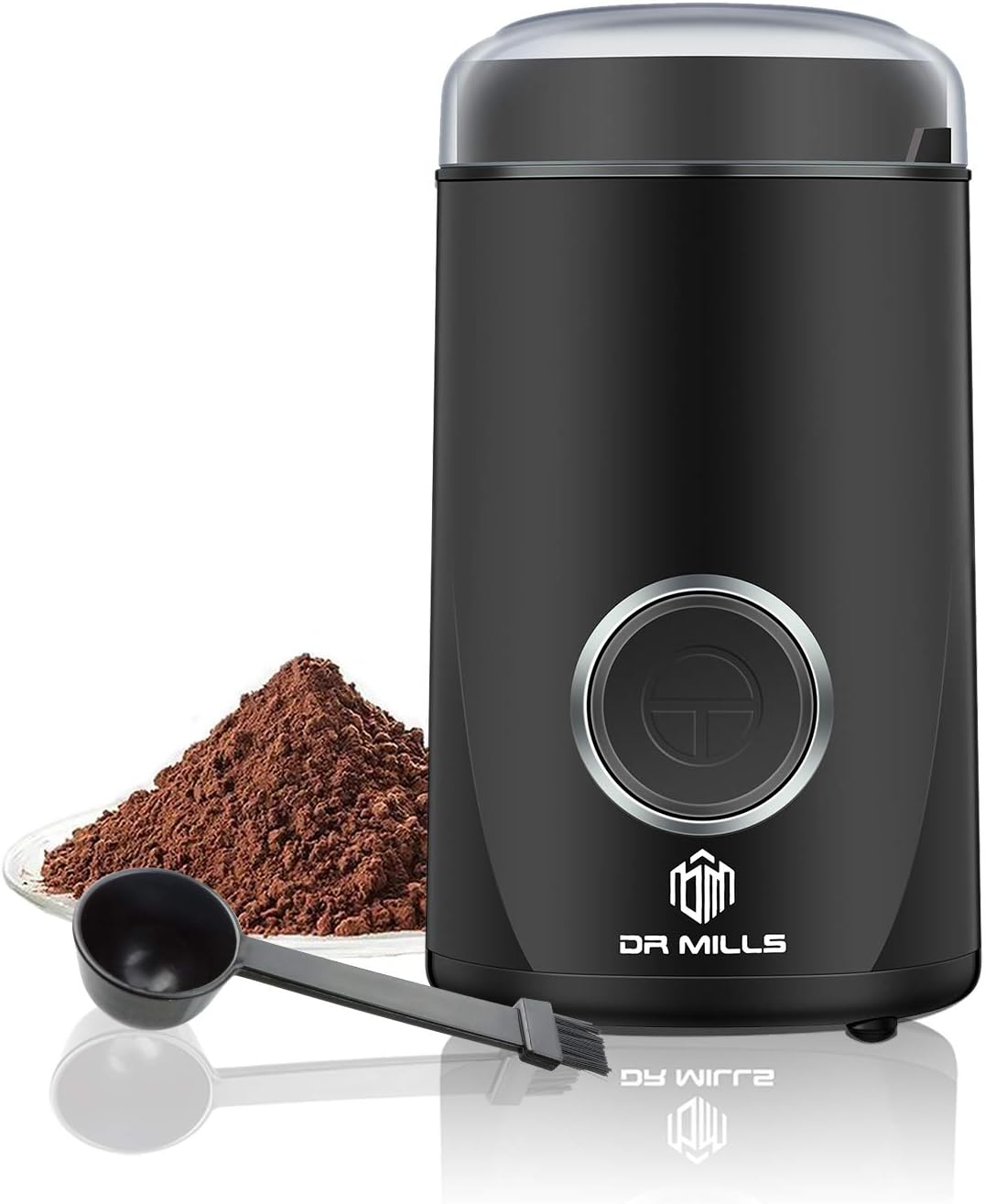
DR MILLS DM-7441 Compact Electric Coffee & Spice Grinder
- Blade, not burr grinding
- Approx. 4 × 3.9 in base
- About 7 inches tall
- 150 W motor
- Approx. 50 g capacity
- Coffee and dry spices
SMEG CGF11 Retro-Style Conical Burr Grinder — Pastel Green
- 30 grind levels
- Stainless conical burrs
- 350 g bean hopper
- Pastel-green retro finish
- Grounds cup and portafilter aid
- Tall statement design

SHARDOR All-Stainless Timed Blade Coffee Grinder — CG728
- Blade grinding mechanism
- Timed rotary knob
- Removable steel bowl
- Full-metal exterior
- Coffee and dry-ingredient use
- Simple cup cleanup
Quick Ranking: Small Kitchen Fit Versus Grind Control
| Model | Mechanism | Space advantage | Best match |
|---|---|---|---|
| Mr. Coffee Burr Mill | Electric burr mill | 18 marked grind settings; cup selector; removable bean hopper and grounds bin | Budget-minded drip and French press brewers who want a vertical entry-level grinder |
| Baratza Encore | Electric · 40 mm conical steel burr | 40 stepped positions; compact 13 × 15 cm footprint; serviceable design | A small kitchen that needs reliable filter grinding with accessible service parts |
| DR MILLS DM-7441 | Electric · stainless-steel blade | About 4 × 3.9 × 7 in; 150 W; 50 g dry-ingredient capacity | Very small kitchens and owners who prioritize drawer storage over precision |
| SMEG CGF11 | Electric · stainless-steel conical burr | 30 grind levels; 350 g hopper; retro 1950s-inspired housing | Design-focused kitchens where a permanently displayed grinder has a purpose |
| SHARDOR Timed Blade | Electric · removable-bowl blade grinder | 1–30 s rotary timer; removable stainless grinding bowl; compact design | Casual coffee drinkers who need simple timed operation and easy bowl access |
What Space-Saving Really Means for Coffee Grinding
A grinder can be compact in three different ways: it can occupy little counter area, require little vertical clearance, or be easy to put away. Those qualities overlap but are not identical. A tall burr grinder may have a small base and still be impossible to fill under a cabinet. A short blade grinder may vanish into a drawer yet demand extra care to produce a balanced cup. Measuring the space and naming the brewing method should come before looking at decorative finishes.
I give the greatest weight to a grinder that makes brewing repeatable without forcing an awkward storage routine. That is why the Encore leads this selection for filter coffee. It is also why I keep two blade grinders in the comparison rather than pretending they perform like burr mills. Some owners need the smallest possible device more than the finest adjustment dial. Honest buying advice has to respect those different needs.
Five Detailed Space-Saving Coffee Grinder Reviews
1. Mr. Coffee Automatic Burr Mill — 18 Grind Settings
Mr. Coffee’s upright burr mill looks sensible beside a drip machine because the controls are easy to understand at a glance. Its eighteen grind positions cover the territory that most casual home brewers visit often: a medium setting for auto-drip, a little finer for many pour-over recipes, and something coarser for a press. The real attraction is not an exotic burr geometry. It is a usable grind selector in a machine that does not demand an elaborate coffee station.
Small-kitchen owners should not confuse an upright silhouette with a tiny footprint. This particular model occupies a broader rectangle than the Baratza Encore, despite being a budget grinder. If the available gap beside the kettle is only five inches wide, measuring the base can decide the purchase before taste or price enters the discussion.
The budget burr advantage over a blade cup
The burr mill feeds beans through a mechanical grind gap. That gives a repeatable reference point for moving between a medium and coarse recipe. A blade machine can be made to run for longer or shorter periods, but it never creates the same fixed gap. For someone frustrated by a sour pour-over one day and muddy coffee the next, Mr. Coffee offers a more useful starting point.
Eighteen settings are adequate for deliberate filter-brew changes, not a promise of professional espresso tuning. The practical approach is to establish one familiar drip position with a weighed dose, then move only a step at a time when the flavor points toward a correction. This avoids confusing a larger setting count with a better cup.
The dimensions that matter on a busy counter
Its hopper sits above the grinding assembly and its grounds bin underneath, keeping the work vertically organized. This makes sense next to a machine with a similar workflow, but it also means there must be room to lift the hopper and pull the bin forward. Under a low cabinet, the available space above a grinder is just as important as the base area.
The published body size is roughly 8.4 inches long, 7.9 inches wide and 12.8 inches high. Those are reference measurements, not an invitation to wedge the appliance into an exact-size slot. Some extra room makes the daily removal and cleaning of the bean hopper far less irritating.
Cup selection is convenient, not weight-based
The cup control can make a familiar routine feel automatic. It lets a user choose a nominal amount and grind without keeping a finger on a switch. However, the machine is not weighing the beans as they pass through. Changing roast or grind setting can alter the number of grams delivered for the same cup selection.
For a repeatable filter recipe, I favor a separate scale. A starting dose such as 20 grams for a single dripper makes more sense than assuming a generic ‘four cups’ selection means a particular brewing ratio. Once the approximate selector output is known, it becomes a useful convenience rather than a source of false precision.
Mr. Coffee Automatic Burr Mill — 18 Grind Settings
Mr. Coffee is the cost-conscious burr choice. Its 18 marked adjustments provide a sensible upgrade for drip, pour-over and French press, but the wider base and plastic receiver deserve attention in a genuinely tiny kitchen.
- Grind-size settings make recipes easier to repeat than with blades
- Entry-level price makes burr grinding accessible
- Tall arrangement keeps hopper and receiver together
- Removable container simplifies transferring grounds
- Nearly eight-inch width and depth still need measurable counter space
- Static and residue can collect in the grounds bin
- Cup selector does not weigh the ground coffee
- Too broadly stepped for demanding unpressurized espresso
Technical Specifications & Daily Features
- BVMC-BMH23-RB-1 / BMH23-RB-1 product family
- 18 marked settings from fine through coarse
- Burr mill mechanism, not a spinning blade
- Cup quantity selector and automatic cycle shutoff
- Removable upper bean hopper and grounds container
- Hopper capacity up to about ½ lb of whole beans in model documentation
- Published dimensions approximately 8.4 × 7.9 × 12.8 inches (L × W × H); check your placement
- US-market electrical configuration; follow exact unit label
Pros & Cons After 30 Days of Use
A first-month ownership review of this model turns on three measurable routines: how reliably a favorite filter setting repeats, whether cup-selector output stays close to the intended dose, and how much static collects in the plastic receiver. These are the issues that determine whether a budget burr mill improves mornings or merely adds another cleaning chore.
A narrow counter makes grounds transfer especially revealing. The hopper needs accessible overhead space and the grounds bin needs room to slide out. Regular dry brushing protects performance, while a separate scale keeps nominal cup quantities from being mistaken for precise grams. The principal compromises are broad grind steps, ordinary static control and its wider-than-expected base.
My Final Verdict
For a buyer seeking the lowest-cost meaningful upgrade from a blade grinder, the Mr. Coffee burr mill earns its place. Its eighteen positions support controlled drip and immersion brewing. I rank it behind the Encore for long-term small-kitchen value because the footprint is not especially narrow and the fine-end precision remains limited.
Best for: Budget-minded drip and French press brewers who want a vertical entry-level grinder.
Static, oils and the removable bin
Ground coffee can stick to the plastic receiver, especially in a dry kitchen. A few scattered grounds feel more noticeable when the grinder shares a narrow work surface with bread, fruit and cooking utensils. Remove the bin only after grinding has stopped, empty it carefully and brush the exit path as permitted in the manual.
Hopper and receiver access are useful, but they do not mean the whole machine can be washed. Keep the powered base dry, avoid dropping water into the burr chamber and let any washable detachable piece dry completely before reassembly. Regular attention is easier than a large deep-clean after oily residue has accumulated.
Where this grinder fits and where it stops
The strongest fit is a household graduating from pre-ground beans to a controllable daily burr grind without paying for more advanced equipment. Drip, simple cone-filter brewing and French press benefit from its practical range. The wide base means it is not automatically the best device for a truly tiny worktop.
I do not recommend treating the finest number as a guarantee of espresso capability. Unpressurized espresso often needs tiny changes to the particle distribution that broad stepped household burr mills cannot provide. The more useful target here is a dependable mug or carafe of filter coffee from an appliance that is easy to reset every morning.
2. Baratza Encore ZCG485BLK Conical Burr Coffee Grinder
The Baratza Encore earns its place in a compact kitchen through a combination that is difficult to improve on without changing category: a narrow base, uncomplicated controls and serviceable grinding parts. It does not try to impress with a display or a dozen programmable presets. The adjustment collar and on/off operation keep attention on the coffee rather than on the interface.
The Encore in this selection is the original ZCG485-style grinder, not the Encore ESP. That distinction matters. This is primarily a filter-and-immersion grinder, with forty marked settings for moving between drippers and presses. It is not the first machine to choose for demanding single-wall espresso baskets.
A genuinely small footprint with real measurements
The manufacturer gives a body size of roughly 13 cm wide, 15 cm deep and 34 cm high. In a crowded kitchen, that means its base occupies considerably less horizontal area than some wide-looking ‘compact’ alternatives. It can fit near a dripper, a small electric kettle or a narrow storage shelf without becoming the dominant appliance.
Height remains the limiting measurement. The bean hopper must be filled and removed from above, so a low cabinet can make a physically narrow grinder frustrating to own. Measure the clearance with the hopper lid lifted, not merely the height of the closed machine. A few centimeters of extra room can save daily shuffling.
Forty settings used intelligently
The original Encore has forty stepped positions. That count gives breathing room between common drip, AeroPress, pour-over and French press recipes without making the control scheme complicated. A small adjustment can be revisited because the collar positions are marked, which is more useful than an uncalibrated blade run duration.
The important limitation is the distribution of those positions. They were designed to cover a broad set of filter uses, not to behave like the very fine microsteps of an espresso-specific adjustment mechanism. Some pressurized espresso baskets are forgiving enough to work with a coarse set of fine-end options, but that is not the same as repeatedly dialing in a conventional espresso shot.
The serviceability advantage in a small kitchen
Counter space is valuable, so replacing an entire grinder because of an accessible wear part is especially irritating. Baratza has a notably serviceable approach, including replaceable components and routine upper-burr access. That matters to the owner who plans to keep the same machine through several coffee-maker upgrades rather than buy a new grinder every couple of years.
Serviceable does not mean maintenance-free. Grounds and oils gather around the burr carrier and chute, especially when dark roasts are ground often. Dry brushing with the grinder unplugged and careful reassembly of the upper ring can help keep the mechanism functioning as intended. The manual remains the correct guide for any deeper disassembly.
Baratza Encore ZCG485BLK Conical Burr Coffee Grinder
The Encore is my first choice for a crowded kitchen built around pour-over, drip, AeroPress or French press. A narrow 13 × 15 cm footprint, straightforward controls and serviceable parts make the space it occupies easier to justify.
- Small measured base for a full-size electric burr grinder
- Forty settings accommodate filter and immersion recipes
- Repairable design helps avoid replacing the whole grinder
- Simple controls are easy to operate beside crowded appliances
- Tall enough to need clearance above the bean hopper
- Not the same as the espresso-oriented Encore ESP
- Grounds bin and chute need routine dry brushing
- No timer or weight-based dosing feature
Technical Specifications & Daily Features
- Classic Baratza Encore / ZCG485BLK, distinct from Encore ESP
- 40 stepped adjustment settings
- 40 mm M3 conical steel burrs
- Manufacturer footprint about 13 cm wide × 15 cm deep; height approximately 34 cm
- Current manufacturer hopper capacity published at 300 g; check original model revision
- Manual on/off and front pulse control; no built-in scale
- Removable top ring burr and supported replacement-parts ecosystem
- Manufacturer power specification 100–120 VAC, 70 W; confirm unit country rating
Pros & Cons After 30 Days of Use
The meaningful first-month checks are straightforward: repeat a familiar pour-over setting, compare one nearby finer and coarser adjustment, and watch whether a given dose transfers neatly from grounds bin to brewer. A clean adjustment collar and properly seated upper burr help preserve the expected range.
Ownership also brings an under-cabinet reality check. Hopper removal needs more vertical room than the base measurements suggest. The long-term advantage is supported replacement parts and accessible service, while the principal limitations remain the lack of a weight-dosing feature and the original model’s coarse espresso adjustment resolution.
My Final Verdict
The original Baratza Encore is the clearest all-around burr grinder for a narrow kitchen counter devoted to filter coffee. Its 13 × 15 cm base, forty settings and service-oriented design beat more elaborate features for everyday usability. Choose a dedicated espresso grinder when unpressurized shot dialing is the priority.
Best for: A small kitchen that needs reliable filter grinding with accessible service parts.
Why a simple toggle can be a benefit
The Encore offers an easy on/off switch and pulse function instead of a programmable dose scale. The daily routine becomes weigh, grind, transfer and brew. There is very little interface to remember, and switching beans does not require exploring settings on a screen.
That simplicity comes with an important trade-off: the grinder does not measure coffee weight. For precise repeatability, measure the dose independently and use the grind selector primarily to control particle size. People expecting automatic portioning from the panel may prefer a different design, but owners who already use a kitchen scale lose very little.
The flavor and sediment questions that matter
For pour-over, the grinder needs to provide a repeatable medium-to-medium-fine bed without turning every brew into a muddy stall. For French press, it needs enough coarse range to preserve body without unnecessarily excessive sediment. The Encore’s adjustable burr mechanism addresses both requirements more deliberately than a simple chopping blade.
No burr grinder creates a perfectly uniform particle distribution, and the cup depends on roast, water, temperature and brewing method. I favor the Encore because it makes one-variable adjustments practical: keep the recipe stable, move the dial a small amount and judge the result. That is a more useful ownership benefit than an unsupported claim of laboratory uniformity.
Is the extra price worth the counter space?
Compared with the Mr. Coffee, the Encore asks a higher initial investment but gives a smaller measured base and a better-established service ecosystem. Those distinctions matter when the grinder is the appliance that never leaves the counter. It becomes part of the kitchen, not a temporary gadget balanced between a toaster and a fruit bowl.
Compared with the SMEG, it offers less visual drama and fewer design flourishes, but it is easier to justify when coffee and space take priority over color. The right buyer is someone who mainly brews filter coffee, values predictable adjustments and wants one narrow grinder to keep for years.
3. DR MILLS DM-7441 Compact Electric Coffee & Spice Grinder
Some kitchens have no practical place for a permanent grinder at all. For those spaces, the DR MILLS DM-7441 is intriguing because it can be moved from a drawer to a counter, used for a quick dose, then stored again. The roughly four-inch body makes a different promise from a tall burr mill: it is a tool that can disappear rather than one that needs a designated station.
Its small footprint is real; its grind precision should not be exaggerated. The DM-7441 uses a rotating stainless-steel blade, so there is no numbered burr gap and no reliable way to recreate exactly the same particle distribution from one run to the next. That trade-off is central to deciding whether this compact appliance serves the kind of coffee being brewed.
A four-inch appliance solves a real storage problem
At approximately 4 × 3.9 inches across the base and seven inches tall, this grinder fits where many burr grinders cannot. It is easier to store in a cupboard, on a shelf or inside a utility drawer and can be useful in a van kitchen or dorm. Short overall height also reduces the chance of hitting a cabinet when the lid is removed.
The approximately 50 g capacity is sufficient for a modest coffee batch or several small doses, but it is not the right number for choosing a brewing ratio. A 50 g bowl is a volume limit, not a recommendation to make every batch that size. Smaller, repeatable amounts are easier to manage when learning how the blades behave.
Blade grinding and the unavoidable size mixture
A spinning blade strikes beans as they circulate inside the chamber. Some pieces may be hit repeatedly while others escape as larger fragments. Running the motor longer creates more small particles, but it does not sort the grounds through a mechanical setting like a burr mill. That makes precision pour-over and espresso the wrong expectations.
For an immersion method such as a French press or a forgiving cold-brew recipe, the machine remains useful when convenience and space dominate. The resulting coffee can carry more fines or sediment, so gentle brewing and careful pouring help. It is more important to acknowledge that compromise than to pretend the blade behaves like a conical burr.
The 150-watt motor and short operating routine
The DR MILLS DM-7441 is commonly specified with a 150 W motor. That rating concerns power consumption and motor design; it does not measure grind uniformity. The machine is suited to short, controlled grinding runs with its lid securely in place. Grinding is completed only after the moving parts have stopped.
There is no advantage in running the blade continuously beyond the operating guidance to force a finer result. Heat can build up, and the mixed particle sizes remain. A repeatable batch weight and careful observation of the texture offer more value than an imagined universal number of seconds for every bean.
DR MILLS DM-7441 Compact Electric Coffee & Spice Grinder
The DR MILLS is the space-saving fallback when physical dimensions outrank precision. It can grind coffee in a tiny area, but it is a blade chopper and cannot match the deliberate grind control of the three burr models.
- Extremely compact counter footprint and short housing
- Simple operating sequence with little learning curve
- Useful for dry spices as well as coffee when cleaned properly
- Easy to relocate from a cabinet to a small preparation space
- No repeatable burr-gap adjustment for pour-over or espresso
- Blade produces a mixture of coarse and fine particles
- Coffee and spice oils can transfer unwanted flavors
- Fixed bowl needs careful dry cleaning
Technical Specifications & Daily Features
- DR MILLS DM-7441 / related DM-7441W styling
- Stainless-steel blade and fixed grinding bowl; not adjustable burrs
- Published motor rating approximately 150 W
- Approximate capacity 50 g of coffee beans or dry ingredients
- Approximate outer dimensions 4 × 3.9 × 6.97 inches
- Press-and-hold operation, with no numbered grind-size dial
- Product is intended for suitable dry ingredients; follow manual
- Protect electric housing and sharp blade during cleaning; no unapproved immersion
Pros & Cons After 30 Days of Use
A sensible first-month ownership assessment focuses on whether the grinder truly returns to its storage place without hassle, whether the small lid and cord remain manageable, and how quickly the fixed cup can be cleaned after a few modest batches. These practical questions are more decisive than claims about espresso-level consistency.
The limitations do not change after repeated use: a blade cannot supply repeatable numbered grind steps, and fragrant dry spices can leave odors in the cup. Accepting those trade-offs makes the DR MILLS useful as a small utility grinder; expecting the precision of a burr mill makes the purchase disappointing.
My Final Verdict
DR MILLS is the winner for the least available counter area. I recommend it for occasional grinding and simple immersion coffee where convenience is paramount, not as a long-term answer to precision pour-over or espresso. A tiny footprint and a fixed blade are inseparable parts of this choice.
Best for: Very small kitchens and owners who prioritize drawer storage over precision.
Coffee and spices: useful but not flavor-neutral
The steel cup is marketed for coffee and compatible dry kitchen ingredients, which can be genuinely useful when a small kitchen has space for only one multipurpose motor. Coffee, cumin, pepper and warm spices are not flavor-neutral, however. Oils can cling to a blade and bowl, and a noticeable aroma can carry into the next grind.
A separate dedicated grinder is the cleanest approach for heavily aromatic spices. When one appliance must do both jobs, follow the permitted cleaning method and leave the bowl completely dry before grinding coffee again. Never assume the motor housing or fixed grinding chamber is dishwasher-safe.
A tiny appliance still needs a safe workspace
Compact dimensions do not remove basic operating needs. The grinder should stand on a dry, stable surface with enough room to handle the lid and cord without snagging neighboring equipment. Pulling a very light appliance from a crowded cupboard can be more dangerous than leaving it where its cable remains accessible.
The best home for this grinder is a space where it can be unplugged and stored without leaving grounds trapped in the bowl. A simple soft brush is usually more useful than complicated cleaning tools. The fixed cup requires patience near the blade, and the device must always be disconnected before the chamber is inspected.
Who benefits from its minimum footprint?
This is a sensible choice for someone who prizes the ability to grind fresh beans in a tiny area and drinks coffee using forgiving methods. It is especially appealing when the same small kitchen occasionally needs a dry-spice grinder. It is less persuasive for a person who just bought a precision dripper or a conventional espresso machine.
My preference for space-saving gear is a machine that does one common job well. For DR MILLS, that job is compact, simple chopping rather than calibrated coffee grinding. Buyers who can spare the Encore’s narrow base will gain substantially more control over extraction; buyers who cannot may accept the blade compromise knowingly.
4. SMEG CGF11 Retro-Style Conical Burr Grinder — Pastel Green
The SMEG CGF11 makes a different argument for keeping a grinder in a small kitchen: it looks like a deliberate part of the room. The pastel-green retro shell, distinctive controls and matching grounds vessel can make a compact counter feel styled rather than cluttered. But good design still has to survive a tape measure. This is a tall appliance, and in low-cabinet kitchens it may be the least convenient grinder in the group.
More importantly, the CGF11 is a genuine electric burr grinder, not a generic pastel blade chopper. Its thirty marked grind levels, conical steel burrs and substantial hopper support a broader coffee routine than a generic description of “adjustability” suggests. Its burr mechanism matters as much as the appearance.
Thirty grind levels beneath the retro shell
The CGF11 uses thirty grind levels that are intended to serve a range of coffee preparation methods. A household can move from filter brews toward an espresso-oriented zone without buying a separate grinder for every drink. Those steps are a genuine benefit because they offer a repeatable adjustment, unlike the running-time control of a blade unit.
There is still a practical limit to any stepped home grinder. A conventional espresso basket can require very small changes that fall between available settings, depending on the beans and machine. Treating ‘espresso capable’ as a universal promise would oversell it. For everyday drip, filter and compatible espresso-style setups, the adjustability is useful; for exacting espresso enthusiasts, a dedicated grinder may suit the job better.
The height-versus-width trade-off
The pastel-green retail variation is associated with a height around eighteen inches. That makes the CGF11 more of a permanent counter display than a device that lives comfortably under every overhead cabinet. The body may occupy a manageable base area, but the top still needs room for opening and filling the hopper.
This is why comparing only horizontal footprint gives an incomplete answer. A low upper cabinet may force the entire grinder forward or require it to be lifted out for every refill. In a small kitchen, that extra motion can outweigh the pleasure of its appearance. Measure both the closed appliance and the space needed to use it.
A 350-gram hopper is not bean storage
The CGF11 accommodates roughly 350 g of beans in its documented hopper, considerably more than is needed for a single cup. The capacity is useful for a household that makes several coffees a day, but it can encourage a habit of leaving beans exposed to light, air and kitchen heat longer than necessary.
I favor keeping the main bag in a sealed container and filling the grinder with a working quantity. This also makes switching roasts easier. A clean hopper and grounds receiver reduce stale fragments mixing into the next dose. The hopper makes the grinder convenient; it is not a substitute for sensible bean storage.
SMEG CGF11 Retro-Style Conical Burr Grinder — Pastel Green
SMEG is the strongest aesthetic choice, not the smallest appliance. Its thirty-level conical-burr system is a real coffee tool, but the substantial height means it belongs on a measured, open counter rather than beneath every cabinet.
- Actual burr adjustment rather than blade timing
- Distinctive finish makes permanent countertop placement attractive
- Multiple grind levels for filter and espresso-style routines
- Includes receiving-container and portafilter-oriented convenience
- Tall, potentially awkward under low-hanging cabinets
- Premium cost and substantial weight for a small-space tool
- Not nearly as easy to hide in a narrow drawer
- Unpressurized espresso fine-tuning needs realistic expectations
Technical Specifications & Daily Features
- SMEG CGF11 pastel-green US family / CGF11PGUS
- 30 grind levels covering coarse, medium and fine zones
- Stainless-steel conical burr set
- Approximate 350 g bean hopper and 130 g grounds container
- Portafilter-support accessory and container; check package and variant
- Glossy retro styling, die-cast housing and anti-slip feet
- Published retail height about 18.13 inches; measure overhead clearance before buying
- US configuration should be checked for the correct supply voltage
Pros & Cons After 30 Days of Use
The first-month ownership factors are alignment with the space and the brewing routine: can the hopper open without contacting a cabinet, can a grounds receiver be removed without shifting nearby equipment, and are the thirty grind levels broad enough for the two methods used most often? These are more useful questions than a decorative score.
The remaining ownership compromises are its substantial height and premium positioning. The conical burr mechanism offers legitimate coffee control, while the large hopper and display-worthy finish demand deliberate daily care. Owners with low cabinet clearances will notice the fit issue immediately, however attractive the appliance looks.
My Final Verdict
SMEG CGF11 is the premium style pick because it combines a real thirty-level conical-burr system with distinctive pastel-green design. It is not my space-efficiency winner: check its considerable height and the hopper-opening clearance before buying. Its appeal is the combination of coffee capability and a counter-worthy finish.
Best for: Design-focused kitchens where a permanently displayed grinder has a purpose.
Portafilter handling and grounds transfer
The SMEG includes accessories oriented toward grinding into a grounds container or a supported espresso handle. That dual-purpose layout is useful when a family alternates between filter coffee and a compatible espresso machine. The container and portafilter arrangement deserve a compatibility check, because accessories and handle shapes are not universal.
When the grinder is placed in a tight space, leave room in front to insert and remove the receiver comfortably. A coffee station that requires twisting a hot kettle out of the way every time the grounds cup comes out is not actually efficient. Good workflow is part of space-saving design.
The cleaning costs of leaving a grinder on display
An appliance kept in the open encounters steam, cooking dust and scattered grounds. The CGF11’s burr access and included brush are helpful, but no premium finish removes the need to clear oils and residue. Clean the relevant parts as directed, with the powered base unplugged and dry.
The pastel finish also deserves ordinary care. Abrasive cleaners can dull decorative surfaces, and a full hopper makes an appliance heavier to move for wiping. The smarter routine is a brief dry brush of the grinding path, a wipe of the accessible exterior and sensible bean storage, rather than infrequent aggressive cleaning.
When style is a practical priority
Some readers genuinely enjoy leaving a beautiful coffee appliance visible; that is a valid purchase consideration in a space where every item is on display. The CGF11 can occupy a dedicated corner with a matching kettle and brewer, avoiding the need to store and retrieve multiple small devices.
That calculation changes when the kitchen has low cabinets or the grinder must disappear after each use. Its height and substantial body become clear drawbacks. I recommend the SMEG to someone who knows exactly where it will live and values both retro styling and real burr adjustment, not to someone trying to squeeze one more thing into an already full drawer.
5. SHARDOR All-Stainless Timed Blade Coffee Grinder — CG728
SHARDOR’s all-stainless timed grinder is the smallest kind of machine that can improve a casual coffee routine without introducing burr controls. A rotary timer starts a repeatable motor cycle and the removable stainless bowl takes the grounds directly to the brewer. These choices are appealing in crowded kitchens because they simplify two everyday tasks: pressing start and cleaning up.
The adjustment deserves accurate language. The timer controls seconds, not the position of a pair of burrs. The blades continue striking circulating beans until the machine stops. That can produce usable coffee for forgiving methods, but the grounds will include a wider range of particle sizes than a well-adjusted burr mill. Calling this a precision adjustable grinder creates the wrong expectation.
The difference between a timer and grind settings
A rotary control lets the user select an operating duration instead of holding down a lid for the entire cycle. The visible timer can help make a familiar daily sequence simpler, but it does not create a calibrated grind-size position. Two batches may behave differently as roast density, bean size and fill level change.
This distinction is particularly important for espresso, where a tiny change in particle size can change how water passes through the puck. The SHARDOR has no mechanical way to make that small adjustment. It belongs with casual drip, immersion and other forgiving brewing methods, where convenience and fresh grinding can still be worthwhile.
A removable bowl is the feature that matters most
A lift-out stainless-steel grinding cup simplifies pouring compared with a fixed bowl that forces the user to tip the entire powered machine toward a brewer. It also creates a more manageable cleaning task because the removable part can be handled away from the motor. In a narrow kitchen, avoiding spills often matters more than saving one additional centimeter of counter width.
Washability is a model-specific detail. SHARDOR describes a dishwasher-safe cup for a related all-metal timed configuration, but the correct instructions are those supplied with the exact unit. Never put the powered body in water, and reassemble only after detachable parts are fully dry.
The metal exterior and storage routine
The stainless-steel exterior offers a straightforward appliance look that can coexist with other metal countertop tools. The squat body is easier to fit into some cupboards than a tall hopper grinder. Its practical shape is especially useful when a small kitchen does not have room for a permanent coffee station.
Compactness also brings a storage obligation: the bowl, lid and cord should remain together, with no loose coffee left inside. The blade must be fully stopped before anything is removed. A simple shelf position near the brewer helps avoid constantly moving the unit across a crowded kitchen.
SHARDOR All-Stainless Timed Blade Coffee Grinder — CG728
SHARDOR is the convenience-first blade option. The timer and lift-out cup are useful for modest, casual coffee doses, but those controls do not turn a blade grinder into an espresso or precision filter burr mill.
- Removable cup simplifies pouring grounds without tipping the motor
- Timed control reduces the need to hold a button
- Small footprint suits busy counters and cupboards
- Metal housing offers a straightforward kitchen-tool appearance
- Timer does not create uniform, numbered grind-size settings
- No accurate route to conventional espresso dial-in
- Still needs mains electricity despite compact size
- Bowl capacity and washability can vary between closely named versions
Technical Specifications & Daily Features
- SHARDOR CG728-style timed coffee blade grinder
- Stainless-steel chopping blade; not a burr mechanism
- Rotary timer sets operating seconds, commonly 1–30 seconds on the manufacturer configuration
- Removable stainless-steel bowl and full-metal outer housing
- Intended for coffee beans and compatible dry spices or herbs
- Bowl washing instructions are variant-specific; manufacturer describes dishwasher-safe cup for related model
- Ground coarseness is affected by running time but is not a calibrated grinder setting
- US plug and voltage configuration should be checked against the actual unit
Pros & Cons After 30 Days of Use
For the first month, the most important ownership questions concern the removal and cleanup of the stainless cup, how consistently the timer repeats a familiar routine, and whether the blade output meets the tolerance of the chosen brewer. Those points can be judged without pretending that a timer is a micrometer.
The key limitations are inherent: the blade never provides a fixed grind gap, the timer does not measure coffee grams, and aromatic spice residue requires careful washing. The strongest ownership benefit is faster grounds transfer and easier bowl access in a crowded kitchen.
My Final Verdict
The SHARDOR makes sense as a compact, easy-clean blade appliance for casual brewing. Its timed knob is useful, but it does not solve the particle-size precision problem. For a coffee-focused buyer who values repeatability, I favor the burr options; for a crowded counter and simple routine, this lift-out bowl is a reasonable compromise.
Best for: Casual coffee drinkers who need simple timed operation and easy bowl access.
Why it cannot replace an espresso burr grinder
Even with the timer set precisely, a blade does not channel every coffee particle through a fixed mechanical opening. Fine dust and larger fragments can remain in the same batch. An unpressurized espresso basket usually needs much tighter control to deliver repeatable extraction.
I do not position this SHARDOR as a low-cost equivalent to the Baratza Encore. The two products solve different problems: SHARDOR saves handling steps with a detachable bowl, while the Encore gives a controllable grind-size dial and a serviceable burr mechanism. Picking between them becomes easy once the brewing method is clear.
Keeping the blade and bowl clean
Small stainless bowls can hold coffee oils along the seams and around the blade. A detachable cup makes those surfaces easier to access, but sharp edges still require careful handling. Unplug the machine first and follow the manual for removal, brushing and any water-based cleaning.
When the same cup is used for aromatic spices, the next coffee can pick up unwanted flavors. A dedicated coffee cup or a separate inexpensive spice grinder is often sensible. A washable bowl reduces that problem only if it is cleaned thoroughly and dried before the next batch.
Who should buy the SHARDOR?
This is the simplest choice for someone who prepares casual coffee at home, uses a forgiving brewer and values push-button timing and easy grounds transfer. Its practical features are visible even without expensive accessories, and a removable bowl can make more difference to daily tidiness than an ornate display.
It is less suitable for someone planning to learn espresso or to compare subtle pour-over recipes. The absence of numbered burr settings becomes a limitation rather than a small inconvenience. Buyers who can fit the Encore and care about extraction control should prioritize burr grinding; those focused on compact casual preparation can choose the SHARDOR knowingly.
Buying Guide: How to Choose a Grinder for a Small Kitchen
The full buying decision starts with the available space and the brewing method, not the cheapest price or most decorative finish. In particular, a compact blade grinder and a compact burr grinder solve different problems. The following considerations help avoid paying for controls, storage capacity or styling that the kitchen cannot use comfortably.
For adjustments across different brewers, the guide to coffee grinders for instant grind adjustments offers another route into choosing a grinder that can move between familiar recipes.
1. Measure the base, the height and the working clearance
Before choosing a grinder, measure the portion of the counter that can stay clear during normal cooking. Note the width and depth of the base, the actual height beneath the nearest cabinet, and the space needed in front of the unit for its grounds container. A five-inch-wide appliance can still be uncomfortable when the handle or lid needs another several inches of movement.
The Encore's approximately 13 × 15 cm base is a concrete advantage in a narrow slot. The DR MILLS occupies even less surface area, around four inches across, because it is a small blade tool. The tall SMEG and upright Mr. Coffee need overhead clearance. Those three dimensions should be considered together, not reduced to a generic compact label.
2. Decide whether the grinder will live on the counter or in storage
A grinder left beside the brewer can be heavier and taller without causing constant inconvenience, provided its hopper opens freely. That favors an Encore or SMEG in a dedicated coffee corner. If every appliance must disappear after breakfast, the short DR MILLS and bowl-style SHARDOR become more appealing.
Moving a grinder twice a day also adds handling risk. A full hopper can spill, a grounds bin can shift and a heavy base can scratch a surface. A simple, repeatable storage spot makes more difference than impressive packaging dimensions. I prefer a slightly larger appliance that is easy to use over a tiny one that must be disassembled whenever coffee is made.
3. Match burr or blade grinding to the brewer
A burr mechanism sets a mechanical path for the beans and gives the brewer an adjustment point that can be revisited. This helps with filter recipes where a small change in grind affects flow and flavor. The Encore, Mr. Coffee and SMEG offer that kind of control. They do not all have identical precision, but their stepped settings are meaningful.
Blade grinders operate differently. Their spinning blades strike pieces that circulate inside the bowl, so run duration produces a changing mixture rather than one uniform target size. DR MILLS and SHARDOR remain useful for casual coffee and compatible dry foods, but I do not rank them alongside burr grinders for espresso dialing or precise pour-over.
4. Do not mistake timer settings for coffee weight
An automatic cycle can save attention, but it does not prove how many grams reached the receiving cup. The Mr. Coffee cup selector uses nominal portions, and the SHARDOR rotary timer selects running time. Throughput and resulting dose can change when beans or grinding conditions change.
A small scale occupies very little space and solves the dosing question more directly. For an uncomplicated dripper, measuring 20 grams of coffee and 300 to 320 grams of water provides a useful starting point. Keep the dose stable while learning the grinder, and use its control primarily for the task that control actually performs.
5. Think about the removal path for beans and grounds
A grinder with a top-mounted hopper needs vertical clearance for the lid and possibly the hopper itself. A removable grounds bin needs enough room in front to pull it without colliding with the dripper. When a machine sits inside a nook, poor access can make its nominal footprint misleading.
Before committing a permanent location, simulate the full routine: fill, set, grind, empty, brush and wipe. The SHARDOR's detachable bowl can be helpful here because it moves the grounds away from the motor. The SMEG's portafilter accessory creates another reach and clearance requirement that should be considered.
6. Choose grind settings you can actually use
More settings can be helpful, but only if the machine covers the range required by the brewer. The Encore's forty steps provide flexibility for filter and immersion methods. The SMEG's thirty offer a substantial general-purpose range. Mr. Coffee's eighteen cover familiar brew categories without the same fine granularity.
The number printed on one dial has no universal relationship to another brand's setting. For the first week with a new coffee, pick a sensible starting position and change one variable at a time. A repeatable routine usually matters more than owning the grinder with the most numbers.
7. Plan carefully for espresso in a small kitchen
Conventional espresso is demanding because the grind influences water flow through a compressed puck. A large step between settings can be frustrating when one position chokes the shot and the next runs too quickly. Small household burr grinders may work with more forgiving pressurized baskets while falling short of specialist unpressurized espresso control.
This comparison is primarily about space efficiency, not identifying a high-end espresso grinder. The original Encore is filter-first, and the SMEG and Mr. Coffee still have practical fine-end limits. Blade options are not appropriate substitutes. For a serious espresso station, choose a grinder whose adjustment mechanism matches the actual basket and machine, even if that means rethinking the available space.
8. Keep the grounds receiver and burr path accessible
Coffee oils accumulate in chutes and cups, especially after repeated dark-roast grinding. On a crowded worktop, scattered fines also mix with other food preparation and become an ongoing nuisance. A removable grounds cup or accessible upper burr turns cleanup into a predictable small task.
Unplug an electric grinder before working near burrs, blades or switches. Keep electrical housings dry. Only wash detachable parts when the exact instructions permit it, and dry them thoroughly. In particular, the fixed DR MILLS grinding chamber is not the same as the removable SHARDOR bowl.
9. Static control is useful, but no grinder is mess-proof
Dry air makes ground coffee cling to plastic receivers and scatter from small chutes. A steady tap and a soft brush can reduce the mess without adding complicated accessories. The SMEG grounds container and the Encore's removable bin each require a slightly different transfer motion, so a good fit should be judged by everyday handling.
Moistening beans to reduce static is sometimes discussed among enthusiasts, but appliance guidance varies. I do not recommend adding water to a grinder without confirming the exact product permits that method. In a tiny kitchen, reliable dry cleaning and sensible bean storage are the safer universal practices.
10. Examine replacement parts before buying a permanent appliance
A small kitchen often has room for one grinder, not a lineup of backups. In that situation, access to replaceable wear parts matters. The Encore has a notably service-oriented design and a practical support ecosystem, which helps justify its permanent place on a counter.
Not every inexpensive grinder offers the same repair path. Blade units may be practical for their price but less economical to repair. Before purchasing, consider how easily the hopper, lid, receiving cup or burr carrier can be replaced, and how long the device is expected to remain useful across future brewing interests.
11. Noise is part of a shared-apartment workflow
A grinder used at dawn in a dorm or apartment can be noticeable to roommates. Blade motors and burr mechanisms make different sounds, but pitch and loudness cannot be inferred reliably from mechanism alone. Counter material, bean hardness and distance can change the impression.
Short grinding periods and a stable, non-slip surface help more than an unsupported decibel ranking. If noise dominates the decision, a compact manual grinder outside this electrically powered group may be a more appropriate choice. None of these five is guaranteed silent.
12. Avoid turning the hopper into long-term storage
Larger hoppers are convenient during busy mornings but they expose beans to repeated opening, air and kitchen temperatures. The SMEG's roughly 350 g hopper is useful for several daily coffees; it does not preserve freshness indefinitely. Mr. Coffee and Encore also have hoppers designed for convenience rather than sealed pantry storage.
Store the bulk of the beans in a suitable closed container and fill the grinder with a manageable working amount. A small kitchen benefits from this habit because it limits stale beans, makes changing roasts easier and reduces the weight of an appliance that occasionally has to be moved.
13. Consider multi-purpose grinding without confusing the results
DR MILLS and SHARDOR can be useful for approved dry spices and herbs as well as coffee. That may sound perfect for someone trying to eliminate duplicate appliances, but strongly aromatic ingredients can leave oils and scent behind. Grinding cinnamon or pepper before coffee can change the beverage unexpectedly.
Separate bowls, when compatible, reduce that problem. Otherwise use the approved cleaning procedure carefully and avoid assuming every spice or oily ingredient is safe for the grinder. A tool that serves two jobs is space-saving only when cleaning it between jobs remains manageable.
14. Use a standard recipe to assess actual grind improvement
For pour-over, begin with one familiar bean, a measured dose and consistent water. A grind adjustment becomes useful only when the brewing recipe stays mostly stable. If a cup tastes thin, a small move finer may help; if the brewer stalls or tastes heavy, the right correction might be a coarser grind or gentler agitation.
For French press, some sediment is normal and the metal filter will not remove every fine particle. A controlled coarse-to-medium-coarse burr grind makes the texture easier to manage, but the steep and pour matter too. The goal is repeatable good coffee, not a marketing promise of identical particles.
15. Do not overlook electrical compatibility
Compact electric grinders still need the correct mains voltage and a safe outlet. A North American 120 V appliance cannot automatically be used on a 220–240 V system simply by changing the plug shape. Check the rating label of the exact unit and obtain appropriate advice for international use.
The same caution applies to dorms, travel trailers and camper vans. Inverter capacity, protected outlets and stable surfaces matter more than a grinder's stylish exterior. Never run an electrical appliance on a wet counter or where the cord crosses a burner or water source.
16. Let long-term fit decide the value
A grinder that costs less initially can become expensive if it is hard to clean, frustrating to operate or impossible to place comfortably. The Encore's serviceability and compact base are strong reasons to keep it. The Mr. Coffee offers lower-cost adjustable grinding. The SMEG offers style with meaningful burr features but significant height.
The blade models solve a different kind of scarcity: cabinet space and time spent transferring grounds. Each has a legitimate role when its compromises are understood. I choose based on the brewing method and the exact physical space rather than asking every model to serve every coffee drinker equally.
Choosing by Kitchen Type: Four Practical Scenarios
Small apartment: one dedicated coffee corner
A small apartment often benefits from a permanent coffee station that occupies a single stretch of counter and avoids dragging equipment through meal preparation. I put the brewer, grinder and scale within comfortable reach, leaving room for the grounds receiver to come out. The Encore's narrow base makes this practical when pour-over or drip is the main routine.
A short shelf or slim organizer can help with filters and a brush, provided it does not block ventilation, the electrical cord or access to the hopper. Cluttering the top of the grinder defeats the purpose. The priority is to preserve a clear work zone so brewing does not interrupt cooking.
Dorm or shared rental: make cleanup immediate
A shared kitchen needs equipment that can be put away quickly and leaves few grounds on the counter. SHARDOR's removable cup is appealing for that reason, while DR MILLS takes less room in a cupboard. Neither gives the precise grind-size adjustments of a burr grinder, but both fit a casual fresh-coffee habit.
A burr grinder can still be a better long-term purchase for a student serious about filter coffee. The deciding factors are the amount of cupboard space, permitted appliance use and tolerance for motor noise. Grounds must be removed and the machine safely unplugged before returning it to storage.
Camper van or small RV: storage is different from brewing
In a vehicle, physical stability and power supply matter as much as dimensions. Even a short blade grinder needs a safe, dry place to sit when operating, and the cord must not cross water or hot surfaces. Store it so the lid cannot rattle free while driving and do not leave loose grounds in the chamber.
An electric countertop grinder may be entirely reasonable in a powered camper setup, but battery and inverter limitations change the calculation. Where power is scarce, a compact manual hand mill outside this five-product shortlist may be the simplest answer. Smallness does not remove the need for a suitable electricity source.
Coffee-first kitchen: choose the compromise you notice least
For an owner who brews fresh coffee every morning, the grinder's controls and clean-up routine become familiar very quickly. A slight footprint difference is less important than the ability to reproduce a recipe without fuss. That is where an adjustable burr grinder can justify the extra space it requires.
For a person who only occasionally grinds a small amount of coffee, the ability to put the device away may matter more. The goal is not to encourage every household to buy a large espresso setup. It is to find the least annoying compromise among space, control, maintenance and cost.
Three Small-Space Brewing Routines Worth Keeping Simple
A weekday drip coffee that needs no complicated setup
For an everyday drip coffee maker, start with a consistent weighed amount of beans and use a medium grinder setting appropriate to the filter type. Mr. Coffee makes sense for a budget-conscious owner, while the Encore makes returning to a favorite setting easier for someone who also brews pour-over. Empty the receiver gently and sweep the small amount of grounds around the machine before starting breakfast.
The whole routine can be short: measure, grind, brew and brush. When the drink tastes thinner than usual, resist immediately increasing the coffee dose, grind time and brewing temperature together. One small adjustment reveals more about what changed, and the kitchen stays free of a pile of unnecessary accessories.
A compact pour-over station
A dripper, a scale, a kettle and a grinder do not require an entire kitchen island. A small mat keeps the scales and grounds receiver in one area, while filters and a brush can live nearby. About 20 grams of coffee to 300–320 grams of water is a reasonable starting ratio for many single-cup methods, though the exact recipe depends on the beans and dripper.
The Encore gives the clearest grind-control advantage for this use. The SMEG can also serve a filter station when there is enough overhead room, and the Mr. Coffee is the lower-cost burr route. The blade alternatives make sense mainly when space or occasional use outranks the desire for consistent drawdown.
An occasional French press in a tiny apartment
French press coffee is forgiving in some ways because the grounds steep in water instead of forming a bed that controls flow. Yet a metal mesh filter allows fine particles through, so an uneven blade grind can make the cup muddier. Begin in a coarse-to-medium-coarse range, keep the dose and steep consistent, then adjust according to taste and sediment.
A patient pour and a short settling period often do more to improve the finish than chasing the absolute coarsest setting. For anyone who drinks press coffee regularly, a burr model earns its counter space. For a rare weekend batch, a well-maintained compact blade unit can be an acceptable compromise, provided its limitations are understood.
Final Comparison: Footprint, Controls and Buying Priorities
| Grinder | Type | Control | Space consideration | Best for | Price |
|---|---|---|---|---|---|
| Mr. Coffee Burr Mill | Electric burr mill | 18 stepped grind sizes | Upright but nearly 8 in wide | Budget-minded drip and French press brewers who want a vertical entry-level grinder | Price on Amazon |
| Baratza Encore | Electric · 40 mm conical steel burr | 40 stepped grind sizes | Approx. 13 × 15 cm base | A small kitchen that needs reliable filter grinding with accessible service parts | Price on Amazon |
| DR MILLS DM-7441 | Electric · stainless-steel blade | Blade run time | Approx. 4 × 3.9 in base | Very small kitchens and owners who prioritize drawer storage over precision | Price on Amazon |
| SMEG CGF11 | Electric · stainless-steel conical burr | 30 stepped grind levels | Tall, about 18 in high | Design-focused kitchens where a permanently displayed grinder has a purpose | Price on Amazon |
| SHARDOR Timed Blade | Electric · removable-bowl blade grinder | Rotary grind timer | Short body; removable bowl | Casual coffee drinkers who need simple timed operation and easy bowl access | Price on Amazon |
My Final Recommendation
For most coffee-focused small kitchens, I choose the original Baratza Encore. Its narrow measured base, forty grind positions and accessible service parts let it support serious filter brewing without turning the counter into an equipment showroom. It makes sense to keep this grinder in one clear spot, with enough room to open the hopper and remove the receiver. The compactness is genuine, and the controls are sufficient for the methods it handles best.
For an entry-level burr mill at a lower price, Mr. Coffee is the practical runner-up—but I recommend measuring its surprisingly broad base. SMEG CGF11 is the style-forward choice with real conical burrs and thirty levels; the pastel finish can be worth displaying, but its height rules it out for many low-cabinet spaces. Neither of those trade-offs should be hidden behind a generic promise of a tiny footprint.
When the kitchen simply cannot spare counter space for a permanent burr grinder, DR MILLS offers the smallest body, while SHARDOR adds the convenience of a removable bowl and timed operation. Both are blade grinders and therefore belong to a more casual brewing category. My final advice is to buy as much grind control as the kitchen and budget can comfortably support, and avoid sacrificing daily usability just to save a small patch of counter.
Frequently Asked Questions About Small Coffee Grinders
Which coffee grinder is best for a very small kitchen?
The Baratza Encore is my best overall choice when filter-coffee performance matters, thanks to its narrow approximately 13 × 15 cm base, forty grind positions and serviceable burr system. The DR MILLS takes less counter area but uses blades, so grind precision is substantially lower.
What is the smallest grinder among these five?
DR MILLS DM-7441 has an approximately 4 × 3.9-inch base and is only about seven inches tall. It is the smallest practical countertop option in this group, but it is a blade grinder rather than an adjustable burr mill.
Is the Baratza Encore good for a small counter?
Yes. Baratza specifies approximately 13 cm width and 15 cm depth for the classic Encore, with a height of around 34 cm. Measure overhead space so the hopper can be opened and removed comfortably.
Is Baratza Encore the same grinder as Encore ESP?
No. The original Encore ZCG485 is primarily intended for filter and immersion coffee. Encore ESP is a different model with an adjustment scheme more specifically aimed at espresso. This article concerns the classic Encore.
How many grind settings does the original Encore have?
The classic Baratza Encore provides forty stepped grind settings. They make it practical to switch among pour-over, auto-drip, AeroPress and French press, although they are not a substitute for the fine adjustment of a dedicated espresso grinder.
How many grind settings does Mr. Coffee BMH23 have?
The Mr. Coffee Automatic Burr Mill has eighteen customized grind positions. The numbered selector controls the mechanical grind range, while the cup selector runs an approximate dosing cycle.
Is the Mr. Coffee burr mill smaller than the Encore?
Not necessarily. Published dimensions for the Mr. Coffee BMH23 family are about 8.4 × 7.9 × 12.8 inches; Baratza specifies an Encore base of about 13 × 15 cm. Measure the space rather than assuming every tall appliance has a small base.
Does Mr. Coffee dispense a precise number of grams?
No. The cup selector chooses an approximate quantity of coffee, not a weight measured by an internal scale. Use a separate kitchen scale when brew ratio and repeatability matter.
Is the DR MILLS DM-7441 a burr grinder?
No. The DR MILLS DM-7441 is a compact electric blade grinder with a stainless-steel cutting blade. It has no calibrated grind-size adjustment dial.
How powerful is the DR MILLS coffee grinder?
The DR MILLS DM-7441 configuration is commonly specified with a 150 W motor and an approximately 50 g capacity. Power tells you little about grind uniformity; its blade mechanism remains the main limitation for precision coffee.
Can DR MILLS be used for spices?
It is marketed for suitable dry coffee beans, herbs and spices. Strongly scented ingredients can leave flavors in the grinding cup, so careful model-approved cleaning or separate grinders may be preferable.
Is SHARDOR B0FG6WPQ3K a burr grinder?
No. The SHARDOR CG728-style model uses stainless-steel blades inside a removable bowl. Its adjustable knob sets grinding time, not a mechanical burr gap.
What does the SHARDOR rotary dial control?
The dial selects the blade motor's operating duration. It can help repeat an approximate routine, but it does not provide numbered particle-size positions and is not a substitute for a burr grinder.
Is the SHARDOR bowl removable?
Yes, the SHARDOR timed-blade model has a detachable stainless-steel grinding cup. Follow the instructions supplied with the exact variation for cleaning and dishwasher use; always keep the powered base dry.
Is the pastel-green retro grinder a genuine SMEG CGF11?
The pastel-green CGF11 model is associated with the SMEG CGF11 retro-style burr grinder. It uses a stainless-steel conical burr mechanism rather than a generic blade design, with thirty adjustment levels.
How many grind levels does the SMEG CGF11 have?
The CGF11 has thirty grinding levels across its stated ranges, along with a roughly 350 g hopper. The substantial body and tall profile need to be measured before committing a small kitchen counter.
How tall is the SMEG CGF11?
The pastel-green retail variant is associated with a height around eighteen inches. Allow additional access for filling and removing the hopper. Dimensions and accessories can vary slightly by market configuration.
Is the SMEG CGF11 good for espresso?
It provides fine grind settings and portafilter-related accessories, but the suitability for conventional single-wall espresso depends on the basket, machine and available adjustment resolution. Dedicated espresso grinders provide finer control when exact dialing is essential.
Can a blade coffee grinder make good drip coffee?
A blade grinder can prepare usable grounds for forgiving drip recipes, especially when convenience matters most. Particle sizes will generally be less controlled than with an adjustable burr grinder, which can make flavor and drawdown less repeatable.
Why do blade grinders make more uneven grounds?
Blades repeatedly strike coffee pieces moving around a bowl. Some fragments become quite fine while others remain larger. A burr grinder instead feeds beans through a set mechanical gap, allowing more deliberate size control.
Can a compact grinder handle French press coffee?
Yes. A burr grinder with a usable coarse range is helpful, though a French press also depends on brewing time, agitation and careful decanting. Some sediment is normal because the mesh filter lets fine particles through.
Do I need a separate coffee scale?
A small scale helps repeat recipes more reliably because grinder timers and cup selectors do not weigh the output. Measuring coffee and water makes it easier to understand whether a grind change actually improves a brew.
Which grinder is easiest to store in a drawer?
DR MILLS is the most compact of the five. SHARDOR's short blade-grinder format may also suit cupboards. Check drawer depth, the cord and any detachable cup before selecting a storage location.
Are removable grinding cups dishwasher-safe?
Not automatically. A detachable bowl may be washable, but instructions differ by grinder and variation. Follow the specific manufacturer's care guidance, keep powered components dry and let all washed parts dry completely before reassembly.
Is a tall grinder always space-saving?
No. Tall appliances may use a small base but require significant overhead room for a hopper lid or access to beans. Compare width, depth, height and the movement needed for normal use.
What is the best compact grinder for pour-over?
Of these five, the classic Baratza Encore is the strongest filter-focused choice because it provides forty repeatable steps and a narrow footprint. The Mr. Coffee is the budget burr alternative, while the SMEG emphasizes design and broad home use.
Can I grind coffee and spices in the same machine?
Some blade grinders permit both ingredients, but aromatic residue can transfer between them. Follow permitted-use guidance, clean thoroughly and consider a separate bowl or grinder when strong spices are used frequently.
Do any of these grinders have a built-in scale?
None of the five selected configurations is established as a grind-by-weight machine. The Encore uses manual control, Mr. Coffee uses approximate cup selection, and SHARDOR uses a rotary timer. A separate scale provides dose accuracy.
Can I use a 120 V grinder on 230 V power?
Only if the exact appliance and a suitable approved electrical arrangement permit it. Changing the shape of the plug does not change voltage. Check the rating label and local electrical guidance before using an imported grinder.
How often should a small coffee grinder be cleaned?
Brush accessible grounds pathways regularly and follow the model's cleaning instructions, especially after oily beans or spice use. Unplug electric appliances first and avoid soaking any motor or burr mechanism unless expressly approved.
Which compact grinder offers the best long-term value?
The Baratza Encore stands out for its combination of filter-brewing adjustment, a small base and accessible service parts. A cheaper machine may still be better when storage space or budget is the main constraint.


