
Best Water Temperature for Pour-Over Coffee


OneHundredCoffee is reader-supported, and some products displayed may earn us an affiliate commission. Details
The best water temperature for pour-over coffee is usually between 195°F and 205°F, or about 90°C to 96°C. If you want one simple beginner answer, start around 200°F / 93°C for medium roasts, go slightly hotter for light roasts, and go slightly cooler for darker roasts. That range gives the water enough energy to pull sweetness, aroma, acidity, and body from the coffee without making the cup taste harsh, flat, or overdone.
Water temperature is one of those brewing variables that sounds small until you taste the difference. A pour-over brewed too cool can taste sour, thin, grassy, or unfinished. A pour-over brewed too hot—especially with darker beans—can taste bitter, dry, roasty, or heavy. The same coffee, same grind, same ratio, and same dripper can taste completely different just because the water temperature changed by a few degrees.
As we discussed previously in our published article about the best coffee-to-water ratio for pour-over, the ratio controls strength and concentration. And as we covered earlier in Best Grind Size for Pour-Over Coffee, grind size controls how quickly flavor extracts. Temperature sits right beside those two variables. Hotter water extracts faster. Cooler water extracts more gently. When you understand how temperature works, pour-over coffee becomes easier to troubleshoot because you can finally tell whether the cup needs hotter water, a finer grind, a stronger ratio, or a slower pour.
For most home brewers, a temperature-control kettle like the Fellow Stagg EKG makes this much easier, but it is not required. A normal kettle can work if you bring water to a boil and let it sit briefly before pouring. Pair that with a reliable grinder like the Baratza Encore ESP, a scale such as the Hario V60 Drip Scale, and a brewer like the Hario V60 Ceramic Coffee Dripper or Chemex Classic 6-Cup Coffeemaker, and you have enough control to make very good pour-over coffee at home.
Best Pour-Over Coffee Makers at A Glance
| Image | Product | Features | Price |
|---|---|---|---|
Best Overall 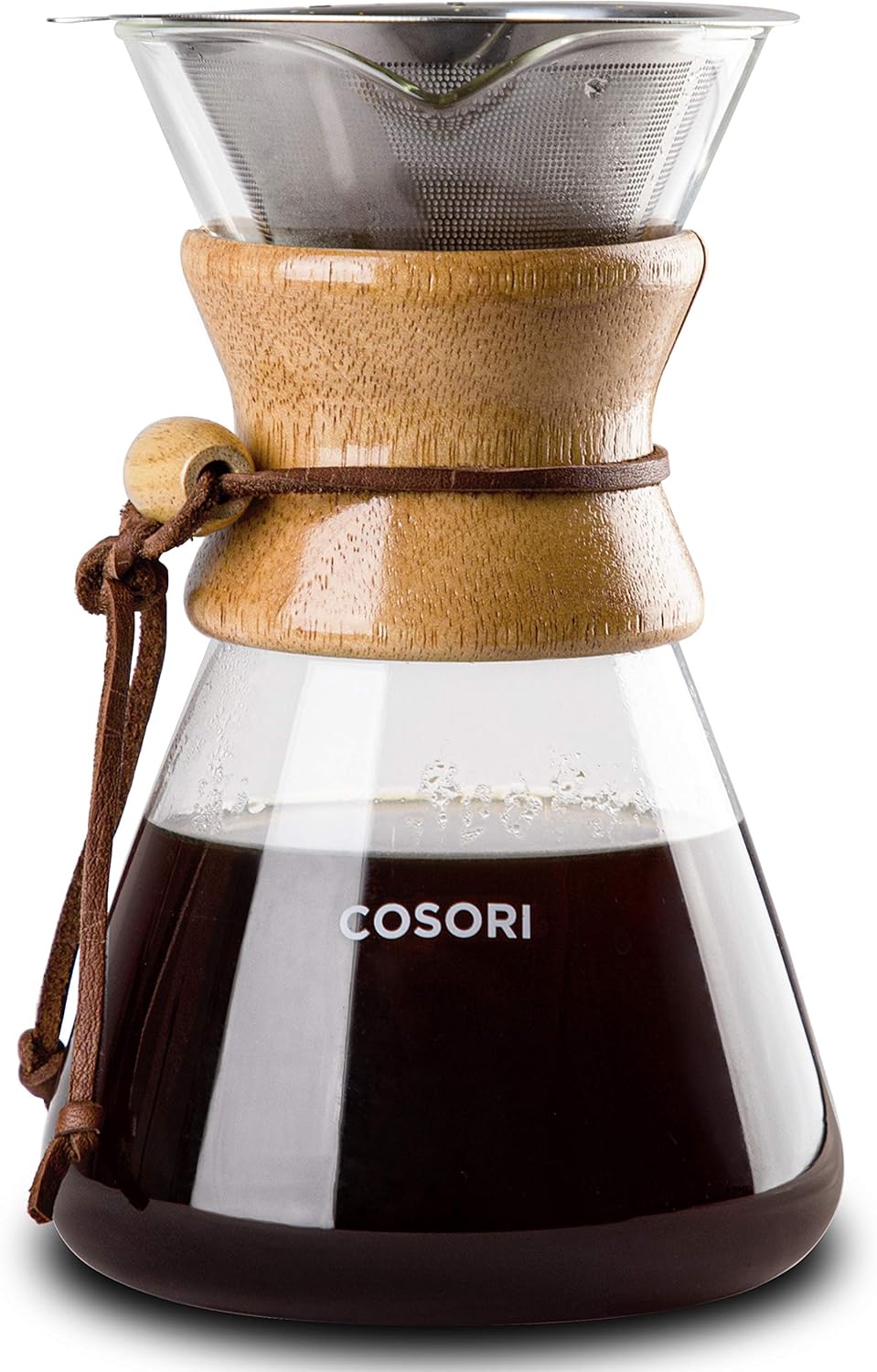 | Best Overall
| Price on Amazon | |
Best Design  | Best Design
| Price on Amazon | |
Best coffee carafe  | Best coffee carafe
| Price on Amazon | |
Best Heat Control  | Best Heat Control
| Price on Amazon |
The Quick Answer: Best Pour-Over Water Temperature
For most pour-over coffee, start here:
| Coffee Roast | Best Starting Temperature | Why |
|---|---|---|
| Light roast | 202–208°F / 94–98°C | Needs more extraction help |
| Medium-light roast | 200–205°F / 93–96°C | Highlights sweetness and brightness |
| Medium roast | 198–203°F / 92–95°C | Balanced daily range |
| Medium-dark roast | 195–200°F / 90–93°C | Reduces harshness |
| Dark roast | 190–195°F / 88–90°C | Helps avoid bitterness |
| Decaf | 190–200°F / 88–93°C | Often extracts quickly |
The commonly recommended hot-brewing range is around 195–205°F, and several pour-over guides place V60-style brewing around 92–96°C / 197–205°F.
My personal starting point is simple:
| Situation | Temperature |
|---|---|
| I do not know the coffee yet. | 200°F / 93°C |
| Light roast tastes sour. | 205°F / 96°C |
| Dark roast tastes bitter | 190–195°F / 88–90°C |
| Chemex tastes thin. | 203–205°F / 95–96°C |
| V60 tastes harsh. | 195–198°F / 90–92°C |
If you are a beginner, start at 200°F / 93°C, taste the cup, then adjust.
Why Water Temperature Matters in Pour-Over Coffee
Water temperature affects extraction. Extraction simply means how much flavor the water pulls from the coffee grounds. Hotter water extracts faster and more aggressively. Cooler water extracts more slowly and gently.
That means temperature changes:
- sweetness
- acidity
- bitterness
- aroma
- body
- aftertaste
- how “complete” the cup feels
When water is too cool, it may not extract enough sweetness and depth. The cup can taste sour, sharp, grassy, salty, or hollow. When water is too hot, especially with darker roasts or fine grinds, it may pull too much bitterness and dryness. The cup can taste roasty, woody, burnt, or astringent.
A good pour-over temperature is not just “as hot as possible.” It is the right temperature for that coffee, grind, brewer, and recipe.
| Temperature Problem | What You Taste |
|---|---|
| Too cool | Sour, thin, grassy, sharp |
| Slightly cool | Clean but lacking sweetness |
| Balanced | Sweet, clear, aromatic |
| Slightly hot | Stronger, more intense |
| Too hot | Bitter, dry, harsh, roasty |
This is why temperature is best treated as a tuning tool, not a fixed law.
Best Water Temperature by Roast Level
Roast level is the easiest way to choose your starting temperature.
Light roasts are denser and less soluble, so they often need hotter water to extract properly. Dark roasts are more brittle and soluble, so they can taste bitter if pushed too hard.
| Roast Level | Starting Temperature | Taste Goal |
|---|---|---|
| Very light roast | 205–208°F / 96–98°C | Pull sweetness from dense beans |
| Light roast | 202–205°F / 94–96°C | Balance acidity with sweetness. |
| Medium-light roast | 200–205°F / 93–96°C | Bright but rounded |
| Medium roast | 198–203°F / 92–95°C | Sweet, balanced, daily cup |
| Medium-dark roast | 195–200°F / 90–93°C | Rich without bitterness |
| Dark roast | 190–195°F / 88–90°C | Smooth, less harsh |
A pour-over guide from Rave Coffee recommends V60 water “just off the boil” or between 92°C and 96°C, which is a strong general range for many medium to light-medium coffees. Another recent V60 guide gives a similar range of 92–96°C / 197–205°F, with 94°C as a middle-ground default.
If I am brewing a light Ethiopian or Kenyan coffee, I usually start near 204–205°F. If I am brewing a chocolatey medium roast, I start closer to 200°F. If I am brewing a dark roast, I often drop closer to 192–195°F.
Best Water Temperature for V60
For V60, I usually start between 198°F and 205°F, depending on roast.
The V60 is fast-flowing and sensitive, so temperature changes show up clearly. If the water is too cool, the coffee can taste sharp and underdeveloped. If the water is too hot with a fine grind, the cup can become bitter or dry.
| V60 Coffee Type | Starting Temperature |
|---|---|
| Light roast | 203–205°F |
| Medium-light | 200–203°F |
| Medium roast | 198–202°F |
| Medium-dark | 195–198°F |
| Dark roast | 190–195°F |
A simple V60 recipe:
| Variable | Starting Point |
|---|---|
| Coffee | 20 g |
| Water | 320 g |
| Ratio | 1:16 |
| Grind | Medium-fine |
| Temperature | 200°F / 93°C |
| Brew time | 2:45–3:45 |
If your V60 tastes sour, try hotter water before changing everything else. If it tastes bitter or dry, try cooler water or a slightly coarser grind.
Best Water Temperature for Chemex
Chemex often benefits from water on the hotter side, especially with light and medium roasts. The Chemex filter is thicker, the brew volume is often larger, and the drawdown can be slower. Hotter water helps keep the extraction strong enough.
| Chemex Coffee Type | Starting Temperature |
|---|---|
| Light roast | 204–206°F |
| Medium-light | 202–205°F |
| Medium roast | 200–203°F |
| Medium-dark | 196–200°F |
| Dark roast | 192–196°F |
A simple Chemex recipe:
| Variable | Starting Point |
|---|---|
| Coffee | 30 g |
| Water | 480 g |
| Ratio | 1:16 |
| Grind | Medium-coarse |
| Temperature | 202°F / 94°C |
| Brew time | 4:00–5:30 |
Chemex coffee can taste thin if the water is too cool, especially because the thick filter removes oils and texture. If your Chemex tastes clean but weak or hollow, hotter water may help. If it tastes bitter and slow, the grind may be too fine rather than the temperature alone.
Best Water Temperature for Kalita Wave
Kalita Wave usually works well around 198–203°F for medium roasts. Its flat-bottom design tends to extract evenly, so you do not always need extreme temperatures unless the coffee is very light.
| Kalita Coffee Type | Starting Temperature |
|---|---|
| Light roast | 202–205°F |
| Medium-light | 200–203°F |
| Medium roast | 198–202°F |
| Medium-dark | 195–198°F |
| Dark roast | 190–195°F |
A simple Kalita recipe:
| Variable | Starting Point |
|---|---|
| Coffee | 20 g |
| Water | 320 g |
| Ratio | 1:16 |
| Grind | Medium |
| Temperature | 200°F / 93°C |
| Brew time | 3:00–4:15 |
If Kalita coffee tastes dull, raise the temperature slightly. If it tastes heavy or dry, lower the temperature or grind a little coarser.
Best Water Temperature for Light Roast Pour-Over
Light roasts usually need hotter water because they are denser and less soluble. If you brew them too cool, they can taste sour, grassy, salty, or overly sharp.
For light roast pour-over, start around
202–205°F / 94–96°C
For very light roasts, some brewers push even closer to boiling, especially with high-quality grinders and carefully controlled recipes. But for most home brewing, 205°F is already a strong starting point.
| Light Roast Problem | Temperature Fix |
|---|---|
| Sour and sharp | Use hotter water. |
| Thin and hollow | Use hotter water or a finer grind. |
| Floral but weak | Use hotter water or a stronger ratio |
| Bitter despite light roast | Grind coarser or reduce agitation. |
| Good acidity but no sweetness | Raise the temperature slightly. |
If your light roast tastes sour at 200°F, try 204–205°F. If it is still sour, grind finer or extend the brew time.
Best Water Temperature for Medium Roast Pour-Over
Medium roasts are the easiest to brew. They usually taste good around the following times:
198–203°F / 92–95°C
This is the zone where sweetness, acidity, and body often balance nicely.
| Medium Roast Goal | Temperature |
|---|---|
| Balanced daily cup | 200°F |
| More sweetness | 202–203°F |
| Softer cup | 198°F |
| Less bitterness | 195–198°F |
| More brightness | 202°F |
For a balanced medium roast like Stumptown Holler Mountain Whole Bean Coffee, I would start at 200°F and adjust by taste. For a smoother classic profile like Lavazza Qualità Oro Whole Bean Coffee, I might start around 198–200°F, depending on the brewer.
Best Water Temperature for Dark Roast Pour-Over
Dark roasts extract quickly and can taste bitter if brewed too hot. For dark roast pour-over, I usually start around the following:
190–195°F / 88–90°C
Dark roast coffee already has more roast flavor, lower perceived acidity, and more solubility. It does not always need 205°F water. Cooler water can make the cup smoother and less harsh.
| Dark Roast Problem | Temperature Fix |
|---|---|
| Bitter and ashy | Lower temperature |
| Dry finish | Lower temperature or grind coarser |
| Too heavy | Use a lighter ratio or cooler water. |
| Weak and flat | Raise slightly or grind finer. |
| Burnt taste | Lower the temperature and reduce agitation. |
If you are using a darker bean for pour-over, try 192°F before assuming the coffee itself is bad. Sometimes, a few degrees cooler makes a huge difference.
Temperature vs. Grind Size: Which Should You Adjust First?
Temperature and grind size both affect extraction, but they do it differently.
Grind size changes the contact surface and flow. Temperature changes the extraction energy. If a cup is clearly sour or bitter, both variables can help, but one may be the better first move.
| Taste Problem | First Adjustment |
|---|---|
| Sour and fast brew | Grind finer. |
| Sour but brew time looks normal | Use hotter water. |
| Bitter and slow brew | Grind coarser. |
| Bitter, but brew time looks normal. | Use cooler water. |
| Thin but clean | Stronger ratio or hotter water |
| Harsh and dry | Cooler water or coarser grind |
| Flat and dull | Hotter water or fresher beans |
| Good flavor but weak | Change ratio, not the temperature, first. |
If your brew time is way off, adjust the grind first. If brew time is reasonable but the flavor feels under- or over-extracted, adjust temperature.
Example:
If your V60 finishes in 2 minutes and tastes sour, grind finer.
If your V60 finishes in 3:15 and still tastes sour, raise the temperature.
How Water Temperature Affects Bloom
The bloom is the first pour, where hot water hits the coffee and releases trapped gas. Fresher coffee often bubbles more. Older coffee may barely bloom. Temperature affects how active the bloom looks and how quickly the coffee saturates.
Hotter water can make the bloom more active and help extract early flavor compounds. Cooler water may produce a gentler bloom, which can be useful for darker roasts.
A good bloom routine:
| Variable | Starting Point |
|---|---|
| Bloom water | 2–3× coffee weight |
| Bloom time | 30–45 seconds |
| Temperature | Same as brew water |
| Goal | Wet all grounds evenly |
For 20 g of coffee, bloom with about 40–60 g of water. Make sure there are no dry pockets. A good bloom helps the rest of the brew flow more evenly.
Do You Need a Temperature-Control Kettle?
No, but it helps.
A temperature-control kettle lets you set a specific number and repeat it every brew. This is useful when you are comparing coffees, dialing in light roasts, or trying to fix bitterness. The Fellow Stagg EKG is popular because it combines temperature control with a gooseneck spout for controlled pouring.
But you can brew an excellent pour-over with a normal kettle. Use this rough guide:
| Target Temperature | Simple No-Thermometer Method |
|---|---|
| 205°F | Use just off the boil. |
| 200°F | Boil and wait 30 seconds. |
| 195°F | Boil and wait 60–90 seconds. |
| 190°F | Boil, and wait 2 minutes. |
These are approximate. Kettle material, room temperature, water volume, and altitude all affect cooling speed. But for home brewing, this is good enough to start.
If you do not have a gooseneck kettle, pour slowly and carefully. Temperature matters, but pouring control matters too.
Should You Use Boiling Water for Pour-Over?
Sometimes, but not always.
Boiling or near-boiling water can work very well for light roasts, especially dense specialty coffees. It can help bring out sweetness and reduce sourness. But boiling water can make darker roasts taste bitter or harsh.
| Coffee Type | Boiling Water? |
|---|---|
| Very light roast | Often useful |
| Light roast | Usually fine |
| Medium roast | Maybe, but 200°F is often safer. |
| Medium-dark roast | Usually not needed |
| Dark roast | Usually too aggressive |
| Decaf | Often too aggressive |
If you brew a light roast and it tastes sour at 200°F, try hotter water. If you brew a dark roast and it tastes bitter at 205°F, use cooler water.
How Altitude Affects Pour-Over Water Temperature
Water boils at lower temperatures at higher altitudes. That means “just off boil” may not be the same everywhere. If you live at a high altitude, your boiling water may already be below 205°F.
For most home brewers, this is not something to worry about unless your coffee consistently tastes under-extracted even with a fine grind and long brew time. In that case, use water as hot as practical, preheat your brewer, and consider grinding finer.
In normal home conditions, especially near sea level, the 195–205°F range is easy to reach.
Preheating the Brewer Helps Temperature Stability
Even if your kettle is set correctly, the actual slurry temperature can drop when hot water touches a cold ceramic dripper, thick glass brewer, or cold mug. This matters more with ceramic V60, Chemex, and winter kitchens.
Preheating helps.
| Brewer | Preheating Importance |
|---|---|
| Ceramic V60 | High |
| Glass Chemex | High |
| Plastic V60 | Lower |
| Metal dripper | Medium |
| Kalita ceramic | High |
| Server/mug | Medium |
Rinse the paper filter with hot water and let the brewer warm up. Then discard the rinse water before brewing. This removes paper taste and stabilizes temperature.
Chemex especially benefits from preheating because the glass and thick filter can pull heat away from the brew.
Best Pour-Over Temperature Troubleshooting Guide
| Cup Problem | Temperature Clue | Fix |
|---|---|---|
| Sour, sharp, grassy | Too cool or under-extracted | Raise the temperature. |
| Thin and hollow | Too cool or coarse a grind | Raise the temp or grind finer. |
| Bitter and dry | Too hot or over-extracted | Lower temperature |
| Harsh dark roast | Too hot | Use 190–195°F. |
| Light roast is too acidic. | Too cool | Use 203–205°F. |
| Chemex is too weak. | Too cool | Use hotter water. |
| The V60 is too intense. | Too hot/fine | Lower temp or coarsen grind |
| Flat and dull | Stale beans or low temp | Use fresh beans or hotter water. |
The best habit is to change the temperature in small steps. Move by 3–5°F at a time. Do not jump from 185°F to boiling unless you are clearly experimenting.
Best Water Temperature by Brewer and Roast
Here is a helpful cheat sheet.
| Brewer | Light Roast | Medium Roast | Dark Roast |
|---|---|---|---|
| V60 | 203–205°F | 198–202°F | 190–195°F |
| Chemex | 204–206°F | 200–203°F | 192–196°F |
| Kalita Wave | 202–205°F | 198–202°F | 190–195°F |
| Melitta cone | 200–205°F | 198–202°F | 190–195°F |
| Origami | 202–205°F | 198–203°F | 190–196°F |
| Flat-bottom dripper | 200–205°F | 198–202°F | 190–195°F |
These are starting points, not laws. The coffee’s taste should always decide the final number.
My Favorite Temperature-Starting Recipes
Balanced V60 Recipe
| Variable | Amount |
|---|---|
| Coffee | 20 g |
| Water | 320 g |
| Ratio | 1:16 |
| Grind | Medium-fine |
| Temperature | 200°F |
| Brew time | 2:45–3:45 |
Best for medium roast coffee.
Light Roast V60 Recipe
| Variable | Amount |
|---|---|
| Coffee | 20 g |
| Water | 320 g |
| Ratio | 1:16 |
| Grind | Medium-fine to slightly finer |
| Temperature | 204–205°F |
| Brew time | 3:00–4:00 |
Best for bright, dense coffees.
Smooth Dark Roast Pour-Over
| Variable | Amount |
|---|---|
| Coffee | 20 g |
| Water | 320 g |
| Ratio | 1:16 |
| Grind | Medium |
| Temperature | 190–195°F |
| Brew time | 2:45–3:30 |
Best for darker beans where bitterness is a concern.
Clean Chemex Recipe
| Variable | Amount |
|---|---|
| Coffee | 30 g |
| Water | 480 g |
| Ratio | 1:16 |
| Grind | Medium-coarse |
| Temperature | 202°F |
| Brew time | 4:00–5:30 |
Best for clean, elegant cups.
Best Gear for Controlling Pour-Over Temperature
| Tool | Suggested Option | Why It Helps |
|---|---|---|
| Temperature kettle | Fellow Stagg EKG | Precise temperature control |
| Beginner dripper | Hario V60 Ceramic Dripper | Classic pour-over brewer |
| Batch pour-over | Chemex Classic 6-Cup | Clean shared brews |
| Grinder | Baratza Encore ESP | Consistent grind adjustments |
| Scale | Hario V60 Drip Scale | Ratio and timing control |
| Filters | Hario V60 Paper Filters | Clean cup |
| Server | Hario Glass Coffee Server | Better brewing workflow |
A kettle with temperature control is convenient, but do not feel blocked without one. A scale and grinder usually matter even more.
Best Beans for Testing Pour-Over Temperature
When testing temperature, use the same coffee for several brews. Medium roast is easiest because it responds clearly without being too fragile.
| Flavor Goal | Bean Style |
|---|---|
| Bright and fruity | Light roast Ethiopian or Kenyan |
| Sweet and balanced | Medium roast blend |
| Chocolatey and smooth | Medium roast Brazil/Colombia |
| Low bitterness | Medium roast Arabica |
| Rich but gentle | Medium-dark blend brewed cooler |
A coffee like Stumptown Holler Mountain Whole Bean Coffee can be a useful medium-roast test coffee because it has enough sweetness and structure to show changes. Lavazza Qualità Oro Whole Bean Coffee can be a softer option if you prefer a smoother daily cup.
My Personal Pour-Over Temperature Routine
When I open a new bag, I usually start at 200°F if it is a medium roast. If it tastes sour but the brew time is reasonable, I raise the temperature to 203°F. If it tastes bitter or dry, I lower it to 196–198°F. For light roasts, I often start at 204°F. For dark roasts, I start at 192–195°F.
My simple routine looks like this:
| Coffee Type | My Starting Temperature |
|---|---|
| Unknown coffee | 200°F |
| Light roast | 204°F |
| Medium roast | 200°F |
| Medium-dark roast | 196°F |
| Dark roast | 192°F |
| Chemex medium roast | 202°F |
I do not treat temperature as separate from the rest of the recipe. If the grind is wrong, temperature alone will not fix the cup. But when the grind and ratio are close, temperature can polish the flavor beautifully.
Final Thoughts: Start at 200°F, Then Let Taste Guide You
The best water temperature for pour-over coffee is usually 195–205°F, with 200°F / 93°C as the easiest beginner starting point. Use hotter water for light roasts and cooler water for dark roasts, and adjust in small steps based on taste.
If your pour-over tastes sour, thin, or underdeveloped, use hotter water. If it tastes bitter, dry, or harsh, use cooler water. If the brew time is clearly too fast or too slow, adjust the grind first. If the flavor is balanced but the strength is wrong, adjust the ratio instead.
Temperature is not a magic switch, but it is one of the cleanest ways to fine-tune pour-over coffee. Once you learn how your beans respond to heat, your cups become sweeter, clearer, and much more consistent.
FAQ: Best Water Temperature for Pour-Over Coffee
What is the best water temperature for pour-over coffee?
The best water temperature for pour-over coffee is usually 195–205°F / 90–96°C. Start around 200°F / 93°C for medium roasts.
What temperature should I use for a V60?
For V60, start around 200°F / 93°C for medium roasts. Use 203–205°F for light roasts and 190–195°F for dark roasts.
What temperature should I use for Chemex?
For Chemex, start around 202°F / 94°C for medium roasts. Chemex often benefits from slightly hotter water because of the thicker filter and larger brew size.
Should I use boiling water for pour-over coffee?
Boiling or near-boiling water can work well for light roasts, but it may make dark roasts taste bitter or harsh. Use cooler water for darker beans.
Why does my pour-over taste sour?
Sour pour-over may mean the water is too cool, the grind is too coarse, or the brew time is too short. Try hotter water or a finer grind.
Why does my pour-over taste bitter?
Bitter pour-over may mean the water is too hot, the grind is too fine, or the brew time is too long. Try cooler water or a coarser grind.
Do I need a temperature-control kettle?
No, but it helps. A normal kettle works if you boil water and let it sit briefly before brewing. A temperature-control kettle makes recipes easier to repeat.
How long should I wait after boiling water for a pour-over?
For around 200°F, wait about 30 seconds after boiling. For around 195°F, wait roughly 60–90 seconds. These are approximate and depend on your kettle and room conditions.
Is cooler water better for a dark roast pour-over?
Usually, yes. Dark roasts often taste smoother around 190–195°F because they extract quickly and can become bitter with very hot water.
Is hotter water better for a light roast pour-over?
Often, yes. Light roasts are denser and harder to extract, so 202–205°F water can help bring out sweetness and reduce sourness.


