
De’Longhi Stilosa Review: Compact Beginner Espresso Machine


OneHundredCoffee is reader-supported, and some products displayed may earn us an affiliate commission. Details
The De’Longhi Stilosa is one of those espresso machines I would not overcomplicate. It is not trying to be a prosumer machine. It is not trying to compete with a Profitec Go, a Rancilio Silvia, an Ascaso Steel DUO, or a Profitec Pro 300. It is not a luxury machine, not a dual boiler, not a grinder-included system, and not the kind of machine I would buy for advanced espresso experiments.
But that is exactly why it makes sense.
The Stilosa is a compact, affordable, manual espresso machine for someone who wants to step away from instant coffee, capsules, or basic drip coffee and try making espresso-style drinks at home. It gives you a real portafilter routine, a 15-bar pump, a manual milk frother, single and double filter baskets, and a small enough footprint for normal kitchens. The US EC260BK version has a 15-bar pump, a 33.81-ounce water tank, 1100W input power, a 120V rating, dimensions of 13.5 x 8.07 x 11.22 inches, and an 8.61 lb product weight.
That is the best way to understand it. The De’Longhi Stilosa is not the final destination for an espresso hobbyist. It is the first real step for someone who wants to learn the basics without spending too much.
The Compact Beginner Espresso Machine I’d Pick When I Want Real Espresso Practice Without Spending Too Much

Best budget espresso machine for learning manual coffee at home
De'Longhi Stilosa Manual Espresso MachineThe De'Longhi Stilosa is a simple, compact manual espresso machine for beginners who want to make espresso, cappuccinos, and lattes at home without spending too much. It gives you a real portafilter workflow, a manual milk frother, and a small footprint that fits easily in most kitchens.
Check Price on AmazonTechnical Specifications & Features
- Machine type: Manual espresso and cappuccino machine
- Pressure system: 15-bar pump pressure
- Milk frothing: Manual milk frother / steam wand
- Drink style: Espresso, cappuccino, latte, and Americano-style drinks
- Coffee format: Ground espresso coffee
- Portafilter: Manual portafilter brewing workflow
- Controls: Simple dial-style operation
- Size: Compact body for smaller kitchens
- Cup clearance: Supports small espresso cups under the spout
- Best for: Beginners, budget buyers, and small-space coffee setups
- Grinder need: Works best with a separate burr grinder or quality espresso-ground coffee
- Main advantage: Low-cost way to practice real espresso technique at home
Pros & Cons After 30 Days of Use
Pros
- Very affordable entry point: after 30 days, the biggest advantage is how easily it lets you start making espresso-style drinks without a high upfront cost.
- Compact kitchen footprint: it fits nicely on smaller counters, apartment kitchens, and tight coffee corners.
- Good for learning basics: you can practice dosing, tamping, locking in the portafilter, pulling shots, and steaming milk.
- Manual frother adds flexibility: cappuccinos and lattes are possible once you get used to the steam wand.
- Simple controls: there are no confusing menus, screens, or complicated drink programs.
- Nice starter machine feel: it gives beginners a real espresso routine instead of only pressing a pod button.
- Easy to justify: the price makes it a low-risk first machine for someone testing home espresso.
Cons
- Needs a good grind: pre-ground coffee can limit crema, body, and shot quality.
- Manual workflow: it is not ideal if you want one-touch drinks.
- Basic build feel: it does not feel as premium as higher-end semi-automatic machines.
My Final Verdict
The De'Longhi Stilosa is the machine I would recommend to someone who wants to try real espresso at home without jumping into an expensive setup. It is simple, compact, and beginner-friendly, but it still gives you the hands-on steps that make espresso feel more personal.
I would not buy it expecting café-level performance straight out of the box, especially without a decent grinder. But for the price, it makes a lot of sense as a first manual espresso machine for small kitchens, casual cappuccino drinkers, and anyone who wants to learn the basics before upgrading.
Our Best-Reviewed DeLonghi Espresso Machines
| Image | Product | Features | Price |
|---|---|---|---|
BEST OVERLL 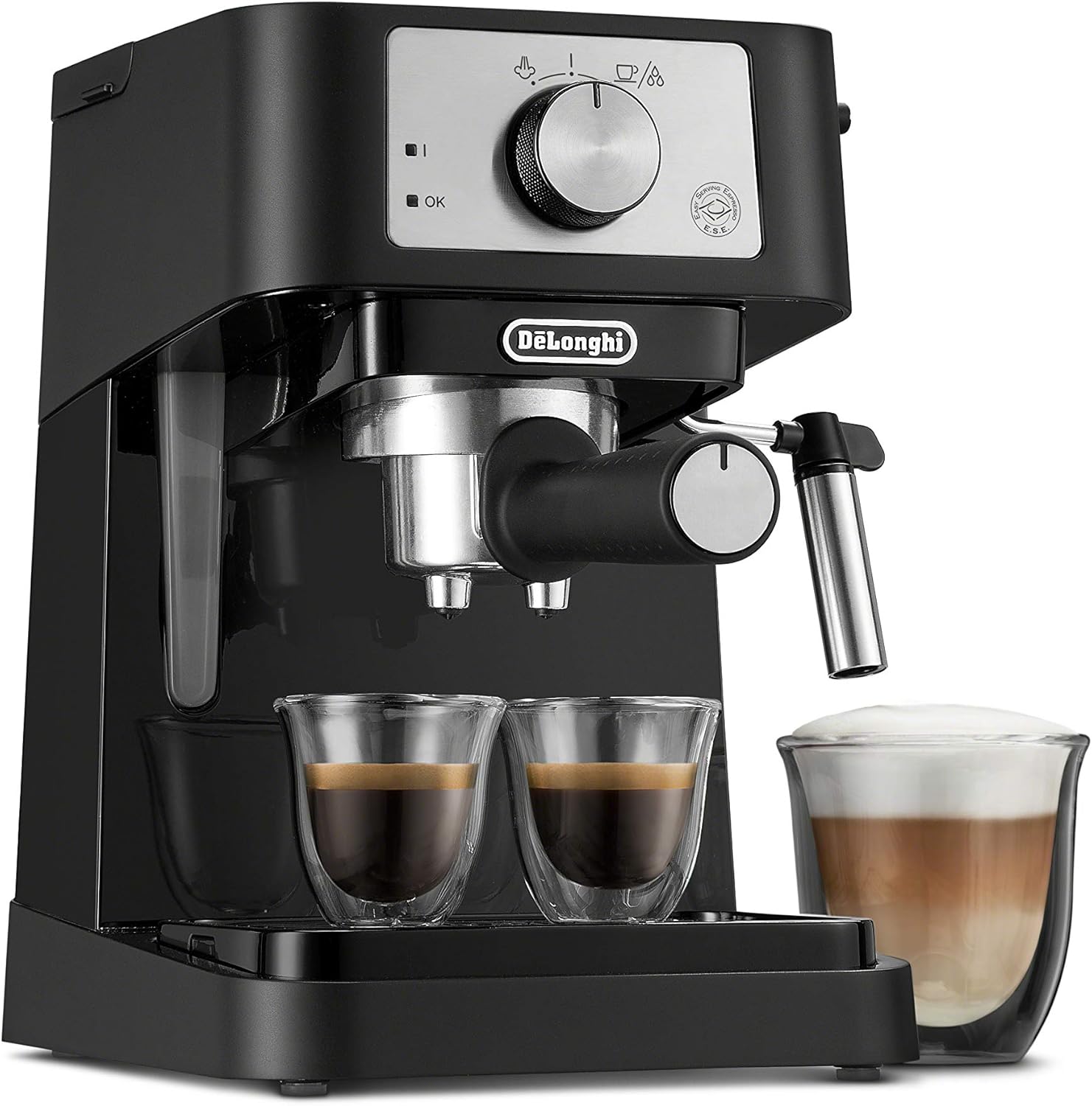 | Best Overall
| Price on Amazon | |
Best Design  | Best Design
| Price on Amazon | |
Best Performance 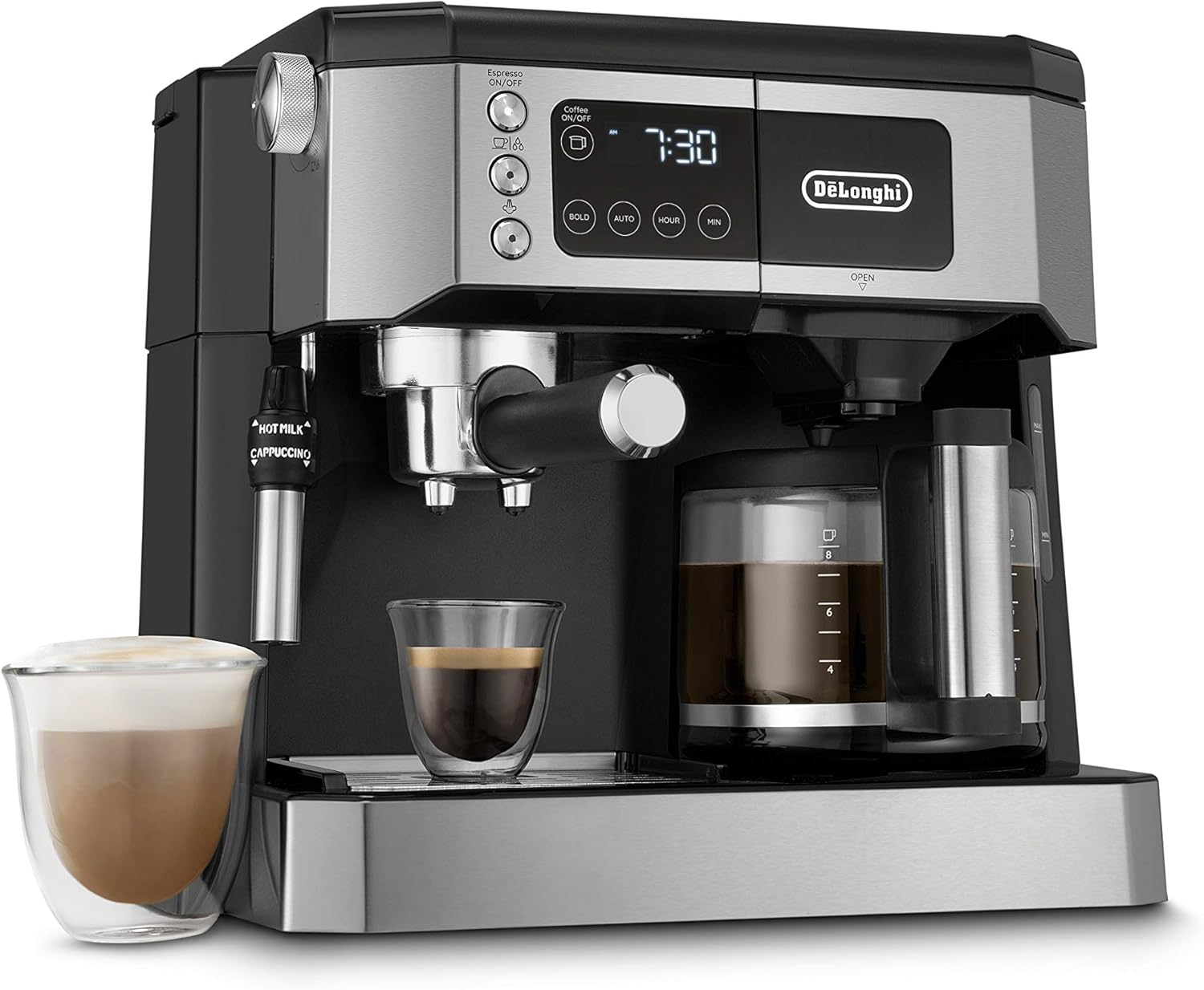 | Best Performance
| Price on Amazon | |
Best Settings  | Best Settings
| Price on Amazon | |
Best Smart Espresso  | Best Smart Espresso
| Price on Amazon | |
Best Automatic Espresso Machine  | De’Longhi Dinamica TrueBrew Fully Automatic Espresso Machine | Best Automatic Espresso Machine
| Price on Amazon |
Best Consistency  | Best Consistency
| Price on Amazon |
My First Impression of the De’Longhi Stilosa
The first thing I like about the Stilosa is that it looks simple and unintimidating. Some espresso machines make beginners feel like they need a barista course before touching the portafilter. The Stilosa does not have that energy. It looks compact, familiar, and easy to place on the counter.
The black and stainless look is clean enough for most kitchens, and the body is narrow enough that it does not dominate the space. At just over 8 inches wide, it is much easier to fit than many larger manual machines. That matters because beginner espresso setups can quickly become bigger than expected once you add cups, coffee, a milk pitcher, a knock box, and maybe a grinder later.
What I also like is that the Stilosa does not pretend to be automatic. You still have to load the portafilter, choose the basket, brew the shot, froth the milk, and clean up. That is good for learning. It gives you the basic espresso ritual without overwhelming you with professional features.
This is the machine I would choose when someone says, “I want to try espresso at home, but I am not ready for a serious machine yet.”
Who the De’Longhi Stilosa Is Really For
De’Longhi Stilosa Espresso Machine
The De’Longhi Stilosa is the machine I would look at when I want a low-cost, compact, beginner-friendly espresso maker that still gives me a real portafilter, a 15-bar pump, and a manual steam wand for cappuccinos and lattes.
Price on AmazonI would recommend the De’Longhi Stilosa to someone who wants an affordable first espresso machine and understands that there will be a learning curve. It is for beginners, students, small-apartment users, casual cappuccino drinkers, and anyone who wants to make stronger coffee drinks without buying a bulky or expensive setup.
It is also a good fit if you are upgrading from a moka pot, capsule machine, or basic drip coffee maker and want something that feels more hands-on. You get to learn how espresso works: grind, dose, tamp, brew, and steam. Even if the machine itself is simple, the habits you build on it can carry over to better machines later.
I would not recommend it to someone who wants café-level espresso right away. I would not recommend it to someone who already owns a serious grinder and wants full control over temperature, pressure, shot timing, and milk texture. In that case, a machine like the Profitec Go, Ascaso Dream PID, or Rancilio Silvia makes more sense.
The Stilosa is best for the buyer who wants value, compact size, and a gentle introduction to manual espresso.
Design and Countertop Fit

The De’Longhi Stilosa is one of the easier espresso machines to place in a small kitchen. The body is compact, the shape is simple, and the machine does not need the counter commitment of a larger manual espresso setup. The EC260BK version measures 13.5 inches tall, 8.07 inches wide, and 11.22 inches deep, with an 8.61 lb product weight.
That size is one of the biggest reasons I would recommend it to beginners. A machine like the Profitec Pro 700 or Rocket R58 Cinquantotto needs a dedicated coffee bar. The Stilosa can sit on a normal kitchen counter, in a dorm-style setup, in a small apartment, or beside a drip coffee maker without feeling ridiculous.
The cup clearance is also practical for espresso cups and smaller cappuccino cups. Some international technical data lists maximum cup height around 110 mm, which is roughly 4.3 inches. That means tall travel mugs are not the point here. This machine is built for espresso cups, small glasses, and compact milk drinks.
The removable drip tray helps with cleaning, and the water tank capacity is large enough for casual use without constant refilling. The US version lists a 33.81-ounce tank, while some international listings describe the tank as 1 liter.
Visually, the Stilosa looks like an entry-level machine, and that is fine. It has enough stainless detailing to avoid looking too cheap, but I would not pretend it has the premium feel of heavier machines. The body uses plastic and stainless accents, and the weight tells you right away that it is a lightweight home appliance rather than a serious semi-commercial build.
Espresso Quality: Good Enough to Learn, Not Built for Perfection

The De’Longhi Stilosa can make enjoyable espresso-style drinks, especially if you use fresh coffee and realistic expectations. I would not buy it expecting café-level shots. I would buy it expecting to learn the basics of espresso and make better drinks than I could with instant coffee or many pod systems.
The 15-bar pump gives the machine enough pressure capability for espresso-style brewing. But pressure alone does not make great espresso. Grind size, freshness, dose, tamp, water temperature, basket design, and user technique all matter. This is where beginners sometimes get disappointed. They see “15 bar” and expect magic. Espresso does not work that way.
With the Stilosa, I would start with a medium-dark espresso roast. It will usually be more forgiving than a very light roast. Chocolatey, nutty, caramel-like blends are the safest match. They work better in milk drinks and are easier to extract on a simple machine.
If you use pre-ground coffee, choose coffee labeled for espresso and use it soon after opening. If you want better results, use a burr grinder that can grind fine enough for espresso. You do not need the most expensive grinder in the world for the Stilosa, but you do need something better than a blade grinder if you want real improvement.
The Stilosa is not built for obsessive dialing. There is no PID, no pressure gauge, no shot timer, no adjustable OPV, and no commercial-style 58mm workflow. But it can teach you what changes matter. If your shot runs too fast, the grind may be too coarse or the dose too low. If it chokes, the grind may be too fine or the basket overfilled. If it tastes weak, the coffee may be stale or under-extracted. These lessons are valuable.
Portafilter and Filters
The De’Longhi Stilosa includes a portafilter, tamper, single espresso filter, double espresso filter, measuring spoon, instruction manual, and quick start guide. That gives beginners enough to start without buying a full accessory kit on day one.
The included tamper is basic, as expected. It works, but if you use the machine regularly, one of the first inexpensive upgrades I would consider is a better tamper. A more solid tamper makes puck prep feel more consistent and less awkward.
The machine is also compatible with E.S.E. pods in some Stilosa versions/regions. That can be useful for someone who wants convenience without grinding. E.S.E. pods will not give the same flexibility as fresh ground coffee, but they are cleaner and easier.
For true learning, I would use ground coffee. For convenience, E.S.E. pods are fine. That flexibility is one of the reasons the Stilosa works well as a beginner machine.
Milk Frothing and Cappuccino Performance

The manual milk frother is one of the Stilosa’s most important features. Without it, this machine would be much less interesting. Espresso alone is nice, but many beginners buy machines like this because they want cappuccinos and lattes.
The Stilosa has a cappuccino-style manual frothing system and can dispense hot milk and hot water on the US version. It is not a powerful prosumer steam wand, but it gives you enough to learn the basics of milk frothing.
I would start with cappuccino-style foam rather than trying to pour perfect latte art. Use cold milk, a small stainless pitcher, and do not overfill it. Keep the steam tip near the surface at first to introduce air, then lower it slightly to roll the milk. Stop before the milk becomes too hot to touch comfortably.
The Stilosa’s steam wand is forgiving enough for beginners but not strong enough to feel like a café machine. That is exactly what I expect at this level. It can make enjoyable cappuccinos and latte-style drinks, but it is not the machine I would choose if latte art is the main goal.
If milk drinks are your daily priority and you want easier consistency, a fully automatic machine like the Bosch 500 or a higher-end De’Longhi super-automatic may fit better. If you want to learn manual steaming, the Stilosa is a good starting point.
De’Longhi Stilosa Espresso Machine
The Stilosa is the machine I would choose when I want a simple first step into espresso without committing to a larger or more expensive setup. It gives me the basics: portafilter brewing, a 15-bar pump, manual milk frothing, and a compact body that fits easily on the counter.
Who This Is For
- First-time espresso users
- Small-kitchen coffee drinkers
- Budget cappuccino fans
- People upgrading from pods
Why I Like It
I like that it keeps espresso simple. It does not overwhelm beginners with advanced controls, but it still gives enough of the real workflow to help you learn.
Best Drink Match
- Espresso-style shots
- Cappuccino
- Latte-style drinks
- Americano-style drinks
- Small milk drinks
Who Should Skip It
- Advanced espresso hobbyists
- Latte-art focused users
- People wanting built-in grinding
- Users wanting PID control
My Bottom Line
I would choose the De’Longhi Stilosa if I wanted an affordable first espresso machine for learning, small cappuccinos, and occasional lattes. It is not advanced, but it is a very sensible beginner machine.
What I Like Most About It
What I like most about the De’Longhi Stilosa is that it makes espresso approachable. It does not ask you to understand dual boilers, flow control, pressure profiling, PID offsets, E61 warm-up, or grinder alignment. It simply gives you a compact espresso machine and lets you start.
That is valuable. Many people never start espresso because the category feels intimidating. The Stilosa lowers the barrier. You can learn what a portafilter feels like. You can learn why fresh coffee matters. You can learn how milk changes when steamed. You can learn what happens when a grind is too coarse or too fine.
I also like that it is small. A beginner machine should not take over the kitchen. If someone decides espresso is not for them, they have not built an entire coffee bar. If they fall in love with espresso, the Stilosa becomes the first chapter before upgrading later.
What I Would Improve
The first thing I would improve is temperature control. The Stilosa does not have PID control, so you do not get the same brew-temperature precision found on machines like the Profitec Go or Ascaso Dream PID. That is expected at this price level, but it does limit consistency.
The second thing is building feel. The machine is lightweight, which helps with moving and storage, but it also means it does not feel as planted as heavier machines. When locking in the portafilter, you may need to hold the machine steady.
The third limitation is milk steaming power. It can froth milk, but it is not a strong steam machine. If you plan to make several lattes back to back, you will likely outgrow it.
The fourth limitation is the grinder question. Since there is no built-in grinder, beginners may start with pre-ground coffee. That is convenient, but it limits espresso quality. A grinder upgrade can improve results, but at that point some users may start wondering whether they should also upgrade the machine.
How It Compares With the De’Longhi All-In-One Coffee and Espresso Maker
The De’Longhi All-In-One Coffee and Espresso Maker is better if you want drip coffee and espresso-style drinks from one appliance. It makes more sense for households that drink regular coffee in a carafe and only occasionally want espresso or cappuccino.
The De’Longhi Stilosa is better if you specifically want a compact espresso machine and do not care about drip coffee. It is smaller, simpler, and more focused on portafilter espresso drinks.
I would choose the All-In-One for mixed coffee households. I would choose the Stilosa for a beginner espresso station.
How It Compares With the Rancilio Silvia
The Rancilio Silvia is a much more serious machine. It is heavier, tougher, more traditional, and more capable if paired with a good grinder. It is also more demanding.
The De’Longhi Stilosa is easier, cheaper, lighter, and less intimidating. It is not in the same performance class, but it is much more beginner-friendly.
I would choose the Stilosa if I were testing whether espresso fits my daily life. I would choose the Silvia if I already knew I wanted a serious manual machine.
How It Compares With the Profitec Go
The Profitec Go is a modern compact single-boiler machine with PID control, shot timing, pressure feedback, and a much more advanced feel. It is the machine I would recommend to someone who wants to take espresso seriously but still keep the setup compact.
The De’Longhi Stilosa is for the earlier stage. It is for the person who wants to start cheaply and learn the basics before investing deeper.
I would choose the Stilosa for budget learning. I would choose the Profitec Go for a more serious, long-term, compact setup.
How It Compares With a Fully Automatic Machine
Compared with a fully automatic machine like the Bosch 300 or Bosch 500, the Stilosa is more manual and less convenient. You need to handle the coffee, portafilter, and milk yourself.
But that manual workflow is also why it can be more educational. A fully automatic machine hides the process. The Stilosa exposes it.
I would choose a fully automatic machine if I wanted easy fresh-bean drinks with minimal effort. I would choose the Stilosa if I wanted to learn espresso and did not mind a little mess.
Cleaning and Maintenance

The Stilosa is simple to clean compared with fully automatic machines because there is no internal grinder, no automatic brew unit, and no milk carafe. That is a real advantage.
After each use, I would empty and rinse the portafilter basket, wipe the group area, empty the drip tray when needed, and rinse the water tank regularly. After steaming milk, I would wipe the steam wand immediately and purge it so milk does not dry inside or around the tip.
Descaling depends on your water hardness and use frequency. If your water is hard, scale builds up faster. Use filtered water if appropriate, and follow the machine’s manual for descaling.
This machine is not complicated, but neglect will still affect taste. Coffee oils, milk residue, and scale can all make drinks worse over time.
De’Longhi Stilosa Technical Specifications
| Specification | Details | What It Means in Daily Use |
|---|---|---|
| Product Name | De’Longhi Stilosa Espresso Machine | A compact manual espresso machine for beginner home use. |
| Model / ASIN | EC260BK / B08C96BG9H | This is the product version used for the review box and affiliate link. |
| Machine Type | Manual pump espresso machine | You load the portafilter, brew manually, froth milk manually, and clean up yourself. |
| Pump Pressure | 15 bar | Enough pressure capacity for espresso-style brewing when coffee is prepared correctly. |
| Water Tank Capacity | 33.81 oz / about 1 liter | Good enough for casual espresso and milk-drink use without constant refilling. |
| Input Power | 1100W | Typical power level for a compact entry-level espresso machine. |
| Voltage / Frequency | 120V / 60Hz for US EC260BK | Designed for standard US household use in this version. |
| Milk System | Manual milk frother / cappuccino system | Lets you froth milk for cappuccino and latte-style drinks, but it requires practice. |
| Hot Water | Available on US feature listing | Useful for Americanos or small hot-water tasks. |
| Included Filters | Single espresso filter and double espresso filter | Lets beginners make single or double shots without buying baskets separately. |
| Included Accessories | Portafilter, tamper, filters, measuring spoon, manual, quick start guide | Enough to start making espresso-style drinks right away. |
| Built-In Grinder | No | Use espresso-ground coffee or pair it with a separate burr grinder for better results. |
| Coffee Input | Ground coffee; E.S.E. pod compatibility noted in some regional listings | Ground coffee is best for learning; pods are easier if supported by your version. |
| Cup Height | Up to about 110 mm / 4.3 inches in technical data | Best for espresso cups and small cappuccino cups rather than tall mugs. |
| Removable Drip Tray | Yes | Makes cleaning easier and helps manage small spills. |
| Water Level Indicator | Yes in technical feature listing | Helps you avoid running the machine with too little water. |
| Dimensions | 13.5″ H x 8.07″ W x 11.22″ D | Compact enough for small kitchens, apartments, and beginner coffee corners. |
| Product Weight | 8.61 lb | Light and easy to move, but not as planted as heavier machines. |
| Best Roast Match | Medium-dark espresso blends | Usually more forgiving for beginner espresso and milk drinks. |
| Best User Type | Budget beginner espresso user | Ideal for someone starting espresso at home without investing in a large setup. |
Final Verdict
The De’Longhi Stilosa is one of the easiest machines to recommend when someone wants to start espresso at home without spending too much. It is compact, simple, affordable, and beginner-friendly. It gives you a real portafilter routine, a 15-bar pump, manual milk frothing, and enough flexibility to make espresso, cappuccino, latte-style drinks, and Americanos.
I would not buy it for advanced espresso control. I would not buy it for heavy milk-drink production. I would not buy it if I already knew I wanted a serious long-term machine.
But as a first espresso machine, it makes a lot of sense.
The best way to think about the Stilosa is this: it is not the machine that finishes your espresso journey. It is the machine that starts it. And for many beginners, that is exactly what they need.
FAQ
Is the De’Longhi Stilosa good for beginners?
Yes. It is one of the more beginner-friendly manual espresso machines because it is compact, simple, affordable, and not overloaded with advanced controls.
Does the De’Longhi Stilosa have a built-in grinder?
No. The Stilosa does not have a built-in grinder. Use espresso-ground coffee or pair it with a separate burr grinder for better results.
Can the De’Longhi Stilosa make cappuccino and latte drinks?
Yes. It has a manual milk frother that can steam and froth milk for cappuccino and latte-style drinks.
Does the De’Longhi Stilosa use 15-bar pressure?
Yes. The EC260BK version has 15-bar pump pressure.
Is the De’Longhi Stilosa better than the Rancilio Silvia?
No, not in performance or build quality. The Rancilio Silvia is a more serious machine. The Stilosa is easier, cheaper, smaller, and better suited for beginners who are just starting.
Who should skip the De’Longhi Stilosa?
I would skip it if you want PID temperature control, built-in grinding, advanced espresso dialing, strong steam power, or a machine that feels heavy and premium.


