
Best Tesslux Coffee Makers and Grinders


One Hundred Coffee is reader-supported, and some products displayed may earn us an affiliate commission. Details
A small coffee brand becomes easier to judge when the products do not all chase the same buyer. Tesslux is a useful example. The three products in this guide form three distinct routes into a home coffee setup: an automatic milk-drink machine built around a 20-bar pump and dual-boiler architecture, a semi-automatic espresso machine that integrates its own conical-burr grinder, and a stand-alone burr grinder for people who already own brewing equipment. The names sound similar at first glance, but the daily routines are not.
That difference matters because buying the wrong kind of convenience can be more frustrating than buying a machine with fewer features. The dual-boiler Tesslux is the easiest choice when cappuccinos and lattes are the center of the morning and you want the machine to manage more of the milk workflow. The grinder-equipped machine asks for more involvement with beans, grind adjustment, dosing, and steaming, but it also creates more room to tune the coffee. The stand-alone grinder makes no drinks by itself, yet it can improve more brewing methods than either espresso machine because grind size affects extraction before water ever reaches the coffee.
I would therefore avoid treating this as a simple first-place, second-place, and third-place contest. The better question is which Tesslux product removes the bottleneck in your coffee routine. If the kitchen still relies on pre-ground beans, the grinder can change aroma and consistency immediately. If a separate grinder already sits beside the machine, buying another integrated grinder may add clutter rather than convenience. If milk drinks dominate the menu, automatic frothing can matter more than another layer of manual control.
The product identities also deserve to be kept separate. The 20-bar Tesslux machine with grinder includes an integrated conical-burr grinder with 20 grind settings, while the stand-alone B0DR89D9PV is a Tesslux conical-burr grinder with a broader 48-setting range. The first espresso machine is a different design again: a 20-bar dual-boiler espresso and cappuccino platform with touch control, a 1.8-liter water capacity, and automatic milk preparation.
What I like about this three-product group is that each item can make sense without pretending to serve everybody. The automatic milk machine suits someone who values one-touch drinks and a more guided interface. The integrated-grinder model is the natural all-in-one choice for a developing home barista who wants whole beans, espresso, steam, and hot or cool coffee from one footprint. The stand-alone grinder is the flexible purchase for a household that moves among espresso, drip, AeroPress, and immersion brewing.
I also pay close attention to maintenance because every convenience feature creates its own cleaning job. Milk systems need prompt rinsing, steam wands need purging, removable tanks need fresh water, grinders collect fines, and oily beans can cling around burr chambers. A coffee station feels convenient only when the cleanup is realistic enough to repeat every day.
Pressure figures need similar context. Both espresso machines advertise a 20-bar pump capability, but the printed pump rating is not the same thing as saying coffee should extract at 20 bar. The practical benefit is having a pump-driven system capable of forcing water through a prepared espresso bed. Grind size, basket design, coffee dose, and the machine’s internal regulation still determine how the shot behaves.
The grinder numbers are more directly useful because they describe available adjustment steps. Twenty settings inside the all-in-one machine are enough to make whole-bean dialing part of the routine without turning the front panel into a laboratory. Forty-eight settings on the separate grinder give a wider path from fine espresso toward coarser brewed coffee. Neither number guarantees perfect particle uniformity, but both are more useful than a blade grinder that offers no controlled burr spacing at all.
Counter space is the final practical filter. An integrated grinder combines two jobs but creates a taller and heavier appliance. A separate grinder adds another footprint, yet it lets you replace the brewer later without losing the grinder. The automatic milk machine occupies its own middle ground because it trades grinder integration for a more guided drink-and-milk system.
With those differences established, the ranking below focuses on ownership fit rather than hype. My first choice is the machine that offers the broadest complete workflow, followed by the dual-boiler milk-drink machine, then the stand-alone grinder as the most versatile supporting product.
Top 3 Tesslux Coffee Products — Editor’s Picks
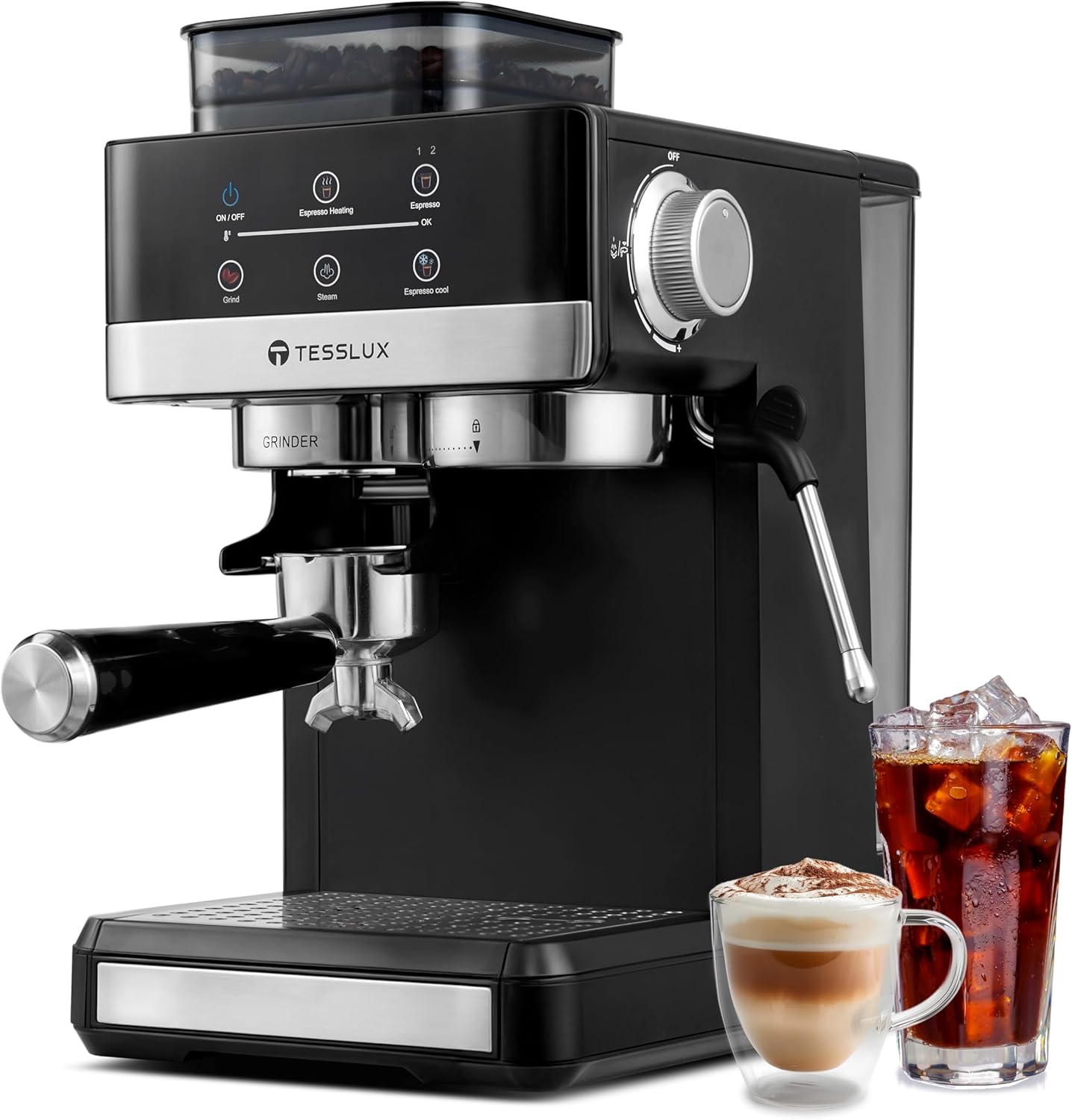
Tesslux 20-Bar Espresso Machine with Grinder
- Built-in conical burr grinder
- 20 grind settings
- 20-bar pump system
- Hot and cool brewing
- Manual steam wand

Tesslux 20-Bar Dual-Boiler Espresso & Cappuccino Machine
- 20-bar pump
- Dual-boiler architecture
- Touchscreen controls
- 1.8-liter water capacity
- Automatic milk system
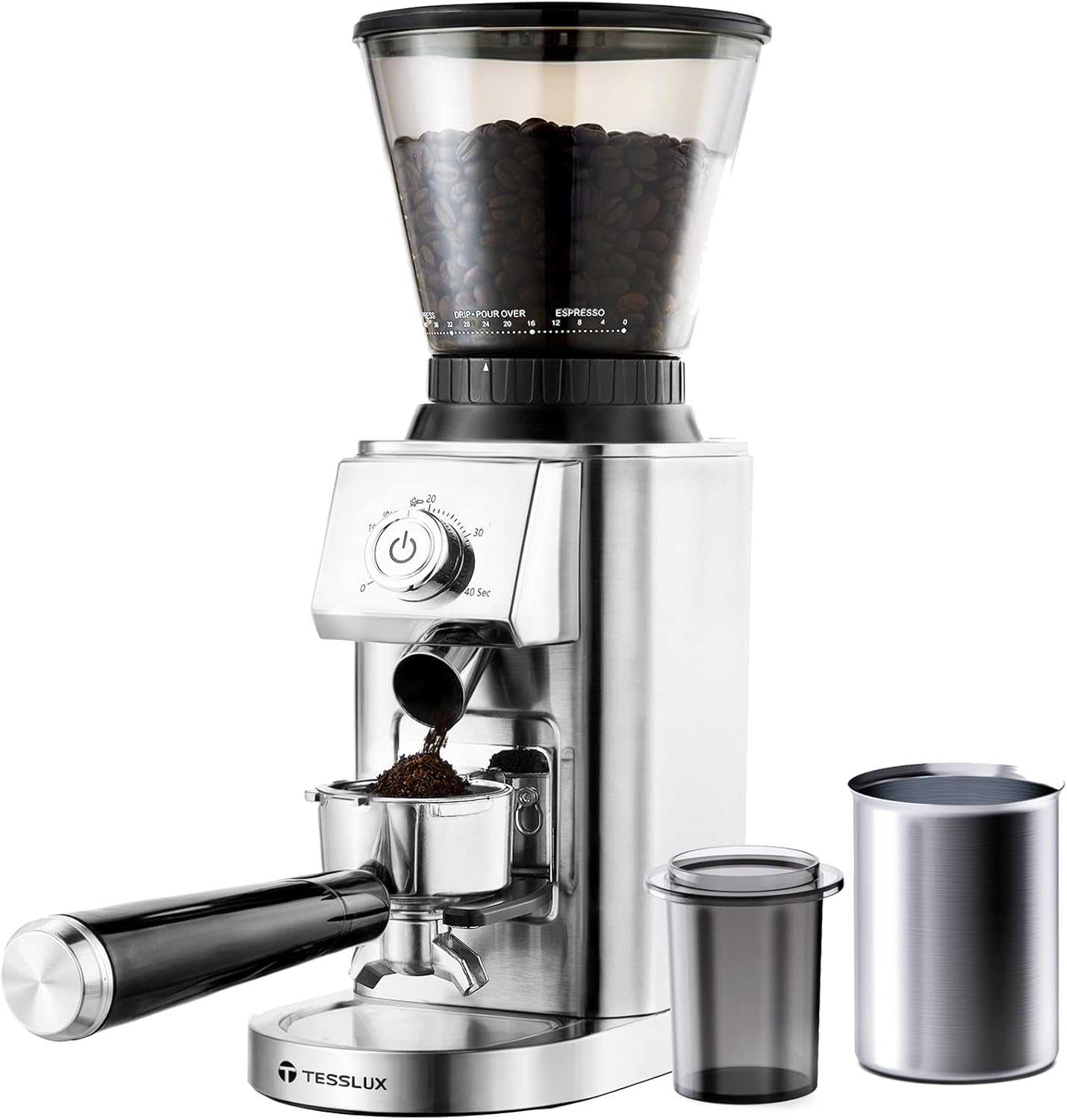
Tesslux 48-Setting Conical Burr Coffee Grinder
- 48 grind settings
- Conical burr system
- Anti-static design
- Precision timer
- 150-watt motor
The integrated-grinder espresso machine earns the first card because it closes the biggest number of gaps in one purchase. Whole beans can move directly into the burr grinder, the grind can be adjusted across 20 settings, the pump handles espresso brewing, and the steam wand covers milk drinks. That does not make it the most automated machine here, but it gives a beginner a complete path from beans to cup without immediately adding another appliance.
The dual-boiler model takes a different approach to convenience. It leaves grinding outside the machine but simplifies beverage preparation with touch controls and a milk system designed around cappuccino and latte service. For someone who already owns a grinder or routinely buys coffee ground correctly for espresso, that can be the cleaner ownership choice.
The stand-alone grinder belongs in the top three because grinders outlive brewing trends. A good burr grinder can move from an espresso machine to a drip brewer, an AeroPress, or a French press. If you are already happy with your coffee maker but not with the consistency of your grounds, replacing the grinder can produce a larger improvement than replacing the brewer.
The rest of the article keeps these roles separate. I do not judge the grinder for lacking a steam wand, and I do not treat the automatic milk machine as inferior merely because it leaves grinding to another device. Each product is strongest when its intended workflow matches the kitchen around it.
Top Tesslux Coffee Makers and Grinder — At a Glance
Tesslux 20-Bar Espresso Machine with Grinder
- 20-bar pump
- Integrated burr grinder
- 20 grind settings
- Hot and cool brew
- Steam wand
- Whole-bean workflow
Tesslux 20-Bar Dual-Boiler Espresso & Cappuccino Machine
- 20-bar pump
- Dual boiler
- Touchscreen interface
- 1.8-liter capacity
- 1350 watts
- Automatic milk frothing
Tesslux 48-Setting Conical Burr Coffee Grinder
- 48 grind settings
- Conical burrs
- Anti-static design
- Anti-clog chute
- Precision timer
- Espresso-to-press range
Quick Ranking: Best Tesslux Coffee Makers and Grinders
| Product | Type | Best For | Why It Ranks Here | Amazon |
|---|---|---|---|---|
| Tesslux 20-Bar Espresso Machine with Grinder | All-in-One | Best Overall | Whole-bean espresso, 20 grind settings, hot/cool brewing, and manual milk control | Price on Amazon |
| Tesslux Dual-Boiler Espresso & Cappuccino Machine | Espresso Machine | Best for Lattes | Touch control, 20-bar pump, dual boilers, and automatic milk preparation | Price on Amazon |
| Tesslux 48-Setting Burr Grinder | Burr Grinder | Best Grinder | Wider grind range, anti-static control, timer, and stand-alone flexibility | Price on Amazon |
Best Tesslux Coffee Makers and Grinders: Detailed Reviews
1. Best Overall: Tesslux 20-Bar Espresso Machine with Built-In Grinder
The integrated-grinder Tesslux is the machine I would place at the center of this roundup because it solves the most common upgrade problem in one chassis. Moving from pre-ground coffee to freshly ground beans normally means adding a grinder, learning a new dosing routine, and finding space for another power cord. Here, the grinder is already part of the machine, so grind adjustment becomes a normal step in espresso preparation rather than a separate appliance decision.
Its 20 grind settings are especially important because espresso is sensitive to small changes in resistance. A shot that runs quickly and tastes thin usually needs a finer grind or another small adjustment to dose and yield. A shot that barely moves may need a coarser setting. The integrated burr grinder gives you a direct way to make those corrections while keeping the beans and portafilter in the same work zone.
The 20-bar pump figure should be read as pump capability rather than a target extraction pressure. What matters in the cup is whether the machine, basket, coffee bed, and grind can create a stable flow. That is why I see the grinder as more meaningful than the pressure badge printed on the front. Freshness and particle size give you variables you can actually change from one shot to the next.
Hot and cool brewing adds another practical branch to the routine. I would use the cooler setting for quick ice-based drinks rather than treating it as traditional long-steep cold brew. The feature is useful when an iced latte is part of the normal menu because the same machine can grind the beans, prepare the concentrated coffee base, and steam milk when the drink changes back to hot.
Milk preparation remains manual, which I consider a reasonable match for this machine. An integrated grinder already gives the user more involvement with espresso, so a steam wand continues that hands-on approach. You control how much air enters the milk, how the pitcher rolls, and when the texture is ready. The learning curve is higher than pressing an automatic latte button, but the technique can improve over time.
The all-in-one design also carries one long-term tradeoff: the grinder and espresso machine share the same body. If one side eventually needs service, you cannot simply remove the other from the workflow. A separate grinder offers more modularity. In return, the Tesslux saves horizontal counter space and reduces the transfer distance between freshly ground coffee and the portafilter.
Best Tesslux choice for a complete whole-bean espresso station.
Tesslux 20-Bar Espresso Machine with GrinderThe most complete Tesslux setup here combines a 20-bar pump, built-in conical-burr grinder with 20 settings, hot and cool brewing, and a manual steam wand in one compact semi-automatic machine.
Price on AmazonTechnical Specifications & Daily Features
- Machine type: Semi-automatic espresso machine with integrated grinder
- Pressure system: 20-bar pump capability
- Grinder: Built-in conical-burr grinder
- Grind adjustment: 20 settings
- Coffee input: Whole beans or ground coffee
- Drink modes: Hot and cool coffee preparation
- Milk system: Manual steam wand with detachable frothing nozzle
- Operation: Touch-control semi-automatic workflow
- Weight: Approximately 15 pounds
30-Day Ownership Outlook: Pros & Cons
Pros
- Whole-bean convenience: Grinding and brewing happen in one workstation.
- Useful dialing range: Twenty settings provide meaningful control for espresso adjustment.
- Flexible drink routine: Hot and cool modes suit straight espresso and iced milk drinks.
- Manual milk control: The steam wand lets technique improve rather than locking texture to one preset.
- Compact all-in-one footprint: It replaces a separate grinder-and-machine pairing on small counters.
Cons
- Less modular: Grinder and brewer cannot be upgraded independently without replacing part of the all-in-one concept.
- Grinder noise: Whole-bean grinding adds sound to the morning routine.
- Manual steaming: Good microfoam requires practice with pitcher position and aeration.
My Final Verdict
This is my Tesslux pick for someone starting from scratch and wanting whole beans, espresso, and milk drinks without building a two-appliance station.
Choose it when learning to dial in coffee is part of the appeal. Skip it when you already own a grinder you love or when one-touch automatic milk drinks matter more than manual control.
I would begin ownership by resisting the urge to change every setting at once. Pick a medium espresso roast, start near the fine end of the grinder range, keep dose and beverage yield consistent, and change grind size in small steps. That process teaches you what the grinder actually changes instead of turning every shot into a new experiment.
The steam wand deserves the same patience. Cold milk, a properly sized pitcher, a short purge, and a controlled introduction of air will produce a more useful texture than simply opening steam at full power and waiting for the milk to become hot. The machine gives you the hardware; the repeatability comes from the routine.
Cleaning is easiest when it is divided into small jobs. Knock out the puck promptly, rinse the basket, wipe the group area, purge and wipe the steam wand after milk, and brush stray grounds away from the grinder exit. None of those tasks is large, but skipping them for several days turns the convenience of an integrated machine into a longer cleaning session.
For the buyer who wants to learn rather than simply press a drink icon, this Tesslux has the clearest upgrade path inside one body. Better beans, more careful grinding, better puck preparation, and improved milk technique can all change the cup without replacing the machine immediately.
2. Best for Lattes: Tesslux 20-Bar Dual-Boiler Espresso & Cappuccino Machine
The dual-boiler Tesslux makes sense for a different reason: it reduces the number of manual decisions between wanting a milk drink and actually holding one. Its touchscreen interface, dedicated milk system, and automatic drink approach are aimed at the person who wants espresso, cappuccino, and latte choices to feel more like selecting a beverage than building one from separate steps.
The dual-boiler architecture is the feature I would pay attention to before the pressure number. Brewing coffee and preparing milk place different thermal demands on a machine. A system designed with separate heating responsibilities can move between those jobs more smoothly than a small single-heater appliance that must climb from brew temperature to steam temperature and then cool again.
A 1.8-liter water capacity also changes the pace of ownership. This is not a tiny two-drink tank that needs attention every morning. For a couple or a household making several drinks, the larger reservoir reduces interruptions. It does, however, reward a simple freshness habit: refill with clean water regularly instead of leaving the same water sitting in the tank for long periods.
The 1350-watt power rating and touchscreen controls support a more appliance-like identity than the grinder-equipped model. This is the Tesslux I would choose for someone who cares less about manually tuning every variable and more about repeating familiar drinks. The machine still depends on correctly ground coffee, but the interface shifts attention away from constant button-and-dial management.
Automatic milk preparation is especially useful when several cappuccinos or lattes are part of breakfast. Manual steaming can be rewarding, but it requires the pitcher to be held correctly for every drink. An automatic milk system exchanges some texture control for consistency and convenience. That trade is valuable for a household where more than one person uses the machine.
The key limitation is that the machine does not include a grinder. That is not automatically a weakness. If you already own a burr grinder, separating the two appliances can be a better long-term arrangement because the grind system can be upgraded independently. If you do not own one, remember to include a grinder in the real cost and counter-space calculation.
Best Tesslux choice for guided cappuccino and latte routines.
Tesslux 20-Bar Dual-Boiler Espresso & Cappuccino MachineA touch-controlled 20-bar espresso platform with dual-boiler architecture, 1.8-liter water capacity, 1350-watt power, digital control, and automatic milk preparation for repeatable milk drinks.
Price on AmazonTechnical Specifications & Daily Features
- Machine type: Guided espresso and milk-drink machine
- Pressure system: 20-bar pump capability
- Heating: Dual-boiler architecture
- Water capacity: 1.8 liters
- Power: 1350 watts
- Interface: Touchscreen / digital control panel
- Milk system: Automatic milk frothing system
- Dimensions: Approximately 11.6 D × 9.1 W × 14.1 H inches
- Best user: Households focused on cappuccinos, lattes, and easier repeatability
30-Day Ownership Outlook: Pros & Cons
Pros
- Milk-drink convenience: Automatic frothing reduces the technique required for everyday cappuccinos and lattes.
- Dual heating roles: The architecture is better suited to switching between coffee and milk preparation.
- Large water tank: A 1.8-liter capacity reduces refill frequency in multi-drink households.
- Touch control: Drink selection is easier for multiple users with different skill levels.
- Compact depth for the feature set: It delivers a substantial drink menu without becoming a prosumer-size machine.
Cons
- No integrated grinder: Fresh whole-bean espresso requires a separate burr grinder.
- Milk-system cleaning: Automatic frothing adds milk-contact components that must be rinsed promptly.
- Less manual texture control: Automatic milk is easier but offers less tactile control than learning a traditional steam wand.
My Final Verdict
This is the Tesslux I would choose for a household that orders cappuccinos and lattes more often than straight espresso and wants a guided touch interface.
Pair it with a good burr grinder for the strongest setup. Choose the all-in-one grinder model instead when whole-bean integration matters more than automatic milk.
The biggest ownership discipline here is milk cleaning. Automatic frothing feels effortless during the drink, but milk residue becomes stubborn when it dries inside small passages. Rinsing the milk path and cleaning removable components promptly preserves both hygiene and foam performance.
The larger tank deserves attention too. More capacity should reduce refills, not encourage old water to remain in the machine indefinitely. I prefer to top up with fresh water only when needed and give the tank a regular rinse rather than treating 1.8 liters as permanent storage.
Because the machine leaves grinding outside the chassis, it pairs naturally with the Tesslux stand-alone grinder in this article. That combination occupies more counter space than the integrated-grinder model, but it gives the owner a wider 48-setting adjustment range and the freedom to use the grinder for other brewers.
For a household with different skill levels, this machine may actually be the easier recommendation than the overall winner. One person can enjoy the simplicity of a touch-controlled latte while another still has access to espresso preparation. Convenience is not always about doing fewer things; sometimes it is about making the same result easier for more people to reproduce.
3. Best Grinder: Tesslux 48-Setting Conical Burr Coffee Grinder
The stand-alone Tesslux grinder is the product with the widest usefulness in this roundup because it is not locked to one brewing method. Forty-eight grind settings let the same appliance move from a fine espresso range through drip coffee and toward coarser immersion brewing. That does not mean every setting will be equally important to every brewer, but the adjustment range gives the grinder room to stay useful when the coffee equipment around it changes.
The first advantage over a blade grinder is control rather than speed. Blade grinders chop coffee unevenly and rely on grinding time to approximate fineness. A conical-burr grinder changes the spacing between burr surfaces, so the adjustment has a more direct relationship with particle size. That makes it easier to repeat a recipe and understand whether a cup needs a finer or coarser grind.
The anti-static design is more valuable than it sounds. Fine coffee can cling to plastic surfaces, remain in a grounds bin, or jump onto the counter as the container is removed. Static does not ruin espresso by itself, but it makes dosing messy and can cause part of the intended coffee weight to stay behind. Reducing that behavior makes everyday transfer cleaner.
The grinder also uses an anti-clog powder channel and a precision timer. I treat the timer as a repeatability aid rather than a scale. The same number of seconds can produce different weights as beans change in density, roast level, or hopper pressure. Once a recipe matters, a small coffee scale is still the better way to confirm the dose.
Its 150-watt motor and tall, narrow body make it a normal household grinder rather than a commercial unit. The dimensions—about 7.68 inches long, 4.72 inches wide, and 13.78 inches high—matter most if the grinder sits beneath upper cabinets. The footprint is modest, but the vertical clearance should be checked before committing to a permanent counter position.
This is also the Tesslux product I would keep if the brewing method changes later. A household might buy it for espresso and then use the coarser end for an AeroPress coffee routine or another immersion brewer. That flexibility gives a stand-alone grinder a longer life than an accessory designed around one machine.
Best Tesslux choice for improving more than one brewing method.
Tesslux 48-Setting Conical Burr Coffee GrinderA stand-alone conical-burr grinder with 48 grind settings, anti-static grounds management, an anti-clog powder channel, a precision timer, and enough adjustment range for espresso through coarse brewed coffee.
Price on AmazonTechnical Specifications & Daily Features
- Grinder type: Electric conical-burr grinder
- Grind adjustment: 48 precise settings
- Burr material: Stainless-steel burr system
- Static control: Anti-static design
- Grounds path: Anti-clog powder channel
- Dosing aid: Precision timer
- Power: 150 watts
- Dimensions: Approximately 7.68 L × 4.72 W × 13.78 H inches
- Best user: A household moving between espresso and brewed coffee
30-Day Ownership Outlook: Pros & Cons
Pros
- Broad adjustment range: Forty-eight positions give useful room across several brewing methods.
- Cleaner grounds handling: Anti-static design reduces cling and countertop scatter.
- More flexible than an integrated grinder: It can stay in service when the espresso machine changes.
- Timed repeatability: The timer helps recreate a familiar starting dose.
- Compact width: The narrow body is easier to place beside an espresso machine.
Cons
- Another appliance on the counter: Separate grinding takes more horizontal space than an all-in-one machine.
- Timer is not weight-based: Bean changes can alter the grams delivered during the same time setting.
- Needs regular brushing: Fines and oils still collect around burrs and the chute.
My Final Verdict
The Tesslux grinder is the strongest purchase when the brewer is already good enough but pre-ground coffee or inconsistent grinding is limiting flavor.
I would pair it with the dual-boiler Tesslux for the most modular setup. Choose the all-in-one machine instead when saving counter space matters more than independent upgrades.
I would calibrate the grinder by brewing, not by assuming the printed numbers correspond perfectly to every coffee. Start within the range appropriate for the brewing method, make one drink, taste it, and adjust only a few steps at a time. Dense light roasts and brittle dark roasts can behave differently even at the same dial position.
For espresso, dose weight and beverage yield should accompany the grind setting. A timer can help recreate a morning routine, but a scale tells you whether the grinder actually delivered the same amount of coffee. Once the dose is stable, grind size becomes easier to diagnose.
Cleaning should stay mostly dry around the burr chamber unless the instructions specifically permit washing a removable part. Brush loose coffee from the upper burr and chute, empty stale grounds from the container, and avoid letting oily residue build up until every new bag smells like the previous one.
As a stand-alone purchase, this grinder is less exciting than a new espresso machine but often more consequential. A capable brewer receiving inconsistent coffee can never behave consistently. Better grinding does not remove the need for good beans and water, but it gives the rest of the recipe a more stable foundation.
Buying Guide: How to Choose the Right Tesslux Coffee Product
Start With the Workflow You Want
An all-in-one espresso machine, an automatic milk machine, and a stand-alone grinder solve different problems. The integrated-grinder model reduces the number of appliances involved in whole-bean espresso. The dual-boiler model reduces manual milk work. The grinder improves the coffee preparation stage while leaving brewing unchanged.
Choose the inconvenience you most want to remove. That usually produces a better purchase than choosing the product with the longest specification list.
Integrated Grinder or Separate Grinder?
Integration saves horizontal counter space and shortens the path from beans to portafilter. It also means the grinder and brewer become one ownership unit. A separate grinder occupies another footprint but can be paired with future machines and used with other brewing methods.
If this is your first serious setup and the counter is small, the 20-setting all-in-one machine is appealing. If you expect to change espresso machines later, the 48-setting stand-alone grinder is the more modular investment.
Decide How Much Milk Technique You Want
Manual steaming rewards practice. You control aeration, whirlpool motion, and final texture, which creates more room to refine latte art. Automatic frothing prioritizes consistency and makes milk drinks easier for people who do not want to learn pitcher technique.
The dual-boiler Tesslux is the stronger fit when cappuccino and latte convenience drive the purchase. The integrated-grinder model is better when manual steam control feels like part of the coffee hobby.
Understand What the 20-Bar Number Means
Both espresso machines use a pump capable of a 20-bar rating, but that number is not a promise that the coffee bed receives 20 bar throughout extraction. Espresso performance depends on internal regulation, basket resistance, dose, grind, and flow.
Do not buy either machine because 20 is larger than another number on a box. Buy according to the total workflow and whether the machine gives you the control or automation you actually want.
Match Grind Range to Your Brewing Methods
Twenty built-in grind settings are practical when the grinder exists mainly to feed one espresso machine. Forty-eight settings become more useful when the same grinder moves between espresso, drip, AeroPress, and French press.
A wider dial is not automatically more precise in the cup, but it gives you more starting positions. The stand-alone Tesslux earns its place when versatility matters.
Plan for Water Capacity and Refilling
The dual-boiler machine’s 1.8-liter tank is the most comfortable choice for several drinks in a row. A larger reservoir reduces interruptions but needs regular freshwater habits. Capacity should serve the number of drinks you make, not simply maximize a specification.
If the household makes only one or two drinks a day, an enormous reservoir provides little benefit. Cleaning access and easy removal can matter more.
Counter Space Includes Height
The grinder and espresso machines all use vertical space as well as width. The stand-alone grinder is narrow but roughly 13.78 inches high, while the dual-boiler machine is about 14.1 inches high. Upper cabinets can make filling hoppers or tanks awkward even when the footprint fits.
Measure the usable space with cabinet doors, hopper access, and removable tanks in mind rather than measuring only the empty countertop.
Cleaning Is Part of the Purchase
Automatic milk systems require milk-path cleaning, steam wands need wiping and purging, burr grinders need brushing, and espresso baskets collect oils. These are not occasional deep-cleaning jobs; small maintenance steps belong in the everyday workflow.
The best Tesslux product is the one you are willing to keep clean. A feature that saves thirty seconds while brewing but adds a cleaning task you continually avoid is not really convenient.
Final Comparison Table: Which Tesslux Product Should You Buy?
| Product | Type | Best For | Product / Use Fit | Amazon |
|---|---|---|---|---|
| Tesslux 20-Bar Espresso Machine with Grinder | All-in-One | Best Overall | Whole beans, espresso dialing, hot/cool drinks, and manual milk control | Price on Amazon |
| Tesslux Dual-Boiler Espresso & Cappuccino Machine | Espresso Machine | Best for Lattes | Touch-guided espresso and easier automatic milk drinks | Price on Amazon |
| Tesslux 48-Setting Burr Grinder | Burr Grinder | Best Grinder | Fresh grinding across espresso, AeroPress, drip, and immersion | Price on Amazon |
My Final Recommendation
My first choice is the Tesslux 20-Bar Espresso Machine with Grinder because it creates the most complete starting point for someone building a home espresso station from nothing. The integrated conical-burr grinder, 20 settings, pump brewing, hot and cool modes, and steam wand give the owner several meaningful variables to improve without immediately buying another major appliance.
The dual-boiler espresso & cappuccino machine is the better choice for a household centered on milk drinks and easier repeatability. Its larger water capacity, touch interface, separate heating roles, and automatic milk preparation reduce the amount of technique required for a morning latte. Pairing it with the 48-setting Tesslux grinder creates the most modular setup in the group.
The stand-alone grinder is my recommendation when the coffee maker itself is not the problem. If a capable brewer is still being fed inconsistent or stale pre-ground coffee, changing the grind stage can improve aroma, extraction, and repeatability without replacing the machine.
The deciding factor is not which Tesslux product looks most advanced. It is whether you want integration, automation, or modularity. The all-in-one machine favors integration, the dual-boiler machine favors milk-drink automation, and the separate grinder favors long-term flexibility.
Frequently Asked Questions
Which Tesslux coffee product is best overall?
The 20-bar Tesslux espresso machine with built-in grinder is my best overall choice because it combines whole-bean grinding, 20 grind settings, espresso brewing, hot and cool drink options, and manual milk steaming in one system.
Does the Tesslux B0DR7RFK7M really have a built-in grinder?
Yes. This model includes an integrated conical-burr grinder with 20 adjustable grind settings. It accepts whole beans and is designed as an all-in-one espresso workflow.
How is the dual-boiler Tesslux different from the grinder model?
The dual-boiler machine emphasizes touch-guided espresso and automatic milk preparation, while the grinder model emphasizes whole-bean integration and manual steaming. The dual-boiler machine requires a separate grinder for freshly ground beans.
Is the B0DR89D9PV grinder Tesslux or Bincoo?
B0DR89D9PV is a Tesslux conical-burr coffee grinder. The product should not be labeled as Bincoo.
How many grind settings does the stand-alone Tesslux grinder have?
The stand-alone Tesslux grinder provides 48 grind settings, giving it a broader adjustment range than the 20-setting grinder integrated into the espresso machine.
Can the Tesslux grinder be used for a French press?
Its adjustment range extends beyond espresso toward coarser brewed-coffee settings, making it suitable for methods such as drip, AeroPress, and French press when the grind is adjusted appropriately.
Does a 20-bar pump mean espresso brews at 20 bar?
No. Twenty bar describes pump capability. The pressure and flow experienced by the coffee depend on the machine’s regulation, basket, grind, dose, and puck resistance.
Which Tesslux setup is better for lattes?
The dual-boiler espresso & cappuccino machine is the easier choice for latte-focused households because it combines touch controls with automatic milk preparation. The all-in-one grinder model gives more manual milk control.
Which option is better for a small counter?
The integrated-grinder machine saves horizontal space because the grinder and brewer share one body. A separate grinder-and-machine combination uses more counter width but offers more modularity.
Should I buy the stand-alone grinder if the espresso machine already has one?
Usually not unless you want a wider grind range, a second dedicated grinder, or more flexibility across several brewing methods. The built-in 20-setting grinder is already part of the all-in-one machine’s value.
How often should I clean the milk system?
Milk-contact parts should be rinsed or cleaned promptly after every use. Dried milk is harder to remove and can restrict frothing performance.
How often should I clean the burr grinder?
Brush loose fines from accessible burr and chute areas regularly, especially when changing between oily dark roasts and lighter coffees. Follow the grinder’s instructions for any deeper disassembly.
Is the cool-brew mode the same as traditional cold brew?
No. It is better understood as a quick, cooler coffee option for ice-based drinks. Traditional cold brew normally relies on a much longer immersion in cool water.
Which Tesslux product offers the best long-term flexibility?
The stand-alone 48-setting grinder is the most modular product because it can continue working with future espresso machines, drip brewers, AeroPress, and immersion equipment.


