
Best SYBO Coffee Makers (2026 Guide)


One Hundred Coffee is reader-supported, and some products displayed may earn us an affiliate commission. Details
Commercial coffee equipment becomes much easier to choose once the question changes from “Which machine has the biggest capacity?” to “How does coffee actually move through this space?” A small office might need one 12-cup pot every hour. A breakfast room may need several decanters held hot at once. A catered event can demand fifty or one hundred cups without tying up staff. SYBO’s lineup covers those different service patterns with pour-over brewers, multi-warmer machines, and large stainless-steel urns.
The strongest choice depends on service rhythm more than on headline numbers. A 12-cup brewer can outperform a 100-cup urn in a meeting room because coffee is made in smaller, fresher batches. The large urn becomes the better tool when guests serve themselves continuously, and a dozen-cup carafe would be emptied before staff could brew another. Capacity is useful only when it matches traffic.
The first SYBO machine in this guide is the most flexible carafe-based option. It brews a standard 12-cup batch, then uses several warmer positions to keep multiple decanters ready. That is valuable when regular, decaf, or different roast profiles need to be staged at the same time without adding a second brewer.
At the other end of the scale, the SR-CP100BG is a 100-cup, 16-liter commercial coffee urn. Its job is not to imitate a café pour-over station. It is designed to create and hold a large reservoir of hot coffee or another hot beverage for events, catering, hotels, offices, and other self-service environments.
The RUG2001 sits much closer to the first machine in spirit. It is a 12-cup commercial pourover brewer with glass decanters and warming capability, built around a simple fill-and-brew workflow rather than digital programming. That simplicity can be an advantage where several employees need to use the machine without navigating menus or schedules.
One product in this lineup deserves to be treated differently because it is not a SYBO model. The NUPANT 12-cup commercial drip brewer is a competing alternative with a 1.8-liter batch size, two glass carafes, and two warmers. It remains useful in the comparison because it represents the same kind of restaurant and office workflow, but it should not be presented as another SYBO machine.
The 50-cup SYBO urn fills the middle ground between carafe brewing and the huge 100-cup unit. Its 8-liter capacity suits gatherings that are too large for repeated 12-cup cycles but do not need the full volume of the 16-liter model. That middle size can be more practical because a partially filled oversized urn adds bulk without creating fresher coffee.
Commercial coffee also puts more pressure on holding strategy than home brewing does. Warmers and urn thermostats keep coffee available, but heat continues changing brewed coffee after extraction ends. The best workflow is to match batch size to demand so the equipment maintains service rather than using heat to preserve one pot for an entire day.
Cleaning is part of capacity planning too. A brewer with several decanters and warmers creates more small pieces to rinse and wipe. A large urn has fewer separate vessels but a much larger chamber, stem, filter basket, and faucet path. Neither is difficult when cleaning happens immediately; both become unpleasant when coffee oils are allowed to dry.
The familiar 12-cup format also makes this category easier to compare with other commercial-style machines. Readers considering a smaller automatic setup can use the existing guide to Kotlie coffee makers and modern brewing convenience as a contrast to SYBO’s much more service-oriented commercial hardware.
The ranking below favors workflow clarity. The multi-warmer 12-cup SYBO brewer is the best overall choice for offices, cafés, and counters that need several decanters in circulation. The 100-cup urn is the large-event pick. The RUG2001 is the simpler commercial pourover choice. The NUPANT model is kept as a clearly labeled outside-brand alternative, and the 50-cup SYBO urn is the mid-size bulk-service option.
Top 3 SYBO Commercial Coffee Picks

SYBO 12-Cup Commercial Coffee Maker
- 12-cup pour-over brewing
- Multiple warmer positions
- Glass decanter workflow
- Stainless-steel body
- No plumbing required

SYBO SR-CP100BG 100-Cup Coffee Urn
- 100-cup capacity
- 16-liter volume
- Percolator urn design
- Keep-warm service
- Continuous-flow faucet

SYBO RUG2001 12-Cup Commercial Pourover
- 12-cup batch size
- Commercial pour-over workflow
- Two glass decanters
- Kettle warmer
- Compact service format
The multi-warmer 12-cup brewer takes the top card because it handles the most common commercial coffee problem: one brew cycle is rarely the whole service. Having several warming positions lets the operator stage coffee for different rooms, decaf service, or the next rush without adding another brewing chassis.
The 100-cup urn belongs in a completely different traffic class. Sixteen liters are useful when guests need to serve themselves continuously and staff cannot spend the event cycling small pots. It trades freshness by the pot for scale, which is exactly the right compromise at a banquet or large meeting.
RUG2001 earns the pourover card because its job is intentionally straightforward. Fill the brewer, start the cycle, move the decanter, and keep service moving. There is no reason to add imaginary smart programming to a machine whose value comes from simple commercial repetition.
The 50-cup urn is intentionally outside the three-card row because its main strength is a middle capacity rather than a fundamentally different brewing method. For many churches, offices, and smaller events, that middle ground may actually be the most proportionate size.
The NUPANT alternative remains useful when comparing commercial drip layouts, but keeping its branding clear prevents an outside-brand machine from being mistaken for part of the SYBO catalog.
SYBO Commercial Coffee Gear at a Glance
SYBO 12-Cup Commercial Coffee Maker
- 12-cup batches
- Multiple warmers
- Glass decanters
- Stainless body
- Pour-over fill
- Commercial service
SYBO SR-CP100BG 100-Cup Coffee Urn
- 100 cups
- 16 liters
- Percolator urn
- Keep-warm
- Two-way faucet
- Large events

NUPANT 12-Cup Commercial Drip Coffee Maker
- 12-cup brew
- 1.8 liters
- 2 carafes
- 2 warmers
- 1450 W
- 304 stainless
SYBO RUG2001 Commercial Pourover Brewer
- 12-cup capacity
- Pourover fill
- 2 decanters
- Kettle warmer
- Stainless body
- Fast batch service
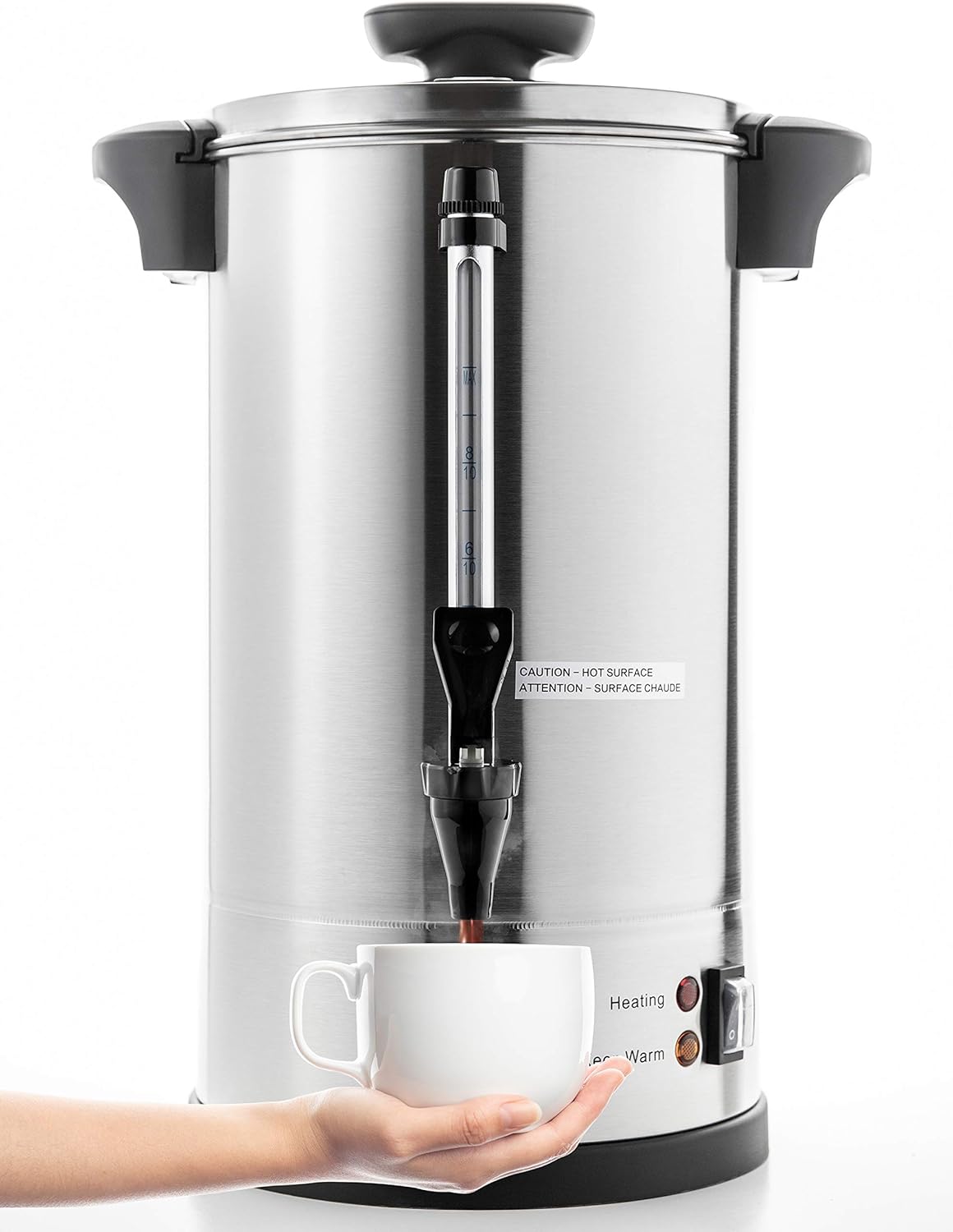
SYBO 50-Cup Commercial Coffee Urn
- 50 cups
- 8 liters
- 304 stainless
- Reusable basket
- Keep-warm
- Self-service faucet
Quick Ranking: SYBO Commercial Coffee Makers
| Product | Type | Best For | Why It Ranks Here | Amazon |
|---|---|---|---|---|
| SYBO 12-Cup Multi-Warmer Brewer | Commercial Drip | Best Overall | Flexible decanter service with several warming positions | Price on Amazon |
| SYBO SR-CP100BG 100-Cup Urn | Percolator Urn | Best Large Event | 16-liter capacity for sustained self-service | Price on Amazon |
| SYBO RUG2001 | Commercial Pourover | Best Pourover | Simple 12-cup workflow with two decanters | Price on Amazon |
| SYBO 50-Cup Coffee Urn | Percolator Urn | Best Mid-Size | 8-liter capacity bridges pots and banquet-size urns | Price on Amazon |
| NUPANT 12-Cup Commercial Brewer | Commercial Drip | Best Alternative | Two-carafe, two-warmer competitor with 1.8-liter batches | Price on Amazon |
| Image | Product | Features | Price |
|---|---|---|---|
Best Commercial Cafetera |
| Price on Amazon | |
Best Commercial Beverage Dispenser | SYBO SR-CP100BG Commercial Coffee Urn & Hot Beverage Dispenser |
| Price on Amazon |
Best Commercial Moka Pot | 12-Cup Coffee Maker 1.8L Commercial Drip Coffee Maker with 2 Glass Carafes and 2 Warmers |
| Price on Amazon |
Best Commercial Pourover |
| Price on Amazon | |
Best Commercial Percolator | SYBO SR-CP-50B Commercial Grade Stainless Steel Percolator Coffee Maker & Hot Water Urn |
| Price on Amazon |
Detailed Reviews: SYBO Commercial Coffee Makers
1. Best Overall: SYBO 12-Cup Commercial Coffee Maker
The 12-cup SYBO multi-warmer brewer makes the most sense in places where coffee service never arrives as one neat batch. A conference room might need a regular pot now and a decaf pot ten minutes later. A café may want one decanter at the serving station and another waiting on a warmer. Several heating positions give one brewer more service flexibility than its 12-cup batch size suggests.
The pour-over format keeps installation simple because the operator adds water manually instead of connecting the machine to a permanent plumbing line. That makes the brewer easier to move between counters or use in a break room where a dedicated water connection is not available. The tradeoff is labor: someone still has to measure and pour each batch.
Stainless-steel construction is practical in a commercial environment because the outer surfaces can be wiped repeatedly and do not depend on fragile decorative panels. The glass decanters remain the breakable part of the system, so spare-carafe planning matters more in a café or church kitchen than it does at home.
Warmers are the feature that changes the workflow most. A single brewer can finish one pot, move it to a holding plate, then immediately start another. That creates a steady rotation during a rush. It also creates a temptation to leave coffee heating for too long, so staff should mark or mentally track which decanter was brewed first.
Coffee quality still starts with batch consistency. Use the same water volume, coffee dose, grind range, and filter shape for every pot before deciding the brewer is inconsistent. Commercial environments introduce human variation quickly because several people may load the machine differently across a day.
A medium drip grind is the most sensible starting point. Grinding too coarse can produce a thin batch, while too fine a grind can slow drawdown and emphasize bitterness. The goal is a bed that saturates evenly and drains cleanly without overflowing the filter basket.
Multi-warmer machines are best when demand is staggered but predictable. If the entire room needs coffee at once, a 50- or 100-cup urn removes more labor. If only six people drink coffee occasionally, several hot plates may be unnecessary. This SYBO sits in the useful middle ground between household drip brewing and bulk urn service.
Best choice for offices, cafés, and service counters that need repeated 12-cup batches and several decanters in rotation.
SYBO 12-Cup Commercial Coffee MakerA commercial pour-over drip brewer with a stainless-steel body, 12-cup batch format, several warmer positions, and a glass-decanter service workflow.
Price on AmazonTechnical Specifications & Daily Features
- Brewer type: Commercial pour-over drip coffee maker
- Batch size: 12 cups
- Holding: Multiple lower warmer positions
- Carafe style: Glass decanters
- Body: Stainless-steel commercial housing
- Water supply: Manual pour-over; no permanent plumbing required
- Best fit: Offices, cafés, meeting rooms, breakfast counters, and small food-service operations
30-Day Ownership Outlook: Pros & Cons
Pros
- Flexible service: Several warmers allow multiple pots to circulate.
- Simple installation: Pour-over filling avoids a dedicated water line.
- Commercial body: Stainless surfaces suit frequent wiping and daily use.
- Fast repeat-batch logic: One pot can hold while the next one brews.
- Easy staff training: The physical workflow is straightforward.
Cons
- Manual refilling: Every batch needs someone to add water.
- Hot plates can overhold coffee: Decanters should be rotated rather than left indefinitely.
- Glass breakage risk: Commercial service benefits from spare decanters.
- Not ideal for huge crowds: Large events are easier with an urn.
My Final Verdict
This is the strongest all-around SYBO option when coffee is served in carafes and demand arrives in waves rather than all at once.
Choose an urn instead when dozens of guests need self-service coffee continuously and staff time matters more than smaller-batch freshness.
I would standardize the recipe with a premeasured scoop or a small scale near the brewer. Commercial equipment becomes much more consistent when every employee uses the same dose instead of judging coffee by eye.
Carafe rotation deserves a simple rule: the newest pot goes to the rear warmer, the oldest usable pot moves forward, and coffee that has been held too long gets discarded rather than blended into a fresh batch. That protects flavor better than relying on heat alone.
The warmers should be wiped after service because spilled coffee can bake onto hot surfaces. Cleaning while the machine is cool prevents that residue from becoming a permanent dark ring around the plates.
2. Best Large Event: SYBO SR-CP100BG 100-Cup Coffee Urn
The SR-CP100BG changes the service model completely. Instead of brewing into removable decanters, it combines brewing, holding, and dispensing inside one large urn. Its 16-liter, 100-cup capacity is intended for events where a twelve-cup pot would disappear almost immediately.
Bulk capacity is most useful when guests can serve themselves. A continuous-flow faucet lets the urn sit at a beverage station while staff focus on food, registration, or other service tasks. That is a meaningful labor advantage at catered meetings, hotels, religious gatherings, and large family events.
The urn uses a percolator-style internal system rather than a café drip basket feeding a glass carafe. Coffee is brewed directly in the vessel, then held hot for service. A reusable stainless filter basket removes the need for stacks of paper filters, but the grind must be coarse enough to keep fines from escaping into the drink.
One hundred cups should be interpreted as small urn servings, not one hundred modern 12-ounce mugs. The more useful number is the 16-liter total volume. Event planners should translate that volume into the actual cup size used at the venue before deciding whether one urn is enough.
Heat retention and keep-warm control are necessary at this scale because the coffee may remain available for a long serving window. That convenience should not become an excuse to brew hours earlier than needed. Even well-held coffee loses aroma with time, so the batch should finish close enough to service that the first guests receive fresh coffee.
Cool-touch handles and a secure lid become more important as capacity grows. Sixteen liters of hot liquid is not a casual countertop object. The urn should sit on a stable surface with enough clearance around the faucet for cups and enough space behind it for safe filling and cleaning.
The 100-cup model is excessive for many offices. A machine this large makes sense only when demand can justify the volume. For smaller events, the 50-cup SYBO keeps the same basic service concept while reducing the physical footprint and leftover-coffee risk.
Best choice for catering, hotels, large meetings, and self-service beverage stations that need a true bulk-brew format.
SYBO SR-CP100BG 100-Cup Coffee UrnA 16-liter commercial percolator coffee urn designed for approximately 100 small servings, with a reusable filter basket, keep-warm function, secure lid, cool-touch handling points, and a continuous-flow faucet.
Price on AmazonTechnical Specifications & Daily Features
- Brewer type: Commercial percolator coffee urn
- Capacity: 16 liters / 100 cups
- Body: Food-grade stainless steel
- Filter: Reusable stainless filter basket
- Dispensing: Continuous-flow two-way faucet
- Holding: Automatic heat/keep-warm service
- Best fit: Catering, hotels, large meetings, schools, churches, and banquet service
30-Day Ownership Outlook: Pros & Cons
Pros
- True bulk capacity: Reduces repeated small-pot brewing.
- Self-service friendly: Faucet dispensing lowers staff involvement.
- No paper filter dependency: Reusable basket suits event service.
- Commercial construction: Stainless body fits frequent use.
- One-vessel workflow: Brewing, holding, and serving happen in the same urn.
Cons
- Large footprint: Needs a stable dedicated service area.
- Heavy when full: Filling and cleaning require planning.
- Too large for modest demand: Half-empty operation wastes the capacity advantage.
- Extended holding changes flavor: Bulk service still benefits from fresh timing.
My Final Verdict
The 100-cup SYBO is the right tool when coffee service is measured in dozens of guests rather than in one or two carafes.
For smaller offices and gatherings, the 50-cup version is easier to justify and still provides the same self-service style.
I would calculate real event demand in ounces or liters before filling the urn. A labeled “100-cup” capacity can sound more generous or more limited than it actually is depending on whether the venue uses small paper cups, ceramic mugs, or large takeaway cups.
Coffee grounds should be coarse enough for the reusable basket, and the stem and filter parts should be rinsed before residue dries. Large urns are easier to maintain when cleanup begins as soon as the vessel is cool and empty.
Position the faucet over a drip tray or washable service mat. High-volume self-service creates drips even with a well-designed spout because guests pull cups away at different times.
3. Best Alternative: NUPANT 12-Cup Commercial Drip Coffee Maker
The NUPANT machine belongs in this guide as a competing commercial drip option rather than as a SYBO model. Its 12-cup, 1.8-liter batch size puts it directly in the same office, restaurant, and beverage-station category as SYBO’s carafe brewers.
Two glass carafes and two warmer plates create a practical rotation system. One pot can remain available while the second is brewing or while a different coffee is held for guests. That setup is particularly useful for regular and decaf service without requiring two separate brewer bodies.
The 1450-watt heating system is designed around a commercial batch cycle, and a full 1.8-liter pot is typically positioned as a roughly seven-minute brew. Speed matters in a restaurant only when the workflow around it is equally organized; filters, ground coffee, clean carafes, and water should be ready before the rush begins.
SS304 stainless steel around the housing and funnel suits a machine that will be wiped and handled frequently. The glass carafes remain more fragile than the brewer body, so keeping a spare is sensible in any workplace where a dropped pot could stop service.
The pour-over format avoids plumbing just like the comparable SYBO machines. That makes installation easier but still requires someone to refill every batch. A plumbed brewer becomes more attractive when the café is busy enough that manual water loading repeatedly interrupts staff.
Two warmers are enough for straightforward dual-pot service without the larger footprint of a three-warmer layout. That can make the NUPANT more proportionate in a smaller break room or restaurant pass where counter width matters.
Because it is an outside-brand alternative, the real comparison is not about brand loyalty. It is about whether two carafes and two warmers are enough for the intended service or whether SYBO’s broader warmer layout and urn options fit the operation better.
Best non-SYBO alternative for a simple two-carafe, two-warmer commercial drip station.
NUPANT 12-Cup Commercial Drip Coffee MakerA 12-cup, 1.8-liter commercial pour-over brewer with two glass carafes, two warming plates, 1450-watt brewing power, and SS304 stainless-steel construction.
Price on AmazonTechnical Specifications & Daily Features
- Brand: NUPANT
- Brewer type: Commercial pour-over drip coffee maker
- Batch size: 12 cups / 1.8 liters
- Carafes: 2 glass carafes
- Warmers: 2 warming plates
- Power: 1450 W
- Body/funnel: SS304 stainless steel
- Typical full-batch cycle: About 7 minutes
30-Day Ownership Outlook: Pros & Cons
Pros
- Clear two-pot workflow: One carafe can serve while another is prepared.
- Regular/decaf flexibility: Two warmers suit parallel coffee choices.
- No plumbing requirement: Easier installation in many offices and restaurants.
- Stainless commercial body: Designed for repeated service.
- Moderate footprint: Simpler than larger multi-warmer stations.
Cons
- Manual water loading: Every batch requires staff attention.
- Glass carafes: Breakage can interrupt service without a spare.
- Not a SYBO product: Accessories and support belong to a different brand ecosystem.
- Limited for large events: Twelve-cup batches cannot match an urn for volume.
My Final Verdict
The NUPANT is a sensible alternative when two warmers and two carafes are enough and the service area does not need a larger SYBO configuration.
Buy it as a commercial drip brewer, not as a moka pot or stovetop espresso maker—the workflow is standard pour-over batch coffee.
A simple station can be a strength in a small restaurant because fewer hot plates mean fewer half-forgotten pots. Two decanters are enough for many regular-and-decaf setups.
I would keep premeasured coffee portions nearby so a replacement batch can start immediately when the first carafe drops below the service threshold. That matters more in practice than shaving a few seconds from the machine itself.
Carafes should be rinsed before coffee oils bake into the glass. Clear glass makes residue easy to see, which is useful if staff treat that visibility as a cleaning reminder.
4. Best Pour Over: SYBO RUG2001 12-Cup Commercial Brewer
The RUG2001 is a traditional commercial pourover machine, and that simplicity is the reason to consider it. There is no need to schedule a brew the night before or navigate a digital menu. Water is added, coffee goes into the filter basket, and the machine turns that manual setup into a repeatable 12-cup batch.
Two glass decanters let the operator alternate service or keep a second pot ready. That is useful in a small café or office where demand rises and falls throughout the morning but never reaches the scale that justifies a 50-cup urn.
The kettle-warmer layout provides a hot-holding position without turning the brewer into a wide bank of multiple plates. That keeps the footprint easier to manage on a smaller counter, especially when the coffee area also needs room for filters, cups, sugar, milk, and a grinder.
A commercial showerhead matters because even saturation is more useful than flashy programming. Water should reach the coffee bed across a broad area instead of creating one deep channel. A flat-bottom basket and sensible grind support that distribution.
Batch timing is another reason this style remains common. A 12-cup pot can be brewed in less than ten minutes, allowing the operator to respond to demand instead of guessing the entire morning’s volume at once. The freshest commercial coffee often comes from brewing smaller pots more frequently.
Glass carafes make coffee level visible from across the room, which is useful during service. The tradeoff is heat exposure on the warmer and breakage risk. A thermal airpot is better for long holding; a glass decanter is better when staff want immediate visual feedback and quick turnover.
For teams choosing between this style and a large urn, the existing guide to electric coffee percolators helps explain why repeated drip batches and bulk percolation create different service rhythms and flavor profiles.
Best SYBO option for a simple, compact commercial pour-over station with two glass decanters.
SYBO RUG2001 12-Cup Commercial PouroverA stainless commercial pour-over coffee maker built around 12-cup batches, two glass decanters, a warming position, and a straightforward no-plumbing workflow.
Price on AmazonTechnical Specifications & Daily Features
- Model: SYBO RUG2001
- Brewer type: Commercial pour-over drip brewer
- Batch size: 12 cups
- Carafes: 2 glass decanters
- Holding: Kettle/decanter warmer
- Body: Stainless-steel commercial housing
- Plumbing: Manual pour-over design
- Best fit: Small cafés, offices, meeting spaces, and moderate batch service
30-Day Ownership Outlook: Pros & Cons
Pros
- Straightforward workflow: Easy for multiple staff members to understand.
- Two decanters: Supports rotation without a second brewer.
- Compact commercial format: Easier to place than a broad multi-warmer bank.
- Responsive batch size: Twelve cups can be refreshed as demand changes.
- No digital complexity: Fewer controls to learn or reset.
Cons
- Manual refilling: Water must be added for each pot.
- Glass holding: Coffee can lose quality if left on heat too long.
- Limited peak capacity: Big events are better served by an urn.
- No scheduling features: It is intentionally simple rather than programmable.
My Final Verdict
RUG2001 is the SYBO I would choose when the operation wants a classic commercial pour-over brewer without a large warmer bank or bulk urn.
Its advantage is predictable simplicity, not smart programming—the machine is strongest when staff brew fresh pots as demand appears.
I would place filters, coffee, and a measured water pitcher beside the machine so every pot begins the same way. Standardization is the fastest route to better commercial consistency.
Use the second decanter as part of a rotation rather than an excuse to hold both pots indefinitely. A fresh twelve-cup batch is easy enough to produce so that stale coffee should not stay simply because a warmer is available.
Descaling frequency should follow water hardness and brew volume. A machine used heavily with mineral-rich water can lose flow long before a lightly used office brewer in soft water does.
5. Best Mid-Size Urn: SYBO 50-Cup Commercial Coffee Urn
The 50-cup SYBO urn is the capacity I would look at first when a twelve-cup pot feels too small but a hundred-cup vessel feels excessive. Eight liters provide enough coffee for a substantial meeting or gathering without doubling the size of the service station unnecessarily.
Like the larger urn, this model combines brewing, holding, and dispensing inside one stainless vessel. That simplifies guest service because cups are filled directly from the faucet instead of staff lifting and replacing heavy glass carafes.
The reusable filter basket keeps the brewer independent of paper-filter supplies. That is useful at events where an overlooked box of filters can stop service, but the basket must be paired with a coarse enough grind to keep fine particles under control.
Food-grade 304 stainless steel gives the body the kind of durability expected from commercial urns. It resists routine staining and can tolerate repeated cleaning, while the smooth interior is easier to inspect than an opaque lined tank.
The keep-warm function is useful because fifty servings may be consumed over an hour or more rather than at one instant. As with the 100-cup version, the best flavor comes from timing the brew reasonably close to service instead of treating warm holding as indefinite preservation.
Clear level markings are particularly helpful at this middle size. The operator can fill for expected attendance instead of automatically making all eight liters, which reduces waste when the guest count is uncertain.
The two-way faucet supports continuous dispensing for carafes or individual cups. That makes the 50-cup urn a strong self-service choice for churches, offices, training sessions, community events, and smaller catering jobs.
Best SYBO urn when commercial service needs more than a few carafes but does not require the full 100-cup format.
SYBO 50-Cup Commercial Coffee UrnAn 8-liter, approximately 50-cup stainless-steel percolator urn with a reusable filter basket, keep-warm function, secure lid, level markings, and self-service faucet.
Price on AmazonTechnical Specifications & Daily Features
- Brewer type: Commercial percolator coffee urn
- Capacity: 8 liters / about 50 cups
- Body: Food-grade 304 stainless steel
- Filter: Reusable filter basket
- Dispensing: Two-way self-service faucet
- Holding: Automatic keep-warm
- Safety/handling: Secure lid and cool-touch handling points
- Best fit: Offices, churches, training rooms, smaller events, and catering
30-Day Ownership Outlook: Pros & Cons
Pros
- Useful middle capacity: Larger than carafe service without the bulk of 100 cups.
- Self-service dispensing: Reduces staff involvement.
- Reusable filter: No paper-filter dependency.
- Stainless construction: Suits repeat commercial cleaning.
- Flexible fill volume: Level markings help match the batch to attendance.
Cons
- Still bulky when full: Eight liters of hot coffee require stable placement.
- Percolator flavor: Not identical to clean commercial drip coffee.
- Large chamber cleanup: More involved than rinsing one carafe.
- Overbrewing creates waste: Capacity should match actual turnout.
My Final Verdict
The 50-cup model is the most proportionate SYBO urn for medium-size gatherings where several 12-cup pots would create too much staff work.
Move to the 100-cup model only when attendance and serving volume genuinely justify doubling the capacity.
I would choose the 50-cup urn over the 100-cup model whenever demand is uncertain. It is easier to brew another batch than to waste several liters because the larger vessel looked more impressive.
Faucet cleaning deserves attention because coffee oils collect wherever liquid repeatedly passes and cools. Flush and wipe the spout as part of every cleanup cycle rather than waiting for flow to become sticky.
Before storing the urn, let the chamber, basket, stem, and lid dry completely. Large enclosed stainless vessels can hold residual moisture longer than a glass carafe.
Buying Guide: How to Choose a Commercial SYBO Coffee Maker
Match Capacity to the Busiest 30 Minutes
Average daily consumption can hide the real equipment requirement. A café may sell hundreds of cups across a day but only needs two decanters at once. A conference can consume most of its coffee in one short break and therefore benefit from an urn.
Estimate the busiest serving window rather than total daily volume. That tells you whether repeated 12-cup batches or one large reservoir makes more sense.
Choose Carafes for Fresh Rotation
Glass-decanter brewers are strongest when coffee turns over quickly. Staff can see volume, brew another pot before the first empties, and separate regular from decaf.
The tradeoff is labor and breakage. Someone must refill, brew, move, clean, and rotate each carafe.
Choose an Urn for Self-Service Scale
Urns shift the workload toward one large preparation cycle and away from repeated small batches. They are ideal when guests serve themselves and coffee demand is concentrated.
The larger the urn, the more important accurate attendance becomes. Brewing 16 liters for a group that drinks only half of it wastes coffee and extends holding time.
Think in Liters, Not Only Cup Counts
Commercial cup counts often use smaller servings than modern mugs. A 100-cup label does not mean one hundred 12-ounce drinks.
Translate the capacity into liters or ounces, then divide by the actual cup size at your venue. That produces a much more realistic service estimate.
Pourover or Plumbed Water?
The machines in this article use pour-over or urn-style manual filling rather than requiring a permanent water line. That makes placement easier and installation cheaper.
In a very busy café, manual filling can become repetitive labor. A plumbed brewer may be worth considering when volume is high enough that staff constantly carry pitchers.
Plan Regular and Decaf Service
Multi-warmer brewers earn their counter space when more than one coffee must be available. Regular and decaf are the obvious examples, but different roasts or service areas can create the same need.
Use labeled carafes or handles so staff and guests can identify each coffee quickly without relying on memory.
Do Not Treat Warmers as Storage
A hot plate keeps coffee hot; it does not keep it freshly brewed. Aroma fades, and harsher flavors can become more obvious during long holding.
Set a practical discard or refresh interval for the venue, then brew smaller batches if coffee repeatedly sits beyond that point.
Use Coarser Grounds in Percolator Urns
Large urns rely on a reusable basket and percolation path rather than paper drip filters. Coarser grounds help reduce sediment and excessive extraction.
Commercial grinding should be repeatable. Mark the correct grinder setting so different staff members do not improvise each batch.
Build Cleaning Time Into Closing Duties
Carafe systems need baskets, decanters, showerheads, and warmers cleaned. Urns need chambers, stems, baskets, lids, and faucets rinsed and dried.
Assign the job explicitly. Commercial equipment becomes unreliable when everyone assumes someone else will descale or clean it.
Keep Replacement Carafes and Parts in Mind
Glass decanters are consumable risks in busy environments. An otherwise functional brewer can become unusable during service if the only matching carafe breaks.
Urns remove that breakage point but rely more heavily on faucets, gaskets, filter baskets, and stems. Long-term ownership includes those replacement parts.
Final Comparison: SYBO Commercial Coffee Makers
| Product | Service Style | Best For | Main Tradeoff | Amazon |
|---|---|---|---|---|
| SYBO 12-Cup Multi-Warmer Brewer | Carafe Rotation | Offices and cafés | Requires manual refilling and pot rotation | Price on Amazon |
| SYBO 100-Cup Urn | Bulk Self-Service | Large events | Large footprint and high batch volume | Price on Amazon |
| NUPANT 12-Cup Brewer | Two-Carafe Drip | Outside-brand alternative | Separate brand ecosystem and only two warmers | Price on Amazon |
| SYBO RUG2001 | Simple Pourover | Smaller service counters | No programming; staff refill each batch | Price on Amazon |
| SYBO 50-Cup Urn | Mid-Size Self-Service | Medium gatherings | Less fresh-batch flexibility than carafes | Price on Amazon |
My Final Recommendation
The SYBO 12-cup multi-warmer commercial brewer is my best overall recommendation because it fits the widest range of offices, cafés, breakfast counters, and meeting spaces. Twelve-cup batches are small enough to refresh regularly, while several warming positions give the operation room to keep regular, decaf, or backup pots in circulation.
The SR-CP100BG becomes the clear choice when the event is large enough that carafe rotation would turn into a full-time job. Its 16-liter capacity and self-service faucet are designed for banquet-scale demand, not for making one office pot in the morning.
RUG2001 is the better SYBO choice when the counter needs a straightforward commercial pourover brewer without a wide bank of warmers. It gives small operations a familiar 12-cup service model with two decanters and simple controls.
The 50-cup urn is the capacity sweet spot for medium events. It removes the need to brew several carafes while avoiding the bulk and waste risk of a full 100-cup unit. The NUPANT machine remains a useful two-warmer alternative for buyers comparing brands, but it should be evaluated as a competitor rather than as part of the SYBO range.
The final decision should come from traffic pattern: choose carafes when freshness and coffee variety matter most, choose an urn when self-service volume dominates, and choose the smallest capacity that comfortably covers the busiest part of service.
Frequently Asked Questions
Which SYBO commercial coffee maker is best overall?
The 12-cup multi-warmer SYBO brewer is my best overall choice because it balances fresh-batch brewing with the ability to keep several decanters in service.
How large is the SYBO SR-CP100BG?
The SR-CP100BG is a 16-liter commercial coffee urn designed around roughly 100 small servings.
Is the SR-CP100BG a refrigerated four-tank beverage dispenser?
No. It is a hot coffee and beverage urn, not a chilled multi-tank dispenser.
Is the NUPANT B0CR7L9BMH a moka pot?
No. It is a 12-cup, 1.8-liter commercial drip coffee maker with two glass carafes and two warming plates.
Is NUPANT a SYBO model?
No. NUPANT is a separate brand. It appears here only as a comparable commercial drip alternative.
What is the SYBO RUG2001?
RUG2001 is a 12-cup commercial pour-over coffee brewer with glass decanters and warming capability.
Does the RUG2001 have 24-hour programming?
This guide treats the RUG2001 as the simple commercial pour-over brewer it is rather than as a programmable smart machine.
How large is the SYBO 50-cup urn?
The 50-cup model uses an 8-liter format, placing it between 12-cup carafe brewers and the 16-liter 100-cup urn.
Does the 50-cup SYBO urn use paper filters?
A reusable filter basket is part of the percolator-urn design, so paper filters are not central to normal operation.
Which SYBO model is best for an office?
A 12-cup carafe brewer usually makes more sense for a typical office because staff can refresh smaller batches instead of holding a large urn all day.
Which SYBO model is best for a wedding or catered event?
The 100-cup urn is the strongest option when attendance is high and guests need self-service coffee for an extended period.
Should I choose the 50-cup or 100-cup SYBO urn?
Choose the smallest size that comfortably covers peak demand. The 50-cup model reduces bulk and waste for medium groups; the 100-cup model is better for large events.
Do commercial coffee warmers keep coffee fresh?
Warmers maintain serving temperature, but brewed coffee still loses aroma and can taste harsher over time. Smaller fresh batches are better when demand allows.
What grind works best in a commercial coffee urn?
A coarse grind is the safest starting point for percolator urns because it reduces sediment and helps prevent overly aggressive extraction.
What grind works best in SYBO drip brewers?
A medium drip grind is a practical baseline. Adjust slightly finer or coarser according to drawdown speed and flavor rather than changing the dose and grind simultaneously.
Do SYBO commercial brewers require plumbing?
The pour-over models covered here are designed to be filled manually, which simplifies placement where a dedicated water line is unavailable.
How often should a commercial coffee maker be descaled?
Descaling frequency depends on water hardness and brew volume. Heavy use with mineral-rich water requires more frequent attention than light use with softer water.


