
How to Dial In Moka Pot Coffee


OneHundredCoffee is reader-supported, and some products displayed may earn us an affiliate commission. Details
Dialing in moka pot coffee means adjusting your stovetop brew until it tastes strong, smooth, rounded, and satisfying instead of bitter, burnt, sour, weak, metallic, or muddy. The moka pot is one of the most charming coffee brewers you can own, but it is also one of the easiest to misunderstand. It looks simple: water in the bottom, coffee in the basket, heat underneath, coffee on top. But small details make a huge difference. Grind a little too fine, use too much heat, tamp the basket, leave it sputtering too long, or use the wrong roast, and that cozy little moka pot can turn into a bitterness machine.
The good news is that Moka pot coffee is not supposed to taste burnt. It is supposed to taste rich and concentrated, somewhere between strong drip coffee and espresso-style intensity. Mokaill does not produce true espresso because it does not use the same pressure as an espresso machine, but it can make a beautifully bold cup for black coffee, Americanos, iced coffee, and milk drinks. Once you learn how grind size, heat, water level, dose, timing, and roast level work together, moka pot brewing becomes much more predictable.
As we discussed previously in our published article about How to Dial In AeroPress Coffee, dialing in is about listening to the cup and changing one variable at a time. And as we covered in Best Grind Size for Moka Pot Coffee, the moka pot grind should usually be fine-medium: finer than drip coffee but not as powdery as espresso. That one detail alone fixes many moka pot problems. Too coarse, and the coffee tastes weak and sour. Too fine, and the brew can taste bitter, harsh, muddy, or even struggle to flow properly.
For a classic setup, the Bialetti Moka Express is the iconic starting point. If you use induction, a stainless steel option like the Bialetti Venus may be more practical. A burr grinder such as the Baratza Encore ESP, a compact manual grinder like the TIMEMORE Chestnut C2, and a small steel scale such as the Hario V60 Drip Scale can make Moka pot brewing far easier to repeat.
Best Moka Pots — At a Glance
| Image | Product | Features | Price |
|---|---|---|---|
|
Best Classic Moka

|
Iconic aluminum moka pot
|
Price on Amazon | |
|
Best Stainless Bialetti

|
18/10 stainless steel body
|
Price on Amazon | |
|
Best Induction Classic

|
Classic moka, induction-ready
|
Price on Amazon | |
|
Best Crema-Style Cup

|
Pressure-valve crema effect
|
Price on Amazon | |
|
Best Gift Moka

|
Brews into two cups
|
Price on Amazon | |
|
Best Color Choice

|
Anodized aluminum moka pot
|
Price on Amazon | |
|
Best Budget Classic

|
Simple cast-aluminum brewer
|
Price on Amazon | |
|
Best Modern Look

|
Stainless Italian-style brewer
|
Price on Amazon | |
|
Best Steel Value
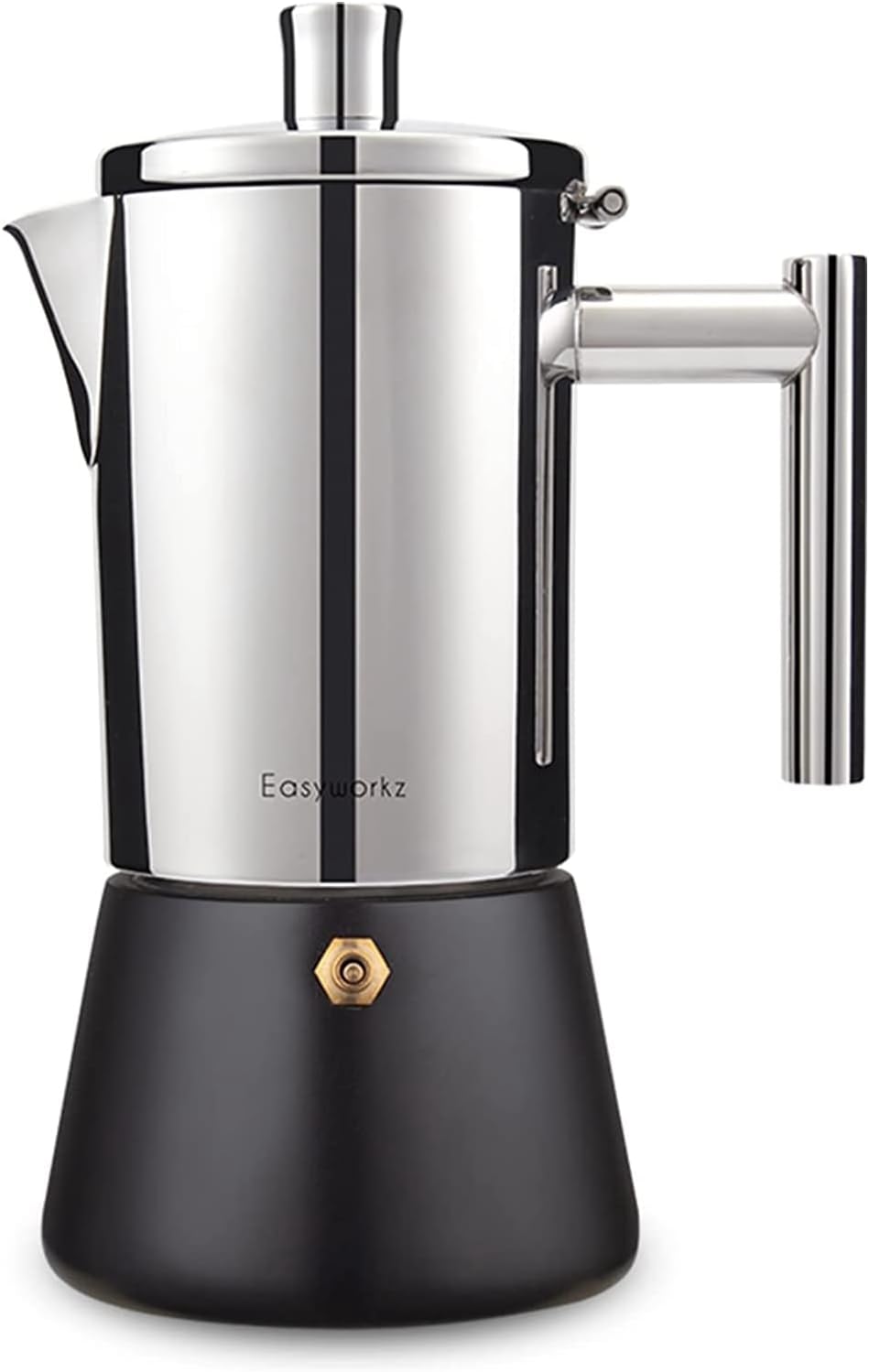
|
Stainless induction moka pot
|
Price on Amazon | |
|
Best Premium Steel

|
Heavy-gauge 18/10 steel
|
Price on Amazon |
The Quick Answer: How to Dial In Moka Pot Coffee
Start with the classic moka pot structure: fill water to just below the safety valve, fill the basket level with coffee, use a fine-medium grind, do not tamp, brew on low to medium-low heat, and remove the pot when the stream turns pale or starts to gurgle.
| Variable | Best Starting Point |
|---|---|
| Water level | Just below safety valve |
| Coffee dose | Basket full and level |
| Grind size | Fine-medium |
| Tamping | Never tamp |
| Heat level | Low to medium-low |
| Brew timing | Remove at first gurgle |
| Roast the level | Medium to medium-dark |
| Flavor goal | Strong, smooth, rounded |
| Serving tip | Stir the upper chamber before pouring |
A simple moka pot rule is
If it tastes sour or weak, extract more. If it tastes bitter or burnt, extract less aggressively.
| the grind. Taste Problem | Likely Cause | First Fix |
|---|---|---|
| Sour and weak | Grind too coarse | Grind slightly finer |
| Bitter and burnt | Heat too high | Lower heat |
| Muddy and harsh | Grind too fine | Grind coarser |
| Metallic | Dirty pot or overheated brew | Clean the pot and reduce heat |
| Watery | Basket underfilled | Fill basket level |
| Bitter at the end | The brew was left too long | Remove earlier |
| Sputtering violently | Too much heat or fine grind | Lower the heat, coarsen the grind. |
| Weak with milk | The base is too diluted | Use less milk or stronger coffee |
What Makes Moka Pot Coffee Different?
Moka pot brewing is pressure-assisted coarse-grind brewing. Water heats in the bottom chamber, pressure builds, and hot water moves upward through the coffee basket into the top chamber. It is not the same as espresso, but it is stronger than most drip coffee.
That means Moka pot coffee needs its own dial-in approach. You cannot treat it like a French press, pour-over, or espresso.
| Brewing Method | Main Style | Main Dial-In Focus |
|---|---|---|
| Espresso | High-pressure extraction | Fine grind, dose, yield |
| Moka pot | Stovetop pressure-assisted | Grind, heat, timing |
| AeroPress | Immersion + press | Grind, steep, ratio |
| French press | Full immersion | Grind, steep, sediment |
| Pour-over | Gravity flow | Grind, pour, drawdown |
| Cold brew | Long immersion | Ratio, time, filtration |
The Moka pot is especially sensitive to heat. Many bad moka pot cups are not bad because the brewer is flawed. They are bad because the pot was blasted over high heat until the last sputtering drops tasted burnt.
The moka pot rewards patience. Low heat, correct grind, and early removal are everything.
Start with a baseline Moka pot recipe.
Moka pots are different from pour-over because you do not usually weigh a flexible dose and water amount every time. The brewer is designed around its chamber size. You fill the water chamber to the right level and fill the coffee basket level. That is the basic recipe.
Classic Moka Pot Baseline
| Step | What to Do |
|---|---|
| Water | Fill bottom chamber just below safety valve |
| Coffee | Fill basket level with ground coffee |
| Grind | Fine-medium |
| Basket | Do not tamp |
| Heat | Low to medium-low |
| Brew | Keep lid open if watching |
| Stop | Remove at first gurgle or pale stream |
| Serve | Stir coffee in the top chamber before pouring |
The basket should be full but loose. Level it with your finger or a flat edge, but do not press it down. Tamping can create too much resistance and cause bitterness, sputtering, or safety issues.
Best Grind Size for Moka Pot Coffee
The best grind size for a Moka pot is usually fine-medium. Think table salt, fine sea salt, or slightly finer than drip coffee. It should not be powdery like espresso.
| Grind Size | Moka Pot Result |
|---|---|
| Too coarse | Weak, sour, thin |
| Medium | Often light but usable |
| Fine-medium | Best starting point |
| Espresso-fine | Bitter, harsh, slow, muddy |
| Powdery | Risk of clogging and bitterness |
This is one of the biggest moka pot mistakes. Many people assume that because Moka pot coffee is strong, it needs an espresso grind. It usually does not. A true espresso grind can make the water struggle through the basket and can create bimoka, over-extracted coffee.
Moka Pot Grind Dial-In Table
| Taste / Behavior | Grind Fix |
|---|---|
| Coffee tastes weak | Grind slightly finer |
| Coffee tastes sour | Grind finer |
| Flow is too fast | Grind slightly finer |
| Coffee tastes bitter | Grind coarser |
| Flow is slow and angry | Grind coarser |
| Coffee tastes muddy | Grind coarser |
| The pot sputters too much | Grind coarser or lower heat |
| Coffee tastes balanced but light | Use fresher beans or less dilution |
Make small grind changes. A Moka pot can swing from weak to bitter quickly if you jump too far.
Why You Should Never Tamp Moka Pot Coffee
Do not tamp Moka pot coffee. This is not espresso. In an espresso, tamping creates a compact puck for high-pressure extraction. In a moka pot, tamping can create too much resistance and make the brew unstable.
The coffee basket should be full and level, but loose.
| Basket Habit | Result |
|---|---|
| Underfilled basket | Weak, watery coffee |
| Level full basket | Best starting point |
| Lightly settled by tapping | Usually okay |
| Firmly tamped | Bitter, slow, risky |
| Overfilled basket | Poor seal and harsh brew |
If you want stronger Moka pot coffee, do not tamp. Use the correct pot size, fresh coffee, and proper grind, and avoid over-diluting afterward.
Best Water Level for Moka Pot
Fill the Mokaom chamber with water up to just below the safety valve. Do not cover the safety valve. That valve is there for pressure safety.
| Water Level | Result |
|---|---|
| Far below value | Less output, possibly stronger but smaller |
| Just below valve | Correct starting point |
| Above valve | Not recommended |
| Covering valve | Unsafe and wrong |
| Too little water | Short brew, possibly harsh |
| Too much water | Pressure and flow problems |
Some people use hot water in the bottom chamber to reduce the time the coffee grounds spend heating before brewing. Others use room-temperature water for simplicity. Both can work, but hot water can reduce the chance of cooked, bitter flavors if you handle the pot safely.
If you use preheated water, assemble carefully because the bottom chamber will be hot.
Hot Water vs Cold Water in Moka Pot
This is one of the biggest moka pot debates. Both methods can work.
Using hot water can reduce the time the pot spends on the stove, which may reduce the chance of overheating the coffee grounds. Using cold or room-temperature water is simpler and safer to handle, but the coffee basket heats for longer before brewing begins.
| Water Start | Pros | Watch-Out |
|---|---|---|
| Hot water | Faster brew, less cooked flavor | Hot metal is harder to handle |
| Cold water | Simple and easy | Grounds heat longer |
| Room-temp water | Convenient middle ground | Can still take longer |
For beginners, I usually recommend room-temperature or hot water only if you are comfortable handling the pot safely. If your Moka pot coffee tastes burnt even with low heat, try starting with hot water and removing the pot earlier.
Best Heat Level for Moka Pot
Heat is the heart of Moka Mokadialing. Most bad moka pot coffee comes from too much heat.
Use low to medium-low heat. The brew should rise steadily, not violently. If coffee shoots out, sputters aggressively, or sounds angry from the beginning, the heat is too high, or the grind is too fine.
| Heat Level | Brew Behavior |
|---|---|
| Too low | Very slow, weak flow, possible under-extraction |
| Low | Gentle, controlled brew |
| Medium-low | Good for many stovetops |
| Medium-high | Often too aggressive |
| High | Bitter, burnt, sputtering coffee |
The ideal moka pot flow looks calm and steady. It should not explode into the upper chamber. When the stream becomes lighter in color or starts to gurgle, remove the pot from the heat.
You can also cool the bottom chamber briefly under running water or wrap it with a cool towel to stop brewing faster, but be careful with hot metal and steam.
When to Stop Moka Pot Brewing
This is where many moka pot cups are ruined.
Do not wait for the pot to sputter violently until every last drop comes out. The final stage is often the harshest. It can taste bitter, burnt, metallic, or dry.
Stop when:
- The stream turns pale
- The flow becomes bubbly
- The pot begins to gurgle
- The upper chamber is mostly filled
- The coffee changes from smooth flow to sputtering
| Brew the tea. | What to Do |
|---|---|
| The first dark flow appears | Keep heat gentle |
| Steady stride | Good extraction |
| The stream turney/golden | Watch closely |
| Pale/bubbly flow | Remove from heat |
| Loud sputtering | Usually too late |
| Dry, angry sputter | Harsh final stage |
Stopping earlier often makes Moka pot coffee taste much sweeter and smoother.
Stir the Upper Chamber Before Serving
Moka pot coffee is not always evenly mixed in the top chamber. The first limoncello that comes through can be stronger and more concentrated. Later, the liquid can be lighter. Stirring before pouring makes the flavor more consistent.
Use a small spoon and stir the brewed coffee in the upper chamber before serving.
| Serving Habit | Result |
|---|---|
| Pour without stirring | The first cup may be stronger |
| Stir before pouring | More even flavor |
| Pour last sputter | More bitterness |
| Dilute after tasting | Better control |
If the moka pot is shared, stirring matters even more. Otherwise, one person may get the strongest portion, and another gets the thinner portion.
How to Fix Sour Moka Pot Coffee
Sour moka-pot coffee usually means under-extraction. The coffee did not extract enough sweetness and body.
Common causes:
- grind too coarse
- heat too low or brew too short
- basket underfilled
- Coffee is too light or hard to extract
- The water did not reach a steady flow
- stale beans with weak flavor
Sour Moka Pot Fixes
| Cause | Fix |
|---|---|
| Grind too coarse | Grind slightly finer |
| Basket underfilled | Fill the basket level. |
| The brew stopped too early | Let steady flow develop |
| Heat too low | Use low-medium heat |
| Light roast | Use finer grind or hotter start |
| Weak beans | Use a fresher medium roast |
Better Sour-Fix Recipe
| Variable | Adjustment |
|---|---|
| Grind | Slightly finer fine-medium |
| Heat | Low-medium, steady |
| Basket | Full and level |
| Stop point | Remove a “t” at the first gurgle, not before steady flow |
| Roast | Medium roast if learning |
If the coffee is sour but also bitter, check for uneven extraction. The grind may be uneven, or the heat may be too aggressive.
How to Fix Bitter Moka Pot Coffee
Bitter moka pot coffee usually means the brew was too aggressive or went too long.
Common causes:
- heat too high
- grind too fine
- basket tamped
- brew left until violent sputtering
- Dark roast brewed too hot
- dirty moka pot
- coffee overfilled or packed
Bitter Moka Pot Fixes
| Cause | Fix |
|---|---|
| Heat too high | Use lower heat |
| Grind too fine | Grind coarser |
| Basket tamped | Fill loose and level |
| The brew was left too long | Remove earlier |
| Dark roast harsh | Use cooler/gentler brewing |
| Dirty pot | Clean gasket and filter plate |
Better Bitter-Fix Recipe
| Variable | Adjustment |
|---|---|
| Grind | Slightly coarser |
| Heat | Low |
| Basket | Level, not packed |
| Stop point | Remove when stream turns pale |
| Roast | Medium or medium-dark, not oily |
| Serving | Do not include the harsh sputter stage |
If your Moka pot tastes burnt, heat and timing are usually the first things to fix.
How to Fix Weak Moka Pot Coffee
Weak moka pot coffee is disappointing because moka pot coffee should taste concentrated. Weakness usually comes from underfilling, coarse grind, too much dilution, or the wrong pot size.
Common causes:
- basket underfilled
- grind too coarse
- coffee stale
- too much milk or water added
- Pot size too large for serving needs
- The brew stopped too early
Weak Moka Pot Fixes
| Cause | Fix |
|---|---|
| Basket underfilled | Fill basket level |
| Grind too coarse | Grind finer |
| Too much dilution | Add less water/milk |
| Wrong the pot size | Use smaller moka pot |
| Old beans | Use fresher coffee |
| Light roast | Use medium roast or extract more |
Do not tamp to fix weak Moka pot coffee. That usually creates bitterness instead of better strength.
For milk drinks, brew the moka pot normally, then add milk gradually. If you add too much Moka milk, the coffee disappears quickly.
How to Fix Muddy Moka Pot Coffee
Muddy moka pot coffee usually means the grind is too fine, the coffee has too many fines, or the brew was too aggressive.
Common causes:
- espresso-fine grind
- Poor grinder consistency
- The basket was packed too tightly
- high heat
- Dark, oily beans
- dirty metal filter
- The final sputtering stage included
Muddy Moka Pot Fixes
| Cause | Fix |
|---|---|
| Great port, too fine | Grind coarse. The |
| Grindwers create fines | Use better burr grinder |
| Basket packed | Fill the loose level |
| Heat too high | Lower heat |
| Dirty filter | Clean thoroughly |
| The last sputter included | Remove earlier |
If your coffee has sediment, a little is normal. But if it tastes like burnt sludge, the grind and heat need attention.
How to Fix Metallic Moka Pot Coffee
Metallic moka pot coffee can come from overheating, a dirty pot, poor cleaning habits, old gasket residue, or a new aluminum pot that has not been seasoned through use.
Common causes:
- The pot was not cleaned properly
- harsh overheating
- old coffee oils
- soap residue
- damaged gasket
- cheap or worn pot
- brewing every last sputter
Metallic Moka Pot Fixes
| Cause | Fix |
|---|---|
| Dirty pot | Clean basket, gasket, filter plate |
| Soap residue | Rinse thoroughly |
| Overheating | Use lower heat |
| Old gasket | Replace gasket |
| New pot flavor | Brew and discard a few initial batches of the he tea. |
| Burnt final stage | Remove earlier |
For aluminum moka pots, avoid harsh, abrasive cleaning. Wash gently, dry thoroughly, and keep the gasket area clean. Stainless steel models are easier for some people, but both can make good coffee when maintained.
Dial In Moka Pot for Milk Drinks
Moka pot coffee works beautifully with milk because it is concentrated. It can make a strong base for homemade lattes, cappuccino-style drinks, iced milk coffee, and café-style drinks without an espresso machine.
Moka Pot Milk Drink Tips
| Problem | Fix |
|---|---|
| Coffee disappears in milk | Use less milk |
| The drink tastes bitter | Brew gentler |
| The drink tastes weak | Use smaller cup or stronger base |
| Iced milk drink watery | Use less ice or more mocha coffee |
| Dark roast harsh | Use medium roast |
| Too intense | Add hot water before milk |
A simple mocha milk is a drink.
- Brew the moka pot coffee gently.
- Stir the upper chamber.
- Pour into a cup.
- Add warm milk or cold milk.
- Taste before adding more milk.
Moka pot coffee is strong, but it is not infinite. Too much milk and ice can overwhelm it.
Dial in a Moka Pot for Iced Coffee
A Moka pot is excellent for iced coffee because it produces a strong base. The key is to avoid over-dilution.
Simple Iced Moka Pot Coffee
| Component | Amount |
|---|---|
| Moka coffee | Freshly brewed |
| Ice | Enough to chill, not drown |
| Cold water | Optional |
| Milk | Optional |
| Sweetener | Optional |
Tips:
- brew gently to avoid bitterness
- Stir before pouring
- cool slightly before adding to ice if desired
- Use less ice if the drink tastes watery
- Use milk gradually
- Do not add too much cold water
If the stirred drink tastes bitter, the moka brew itself was probably harsh. Use the brew before fixing the iced recipe.
Dial In Moka Pot by Roast Level
Roast level changes how the Moka pot coffee behaves. Medium and medium-dark roasts are easiest. Very light roasts can taste sour. Very dark roasts can taste bitter.
| Roast Level | Moka Pot Approach |
|---|---|
| Light roast | Grind slightly finer; careful extraction |
| Medium-light | Good with steady heat |
| Medium | Best learning roast |
| Medium-dark | Rich and milk-friendly |
| Dark roast | Brew gently, lower heat |
| Very dark/oily | High bitterness risk |
Light Roast Moka Pot
Light roasts can be tricky because a Moka pot is not always gentle enough to highlight delicate acidity, but not always strong enough to extract dense beans fully. If light roast tastes sour, grind slightly finer and use steady heat. If it tastes harsh, the roast may simply not suit a moka pot.
Medium Roast Moka Pot
Medium roast is the easiest starting point. It gives sweetness, body, and balance without becoming too bitter too quickly.
Dark Roast Moka Pot
Dark roast can taste bold and classic, especially with milk, but it needs lower heat and earlier removal. Do not blast dark-roast moka pot coffee.
A medium roast like Lavazza Qualità Oro Whole Bean Coffee can be smoother for daily moka pot brewing. A fuller coffee, such as Peet’s Major Dickason’s Blend Whole Bean Coffee, can work well for milk drinks, but it should be brewed gently. If you want a balanced medium profile with more character, Stumptown Holler Mountain Whole Bean Coffee can be a useful option to test.
How to Dial In Moka Pot Without Wasting Beans
A Moka pot is harder to test in tiny doses because the basket is designed to be filled. The best way to avoid wasting beans is to use the right pot size.
If you only drink one small cup, do not use a huge moka pot. Use a smaller one.
| Pot Size Habit | Result |
|---|---|
| Using oversized pot | Wastes coffee or creates leftovers |
| Underfilling basket | Weak, uneven brew |
| Correct pot size | Better flavor and less waste |
| Smaller pot for testing | Easier dialing in |
| Full basket every time | More consistent extraction |
Low-waste moka pot dialing:
- Use the smallest pot that fits your serving.
- Keep the water level consistent.
- Fill the basket level every time.
- Change only grind or heat first.
- Taste before adding milk or water.
- Keep notes on grind and heat.
Since the dosing is less flexible in a Moka pot, your main variables are grind size, heat level, timing, roast, and dilution.
Moka Pot Dial-In Cheat Sheet
| Problem | First Fix | Second Fix |
|---|---|---|
| Sour | Grind finer | Use slightly more heat / medium roast |
| Weak | Fill basket level | Grind finer |
| Bitter | Lower heat | Grind coarser |
| Burnt | Remove earlier | Start with hot water |
| Muddy | Grind coarser | Use better grinder |
| Metallic | Clean pot | Lower heat |
| Sputters early | Lower heat | Check the grind/basket. |
| Slow flow | Grind coarser | Do not tamp |
| Too strong | Dilute after brewing | Use more milk/water |
| Milk drink weak | Use less milk | Brew gentler, stronger base |
Best Tools for Dialing In Moka Pot Coffee
| Tool | Suggested Option | Why It Helps |
|---|---|---|
| Classic moka pot | Bialetti Moka Express | Classic stovetop brewing |
| Induction moka pot | Bialetti Venus | Stainless, induction-friendly |
| Burr grinder | Baratza Encore ESP | Better fine-medium control |
| Manual grinder | TIMEMORE Chestnut C2 | Compact, consistent grind |
| Scale | Hario V60 Drip Scale | Helps track coffee and water |
| Kettle | Fellow Stagg EKG | Useful for hot-water starts |
| Milk frother | Handheld Milk Frother | Better mocha milk drinks |
| Replacement parts | Bialetti Gasket and Filter Set | Keeps pot working well |
A good grinder matters more than most accessories. If your Moka pot coffee tastes muddy, harsh, or inconsistent, grind quality is one of the first things to check.
Clean Your Moka Pot Properly
A dirty moka pot can make the coffee taste bitter, metallic, stale, or muddy. Coffee oils and fine particles collect in the basket, filter plate, gasket area, and upper chamber.
Clean these parts regularly:
- bottom chamber
- coffee basket
- filter plate
- rubber gasket
- upper chamber
- spout area
- threads and seal area
For aluminum moka pots, avoid harsh, abrasive cleaning. Rinse and dry thoroughly. For stainless moka pots, cleaning is usually more flexible, but you still need to remove coffee oils and grounds.
| Cleaning Problem | Flavor Result |
|---|---|
| Old oils | Bitter/stale taste |
| Dirty gasket | Metallic or dirty flavor |
| Clogged filter plate | Slow flow, harsh brew |
| Wet storage | Odor or corrosion risk |
| Soap residue | Strange flavor |
| Worn gasket | Poor pressure and weak coffee |
If your Moka pot suddenly tastes off, clean it and check the gasket before blaming the beans.
My Personal Moka Pot Dial-In Routine
When I dial in Moka pot coffee, I start with a medium roast, a fine-medium grind, water just below the safety valve, and a full-level basket. I use low to medium-low heat and keep the lid open so I can watch the flow. When the coffee starts coming out steadily, I lower the heat if needed. As soon as the stream turns pale or the pot begins to gurgle, I remove it from the heat.
Then I stir the upper chamber and taste.
If it is sour, I grind slightly finer next time.
If it is weak, I make sure the basket is filled level and reduce the dilution.
If it is bitter, I lower the heat and remove it earlier.
If it is muddy, I grind coarser.
If it is metallic, I clean the pot and check the gasket.
If it tastes burnt, I stop chasing the final sputtering drops.
Once I stopped treating the moka pot like a tiny espresso machine and started treating it like its own brewer, the coffee became much smoother.
Final Thoughts: Moka Pot Dialing Is Mostly Grind, Heat, and Timing
Dialing in Moka pot coffee is not complicated once you know what matters. Use a fine-medium grind, fill the basket level without tamping, add water just below the safety valve, make the brew on low to medium-low heat, and remove the pot when the stream turns pale or starts to gurgle. Stir the upper chamber before serving, and do not chase every last sputtering drop.
If the coffee tastes sour or weak, grind slightly finer and make sure the basket is full. If it tastes bitter or burnt, lower the heat, grind a little coarser, and remove the pot earlier. If it tastes muddy, improve grind consistency and avoid espresso-fine grounds. If it tastes metallic, clean the pot and check the gasket. If it disappears in milk, use less milk or brew with a smaller serving in mind.
Moka pot coffee should be bold, cozy, and flavorful—not burnt and punishing. Once you dial in the grind, heat, and timing, it becomes one of the most satisfying ways to make strong coffee at home without an espresso machine.
FAQ: How to Dial In Moka Pot Coffee
What grind size is best for Moka pot coffee?
Moka pot coffee usually works best with a fine-medium grind, finer than drip coffee but coarser than espresso. It should not be powdery.
Should I make moka pot coffee?
No. Never tamp moka pot coffee. Fill the basket level and loose. Tamping can create too much resistance and make the brew bitter or unsafe.
Why does my Moka pot coffee taste bitter?
Moka pot coffee tastes bitter when the heat is too high, the grind is too fine, the basket is tamped, the pot is left too long, or the Moka pot is too dark for the recipe.
Why does my Moka pot coffee taste sour?
Sour moka-pot coffee usually means under-extraction. Grind slightly finer, use steady low-medium heat, fill the basket level, and let the Mokaflow develop properly.
Why does my Moka pot coffee taste weak?
Weak moka pot coffee often comes from underfilling the basket, using too coarse a grind, using stale beans, choosing the wrong pot size, or adding too much milk or water afterward.
When should I remove the Moka pot from the heat?
Remove it when the stream turns pale, bubbly, or starts to gurgle. Do not wait for violent sputtering because that final stage often tastes hammocky.
Should I use hot or cold water in a moka pot?
Both can work. Hot water can reduce cooked flavors and shorten brew time, but it makes the pot hotter to handle. Beginners can use room-temperature water and focus on low heat.
Why does my Moka pot sputter too much?
Too much sputtering can come from high heat, too fine a grind, tamped coffee, an overfilled chamber, or gasket/filter issues. Lower the Moka pot and check the grind.
How do I make moka pot coffee better for milk drinks?
Brew gently, use a medium or medium-dark roast, stir the upper chamber before serving, and avoid adding too much milk. Moka pot coffee is strong, but milk and ice can still dilute it quickly.
How do I reduce the metallic taste in Moka pot coffee?
Clean the pot thoroughly, rinse away residue, avoid overheating, check the gasket, and remove the pot before harsh sputtering. New aluminum pots need a few seasoning brews before tasting their best.


