
Best SHARDOR Blade Coffee Grinders (Top Picks)


OneHundredCoffee is reader-supported, and some products displayed may earn us an affiliate commission. Details
Grinding fresh beans does not have to involve a large countertop appliance. A compact electric blade grinder can turn whole coffee beans into usable grounds quickly, fit neatly into a small kitchen, and often handle dry pantry ingredients between coffee sessions. SHARDOR makes several variations on that theme, but the differences matter. One uses a rotary timer, another remembers an electronic setting, one is deliberately uncomplicated, and one adds a separate bowl for wet food preparation.
Blade grinders deserve an accurate description. Their fast-spinning steel blades cut and fracture beans for a selected duration. They do not pass coffee through an adjustable burr gap, so even when the overall mixture looks finer, larger fragments and tiny powder can remain together. This is workable for everyday drip and immersion coffee when technique and expectations are sensible. It is less dependable for espresso made with a nonpressurized basket or for a pour-over recipe where uniform grinding is central to the flavor.
Editor’s Picks: Three Practical SHARDOR Blade Grinders
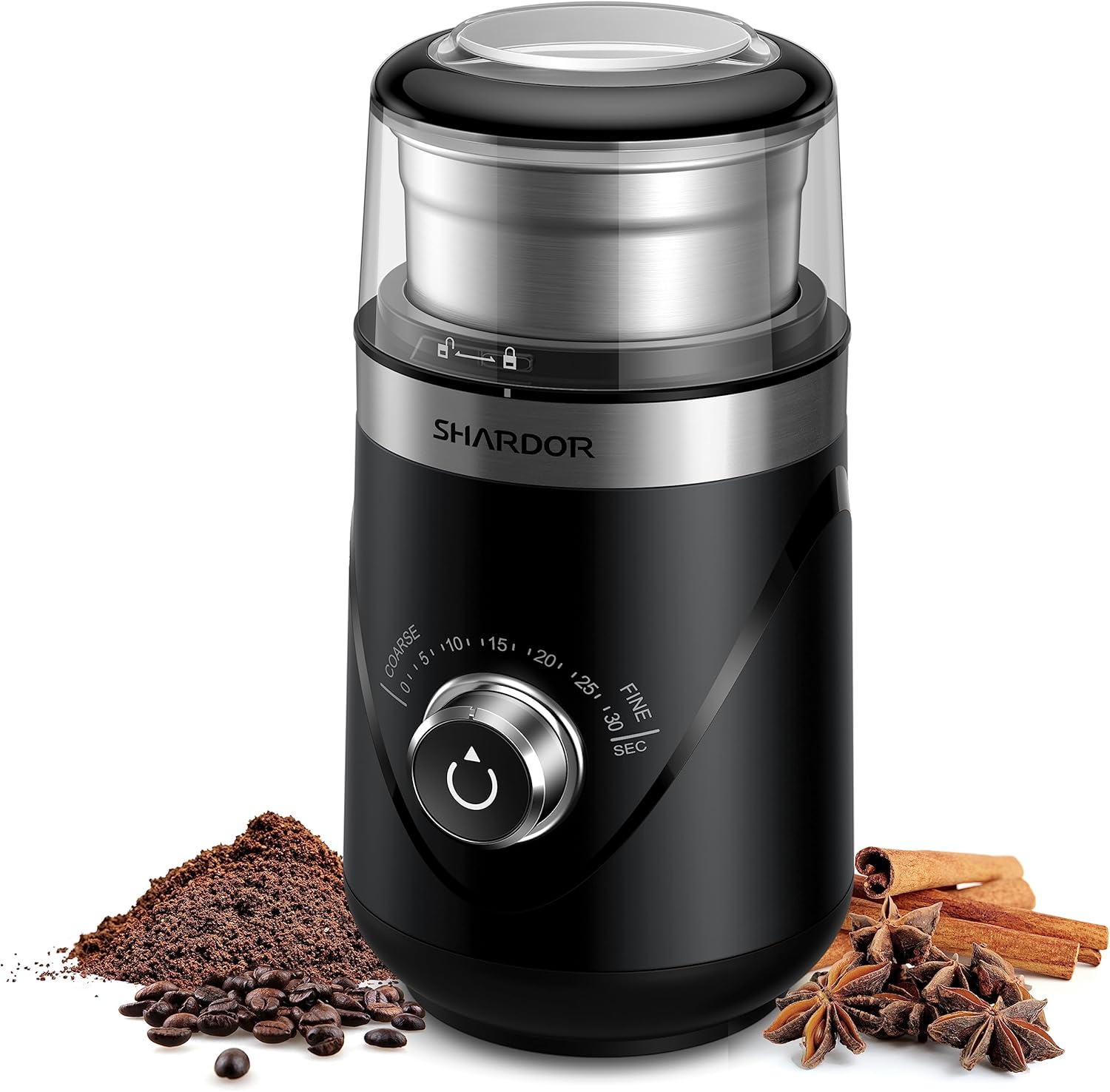
SHARDOR CG638B
- 150 W motor
- 2.5 oz removable bowl
- Rotary timer dial
- Claimed 63 dB operation
- Two-blade steel cup
- Dry coffee and spices

SHARDOR CG639B
- Electronic +/- timer
- Remembers last duration
- 2.5 oz steel cup
- 63 dB advertised
- Dry coffee and spices
- Removable cup access

SHARDOR OK2075
- Press-and-release control
- Removable steel bowl
- About 75 g capacity
- 60 dB advertised
- Dry spices and coffee
- Single-cup attachment
The five linked SHARDOR choices cover different household priorities: the CG638B Super Silent rotary model, the CG639B with electronic time memory, the OK2075 One Touch, the slim CG-618, and the SP7437 with dry and wet bowls. All five use blade mechanisms. Their most meaningful differences are activation, removable-bowl convenience, kitchen versatility, published noise figures, power requirements and how easy the workflow is to repeat.
For a daily coffee setup, I prioritize a grinder that matches the amount of coffee prepared, is easy to empty without making a mess and does not tempt the owner to confuse longer grinding with precision. Noise claims are worth considering but need context: an advertised decibel figure is not a promise of silence in every kitchen. A removable bowl is often more valuable than an elaborate name because it makes transferring grounds and cleaning around the blade much simpler.
Below, I rank the five products by practical usefulness rather than inventing a measured taste contest. The comparison identifies the intended uses and the limits of each design, while the buying guide explains how to brew better with a blade grinder and when a burr grinder is worth the upgrade. The product details distinguish dry-grinding appliances from a genuinely wet-capable, two-bowl attachment system.
Readers who also want the difference in brewing precision can explore our drip-coffee grinder guide. For now, the essential point is that a blade grinder is a compact convenience tool, while a burr grinder is an adjustable grind-size tool.
Best SHARDOR Blade Coffee Grinders at a Glance


Quick Ranking: Which SHARDOR Blade Grinder Fits Your Kitchen?
| Rank | SHARDOR model | Control | Bowl package | Best use | Key limitation |
|---|---|---|---|---|---|
| 1 | SHARDOR CG638B | Rotary timer | 1 removable cup | Best Overall | Time is not calibrated grind size |
| 2 | SHARDOR CG639B | Electronic time memory | 1 removable cup | Best Timer Memory | Timer does not set particle size |
| 3 | SHARDOR OK2075 | Press to run | 1 removable cup | Best One-Touch | Timing depends on operator |
| 4 | SHARDOR CG-618 | Press-lid | 1 removable cup | Best Compact Value | No timer memory or preset |
| 5 | SHARDOR SP7437 | Wet/dry bowl controls | 2 removable bowls | Best Wet and Dry | Extra pieces to store and clean |
1. SHARDOR CG638B Super Silent Blade Coffee Grinder — Best Overall
Best for: A useful balance of quiet-oriented design, timed texture control and compact removable-cup cleanup for early-morning coffee.
What the rotary dial changes
The CG638B is most persuasive when its timer is treated as a convenience rather than as a true fineness selector. Two people can set the dial to the same number and still produce different-looking grounds if one uses 15 grams and the other fills most of the bowl. Keeping dose size constant helps the same time setting behave more predictably. That is especially useful before work when the priority is a familiar cup without resetting a complicated menu.
Quiet-minded design without unrealistic silence
SHARDOR markets this model as Super Silent and cites roughly 63 dB operation. That is a useful feature claim, but it does not mean the motor disappears acoustically. A kitchen with tile walls may amplify the sharp sound of beans striking steel, and a larger load may alter the tone. I favor shorter completed cycles rather than unnecessarily long grinding, as much for the coffee as for the duration of noise. It remains an electric blade appliance and should be expected to make a noticeable sound.
Why the removable cup is more important than it looks
A removable bowl makes an everyday difference because the grounds can be poured directly into a filter rather than scooped around a blade inside a fixed chamber. It also exposes the inner surfaces for careful cleaning and reduces the risk of tipping an entire motor assembly over a narrow dripper. Blade edges remain sharp even with the motor unplugged. Remove residual coffee using a soft brush or appropriate cloth before lifting the cup away for any washing permitted by the instructions.
Drip and immersion coffee are the realistic targets
The best use is fresh grounds for an ordinary drip machine, immersion brewer or casual French press. A rotating blade can create fine powder before every bean has reached the desired larger size. Those fines may slow paper-filter drawdown or add sediment to French press. Use small batches and stop once the coarse fraction is adequately broken down; extending the time in search of uniformity generally grinds the already-small pieces finer. A dedicated burr grinder is a more dependable upgrade for clarity-oriented recipes.
Capacity is a ceiling, not a recommended batch
The 2.5 oz bowl capacity makes this model flexible enough to process more than a single serving, but maximum capacity is not automatically the best operating dose. When the chamber is crowded, circulation around the blade can become uneven. A moderate measured dose makes it easier to see what is happening, and it leaves room for the beans to move. Dividing an unusually large batch may improve handling, provided each run stays within the operating limits and cooling guidance in the instructions.
The household this SHARDOR best serves
The CG638B fits a household brewing one or two straightforward coffee recipes, especially when several people prefer the convenience of a dial to a press-and-hold lid. It is also useful when the coffee grinder occasionally tackles dry pantry ingredients in a separate cup. It is not the best path for nonpressurized espresso baskets, which demand fine particle control that a rotating blade cannot deliver. That limitation is mechanical, not a criticism of the accessible price category.
SHARDOR CG638B Super Silent Blade Coffee Grinder
Electric blade • rotary timer • 1 removable bowl
Model: CG638B
Mechanism: Stainless steel rotating blade
Capacity: 2.5 oz / about 71 g
Control: Rotary timed dial
Motor: 150 W / 120 V
Noise: 63 dB advertised
Pros
- Timed dial is easy to read
- Removable stainless cup
- Compact for a small kitchen
- Designed for lower-noise use
Cons
- Time is not calibrated grind size
- Uneven particles versus burrs
- Still audible during operation
Technical Specifications & Daily Features
The CG638B is a blade machine: its stainless steel blades spin inside a removable bowl, and a rotary control sets how long the motor runs. The grinder has a 150 W electrical rating and a stated capacity of 2.5 oz, approximately 71 g of beans. The published quiet-operation figure is around 63 dB; the actual noise level depends on room acoustics, the load, and how it is measured.
Unlike an adjustable burr mill, the rotary marks cannot move two grinding surfaces closer together. A longer timed cycle generally makes a greater proportion of the beans smaller, yet fine dust and larger fragments may coexist. The cup is useful for emptying grounds and for access to the blades. Never reach into the cup while it is attached to an energized base.
Pros & Cons After 30 Days of Use
The strongest long-term benefit is control over the amount of time a batch spends in the blade chamber. Repeating a weighed bean dose and a saved timer position creates a more predictable routine than grinding for an arbitrary number of seconds. It does not make the resulting particles uniform, so use the visual texture and brewed taste to correct the routine.
The principal cleaning consideration is oil and fine dust gathering beneath the blade. Unplug before removing the cup; wash only components the model instructions identify as washable and dry them fully before reassembly. If grinding fragrant spices, keep a dedicated bowl for coffee where possible because odors can cling to small joints and lids.
My Final Verdict
The CG638B is my overall SHARDOR blade recommendation for someone who wants a small grinder with clear timed control and a quieter-oriented design. Its removable cup is practical for daily coffee, while the blade mechanism makes it a poor match for precision espresso or delicate single-origin pour-over.
Daily Setup, Cleaning, and Ownership
Begin with a small measured batch and choose a short, manufacturer-permitted timer setting. Inspect the powder when the motor stops; adjust the next run gently rather than assuming the darkest or finest appearance means better extraction. For French press, avoid chasing exceptionally coarse particles with long blade cycles.
The removable bowl is the cleaning advantage, but the motor stays dry at all times. After unplugging, brush or wipe stray powder from around the rim and blade hub. Let every washed component dry before returning it to the appliance; do not touch the blade until movement has fully stopped.
2. SHARDOR CG639B Blade Grinder with Time-Memory Control — Best Timer Memory
Best for: Best for the coffee drinker who repeats a familiar dose and appreciates electronic time memory without paying for burr-grinder complexity.
A genuine reason to choose electronic memory
CG639B offers a useful difference from the other four machines: it remembers a previously selected grind duration. For a household grinding the same 20-gram dose for a familiar brewer, that removes a small daily decision. It also makes the workflow easier for a second person who needs the same cup without remembering a particular counting rhythm. The advantage disappears when the dose changes dramatically, because the stored time does not understand how many beans are inside the bowl.
Time control and grind size are not synonyms
This is an important distinction in a category full of vague claims. CG639B controls how long a blade spins, but does not use matched burrs to pass beans through a fixed gap. A longer time creates a finer overall mixture, with a variety of particle sizes remaining. That is manageable for ordinary drip and immersion brewing, where minor particle variation is less unforgiving than in a pressurized espresso puck. It is not a substitute for a conical or flat burr espresso grinder.
Preparing a reliable repeat dose
An uncomplicated method is to weigh one intended coffee portion, choose a starting grinding duration and compare the next brewed cup. Keep the water, brew ratio, and coffee quantity the same while adjusting time. Once the flavor suits the brewer, saving that duration makes daily preparation easy. When the bag becomes noticeably older, or when the roast changes, adjust deliberately. The goal is a familiar drinking result, not a promise that equal time produces identical ground particle distributions.
Cleaning a grinder that handles both coffee and seasoning
The removable steel cup is valuable because lingering coffee oils, pepper dust, and aromatic spices can be cleaned from an accessible surface. If coffee freshness matters, a separate cup or separate appliance for pungent ingredients remains the simplest way to prevent flavor transfer. Washability applies only to components approved by the instructions. The inner blade hub deserves attention because powder can collect around its base, yet blade edges require careful handling even after the power is disconnected.
Why noise figures need context
SHARDOR describes the CG639B as a quieter appliance, with a published figure around 63 dB. A sound level measured under one set of conditions should not be interpreted as a guarantee in a different kitchen. Vibration through a thin countertop, the amount of beans loaded and the room itself change perceived loudness. The sensible recommendation is to consider the quieter-oriented feature alongside short operating cycles, not to promise that it can run without disturbing a sleeping person.
When this model is the sensible premium blade choice
CG639B works for someone committed to blade grinding because of its low cost, simplicity and small profile, but who still likes a measured daily workflow. Its memory panel makes it easier to repeat the same duration than a manually held lid. Coffee drinkers who change methods frequently or demand narrow particle sizes get more practical value from an adjustable burr mill. Paying for time memory is worthwhile only if time memory is genuinely used.
SHARDOR CG639B Blade Grinder with Time-Memory Control
Electric blade • electronic timer • memory setting
Model: CG639B
Mechanism: Stainless steel blade
Capacity: 2.5 oz / about 71 g
Control: +/- seconds and on/off
Memory: Last time setting
Noise: About 63 dB advertised
Pros
- Last-time memory simplifies routine
- Electronic time adjustment
- Removable steel cup
- Suitable for dry pantry ingredients
Cons
- Timer does not set particle size
- No true burr precision
- Needs cleaning after spices
Technical Specifications & Daily Features
The CG639B uses stainless-steel chopping blades inside a detachable bowl, with plus and minus time controls and an electronic memory function. It recalls the last selected grind duration, which can save a small daily adjustment for people who use the same bean dose. Capacity is stated around 2.5 oz and the manufacturer advertises approximately 63 dB operation.
Its programming changes operating duration, not the position of a burr gap. A display showing twenty-five seconds should not be mistaken for a measured grind-size setting or weight-based dosing system. For each batch, a scale and an appropriate brew recipe still supply the consistency that the appliance itself cannot guarantee.
Pros & Cons After 30 Days of Use
With identical beans and similar loads, remembering a preferred grind duration reduces the effort of repeating a morning routine. The important qualifier is that coffee properties and dose size change the speed at which a blade creates powder. Recheck texture after switching to a lighter, denser roast rather than keeping one duration forever.
The electronic controls add a convenience feature and a possible maintenance vulnerability compared with a simple push lid. Keep moisture away from the display and motor housing. Remove the cup only when unplugged and stopped, and clean the surfaces intended for washing rather than immersing any part of the powered base.
My Final Verdict
Choose CG639B for its practical memory control if the same coffee and serving size are used frequently. It gives a more repeatable timed workflow than a basic press-lid grinder but remains a blade machine that cannot finely calibrate espresso extraction.
Daily Setup, Cleaning, and Ownership
Use the same dose with the stored duration for a week of similar beans, checking texture when opening a fresh bag. Do not attempt to compensate for a poor brew by increasing time and dose simultaneously. Use one brewing change at a time so the effect is understandable.
Unplug the appliance before removing the bowl, inspect the rim for stuck powder, and never rinse or wipe the powered control panel with dripping water. Keep a dry brush close to the grinder for ordinary coffee residue and follow the approved cleaning instructions for the detachable cup.
3. SHARDOR OK2075 One-Touch Blade Grinder — Best One-Touch
Best for: The simplest tactile workflow: press to start, release to stop, then lift out the stainless bowl for easier pouring and cleaning.
Controls that almost explain themselves
Some appliances make a simple job feel like programming a small computer. OK2075 avoids that problem. Fill the steel cup to a sensible level, seat it correctly, press the activation control and stop as soon as the coffee reaches the desired approximate texture. The absence of menus makes it especially suitable for a student apartment, office kitchen or holiday home where several people may use the grinder without much instruction. The same simplicity also means that the user must pay attention to time.
How one-touch grinding affects consistency
For two brews to taste reasonably similar, the amount of coffee, the beans and the grinding duration should remain close. OK2075 does not store these variables. A few short pulses or one continuous hold can produce different textures, particularly as the beans fracture and the smaller pieces are cut repeatedly. Measuring a dose and noting a useful duration can improve the habit. There is still no way to force all the particles through an identical opening, which remains the fundamental advantage of burr grinding.
The detachable bowl keeps cleanup manageable
Being able to lift out the small steel cup makes transfer less messy than scooping around a stationary blade. It is also helpful after aromatic ingredients, such as cumin or coriander, where the best cleaning involves reaching the cup away from the electrical base. The published listing describes the detachable bowl as dishwasher safe. Follow the product instructions for the exact variant and dry the cup completely before reconnecting it; a damp contact surface is not suitable for an electrical appliance.
What the quiet-operation promise means
The one-touch model carries a marketed operating figure around 60 dB, but published noise figures often rely on particular measurement distances and conditions. Beans hitting steel can create a higher-pitched sound that does not show in a simple number. This is a machine intended to be relatively unobtrusive for its category, not a silent motor. Placing it on a firm, stable counter, using sensible amounts and avoiding unnecessarily long grinding are practical ways to make a morning routine less disruptive.
A small coffee dose versus a filled bowl
The approximately 75 g stated capacity is larger than most single cups require. Grinding the full amount each time is unnecessary for freshness, and a crowded chamber may allow some beans to linger farther from the blade. Begin with only the dose needed for brewing and watch for uneven pieces. For one-cup filter brewing, that generally means a modest fraction of the maximum bowl capacity. The appliance is flexible enough to take a larger batch when necessary, within its instructions.
Where OK2075 fits among the five
This grinder earns its place for the owner who cares most about simplicity. CG638B offers a rotary dial, CG639B offers electronic time memory and SP7437 has two different bowls for kitchen tasks. OK2075 removes almost all those extra decisions. It serves casual coffee made in a drip machine or immersion brewer; it should not be sold as a calibrated precision espresso tool. A dedicated burr grinder is the better purchase when predictable particle size becomes the main goal.
SHARDOR OK2075 One-Touch Blade Grinder
Electric blade • press-to-grind • removable steel cup
Model: OK2075
Mechanism: Stainless steel rotating blade
Capacity: About 75 g stated
Control: Press to start, release to stop
Bowl: Single detachable cup
Noise: 60 dB advertised
Pros
- No menu to learn
- Removable dishwasher-rated cup
- Easy batch visibility
- Useful for coffee and dry spices
Cons
- Timing depends on operator
- No precise grind size settings
- One dry bowl included
Technical Specifications & Daily Features
The OK2075 is a straightforward press-to-start blade grinder. Keep the activation control depressed to run the motor, then release it to stop. The removable stainless-steel bowl is designed for easy transfer and cleaning, and the linked package is a one-bowl dry-grinding version. Published specifications place capacity around 75 g and advertise approximately 60 dB operation.
As with all blade grinders, grind texture is controlled indirectly through duration and technique rather than by setting a burr gap. There is no programmable dosage scale, no stepless espresso collar and no meaningful fixed number of grind settings. That simplicity is the central attraction for a household that wants fresh beans ground quickly with minimal appliance controls.
Pros & Cons After 30 Days of Use
The one-touch design is easy to hand to a new coffee drinker, but it makes consistency more dependent on the operator. A small scale and a written approximate pressing duration help two people produce similar results from the same beans. For fine brewing, some powder will remain alongside larger particles despite careful operation.
The removable cup is promoted as dishwasher safe, although the current instructions for the exact variant should govern cleaning. The grinder base, wiring and switch must never be immersed. Coffee and strong spices can share a machine only with thorough cleaning or preferably a separate compatible cup, since aromatics may linger.
My Final Verdict
OK2075 is the most approachable blade-grinder choice in this set. Buy it for uncomplicated press-to-grind coffee, a removable cup and modest countertop demands; buyers seeking programmed repeats should choose CG639B, and those seeking espresso precision need a burr system.
Daily Setup, Cleaning, and Ownership
Choose a small dose, hold the control for short intervals and stop to inspect the grounds with the lid secured while the motor runs. Keep fingers and utensils away from the bowl until the appliance is unplugged. Find a workable rhythm for the normal brew rather than assuming every coffee needs the same time.
Empty the cup after each use and clean it following the exact instruction manual. The single-bowl package is intended for dry grinding. Do not try to turn it into a wet chopper by adding liquids or thick mixtures to the steel cup.
4. SHARDOR CG-618 Compact 200 W Blade Coffee Grinder — Best Compact Value
Best for: A narrow classic blade grinder with a removable cup, a 200 W motor and no complicated electronic programming.
A classic compact grinder without complicated controls
CG-618 is the easiest to understand visually: a slim motor body, a removable steel container and a press-operated lid. That combination has remained useful because grinding a small amount of coffee is fundamentally a brief kitchen task. The design avoids electronic menus, saved preferences and expensive accessories. For a household that grinds ordinary beans only when making a pot, those omissions are not major drawbacks. For someone who changes brew styles every morning, the absence of marked fineness control becomes more noticeable.
What the 200 W rating does—and does not—say
The linked machine is rated at 200 W, a numerical detail worth reporting accurately. It is not proof of higher cup quality or better burr geometry, since this grinder has no burrs. Motor output and blade speed influence how quickly beans break apart, but the final mixture still includes a spread of sizes. Grinding longer tends to increase fines along with breaking the remaining coarse pieces. Good coffee requires stopping at a reasonable point rather than maximizing the duration just because the motor is powerful.
Why removable cups matter for daily coffee
A fixed blade chamber often forces the user to tilt the entire machine to pour grounds, sometimes bringing the power cord uncomfortably close to the brewing station. The detachable cup allows grounds to be transferred separately from the motor. It also makes careful cleaning more accessible after oily coffee or strong spices. Brush around the blade base gently and avoid scraping with hard metal objects. Always disconnect power before removing the cup and dry it thoroughly after any permitted washing.
Taste expectations for brewed coffee
Coffee ground in a blade grinder can brew a pleasant cup when beans are fresh and the recipe is forgiving. Drip brewers and immersion methods usually tolerate particle variation better than espresso. Expect a mixture of smaller and larger pieces, especially when aiming for coarse French press. Smaller fragments can create extra sediment or bitterness if the brew time is long. Start with a simple dose and adjust the brewing method instead of claiming the grinder has a precise medium-coarse setting.
When the small dimensions are the real advantage
The CG-618 body is notably slim compared with a full hopper-fed burr grinder. That matters in a dorm, a small rental kitchen or a coffee station that shares space with a kettle and toaster. There is no large bean hopper to leave filled and little reason to keep the grinder permanently displayed. The trade-off is batch-by-batch handling and a relatively simple lid control. For casual daily brewing, many buyers will prefer that compromise to an appliance that monopolizes valuable counter space.
How it differs from OK2075
Both are uncomplicated removable-cup blade grinders. CG-618 stands out for its traditional narrow form and 200 W electrical rating; OK2075 is the newer one-touch-oriented design with a published lower-noise claim. Neither can finely dial nonpressurized espresso, and neither measures output by weight. The best match depends on the preferred activation style, kitchen dimensions and accessory availability. I put CG-618 just behind the one-touch model for its compact footprint and essential features.
SHARDOR CG-618 Compact 200 W Blade Coffee Grinder
Electric blade • 200 W • press-lid operation
Model: CG-618 / CG-618-UL
Mechanism: Stainless steel blade
Capacity: 2.5 oz / about 71 g
Motor: 200 W
Control: Press lid to operate
Voltage: 110–120 V product versions
Pros
- Very simple lid-operated routine
- Compact narrow body
- Removable 2.5 oz cup
- 200 W rated motor
Cons
- No timer memory or preset
- Uneven particles versus burr
- Motor base cannot be washed
Technical Specifications & Daily Features
The CG-618 is a conventional small electric blade grinder with a 200 W-rated motor and a detachable 2.5 oz stainless-steel cup. It runs with press-lid operation instead of an advanced timer. The product is meant for dry coffee, seeds, herbs and spices; none of those uses turns it into a precision coffee burr grinder.
Capacity and motor wattage describe the appliance, not its grind uniformity. A higher wattage figure does not mean the grounds are automatically more evenly sized than those from a smaller blade appliance. The best daily fit is convenient fresh grinding for normal home coffee, with the expectation that brewing adjustments will be coarser than on a dedicated burr machine.
Pros & Cons After 30 Days of Use
The narrow body works well for someone who puts the grinder back in a cabinet after every use. Because there is no electronic time memory, repeating a familiar cup depends on weighing the beans and keeping the pressing duration reasonably similar. A slightly varied grind may be acceptable for drip and immersion brewing, while tightly controlled espresso extraction is not a sensible primary use.
The stainless cup lifts away for pouring and cleaning. Keep the motor base out of water, wait for the blade to stop, and handle the hub with care. An old blade machine may run for years with sensible maintenance, but claims about motor lifespan or measured performance cannot be established merely from the electrical rating.
My Final Verdict
CG-618 is the value-oriented compact option for traditional drip and French press routines. It does not provide the precision of the electronic timer models, but its removable cup and straightforward operation are clear benefits for buyers seeking an uncomplicated kitchen tool.
Daily Setup, Cleaning, and Ownership
Use this grinder for a measured daily dose and short, deliberate runs. Avoid filling the chamber to its capacity when only a single mug is needed. A simple written record of dose and approximate run time gives greater repeatability than relying on the visual appearance alone.
Empty the detachable cup carefully and brush out the blade hub after use. If the appliance is needed for both spices and coffee, clean thoroughly between ingredients or keep a dedicated cup to prevent flavor transfer. Never rinse the motor housing or operate with a loose lid.
5. SHARDOR SP7437 Two-Bowl Wet and Dry Blade Grinder — Best Wet and Dry
Best for: The only linked model designed for distinct wet and dry kitchen tasks, with separate two-blade and four-blade bowls.
Two bowls change what the machine is for
SP7437 is not just another coffee blade grinder with a different badge. The linked kit includes separate grinding cups, one designed with two blades for dry ingredients and one with four blades for certain wet foods. A home cook can use the dry container for whole beans or spices and keep the wet container for small garlic or herb mixtures. That separation is the feature worth paying for. It is more meaningful than claiming a blade machine somehow creates the uniformity of a burr grinder.
Coffee preparation still uses the dry bowl
The dry two-blade cup behaves like other rotating-blade coffee grinders. It chops beans for as long as the motor runs, meaning the texture remains a mixture rather than a uniformly sized grind selected by a dial. Drip and immersion methods are the most realistic targets. Resist the temptation to add water or coffee syrup into the dry grinding cup in an attempt to create a beverage mixture. Liquid belongs only in the appropriate attachment if the instructions explicitly approve that use.
Wet ingredients need controlled quantities
Small wet grinding accessories can be useful for a modest spoonful of garlic, ginger or pesto-style ingredients. They are not suitable for filling to the brim with sauce or pushing through hard items beyond the machine instructions. Leave room for ingredients to circulate and check that the anti-splash lid is assembled correctly. A short controlled run is easier to manage than an extended continuous cycle when processing soft herbs. A full food processor remains better for large recipes that need broad, even chopping.
How the two-cup system can reduce flavor transfer
Coffee picks up aromas easily. The concern with a single cup used for both cinnamon and oily garlic is not simply visible residue but lingering fragrance caught around a gasket, blade hub or lid. SP7437 allows stronger wet flavors to remain in a separate attachment, making it a better culinary companion than a one-bowl grinder. Still clean both containers after use, especially before ingredients dry on the surfaces. The motor coupling and any non-washable parts should never be submerged.
Countertop and storage considerations
This machine replaces a second small kitchen gadget only when the cooking use is frequent enough to justify it. Two bowls and lids take cabinet space and require organization, while the base remains reasonably compact. A person who makes coffee exclusively receives little advantage from the wet attachment, and the extra cup may end up unused. A home cook with limited storage, by contrast, may appreciate combining several very small tasks into one powered base. It is a lifestyle selection more than a coffee-quality selection.
Who should avoid the wet/dry model
Someone brewing fine espresso daily should avoid choosing SP7437 for the sake of additional bowls. Wet chopping and espresso particle control are completely different tasks. Likewise, the grinder is unnecessary for a coffee drinker who already owns a reliable mini chopper and only wants fresh beans ground for a press. Its appeal is practical versatility, separate cups and easier transfers—not a promise of superior extraction. The two-cup design is most convincing when both coffee and food preparation are part of the normal week.
SHARDOR SP7437 Two-Bowl Wet and Dry Blade Grinder
Electric blade • 2 bowls • separate wet/dry uses
Model: SP7437
Mechanism: Two-blade dry / four-blade wet
Bowls: Two removable steel bowls
Control: Lid-controlled electric motor
Uses: Coffee, spices, wet prep
Safety: Cup and lid interlocks
Pros
- Separate wet and dry bowls
- Better kitchen versatility
- Detachable cup cleanup
- Useful for small sauce batches
Cons
- Extra pieces to store and clean
- Wet bowl is not for coffee grinding
- Cannot produce burr-style grind control
Technical Specifications & Daily Features
SP7437 is a wet-and-dry kitchen appliance supplied with two removable stainless-steel bowls. The two-blade bowl is intended for dry coffee and spices, while a separate four-blade bowl is intended for certain wet ingredients such as garlic, ginger or pesto-style mixtures. The package also includes lid components intended to limit splashing. This arrangement distinguishes it clearly from the other four dry-focused blade grinders.
Use the bowls as directed, not interchangeably. Wet ingredients belong only in the wet-capable bowl and quantities must remain within the marked limits. The motor housing is still an electrical appliance and must remain dry. For coffee, the dry bowl chops beans using a blade rather than controlling their grind size through an adjustable burr gap.
Pros & Cons After 30 Days of Use
A two-bowl system helps avoid transferring fresh garlic aroma directly into a coffee dose. That is a major practical benefit for someone who genuinely uses the appliance in food preparation. However, the extra attachments create more items to wash, dry and store, and a small blade grinder is not equivalent to a full-sized food processor.
The wet bowl requires particular care around seals, inner lids and the blade hub. Wash only approved removable components and dry completely. Persistent strong food flavors may still require separate cleaning tools. The best case for SP7437 is saving one appliance slot in a tiny kitchen without misleading buyers that wet chopping improves the quality or precision of coffee grinding.
My Final Verdict
Choose SP7437 when dry coffee grinding is only one of several kitchen tasks. Its separate wet and dry cups are useful for herbs and small preparation jobs, but the additional bowls and cleaning effort are unnecessary for someone who simply grinds coffee every morning.
Daily Setup, Cleaning, and Ownership
Use the two-blade container for beans and other dry ingredients and the designated four-blade attachment only for approved wet food tasks. Seat all lids and safety parts correctly and never bypass an interlock to operate with an exposed blade.
Separate cleaning tools for strong spices and wet foods can keep coffee flavors clearer. Clean the removable bowls as permitted, inspect lid seals for residue and let every detachable component dry fully before placing it back onto the powered base.
Final Comparison: Controls, Capacity, and Kitchen Versatility
| Grinder | Blade / bowl | Control | Capacity | Motor | Best daily reason |
|---|---|---|---|---|---|
| SHARDOR CG638B | 2-blade removable cup | Rotary time dial | 2.5 oz | 150 W | Quiet-oriented, timed coffee |
| SHARDOR CG639B | Removable stainless blade cup | Electronic +/- and memory | 2.5 oz | See exact model label | Repeat a saved duration |
| SHARDOR OK2075 | 1 removable dry-grinding cup | One-touch press/release | Approx. 75 g | See exact model label | Simple press-to-grind |
| SHARDOR CG-618 | 1 removable stainless blade cup | Press-lid | 2.5 oz | 200 W | Compact basic value |
| SHARDOR SP7437 | Dry 2-blade / wet 4-blade bowls | Lid-control operation | Follow each bowl fill line | See exact model label | Coffee plus wet kitchen prep |
SHARDOR Blade Grinder Buying Guide: 20 Decisions That Matter
1. Understand what blades can and cannot control
A rotating blade cuts beans through repeated contact while the motor runs. As the coffee breaks into smaller fragments, some pieces encounter the blade more often than others. The result is usually a mixture that contains fine powder and coarser particles. A longer run changes the distribution but cannot select one uniform size. That distinction matters more than the appearance of a particular grinder body or timer dial.
For drip and immersion coffee, the distribution can still support an enjoyable cup if the brewing method is forgiving. For a nonpressurized espresso basket, a narrow and adjustable particle distribution becomes far more important. Buy a blade grinder because its simplicity, size and price suit the coffee routine, not because it promises the same control as a true burr system.
2. Match a SHARDOR blade model to your control preference
Some people enjoy a physical rotary dial with visible time markings. CG638B serves them well. Others repeatedly prepare the same measured portion and value the CG639B electronic memory. OK2075 and CG-618 focus on simpler press-to-run operation. SP7437 offers a different advantage: two containers serving dry coffee and selected wet food preparation.
The choice is not a hierarchy of coffee extraction performance, since every linked product uses blades. Decide whether controlling time with a dial, storing a duration in memory, pressing a lid or avoiding a separate kitchen chopper will genuinely help. Features that are never used only add complication or cleaning work.
3. Choose a sensible dose instead of always filling the cup
A blade grinder needs room for beans to move toward the cutting edges. A bowl filled to its maximum line is not necessarily the best load for uniform chopping. A modest measured batch makes it easier to assess the outcome and avoid repeatedly grinding only the beans nearest the blade. This is especially useful for single-cup brewers.
Use a digital kitchen scale if available. The daily dose is set by the coffee-to-water ratio rather than by the grinder capacity. A cup that can hold about seventy grams need not be filled with seventy grams every morning. The bowl rating sets a limit; the brew recipe sets the amount you actually need.
4. Use short, controlled grinding periods
A single continuous run is simple, but it can create considerable fine powder while some larger fragments remain. Working in short, manufacturer-permitted bursts lets the user stop, examine the texture and avoid overgrinding the entire dose. Follow the model’s lid interlock and operating instructions at all times.
Never open the lid or handle the cup while the motor is running, and do not defeat safety switches. If the instructions permit shaking or redistributing the coffee, do it only with the appliance stopped and safely secured. The objective is a predictable workflow and safer handling, not maximum grinding speed.
5. Know why a blade grinder is not an espresso adjustment tool
Espresso made with a nonpressurized basket depends on the ground coffee creating appropriate resistance to pressurized water. A burr grinder can change the particle size through small, repeatable adjustments. A blade grinder instead changes total cutting time and creates a wide distribution that can lead to channels or inconsistent resistance.
Some pressurized home-machine baskets tolerate less uniform grounds, but that does not make a blade grinder a precision espresso product. Anyone upgrading to a single-wall basket should budget for a genuine espresso-capable burr grinder. Spending time on a fine-looking blade powder seldom fixes the underlying limitation.
6. Make the most of a paper-filter drip brewer
For an ordinary drip machine, a measured dose and a sensible brewing ratio matter more than a dramatic claim about blade speed. Grind enough to expose fresh aroma without reducing every particle to dust. Very fine powder may slow the water and produce a harsher cup, especially if the filter is small or the brewer has a long contact time.
If the brew tastes muddy, do not immediately grind longer. Change one variable at a time: reduce duration, measure the dose or adjust water ratio. A clear paper filter can catch much of the fine sediment but cannot completely cancel the effects of uneven extraction. For a more controlled upgrade, explore a genuine burr grinder.
7. Adapt technique for French press
French press uses immersion brewing and retains oils and some small particles in the cup. A blade grinder can make a workable press brew, but the mixed particle sizes tend to include fines that pass through the metal mesh. Grinding excessively in pursuit of a uniformly coarse look usually makes that issue worse.
Use a moderate run, allow the brew to settle, and pour slowly without agitating the sludge. Consider decanting the prepared coffee rather than leaving it in contact with the grounds for an extended period. If a very clear French press is the primary goal, a coarse-capable burr grinder becomes a more meaningful purchase.
8. Evaluate pour-over consistency realistically
A narrow pour-over filter creates a sensitive flow path. Fine powder may settle into the paper and slow drawdown, while oversized pieces extract more slowly than smaller particles. Blade grinders therefore tend to be less predictable for delicate V60-style recipes than burr grinders, even when a few cups turn out very well.
Use the same dose, kettle technique and water temperature while learning the limits of a particular blade grinder. If brews swing between thin and overextracted without other changes, grinding uniformity may be the problem. A properly adjusted burr grinder is a practical solution rather than another attempt to perfect a fixed chopping duration.
9. Avoid confusing timers with grind settings
CG638B has a rotary time dial, while CG639B includes electronic duration memory. Neither moves burrs or selects a discrete physical grind gap. A ten-second setting on one machine also cannot be transferred to another as if the time were a universal recipe. Load, roast and motor behavior all influence the result.
I recommend writing recipes in terms of grams of coffee, water amount and approximate grinding duration. Timer convenience is useful, especially when repeating the same batch, but treat the final appearance and flavor as feedback. Do not interpret an electronic display as a built-in weighing scale.
10. Consider published noise figures carefully
SHARDOR advertises lower-noise operation on several linked models, including figures around 60 or 63 dB. Those numbers may depend on test distance, background noise, bean load and the surface supporting the appliance. The sharp sound of beans hitting a blade may also be perceived differently from a motor tone measured by a sound meter.
A quiet-oriented design is a reasonable reason to shortlist a model, but it is not proof that grinding before sunrise will never wake anyone. Keep the appliance on a stable counter, avoid an overloaded bowl and complete the dose efficiently. If silence is the central priority, a hand grinder is a separate category worth considering.
11. Decide whether a removable cup matters
All five linked selections have a removable grinding cup or bowls, a useful advantage over fixed-cup blade models. A detachable container makes it easier to pour directly into a filter, rinse approved parts and inspect the blade hub for trapped powder. It also helps when the coffee area is distant from the wall socket.
The motor base remains an electrical component and must not be submerged. Dishwasher-safe language may apply to an accessory but not to its wiring, switch or motor. Always consult the exact model’s instructions before putting a component into water, particularly if a different finish or cup version is supplied.
12. Keep strong spices separate from coffee
Coffee oils and strong spice aromatics can remain around seals, blade joints and lids. A grinder that has recently processed cumin, cloves or garlic may carry traces of those flavors into a subtle cup of coffee. This is not a criticism of any particular model; it is a practical consequence of using one small appliance for several aromatic ingredients.
Where possible, use separate compatible bowls for savory preparations and coffee. SP7437 comes with distinct dry and wet attachments, helping divide tasks by ingredient type. For a one-bowl grinder, thorough cleaning between uses is necessary, and dedicated equipment may be simpler when flavor purity matters.
13. Wet and dry grinding require different attachments
The SP7437 kit is designed around separate dry and wet bowls. The dry two-blade attachment handles coffee and related pantry items; the four-blade bowl handles certain wet recipes such as garlic and small herb pastes. The existence of a wet bowl does not make it acceptable to pour liquids into every SHARDOR grinder.
Use only the attachment and fill level specified by the exact instructions. Keep all lids and seals seated and avoid overfilling thick mixtures. A wet-capable grinder is useful for small preparation tasks, not a replacement for a powerful blender or food processor when making large recipes.
14. Use a scale even for quick weekday coffee
An inexpensive kitchen scale removes much more guesswork from brewing than an arbitrary count of scoops. Coffee beans vary in shape and density, so the same scoop can hold different masses. With a blade grinder, using a consistent bean weight also makes a timed grinding routine easier to compare from day to day.
A starting drip recipe such as 15 grams of coffee to 250 grams of water is easy to record and refine. Change one factor at a time until the cup tastes balanced. This keeps attention on the brew rather than making unfounded claims that a particular number of grinding seconds guarantees café-quality results.
15. Interpret wattage without assuming better flavor
The linked CG638B is rated at 150 W, while the classic CG-618 is rated at 200 W. These figures describe electrical characteristics, not the resulting size distribution of ground coffee. A higher number does not transform rotating blades into burrs or establish a quieter motor.
Compare wattage when considering electricity compatibility and the motor package, but rank coffee tools by practical controls, cleaning, capacity and intended brewing method. A small, thoughtfully used blade grinder can be more convenient than a larger one without promising superior extraction from its power label.
16. Protect the motor and blade safety interlocks
Blade grinders are compact, but their cutting surfaces spin at high speed. Never reach into a cup with the appliance plugged in, never defeat a lid safety switch, and never remove or replace a cup until the blades have stopped. Follow any specified rest intervals between long runs to avoid overheating.
A jammed appliance should be disconnected before inspection. Do not use metal utensils to dislodge material near moving parts. For SP7437, select the appropriate bowl and confirm it is correctly locked before starting. These safety basics protect the user and help avoid unnecessary damage to the motor coupling.
17. Clean coffee oils before they become stubborn
Fresh coffee leaves oils and fine powder on the bowl walls and around the blade hub. Dark roasted beans may leave more visible residue. A quick dry brush after use is often easier than letting deposits build up for weeks. Wash the approved removable cup when necessary and dry it thoroughly.
Never immerse the electrical base. Avoid improvised abrasive cleaning methods or running uncooked rice through a grinder as a universal maintenance trick; hard particles can stress components and are not a substitute for the product’s specific cleaning instructions. If an odor persists, separate coffee and spice bowls rather than masking the smell.
18. Plan storage for a small kitchen
CG-618 is the narrow classic choice, while the dial and electronic timer models use slightly different top controls and housings. Many small kitchens benefit from a grinder that can return to a cabinet rather than occupy a permanent station next to the kettle. Consider where the removable cup and lid will be stored.
SP7437 needs space for two bowls and the accompanying lids. That extra space is justified only when the wet-processing capability is regularly used. A one-cup appliance is less versatile, but it can be easier to keep organized when the kitchen is already full of accessories.
19. Know when a burr grinder is the better value
The benefit of a burr grinder is not merely price or premium styling. It is the ability to control the gap through which beans pass, producing a narrower and more repeatable particle-size distribution. That makes an especially clear difference for espresso, delicate pour-over recipes, and anyone who changes beans frequently.
For casual drip and immersion coffee, the blade models can offer a useful first step from pre-ground beans. When a household begins measuring shot yields or chasing a clear pour-over cup, spending on a genuine adjustable burr system is more likely to solve the problem than buying another blade grinder with a longer timer.
20. Make a decision that fits the actual routine
CG638B is my broadest recommendation for a small coffee-only station that values a rotary timer and quieter-oriented specification. CG639B is the better fit for time-memory users. OK2075 removes menus, CG-618 offers a classic 200 W narrow design, and SP7437 works for a household sharing one base between coffee and selected food tasks.
The five selections should be compared as convenience-oriented blade grinders, not ranked as if their timer designs establish laboratory grind uniformity. Choose the control and cleaning arrangement that will be used most often, keep expectations appropriate for the brewing method, and spend on a burr grinder when precision becomes essential.
Frequently Asked Questions About SHARDOR Blade Coffee Grinders
Which SHARDOR blade grinder is the best overall?
CG638B is my overall choice for a small daily coffee station because its removable steel bowl, rotary timer and quieter-oriented design balance convenience and predictable operation. CG639B is a stronger choice when remembering an exact grinding duration is important. All five are blade grinders; none replaces a precise burr system for espresso.
Are all five linked SHARDOR models really blade grinders?
Yes. The five linked products use spinning stainless-steel blades inside removable cups or bowls. They should be classified as blade appliances, not burr machines. The time dials change the number of seconds spent chopping beans and do not select a physical gap between burrs.
Does the CG638B have a burr mechanism?
No. The CG638B uses a two-blade stainless-steel cup, a 150 W motor and a rotary timer. It is useful for practical small-batch grinding, but it does not provide fine-position burr adjustment. It is unsuitable as a primary precision grinder for nonpressurized espresso.
What makes the CG639B different from CG638B?
CG639B has electronic plus and minus time controls and a memory function that recalls the last operating duration. CG638B uses a physical rotary timer dial. Both chop beans with blades and offer detachable cups, so neither makes one uniform grind size merely because its time controls are more sophisticated.
What is the easiest SHARDOR blade grinder to use?
OK2075 is an accessible choice because the operating instruction is simple: press to run and release to stop. It has a removable stainless cup and no complex menus. CG-618 is similarly straightforward, with a traditional press-lid design and a narrow body.
Can these grinders produce true espresso grounds?
They can make coffee look finely ground, but they cannot reliably produce the narrow particle-size distribution and precise adjustment required for a conventional nonpressurized espresso basket. A proper espresso-capable burr grinder is the more reliable choice. A pressurized basket can tolerate some variation, but that does not make the blade mechanism precise.
Is the SHARDOR Super Silent completely silent?
No. SHARDOR advertises a lower-noise design and around 63 dB operation for the linked CG638B. This is a published figure rather than a guarantee for every kitchen. Room surfaces, distance, beans and duration affect perceived loudness. Expect an audible electric grinder, even one marketed for quieter mornings.
How loud is the SHARDOR OK2075?
Its marketed operating figure is around 60 dB. That value should be interpreted in the context of a specific measurement method rather than treated as an absolute sound level in a different home. A stable counter and moderate batch size are useful practical considerations.
Does the CG639B timer weigh the coffee?
No. It controls motor duration and can recall the previous time setting. It does not measure grams or monitor brew extraction. Weigh the coffee separately and keep dose size steady if you want the stored duration to provide a more repeatable starting point.
How much coffee fits in the CG638B bowl?
The published capacity is about 2.5 ounces, roughly seventy-one grams. That is a capacity ceiling, not a recommendation to grind that full amount every time. For a single cup, weigh only the needed portion and leave room for beans to circulate inside the bowl.
How much does the OK2075 hold?
Its published removable-cup capacity is about 75 grams. Actual preferred batch size depends on brewing needs and the manufacturer’s operating instructions. For a 15–20 gram filter dose, use only the amount required rather than filling the entire cup.
What is the CG-618 motor rating?
The linked classic SHARDOR CG-618 blade grinder has a published 200 W motor specification and a 2.5 oz detachable cup. The power rating describes the electrical design; it does not establish higher grind uniformity or a burr-quality result.
Can I wash the removable stainless-steel cups?
Several linked cups are described as washable or dishwasher suitable, but that guidance applies only to the identified removable components. Check the instructions for the exact model, avoid submerging the electrical base, and dry washed parts completely before reassembly.
Can I grind wet ingredients in the OK2075?
The linked OK2075 is a one-bowl dry-grinding version. Do not assume that a removable steel cup makes it suitable for wet mixtures. For approved wet chopping, the SP7437 is the appropriate linked product because it includes a separate wet-purpose bowl.
What does SP7437 include?
SP7437 includes two removable stainless-steel bowls: a two-blade dry cup and a four-blade wet cup. It is designed for coffee and spices as well as selected wet preparations such as garlic, ginger or small herb mixtures. Use the lids, seals and each bowl only as directed.
Can I make pesto in the wet/dry SHARDOR?
The SP7437 wet-capable attachment is intended for certain small wet preparations, including pesto-style ingredients. Keep batch sizes within the instructions and use its proper four-blade wet bowl. It is not a substitute for a full-size food processor or an invitation to add liquids to a dry-grinding cup.
Which model is most convenient for spices?
All five can handle certain dry spices, but SP7437 is the most versatile overall because it offers distinct wet and dry attachments. If using a one-bowl appliance, clean thoroughly after strong spices; otherwise, their aroma can affect the next dose of coffee.
Will spicy aromas transfer to my coffee?
They can. Oils and fragrances linger around blades, seals and lids even when the cup looks clean. A separate compatible bowl for coffee is the clearest solution. Thorough cleaning between ingredients helps but may not remove every lingering scent immediately.
Is a timed blade grinder more consistent than a press-lid model?
A timed model helps repeat the same motor duration with a similar dose. That improves workflow repeatability, but it does not guarantee particle-size uniformity. Both models retain the same fundamental limitation: beans are chopped randomly rather than passed through a set burr gap.
Does grinding longer always make better coffee?
No. Longer grinding can create excessive powder while larger fragments remain. Fines may slow paper-filter flow or create sediment in immersion coffee. Stop at a sensible texture for the brewing method and adjust a single variable at a time rather than assuming additional seconds guarantee stronger or better extraction.
Is a blade grinder acceptable for drip coffee?
Yes, for casual brewing it can produce a practical fresh-ground dose. Use consistent quantities and carefully judged running time. A burr grinder becomes more valuable when a reader wants narrower particle sizes, reliable drawdown times or an easier way to switch between brewing recipes.
Can I use a SHARDOR blade grinder for French press?
Yes, but expect some fine sediment because a rotating blade produces particles of different sizes. Do not chase a coarse setting by grinding indefinitely. Let the brewed coffee settle and pour gently to reduce sludge in the cup.
Do blade grinders work for V60 and Chemex?
They can produce coffee for these brewers, but the variable particle distribution may make the brew less predictable. Fine powder can accumulate in the filter and slow flow. A genuine burr grinder is a more useful upgrade for someone aiming for repeatable pour-over clarity.
Can I grind oily dark-roast beans?
Dark-roast beans can leave more oils and fine residue around the blade hub and lid. Keep the cup clean, respect the maximum fill level and dry components completely before use. Monitor whether the grinder’s instructions specify additional restrictions for very oily materials.
Should I add water to coffee beans to reduce static?
Do not make moisture addition a universal recommendation for these small electric blade grinders. Follow the manufacturer’s operating and cleaning guidance, and keep liquids away from motor housings and non-wet-rated bowls. The SP7437 wet bowl is a separate food-preparation feature, not a coffee-moistening instruction.
What is the safest way to open a blade grinder?
Stop the motor, unplug the unit and allow the blade to come to a complete halt. Never bypass a safety interlock or reach into a cup while connected to power. Remove the approved bowl carefully, keeping fingers away from sharp cutting edges.
How often should I clean my grinder?
Remove loose coffee powder after use and inspect for oily buildup regularly. Wash detachable components only as permitted and let them dry fully. Strong-smelling ingredients require more careful cleaning before the cup is used for coffee again.
Should I grind uncooked rice to clean it?
Do not treat uncooked rice as a universal grinder cleaner. It can stress mechanisms and does not replace the manufacturer’s instructions. A suitable soft brush, a properly washed removable cup and careful drying are safer routine methods for these models.
Which SHARDOR is best for a small apartment?
CG-618 has a narrow conventional body and removable cup. OK2075 is also straightforward with no control panel to learn. The right choice depends on cabinet space, preferred control and whether quieter-oriented operation is important. SP7437 needs additional storage for two bowls.
Do these grinders have built-in scales?
No. None of the five linked blade products weighs the coffee dose. A timer controls grinding duration, while a separate kitchen scale measures the amount of beans and the brewed beverage. This difference is particularly important for repeatable coffee recipes.
What should I buy when moving from blade to burr?
Choose a grinder with a true adjustable conical or flat burr gap. For normal drip and French press, a basic burr model may be sufficient. For nonpressurized espresso, select a grinder with small fine-range adjustments and a workable dosing routine. It should solve a brewing need rather than simply add more advertised settings.
Which model is the best overall for coffee and cooking?
SP7437 is the most useful combined kitchen appliance in this group because it includes separate dry and wet bowls. It is not the most straightforward coffee-only grinder and requires more cleaning. Buy it when the wet bowl will be used, not when the goal is better espresso extraction.
Final Recommendation: Choose Convenience Without Confusing It with Precision
For a coffee-only kitchen seeking a compact, quieter-oriented appliance and familiar time control, SHARDOR CG638B is my first selection. The removable 2.5 oz bowl and rotary dial are an approachable combination. CG639B has the more useful interface for someone who repeats an identical measured dose and wants the last duration saved. OK2075 strips the routine down to press and release, while the CG-618 is a narrow, classic 200 W design for straightforward daily grinding.
SP7437 belongs in a different practical category because its separate dry and wet bowls can simplify occasional small kitchen jobs. Its usefulness depends on actually needing those food-preparation attachments, not on a claim of improved coffee particle uniformity. All five are blade grinders, and for true espresso or careful pour-over dialing, an adjustable burr grinder remains the stronger choice. Match the machine to your normal coffee portion, cleaning tolerance, counter space and cooking habits, and the purchase will make more sense long after the packaging is gone.


