
Breville Barista Touch BES880BSS Review


OneHundredCoffee is reader-supported, and some products displayed may earn us an affiliate commission. Details
Breville Barista Touch BES880BSS Review: The Touchscreen Espresso Machine I’d Choose When I Want Barista Express Control With Less Guesswork
The Breville Barista Touch BES880BSS is one of the most practical upgrades in Breville’s all-in-one espresso lineup. If the Breville Barista Express feels like the classic beginner machine for learning espresso, the Barista Touch feels like the version I would choose when I still want to grind, dose, and brew manually—but I want the machine to guide me more clearly and handle milk with less stress.

Breville Barista Touch BES880BSS
The Breville Barista Touch is the machine I would choose when I want the built-in grinder and real espresso workflow of the Barista Express, but with a smarter touchscreen, faster heat-up, and automatic milk texturing that makes daily cappuccinos and lattes feel much easier.
Price on AmazonThat is the big difference. The Barista Touch does not turn espresso into a fully automatic bean-to-cup routine like the Bosch 500 or a Gaggia super-automatic. You still use a portafilter. You still grind fresh beans. You still need to dial in the shot. But the touchscreen interface, automatic milk texturing, fast ThermoJet heating, and drink-menu workflow make the machine feel far more polished than the Barista Express.
The Barista Touch has an integrated conical burr grinder, a touchscreen drink menu, automatic milk texturing, ThermoJet heating that reaches extraction temperature in about 3 seconds, low-pressure pre-infusion, PID temperature control, a 67-ounce water tank, and a brushed stainless steel body. It is around 12.7 inches deep, 15.5 inches wide, and 16 inches high, with 30 grinder settings and 1680W power.
Our Best Reviewed Breville Coffee and Espresso Machines
| Image | Product | Features | Price |
|---|---|---|---|
Best Touchscreen All-in-One  |
| Price on Amazon | |
Best Automatic Espresso Machine  |
| Price on Amazon | |
Best Dual Boiler Value  |
| Price on Amazon | |
Best Assisted Tamping  |
| Price on Amazon | |
Best Mid-Range All-In-One  |
| Price on Amazon | |
Best Hands-Off Café Experience  |
| Price on Amazon | |
Best All-in-One Espresso Machine for Serious Home Baristas 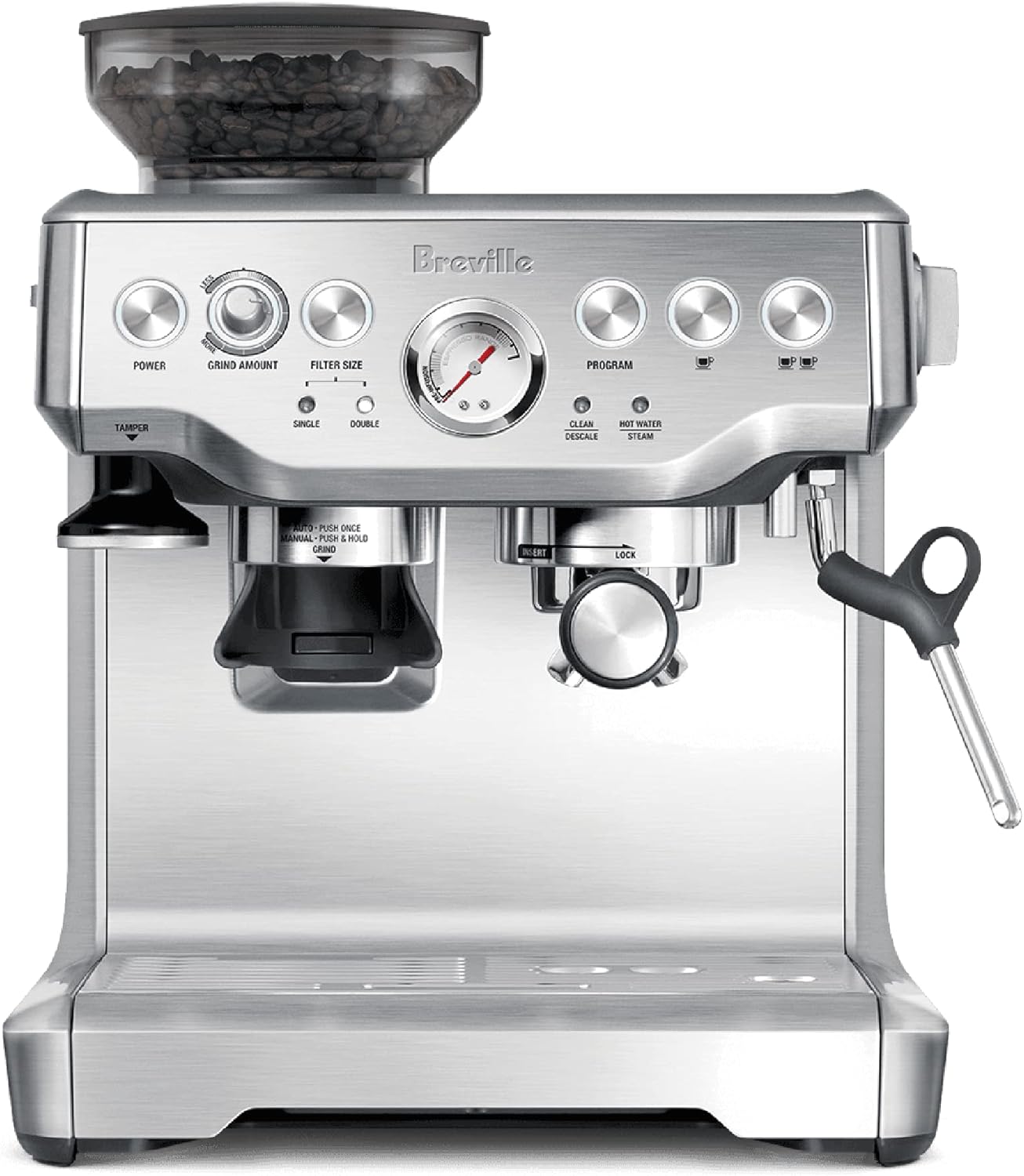 |
| Price on Amazon | |
Best All-in-One Starter 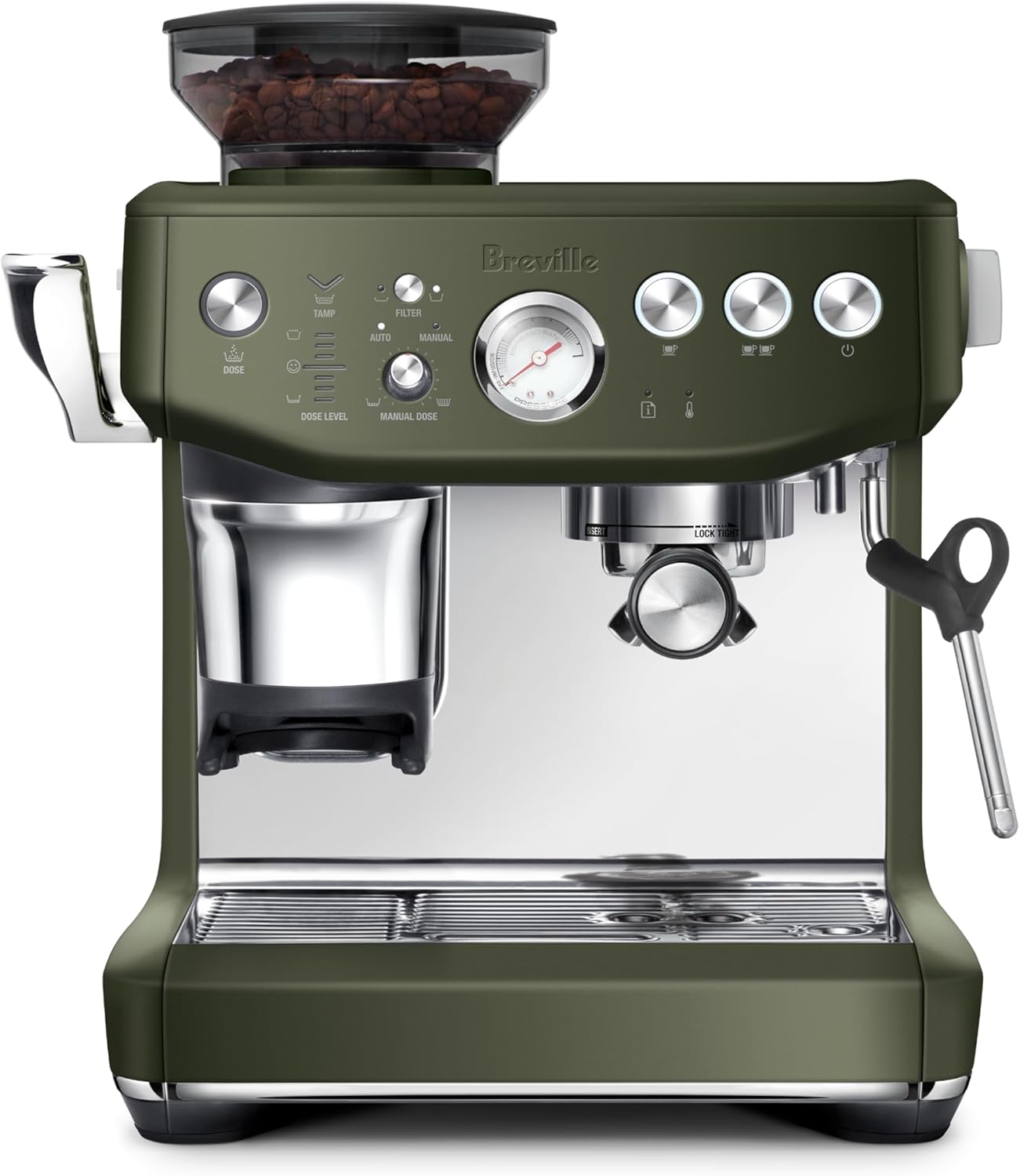 | Breville Barista Express Impress Espresso Machine (BES876BSS) |
| Price on Amazon |
My First Impression of the Breville Barista Touch
Breville Barista Touch Espresso Machine (BES880BSS)
Key Features
- Intuitive touchscreen with guided drink menus
- Built-in conical burr grinder with multiple grind settings
- Fast ThermoJet™ heating for near-instant readiness
- Auto steam wand with adjustable temperature & texture
- Low-pressure pre-infusion and ~9-bar extraction
- 54 mm portafilter; programmable single/double shots
Why We Like It
The Barista Touch simplifies café drinks—choose a recipe on the screen, let the machine dial in the steps, and finish with silky, automatic microfoam. Quick heat-up makes weekday lattes realistic.
Pros
- Touchscreen speeds up workflow
- Auto milk texturing is consistently silky
- Quick warm-up for fast morning drinks
- All-in-one footprint saves counter space
Cons
- 54 mm basket less “pro” than 58 mm setups
- Regular cleaning/backflush cycles required
Bottom Line
A user-friendly, modern espresso station that delivers fast heat-up, guided recipes, and reliable microfoam—perfect for busy latte lovers.
Price on AmazonThe first thing I like about the Barista Touch is that it feels like Breville took the Barista Express idea and made it friendlier for real daily use. The Express is already popular because it gives beginners a grinder and espresso machine in one body. But the touch goes further. It gives the routine a screen-based flow: grind, brew, milk, drink.
That sounds simple, but it matters. With the Barista Express, beginners often stare at buttons, dials, a pressure gauge, and a grind setting, then wonder which thing to adjust first. With the Barista Touch, the machine feels more like it is organizing the process for you. You are still doing espresso, but the workflow feels less scattered.
I also like that this machine does not completely remove the learning. You still need to understand beans, grind size, dose, tamping, and extraction. It is not a one-touch super-automatic. But it softens the parts that usually frustrate beginners, especially milk steaming.
That makes it a very nice middle machine. More guided than the Barista Express. More hands-on than a fully automatic one. More compact and approachable than a serious prosumer machine like the Profitec Pro 500 or Rocket R58 Cinquantotto.
Who the Breville Barista Touch Is Really For
I would recommend the Barista Touch to someone who wants real espresso at home but does not want the whole process to feel like a technical project every morning.
This is the buyer who wants to make espresso, cappuccino, flat white, and latte-style drinks with fresh beans but also wants a machine that feels modern and forgiving. The touchscreen menu makes drink selection easier, and the automatic steam wand removes one of the hardest beginner skills: milk texture.
It is especially good for someone who looked at the Breville Barista Express and thought, “I like this idea, but I want something easier and faster.” It also makes sense for someone who looked at the Breville Bambino Plus but wanted a built-in grinder instead of buying a separate one.
I would not recommend it to someone who wants the absolute best grinder quality for the money. A separate grinder plus a machine like the Profitec Go or Ascaso Steel DUO can give more long-term upgrade flexibility. I also would not recommend it to someone who wants full prosumer control, 58mm accessories, dual boilers, or pressure/flow profiling.
The Barista Touch is for the person who wants espresso craft but with guardrails.
Design and Countertop Fit

The Barista Touch feels larger than a compact espresso machine but smaller than a separate machine-and-grinder setup. That is important because the built-in grinder changes how I judge the footprint. A Breville Bambino Plus is smaller, yes, but it still needs a grinder beside it. A Profitec Go is compact, but it also needs a grinder. The Barista Touch puts both into one body.
The stainless steel version looks clean and modern, and the touchscreen gives the front panel a much simpler feel than the Barista Express. Instead of a more mechanical control layout, the Touch feels closer to a smart kitchen appliance. I know some espresso traditionalists dislike that, but for a daily home machine, I think it works.
The common dimensions are about 12.7 inches deep, 15.5 inches wide, and 16 inches high. It uses a 67-ounce water tank and includes an integrated grinder, milk jug, filter accessories, and espresso workflow tools in one body.
The width is the main thing to measure. Around 15.5 inches wide is not tiny, but it is still reasonable when you remember that a separate grinder would usually add 5 to 8 more inches beside a machine. Height also matters if you have low cabinets, because you need access to the bean hopper on top.
Espresso Quality: Friendly, Capable, and Still Dependent on Beans

The Barista Touch can make very enjoyable espresso, especially for users moving up from capsules, basic machines, or pre-ground coffee. The built-in grinder, PID temperature control, pre-infusion, and guided touchscreen workflow give you a much stronger espresso foundation than a basic beginner machine.
But I would still be honest: the espresso is only as good as your beans, grind setting, dose, tamp, and recipe. The touchscreen makes the process easier, but it does not replace dialing in. You may still need to adjust grind size, change grind duration, tweak shot volume, and taste carefully.
I would start with a medium or medium-dark espresso roast. Chocolatey, nutty, caramel-like blends are usually the easiest to dial in and the most satisfying in milk drinks. Very light roasts can be harder because they often need more grinder precision and temperature experimentation. Very oily dark beans can leave residue in the grinder, so I would avoid shiny, oily beans.
The machine uses low-pressure pre-infusion before extraction, which helps wet the puck more gently before full pressure. It also uses PID temperature control and a ThermoJet heating system designed for fast readiness.
For someone who wants easy, consistent home espresso without building a separate grinder setup, that combination is very appealing.
Built-In Grinder: The Convenience and the Limit

The built-in grinder is one of the main reasons to buy the Barista Touch. You load beans into the hopper, grind directly into the portafilter, tamp, brew, and move on. For beginners, that is far less intimidating than buying a separate grinder.
The grinder uses conical burrs and commonly offers 30 grind settings. That gives enough room for most medium and medium-dark espresso roasts, and it is more than enough for someone learning the basics.
The limitation is long-term flexibility. A good standalone grinder can offer better grind consistency, more precise adjustment, easier burr upgrades, and better performance with tricky coffees. If you become very serious about espresso, the grinder may be the part you outgrow first.
That does not make the Barista Touch a bad machine. It just means the built-in grinder is best understood as a convenience feature and learning tool, not the final word in espresso grinding.
Automatic Milk Texturing
Milk is where the Barista Touch becomes much easier than the Barista Express. Manual steaming is one of the hardest skills for beginners, and the Touch reduces that stress by letting you choose milk temperature and texture settings.
The automatic steam wand can adjust milk temperature and texture level, with many versions offering 8 texture levels and a temperature range around 40°C to 75°C.
This is a big deal for everyday cappuccinos and lattes. You do not need to learn the exact wand angle, stretching sound, whirlpool position, and stopping temperature right away. You can let the machine handle the milk while you focus on grinding and espresso.
I still think manual steaming is worth learning eventually, especially if you care about latte art. But for daily drinks, automatic milk texturing makes the machine much more shareable. Someone else in the house can make a latte without needing your full espresso explanation every time.
Breville Barista Touch BES880BSS
The Barista Touch is the machine I would choose if I wanted a built-in grinder, fresh espresso, guided touchscreen drinks, and automatic milk texture without moving all the way into a fully automatic machine.
Who This Is For
- Barista Express upgraders
- Beginner-to-intermediate users
- Latte and cappuccino drinkers
- Homes wanting easier milk drinks
Why I Like It
I like that it keeps the portafilter espresso experience but removes some of the daily friction. The touchscreen and automatic milk wand make it easier to use before coffee brain fully wakes up.
Best Drink Match
- Espresso
- Cappuccino
- Latte
- Flat white
- Americano
Who Should Skip It
- One-touch super-automatic users
- Advanced grinder hobbyists
- Small-counter minimalists
- Purists avoiding touchscreens
My Bottom Line
I would choose the Breville Barista Touch if I wanted the most user-friendly Breville all-in-one machine before stepping into the more expensive Touch Impress or Oracle category.
30 Days of Use: What I’d Expect After Living With It
The first week with the Barista Touch is mostly about learning the grinder. The touchscreen makes drink selection feel easy, but espresso quality still depends on grind size and dose. I would spend the first few days dialing in one bag of medium-roast beans rather than jumping between coffees.
By the second week, the machine should feel much easier. You will probably have a favorite grind setting, a preferred milk temperature, and a drink button you return to every morning. This is where the Barista Touch starts to feel more convenient than the Barista Express. Milk texture is less stressful, and the touchscreen removes some morning decision fatigue.
By the third and fourth week, the cleaning routine becomes the real ownership test. You need to wipe and purge the steam wand, empty the drip tray, clean the portafilter, keep the grinder path tidy, and use fresh beans. The machine is convenient, but not maintenance-free.
Breville Barista Touch: 30 Days of Real Use
After a month, this machine would mainly prove itself by how smoothly it fits into a daily espresso-and-milk routine. The touchscreen makes the process feel calmer, while the automatic steam wand makes it easier for more than one person in the house to get good milk drinks.
1. Daily Workflow After 30 Days
The daily workflow becomes very simple once one bean is dialed in: wake up, choose the drink, grind into the portafilter, tamp, brew, and let the automatic wand texture the milk. Compared with the Barista Express, the biggest comfort is not better espresso by magic — it is less friction.
The touchscreen helps keep the order clear, and saved drink preferences make repeated lattes and cappuccinos easier. The machine still rewards fresh beans and a consistent tamp, so I would not treat it like a fully automatic. It is more like a guided semi-automatic.
2. What Gets Better and What Still Needs Work
The milk routine gets better quickly. Once you find the milk temperature and texture you like, the machine becomes very easy for cappuccinos and lattes. The grinder also becomes easier once you stop changing beans every few days.
The main thing that still needs work is espresso dialing. If the shot tastes sour, bitter, weak, or thin, the touchscreen will not solve that alone. You still need to adjust grind size, dose, shot volume, and beans. The built-in grinder is convenient, but advanced users may eventually want more precision.
3. Buy It or Skip It?
Buy it if you want a polished all-in-one espresso machine with a built-in grinder, touchscreen recipes, fast heat-up, and easier milk drinks than the Barista Express. It is especially strong for daily latte, cappuccino, flat white, and Americano drinkers.
Skip it if you want the best possible grinder, a tiny footprint, fully automatic one-touch coffee, or a machine you can upgrade piece by piece. In that case, a separate grinder plus a machine like the Bambino Plus, Profitec Go, or Ascaso Steel DUO may make more sense.
What I Like Most About It
What I like most about the Breville Barista Touch is how well it reduces the emotional load of espresso. Espresso can become a little exhausting for beginners because every small mistake seems to matter. If the grind is too coarse, the shot runs fast. Grind too fine, and the shot chokes. Milk is too hot; the texture collapses. Tamp unevenly, extraction channels.
The Barista Touch does not remove all of that, but it makes the process feel less scattered. The touchscreen gives structure. The grinder is built in. The milk wand handles texture. The machine heats quickly. The whole experience feels more like a modern routine and less like a science project.
I also like that it is shareable. A serious manual machine can become “one person’s machine” in the house because only one person knows how to use it. The Barista Touch is much easier for another family member to approach.
What I Would Improve
The first thing I would improve is grinder precision. The built-in grinder is convenient and good enough for most users, but it is not as satisfying as a high-quality standalone grinder. This is the part advanced users may eventually outgrow.
The second thing is the portafilter ecosystem. Breville’s 54mm system works fine, but many espresso accessories and upgrade paths are more common in the 58mm world. If you already own 58mm baskets, tampers, and tools, this may feel limiting.
The third thing is repair and upgrade flexibility. With an all-in-one machine, the grinder and espresso machine are tied together. That is convenient at first but less flexible later.
The fourth thing is price. The Barista Touch usually costs noticeably more than the Barista Express. The upgrade makes sense if the touchscreen, faster heat-up, saved drinks, and automatic milk texture matter to you. If you enjoy manual milk steaming and do not care about the screen, the Barista Express may still be a better value.
How It Compares With the Breville Barista Express
The Breville Barista Express is the classic all-in-one learning machine. It has a built-in grinder, manual steam wand, pressure gauge, and enough control for beginners to learn espresso.
The Barista Touch feels more modern and easier. The touchscreen interface organizes the drink workflow, the ThermoJet system heats quickly, and the automatic steam wand makes milk drinks much less intimidating.
I would choose the Barista Express if budget matters more and I want a more manual learning experience. I would choose the Barista Touch if I wanted easier milk drinks and a more polished daily routine.
How It Compares With the Breville Bambino Plus
The Breville Bambino Plus is smaller, faster, and excellent for people who already have or plan to buy a separate grinder. It also has automatic milk texturing, which makes it very beginner-friendly.
The Barista Touch adds the grinder and touchscreen drink workflow. It takes more space, but it gives you the whole espresso station in one body.
I would choose the Bambino Plus if counter space is tight or I want a better separate grinder. I would choose the Barista Touch if I wanted one complete machine with fewer buying decisions.
How It Compares With the Breville Barista Touch Impress
The Barista Touch Impress is the more assisted version. It adds more guidance around dosing and tamping, making it even easier for users who want fewer espresso variables.
The Barista Touch is still guided, but it expects more from the user during dosing and tamping. That can actually be a good thing if you want to learn more manually.
I would choose the Barista Touch if I want touchscreen comfort but still want to keep the traditional hand-tamping workflow. I would choose the Touch Impress if I wanted more help with puck prep.
Cleaning and Maintenance

The Barista Touch needs regular care because it has a grinder, espresso path, steam wand, drip tray, and water system all in one machine.
After every milk drink, I would wipe the steam wand and let the autopurge do its job. After every espresso, I would knock out the puck, rinse the basket, and keep the portafilter clean. I would empty the drip tray before it gets unpleasant and clean the grinder chute periodically.
The grinder matters more than many users realize. If old coffee grounds and oils build up, shots can become inconsistent. I would avoid oily beans and clean the burr area on a schedule.
The touchscreen may make the machine feel automatic, but maintenance is still part of ownership. Treat it well, and it becomes a very comfortable daily machine.
Breville Barista Touch BES880BSS Technical Specifications
| Specification | Details | What It Means in Daily Use |
|---|---|---|
| Product Name | Breville Barista Touch BES880BSS | A touchscreen all-in-one espresso machine with grinder and automatic milk texturing. |
| Model / ASIN | BES880BSS / B078WMLXXG | This is the brushed stainless steel product version used for the review box. |
| Machine Type | Semi-automatic espresso machine with touchscreen guidance | You still use a portafilter, but the touchscreen makes the workflow easier to follow. |
| Built-In Grinder | Integrated conical burr grinder | Lets you grind fresh beans directly before brewing without buying a separate grinder. |
| Grind Settings | 30 settings commonly | Enough range for most beginner and intermediate espresso dialing. |
| Bean Hopper | About 1/2 lb / 250g class | Good for daily use, though fresh smaller refills are better than storing beans too long. |
| Heating System | ThermoJet heating system | Very fast heat-up compared with older thermocoil and boiler machines. |
| Heat-Up Time | About 3 seconds to extraction temperature | Makes the machine feel easy to use on busy mornings. |
| Temperature Control | PID temperature control | Helps stabilize brew temperature for more consistent espresso. |
| Pre-Infusion | Low-pressure pre-infusion | Gently wets the puck before full pressure extraction. |
| Brewing Pressure | 9-bar espresso brewing pressure | Matches the typical espresso pressure target during extraction. |
| Portafilter Size | 54mm Breville-style portafilter | Works well in Breville’s ecosystem, but is less universal than 58mm accessories. |
| Milk System | Automatic steam wand with adjustable milk temperature and texture | Makes cappuccino and latte milk much easier than fully manual steaming. |
| Milk Texture Control | Multiple texture levels, commonly 8 levels on retailer specs | Lets you choose foamier cappuccino milk or smoother latte-style milk. |
| Milk Temperature Control | Adjustable, commonly around 40°C to 75°C on retailer specs | Helps prevent milk from being too cool or overheated. |
| Drink Interface | Touchscreen menu with pre-programmed café drinks | Makes drink selection and workflow easier for beginners and shared households. |
| Custom Drinks | Customizable drink settings | Useful once you find your preferred espresso and milk settings. |
| Water Tank | 67 oz / 2L class removable water tank | Large enough for normal daily home use without constant refilling. |
| Power | 1680W | Supports fast heat-up and automatic milk workflow. |
| Dimensions | Approx. 12.7″ D x 15.5″ W x 16″ H | Compact for grinder-plus-machine setup, but wider than machine-only models. |
| Finish | Brushed stainless steel | Gives the machine a clean modern kitchen look. |
| Best Bean Match | Medium to medium-dark espresso roasts | Usually easiest to dial in and best for milk drinks on this grinder. |
| Best User Type | Beginner-to-intermediate user wanting guided espresso | Ideal for someone who wants fresh espresso and easier milk drinks in one machine. |
Final Verdict
The Breville Barista Touch BES880BSS is the machine I would choose if I wanted the all-in-one convenience of the Barista Express but with a smoother, more modern, more milk-friendly daily workflow. The touchscreen is not just a gimmick. It makes the machine easier to approach, especially for households where more than one person will use it.
The built-in grinder is convenient. The ThermoJet heating is fast. The automatic milk wand makes cappuccinos and lattes much easier. The pre-programmed drink workflow helps beginners feel less lost. And because it still uses a portafilter, it teaches more than a fully automatic machine does.
I would not buy it if I wanted the best possible grinder, a tiny footprint, full manual purist control, or a long-term upgrade path with separate components. But if I wanted one polished machine that can grind, brew, and texture milk with less guesswork, the Barista Touch would be one of the easiest Breville machines to recommend.
FAQ
Is the Breville Barista Touch good for beginners?
Yes. It is beginner-friendly because the touchscreen organizes the workflow, the grinder is built in, and the automatic milk wand makes cappuccinos and lattes much easier.
Does the Breville Barista Touch have a built-in grinder?
Yes. It has an integrated conical burr grinder with 30 grind settings.
Does the Breville Barista Touch make automatic milk foam?
Yes. The automatic steam wand can texture milk with adjustable temperature and texture settings, which makes milk drinks easier than fully manual steaming.
Is the Barista Touch better than the Barista Express?
I would choose the Barista Touch if I wanted a touchscreen, faster heat-up, saved drink workflow, and automatic milk texturing. I would choose the Barista Express if budget mattered more and I wanted a more manual learning experience.
Who should skip the Breville Barista Touch?
I would skip it if you want a fully automatic one-touch machine, a separate high-end grinder setup, a compact machine-only body, or a more traditional prosumer espresso machine.


