
Best Budget Espresso Machine with Grinder and Frother: 7 Picks


OneHundredCoffee is reader-supported. Products displayed may earn us a commission at no extra cost to you.
The strange thing about shopping for a budget espresso machine with a grinder and frother is that the lowest sticker price is rarely the whole story. I have watched plenty of people begin with a cheap espresso maker, then add a grinder, a milk pitcher, a tamper, a scale, and a better basket until the “budget” setup costs more than the all-in-one machine they originally avoided. The smarter question is not simply which machine is cheapest. It is which complete workflow gives you the fewest frustrating compromises for the way you actually make coffee.
That is how I approached this guide to the Best Budget Espresso Machine with Grinder and Frother 2026. I compared the seven machines as complete ownership packages: how naturally the grinder and brewer work together, whether the milk system suits daily lattes, how much technique the machine demands before breakfast, what needs cleaning after every drink, and whether the machine still feels useful once the first-week excitement has worn off.
Top 3 Budget Espresso Machines — Editors’ Picks
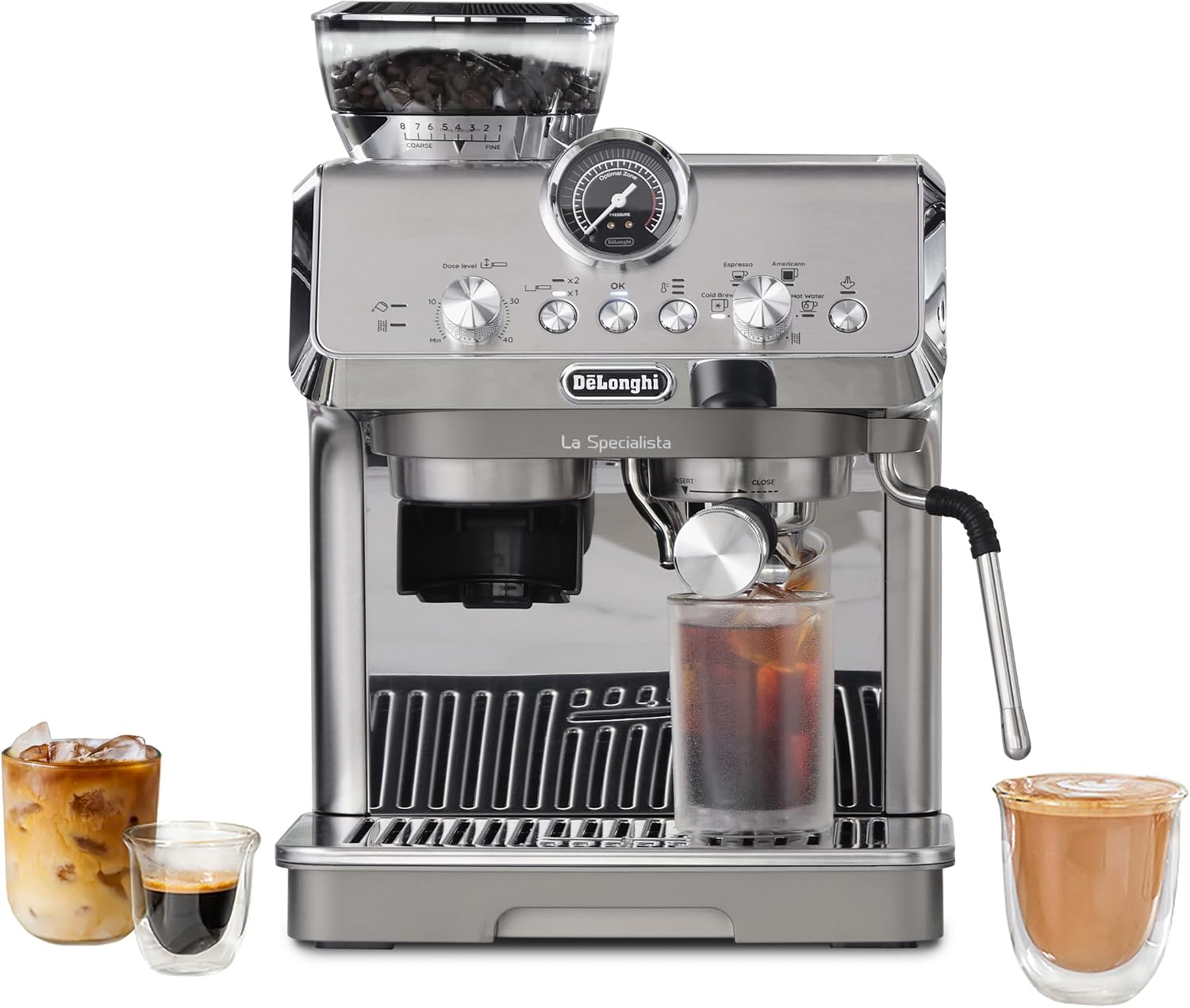
De’Longhi La Specialista Arte Evo EC9255M
- 8-setting conical burr grinder
- Commercial-style steam wand
- Cold Extraction Technology
- Compact home-barista footprint

De’Longhi Magnifica Start ECAM22022B
- Espresso, coffee, Americano
- 13-setting conical grinder
- Traditional milk frother
- Dishwasher-safe removable parts

Ninja Luxe Café Premier ES601
- Espresso, drip, and cold brew
- 25-setting integrated grinder
- Spring-assisted tamper
- Four hands-free froth programs
The products here fall into two very different families. The De’Longhi La Specialista Arte Evo, Breville Barista Express, Ninja Luxe Café Premier, and CASABREWS 5700Gense are hands-on machines. They grind into a portafilter, ask you to manage the coffee puck, and keep you involved in extraction and milk. The De’Longhi Magnifica Evo, Philips 3200 LatteGo, and De’Longhi Magnifica Start are bean-to-cup machines. They grind and brew internally, then handle milk either automatically or through a simpler manual frother.
Neither style is automatically better. I have compared these same ownership personalities across our all-in-one espresso machine guide and our espresso machines for lattes and cappuccinos. The pattern is consistent: manual all-in-ones usually offer more control and a better path toward true microfoam, while super-automatics protect your time and make it easier for several people to get repeatable drinks.
For this topic, “budget” means strong total value within the grinder-equipped category—not necessarily the absolute cheapest espresso appliance on Amazon. A low-cost machine without a capable grinder or usable frother can be poor value. A more expensive machine may be the better budget decision when it replaces a grinder, separate frother, drip brewer, cold-brew device, or daily café habit.
My closing thesis is simple: choose the workflow before the machine. Pick the La Specialista Arte Evo or Barista Express when you want to become the barista, the Magnifica Evo or Philips 3200 when you want the machine to become the barista, the Magnifica Start when black coffee comes first, the Ninja when one household wants everything, and the CASABREWS when maximum hardware per dollar matters more than owning the most established support network.
Best Budget Espresso Machines with Grinder and Frother — At a Glance
| Image | Product | Features | Price |
|---|---|---|---|
|
Best Overall Value
|
De’Longhi La Specialista Arte Evo EC9255M |
Guided manual control with cold brew flexibility
|
Price on Amazon |
|
Best Proven Classic
|
Breville Barista Express BES870XL |
Time-tested manual espresso learning platform
|
Price on Amazon |
|
Best Multi-Drink Value
|
Ninja Luxe Café Premier ES601 |
Three brewing styles plus automated frothing
|
Price on Amazon |
|
Best Automatic Milk Value
|
De’Longhi Magnifica Evo ECAM29084SB |
Seven one-touch recipes with automatic LatteCrema milk
|
Price on Amazon |
|
Best Easy-Clean Automatic
|
Philips 3200 Series LatteGo EP3241/54 |
Low-drama LatteGo cleaning with five core drinks
|
Price on Amazon |
|
Best Simple Automatic
|
De’Longhi Magnifica Start ECAM22022B |
Three one-touch black drinks with a manual frother
|
Price on Amazon |
|
Best Lower-Cost 58 mm Pick
|
CASABREWS 5700Gense |
Affordable 58 mm workflow with a large reservoir
|
Price on Amazon |
My Quick Take Before You Choose
For the best overall balance: choose the De’Longhi La Specialista Arte Evo. It gives a beginner meaningful control, useful puck-prep tools, capable milk steaming, and a cold-drink lane without becoming excessively large.
For the easiest automatic value: choose the De’Longhi Magnifica Start if you mostly drink espresso, coffee, or Americano. Choose the Magnifica Evo when automatic cappuccinos and lattes justify the extra milk system.
For the widest household flexibility: choose the Ninja Luxe Café Premier. It makes the strongest value argument when it replaces several machines rather than when it is judged only as an espresso maker.
For the safest proven manual choice: choose the Breville Barista Express. It is older, but the support, tutorials, accessories, and well-understood workflow remain major advantages.
The 7 Best Budget Espresso Machines with Built-In Grinder and Milk Frother for 2026
1. De’Longhi La Specialista Arte Evo EC9255M
Best budget-friendly all-in-one for guided manual espresso and fast cold drinks
The Arte Evo gives you a built-in burr grinder, a real portafilter workflow, a strong manual steam wand, and a quick cold-extraction option without pushing you into a separate-machine-and-grinder setup.
Technical Specifications & Daily Workflow
- Machine type: Semi-automatic all-in-one espresso machine
- Grinder: Built-in conical burr grinder
- Grind control: 8 grind settings
- Coffee formats: Whole beans and pre-ground coffee through the portafilter
- Drink styles: Single espresso, double espresso, Americano-style drinks, cappuccino, latte, flat white, iced espresso, and quick cold brew
- Milk system: Manual commercial-style steam wand
- Cold coffee: Cold Extraction Technology for a fast cold-brew-style drink
- Puck preparation: Separate dosing funnel, tamper, and barista accessories
- Control style: Hands-on grinding, dosing, tamping, extraction, and milk texturing
- Best workflow: One or two drinks at a time with active user involvement
- Counter fit: More compact than many full-size grinder-equipped espresso stations
- Main value: A balanced bridge between beginner guidance and genuine espresso technique
What to Expect During the First 30 Days
Pros
- Balanced all-in-one package: The grinder, portafilter, steam wand, and included puck-prep tools remove the need to assemble a separate starter setup.
- Helpful without feeling fully automatic: You still learn dose, tamp, extraction, and milk texture, but the machine keeps the workflow more organized than a traditional machine plus separate grinder.
- Milk texture has real potential: The steam wand is better suited to glossy microfoam and basic latte art than simple panarello-style frothers.
- Cold drinks add genuine utility: The quick cold-extraction option is useful for iced-coffee households that do not want to wait overnight for a cold-brew concentrate.
- Compact for its feature set: It brings several pieces of a home espresso bar into one reasonably tidy footprint.
- Easy machine to grow with: A beginner can start with forgiving beans and simple ratios, then refine grind, dose, and steaming technique over time.
Cons
- Only eight grinder positions: The range is usable, but fine-tuning can feel less precise than on grinders with more micro-adjustment steps.
- Manual work is still required: It is not a push-button latte machine; dosing, tamping, locking in the portafilter, and steaming remain part of every milk drink.
- Single-heater rhythm: You should expect a brew-then-steam workflow rather than simultaneous extraction and milk steaming.
Who Should Buy, Who Should Skip & My Final Verdict
Buy it if: Buy it when you want a compact all-in-one that teaches real espresso skills, you make lattes or cappuccinos regularly, and cold drinks are more than an occasional novelty.
Skip it if: Skip it when your priority is one-touch coffee before work, multiple drinks back-to-back with almost no handling, or very fine grinder adjustment for demanding light-roast espresso.
My final verdict: My overall pick is the La Specialista Arte Evo because it solves the central budget problem well: it gives a new home barista enough grinder, espresso, milk, and accessory capability to build a serious routine without immediately buying three separate appliances. It is not the cheapest machine here, but it is one of the most complete values when the whole setup is considered.
Best for: Beginners who want to learn espresso while keeping dosing, grinding, tamping tools, and milk steaming in one coordinated station.
What keeps the Arte Evo near the top for me is the way it organizes the messy first stage of espresso ownership. New users often buy a machine, then discover they still need a grinder, a usable tamper, a dosing funnel, a milk pitcher, and a better plan for puck preparation. This machine brings that learning curve into one system without turning the process into a one-button imitation of barista work.
I have taken a closer look at the same workflow in my De’Longhi La Specialista Arte review, and the practical appeal remains the same: it is most convincing when you enjoy being involved but want guardrails around grinding, dosing, milk texturing, and quick cold drinks.
The main question is whether eight grinder settings will be enough for your beans and expectations. For medium and medium-dark roasts, most beginners should find a workable zone. Very light specialty beans can demand finer adjustment than this integrated grinder is designed to provide.
2. Breville Barista Express BES870XL

Best established all-in-one for learning espresso through a traditional home-barista workflow
The Barista Express remains a practical starting point when you want fresh grinding, a pressure gauge, a 54 mm portafilter, manual steaming, and a large owner community in one familiar machine.
Technical Specifications & Daily Workflow
- Machine type: Semi-automatic espresso machine with integrated grinder
- Grinder: Built-in conical burr grinder with on-demand dosing
- Portafilter: 54 mm stainless-steel portafilter
- Heating: Thermocoil heating system with digital temperature management
- Extraction feedback: Front pressure gauge
- Shot controls: Programmable single and double shot buttons plus manual control
- Pre-infusion: Low-pressure pre-infusion before full extraction
- Milk system: Manual steam wand
- Hot water: Dedicated outlet for Americanos and cup warming
- Best workflow: Hands-on daily espresso with repeatable routines
- Learning curve: Moderate; rewards grind, dose, distribution, and steaming practice
- Main value: A complete and widely supported first espresso station
What to Expect During the First 30 Days
Pros
- A genuinely complete first setup: The integrated grinder and manual milk system let a new owner make espresso and milk drinks without a separate grinder purchase.
- Feedback encourages learning: The pressure gauge, shot timing, grind dial, and manual steam wand help users understand why shots change.
- Huge knowledge base: Tutorials, replacement parts, accessories, cleaning guidance, and owner troubleshooting are easy to find.
- Good medium-roast compatibility: It performs well with the forgiving beans most new espresso drinkers are likely to use.
- Solid milk-drink capability: With practice, the steam wand can produce smooth milk for cappuccinos, lattes, and flat whites.
- Familiar resale and upgrade path: Owners know what the machine is, what it can do, and where its limitations begin.
Cons
- Older heating platform: Warm-up and brew-to-steam transitions are slower than newer ThermoJet-style systems.
- Integrated grinder has limits: It is convenient but not as precise, quiet, or upgradeable as a strong separate espresso grinder.
- Technique matters: Inconsistent dosing, distribution, tamping, or bean freshness can quickly create fast, sour, or bitter shots.
Who Should Buy, Who Should Skip & My Final Verdict
Buy it if: Buy it when you want the safest well-known all-in-one learning machine, you enjoy manual milk steaming, and you value a large ecosystem of tutorials and accessories.
Skip it if: Skip it when you want instant warm-up, automatic milk, a touchscreen, or an upgrade path centered on a separate high-performance grinder.
My final verdict: The Barista Express is still one of the easiest all-in-one machines to recommend because its weaknesses are well understood and its strengths match the needs of a first serious home barista. It is not the newest platform, but it remains a sensible budget package when the alternative is buying a machine, grinder, and accessories separately.
Best for: The serious beginner who wants a proven model, enjoys learning by adjustment, and values broad accessory, tutorial, and troubleshooting support.
The Barista Express feels less like a shortcut and more like a compact training station. You will notice when the grinder setting is wrong, when the dose is too low, and when the milk wand is buried too deeply. That feedback can frustrate someone who wants effortless coffee, but it is exactly what helps a curious beginner improve.
My detailed Breville Barista Express review goes deeper into its daily strengths and limitations. The key point is that the machine works best when you treat the grinder and espresso side as a coordinated system rather than expecting every bean to behave with the same setting.
I would choose it over a no-name budget all-in-one when long-term familiarity, replacement parts, owner support, and predictable workflow matter more than getting the longest feature list for the lowest initial price.
3. Ninja Luxe Café Premier ES601
Best all-in-one for espresso, drip coffee, rapid cold brew, and hands-free milk foam
The Luxe Café Premier is the broadest machine here: it combines espresso, drip coffee, rapid cold brew, a built-in grinder, assisted tamping, guided adjustments, and automatic hot or cold foam.
Technical Specifications & Daily Workflow
- Machine type: Guided semi-automatic 3-in-1 coffee and espresso system
- Brew formats: Espresso, drip coffee, and rapid cold brew
- Grinder: Integrated conical burr grinder
- Grind control: 25 settings with Barista Assist recommendations
- Dosing: Weight-based or guided dosing workflow
- Tamping: Spring-loaded assisted tamper
- Milk system: Hands-free Dual Froth System
- Froth programs: Steamed milk, thin froth, thick froth, and cold foam
- Milk compatibility: Designed for dairy and plant-based milk
- Drink menu: Multiple espresso, coffee, iced, and milk combinations
- Best workflow: Mixed-drink households and users who want guidance
- Main value: Replaces several coffee appliances with one guided station
What to Expect During the First 30 Days
Pros
- Exceptional drink coverage: It is the only machine in this group that convincingly spans espresso, larger drip-style coffee, rapid cold brew, and hot or cold milk foam.
- Guidance reduces wasted beans: Grind recommendations and automated adjustments help beginners get closer to a workable recipe without blind trial and error.
- Assisted tamping cleans up the workflow: The spring-loaded tamper helps create a flatter, more repeatable puck with less mess.
- Hands-free frothing is family-friendly: Users can select a milk texture while the machine handles steaming and whisking.
- Strong plant-milk practicality: Cold foam and different froth programs make it more flexible for oat, almond, and other alternatives.
- High utility per counter position: It can replace a drip brewer, cold-brew shortcut, espresso machine, grinder, and separate automatic frother.
Cons
- Large and visually busy: The machine needs meaningful counter depth, accessory storage, and room to work around the portafilter and milk jug.
- More systems to clean: A multi-drink machine naturally creates more baskets, milk parts, storage pieces, and cleaning routines.
- Less traditional espresso personality: Purists may prefer a simpler machine with fewer automated decisions and a more conventional steam wand.
Who Should Buy, Who Should Skip & My Final Verdict
Buy it if: Buy it when one household wants espresso, drip coffee, iced coffee, and milk drinks, and you value guidance more than traditional manual control.
Skip it if: Skip it when counter space is tight, you only drink straight espresso, or you prefer a simpler machine with fewer modes and accessories.
My final verdict: The Ninja Luxe Café Premier is the value winner for variety. It is not the lowest-cost machine, but it can be the cheapest complete solution when it replaces a grinder, espresso maker, drip brewer, cold-brew device, and milk frother. That broader arithmetic matters in a real kitchen.
Best for: Households split between espresso, larger coffee, iced drinks, dairy milk, and plant-based milk that want one machine rather than several specialized appliances.
This is the machine I would place in a household where nobody agrees on what “coffee” means. One person wants a double espresso, another wants a large mug, and someone else wants iced oat-milk foam. A conventional semi-automatic can serve that group, but it requires more manual adaptation than the Ninja.
The versatility case is also why I included it in my guide to drip coffee makers with built-in grinders. It is not merely an espresso machine with extra buttons; its value comes from crossing several brewing categories without requiring separate grinders or milk equipment.
I would still avoid it for the minimalist. More drink modes mean more decisions, more cleaning pieces, and more counter presence. The right buyer sees those systems as consolidation; the wrong buyer sees them as clutter.
4. De’Longhi Magnifica Evo ECAM29084SB

Best bean-to-cup value for one-touch cappuccino, latte macchiato, coffee, and iced coffee
The Magnifica Evo pairs a 13-setting conical burr grinder with seven one-touch drinks and De’Longhi’s automatic LatteCrema carafe, making it the easiest full milk-drink system in this group.
Technical Specifications & Daily Workflow
- Machine type: Fully automatic bean-to-cup espresso and coffee machine
- Grinder: Built-in conical burr grinder
- Grind control: 13 settings
- Drink menu: Espresso, cappuccino, latte macchiato, iced coffee, coffee, hot water, and My Latte
- Milk system: Automatic LatteCrema milk carafe
- Milk storage: Detachable carafe can be stored in the refrigerator
- Controls: One-touch icon panel with drink customization
- Water capacity: 60 fluid ounces
- Machine size: Approximately 17.32 in deep × 9.45 in wide × 14.17 in high
- Cleaning: Automatic rinsing plus removable, washable components
- Best workflow: One-touch black and milk drinks throughout the day
- Main value: The most complete automatic milk experience among these value-focused picks
What to Expect During the First 30 Days
Pros
- Milk drinks require very little technique: The LatteCrema carafe handles frothing and dispensing, which makes cappuccinos and latte macchiatos easy to repeat.
- Seven genuinely useful recipes: The menu covers core black drinks, milk drinks, iced coffee, hot water, and a customizable milk option without becoming overwhelming.
- Fresh beans without puck work: Grinding, dosing, brewing, and spent-puck handling happen inside the machine.
- Narrow front width: The body is relatively slim even though it is deep, which can help on crowded counters.
- Good household accessibility: Guests and non-enthusiasts can produce a recognizable drink without learning tamping or steam-wand technique.
- Carafe storage is practical: Detaching the milk container and placing it in the refrigerator reduces waste between drinks.
Cons
- Milk system adds cleaning responsibility: Automatic milk is easy to use but only stays pleasant when the carafe, spout, and rinse routine are maintained.
- Less espresso control: You can adjust strength and grinder settings, but you do not control puck preparation or extraction like a semi-automatic owner.
- Deep countertop footprint: The machine is narrow but extends farther back than many compact manual models.
Who Should Buy, Who Should Skip & My Final Verdict
Buy it if: Buy it when automatic cappuccinos and lattes are the reason you want an espresso machine, and you would rather maintain a carafe than learn manual steaming.
Skip it if: Skip it when straight espresso nuance matters more than convenience, you dislike milk-system cleaning, or you want a compact shallow machine.
My final verdict: For automatic milk drinks, the Magnifica Evo is the strongest value in this list. It costs more than an entry semi-automatic, but it removes the grinder, tamping, puck, and steaming work from every cup. That is the feature many busy owners will appreciate long after the novelty fades.
Best for: Latte and cappuccino drinkers who want fresh beans, one-touch preparation, repeatable foam, and less manual handling than a portafilter machine.
The Magnifica Evo is less about the romance of espresso and more about protecting the routine. You press a drink icon, the machine grinds fresh beans, and the milk system finishes the cup. That consistency is especially valuable in a household where several people want coffee but only one person would ever learn a portafilter.
Its position becomes clearer beside a hands-on machine in my De’Longhi Magnifica Evo comparison: the Evo is for the owner who measures value in saved effort, repeatable milk drinks, and low-friction mornings rather than maximum espresso control.
The maintenance tradeoff should not be ignored. Automatic milk systems are wonderful when rinsed promptly and cleaned consistently. Neglect the carafe, and the very feature that made the machine convenient becomes the part you resent.
5. Philips 3200 Series LatteGo EP3241/54

Best super-automatic value for a simple five-drink menu and quick-rinse LatteGo milk system
The Philips 3200 focuses on the drinks most homes actually use, then makes the milk side easier to live with through a two-part LatteGo container with no long milk tube.
Technical Specifications & Daily Workflow
- Machine type: Fully automatic bean-to-cup espresso machine
- Grinder: 100% ceramic burr grinder
- Grind control: 12 adjustment steps
- Drink menu: Espresso, coffee, Americano, cappuccino, and latte macchiato
- Milk system: Two-part LatteGo milk frother without a long tube
- Customization: My Coffee Choice strength and volume settings
- Controls: Intuitive touch display
- Water care: AquaClean filter compatibility
- Bean storage: Top hopper with aroma-seal-style lid
- Cleaning: Removable brew group and quick-rinse milk container
- Best workflow: Simple daily cappuccino and coffee with low milk cleanup
- Main value: A balanced first super-automatic with one of the easiest milk systems to rinse
What to Expect During the First 30 Days
Pros
- LatteGo is genuinely easy to rinse: The two milk pieces separate quickly and avoid the hidden residue problems associated with long intake tubes.
- Focused menu reduces confusion: Five core drinks cover most everyday needs without pages of specialty recipes.
- Ceramic grinder offers useful adjustment: The 12-step system gives enough range for normal medium and dark espresso roasts.
- Removable brew group supports ownership: Access to the internal brewing unit makes routine rinsing and inspection straightforward.
- Good pod-machine upgrade path: It gives push-button convenience while moving the drink base from capsules to freshly ground beans.
- Family-friendly interface: The drink icons and simple controls are approachable for users with different coffee knowledge levels.
Cons
- Espresso can taste lighter: The cup profile often favors smooth, approachable coffee over dense manual-machine intensity.
- Milk texture prioritizes convenience: LatteGo foam is useful and consistent, but it is not the same as finely controlled steam-wand microfoam.
- Older platform feel: The interface is clear, though newer Philips series offer quieter operation and larger drink menus.
Who Should Buy, Who Should Skip & My Final Verdict
Buy it if: Buy it when milk-system cleanup is your biggest concern, you want five familiar drinks, and you prefer a simple bean-to-cup routine over manual espresso technique.
Skip it if: Skip it when you want very dense straight espresso, advanced user profiles, a large specialty menu, or true steam-wand latte-art control.
My final verdict: The Philips 3200 is the best “I will actually clean this” automatic machine in the group. That sounds unglamorous, but it is a major ownership advantage. A milk system that is easy to rinse tends to get used more often and neglected less often.
Best for: First-time super-automatic owners who value easy milk cleanup, a simple touch panel, core café drinks, and ceramic-grinder durability.
The 3200 makes the most sense for someone moving away from pods. The interaction is familiar—choose a drink and press a button—but whole beans replace capsules, the grinder can be adjusted, and the brew strength can be personalized without turning the morning into a hobby.
I rank it highly in my best Philips espresso machines guide for the same reason: five drinks, 12-step grinder control, LatteGo, and AquaClean create a practical middle ground between low-cost basics and expensive touchscreen super-automatics.
Its limitation is the espresso ceiling. The Philips can make pleasant, consistent coffee, but a well-dialed semi-automatic will produce a more concentrated and expressive shot. Convenience, not ultimate extraction control, is the point.
6. De’Longhi Magnifica Start ECAM22022B
Best affordable bean-to-cup machine for one-touch black coffee plus manual milk frothing
The Magnifica Start keeps the automatic side simple with espresso, coffee, and Americano recipes, then gives you a traditional frother for cappuccinos and lattes when you want them.
Technical Specifications & Daily Workflow
- Machine type: Fully automatic bean-to-cup machine with manual milk frother
- Grinder: Built-in conical burr grinder
- Grind control: 13 settings
- One-touch drinks: Espresso, coffee, and Americano
- Milk system: Traditional manual frother
- Strength control: Adjustable coffee intensity
- Coffee input: Whole beans with a bypass option for pre-ground coffee where supported
- Controls: Simple one-touch icon panel
- Cleaning: Removable and dishwasher-safe components
- Best workflow: Daily black coffee with occasional manual cappuccino or latte
- Learning curve: Low for coffee; moderate for milk texturing
- Main value: Automatic bean-to-cup convenience without paying for an automatic milk carafe
What to Expect During the First 30 Days
Pros
- Simple menu is easy to live with: Espresso, coffee, and Americano cover the drinks many owners make every day.
- Thirteen grinder settings add flexibility: The integrated conical grinder can be adjusted for different beans and desired strength.
- Manual frother keeps the price focused: You are not paying for a milk carafe if milk drinks are only occasional.
- Fewer milk parts to store: The traditional frother avoids a detachable refrigerator carafe and long milk-tube system.
- Good first bean-to-cup machine: It removes grinding, dosing, brewing, and spent-puck handling without overwhelming the user.
- Practical cleaning access: Removable parts and automatic rinse behavior support a straightforward maintenance routine.
Cons
- Milk drinks are not one-touch: You still need a pitcher, cold milk, steam-wand technique, and a wipe-and-purge routine.
- Small specialty menu: Buyers wanting latte macchiato, flat white, iced presets, or user profiles will outgrow the interface.
- Foam style is more traditional: The manual frother can make enjoyable milk drinks, but silky microfoam requires practice.
Who Should Buy, Who Should Skip & My Final Verdict
Buy it if: Buy it when espresso, coffee, and Americano are your core drinks, you want automatic bean-to-cup preparation, and you only froth milk occasionally.
Skip it if: Skip it when most of your drinks are lattes or cappuccinos and you expect the machine to dispense milk automatically.
My final verdict: The Magnifica Start is my automatic-value pick because it spends the budget on the grinder, brewing unit, and simple coffee controls rather than an elaborate milk menu. For a black-coffee-first household, that can be the smarter allocation.
Best for: Mostly-black-coffee drinkers who want automatic grinding and brewing but only need occasional manually frothed milk drinks.
The Start is a reminder that a budget machine does not need to do everything. Its value comes from automating the repetitive parts—grinding, dosing, extraction, and puck disposal—while leaving milk as an occasional manual step.
I also included it in my guide to the most reliable espresso machines for daily use because the focused menu and familiar De’Longhi bean-to-cup layout make the ownership proposition easy to understand.
Choose the Magnifica Evo instead when milk drinks dominate your week. Choose the Start when you mostly drink espresso, coffee, or Americano and do not want to clean an automatic milk carafe every day.
7. CASABREWS 5700Gense

Best lower-cost semi-automatic for a 58 mm portafilter, 15 grind settings, and a large water tank
The 5700Gense takes the ambitious route for its price class with a built-in conical grinder, 58 mm portafilter, pressure gauge, manual steam wand, and a very large removable reservoir.
Technical Specifications & Daily Workflow
- Machine type: Semi-automatic all-in-one espresso machine
- Grinder: Built-in conical burr grinder
- Grind control: 15 adjustable settings
- Portafilter: 58 mm portafilter with single and double baskets
- Pump: 20-bar advertised pressure system
- Extraction feedback: Built-in pressure gauge
- Milk system: Manual steam wand
- Water capacity: 91 fluid ounces
- Power: 1500 watts
- Controls: Dial plus pre-programmed single and double shots
- Included tools: Distributor, tamper, mat, pitcher, cleaning tools, and accessories
- Main value: A broad manual espresso kit at a lower entry price
What to Expect During the First 30 Days
Pros
- 58 mm basket is appealing: The commercial-style diameter opens more accessory options and gives the puck a wider, shallower geometry than many beginner 51 or 54 mm systems.
- Fifteen grind settings offer useful range: The built-in grinder provides more adjustment steps than several compact all-in-ones.
- Large tank reduces refilling: The 91-ounce reservoir is helpful for Americanos, steaming, and multi-drink households.
- Generous accessory bundle: The included distributor, tamper, mat, pitcher, brushes, and filters reduce immediate add-on purchases.
- Pressure gauge supports learning: It gives a visible signal when grind, dose, or tamping is producing too little or too much resistance.
- Strong feature-to-price ratio: Few lower-cost machines combine a grinder, 58 mm portafilter, gauge, large tank, and steam wand in one body.
Cons
- Brand support is the main question: Parts availability, repair pathways, documentation, and long-term community knowledge are not as deep as Breville or De’Longhi.
- Advertised pump pressure is not shot pressure: The 20-bar figure should not be treated as a quality guarantee; good espresso still depends on grind, dose, puck prep, temperature, and flow.
- Large body and accessory count: The machine is substantial, and the lower purchase price does not eliminate the need for careful cleaning and dialing in.
Who Should Buy, Who Should Skip & My Final Verdict
Buy it if: Buy it when the 58 mm workflow, large tank, included tools, and lower initial price matter more than owning the most established service ecosystem.
Skip it if: Skip it when long-term parts support, extensive tutorials, resale value, and proven multi-year ownership are more important than maximum features per dollar.
My final verdict: The CASABREWS is the most aggressive budget specification package here. I would treat it as a value experiment for a hands-on buyer, not as an automatic replacement for the better-established Breville or De’Longhi options. The appeal is real, but so is the support tradeoff.
Best for: Value-focused buyers who prioritize a 58 mm basket and included accessories, understand the tradeoffs of a smaller brand, and are comfortable learning manual espresso.
The 58 mm portafilter is the feature that makes this model stand out. It gives the machine a more traditional basket format and can make distribution tools easier to source, but diameter alone does not guarantee better espresso. Temperature behavior, grinder consistency, and puck preparation still decide the cup.
For a wider look at this category, my espresso machines with built-in grinders guide explains why the machine, grinder, milk system, workflow, and support network should be judged as one package rather than as isolated specifications.
I would choose the CASABREWS for an enthusiastic bargain hunter who accepts some ownership uncertainty. I would choose Breville or De’Longhi for the buyer who wants more predictable documentation, parts, and community troubleshooting.
Buying Guide: How to Choose a Budget Espresso Machine with Grinder and Frother
A machine can include a grinder and frother yet still be wrong for your routine. Before comparing brands, decide how much work you want between beans and cup. That one decision narrows the category faster than any pressure rating or drink-count badge.
Manual all-in-one or bean-to-cup?
Choose a manual all-in-one when you want to grind into a portafilter, tamp, watch the shot, and steam milk yourself. Choose bean-to-cup when speed, repeatability, and easy household use matter more than puck-level control.
Judge the grinder, not just its presence
Look at adjustment range, access to the burr area, dosing consistency, noise, and how easy it is to change beans. An integrated grinder saves space, but it also becomes part of the machine you cannot upgrade separately.
Match the frother to your milk habits
A manual steam wand gives the best path to silky microfoam but requires practice. An automatic carafe is easiest for frequent lattes. A simple traditional frother is best when milk drinks are occasional and black coffee dominates.
Do not shop by pump pressure
Fifteen or twenty bars describes pump capability, not the pressure that should pass through the coffee puck. Grinder quality, dose, puck preparation, temperature stability, and controlled flow matter more to the final espresso.
Check the real counter footprint
Measure width, depth, overhead clearance for the hopper, and front working space for the portafilter or drip tray. A narrow machine can still be very deep, and a grinder-equipped machine needs room for beans and cleaning access.
Think about drink volume
Single-heater manual machines are comfortable for one or two drinks at a time. Automatic machines are easier for repeated household use, while the Ninja is useful when drink styles vary more than shot volume.
Price the cleaning routine
Automatic milk systems save preparation time but add milk-path cleaning. Manual steam wands need immediate wiping and purging. Super-automatics need brew-group care, rinse cycles, dreg-box emptying, and periodic descaling.
Value support and replacement parts
Established brands often offer deeper documentation, accessories, service pathways, and owner communities. A lesser-known model may win on hardware per dollar but carry more uncertainty when a gasket, grinder part, or control component fails.
What grinder range is enough?
There is no magic minimum, because the spacing between settings matters as much as the number printed on the dial. Eight well-chosen positions can be workable for forgiving medium roasts, while even 15 or 25 positions can disappoint if the fine end does not match the machine. For a first all-in-one, prioritize consistent dosing and a usable espresso range over a large marketing number.
Manual steam wand vs automatic milk carafe
A manual wand is the better tool when you want flat whites, latte art, or control over temperature and texture. It also creates the shortest milk path: wipe, purge, and clean the pitcher. An automatic carafe is better when you want a cappuccino by pressing one button, especially in a household where several people use the machine. The tradeoff is more milk-contact parts and stricter cleaning discipline.
When is a super-automatic the better budget choice?
A super-automatic becomes the better value when café visits are frequent, several people use the machine, or manual setup would discourage daily use. The cheapest machine is not economical if it sits untouched because grinding, tamping, steaming, and cleanup feel like too much work. Convenience has real financial value when it changes behavior.
When should you buy a separate grinder instead?
Buy separate components when espresso quality and long-term upgrade flexibility matter more than compactness. A separate grinder can be replaced or upgraded without replacing the brewer, and fine adjustment is usually better. An all-in-one is more rational when counter space, simplicity, coordinated design, and lower initial setup cost matter most.
Frequently Asked Questions
What is the best budget espresso machine with grinder and frother in 2026?
The De’Longhi La Specialista Arte Evo is my best overall value because it combines a usable conical grinder, guided portafilter workflow, capable steam wand, barista tools, compact proportions, and quick cold extraction. The best automatic value is the De’Longhi Magnifica Start for mostly black coffee or the Magnifica Evo for automatic milk drinks.
Is the Breville Barista Express still worth buying in 2026?
Yes, especially for a beginner who wants a proven all-in-one manual machine with extensive tutorials, accessories, replacement parts, and owner support. Its heating system and grinder are older than newer competitors, but the overall package remains practical and well understood.
Which machine is easiest for lattes and cappuccinos?
The De’Longhi Magnifica Evo is the easiest for one-touch milk drinks because the LatteCrema carafe froths and dispenses automatically. The Philips 3200 LatteGo is the easiest milk system to rinse. The Ninja Luxe Café Premier is the easiest guided semi-automatic because its Dual Froth System textures milk hands-free.
Which machine makes the best manual milk foam?
The La Specialista Arte Evo and Barista Express offer the strongest traditional learning paths for microfoam. The Arte Evo has a commercial-style wand and a tidy guided setup; the Barista Express has a huge tutorial ecosystem. Actual results still depend on milk temperature, pitcher position, and technique.
Is an automatic espresso machine cheaper than buying coffee every day?
It can be, particularly for households buying several café drinks each week. The break-even point depends on machine cost, beans, milk, filters, cleaning products, maintenance, and the price of the café drinks being replaced. A machine only saves money when it is convenient enough to be used consistently.
Do more grinder settings always mean better espresso?
No. The useful espresso range, burr consistency, step spacing, dosing repeatability, and bean compatibility matter more than the raw number. More settings can make dialing in easier, but they do not compensate for an inconsistent grinder or unstable brewing system.
Is 20-bar pressure better than 15-bar pressure?
Not by itself. The pump rating is not the same as the pressure applied through the coffee puck during extraction. Good espresso depends on controlled flow, correct grind, dose, puck preparation, temperature, and an appropriate brew-pressure profile.
Which machine is best for someone upgrading from Nespresso or Keurig?
The Philips 3200 LatteGo is the smoothest transition because it keeps push-button convenience and adds fresh beans with easy milk cleanup. The Magnifica Evo is better when automatic milk drinks matter most. The Magnifica Start is better when espresso, coffee, and Americano are the main drinks.
Which model is best for a family with different drink preferences?
The Ninja Luxe Café Premier has the broadest range because it handles espresso, drip coffee, rapid cold brew, hot foam, and cold foam. The Magnifica Evo is easier when the family mainly wants one-touch espresso and milk drinks.
How often should an espresso machine with a grinder be cleaned?
Wipe and purge a manual steam wand immediately after every use, empty the drip tray and puck container as needed, rinse milk components daily, clean the brew group according to the manufacturer’s schedule, brush grinder residue periodically, and descale based on water hardness and machine alerts.
Final Verdict
Choose the De’Longhi La Specialista Arte Evo for the best overall balance of price, manual control, grinder integration, milk capability, compactness, and cold-drink flexibility.
Choose the Breville Barista Express when proven ownership support and a traditional learning workflow matter most. Choose the Ninja Luxe Café Premier when one machine needs to cover espresso, drip, cold brew, and several milk textures.
Choose the De’Longhi Magnifica Evo for effortless automatic lattes and cappuccinos, the Philips 3200 LatteGo for the easiest milk cleanup, and the Magnifica Start for the simplest bean-to-cup value when black coffee comes first.
The CASABREWS 5700Gense offers the most aggressive hardware package at the lower end, but I would only choose it after accepting the support and long-term-parts uncertainty that comes with a smaller brand. The best budget machine is ultimately the one whose daily workflow you will still enjoy after the novelty is gone.


