
Top Rated Coffee Grinders for Beginners (2026 Guide)


OneHundredCoffee is reader-supported, and some products displayed may earn us an affiliate commission. Details
My first rule for buying a coffee grinder is simple: the grinder must make the next cup easier, not make breakfast feel like homework. A beginner deserves clear controls, a sensible way to collect the grounds, and enough consistency to know why the coffee tasted better this morning. I care more about those small improvements than a dramatic-looking display. Freshly ground beans are worth the effort; the equipment should not turn that effort into a daily obstacle.
The five machines here approach that job from very different directions. The KRUPS GX550850 and Cuisinart DBM-8 have adjustable burr mechanisms, giving the owner a physical grind position to revisit. Mr. Coffee’s Multi-Grind automates a blade-chopping cycle; BLACK+DECKER keeps blade operation as basic as a single button; Hamilton Beach makes its removable bowl the headline convenience. I am not going to pretend that all five offer equivalent particle-size control. They do not. What makes each worth discussing is the kind of new coffee drinker it can realistically help.
My buying preference is to begin with the brewer you use most often. An automatic drip machine, French press, V60 dripper and espresso machine put different demands on ground coffee. From there I think about dose size, counter space, how grounds move into the filter, and whether anyone in the household wants to clean the machine every day. These ordinary details can make the difference between fresh grinding becoming a habit and the appliance ending up forgotten in a cupboard. Below are my practical choices and the tradeoffs I explain to a friend buying a first grinder.
There is also a model-name trap worth avoiding. Coffee grinder model families often look alike, yet a different letter or number can change the grinding mechanism, the controls or the cleaning method. In this group, the KRUPS model is GX550850 and the automatic Mr. Coffee model is BVMC-PBG77. They should not be confused with older models whose specifications circulate alongside them. Knowing exactly which product you are purchasing is more useful than memorizing a generic best-seller description.
I do not think a beginning brewer needs to chase perfectly uniform particles or a perfect temperature-controlled extraction graph. A consistent coffee dose, a sensible grind, clean equipment and a recipe you enjoy are already excellent foundations. Those are the habits I prioritize across the first month, and they shape the recommendations below.
My Three Editor’s Picks for New Home Brewers

KRUPS Precision Burr Coffee Grinder GX550850
- Electric flat burr
- 12 major settings plus micro-adjustments
- Switching among drip, pour-over and French press
- Intermediate corrections for filter recipes
- 2–12-cup quantity selection
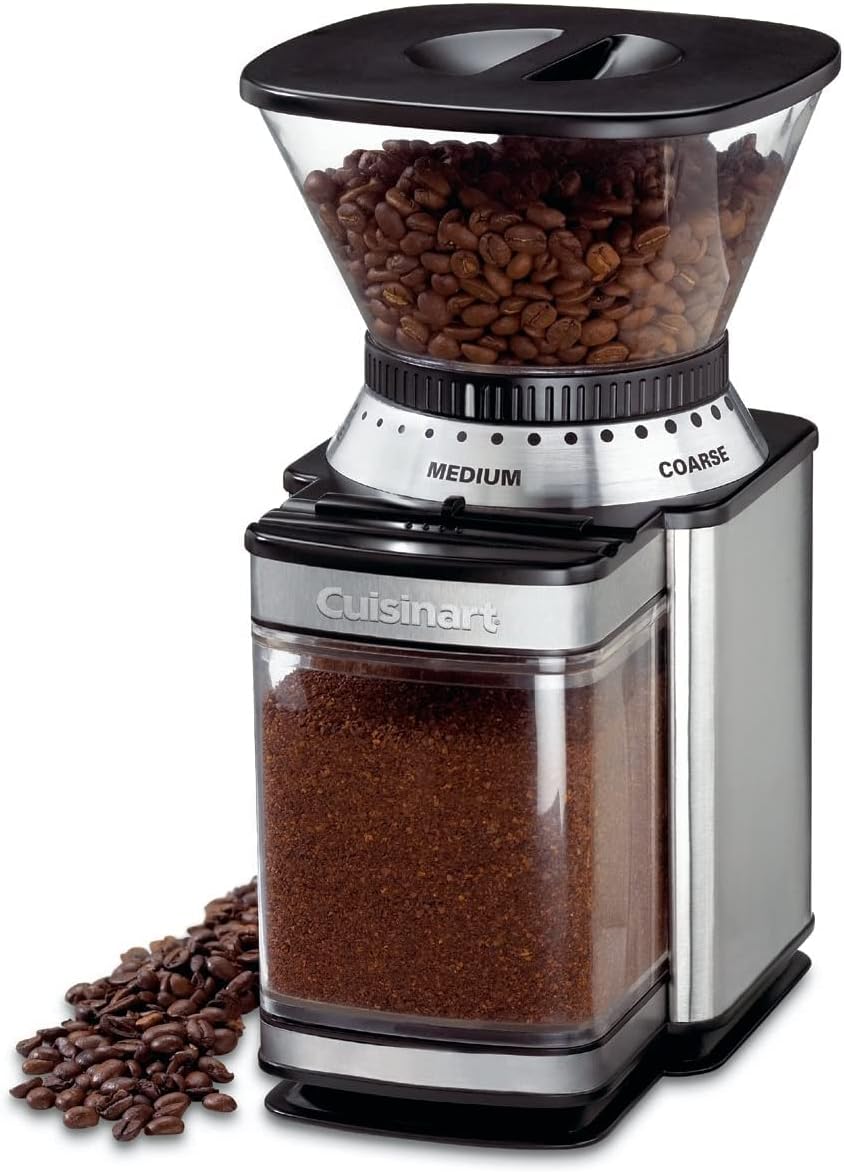
Cuisinart Supreme Grind Automatic Burr Mill DBM-8
- Electric burr mill
- 18 positions
- Daily drip and French press brewing
- 4–18-cup batch selection
- Discontinued: inspect seller support

Hamilton Beach Fresh Grind Coffee Grinder 80335R
- Manual-control blade
- Hold-and-release operation; no stepped selector
- Beginner prioritizing easy pouring, washing and compact storage
- Removable dishwasher-safe steel bowl
- Hidden power-cord storage
For the person who wants to compare methods and learn what extraction feels like, I favor the KRUPS. The Cuisinart offers a more straightforward entry to adjustable burr grinding, although the discontinued model deserves a careful look at the seller and warranty. If cleanup dominates the decision and the household mainly drinks everyday drip coffee, Hamilton Beach offers a practical removable bowl. These are different recommendations for different mornings, not three slightly reworded winners.
A first grinder should also make you comfortable saying no to features you do not need. You can make satisfying coffee without an LCD display, a built-in scale or a sophisticated espresso setting. Some people genuinely need that control eventually; many will not. Choosing the right level of simplicity now leaves more time to enjoy the coffee itself.
Top 5 Coffee Grinders for Beginners — At a Glance
Cuisinart Supreme Grind Automatic Burr Mill DBM-8
- Electric burr mill
- 18 positions
- 4–18 cup selector; grounds chamber holds enough for up to 32 cups
- Daily drip and French press brewing
- Removable hopper and grounds chamber; use a dry brush for grinder internals
- Discontinued model; static, audible motor and wider grind steps
KRUPS Precision Burr Coffee Grinder GX550850
- Electric flat burr
- 12 major settings plus micro-adjustments
- 2–12-cup selection
- Switching among drip, pour-over and French press
- Keep burr housing dry; empty and brush grounds chamber
- Distinct from GX500050; not a specialist espresso grinder

Mr. Coffee Multi-Grind 12-Cup Automatic Grinder BVMC-PBG77
- Automatic blade
- 5 timed grind settings
- 4–12-cup selector
- Beginner who wants automated grinding with a small learning curve
- Twist-to-clear Chamber Cleaning System plus removable bowl
- Blade grinding is less uniform than real burr grinding

BLACK+DECKER One-Touch Coffee Grinder CBG110S
- Manual-control blade
- Hold-and-release operation; no stepped selector
- Compact household batches; do not overfill
- Small kitchen, basic drip coffee and straightforward controls
- Unplug before cleaning; wipe the fixed bowl carefully; do not immerse motor base
- Fixed grinding bowl; uneven particles and no automatic portioning
Hamilton Beach Fresh Grind Coffee Grinder 80335R
- Manual-control blade
- Hold-and-release operation; no stepped selector
- Enough for up to 12 cups of brewed coffee
- Beginner prioritizing easy pouring, washing and compact storage
- Removable dishwasher-safe grinding bowl; never wash the motor base
- Blade grinder, not a substitute for adjustable burrs
Quick Ranking: Which Grinder Fits Your Starting Point?
| Your priority | My choice | Why it earns that position |
|---|---|---|
| Learning across several brew methods | KRUPS GX550850 | Flat burrs with 12 major settings and smaller adjustments |
| Simple first burr grinder | Cuisinart DBM-8 | 18 grind positions, larger quantity controls; older discontinued model |
| Automatic without a burr dial | Mr. Coffee Multi-Grind | Five programmed blade settings and automatic shutoff |
| The plainest possible control | BLACK+DECKER CBG110S | One push-button blade grinder with safety interlock |
| Easy emptying and washing | Hamilton Beach 80335R | Separate stainless steel removable grinding bowl |
What I Look for in a First Coffee Grinder
A good first grinder teaches a useful habit without creating unnecessary chores. The controls should make sense, the chamber should be easy to empty, and the coffee should suit the brewer sitting next to it. I prioritize those things over elegant product photography. The equipment should be sturdy enough for ordinary use but does not have to be a lifetime commercial investment. Most beginners will learn more from a week of consistent brewing than a week of reading complicated feature charts.
It helps to separate two goals: freshly ground coffee and precisely ground coffee. All five machines can produce fresh grounds. Only the burr machines offer a repeatable mechanical adjustment for target particle size. The blade machines control how long their chopping action runs, whether manually or through a preset. That is a real and important distinction, but it does not make every blade owner a second-class coffee drinker. Your preferred brewing method determines how much precision you need.
Five Detailed Beginner Coffee Grinder Reviews
1. Cuisinart Supreme Grind Automatic Burr Mill DBM-8
For a beginner preparing a full carafe of morning coffee, the first meaningful improvement is usually not a fancy tasting note. It is the ability to prepare a similar dose at a familiar grind day after day. That is why I still see appeal in a straightforward burr mill, provided the buyer understands its age and limitations.
The real beginner upgrade is repeatability
The Cuisinart DBM-8 is the model I place in front of someone who has grown tired of guessing how long to hold down a blade-grinder button. Its achievement is not high-end precision. The improvement is that the beans pass through a burr mechanism while you choose one of 18 grind positions. There is a clear physical relationship between the setting and the size of the grounds. That is a meaningful change when the same household brews a pot of drip coffee every morning. Rather than trying to reproduce a series of pulses, you return the dial to the position you liked yesterday.
The first thing I establish is a simple reference recipe: the same coffee, the same amount of water, and one middle grind setting. I recommend brewing it, taste it, and write down whether the cup seems heavy, sharp, thin, or balanced. Only then would I move the grind finer or coarser. Even with the most expensive grinder, changing beans, water, dose, and grind all at once makes improvement impossible to understand. The DBM-8 rewards a calm, repeatable approach and gives a beginner a better foundation than an assortment of unexplained numbers.
Cuisinart also gives you a 4–18-cup selector. I like the idea of a straightforward quantity control for households that make a full drip carafe, although I do not confuse the dial with a scale. Coffee density and bean size vary, so the weight delivered is not necessarily the same every time. If accurate strength matters, weighing beans remains the easiest upgrade to the workflow. The grind chamber is roomy, but storing finished coffee in it defeats much of the reason to grind fresh.
What gets easier after the first week
The second-week difference with an ordinary burr mill is psychological as much as mechanical: you stop staring at the grinding chamber and start thinking about what is happening in the brewer. The coffee may still produce some fines, especially toward its finer settings. Yet a medium grind for an automatic brewer becomes easier to recreate, and coarser French press adjustments have a clear reference point. This is where I see the value of a basic burr grinder—not in magical flavor promises, but in removing one source of uncontrolled variation.
There is a catch worth stating plainly. The DBM-8 is a discontinued product line, so I pay closer attention to condition, seller support, and return options than I am with a currently manufactured grinder. Its large plastic collection chamber can attract coffee dust. That is a nuisance, not a reason to reject it, but it is exactly the kind of detail you notice after repeated mornings. My preferred routine is to empty the container promptly and brush dry residue from the grinding path rather than letting grounds compact there for days.
For French press I begin on a coarse setting, then adjust based on sediment and extraction rather than assuming the far end of the dial must always be best. For pour-over, I begin somewhere in the medium range and watch the drain time. The Cuisinart does not need elaborate theory to produce useful results; its value lies in learning how a grind change affects a familiar cup.
Where I see value in upgrading—and where I do not
I do not recommend this machine as the centerpiece of an ambitious nonpressurized espresso setup. Eighteen marked positions sound generous until the correct espresso setting falls between two steps, and entry-level burr geometry may still produce a less controlled fine grind than a dedicated espresso grinder. That limitation does not diminish its usefulness for drip, immersion, or everyday filter coffee. It simply keeps the recommendation within its natural strengths.
The machine itself occupies more space than a compact blade grinder and makes an audible grinding sound. Neither issue would trouble me on a dedicated coffee counter. In a studio apartment with one occasional coffee drinker, however, the extra hopper and collection bin might be harder to justify. Beginners sometimes buy features for the kitchen they imagine rather than the coffee they actually brew. My rule is to fit the equipment to the next several months of realistic use, not to a distant aspiration of opening a café.
By the end of a first month, I aim for the owner to know two settings almost instinctively: one for their main brewer and one for an occasional second method. If they also have a dry-brush cleaning habit and stop measuring coffee only by vague scoop counts, that is already a substantial step forward. The DBM-8 is at its best when treated as a practical learning tool instead of an all-purpose professional machine.
Cuisinart DBM-8: What Matters in Daily Ownership
The first adjustment a beginner needs from the DBM-8 is a dependable reference, a sound basis for everyday brewed coffee. Its 18-position dial provides that reference for drip or French press. The cup selector gives the owner a convenient batch estimate, while a small scale remains useful for checking actual ground-coffee weight. These are strengths of the controls themselves, things that make daily preparation more manageable.
I place the discontinued status at the center of the longer-term decision. A damaged hopper, missing collection chamber, or weak return policy can cancel out an appealing purchase price. The plastic receiver and grinding passage also need regular brushing because coffee oils and fine particles do not disappear between uses. For someone who accepts those chores and brews ordinary filter coffee, the DBM-8 remains understandable and useful.
Over the following two weeks, the meaningful comparison is whether moving one or two burr positions changes flow and taste consistently. The fourth week is time to assess static, grounds left in the chute, and whether buying a discontinued model still feels sensible given the seller support.
Cuisinart Supreme Grind Automatic Burr Mill DBM-8
Daily drip and French press brewing. Older discontinued model; static, audible motor and coarse steps.
- Repeatable burr settings
- Straightforward 4–18-cup selector
- Large capacity for batch coffee
- Easy-to-locate controls
- A discontinued model
- Less precise at fine espresso settings
- Static and residual grounds are possible
Technical Specifications & Daily Features
- 18-position burr selector from ultra-fine to extra-coarse
- 4–18-cup quantity control with auto-stop
- Removable 8 oz bean hopper
- Separate one-touch activation bar
- Removable large grounds chamber
- Official DBM-8 product line marked discontinued
- Intended use: Daily drip and French press brewing
- Practical limitation: Discontinued model; static, audible motor and wider grind steps
I see the 18 marked grind positions and quantity selector as the DBM-8’s main beginner benefits. Its grounds chamber and accessible parts still need brushing and careful dry cleaning. Discontinued status also makes replacement-part and warranty terms part of the buying decision.
Pros & Cons After 30 Days of Use
My strongest reason to consider the Cuisinart DBM-8 is its 18-position burr adjustment. A beginner can establish a coarse setting for French press and a different one for drip brewing without estimating blade-running time. The 4–18-cup selector also makes larger household batches less fiddly. I regard those controls as useful conveniences, not evidence that the machine weighs the coffee or offers specialist espresso precision.
The trade-offs are equally plain. The DBM-8 is an older, discontinued model; replacement parts, seller support, and condition deserve more attention than they do with a current grinder. A plastic grounds chamber invites static and routine brushing, while the spacing of its burr settings limits fine tuning. For everyday brewed coffee it still has a sensible role, but the ownership case depends on a sound unit and a realistic price.
My Final Verdict
I recommend the Cuisinart DBM-8 only when its price and condition make sense for a beginner who brews ordinary drip coffee or French press. The straightforward burr dial and quantity selector are easy to understand, and a new coffee drinker gains repeatable reference settings instead of relying on guesswork with a blade.
Its discontinued status is a meaningful drawback, and I do not recommend it for demanding nonpressurized espresso. If the DBM-8 costs almost as much as a supported, current-generation burr grinder, my choice shifts to the newer model. The Cuisinart is a practical entry point, not a buy-at-any-price classic.
The Cuisinart offers a good reminder that beginner-friendly does not mean universally capable. I recommend buying it only for the ordinary brewed-coffee routine it handles well, and I weigh the discontinued status against whatever other burr models are available at the time.
2. KRUPS Precision Burr Coffee Grinder GX550850
Some beginners arrive with a single drip brewer; others already have a French press, dripper and AeroPress cluttering the counter. When someone genuinely enjoys switching methods, I take a closer look at the KRUPS than the simplest models here. Its separate major and intermediate adjustments provide a logical route from one working recipe to another.
A more flexible dial for the curious beginner
I place the linked KRUPS model above a basic starter burr mill for the person who knows they will switch between coffee methods. The essential correction is the model number: the product linked here is GX550850, not GX500050. It uses flat grinding disks, twelve main settings, and additional small adjustments between them. That last detail matters more than a flashy number printed on a box. A new brewer who enjoys a Hario dripper on Saturday and a French press on Sunday can return to a working setting and then make a smaller correction without guessing at pulse length.
What I appreciate about the KRUPS arrangement is how it encourages experimentation within manageable limits. The learner does not have to master dozens of nearly identical positions before brewing a decent cup. Start with a middle setting, prepare the coffee exactly as before, and pay attention to whether the water moves too quickly or too slowly. In pour-over, that simple observation can tell you far more than someone else’s supposedly perfect dial number. In French press, sweetness and the amount of settled sediment are often more useful than the time it takes to grind.
The 2–12-cup selector adds everyday convenience, particularly when one person makes a small morning serving and a partner joins for a larger pot on weekends. Still, I favor weighing the whole beans separately when chasing consistency. The cup control changes the duration or quantity of grinding; it cannot know how much coffee is right for your chosen recipe.
Learning what the extra adjustments can and cannot do
An intermediate grind adjustment is helpful only when the brewer has a reason to use it. New owners sometimes confuse the act of making tiny changes with improvement. I recommend making three ordinary brews at the same position. If the cups are similarly under-extracted, move finer. If they all taste harsh and drain sluggishly, move coarser. If one cup is good and the next is not, check dose, water temperature, pouring technique, and the freshness of the beans before declaring the grinder inconsistent. This is the practical method I teach a first-time buyer who wants to learn instead of chasing endless settings.
The KRUPS is a flat-burr grinder, but I resist turning that into a blanket claim that every particle is identical. Real coffee grinding always creates a distribution of sizes; price, burr alignment, bean hardness, and the chosen setting all influence it. Compared with a blade grinder, a burr system offers a more repeatable way to pursue a particular texture. It does not guarantee perfect espresso shots or eliminate every fine particle. That distinction helps set expectations without underselling the advantage of the design.
Cleaning deserves attention sooner than many beginners expect. Empty the grounds bin after brewing, keep moisture away from the motor and burr chamber, and brush away residue as permitted by the manual. I also avoid storing beans permanently in the hopper if the kitchen is warm or bright. An airtight container, filled with only enough beans for the coming days, is usually kinder to flavor than treating the grinder as long-term storage.
The first month with more than one brew method
During the first several days, my advice would be to choose one filter-coffee recipe and resist unnecessary adjustments. In the second week, bring in a second brewing method, write down the two grind positions, and compare how much extra work changing between them creates. During weeks three and four, pay attention to the grounds transfer, static, cleanup, and whether the larger hopper feels convenient or merely takes up space. This is a realistic way to evaluate a multi-method grinder while keeping attention on the everyday workflow.
The GX550850 is not the machine I recommend buying for someone whose sole ambition is dialing in demanding, traditional espresso with an unpressurized basket. It can reach fine settings, but the requirements for espresso are narrower and less forgiving than for drip or immersion. A dedicated espresso grinder provides a different level of adjustment and control. By contrast, a beginner preparing filter coffee, AeroPress, and weekend French press has plenty to learn and enjoy here.
I favor KRUPS over the smallest blade alternatives when the buyer wants to understand extraction, not merely reduce the cost of fresh beans. That is an investment in the brewing habit. A few weeks spent noticing how grind adjustments change the same recipe can be more valuable than buying a complicated machine and never moving past its default.
KRUPS: Keeping Two Brewing Settings Under Control
The KRUPS offers a more interesting progression than turning a dial at random. I establish one medium-grind reference for the daily brewer, then use its intermediate settings only when a specific flavor or flow problem appears. That is how the extra steps translate into something tangible for a beginner. A second method such as French press introduces a separate coarse reference, not a requirement to adjust every morning.
Longer-term convenience comes down to three parts: how confidently those settings can be revisited, how thoroughly the grounds path is cleaned, and whether the 2–12-cup selector suits actual household doses. I give these practical details more weight than a single score. I value the KRUPS because the mechanical control supports deliberate brewing decisions, while its ordinary burr-maintenance requirements remain easy to understand.
In week three, switching to a French press becomes an informative exercise: how quickly can you return to yesterday’s filter setting? By day thirty, the KRUPS should have helped you understand both a repeatable grind dial and the cleaning it demands.
KRUPS Precision Burr Coffee Grinder GX550850
Switching among drip, pour-over and French press. Not the GX500050 named in an older model description; not a specialized espresso grinder.
- Useful middle-grind adjustment
- Flat-burr system rather than blades
- Simple quantity selection
- Compact body for a burr machine
- Requires dry brushing and regular maintenance
- Espresso range has limitations
- A little more dial learning than one-button grinders
Technical Specifications & Daily Features
- Model GX550850 Precision Burr Grinder
- 12 major grind settings with intermediate adjustments
- Flat burr grinding disks
- 2–12-cup quantity control
- 8 oz bean hopper
- Approximate body size 7.28 × 4.41 × 10.35 inches
- Intended use: Switching among drip, pour-over and French press
- Practical limitation: Distinct from GX500050; not a specialist espresso grinder
Flat grinding disks and twelve major positions with intermediate adjustment give the GX550850 a practical filter-brewing range. I still use a scale to establish dose, and I keep moisture away from the burr and motor housing during cleaning.
Pros & Cons After 30 Days of Use
The KRUPS GX550850 stands out because its flat burrs and twelve major grind settings have intermediate adjustments. That is genuine flexibility for someone moving between pour-over, a drip machine, and French press. I value having a recognizable starting position, followed by the option to make a smaller change when taste or water flow calls for it. Its 2–12-cup selector is convenient for varied household batch sizes.
The drawbacks concern upkeep and realistic expectations. The burr chamber and exit path collect residue and need careful dry brushing, and the cup selector does not measure grams. More adjustment choices also ask the owner to develop a few reliable references rather than spin the dial without purpose. I recommend this model chiefly for filtered coffee; it is not my answer for tightly controlled traditional espresso shots.
My Final Verdict
My top choice in this five-grinder comparison is the KRUPS GX550850 for a beginner who actually wants to learn why grind size changes coffee. Its twelve broad settings plus smaller in-between corrections give it a more useful learning path than any of the three blade machines. I also prefer its versatility when more than one filter brewer shares the counter.
I do not call it a professional espresso grinder or a maintenance-free appliance. I recommend it to curious home brewers who want an accessible mechanical dial and enough adjustment to work methodically with different coffee recipes. The extra control has a practical purpose here, not just a better-looking specification.
If the new brewer enjoys making small changes and learning why cups taste different, KRUPS offers the most interesting adjustment path in this particular five-product group. That is a reason to buy it, not a promise of perfect extraction on every setting.
3. Mr. Coffee Multi-Grind 12-Cup Automatic Grinder BVMC-PBG77
This is the choice that makes sense only if we first stop calling every automatic grinder a burr grinder. The Mr. Coffee Multi-Grind makes a strong convenience argument but uses blades. I like that straightforward tradeoff for the right household: fewer steps before brewing, while accepting that particle uniformity will not match a thoughtfully adjusted burr system.
Why automatic does not mean burr
The Mr. Coffee Multi-Grind has an interesting position in a beginner lineup because it feels like an automatic grinder while retaining a blade mechanism. That difference is easy to miss. This model is BVMC-PBG77. It uses stainless steel blades, five programmed grind settings, a cup selector for four through twelve cups, and automatic shutoff. Unlike a basic press-and-hold appliance, it can finish its own timed cycle. Unlike a burr grinder, it still chops beans as they move around the chamber. Both facts deserve equal space in the recommendation.
I can see the appeal for a household where mornings are hurried and nobody wants to stand over a button waiting to stop at approximately the right second. Choose a setting, select a quantity, secure the lid, and let the machine handle the cycle. That convenience is genuine. It does not mean the particles emerging from the bowl are as consistent as those from a well-adjusted burr set. A programmed time is an imperfect substitute for controlling the gap between burrs, especially when beans differ in size or roast level.
For someone making a large automatic-drip pot, that tradeoff can be acceptable. A typical drip brewer is forgiving enough that modest variation may not dominate the cup. A clean, fresh dose of decent beans is a worthwhile improvement over coffee left open in a bag for months. I still avoid promising that selecting “fine” transforms this blade grinder into a true espresso mill.
The chamber-cleaning trick that matters more than its speed
The unusual feature here is the Chamber Cleaning System, designed to help dislodge grounds from the walls, combined with a removable grinding chamber. Small conveniences often decide whether an affordable appliance stays on the counter or moves into the back of a cupboard. A grinder that is annoying to empty can make the owner resent a perfectly good morning habit. For that reason I recommend spending more time assessing the Mr. Coffee’s pouring and cleanup experience than celebrating its automatic timer.
I also take a little care with its cup settings. Four cups on the control are a programmed quantity, not an instruction to skip measuring if you want a precise brew ratio. The coffee maker’s definition of a cup might differ from the mug on your desk. If you brew 600 milliliters and want to begin near a 1:16 ratio, weigh about 37 to 38 grams of beans, then evaluate strength and extraction separately. Nothing about that procedure requires expensive equipment. It just prevents the grinder’s labels from becoming mysterious flavor controls.
In use, blade chopping produces a mixture of small and larger particles. Some fine powder can make a French press muddy and can slow a paper-filter brew. If that happens, I reconsider the dose and duration before assuming the beans themselves are poor. When the results become a recurring frustration, the logical next step is an adjustable burr grinder, not a more complicated sequence of timed blade pulses.
What thirty mornings can teach
On the first day, the Mr. Coffee wins attention for how little explanation the buttons need. By the end of the first week, the real question is whether its presets yield cups the household actually likes. I recommend comparing a repeatable drip recipe on two or three settings rather than changing beans with every brew. During the second week, a quick daily wipe and regular chamber emptying will reveal whether the cleanup system is as helpful for that kitchen as it sounds on paper.
Weeks three and four are when I decide if automation has made a difference. If the grinder lives beside the brewer and the whole routine is more pleasant than scooping pre-ground coffee, it is serving a purpose. If brewing demands more control, particularly for single-cup pour-over, the blade construction will become its limiting factor. Convenience and grind quality are separate considerations; this model puts the first ahead of the second.
My verdict is deliberately narrow: it is a useful automatic blade grinder for beginners who prize a simple programmed routine. It is not a secret substitute for a quality burr mill, and it is not the same product as the older IDS77 discussed in some comparisons. Knowing those boundaries helps shoppers choose it for the right reasons.
Multi-Grind: The Convenience and Its Limits
I measure the Multi-Grind’s usefulness by how effectively its presets simplify a real household task. The machine runs a selected blade-grinding cycle and stops automatically; that reduces attention at the counter. Its five settings still alter chopping duration rather than establish five fixed particle gaps. The difference matters most when a brewer becomes sensitive to fines or uneven extraction.
The chamber-cleaning twist and removable bowl help with the other half of the routine: emptying and washing. I value those conveniences more than a claim that every timed cycle makes identical particles. The deciding question is whether the household primarily values automatic drip preparation or expects to dial in filter coffee with the precision that only an adjustable burr mechanism supplies.
In the third week, watch whether timed automatic operation is actually saving attention. The fourth week is for the honest ownership verdict: are the grounds consistent enough for the family’s brewer, or have the limits of blade chopping become the main thing the owner notices?
Mr. Coffee Multi-Grind 12-Cup Automatic Grinder BVMC-PBG77
Beginner who wants automated grinding with a small learning curve. Blade grinding is less uniform than real burr grinding.
- Automatic grind cycle
- Cup quantity selection
- Removable chamber
- Useful cleanup mechanism
- Blade-size variation remains
- A timed setting is not a particle-size guarantee
- No burr dial to return to an exact particle size
Technical Specifications & Daily Features
- Model BVMC-PBG77 Multi-Grind
- Five programmed coarse-to-fine grind settings
- Stainless steel chopping blades
- 4–12-cup quantity selector
- Automatic shutoff and lid-interlock safety
- Removable grinding chamber and Chamber Cleaning System
- Intended use: Beginner who wants automated grinding with a small learning curve
- Practical limitation: Blade grinding is less uniform than real burr grinding
This BVMC-PBG77 is an automatic blade grinder with five time-oriented grind settings, 4–12-cup selection, a removable chamber and a cleaning mechanism. The controls are conveniences; they are not a physical burr adjustment.
Pros & Cons After 30 Days of Use
The Mr. Coffee Multi-Grind BVMC-PBG77 makes its case through automation rather than burr precision. Five programmed blade-grinding settings, a 4–12-cup selector, automatic shutoff, and a lid safety switch help simplify the steps before an ordinary drip brew. Its removable chamber and twist-operated cleaning feature are especially relevant for a busy kitchen where loose coffee dust becomes an everyday irritation.
I separate those conveniences from actual grind-size control. The stainless blades repeatedly chop beans, producing a wider mix of fragments and fines than a controlled burr gap. Programmed time cannot reproduce a particular particle size across beans and dose sizes. I regard this as a useful household blade appliance, not an alternative to a burr grinder for demanding pour-over or espresso.
My Final Verdict
I recommend the Mr. Coffee Multi-Grind for beginners who prefer automatic operation and easy chamber handling over small grind-size corrections. The five presets, quantity selection, and auto-stop suit a household that mainly wants fresh grounds for a regular coffee maker without supervising every second of chopping.
My reservation is decisive: it remains a blade grinder. If the primary goal is predictable pour-over drainage, cleaner French press texture, or a repeatable grinding gap, I favor the KRUPS or Cuisinart burr machine instead. The Multi-Grind earns its place by making preparation simpler, not by disguising its mechanism.
I can imagine the Mr. Coffee making coffee preparation easier for a family that dislikes standing over a button. I cannot imagine recommending it as an alternative to a dedicated precision burr grinder. Convenience is its honest strength.
4. BLACK+DECKER One-Touch Coffee Grinder CBG110S
A first grinder does not always need an elaborate learning curve. A student, occasional coffee drinker or traveler using a basic drip maker may want nothing more than a quick way to break up whole beans. BLACK+DECKER offers that simplicity in a compact machine. I do not confuse it with precision grinding, but I do not pretend simple equipment has no place either.
A button, a bowl, and very little to learn
The BLACK+DECKER CBG110S makes the strongest case for simple controls. There is no selector ring, touchscreen, programming routine, or grounds chute. Put whole beans in the stainless steel bowl, secure the lid, and press the button. Release it when the beans are ground to roughly the texture you want. That is the whole interface. A new coffee drinker may prefer that to navigating settings before they even know whether they like French press or drip coffee.
The limitation is built into the same simplicity. A blade spins through beans at high speed, and the pieces that spend longer near it become smaller than those that escape its path. Pressing for a longer period produces finer material on average, but not the consistent particles required for repeatable espresso. I use it for ordinary drip coffee with realistic expectations, and treat French press as possible but potentially more sediment-heavy. For a careful pour-over routine, an adjustable burr grinder is the more sensible purchase.
I also prefer not to call it a universal replacement for every spice grinder in a kitchen. The appliance can chop dry spices, but aromas from cloves or cumin are stubborn. If the same chamber will handle coffee every morning, keeping it dedicated to coffee avoids carrying last night’s curry into breakfast. It sounds obvious until the first unexpectedly aromatic mug.
Learning a pulse rhythm without mistaking it for calibration
A beginner using the CBG110S can improve results by grinding modest batches and pausing to redistribute beans. Short pulses with the lid secured can reduce the tendency to create a layer of very fine powder while larger pieces remain untouched. Always let the blades stop before removing or repositioning the lid, and never put a utensil into a connected grinder. I favor this simple routine because it respects the mechanism rather than pretending there is a hidden setting capable of perfect consistency.
The grinding bowl is part of the electrical appliance. That makes cleanup different from a grinder with a removable dishwasher-safe cup. Unplug the machine, brush or wipe residue from the bowl, and follow the model’s care instructions. Do not immerse the motor base. The steel can be cleaned without elaborate disassembly, but it does not mean the whole unit belongs under a running tap. This is one of the most important practical distinctions between this BLACK+DECKER and the Hamilton Beach model later in the article.
I do not attach a made-up noise score to such a small appliance. It makes the normal sound of a high-speed blade chopping beans; whether that feels intrusive depends on the household and time of day. The upside is that the action is brief. For someone who only grinds an occasional serving, a short burst of noise may matter less than saving money and cupboard space.
When a cheap grinder is the sensible choice
It is tempting to push every beginner toward a burr grinder, but there are reasonable exceptions. A student preparing one basic drip pot on weekends might prefer a compact appliance that is easy to put away. Someone replacing a broken grinder while saving for a better one may need a temporary, inexpensive tool. A household that drinks mainly store-ground coffee but wants to try whole beans now and then may not benefit from a larger countertop machine. The BLACK+DECKER suits these situations better than it suits careful brewing experiments.
Over a first month, I ask three questions. Are the grounds easy to move into the filter without making a mess? Is the cup enjoyable even though the grind isn’t perfectly uniform? And is cleaning simple enough that the owner keeps doing it? A person answering yes does not need to apologize for using an inexpensive blade grinder. But if the same person begins chasing lighter-roast sweetness or precise pour-over drainage, it becomes time to consider what a burr machine adds.
I recommend this as a simple first encounter with whole beans, not as the final grinder for a demanding barista. A little honesty about what it cannot control makes the purchase more satisfying and sets the stage for a smarter upgrade later.
BLACK+DECKER: The Simplicity–Precision Trade-Off
The CBG110S keeps ownership simple but places more responsibility on the person doing the grinding. Its one-touch control has no numerical setting to remember. A modest dose and a consistent, short chopping routine are easier to manage than pushing the button continuously while hoping larger pieces catch up with fine powder. That is practical technique, a practical part of using this design.
The fixed steel bowl creates the most noticeable maintenance compromise. Unlike a detachable chamber, it must be brushed or wiped without immersing the powered body. I recommend it for occasional drip coffee when the low price, compact size, and uncomplicated switch matter more than extraction precision. A buyer who grows frustrated by sediment or erratic pour-over flow has reached the machine’s natural limit.
During week two, notice whether small changes in grind time shift the cup enough to matter. In weeks three and four, cleaning the attached steel bowl and storing the power cord will be more decisive than experimenting with extreme fineness. A beginner whose coffee already tastes good may have no reason to complicate the routine.
BLACK+DECKER One-Touch Coffee Grinder CBG110S
Small kitchen, basic drip coffee and straightforward controls. Fixed grinding bowl; uneven particles and no automatic portioning.
- Very easy to understand
- Small countertop footprint
- No menus or programming
- Built-in safety interlock
- No burr precision
- Cleaning an attached bowl takes care
- Not recommended for dialing in nonpressurized espresso
Technical Specifications & Daily Features
- Stainless steel blades and steel grinding bowl
- One-touch push-button operation
- Lid-locking safety feature
- 150 W rated power
- No separate burr size setting
- Fixed grinder body requires careful cleaning
- Intended use: Small kitchen, basic drip coffee and straightforward controls
- Practical limitation: Fixed grinding bowl; uneven particles and no automatic portioning
This model’s control is the one-touch button, not a marked particle-size scale. I treat its locking lid and careful fixed-bowl cleaning as the most important operating details for beginners.
Pros & Cons After 30 Days of Use
The BLACK+DECKER CBG110S is appealing because its operation is immediately understandable: secure the lid, press the button, and release it to stop. The compact body and lid-locking interlock make sense for a student, a small kitchen, or occasional coffee preparation. I like its lack of complicated controls when a buyer simply needs a modest way to start grinding whole beans.
The drawback is that blade timing substitutes for a grind-size dial. The fixed bowl requires careful cleaning while attached to the electrical base, and a longer run does not create uniform grounds. This simplicity is an advantage for occasional drip coffee, but it becomes restrictive for people trying to make delicate filter recipes consistent. I also keep the appliance unplugged while cleaning around its sharp blade.
My Final Verdict
I recommend the BLACK+DECKER CBG110S as a compact, straightforward first grinder for occasional brewed coffee and tight budgets. Its greatest virtue is how little a beginner has to learn to operate it safely. No interface complexity, large hopper, or elaborate setup stands between beans and a basic drip machine.
I do not recommend it for precise pour-over or espresso preparation. The permanently attached bowl and broad particle-size spread are meaningful compromises, especially beside the removable-bowl Hamilton Beach and the two burr grinders. Choose it for simplicity, not a promise of finely controlled extraction.
The BLACK+DECKER is refreshingly plain. It can introduce someone to grinding whole beans without asking for much money or counter space; the more demanding the brewing method, the sooner its particle-size limits will matter.
5. Hamilton Beach Fresh Grind Coffee Grinder 80335R
The grinding itself is not the only step that can put a beginner off. Transferring coffee out of a cramped chamber and trying to clean around a blade can be more irritating than grinding beans. I like the Hamilton Beach design because its removable bowl gives a straightforward answer to both chores while keeping the controls uncomplicated.
The removable bowl changes the conversation
The Hamilton Beach Fresh Grind 80335R has a particular advantage that is easy to underestimate: the grinding chamber lifts out. Most people notice the blades, the price, or the push-button operation first. I notice how the grounds will get from the grinder into the brewer. An attached bowl asks you to lift the entire appliance or spoon coffee from a confined space. A removable stainless steel chamber can be lifted and tipped over the filter basket, then washed separately. That is a small mechanical difference with a large effect on morning tidiness.
It is still a blade grinder. I never tell a new buyer that a removable chamber magically creates uniform particles. For drip coffee, with a modest batch and controlled grinding time, this can be an accessible way to start using fresh beans. For French press, the natural mixture of fines and larger particles may lead to a cloudier cup. For pour-over, the fines can alter drawdown enough to frustrate a beginner who is trying to understand one variable at a time. Those are limitations of the grinding method rather than the cleaning design.
I also like the hidden cord storage. In a small apartment, being able to wind the cord away is more useful than another decorative chrome accent. The grinder can be stored between uses without dangling cable loops catching on other appliances. It is the kind of unglamorous feature that becomes more valuable after a few weeks than a flashy indicator light.
How I keep a blade grinder useful
The sensible routine is to grind only the dose you need, use brief controlled bursts, and inspect the grounds before brewing. There is no numbered adjustment ring; texture depends on batch size, duration, and how the beans circulate. Rather than chasing a universal number of seconds, I recommend learning the texture of coffee that tastes good in the household’s usual brewer. If the batch suddenly tastes harsh, it is worth comparing the grounds visually with a previous successful brew and checking whether a larger dose caused the beans to circulate differently.
The removable metal bowl is dishwasher safe. That makes thorough cleaning easier when oils accumulate, especially after several dark-roast batches. I let it dry completely before placing it back on the motor base. The appliance body remains an electrical item and should never be submerged. This is a model where the everyday cleaning experience matters as much as the grinding speed. If a household brews daily and hates brushing tiny corners, the ability to detach the bowl may decide the purchase.
The 80335R can grind enough coffee for a household pot, but that does not mean every full bowl will grind equally well. Avoid overfilling. Working with smaller, repeatable batches gives the blades more room to circulate the beans and makes a new user’s results easier to understand. The coffee may taste good while retaining some particle-size variation.
A realistic four-week ownership verdict
The first week with a simple blade grinder should be about learning how much coffee fits a typical breakfast brew and how the button changes texture. During the next week, I recommend comparing a short, coarse pulse sequence with a somewhat longer grind while keeping water and coffee weight constant. The difference in the cup can teach a beginner what overgrinding looks and tastes like, even if the machine lacks a burr dial. The important outcome is a habit of observation, not the pursuit of exact sound or particle-size numbers.
By weeks three and four, cleanup is often the deciding factor. A removable bowl may be washed after dark-roast coffee or spice grinding; a hidden cord can make storage less annoying. I also watch whether the machine encourages brewing fresh coffee or becomes an appliance nobody bothers to retrieve. The best grinder for a beginner is often the one that fits a repeatable routine rather than the machine with the most impressive description.
For the right buyer I consider Hamilton Beach the most convenient of these simple blade options. I still recommend Cuisinart or KRUPS first when someone intends to explore pour-over, espresso-style brewing, or consistent adjustments over time. The Hamilton Beach offers ease, not the calibration of a burr grinder, and that is a perfectly legitimate difference.
Hamilton Beach: The Cleanup Advantage Over Time
The removable bowl is the most convincing ownership detail on the Hamilton Beach. It separates coffee transfer and washing from the motor base, so the user is not repeatedly tipping the entire grinder over a filter. I regard that as an everyday advantage for casual brewers, not merely a specification to tick off.
The rest of the ownership picture is more restrained. This is still a blade machine without stepped particle-size control; coffee texture depends on dose, bean circulation and grinding time. The bowl must dry completely after washing, and the electrical base stays out of the sink. I recommend the 80335R for easy cleanup and basic brewed coffee, while preferring a burr machine for systematic grind adjustment.
In the next two weeks, compare a consistent medium grind with a slightly coarser result for immersion brewing. By the final week, ask whether the washable bowl and hidden cord storage make fresh grinding easier than buying pre-ground coffee. That is the natural strength of the Hamilton Beach, not burr-level precision.
Hamilton Beach Fresh Grind Coffee Grinder 80335R
Beginner prioritizing easy pouring, washing and compact storage. Blade grinder, not a substitute for adjustable burrs.
- Separate washable chamber
- Pour grounds without tipping the motor unit
- Compact with concealed cord
- Simple one-button learning curve
- No adjustable burr setting
- Blade particle variation
- Chamber must be completely dry before use
Technical Specifications & Daily Features
- Original linked model is 80335R
- Stainless steel blade grinder
- Removable, dishwasher-safe grinding chamber
- Enough whole beans for brewing up to 12 cups
- Push-button press-and-release operation
- Hidden cord storage in the base
- Intended use: Beginner prioritizing easy pouring, washing and compact storage
- Practical limitation: Blade grinder, not a substitute for adjustable burrs
The removable stainless grinding bowl, dishwasher-safe when separated from the motor, is the 80335R’s signature practical feature. A clean, fully dry bowl and a sensible small batch matter more here than a numbered grind setting the machine does not have.
Pros & Cons After 30 Days of Use
The Hamilton Beach 80335R has the most useful cleanup advantage among the three blade models: its stainless-steel grinding bowl lifts out of the motor base. Grounds can be poured into a filter without tipping an entire electrical appliance, and the detached bowl is dishwasher-safe when cleaned according to the care instructions. The simple button and concealed cord storage suit a compact kitchen.
What the removable bowl cannot do is turn blades into burrs. Grind size remains dependent on chopping time, bean movement and dose, so some powder and larger fragments are normal. The washed bowl also needs to be completely dry before it is returned to the machine. I regard it as a tidy, approachable blade grinder rather than a tool for fine adjustments in a V60 or espresso basket.
My Final Verdict
Hamilton Beach earns my strongest recommendation among the blade options for the beginner who values a clean counter and effortless transfer. The removable bowl is a genuine mechanical convenience, especially compared with fixed-chamber models that have to be tipped or brushed out while attached to the motor body.
I still recommend a burr grinder for someone who wants repeatable filter-coffee adjustments. But for a casual drip coffee drinker who wants fresh beans, a simple switch, and a bowl that can be cleaned separately, the 80335R is a sensible choice. Its practicality is more persuasive than unsupported claims of precision.
For a first grinder that can be emptied and washed without fuss, Hamilton Beach has an appealing everyday answer. Its removable bowl is the reason to choose it over a fixed-bowl blade grinder, not any claim that it produces burr-level uniformity.
Buying Guide: How to Choose a Beginner Coffee Grinder
Start with the coffee you actually make
I begin every grinder purchase with the brewer, not the grinder. A beginner using a standard drip machine every day has different needs from someone learning V60 pouring or experimenting with a pressure-based espresso machine. Drip coffee is forgiving enough that either a basic burr mill or a simple blade grinder can produce an enjoyable cup. Pour-over exposes grind differences more clearly because small particles can slow drainage and large ones can under-extract. French press allows longer contact with the grounds but can reveal excess fines as sediment. Espresso creates the narrowest margin for error, especially with a nonpressurized basket.
Write down the brewer you use five mornings out of seven. Add a second method only if it is something you genuinely prepare. If both are filter methods, a straightforward electric burr grinder may cover the household for years. If one is serious espresso, the right question might be whether to buy a dedicated espresso grinder instead of forcing a budget model to do everything. This prevents the beginner mistake of buying a long list of settings that never contribute to better coffee.
Burr versus blade: why they are not interchangeable
A burr grinder pushes beans through a controlled gap between cutting surfaces. Moving those surfaces changes the target grind size in a repeatable way. A blade grinder uses rotating knives to chop beans within a chamber. The longer it runs, the more pieces are repeatedly hit, but there is no fixed exit gap determining particle size. Both can make beans smaller; they do not provide the same kind of control.
I recommend a burr grinder when the reader intends to adjust brew time, extraction, or flavor methodically. I do not claim that every inexpensive burr machine outperforms every blade grinder in every sensory test. The important point is repeatability: a dial gives you a location to return to. With a blade machine, you are trying to recreate timing, batch size, and how the beans moved. For casual drip coffee that may be sufficient, while a dedicated brewing hobby often makes a burr upgrade worthwhile.
Why the number of grind settings is not a quality score
An advertised count is only part of the design. Twelve positions with useful intermediate steps can be more convenient than thirty positions spread awkwardly across the wrong range. A grinder’s adjustment system has to match its burr geometry and intended brewing methods. More clicks cannot repair poor alignment, worn burrs, or a chute that holds stale powder. That is why I never rank a beginner grinder solely by the largest number on its packaging.
The Cuisinart has 18 marked settings. KRUPS uses 12 major settings with smaller adjustments. The automatic Mr. Coffee has five programmed blade settings, not five physical burr gaps. BLACK+DECKER and Hamilton Beach offer button control rather than calibration. They are different mechanisms. The buyer should not treat all those numbers as interchangeable or interpret their absence as a flaw for an appliance designed purely for simplicity.
Get a small scale before another accessory
Coffee ratios sound technical until they solve a very ordinary problem. Suppose one morning you use a rounded scoop, and the next morning you use a different roast packed loosely into the same scoop. The weight changes even if the scoop looks full both times. If the coffee then tastes different, you have no way to know whether the grinder was responsible. A small digital scale removes much of that uncertainty.
For filter coffee I may begin around 1 gram of coffee to 16 grams of water, then adjust for taste. That is a starting point, not a rule about what every coffee must taste like. For 400 grams of water, 25 grams of beans offers a clear reference dose. Keep that constant while exploring one grind adjustment at a time. The result is a brewing habit that teaches useful cause and effect rather than a collection of random tweaks.
How to recognize a useful grind by eye and taste
A medium grind should look reasonably like a uniform field of distinct grains rather than a mixture of powder and large bean fragments. The exact appearance varies with roast, light, and even how freshly ground coffee clumps. I do not try to estimate microns by staring at a kitchen counter. Instead, use visual texture as one clue and the brewed cup as the main judge. If pour-over takes an unusually long time and tastes drying, fines or excessive fineness may be contributing. If it drains much too quickly and seems thin, move finer while preserving the other variables.
French press offers different clues. A little sediment is normal, but a thick layer of sludge may mean too much fine material or aggressive pouring. Bitter coffee can also come from roast level, water temperature, brewing time, and strength, so blaming the grinder alone is too simplistic. Learning to taste slowly is more useful than memorizing a chart with an allegedly perfect number beside each brewer.
Static, mess and retention in a beginner kitchen
Coffee dust clinging to a plastic grounds bin is not glamorous, yet it affects how often a new owner enjoys grinding. Static is influenced by bean moisture, air humidity, materials, and how the grounds travel through the appliance. It tends to be more noticeable when the air is dry. Residual grounds inside a chute can also mix yesterday’s coffee with today’s dose, which matters especially when switching beans or brewing small servings.
My basic routine is modest: empty the collection area completely, tap lightly where appropriate, and brush away powder after the machine is unplugged. Some experienced brewers use a very small amount of water on beans to reduce static, but I do not advise adding moisture to an appliance unless the manufacturer permits it. Keep the burr chamber dry. For a first-time owner, consistent dry cleaning beats an elaborate technique that could damage the grinder.
What the hopper does and does not tell you
Bean capacity is useful when a family brews a full pot, but I do not recommend buying the biggest hopper simply because the number looks impressive. Fresh beans lose aroma after exposure to air, moisture, heat, and light. A removable hopper is convenient for filling and for routine cleaning; it is not automatically the best storage container for all the coffee in your kitchen. The most flavorful workflow often means keeping most beans sealed and measuring a dose when you are ready to brew.
For a compact blade grinder, chamber size becomes a different concern. Overfill the bowl and the beans may circulate poorly. Grind tiny amounts and the blades may throw them against the wall. Follow the machine’s instructions and learn which batch size works most reliably for your normal recipe. The objective is not to fill every available cubic centimeter.
Choosing a grinder that is pleasant to clean
Before buying, picture the end of a rushed Monday morning. The grounds have been transferred, coffee is brewing, and nobody wants to disassemble six small pieces. Cuisinart and KRUPS offer removable collection components but require careful dry cleaning around their grinding mechanisms. Mr. Coffee adds a twist-operated chamber cleaning aid. BLACK+DECKER keeps the bowl attached, so wiping and brushing need care around the motor base. Hamilton Beach provides a removable bowl that can be placed in the dishwasher once detached.
This may sound less exciting than a discussion of burr sizes, but inconvenience accumulates. A machine that is quick to empty and safe to clean encourages fresh grinding every day. I prefer to own a modest grinder that I keep clean than a technically superior one whose chute contains weeks of old coffee.
Safety rules that should become automatic
Unplug an electric grinder before cleaning, removing burr parts, or reaching near the blades. Never immerse its motor base. Keep fingers, utensils, and damp cloths away from moving parts. For models with removable bowls, confirm that the removable part—not the electrical base—is the item described as dishwasher safe. Allow washed components to dry completely before reassembly. A lid-locking feature adds protection, but it does not justify bypassing the safety mechanism or opening the machine while anything is spinning.
I also keep power cords away from a hot stovetop, wet sink edges, and places where someone might pull them accidentally. Coffee preparation is meant to be a pleasant routine; basic appliance care should not be treated as an optional technical detail.
When you should skip a budget grinder altogether
If you already know you want to make several nonpressurized espresso shots every day, I recommend looking beyond this group. The fine adjustments needed to control espresso flow are more demanding than those needed for ordinary drip coffee. A machine described as “espresso capable” may grind finely enough for some pressurized baskets without having the precision or consistency required for an unpressurized portafilter. I prefer to be candid now than have a new barista blame their beans, tamper, or espresso machine for a limitation in the grinder.
Similarly, a dedicated pour-over enthusiast who values transparent light-roast flavors may soon outgrow a blade grinder. Spending twice on two disappointing budget devices can be less economical than buying an appropriate burr model once. On the other hand, if your goal is simply to enjoy fresher drip coffee a few times a week, one of the inexpensive blade options could be completely reasonable.
Discontinued models and the value of replaceable parts
A discontinued machine requires a little more care at purchase. The Cuisinart DBM-8 is a longstanding design, but Cuisinart classifies the DBM-8 as discontinued. That does not establish that every remaining unit is old or defective, and some merchants may still have stock. It does mean I pay attention to seller condition, included accessories, return terms, and the availability of replacement hopper or chamber parts. Newer alternatives may be a safer long-term choice when prices are similar.
The same principle applies to any grinder that receives heavy use. The burrs or blades are not the only parts that can become troublesome. Lids, interlocks, switches, and collection containers all affect whether a small appliance stays useful after its initial excitement wears off. I prefer a straightforward product whose maintenance makes sense over a feature-heavy bargain with no path to replacement pieces.
Budget properly instead of chasing the lowest sticker
The lowest initial price is not necessarily the lowest cost of ownership. Think about coffee waste while learning, how often the grinder needs cleaning, whether it suits the brewer, and how soon you are likely to want something better. A blade grinder may be excellent value if it meets your modest needs for years. It becomes poor value if it frustrates every pour-over and is replaced after three weeks. A burr mill costs more up front but may make dialing in easier and waste less coffee during repeated experiments.
I prefer to ask what the buyer is willing to spend to make their next hundred cups more enjoyable than promise a universal “best under” price. Prices and stock change. Function, cleaning, and control matter even when a temporary discount makes two very different machines look equally attractive.
Practical Brewing Recipes and a First-Month Routine
A first drip-coffee recipe I teach
For an ordinary automatic drip brewer, start by measuring 30 grams of whole beans and 480 grams of water. This makes a convenient 1:16 reference that can be increased proportionally for a larger pot. Grind near the medium range on a burr machine. If you are using a blade grinder, work in modest batches and pulse carefully until the coffee looks medium rather than powdery. Start the machine, taste the result after it cools slightly, and note one thing you would change.
If the cup seems thin but not unpleasantly sour, add a little coffee or grind slightly finer on the next attempt. If it is dense, drying, or bitter, try a coarser setting or a slightly lower dose. I never move all three at once. A simple written note of dose, water and grind can turn an inconsistent new habit into a morning recipe you can trust.
A beginner French press without the grit obsession
For a 500-milliliter French press, I start with about 30 to 32 grams of coffee and water just off the boil. Grind coarse to medium-coarse rather than obsessing over the largest chunks possible. Add the grounds, pour in the water, stir gently if needed, and leave the coffee to steep around four minutes as an initial reference. Then plunge slowly or allow the grounds to settle before pouring. French press is a flexible brewer, so there is room for personal preference in time and texture.
An inexpensive blade grinder can make a drinkable French press, although fine powder may increase sediment. If the cup is muddy, pour gently and leave the final small amount in the press instead of forcing every drop into the mug. If you dislike grit enough to remove all sediment, the next purchase should probably be an adjustable burr grinder, not a finer mesh that promises to solve every problem.
A simple pour-over session using a burr machine
Use a paper-filter dripper you already own, perhaps a V60 or Kalita Wave, and choose 20 grams of coffee for roughly 320 grams of water as a first recipe. Rinse the paper filter according to your brewer’s instructions, add the coffee, and use enough water to wet all the grounds during a short bloom. Continue pouring steadily rather than changing the pouring pattern with every test. A medium-fine to medium grind is a sensible starting point; the correct position is determined by the actual brewer and beans, not a universal dial number.
If the water races through and the coffee is thin, try a slightly finer grind on the next brew. If it drains very slowly and tastes astringent, go coarser while keeping dose and pouring consistent. The KRUPS and Cuisinart make this exercise easier to repeat than a blade machine. That is why I prefer true burr control for beginners who want to learn pour-over rather than simply drink it.
A Moka pot deserves a different grind
Moka pots generally work well with coffee ground finer than ordinary drip but not as fine as demanding espresso preparation. Use your pot’s proper basket, fill it level without tamping, and keep the grind from becoming a dense powder that can restrict flow. Add water below the safety valve as directed by the pot maker, assemble carefully, and apply controlled heat. Stop the brew before prolonged harsh sputtering dominates the final liquid.
A burr machine with a usable medium-fine adjustment can make this easier to repeat. A blade grinder may produce an unpredictable blend of powders and fragments, so start cautiously and do not interpret bitterness as proof that you simply need the finest possible grind. Moka flavor depends on heat and timing as well as coffee particle size.
Switching beans without losing your reference
A common beginner mistake is to treat the grind position that worked for one coffee as a universal number. A dense light roast and a porous dark roast can behave differently even when both labels say “medium.” The age of the roast also affects how coffee behaves. Whenever you change beans, I keep the same dose and brewer, begin near the last successful grind setting, and move only one small step if taste or flow needs correcting.
If a grinder retains a little old coffee, clear the grounds path according to its instructions before judging the new beans. Coffee grinding is one part of a larger recipe; keeping other variables stable makes each adjustment meaningful.
A four-week skill-building plan rather than a performance contest
In the first week, learn how the appliance locks, operates, empties and cleans. Choose one bean and one brew method. In the second week, write a repeatable coffee-to-water ratio and explore what a change in grind does while everything else stays steady. In the third week, prepare a second brew style if your household actually uses it. In the fourth week, pay attention to how much work the appliance adds to everyday life: cleaning, counter space, noise, measuring, and whether anyone else can use it confidently.
That sequence develops practical brewing confidence. The end goal is not to prove that you selected the universally best machine; it is to produce coffee you enjoy reliably and to know what you need from your next piece of equipment, if you need one at all.
Common Beginner Grinder Problems and Their Fixes
The grinder makes coffee that tastes bitter
Start by separating roast bitterness from over-extraction. If the coffee is very dark, a coarser setting will not remove every roasted note. For a burr grinder, make one modest coarser adjustment and keep dose and water steady. With blades, shorten the grinding routine slightly and avoid turning half the dose to powder while larger pieces remain.
My pour-over is draining too slowly
A large number of fines or an overly fine grind can slow flow through a paper filter. Try a slightly coarser burr setting and use the same pouring pattern for comparison. If you use a blade grinder, reduce overly long cycles; the fundamental limitation is that it produces mixed particle sizes. Check that the filter is seated correctly too.
My French press has muddy sediment
Some sediment is natural in immersion brewing. Coarsen a burr setting a little or use a gentler plunge and pour. A blade grinder may keep producing powder even when most pieces look coarse. Let the coffee settle and avoid tipping the final slurry into the mug. If sludge consistently spoils your enjoyment, a burr grinder is a logical next purchase.
The grounds cling to the sides of the bin
Dry conditions, container material and bean properties can encourage static. Unplug the machine before wiping or brushing it. A gentle tap on a secure container can help dislodge clinging grounds. Do not put water inside the motor, burr housing or attached blade chamber. Treat manufacturer-approved cleaning instructions as more important than internet tricks.
The machine stops before I expect it to
Check whether a programmed cup quantity or grind setting has finished its cycle. Make sure the lid and container are properly secured, since safety interlocks can stop operation. If the machine is unusually hot, unplug it and follow the required cooling period. Never bypass a safety switch or insert fingers while the appliance is connected.
I keep getting different results from the same coffee
Weigh the beans and water, check whether the grinder retains old powder, and write down the setting. Then check the brewing process: temperature, time and pour pattern all matter. Changing everything simultaneously makes the grinder look inconsistent even when the actual cause lies elsewhere. A short recipe notebook helps enormously.
The machine is awkward to clean
Look for parts the model specifically allows you to remove. Keep grinder mechanisms dry unless the maker explicitly permits washing. Hamilton Beach has a dishwasher-safe removable bowl; BLACK+DECKER needs a more careful wipe because the grinding bowl stays with the powered unit. Never treat the whole appliance as dishwasher safe.
I am wasting beans while trying to learn
Stop chasing an exact flavor by repeating multiple large brews. Make smaller test batches and compare only one adjustment between cups. If the coffee is already enjoyable, do not change a setting just because a chart suggests another number. Learning is about repeatability and preference rather than proving that every possible position has been used.
Final Comparison: Five Beginner Coffee Grinder Choices
| Grinder | Grinding mechanism | Adjustment | The buyer I favor it for | Important caution |
|---|---|---|---|---|
| Cuisinart DBM-8 | Electric burr mill | 18 positions | Daily drip and French press brewing | Older discontinued model; static, audible motor and coarse steps |
| KRUPS GX550850 | Electric flat burr | 12 major settings plus micro-adjustments | Switching among drip, pour-over and French press | Not the GX500050 named in an older model description; not a specialized espresso grinder |
| Mr. Coffee Multi-Grind | Automatic blade | 5 timed grind settings | Beginner who wants automated grinding with a small learning curve | Blade grinding is less uniform than real burr grinding |
| BLACK+DECKER CBG110S | Manual-control blade | Hold-and-release operation; no stepped selector | Small kitchen, basic drip coffee and straightforward controls | Fixed grinding bowl; uneven particles and no automatic portioning |
| Hamilton Beach 80335R | Manual-control blade | Hold-and-release operation; no stepped selector | Beginner prioritizing easy pouring, washing and compact storage | Blade grinder, not a substitute for adjustable burrs |
My Final Recommendation
For a beginner who wants to understand what grind changes do, the KRUPS GX550850 is my favorite of these five. Its flat-burr mechanism and smaller adjustments offer a practical learning path for filter coffee. The Cuisinart DBM-8 remains an approachable burr design for households making larger pots, although I recommend checking availability and support carefully because it is discontinued. Both are more suitable than blades for someone determined to learn the relationship between grind setting and extraction.
Among the blade machines, I favor Hamilton Beach when washing and pouring grounds easily matter most, the automatic Mr. Coffee Multi-Grind when preset cycles and quantity selection matter most, and BLACK+DECKER when the buyer wants the simplest possible button and a compact appliance. None should be sold as a precision espresso grinder. They are different answers to ordinary beginner priorities, and I think that is a far more useful way to shop.
The best result from a first grinder is not a perfect purchase or an impressive collection of numbers. It is the moment your morning coffee stops feeling unpredictable. Choose equipment you will actually use, learn one recipe, keep it clean, and adjust slowly. Once you know what you want to improve, any future upgrade becomes a much more confident decision.
Frequently Asked Questions About Coffee Grinders for Beginners
Which beginner coffee grinder is the best overall choice here?
For someone who intends to learn several filter-coffee methods, I favor the KRUPS GX550850 because it offers a real flat-burr mechanism with twelve major settings and smaller adjustments. If the budget is tighter or the household primarily makes drip coffee, the Cuisinart DBM-8 remains a useful basic burr choice if its discontinued status and seller terms are acceptable. A blade model is easier to justify for occasional, uncomplicated use.
Do I need a burr grinder as a beginner?
No. Freshly ground coffee from a blade grinder can be enjoyable, especially with a forgiving automatic drip machine. A burr grinder becomes much more attractive when you want to reproduce a grind setting, dial in pour-over, reduce the randomness of French press sediment, or explore flavor changes systematically. Its main advantage is control, not the promise of perfect cups without practice.
Is a blade grinder bad for coffee?
Not automatically. Blade grinders are inexpensive, fast and compact, which may suit many households. Their disadvantage is a less predictable mixture of fine and coarse particles. That can affect extraction and sediment, particularly in sensitive brewers. The best question is whether that variation matters to your cup and whether the lower price and simpler operation outweigh it.
Does the Cuisinart DBM-8 have 18 grind settings?
Yes. The DBM-8 has an 18-position grind selector and a separate 4–18-cup quantity control. Those are different adjustments: one changes the intended fineness and the other controls how much grinding takes place. The machine is marked discontinued by Cuisinart, so I recommend checking the actual seller terms rather than assuming it is current production.
Is the linked KRUPS really the GX500050?
No. The model featured here is the KRUPS GX550850. It has twelve major settings with micro-adjustments, flat burrs and a 2–12-cup quantity selector. The older GX500050 is a separate product. Keeping those names distinct matters because parts, accessories and controls are not automatically interchangeable.
How many grind settings does the Mr. Coffee Multi-Grind have?
The BVMC-PBG77 Multi-Grind has five programmed settings. Some older Mr. Coffee blade models, including the IDS77 family, use different controls. Do not mix the two specifications. The Multi-Grind remains a blade machine rather than an adjustable burr grinder.
Can any of these grinders make espresso?
They can make fine coffee grounds to differing degrees, but that is not the same as precise espresso grinding. Traditional espresso using an unpressurized basket requires consistent small changes to control flow. Budget burr mills may struggle to land on an exact fine setting; blade grinders cannot control a fixed particle gap. Buyers mainly interested in espresso should consider a dedicated espresso grinder.
Can I use a beginner grinder for a French press?
Yes. A coarse-to-medium-coarse grind is a reasonable starting point, and French press is flexible enough to tolerate some variation. Burr mills usually make it easier to return to a successful setting. Blade machines can work, but small fines may pass through the filter and increase sludge. Pour slowly and leave the last sediment-heavy liquid behind if texture bothers you.
What grind works for a drip coffee maker?
Medium is a useful first reference for many paper-filter drip machines. Exact texture depends on the filter basket, coffee dose, roast and brewer geometry. If your coffee is thin, consider a slightly finer grind or a stronger dose; if it is harsh, a coarser grind may help. Change one variable at a time rather than following a supposedly universal dial number.
Can I use a blade grinder for pour-over coffee?
You can, but results may vary from cup to cup because fine powder and large fragments can coexist. That makes pour-over drainage harder to predict. If you want to explore pour-over seriously, the Cuisinart or KRUPS burr systems are a more appropriate starting point. If you own only a blade grinder, use smaller batches and a consistent pulse routine until you decide whether to upgrade.
Do coffee grinders preserve flavor by running more slowly?
Excessive heat during intensive grinding can be undesirable, but it is an overstatement to say any particular home grinder automatically preserves flavor simply because its motor sounds slower. Bean freshness, roast, grind consistency, dose and brew method matter greatly. In a short domestic grinding session, I focus first on accurate, repeatable brewing instead of treating motor speed as the single measure of quality.
Is a 12-cup grinder really making 12 mugs of coffee?
Not necessarily. Manufacturers may use a smaller cup size than a modern household mug. A 4–12-cup or 4–18-cup selector is a convenience feature that controls a programmed grinding amount, not a universal brew ratio. Weighing coffee beans and water is the most reliable way to reproduce strength between mornings.
Should I wash coffee grinder burrs in water?
Usually not unless the maker expressly approves it. Burr assemblies, motors and internal housings should generally stay dry; use the recommended brush and follow the manual for disassembly. Washing a removable collection container does not mean immersing the entire machine. Let every washed part dry fully before returning it to the grinder.
Is the Hamilton Beach grinding chamber dishwasher safe?
The Fresh Grind 80335R uses a removable stainless steel grinding chamber that is described as dishwasher safe. Detach the chamber before washing it and never place the electrical base in water. That distinction makes Hamilton Beach especially convenient for people who dislike brushing an attached blade bowl.
Can I rinse the BLACK+DECKER CBG110S in the sink?
Do not immerse the motorized unit or assume the attached grinding bowl can be rinsed like a separate utensil. Unplug the grinder and follow the manufacturer’s instructions for wiping or brushing the blade area. Its fixed-bowl cleaning workflow is different from the removable Hamilton Beach chamber.
What is static in coffee grinding?
Static electricity makes fine dry coffee particles cling to the container or fly around when grounds are poured. It is affected by bean moisture, weather, materials and grinding conditions. Empty and brush the grinder regularly. Do not add water inside electrical components, and be cautious about moisture-based tricks unless the appliance maker allows them.
How often should I clean a beginner grinder?
Empty loose grounds after each brew and give collection areas a quick brush or wipe when necessary. A more thorough cleaning depends on how much coffee you grind and how oily the beans are. Daily dark-roast use usually requires closer attention than occasional light-roast grinding. Follow the appliance’s specific disassembly and care instructions.
Does a more expensive grinder always make better coffee?
No. A good grinder helps control particle size, but expensive hardware does not fix stale beans, poor water, inconsistent doses or incorrect brewing technique. A beginner can gain remarkable consistency by choosing one recipe and making deliberate adjustments. Spend more when you can identify a limitation that better equipment will actually solve.
Can I grind spices and coffee in the same machine?
Some blade grinders are intended for dry spices as well as beans. Check the appliance instructions, and remember that strong aromas can linger. I prefer a dedicated coffee chamber when flavor purity matters. Remove and clean washable components according to the manual, but never immerse a powered base.
What does the grinder’s automatic shutoff do?
It ends a programmed grinding cycle, which is useful when preparing a repeated household quantity. It does not sense the chemical extraction of coffee or guarantee an exact number of grams. The Cuisinart and KRUPS use quantity controls, while the Mr. Coffee Multi-Grind combines automatic timing with a blade mechanism. These are convenience tools, not substitutes for measuring.
What should I do if my grinder stops running?
First unplug it and check that the lid, hopper or chamber is seated as directed. Look for a blocked chute or overfilled chamber only after all moving parts have stopped. Some models include thermal protection and need time to cool. Do not bypass interlocks, force the blades, or insert objects into a connected machine. Consult the specific manual if the problem remains.
What is coffee grind retention?
Retention is the amount of coffee left inside the grinder after a dose is processed. It may sit in a chute, between burrs or against a collection chamber. Retained coffee can become stale or mix with the next batch. For ordinary daily brewing, a simple empty-and-brush habit is often more useful than pursuing an exaggerated zero-retention claim.
How long should freshly ground coffee sit before brewing?
My preference is to grind shortly before brewing. Ground coffee exposes far more surface area to air than whole beans, and aroma changes as it sits. That does not mean coffee becomes worthless after a few minutes, but the habit is easy: measure the beans, grind them, and brew while the kettle or coffee maker is ready.
What is the easiest grinder here to clean?
For a beginner who wants a blade grinder, Hamilton Beach stands out because its grinding bowl can be removed and washed separately. Mr. Coffee also offers a removable chamber with a chamber-cleaning mechanism. Burr machines have collection parts that come off but require careful, dry cleaning around the grinding components. The easiest choice depends on which grinding method you need.
Are the purchase prices in this article guaranteed?
No. Prices and availability change, and older models can be stocked by different sellers in different conditions. Compare the actual product model, included parts, warranty and seller terms before buying. Do not mistake a temporary low price for proof that a model is the most suitable grinder for your brewing method.
Can a grinder with fewer settings outperform one with more?
Absolutely. The number of steps does not alone determine burr alignment, ground-coffee distribution, ease of use or consistency. A machine with a well-chosen useful range can be better for your brewer than a unit with many poorly differentiated positions. I care more about repeatability, cleaning and the cup you can actually make than the size of a number on the packaging.
How would I choose between the two burr machines?
I favor the KRUPS GX550850 when smaller in-between adjustments and changing brew methods are priorities. The Cuisinart DBM-8 appeals to someone who values its simple 18-position selector and larger household quantities, assuming the discontinued model is available through a suitable seller. Neither would be my first recommendation for demanding traditional espresso.
How would I choose among the three blade machines?
Mr. Coffee is most appropriate for a buyer who wants timed automatic operation and programmable cup quantity. BLACK+DECKER is for someone who wants a plain push-button machine with few parts to learn. Hamilton Beach is for someone who values a removable, dishwasher-safe steel bowl and simple cord storage. All three trade burr-style grind precision for affordability and convenience.
What is the best way to improve coffee during the first 30 days?
Keep one recipe steady for a week, including beans, dose and water. Explore one grind adjustment at a time during the second week, and record what changes in extraction or taste. In the third week, try a second method only if it is part of your routine. In the fourth week, evaluate cleanup, storage and how much waste or guesswork remains. That creates useful personal knowledge without requiring expensive laboratory equipment.


