
5 Best Coffee Grinders for Moka Pot Coffee


OneHundredCoffee is reader-supported, and some products displayed may earn us an affiliate commission. Details
The first strong sip from a Moka pot can make a kitchen feel like a tiny Italian coffee bar. The flavor is concentrated, fragrant, and full enough to stand up beautifully to warm milk. But I have learned to give the grinder as much attention as the stove. A pot that is filled and heated carefully can still taste sharp when the coffee is too powdery or surprisingly thin when the grounds are too coarse. A good grinder lets me respond to those changes without rebuilding the whole morning routine.
What I want from a Moka grinder is much more specific than a dramatic claim about espresso fineness. I want a useful medium-fine range, repeatable adjustment, manageable residue, and controls that make sense at half awake in the kitchen. I also want the grinder to match the volume of coffee I actually make. A commercial multi-hopper grinder and a small blade appliance cannot be evaluated as if they serve the same owner. Their strengths are real, but they belong to completely different routines.
My Three Grinder Picks for Moka Pot Coffee

CASABREWS Tornado Conical Burr Grinder
- 77 adjustments, not 51
- Large 14 oz bean hopper
- LCD with timed control
- Good room to refine Moka grind
- Versatile beyond stovetop brewing

Mr. Coffee Automatic Burr Mill (BMH23)
- 18 custom grind steps
- Simple timed operation
- A sensible home burr upgrade
- Easy-to-remember grind positions
- Best for value-focused Moka use

Amazon Basics Stainless Steel Electric Blade Grinder
- Low-cost electric option
- 60 g maximum coffee load
- No grind-selection steps
- Compact household appliance
- Best as a temporary backup
Among these four products, the CASABREWS Tornado is my most useful home recommendation for people who enjoy fine-tuning coffee. The Mr. Coffee Automatic Burr Mill offers a simpler entry into adjustable burr grinding. Amazon Basics is a genuinely inexpensive blade option, which is workable for occasional Moka brewing but cannot match the mechanical precision of the burr models. BUNN’s MHG is a high-capacity professional unit whose inclusion makes sense only when the buyer operates a much larger coffee service.
I prefer to be clear about those differences than pretend the most expensive or heaviest appliance makes the best stovetop cup. Good Moka coffee begins with fresh beans, the right grind, a properly filled basket, controlled heat, and a clean, safe pot. The grinder supports that sequence. It does not replace it.
Best Coffee Grinders for Moka Pot — At a Glance
These four models belong to different brewing routines. I find the most useful comparison starts with what each grinder does well, followed by the limitations that could matter after months in a real kitchen.
Mr. Coffee Automatic Burr Mill (BMH23)
- 18-step adjustment
- Half-pound bean hopper
- One-touch grind cycle
- Removable grounds bin
- Burr system, not blades
- Easy Moka grind repeatability
CASABREWS Tornado Conical Burr Grinder
- 77 grind-size steps
- 14 oz bean hopper
- Stainless conical burrs
- LCD dose/time controls
- Removable burr access
- Container and portafilter use
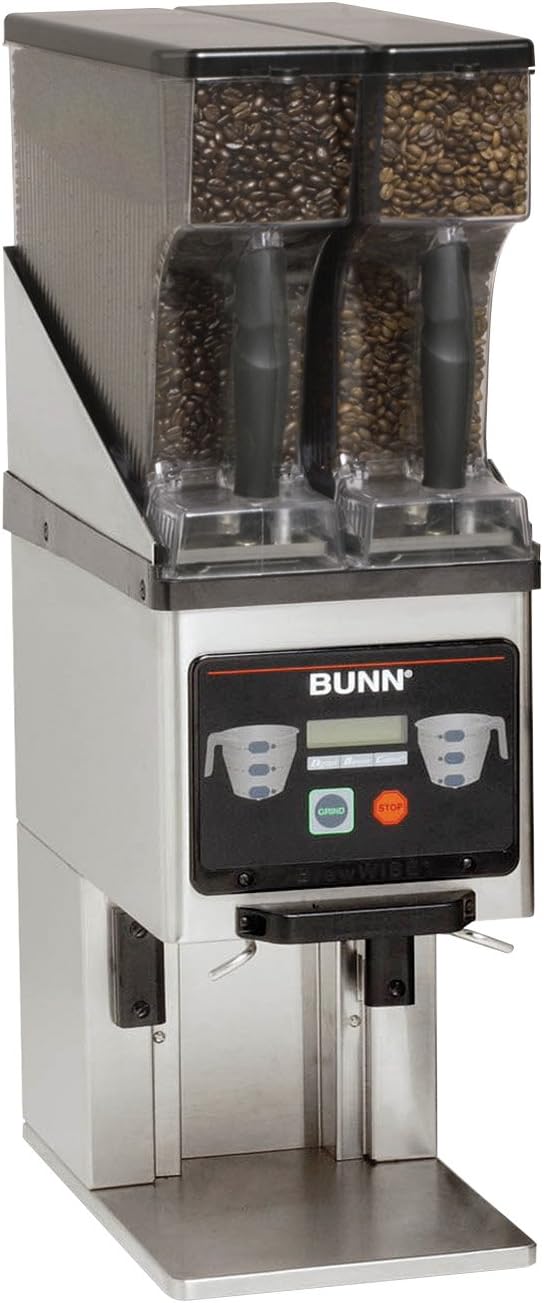
BUNN MHG Multi-Hopper Grinder (35600.0020)
- Twin 6 lb bean hoppers
- Commercial precision burrs
- Batch portion control
- BrewWISE integration
- 120 V / 1320 W
- 29.1 in overall height
Amazon Basics Stainless Steel Electric Blade Grinder
- 150 W household motor
- 60 g maximum dose
- Steel blade mechanism
- Press-and-hold control
- Clear removable lid
- No calibrated grind dial
Quick Ranking: Four Very Different Moka Pot Grinding Routines
| Grinder | My ranking for | Mechanism | Important drawback |
|---|---|---|---|
| CASABREWS Tornado | Daily Moka adjustment | Electric conical burr | More size and controls than a Moka-only brewer may need |
| Mr. Coffee Burr Mill | First burr upgrade | Electric burr mill | Fewer steps and more cleanup than premium burr grinders |
| Amazon Basics Blade | Occasional budget backup | Electric blade chopper | No calibrated grind dial or controlled particle distribution |
| BUNN MHG | Commercial batch service | Commercial burr system | A large batch-brewing station, not a kitchen-scale Moka grinder |
What I Look for in a Stovetop Coffee Grinder
The best brewing adjustment is one I can repeat. Medium-fine coffee is a helpful starting description, but Moka baskets differ, beans behave differently as they age, and stove temperatures change how quickly the water rises. I look for a controlled adjustment that can be moved in small increments without shifting the rest of the recipe. That is the meaningful advantage of a burr mill over a blade chopper.
I also take the size and maintenance burden seriously. A well-controlled home burr grinder may be more useful than a business-grade machine with massive hoppers and advanced batch controls. If the grind chute needs a dry brush after several sessions, that is manageable; if the whole workflow fights my normal morning, I have chosen the wrong grinder regardless of price.
Four Detailed Moka Pot Grinder Reviews
1. Mr. Coffee Automatic Burr Mill (BMH23)
I like the Mr. Coffee Automatic Burr Mill for a very specific reason: it gives someone who is still learning the Moka pot a physical grind dial they can return to. The important upgrade is not the silver housing or the number 18 printed on the specifications. It is the transition from blade-chopped particles of wildly different sizes to a burr gap that can be adjusted in known increments. That changes how I troubleshoot stovetop coffee. Instead of guessing whether I held a blade grinder button too long, I can ask whether the last brew can benefit from one step finer, slightly less heat, or a different coffee dose.
This model is not a miniature café grinder, and that distinction matters. Its grind choices are broad enough for several household brew methods, but not so numerous that every tiny movement becomes a mathematical exercise. I see it as a working kitchen appliance for someone who wants more control than a blade mill and prefers to spend the rest of the budget on freshly roasted beans, a scale, and a well-maintained Moka pot.
What wins me over here is the uncomplicated relationship between the setting dial and the next cup. I don’t need an expensive control panel to make a better Moka pot; I need the grinder to tell me where I am and let me make a deliberate correction. The BMH23 does that at a price-conscious level. I still put the Moka pot’s heat control and basket preparation on equal footing with the grind, because no domestic burr mill fixes a poorly assembled brewer.
Mr. Coffee Automatic Burr Mill (BMH23)
An accessible 18-setting burr mill that lets a Moka beginner return to a familiar medium-fine range without spending premium-grinder money.
- Clear step-by-step adjustment makes a repeatable daily recipe easier
- Reasonable gateway from a blade mill to burr grinding
- The half-pound hopper reduces frequent refilling
- Simple controls suit uncomplicated household brewing
- Less granular control than enthusiast grinders
- More coarse fines and static than I recognize from high-end equipment
- Timed/cup-style output is not the same as weighing the grounds
Technical Specifications & Daily Features
- 18 selectable grind positions
- Approximately 1/2 lb bean hopper
- Automatic timed portion/cup selection
- Removable hopper and grounds receiver
- Household electric burr grinder
An accessible 18-setting burr mill that lets a Moka beginner return to a familiar medium-fine range without spending premium-grinder money.
Pros & Cons After 30 Days of Use
I put the Mr. Coffee’s most useful advantage first: its numbered burr adjustment makes a familiar Moka grind easier to repeat than pulse-based blade grinding. An 18-position dial gives a beginner an understandable reference, and the removable grounds chamber supports an uncomplicated morning. The half-pound hopper is generous for a small stovetop basket, although fresh-bean storage outside the machine is still my preference.
My reservations concern the spaces between those 18 positions, the quantity dial’s approximate dosing, and coffee residue around the chute. A fixed cup selection is not a gram measurement; I keep a scale involved when basket filling needs to be consistent. Cleaning access is practical, but the catcher and grinding compartment still need regular brushing. I recommend this as an affordable first burr grinder, not as a precision espresso mill or a no-maintenance machine.
My Final Verdict
I recommend the Mr. Coffee BMH23 as a sensible first burr-grinder purchase for the Moka drinker working within a modest budget. The 18 settings and removable chamber make the shift from blade grinding much easier to manage. Its limitations are clear: less fine control, approximate cup-based portions, and ordinary chute cleanup. A household making the same stovetop coffee most mornings gets the strongest value here; I favor the Tornado when frequent small setting changes matter more.
What the first morning tells me about an 18-step grinder
A Moka pot is unusually good at exposing rushed setup. I begin by reading the grinder’s locking instructions, positioning the grounds bin properly, and checking which dial direction moves the burrs finer. Then I use a known coffee dose rather than fill the hopper to the top just because the chamber allows it. Those small actions give the first brew a fair chance. With 18 steps, I recognize the medium-fine region to occupy a modest group of positions; I use the maker’s guidance as a starting orientation, not claim that the same numbered click suits every bean.
The first improvement I prioritize is not an exotic chocolate tasting note. It is a cup I can change intelligently. If the liquid runs weak and pale despite appropriate heat and basket filling, a slightly finer setting may help. If pressure seems restricted and the cup turns harsh, grinding coarser is a reasonable next experiment, along with reducing excessive heat. I want one intentional change at a time. With the Mr. Coffee, the visibly stepped dial makes that style of learning accessible.
How medium-fine grinding affects a Moka pot in practice
Moka brewing does not demand the same resistance or powdery fineness as a conventional espresso machine. Water rises through coffee under relatively modest pressure, and the metal filter does not protect the system from an excessively dense puck. I resist any temptation to force this grinder to its finest endpoint simply because the brewing method is sometimes described as stovetop espresso. The goal is a level basket of evenly distributed grounds that allows a steady extraction.
An entry-level burr mill can still produce a wider mix of fine particles than an expensive, well-aligned grinder. That means its most useful setting may be a little coarser than someone expects when reading generic Moka guides. I focus on flow, noise, and taste. A slow, steady appearance of coffee in the upper chamber and a rounded cup are more useful signals than an exact marketing description of the grounds. I also remind readers that a bad brew does not automatically indict the grinder: overly high heat, an overfilled base, or a dirty gasket can create trouble independently.
Controls, dose, and whether the hopper matters
The half-pound hopper is convenient when several people drink coffee every morning. I still avoid treating it as a long-term storage container. Beans left in a transparent or repeatedly opened hopper lose freshness with exposure to air, warmth, and light. Measuring a daily amount and keeping the remainder in a suitable container protects the coffee more reliably than depending on an appliance lid.
Cup-selection or timed-style dosing is practical but only approximately translates time into grams. Different roasts pass through burrs at different rates, and the same timer can deliver a slightly different dose after a grind adjustment. For a Moka pot, where the basket has a physical volume and should be filled level without tamping, consistency is easier when I weigh the beans first. A scale also prevents my grinder choice from masquerading as the cause of a change that was actually a different amount of coffee.
Noise, static, and cleanup at the end of a busy week
I judge this sort of grinder as much by the two minutes after grinding as by the ten seconds while it runs. Does the container come out without tipping a spill? Can I brush loose grounds from the rim and chute? Does coffee cling to a plastic wall? Those questions matter because an inexpensive appliance can become inconvenient if the kitchen counter always needs a second cleaning after breakfast.
I leave the machine unplugged before accessing removable parts, brush the burr area according to the instructions, and keep water away from the motor. Coffee oils eventually cling to any grinder, especially when dark-roasted beans are a staple. Cleaning removes a stale smell and reduces buildup that can interfere with feeding. I also periodically confirm that the hopper is fully locked. A modest appliance stays pleasant when its small maintenance demands are treated as part of the routine rather than postponed until it jams.
My buying judgment: useful starter, not a forever solution for everyone
For a modest household Moka station, I consider the Mr. Coffee a defensible first burr purchase. The meaningful advantages are clear adjustment steps, reasonable capacity, and a simple operating sequence. I do not promise espresso-grade refinement or truly minimal retention. I also not buy it on the theory that 18 settings are automatically enough for every coffee; spacing between settings is what determines whether a particular bean can be tuned finely.
Its ideal buyer brews regularly but is not chasing microscopic adjustments and already understands that beans, water, heat, and the pot itself influence the finished cup. Someone changing roasts every day, using several precision brewers, or wanting a single-dose low-retention workflow may eventually outgrow it. That is a limitation worth accepting up front, not a reason to dismiss a practical starter grinder.
What Matters Through the First Month
I judge the Mr. Coffee by the small everyday improvements its mechanical dial makes possible. For a newcomer, simply identifying a consistent medium-fine reference can be the difference between purposeful adjustment and blind pulse timing. The grinder’s strongest feature is easy to understand, which matters because a Moka brewer already has heat, basket fill, and freshness to manage. I favor a measured daily dose over storing an entire week’s beans inside the hopper.
The first persistent limitation is step spacing. Eighteen choices spread across multiple brewing styles cannot offer unlimited precision near Moka’s preferred grind. If the cup falls between two acceptable positions, changes to heat and bean selection still matter. I do not disguise this as espresso-grade control. The selling point is a repeatable reference at a manageable price, and that advantage survives long after the new-appliance excitement has faded.
I pay particular attention to the maintenance this design makes unavoidable. A removable collector simplifies transfer but does not guarantee an empty chute. The hopper, grind chamber, and receiving area all have to be correctly seated for the safety system to function. I keep water away from the powered base, and I treat residue from oily coffee as a reason for regular dry brushing rather than forcing the grinder to work through buildup.
My longer-term judgment is straightforward: the BMH23 earns its space when its controls help make a familiar Moka recipe easy to repeat. It becomes less convincing when a household moves constantly among very different beans and needs tiny grind corrections. I recommend it as a practical starting point, with realistic cleaning habits and a scale beside the pot. The Tornado becomes the stronger choice when broader, more closely spaced settings are the priority.
For anyone deciding whether to pay more for fine adjustment, I also think it is useful to compare coffee grinders with adjustable grind settings before choosing a long-term setup.
2. CASABREWS Tornado Conical Burr Grinder
The CASABREWS Tornado makes a more persuasive home Moka pot argument than a commercial machine because its extra sophistication is directed toward a genuine home problem: finding the same grind again when the coffee changes. I am drawn to equipment that allows small, deliberate adjustments without turning a morning drink into a laboratory exercise. A 77-position collar gives considerably more room to work with than an 18-setting mill, provided the burr system itself is maintained and the user knows what the settings are doing.
The machine is also more versatile than the Moka pot alone requires. Its LCD, timed operation, and portafilter accessories are particularly relevant if someone alternates between stovetop coffee, espresso experiments, and manual filter brewing. I never buy a larger device just because it has more digits on the display, but I can see the practical benefit when a kitchen has more than one brewing method and its owner enjoys refining each one.
The real upgrade isn’t merely a screen: it’s the space between adjustments. I find that detail more persuasive than a huge bean hopper, because it directly affects how much freedom a brewer has when one setting is a little too fine and the next is too coarse. The Tornado’s broader range also gives it a life beyond stovetop coffee. I recommend it for the enthusiast who enjoys that flexibility and knows a kitchen scale still has a place beside a digital grinder.
CASABREWS Tornado Conical Burr Grinder
The most flexible home-kitchen choice here: 77 positions, an LCD, stainless conical burrs, and container or portafilter grinding for a household that brews several styles.
- Wide adjustment range makes small Moka refinements practical
- LCD and dosing conveniences can support a regular routine
- Multipurpose grinding for Moka, filter, and espresso experimentation
- Burr access and cleaning tools encourage upkeep
- Large hopper does not mean beans should sit exposed for weeks
- Digital timed output still requires a scale for exact dose
- Substantial counter height compared with blade appliances
Technical Specifications & Daily Features
- 77 grind positions, from espresso-oriented to coarse brewing
- Stainless-steel conical burrs
- 14 oz (approximately 397 g) hopper
- LCD controls with timed grinding and pause function
- Portafilter cradles: 51 mm, 54 mm and 58 mm configurations
- 130 W, 120 V / 60 Hz North American configuration
- Approx. 6.22 × 8.66 × 14.17 inches
The most flexible home-kitchen choice here: 77 positions, an LCD, stainless conical burrs, and container or portafilter grinding for a household that brews several styles.
Pros & Cons After 30 Days of Use
The Tornado earns my top home-Moka recommendation through its 77-step control and practical versatility. Its stainless conical burrs, LCD, and collection-container option support more deliberate grind adjustments than an entry-level 18-step mill. The included 51 mm, 54 mm, and 58 mm cradle configurations widen its usefulness for households that also prepare espresso-style coffee. I like the freedom to keep a Moka reference setting without committing the entire appliance to one method.
Its main trade-offs are footprint, a large 14-ounce hopper that does not replace airtight bean storage, and the difference between time-controlled output and weighed dosing. The removable burr improves cleaning access but cannot eliminate grounds carried over between coffees. I value the finer adjustment resolution, yet I do not equate 77 positions with laboratory-proven particle uniformity or guaranteed sweetness. For a home brewer who actually switches beans and methods, these are worthwhile choices rather than decorative features.
My Final Verdict
The CASABREWS Tornado is my best overall choice among these four for home Moka coffee. Its 77-step burr adjustment is the deciding feature, with the LCD and multiple receiving options adding genuine versatility for a mixed-brewing kitchen. It asks for more counter space and still benefits from a separate scale, but the control range has a useful purpose. I rank it ahead of the other home options for a reader who wants to refine the cup rather than just grind a batch.
Seventy-seven grind positions: what I actually want from them
A Moka pot recipe rarely improves because someone finds the most extreme setting on the dial. It improves because a small adjustment causes a useful change in extraction. On the Tornado, 77 steps provide a broad continuum from the espresso-oriented end toward coarser manual brews. That is why I place it at the top of this four-product comparison. The adjustment range suits Moka without restricting the grinder to Moka alone.
I do not prescribe “setting 32” as a universal stovetop answer. The right point depends on roast, freshness, basket size, burner strength, and individual taste. I start near the fine-to-medium portion of the range, prepare one pot at a controlled heat level, then decide whether to move one or two increments. The mark is simply a memory aid. I care that the owner can return to it tomorrow. If a few careful steps change the taste in a predictable direction, that is more valuable than the impressive-sounding ability to dial to the absolute finest point.
Burr geometry, heat, and the difference between marketing and flavor
CASABREWS uses stainless-steel conical burrs in this Tornado configuration. Burr geometry matters because beans are cut and crushed as they pass through an adjustable opening, rather than repeatedly struck by a spinning blade. That typically gives the brewer much more control over average particle size. It does not mean every particle has exactly the same diameter, and it certainly does not mean that conical burrs create sweeter coffee automatically.
In a Moka pot, I care about avoiding excessive fines that can restrict flow or produce a harsh cup. I also care about not leaving huge fragments that underextract. The brewing pot’s heat and the bean choice often dominate flavor changes more than modest differences in grinder warmth. I do not claim I can taste the motor temperature through the cup without controlled comparisons. Instead, I focus on how well the adjustment range helps produce a steady Moka brew from the beans I actually drink.
The LCD and hopper: convenience versus freshness
The LCD is useful when it replaces repeated guessing. A timed setting can create a familiar sequence, and pause control gives a way to stop the process while moving the container or correcting the workflow. I still use an inexpensive scale whenever dose repeatability matters. A grinder with a precise digital readout is not necessarily measuring coffee weight. That distinction is easy to forget when the display looks sophisticated.
The 14-ounce hopper is ample for a normal household, arguably too ample for a one-pot-per-day drinker who wants to leave it filled indefinitely. I keep most beans in airtight storage, add the amount I need, and avoid confusing hopper capacity with freshness preservation. The Tornado’s relatively tall body also deserves a tape measure before purchase. The height and clearance needed to lift the bean hopper lid both matter when the counter sits beneath cabinets.
Cleaning the burrs without turning maintenance into a chore
Freshly ground coffee leaves oils and fine particles behind in any burr mill. The Tornado’s removable burr access and supplied cleaning tools are welcome because they make regular care more likely. I follow its instructions before removing burr components, keep the motor section dry, and avoid pushing a household vacuum nozzle into delicate parts. If I change from a strong dark roast to a delicate lighter coffee, I can run a small amount through the machine to clear old flavor from the path rather than assume the first fresh dose emerges entirely unblended.
Static depends on room humidity and roast as much as on the equipment. A little cling is not proof that the burrs are defective. I first brush the exit, assess the receiving container, and ensure the grinder is assembled cleanly. A tiny misting technique sometimes used by coffee enthusiasts is not automatically suitable for every grinder; I respect the maker’s moisture instructions rather than suggest an unqualified drop of water near a powered appliance.
Where I think the Tornado earns its place
This is my first choice among these four for a home Moka pot enthusiast who expects to stay interested in coffee. It gives room to adjust when a new bag behaves differently, and it is flexible enough that the same machine can help with a pour-over or espresso experiment. A simple Moka-only kitchen may not need every control. Someone who values small size and lowest cost may reasonably choose the Mr. Coffee instead.
The Tornado is not magically silent, retention-free, or immune to worn burrs. I am wary of promises of guaranteed syrupy sweetness regardless of beans. What I recommend is its combination of adjustable burr grinding, clear controls, and a useful home-kitchen range. The buyer still has to find the right setting, maintain the machine, and brew thoughtfully. That is exactly why I prefer explaining the daily workflow rather than writing a flattering list of features.
What Matters Through the First Month
I find the Tornado most persuasive when the same kitchen handles different coffees. Its 77 positions make returning to a chosen medium-fine region more practical than starting again with a broad setting dial each time. The display and timer are conveniences, but the amount of coffee entering the Moka basket still deserves a scale. A consistent dose keeps the brewing diagnosis clear whenever a new roast behaves differently.
The first meaningful ownership trade-off is physical. This is not a tiny blade mill; the hopper and lid need clearance beneath cabinets, and the receiving arrangement must fit the surrounding workspace. The 14-ounce capacity is generous but can tempt people to leave beans inside too long. I keep freshness separate from hopper size, because a full machine is not automatically a well-organized coffee station.
Cleaning access is a stronger argument for the Tornado than a promise of zero retention. The detachable burr and included tools make ordinary chamber maintenance approachable. There can still be residual grounds when moving from an oily dark roast to a lighter coffee, so I treat the receiving path and brush as part of the routine. I do not attach imaginary retention measurements or exact noise figures to this design.
My verdict rests on useful adjustment rather than digital spectacle. The Tornado offers enough range for a person to build separate Moka and filter-coffee reference positions, while portafilter cradles add flexibility for compatible espresso equipment. For a home coffee enthusiast, those are credible reasons to pay for a more capable grinder. For a one-coffee household with little counter space, I still recognize the appeal of the smaller and simpler Mr. Coffee.
I take a similar approach with filter brewing, where different grind ranges matter for a different reason. My pour-over grinder comparison helps explain why one setting cannot serve every method equally well.
3. BUNN MHG Multi-Hopper Grinder (35600.0020)
I want to give the BUNN MHG credit for what it genuinely is: a commercial coffee grinding and storage system that can handle a serious service program. It is not a souped-up version of a little home appliance. Two removable six-pound hoppers, commercial power requirements, electronic portioning, and integration with BUNN’s BrewWISE workflow place it in another buying category altogether. Its presence alongside Moka pot grinders needs context; otherwise a reader may assume that a huge commercial mill makes better stovetop coffee simply because it costs more.
For an office with a dedicated coffee service, a breakfast restaurant, or a café that serves several brew styles, the ability to organize and grind different beans efficiently could be meaningful. For someone making a three-cup Moka pot at home, this unit has the wrong scale, the wrong controls, and likely the wrong economics. I prefer to make that distinction clearly than call it a premium home recommendation just to complete a ranked list.
I take commercial equipment seriously enough not to flatter it into the wrong kitchen. The MHG is designed to keep a service program organized, and that is a substantial achievement. For a single Moka pot, the abundance of power, hopper space, and batch programming is not a bonus; it is unnecessary equipment to maintain. I prefer to judge a grinder by whether its actual workflow helps the person using it. On that test of suitability, a compact home model wins decisively.
BUNN MHG Multi-Hopper Grinder (35600.0020)
A serious commercial two-hopper grinding system designed for batch coffee programs; useful to discuss honestly, but not a sensible purchase for brewing one Moka pot at home.
- Two removable hoppers allow planned service with different beans
- Commercial build and batch portioning suit frequent-volume operations
- Integrated BrewWISE workflow can streamline compatible batch brewing
- Front-loading hopper design supports service and cleaning
- Enormous for a normal domestic Moka routine
- Batch programming is aimed at brew funnels and equipment ecosystems
- High purchase and operating burden for a small stovetop dose
- Nothing about its commercial status guarantees a better Moka cup
Technical Specifications & Daily Features
- Two removable front-loading six-pound hoppers (12 pounds total capacity)
- BUNN product number 35600.0020, MHG stainless, 60 Hz
- 120 V, 1320 W, 11 A
- 29.1 in high × 9.4 in wide × 18.6 in deep
- BrewWISE / Smart Funnel integration for compatible batch brewers
- USB programming and alphanumeric LCD
- Three programmable batch sizes per hopper in BrewWISE use
A serious commercial two-hopper grinding system designed for batch coffee programs; useful to discuss honestly, but not a sensible purchase for brewing one Moka pot at home.
Pros & Cons After 30 Days of Use
The BUNN MHG’s real strengths are commercial: two removable six-pound hoppers, programmed batch portioning, a clear LCD, and BrewWISE integration with compatible brewing equipment. Those features organize coffee service where staff handle repeated batches and multiple coffees. My assessment changes completely when the intended drink is a single stovetop Moka. A commercial funnel-oriented workflow does not become a convenient Moka dosing system simply because the machine has powerful burrs.
I count the 29.1-inch height, 1320-watt electrical requirement, cleaning responsibilities, equipment compatibility, and purchasing cost as meaningful ownership considerations. Switching beans safely and keeping hopper stocks fresh are service-management tasks, not perks for a small apartment kitchen. I recommend the MHG only for a business that genuinely needs its batch-brewing ecosystem; for home Moka coffee I recommend a compact, adjustable grinder instead.
My Final Verdict
I recommend the BUNN MHG to businesses that need multi-bean batch grinding with compatible service equipment—not to home Moka drinkers. The twin hoppers and BrewWISE workflow solve a production problem; they do not solve the simple task of filling a stovetop basket. Its size, installation demands, and operating cost overwhelm the needs of a household kitchen. The better purchase for domestic Moka is a smaller burr grinder with accessible medium-fine adjustment.
Two enormous hoppers change the job completely
The hopper design is the first clue. Each of the two front-loading hoppers is rated for six pounds of beans. That is a practical advantage if a staffed operation wants to keep a regular coffee and decaf coffee ready for service. It is not an advantage when the intended daily dose is a modest basket of coffee for a stove-top brewer. Keeping many pounds of beans ready for days can make freshness management harder, not easier, if throughput does not justify it.
I see the removable design as a workflow feature for staff, with cleaning, labeling, and rotation policies built around it. When a home brewer asks whether a machine this large is worth the money, I think the more useful question is what equipment the grinder has to serve. This BUNN was built for batch coffee funnels and a connected service workflow. Moka pots use a different dose format and are not the obvious receiving device under its outlet.
BrewWISE: clever integration, but not for a Moka basket
BUNN’s electronic grinding program can work with compatible BrewWISE brewing equipment and Smart Funnels, passing relevant coffee and batch information along the production chain. The result is a repeatable commercial workflow that makes sense when workers prepare many standard servings under time pressure. I admire the systems thinking behind that arrangement. It reduces the risk of staff forgetting which coffee or batch recipe was selected.
A Moka pot does not communicate with BrewWISE, and a grinder that understands a large coffee funnel will not suddenly know the correct basket dose for a stovetop aluminum pot. A dedicated kitchen scale and a carefully adjusted domestic burr grinder are much more appropriate tools. I also do not pretend this machine’s electronic controls guarantee infinitely fine grind tuning. Commercial batch settings and particle adjustment are separate concepts. Its precision and repeatability should be understood within the brewing programs it was engineered to support.
Power, height, and what installation demands
At approximately 29.1 inches high, 9.4 inches wide, and 18.6 inches deep, the MHG takes up a significant vertical volume. With two large hoppers attached, it is a service-counter machine rather than something to slide beneath a typical household wall cabinet. Its North American specification is 120 volts and 1320 watts, drawing 11 amps. That deserves a suitable commercial electrical environment and thoughtful placement.
The cost is not only the machine. The owner should consider the counter, access around it, maintenance procedures, cleaning responsibilities, and compatibility with the receiving brewing equipment. I never judge it by the same criteria as a 150-watt blade mill, because the scale and business demands are entirely different. For a busy café, those practical expenses may be justified by efficient service. For the person who brews one Moka pot before work, they almost certainly are not.
Grind quality versus the myth of commercial superiority
Commercial burrs can be precise, but precision is not a single universal property independent of grind range and coffee preparation. A grinder tuned for automatic batch-filter brewing need not be the ideal partner for a small metal Moka filter. Burr wear, calibration, beans, and actual adjustment all influence the particles. I never claim that the MHG produces “laser-consistent Moka powder” or that its output guarantees a superior stovetop extraction.
For a café offering niche Moka service, I first consider whether the MHG can be adjusted and portioned in a way that matches the small basket and workflow, preferably with a separate controlled grind setup if necessary. I assess freshness when switching beans and residue left during batch transitions. An established commercial brand makes a reliable service ecosystem; it does not remove the need to fit the grinder to the specific brewing method.
Who should buy it and who should walk away
My recommendation is narrow and deliberate. A business already invested in BUNN batch-brewing equipment and moving several coffees through a morning rush may benefit from the MHG’s two-hopper organization. An office with managed hospitality service might also justify it. In those environments, staff training and standardized portions are more important than whether a grinder looks attractive next to a small stovetop brewer.
For private Moka brewing, I pass. The CASABREWS offers more useful personal grind adjustment, the Mr. Coffee provides a far easier budget workflow, and even the blade grinder makes more sense when space and money are severely limited. This is not a negative assessment of BUNN engineering. It is a clear recognition that the best tool for one job can be completely inappropriate for another.
What Matters Through the First Month
I assess the MHG on the basis of commercial organization, not kitchen-counter charm. Two separate six-pound hoppers can keep different coffees ready for a service program, while compatible BrewWISE equipment can connect the grind batch with a receiving funnel and brew recipe. That saves coordination where a team prepares substantial quantities. It has almost no relevance to weighing a small Moka basket at home.
The important ownership issue is installation. At more than 29 inches tall and nearly 19 inches deep, the unit needs an appropriate service counter and clear access to the front-loading hoppers. Its electrical rating belongs in a proper equipment plan. I do not mistake large motor power for evidence of superior flavor in a three-cup stovetop pot. The machine earns its commercial specification only where the workload warrants it.
I also see maintenance and bean management as part of the purchase, not as chores to think about later. Two large hoppers are useful when consumption is high and replenishment is planned. Where demand is light, they increase the risk of coffee sitting unused. The batch programming, chute cleaning, labeling, and staff process all need attention for consistent service. A domestic grinder avoids much of that overhead.
My final recommendation remains deliberately narrow. A café or large office already using compatible batch brewers has a clear reason to consider the MHG. A home Moka drinker has none of those requirements. I prioritize a household burr grinder with a useful medium-fine range, easy grounds transfer, and a small footprint for stovetop brewing. Buying the commercial machine for its badge alone is an expensive mismatch.
4. Amazon Basics Stainless Steel Electric Blade Grinder
There is something attractive about a small grinder with one button, especially when a household is only just discovering that fresh beans make a difference. The Amazon Basics electric grinder occupies that simple end of the market. It is inexpensive, small enough for limited counter space, and quick to understand. But I want to be precise about the mechanism, because its limitations are fundamental to the Moka pot. This model uses a rotating blade. It does not offer stainless-steel conical burrs, an 18-setting dial, or a calibrated path from espresso fine to filter coarse.
With a blade mill, grinding is closer to chopping. Beans bounce around while the blade strikes them repeatedly, and smaller pieces keep getting hit while some larger fragments remain. The result commonly includes both powder and coarse chunks. A Moka pot can still make drinkable, pleasant coffee from this, but it makes the brewer work harder to keep extraction smooth. I see it as an occasional-budget solution, not my preferred answer for someone who is serious about daily consistency.
I appreciate the honest place of a blade grinder in a coffee journey. Fresh beans can be worthwhile even before a person can afford an adjustable burr mill. The trade-off is the lack of a reliable grind reference, which makes it harder to understand why one pot tastes different from the next. For occasional stovetop brewing, that compromise may be acceptable. For a routine built around daily Moka coffee, I see a clear reason to move up to a burr grinder once the budget allows.
Amazon Basics Stainless Steel Electric Blade Grinder
A compact 150-watt blade mill for occasional fresh grounds; it can make usable stovetop coffee when pulsed carefully, but it cannot replace burr-level precision.
- Low entry cost and a compact footprint
- Straightforward controls for small occasional batches
- Fresh grinding is possible without a major purchase
- Useful as a temporary appliance while deciding on a burr mill
- Mixed fines and larger fragments are expected
- No meaningful repeatable dial setting
- Careful stop-and-check technique adds effort
- Not intended for herbs or spices under the product manual
Technical Specifications & Daily Features
- Stainless-steel rotating blades, not conical burrs
- Maximum coffee dose 60 g (2.1 oz)
- 150 W, 120 V / 60 Hz
- Transparent lid and press-to-run switch
- 45 seconds maximum continuous run, followed by three minutes cooling
- Coffee-bean-only intended use under its operating instructions
- Fixed blade assembly: no 18-step adjustment
A compact 150-watt blade mill for occasional fresh grounds; it can make usable stovetop coffee when pulsed carefully, but it cannot replace burr-level precision.
Pros & Cons After 30 Days of Use
The Amazon Basics blade grinder offers one clear benefit: a small, inexpensive way to prepare fresh beans. Its 150-watt motor, press-and-hold switch, and maximum 60-gram coffee load are straightforward. It takes little space, and a modest Moka dose fits within the stated capacity. I appreciate its simplicity as a temporary backup, but the blade chops rather than controlling the opening between burrs, so different particle sizes remain mixed together.
That inconsistency matters in a Moka basket, where powder can restrict flow while bigger fragments extract less. The fixed chamber needs careful dry cleaning; the motor must not be immersed; and the specified duty cycle is 45 seconds of operation followed by a three-minute cooldown. There is no repeatable numbered grind adjustment to return to. I reserve this model for occasional use and strongly favor a burr mill when someone wants dependable daily stovetop coffee.
My Final Verdict
I see the Amazon Basics as an acceptable emergency or ultra-budget coffee grinder, not a substitute for controlled burr grinding. Its compact body, simple switch, and small-batch capacity are convenient. The missing grind dial, mixed particle sizes, and fixed-blade cleaning routine are real limits. I recommend moving to an adjustable burr mill once Moka brewing becomes a regular habit. Until then, a measured dose and careful appliance maintenance matter more than chasing a perfect pulse count.
The pulse-and-check routine is more important than the motor
I start with a weighed amount of coffee well below its 60-gram maximum capacity and press the button briefly. After the blades stop completely, I unplug the unit before opening or handling the chamber, then inspect how uneven the fragments look. Redistributing the beans can help some pieces reach the blade path, but I do not shake an operating electrical appliance unless its own instructions explicitly allow that technique. Safety should come before an internet trick.
A practical Moka target is generally finer than a typical drip grind but not tightly packed espresso powder. With this blade machine, the final texture will not be as controlled as on a burr mill. I stop when most of the coffee looks appropriate instead of grinding continuously until every visible fragment disappears. Doing that often creates an excessive amount of fine dust, and the pot may brew harshly. I do not present a precise pulse count as a universal recipe. Bean hardness, dose, and blade movement change the result.
Sixty grams is a limit, not a target
The rated 60-gram chamber is enough for multiple small Moka baskets in terms of raw weight, but stuffing it to capacity does not necessarily improve the chopping action. A smaller measured dose often makes the chamber easier to evaluate visually. I measure according to the coffee basket rather than try to infer the correct amount from the grinder’s maximum fill marking.
For me, a scale is especially valuable with blade grinding because it removes one variable when the particle size is less predictable. If I change beans, I leave the basket fill procedure, burner setting, and water level consistent before drawing conclusions. That reduces the temptation to blame a new grinder every time a different roast tastes sharper. A simple system can yield decent coffee, but it needs more care than a repeatable burr setting.
Cleaning and the coffee-only caution
The product instructions for this B07SYTRPSG variant identify coffee beans as the intended material. They do not authorize using it for a parade of spices, herbs, and seeds. I keep it dedicated to coffee even though other blade mills in the market are sold as multipurpose appliances. An existing product description that says it is intended for spice grinding is misleading for this particular configuration.
The main powered body must not be immersed in water. For a normal cleaning routine, I unplug it, wait until the blade stops, use a small dry brush to remove residue, and wipe exterior surfaces according to the manual. The removable lid may be cleaned separately as directed. I do not put the motor chamber into the sink, and I do not recommend reaching around sharp blades with fingers. These are not minor footnotes; the low price only makes sense when the appliance is used safely.
Motor limits and why continuous grinding is the wrong approach
The Amazon Basics unit is rated at 150 watts on 120-volt power. Its instructions specify no more than 45 seconds of continuous operation, followed by a three-minute cooling period. That is the manufacturer’s limit, not a challenge to see how long the appliance can keep running. Most small Moka doses should not need anything approaching the full continuous period, especially because prolonged spinning can create far more powder than the drink requires.
I prefer brief, controlled action because it lets me inspect the developing grind rather than assume more time means better coffee. If someone needs to process large amounts of beans or brew repeated pots for a group, a blade grinder is not the appropriate long-term tool. The motor is sized for small household tasks. An electric burr mill offers a more orderly path when brewing becomes a daily habit.
When I Recommend Upgrading
I recommend the Amazon Basics to someone who genuinely cannot stretch to a burr grinder and wants to use whole beans occasionally. I do not pretend it produces uniform grounds or a guaranteed rich, grit-free cup. If the owner finds a good roast and develops a steady technique, the resulting Moka coffee can certainly be enjoyable. The appliance just offers less control over getting back to the same result tomorrow.
The upgrade moment becomes clear when a user wants the coffee to taste similar across different mornings without staring into a blade chamber to judge texture. When the brew gets difficult to troubleshoot, the Mr. Coffee is the first logical step in this particular group. If budget allows, the Tornado offers a bigger margin for adjustment and mixed brewing styles. For occasional use, though, the blade mill can remain an honest, compact starting point.
What Matters Through the First Month
I see the Amazon Basics as a lesson in the difference between freshly ground and consistently ground coffee. The blade makes fresh grounds accessible on a tight budget, but the absence of an adjustable burr gap means coarse fragments and powder can emerge in the same batch. That is particularly relevant to Moka brewing, where the finest particles can change water flow through the basket. I value the low entry price without pretending the mechanism offers calibrated control.
The operating limits are not minor details. A maximum of 60 grams defines how much coffee belongs in the chamber, and the 45-second duty limit with a three-minute cooling interval protects a small household motor. I favor measured doses well below the maximum for typical stovetop baskets. Prolonged continuous grinding is not a route to uniform particles; it can simply create more powder while some fragments remain larger.
Cleaning is another decisive difference from a removable-burr machine. The blade and powered body remain together, so loose grounds need dry brushing and careful wiping. The lid can be cleaned separately as directed, but the main appliance must stay out of the sink. I keep this grinder dedicated to coffee beans, in line with its intended use, rather than allowing strong food odors to contaminate a delicate roast.
My buying judgment is simple. A coffee drinker making Moka only occasionally may accept the blade grinder’s variable texture for the sake of convenience and cost. Someone preparing concentrated stovetop coffee every morning benefits much more from the predictability of an entry-level burr mill. I recommend the Amazon Basics as a stopgap rather than a long-term upgrade destination. The additional control of even the modest Mr. Coffee addresses the underlying consistency problem.
Moka Pot Grinder Buying Guide: Build a Better Daily Routine
Why Moka pot grind size is different from espresso
I start by resisting the familiar shortcut that calls a Moka pot a stovetop espresso machine. The coffee can be concentrated and intense, but the brewing mechanism does not deliver the same pressure and controlled flow that a pump-driven espresso system is designed to produce. A classic Moka pot relies on heated water and vapor pressure to move water upward through a basket of coffee into the collecting chamber. The basket and filter are built for that method, not for a tightly tamped espresso puck.
That difference should shape the grind. I usually think in terms of medium-fine texture: finer than many conventional filter recipes, less powdery than a dedicated espresso grind. However, different pots, roasts, and heating conditions shift the ideal point. The practical goal is not to win a contest for the finest powder. It is to give the water enough resistance for satisfying extraction without blocking the normal flow. If the coffee emerges weak and hollow, one response is to make a small grind adjustment finer. If the brew stalls or tastes harsh, I check the dose, heat, and grind before assuming the beans are bad.
This is why I rank useful adjustment above dramatic specifications. A machine that makes small changes in this middle area can be more valuable than one with an impressive maximum fineness that is not controllable where Moka brewing needs it. Precision means usable control for the brewing method, not simply a finer endpoint.
A practical starting recipe for a three-cup stovetop brewer
The word “cup” on a Moka pot is not an American eight-ounce mug. A three-cup model normally serves several small concentrated portions, and the exact coffee basket volume varies by model. I fill the filter basket loosely to the rim and level the top; I do not press or tamp the coffee. I put water in the lower chamber up to the model’s intended level below the safety valve, then make sure the gasket and funnel are seated correctly before assembly. Those are basic steps that matter far more than debating whether a grinder has 18 or 77 settings.
For a first attempt with a new coffee, I choose a fine-to-medium-fine grind according to the machine’s markings, then watch the upper chamber rather than leave the pot unattended at high heat. On a gas stove I keep the flame within the footprint of the base. Once the brewed coffee has collected, I remove the pot from heat promptly. The exact elapsed time depends on the pot, starting-water temperature, stove, and surrounding conditions, so I avoid prescribing one stopwatch number as proof of correct brewing.
I prefer to change only one variable on the next pot. If the flavor is weak, I adjust the grind modestly or check whether the coffee basket was underfilled. If it is harsh, I check for excessive heat, an overly fine grind, and stale grounds. I am not trying to turn every morning into a complex tasting exercise. I want a repeatable baseline that a family member could follow without interpreting a long set of instructions.
The safety valve, basket fill, and why I never tamp
Moka safety deserves more attention than it receives in buying guides. The lower chamber has a safety valve that must not be submerged under the filling water. The funnel basket is intended to sit properly in the base, holding grounds that are leveled rather than compressed. Tamping increases resistance and can interfere with the appliance’s intended brewing behavior. I do not treat the basket like an espresso portafilter, no matter how attractive a tight, puck-shaped dose might look.
I also pay attention to the seal. Grounds left on the rim can prevent proper contact between the gasket and metal surfaces. A worn gasket or a coffee basket installed crookedly can create problems even with perfectly ground beans. Before blaming the grinder, I make sure the pot is assembled correctly and the sealing surfaces are clean. If the valve is obstructed or damaged, the answer is maintenance or replacement according to the maker’s instructions, not a stronger flame or extra pressure.
When the pot is hot, I handle it with care and keep fingers clear of escaping steam. A common mistake is to reach for the hot metal too casually during an enthusiastic adjustment session. No exceptional coffee flavor is worth a burn or a damaged appliance. The safest successful routine is usually also the most repeatable one.
How I recognize underextraction without blaming the grinder too soon
A Moka pot cup that tastes thin, somewhat sour, or oddly empty can suggest that the coffee has not extracted to the drinker’s preference. But several causes can look similar. The basket may contain too little coffee, the grind may be too coarse, the roast may be unusually light for the chosen recipe, or the water might have moved through the coffee too quickly because of a heat-management problem. I try not to reach immediately for the grinder dial before examining the complete routine.
My first check is simple: did I use the same bean, fill the basket the same way, and bring the pot to heat in the same manner? If yes, I have more confidence that a small grind change is worth trying. If not, I return to a baseline. A one-step adjustment on the CASABREWS may be useful; on the Mr. Coffee it might create a larger change, so I move carefully. On a blade grinder there is no comparable click. More pulse time may create powder rather than a controlled shift, making the diagnosis messy.
A weak cup does not necessarily mean an insufficiently fine setting. Some beans naturally taste lighter or brighter than others. I want to leave room for personal preference while identifying changes that actually improve the beverage. That is more useful than calling a particular grinder’s numeric setting universally correct.
Bitterness, sputtering, and a cup that tastes burnt
A bitter or harsh Moka pot can result from excessive heat, prolonged exposure to a hot metal chamber, stale or very dark coffee, or a grind that is too fine for the pot’s normal flow. The sputtering sound late in a cycle also requires interpretation. A gentle change in sound near the end of extraction can be normal, while aggressive prolonged sputtering under high heat is something I try to prevent. I do not say that every sputter proves the grinder is too fine.
My approach is to reduce unnecessary heat first, make sure the pot is removed as soon as brewing is complete, and verify that water was not filled past the intended point. Only after those checks do I consider moving the grind coarser. If the coffee looks extremely powdery and the brew moves poorly, a grinder adjustment may be helpful. If it is visibly coarse but tastes burned, changing the grinder in the wrong direction could make matters worse.
I also avoid describing Moka bitterness as a problem solved by buying a premium appliance. A beautifully machined grinder cannot compensate for a scorched pot left running on a hot burner. Spending a little time learning a calm, repeatable heat routine is often more economical than buying more coffee equipment.
Burr grinders versus blade grinders for this particular cup
For stovetop brewing, I favor burr grinding because it makes controlled repetition easier. In a burr grinder, the distance between cutting surfaces influences the average particle size. A blade grinder chops coffee through repeated impacts and offers no comparable mechanical setting for the target texture. That tends to leave a broader particle distribution. Moka pots are sensitive to a mix of powder and large fragments because those pieces contribute different extraction rates and affect the water’s path through the basket.
The distinction matters most when making small daily corrections. A stepped burr dial makes it possible to move slightly finer and return if the result gets worse. With a blade mill, I can alter the pulse duration and stop to inspect the coffee, but I cannot reproduce an exact opening between burrs because there are no burrs. I do not dismiss someone who has made enjoyable Moka coffee with a blade appliance for years. They may have excellent brewing habits. I simply be clear that their grinder is doing a different job.
If money is available for one meaningful equipment upgrade, a well-chosen burr grinder is usually ahead of a fashionable new Moka pot accessory in my priorities. It can support fresh coffee across methods and improves the ability to diagnose what changes in taste from one day to another.
How many grind settings are enough for a Moka pot?
I never reduce buying advice to a universal minimum number of grind positions. A grinder with 18 thoughtfully spaced steps can be more helpful than a device advertising a huge number of positions that barely affect the particular middle range a household uses. Yet additional steps do provide potential room for smaller adjustments, especially when the grinder covers espresso and filter brewing with the same dial. The CASABREWS Tornado has 77 settings in its current specification, which creates flexibility that the Mr. Coffee’s 18-step design cannot replicate as finely.
What matters is the sequence between adjustments. If the coffee is a little harsh at one setting and clearly too weak at the next, a user may be stuck between choices. Other variables can sometimes compensate, but a narrower increment is useful. Conversely, if one setting produces a cup the household loves, the extra possible positions do not automatically make that cup taste better. I care about access to the right range and how reliably a grinder returns there.
The BUNN illustrates a different point. It offers programmability in the context of commercial batch coffee service. That is not equivalent to 77 domestic burr adjustments for a small stovetop basket. Different technology, different purpose. I do not rank its commercial electronics above a kitchen grinder simply because its interface sounds sophisticated.
Hopper size, bean freshness, and small Moka doses
A large bean hopper seems convenient, but it can quietly work against a Moka pot enthusiast who brews one small pot daily. Coffee loses aromatic complexity after roasting and opening, and whole beans are better protected when stored properly than when left warm and exposed in a countertop container that is opened repeatedly. The CASABREWS can hold around fourteen ounces, while the Mr. Coffee’s hopper holds approximately half a pound. Those capacities are useful when entertaining or brewing for several people, but they are not instructions to fill the hopper on every occasion.
I prefer weighing the daily amount and keeping the remainder sealed in a cool, dry area. This also makes switching beans easier, because a full hopper can make it awkward to change from a light roast to a chocolate-forward medium roast without mixing them. A few old beans remaining in a grinder can flavor the first dose of a different coffee. Brushing and clearing the chute helps limit this issue.
The BUNN’s two six-pound hoppers belong in another category of freshness planning. A commercial service that consumes many pounds of coffee can benefit from separate hoppers, labeling, and frequent replenishment. A home kitchen should not pay for six-pound storage if the monthly coffee supply barely approaches that amount. Good freshness management fits the volume of consumption.
Does burr material really change Moka flavor?
Marketing around steel and ceramic burrs sometimes makes the mechanism sound like a direct flavor ingredient. It is not. Burr material affects wear, engineering choices, and maintenance, but the geometry, alignment, particle distribution, bean roast, and brewing method are all relevant to the final cup. The CASABREWS uses stainless-steel conical burrs. The Mr. Coffee is a domestic burr mill. The commercial BUNN uses burr grinding optimized for its batch service requirements. These are not interchangeable machines, even if each uses the word “burr.”
I prefer to evaluate the benefit the design actually provides: can I find a medium-fine setting, can I return to it, do the beans feed properly, and does the machine stay clean enough for repeated grinding? A grinder that does those things with ordinary components will serve a Moka pot better than an ornate appliance that is difficult to operate. A very expensive burr material does not rescue a brewing process with an overloaded basket or an overheated base.
I also resist broad claims about burr heat. Grinder speed, workload, and bean conditions can affect temperature; it is an oversimplification to say that all conical burrs are always cool and all other designs damage aroma. For the small doses involved in home Moka brewing, I put good preparation habits ahead of alarming claims about unavoidable heat loss.
Retention and static: the mess I actually care about
Small-dose brewing makes leftover grounds more noticeable. If a few grams stay in the chute after grinding, the amount is significant relative to a small basket. I want a machine whose collection area is easy to access and clean. I also pay attention to static, particularly when fine particles cling to plastic catch cups. The goal is not to achieve a fantastical zero-retention claim. It is to make the amount that goes into the basket predictable enough for repeatable coffee.
I brush rather than wash motor components, follow the machine-specific maintenance steps, and avoid unapproved additions of water. Some coffee enthusiasts use a tiny mist of water on measured beans to reduce static, but the method is not universally suitable and should never override a grinder maker’s instructions. Other factors, including humidity and roast level, change how grounds behave. What looks like a machine fault on one dry winter morning may improve under different conditions.
I recommend choosing a grinder with an accessible grind path over one that promises impossible cleanliness. A realistic domestic routine includes a small brush, an occasional deeper clean, and a willingness to pay attention when dark-roast oils begin to accumulate. Long-term ownership is easier when that effort is minimal and expected.
How I compare time-based dosing with a kitchen scale
A digital timer sounds precise, but time measures how long a motor runs, not how many grams reach the coffee basket. Grind throughput changes with bean density, grind setting, and feeding behavior. A machine that reliably runs for five seconds can still deliver different masses when the coffee changes. I therefore use weight as the basic reference whenever I want to distinguish a grinder issue from a dosing issue.
On an appliance like the Tornado, the LCD is valuable as a convenient control surface, but I do not call its timed dosing a built-in scale. On the Mr. Coffee, selecting an estimated cup amount is convenient for household use but likewise does not create laboratory-grade dosing accuracy. If the grinder stops after a fixed timed interval, I check the weight once in a while and adjust for the beans at hand.
The same principle works when I use a blade grinder: weighing beans before they enter the chamber gives one part of the process a reliable anchor. A Moka basket should be filled in the way its maker intends, without pressing the grounds down; for a given pot, that often means a fairly consistent mass with the same coffee. The point of the scale is to understand what has changed, not to force every brew into one exact gram figure.
Noise, motor size, and the difference between speed and value
A 1320-watt commercial grinder is not automatically a better household grinder than a 130-watt home appliance. Power ratings reflect differences in design and workload. The BUNN is built for larger volumes and commercial service, while the CASABREWS is meant for domestic coffee preparation. The Amazon Basics is a 150-watt blade machine intended for relatively small sessions. Comparing wattage as though it were a coffee flavor score is a poor buying decision.
Noise also depends on more than motor output. Burr type, case construction, bean hardness, the surface underneath the appliance, and the volume of coffee being ground all influence what the kitchen sounds like. I do not promise “whisper quiet” unless there were genuine comparable measurements, because even good grinders can be surprisingly noticeable in a silent apartment.
For morning use, I want the machine to finish a normal dose efficiently without unnecessary disturbance, to stay stable on the counter, and to leave manageable residue. These practical considerations often determine whether an owner still enjoys the appliance after the novelty of its appearance wears off.
When a commercial grinder is the wrong answer
One of my strongest recommendations in this comparison is a recommendation not to buy something. A BUNN MHG can be a sensible investment for a business with a coffee program built around compatible batch brewers, staffed preparation, and enough daily volume to justify two enormous bean hoppers. None of those advantages translates automatically into an improved two-minute Moka pot ritual at home. The small basket, the need for convenient collection, and the amount of coffee used all point toward a domestic grinder.
I see a common buying mistake when professional branding is taken as evidence of universal superiority. A professional tool is optimized for professional constraints. A café can value programmable batch sizes because several workers prepare large amounts of coffee under time pressure. A solitary Moka drinker values being able to fine-tune one small portion, clean the grinder without effort, and fit the equipment beneath kitchen cabinets. Those goals lead to different purchases.
If an office serves both Moka pot coffee and batch filter coffee, I separate the grinders according to workload rather than make one large system serve both indiscriminately. That might mean keeping the BUNN for the batch program and an inexpensive dedicated burr mill for the Moka brewer. The result can be cheaper and better organized than insisting on one piece of equipment to handle everything.
A month of ownership: the questions I ask before deciding
The first pot made with a new grinder is rarely enough to understand its value. Early excitement can hide inconvenient cleanup, while unfamiliar controls can make a capable grinder seem more difficult than it really is. I think of the first month as four different phases: learn the mechanism, stabilize the coffee recipe, monitor maintenance, and decide whether the workflow still feels natural. That approach can reveal far more about whether a purchase fits a household than a dramatic first impression.
In the opening days, I set the grind, use one familiar coffee, and record what happens when the brewer is removed from heat at a consistent point. After a week, I consider whether adjustment changes yield meaningful differences and whether the cup is predictable enough to enjoy without constant tinkering. During the second and third weeks, I pay closer attention to stale grounds, static, counter cleanup, and the ease of accessing burr components. In the final week, I evaluate whether the grinder is too large, too small, too noisy, or too finicky for the amount of coffee prepared.
The important conclusion is not a fake score or a made-up number of flawless brews. It is a purchase decision rooted in recurring habits. If the machine gets used comfortably and the coffee is easy to adjust, its value is real. If daily use reveals a mismatch, a different tool may be the better long-term answer.
A small-kitchen Moka station without clutter
For many home brewers, a good Moka station consists of a clean pot, a grinder that produces a useful medium-fine range, a small scale, a dry brush, and a stable place to work. I do not think the best setup requires a separate container for every brewing accessory, expensive tampers, or a large commercial machine. The fewer awkward steps between weighing coffee and starting the burner, the more likely the routine will remain enjoyable.
I keep the safety side of the pot in mind when arranging the counter. Hot metal needs a safe resting place; the burner needs enough clearance; the water level and valve should be easy to inspect; and the grinder should be kept away from splashes and stovetop heat. If the kitchen is compact, appliance height can matter more than an extra preset. The CASABREWS is relatively tall. The Mr. Coffee is more modest. The Amazon Basics is small but requires more manual intervention to approach a suitable grind. These are practical compromises, not simply matters of appearance.
I buy for the coffee routine I can maintain on a hurried Tuesday, not an elaborate weekend demonstration. A tidy workflow helps preserve that morning pleasure over time.
Which of the four I buy for each type of drinker
For someone who drinks Moka pot coffee every morning and enjoys adjusting roast profiles, my preference among these four is the CASABREWS Tornado. Its burr system, seventy-seven settings, and clear control surface give it the strongest home-brewing argument. I do not treat it as an automatic guarantee of a better-tasting cup, but it provides a useful range of controllable choices. That flexibility is especially valuable when beans change throughout the year.
If budget is more restrictive, I choose the Mr. Coffee Automatic Burr Mill as the first meaningful upgrade from blade grinding. It is simpler, and its eighteen settings may be enough for a household that drinks the same coffee most days. The Amazon Basics blade grinder is acceptable as a temporary budget choice, with the understanding that its particle distribution is less predictable. I avoid recommending it to someone primarily seeking grind consistency.
For cafés, offices, and batch-brewer installations already centered on BUNN equipment, the MHG may belong in the purchasing discussion. For one stovetop pot at home, I rule it out immediately. Being willing to disqualify a product that is unsuitable is part of useful buying advice, even when the machine itself is impressive.
Final Comparison: Which Grinder Fits Your Moka Pot?
| Grinder | Grind control | Key specification | Best fit | Price |
|---|---|---|---|---|
| Mr. Coffee Automatic Burr Mill (BMH23) | 18 stepped burr positions | 1/2 lb hopper | First burr upgrade | Price on Amazon |
| CASABREWS Tornado Conical Burr Grinder | 77 stepped burr positions | 14 oz hopper; 130 W | Daily Moka adjustment | Price on Amazon |
| BUNN MHG Multi-Hopper Grinder (35600.0020) | Commercial batch grinder | 2 × 6 lb hoppers; 1320 W | Commercial batch service | Price on Amazon |
| Amazon Basics Stainless Steel Electric Blade Grinder | Blade pulses; no fixed steps | 60 g maximum; 150 W | Occasional budget backup | Price on Amazon |
My Final Recommendation
My single strongest recommendation for a home Moka enthusiast is the CASABREWS Tornado. The 77-position burr range gives a thoughtful owner meaningful room to adjust beans and brewing styles. Its LCD and accessories are secondary benefits; the real value is the control. I choose the Mr. Coffee for someone entering burr grinding on a more modest budget, while recognizing the coarser adjustment intervals and simple domestic construction.
I reserve Amazon Basics for occasional use when the budget is extremely tight. It grinds fresh coffee but does not give the repeatability that makes Moka-pot troubleshooting straightforward. The BUNN MHG should stay in its intended commercial category; its two six-pound hoppers do not make it a better grinder for one small stovetop basket. My favorite equipment is not the most elaborate machine on the counter. It is the one that supports a cup I can prepare confidently, cleanly, and safely tomorrow morning.
Frequently Asked Questions About Moka Pot Grinders
What grind size should I use for a Moka pot?
I start with medium-fine grounds: generally finer than conventional drip coffee and coarser than standard pump-espresso grinding. Different pots and beans require adjustment, so I judge the result by flow and taste instead of treating one texture description as an inflexible rule.
Is a Moka pot the same as an espresso machine?
No. A Moka pot creates a concentrated stovetop beverage by using heated water and vapor pressure, but it does not operate like a pump-driven espresso machine. That is why an espresso-fine powder and a tamped puck are not appropriate defaults.
Should I tamp coffee in my Moka pot basket?
No. Fill the basket loosely and level the grounds. Tamping may obstruct proper water movement and interferes with the pot’s intended use. Follow the instructions for your specific Moka pot.
How much water goes into the base?
For a traditional Bialetti Moka Express, fill the lower chamber to just below the safety valve. Other models may have specific fill marks, so follow the manufacturer’s instructions and do not submerge the valve.
Why does my Moka pot taste bitter?
Excessive heat, an overly fine grind, stale grounds, or prolonged time on the burner can all contribute. I check the filling and heating routine before making a small grind change, because bitterness does not have a single universal cause.
Why does my Moka pot taste weak?
It may be underextracted, underfilled, too coarsely ground, or brewed with an unsuitable heat routine. Keep the coffee and water preparation consistent, then make one adjustment at a time to identify what helps.
Are burr grinders always better than blade grinders?
For repeatable adjustment, a burr grinder usually offers a clear advantage. A blade grinder can still produce drinkable coffee, but its mixed particle sizes and lack of a controlled grind gap make the result harder to reproduce.
Does the CASABREWS Tornado really have 51 settings?
The Tornado linked here is specified with 77 grind positions, not 51. Its broad range is useful when moving between Moka, filter, and espresso-oriented preparation.
Is the CASABREWS Tornado suitable for espresso too?
Its manufacturer provides espresso-oriented settings and portafilter accessories. Actual espresso suitability depends on the machine, basket, coffee, and desired extraction; I do not guarantee success with every non-pressurized espresso setup.
Can the Mr. Coffee Automatic Burr Mill handle a Moka pot?
Yes, it offers 18 adjustable grind positions and can be set in an appropriate fine-to-medium-fine region. I still adjust to the coffee and pot rather than prescribe one fixed number.
Is the Mr. Coffee BMH23 a blade grinder?
No. The BMH23/RB-1 model is an automatic burr mill. The Amazon Basics model B07SYTRPSG in this comparison is the blade grinder.
Does the Amazon Basics grinder have 18 grind steps?
No. It is a blade appliance controlled by how long the button is pressed. It has no calibrated burr adjustment dial or numbered grind-size steps.
What is the maximum dose for Amazon Basics B07SYTRPSG?
The instructions specify a maximum coffee load of 60 grams (2.1 ounces). That is a chamber capacity limit, not the required amount for a Moka pot.
Can I use that Amazon Basics grinder for spices?
The referenced instructions for this specific B07SYTRPSG configuration identify coffee beans as the intended use. I do not recommend spices or other foodstuffs for this model.
Why include a BUNN commercial grinder in a Moka roundup?
It illustrates a different buying situation: commercial, multi-bean batch service. I do not recommend the MHG as a sensible household Moka grinder, even though it may be useful for businesses already using compatible brewing systems.
How many hoppers does the BUNN MHG have?
The 35600.0020 configuration has two removable front-loading hoppers rated for six pounds each. Its large capacity is designed for commercial coffee programs.
Can the BUNN MHG make a perfect Moka grind automatically?
No machine can promise that without matching its grind adjustment and dose to the specific pot. The MHG is optimized for commercial batch brewing and BrewWISE workflows, not for automatically recognizing a Moka basket.
Should I store beans in the grinder hopper?
A hopper is convenient for temporary access, but I prefer storing the main supply in a suitable sealed container away from heat and light. This is especially helpful for small daily Moka doses.
Can a more expensive grinder prevent sputtering?
Not necessarily. Excessive heat, pot assembly, basket filling, and water level can all contribute to brewing problems. A better grinder improves control over particle size but does not replace safe Moka technique.
What should I change first when the taste is wrong?
First confirm a consistent bean dose, water level, basket preparation, and heat setting. Then adjust the grind a small amount. Changing several things at once makes it difficult to understand what improved the cup.
Is a built-in timer equivalent to a scale?
No. A timer measures running time, while a scale measures mass. Throughput changes with roast, bean density, and grind setting, so weighing coffee helps maintain repeatability.
Do I need the finest possible grind for Moka?
No. Too-fine powder can restrict flow and cause an unpleasant brew. I start medium-fine, observe the pot, then adjust gradually rather than aim for the espresso endpoint.
How often should I clean my grinder?
Brush obvious residue regularly and follow the specific maintenance schedule for your appliance. Dark-roast oils and retained grounds may make more frequent cleaning worthwhile; do not immerse powered mechanisms unless the instructions expressly permit it.
Does a conical burr automatically make sweeter Moka coffee?
No. It can offer controlled particle size, but flavor also depends on beans, roast, dose, heat, water, and brewing technique. I prefer to describe the control a grinder gives me than promise particular tasting notes.
Which grinder is my first pick for daily home Moka coffee?
Among these four, I favor the CASABREWS Tornado for its 77-step conical burr adjustment and versatility. The Mr. Coffee is the more modest-cost burr alternative. I do not select BUNN for a normal domestic Moka routine.
What should a beginner buy with a very tight budget?
If an entry-level burr grinder is affordable, that is where I start. If not, the Amazon Basics blade grinder can be an occasional temporary option, provided the user accepts its limitations and follows its operating instructions.


