
5 Best Coffee Grinders for Pour-Over Coffee in 2026


OneHundredCoffee is reader-supported, and some products displayed may earn us an affiliate commission. Details
I give the coffee grinder more credit—and more scrutiny—than nearly any other piece of pour-over equipment. A beautifully controlled pour cannot rescue a wildly uneven grind. Fine particles race ahead of the larger fragments, a paper filter begins to choke, and suddenly a promising coffee tastes both harsh and hollow. I start with the grind before blaming the beans or buying another kettle. The useful change is often small: one notch finer, a gentler pour, or a dose that finally stays consistent from morning to morning. That is what I look for in an everyday burr grinder: enough control to solve an actual problem without turning breakfast into a science fair.
I have five quite different grinders on my list, and I like that they refuse to fit neatly into one category. Capresso’s Infinity 560.04 is unapologetically mechanical; the dial and timer do the talking. Bodum’s Bistro makes a practical argument for a glass grounds catcher. Secura gives a new brewer a path away from blade-chopped beans without asking for a premium budget. De’Longhi’s Dedica KG521M suits people who prefer a screen and several receiving options. Gevi offers a longer adjustment scale for the brewer who enjoys tuning recipes. None automatically wins on the number of settings alone. I rank them by the frustrations their designs actually address—and by the compromises they leave on the counter.
My Three Picks for Pour-Over Coffee

Capresso Infinity Conical Burr Grinder 560.04
- 16 marked grind positions
- Slow gear-reduction motor
- 5–60-second mechanical timer
- 8.8 oz bean hopper
- Removable upper burr

Bodum Bistro Electric Burr Coffee Grinder
- 12 coarseness settings
- Borosilicate glass catcher
- Conical burr system
- 5–20-second preset timer
- Friction-clutch protection

Gevi Electric Burr Coffee Grinder, 35 Settings
- 35 graduated grind positions
- Anti-static design
- Fine, medium, coarse brew range
- Timed or cup-oriented variants
- Grounds container for daily batches
My recommendation begins with the brewer sitting on the counter. A V60 can respond strongly to a small shift in grind or agitation. A flat-bottom Kalita may give you more room to maneuver. A Chemex combines a deeper bed with thick paper, often calling for a different starting texture altogether. Even with the same beans, a 15-gram single cup behaves differently from a 35-gram batch. That is why I never treat one printed grind setting as a universal pour-over prescription. I find a balanced cup, record the variables, and make the next change for a specific reason.
I also separate precision from convenience. A digital screen cannot correct stale coffee; a glass catcher does not remove the need for cleaning; and a 35-step dial does not guarantee that the burrs produce a more uniform grind than every 16-step alternative. The details worth paying for are the ones I use: a well-controlled medium range, a chute that does not demand constant attention, easily accessible grinding surfaces, and a dose routine that suits my kitchen. The comparison below looks at those everyday decisions rather than claiming that all five grinders are interchangeable.
5 Best Coffee Grinders for Pour-Over — At a Glance
I use this comparison to match a grinder to the work it will do every morning. A readable adjustment dial, an easy-to-handle grounds container, and a realistic grind range often matter more than an impressive-looking feature list.
Capresso Infinity Conical Burr Grinder 560.04
- 16 marked grind positions
- Slow gear-reduction motor
- 5–60-second mechanical timer
- 8.8 oz bean hopper
- Removable upper burr
- ABS body, stainless-look finish
Bodum Bistro Electric Burr Coffee Grinder
- 12 coarseness settings
- Borosilicate glass catcher
- Conical burr system
- 5–20-second preset timer
- Friction-clutch protection
- Compact visual design
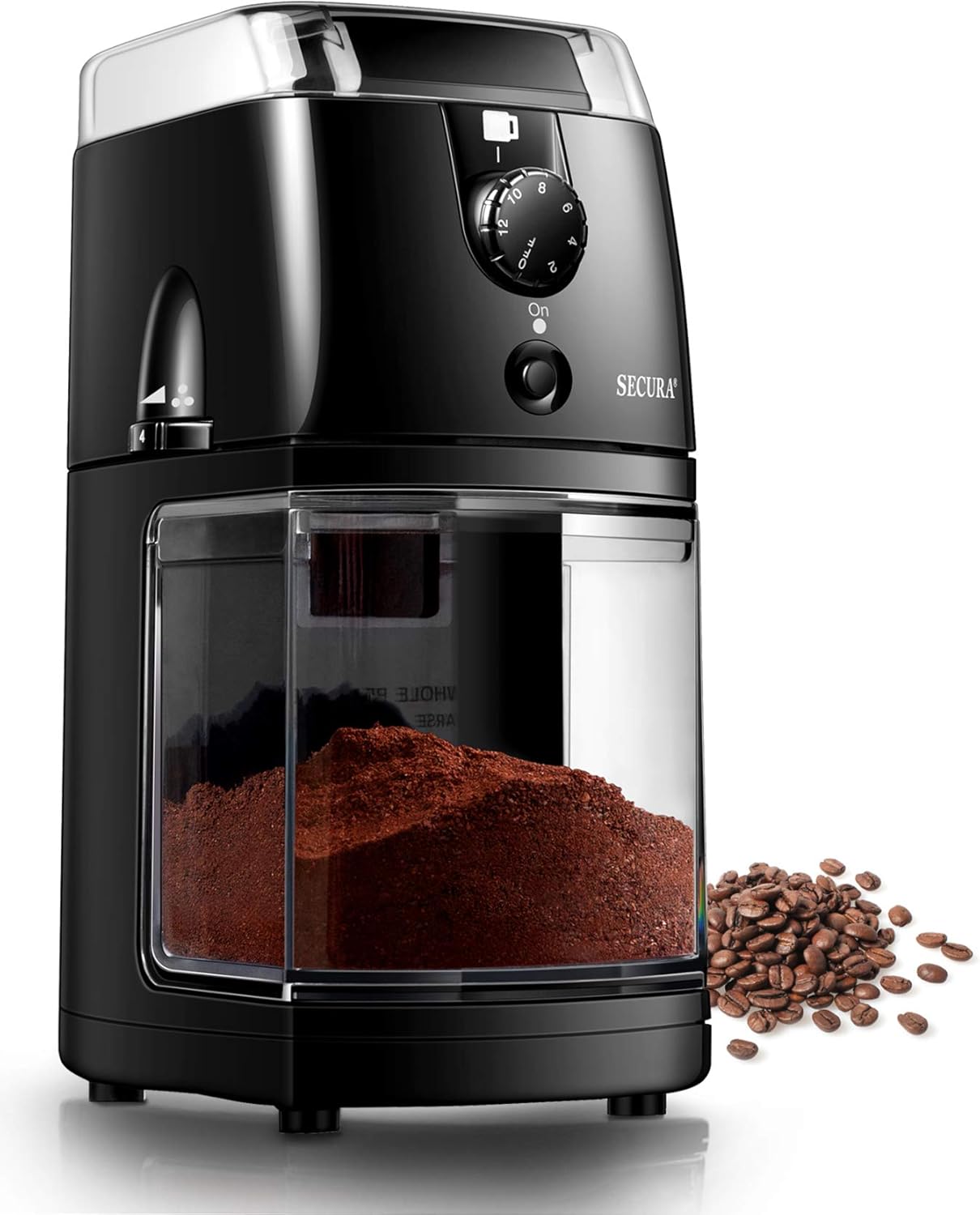
Secura Automatic Burr Coffee Grinder SCG-903B
- 17 numbered adjustments
- 110-watt motor
- 2–12-cup quantity control
- Auto-stop operation
- Compact 6 x 4-inch footprint
- Removable grinding ring

De’Longhi Dedica Digital Coffee Grinder KG521M
- 18 stepped grind choices
- Digital LCD interface
- 350 g bean hopper
- 150-watt motor
- Portafilter adapter included
- Container dosing for up to 14 cups
Gevi Electric Burr Coffee Grinder, 35 Settings
- 35 graduated grind positions
- Anti-static design
- Fine, medium, coarse brew range
- Timed or cup-oriented variants
- Grounds container for daily batches
- Medium-range pour-over adjustment
Quick Ranking: Which Grinder Fits Your Brewing Routine?
| Grinder | Best role | Grind range | The limitation I keep in mind |
|---|---|---|---|
| Capresso Infinity 560.04 | Simple daily all-rounder | 16 steps | Analog timer; chute needs cleaning |
| Bodum Bistro | Low-static grounds transfer | 12 steps | Fewer adjustment choices; glass needs care |
| Secura SCG-903B | First burr grinder | 17 steps | Basic finish and approximate cup dosing |
| De’Longhi Dedica KG521M | Shared household / LCD controls | 18 steps | Larger footprint; broad rather than espresso-micro steps |
| Gevi 35-setting burr grinder | Fine-tuning across drippers | 35 steps | Not a guarantee of specialist espresso accuracy |
How I Judge Grind Quality Without Chasing One Magic Setting
Before the individual reviews, there is one principle I return to: a pour-over recipe is a system. The grinder prepares the particles, the brewer shapes water flow, the paper traps fines, and the way I pour controls agitation. If I change all of these together, I have no clear idea why the coffee improved. I prefer to weigh a repeatable dose, brew with the same water, and keep a simple record of setting, drawdown, and taste. That creates a reference point I can trust from day to day.
For a typical 20-gram brew, a roughly 1:16 coffee-to-water ratio means about 320 grams of water. It is a reasonable reference, not a rule. Some beans taste livelier at a different ratio; some drippers flow differently; some roasts need more or less energy. A sour cup might benefit from a finer grind, hotter water, or more effective saturation. A bitter, drying cup might improve when the grind is coarser, the brew time is shorter, or agitation is gentler. I decide which lever to pull after tasting, not merely after checking a stopwatch.
Grind uniformity is also more complicated than counting visible fragments on the countertop. Fines are not automatically evil: they contribute surface area and body, and even excellent grinders create some. Trouble begins when too many fines restrict flow or when a wide particle spread makes flavor difficult to control. I pay attention to whether the coffee bed behaves reasonably and whether the cup tastes clear and balanced. A grinder that makes enjoyable, repeatable coffee without an elaborate cleanup routine has done an important part of its job.
Five Detailed Pour-Over Grinder Reviews
1. Capresso Infinity Conical Burr Grinder 560.04
The Capresso Infinity 560.04 is the grinder I put first for someone who wants their V60 routine to become simpler, not more complicated. I like the plain, readable hopper collar: 16 marked settings, four broad zones, and a 5–60-second mechanical timer. There is no bright display trying to earn its place on the counter. I can see why that appeals to a brewer who buys one good bag of coffee, uses a scale, and wants to get to the kettle without ten extra decisions. I also make the limitation clear at the start: this is a value-minded home burr grinder, not a tiny commercial espresso machine.
The distinction between this machine and the Infinity Plus deserves attention. The 560.04 is the regular Infinity with a 5–60-second timer, an ABS body with a stainless-look finish, and the familiar four coarseness zones. The Plus models use a different cup-oriented control scheme. Buying the wrong replacement part, following the wrong adjustment instructions, or assuming that a Plus-specific feature is present can turn an otherwise simple purchase into an unnecessary headache. I treat the number printed on the machine as more important than the family name on a review headline.
For pour-over, the machine’s sweet spot is the middle of its range. I start in that region, not with a fixed internet number, because a dense washed Ethiopian coffee and a medium-roast Brazilian blend do not necessarily draw down in the same way. The grind affects how easily water passes through the bed, but pouring speed, agitation, paper thickness, dose, and filter geometry are also part of the result. A grinder cannot rescue an inconsistent brewing routine all by itself. For the bigger picture on materials and handling, I also consider coffee grinders with premium construction when comparing options for a permanent home coffee station.
Best OverallCapresso Infinity Conical Burr Grinder 560.04
My balanced choice for a home pour-over station that needs a straightforward grind dial without demanding digital controls.
- Straightforward collar adjustment
- Well-established conical-burr format
- Slow, gear-reduced grinding
- Practical medium-range settings
- No built-in scale or gram dosing
- Grounds collect around chute and bin
- Only 16 adjustment positions
Technical Specifications & Daily Features
- Model 560.04: standard Infinity, not Infinity Plus
- Steel conical burrs, 16 settings across four ranges
- 100 watts, 120V (U.S. model)
- Timer adjusts from 5 to 60 seconds
- Bean hopper: approximately 8.8 oz
- Housing: ABS plastic with stainless-look finish
- Dimensions: 5 x 7.75 x 10.5 inches
- Removable upper burr and cleaning brush
My Capresso priority is the middle of the adjustment scale. I value a dial that is easy to revisit, a removable upper burr that makes dry brushing possible, and an uncomplicated timer for routine batches. I still treat that timer as a convenience rather than a measurement of coffee mass.
Pros & Cons After 30 Days of Use
The first practical advantage is the 560.04’s familiar adjustment collar. I start a filter-coffee recipe with a measured dose, settle near the medium range, and keep the water and pouring pattern consistent while adjusting grind one notch at a time. I trust that process more than a setting number copied from another kitchen. A washed light roast and a medium-roast blend rarely behave identically under the same water stream. The Capresso makes the decision legible: coarser or finer, then taste again. Its limitation is just as plain. Sixteen positions give useful control, but the ideal midpoint sometimes sits between two clicks.
The ownership compromise appears around dosing and cleanup. The grinder’s timer follows seconds, not grams, and retained grounds around a chute can affect the amount that reaches the receiver. I keep a scale in the conversation and favor regular dry brushing around the removable upper burr. That adds a small chore, but the service access is preferable to pretending stale residue disappears on its own. For a household making the same drip or pour-over recipe each morning, the controls are approachable. For frequent switches between espresso and filter, the adjustment spacing becomes a much bigger frustration.
My Final Verdict
I recommend the standard Capresso Infinity 560.04 as the most balanced starting point for routine home pour-over. The mechanical controls are its strength; limited fine-step resolution and occasional chute cleanup are the price of that simplicity. It is the standard Infinity, not the Infinity Plus, and I do not recommend it for demanding non-pressurized espresso dialing.
Why its familiar controls work for filter coffee
On the Infinity, the hopper collar is also the grind adjustment. That arrangement keeps the steps easy to see and avoids the tiny, delicate knobs that some compact appliances use. I prefer to establish a repeatable reference with one bag of beans, then move only one step at a time when a cup is too tart or a finish feels dry. A small change that improves the cup is more useful than turning the collar three positions and losing track of what helped.
Capresso’s gear-reduced motor is intended to keep grinding relatively slow. I care less about a sweeping promise to preserve every aroma molecule and more about its ordinary effect on use: a controlled approach to grinding without the aggressive speed associated with some inexpensive choppers. Burrs can still produce heat during extended work, and the beans, workload, and ambient conditions matter. A small home pour-over dose is simply not the same thermal challenge as grinding for a busy café line.
Sixteen steps are adequate for a broadly defined medium grind, but the spaces between them are part of the compromise. Sometimes one position is slightly too quick and the next slows the brew more than I want. When that happens, I adjust pouring intensity or brew ratio rather than pretend the machine has hidden microsteps. That technique works well for filter coffee, where several recipe variables can be tuned without the extreme sensitivity of a non-pressurized espresso basket.
The parts I watch after the excitement fades
The grounds chute and collection bin matter at least as much as the timer once the grinder becomes routine. With a hopper-style grinder, a little coffee can remain behind and emerge on the next session. That is why I prefer dosing by mass rather than trusting the timer to deliver an identical amount every morning. I weigh the beans, grind, and check what reached the container when repeatability really matters. The timer helps workflow, but it never becomes a scale simply because its markings look precise.
Cleaning is straightforward in principle: disconnect power, remove the upper burr as directed, brush dry residue, and clear the grounds area without wetting the grinding mechanism. The removable burr is a good long-term feature because stale coffee can accumulate where an exterior wipe cannot reach. Oily beans may demand attention more often. My practical rule is to treat a change in grind behavior, unexpected dust, or a stale odor as a reason to inspect the chamber before blaming the coffee.
The 560.04 has a stainless-looking exterior, but its principal housing is plastic. That is not automatically a defect: the more important question is whether the body sits securely, the adjustment stays engaged, and the serviceable areas are accessible. It is a value-minded machine, not a miniature commercial grinder. I prefer to describe that honestly than sell its finish as solid steel.
Where it makes sense—and where it does not
My first choice for this Capresso is an ordinary morning filter brew. A V60 with a controlled kettle benefits from the grinder’s clear middle settings, while a flat-bottom dripper can be a little more forgiving when grind size is not finely adjustable. With a Chemex, the thick paper and deeper bed may justify starting a step coarser. These are directions for experimenting, not permanent numbers that apply to every roast or recipe.
The Infinity is far less compelling if the same machine must serve a demanding espresso setup. Having an extra-fine range is not the same as delivering the closely spaced adjustments that espresso requires. It also is not a true single-dose grinder engineered for minimal retention. Those two limitations matter if your habits revolve around changing between beans, weighing out tiny espresso doses, or switching constantly between brew methods.
For an everyday brewer who wants a recognizable set of controls and tolerates occasional brushing, though, the Infinity remains one of the easier machines to recommend. Its strengths are practical: an accessible grind collar, a familiar burr format, manageable size, and a straightforward relationship between what you adjust and the cup you taste.
How I Think About the First 30 Days
The 560.04 rewards restraint when changing beans. My first check is the cup, not the dial: a new roast may need one step finer, or it may need a gentler pour and a slightly different ratio. I favor keeping everything else stable before attributing a flavor shift to the burrs. The point of sixteen clear positions is repeatability, not an illusion of infinite precision. The removable upper burr is the other feature I rate highly for ownership because access matters every time dark-roast residue builds up around the grinding path.
My longer-term view is straightforward. A brewer who uses a V60, Kalita, or electric drip machine gets a practical grinder with a small learning curve. A person who changes methods constantly or wants to adjust espresso shots by tiny increments soon encounters the boundaries of its design. The ABS housing also deserves an accurate description; it is not a solid stainless-steel machine. I still prefer that honest package over a polished exterior that fails to help with the next cup.
My final buying judgment: The Capresso Infinity 560.04 is my top everyday pour-over choice in this group: familiar adjustment, accessible cleaning, and a sensible price-to-function balance. I accept its basic timer and sixteen-step range for filter coffee, not for precision espresso.
2. Bodum Bistro Electric Burr Coffee Grinder
What catches my attention about the Bodum Bistro is not the motor or the styling. It is the moment between finishing the grind and getting coffee into the filter. Anyone who has tapped a static-charged plastic container over a V60 knows how an otherwise pleasant routine turns into a countertop cleanup. Bodum puts borosilicate glass into that part of the workflow. I like the thinking behind it. The glass catcher cannot eliminate every fine particle, and it can break if dropped, but it is a genuine handling choice rather than another line of shiny marketing copy. That is why the Bistro earns a distinct place alongside the Capresso.
I find the Bistro’s personality easy to understand. Twelve grind positions, a timer that operates over a short 5–20-second window, a traditional hopper, and a compact silhouette make it approachable for anyone brewing one or two filter coffees at home. The design has color and character without hiding what the machine is doing. In a small kitchen, a grinder you can operate without reading instructions every morning is a genuine quality-of-life benefit.
A practical caution: this is not an espresso-specialist grinder. Its fine end may work for some pressurized workflows, but a non-pressurized espresso basket asks for extremely small changes that the Bistro’s twelve steps were not designed to supply. I judge it mainly by its filtered coffee rather than awarding bonus points for having the word espresso in the adjustment range.
Cleanest CatcherBodum Bistro Electric Burr Coffee Grinder
The appealing alternative when the annoying part of morning grinding is fine coffee dust scattering around a plastic grounds bin.
- Glass catcher addresses cling
- Pleasant daily counter presence
- Easy adjustment for filter brewing
- Straightforward timed grinding
- Glass catcher needs careful handling
- Twelve adjustment steps limit precision
- Timed dose changes with coffee density
Technical Specifications & Daily Features
- BISTRO burr model, 12 grind positions
- Steel conical burrs
- Borosilicate-glass grounds catcher with grip
- 5–20-second adjustable grind timer
- Approx. 220 g / 7.75 oz bean hopper
- Friction clutch for obstruction protection
- Mixed plastic, steel, glass, rubber, silicone construction
- Not a grind-by-weight or specialist espresso grinder
With the Bistro, I care most about the catcher and the modest control scheme. Twelve grind positions and the 5–20-second timer make sense for routine drip, press, and pour-over. They do not give me the tiny espresso corrections that a dedicated portafilter setup requires. I also treat the glass container as a useful tool, not an indestructible accessory.
Pros & Cons After 30 Days of Use
The Bistro’s everyday strength begins after grinding. Its borosilicate catch cup gives the transfer a different feel from the thin plastic bins used on some inexpensive grinders. I prefer a receptacle that can be lifted, handled securely, and emptied without an unnecessary shower of chaff. That advantage comes with a responsibility: the glass should be seated fully and kept away from the edge of a crowded counter. I also like the honest simplicity of the twelve-position dial. A medium starting point covers everyday filter work, but the number does not travel unchanged from a V60 to a large Chemex batch.
The practical drawback is a short adjustment ladder. When two neighboring settings bracket the ideal drawdown, I lean on water delivery, dose, and brew ratio rather than pretending that a hidden intermediate click exists. The preset timer also requires the usual reality check: seconds do not equal grams when bean density or roast changes. I regard the friction clutch as a sensible protective feature, not a promise against all mechanical damage. Routine dry brushing, careful handling of the glass cup, and realistic expectations about espresso are what make the Bistro a convincing brewed-coffee purchase.
My Final Verdict
The Bistro is my preferred choice for pour-over drinkers who dislike static and enjoy a straightforward, attractive grinder. The glass catcher is its strongest day-to-day selling point; twelve settings and timed dosing define its limits.
The glass catcher is more than decoration
I pay special attention to the grounds container because it affects the last ten seconds of grinding, when the coffee moves from machine to brewer. A good catch cup should be easy to seat, comfortable to hold, and able to pour without scattering grounds across the counter. Bodum’s borosilicate-glass design helps reduce the static annoyance that can accompany conventional plastic cups. It also brings a trade-off: glass must be handled carefully, especially when the kitchen is crowded or someone is making breakfast in a hurry.
I prefer to return the catcher fully into place before starting the grinder, then take a moment after grinding to let the last grounds settle. Rushing the transfer can defeat some of the benefit of a cleaner receptacle. The rubberized grip is a useful detail because it improves handling when your hands are damp from preparing the dripper. That is the kind of design choice that matters repeatedly, not only during the first unboxing.
The machine also includes a friction clutch intended to protect the grinding mechanism if a small hard obstruction reaches the burrs. It is a sensible safeguard, not permission to ignore foreign material or use the appliance for anything other than coffee beans. If the sound changes sharply or the burrs stall, I stop, disconnect power, and inspect as directed instead of pushing ahead.
Twelve settings: enough for your favorite pour-over?
I see the Bistro as a practical filter grinder: its dial runs from fine through coarse, and its middle positions cover the territory many pour-over drippers need. There is no universally right numbered click for a V60, Kalita, Origami, or Chemex. I choose one coffee, grind a modest dose, and observe the cup and drawdown. On a V60, a fast, sour cup often invites a slightly finer setting. A muddy bed and a dry, bitter finish may ask for a coarser one. These signals have exceptions, but they help narrow the search.
Compared with a 35-setting grinder, twelve positions give you less resolution for small changes. The difference becomes more obvious when working with a very light roast or switching between high-extraction and gentler recipes. If I cannot land exactly where I want, I adjust agitation and recipe ratio rather than continuing to turn a coarse dial back and forth. For most casual filter drinkers, this compromise is manageable; for obsessive recipe tinkerers it can feel restrictive.
I also resist the temptation to leave a full hopper exposed for days solely because it can hold the beans. A bag closed well away from warmth and light usually offers more predictable freshness. I load what I need for the next session or for a short stretch, keeping in mind that grinding duration and bean density affect how much exits the chute. The timed control is a convenience, not a precision scale.
Cleaning, noise, and the everyday ownership equation
The separate catcher makes emptying and wiping manageable. Bodum’s removable grinding ring and hopper parts also improve access to the areas that accumulate coffee dust. I never rinse a burr assembly or motor section casually; dry brushing is the safer default unless the care instructions explicitly permit another method. A clean grinder reduces the chance that yesterday’s dark roast flavors today’s delicate light roast.
Noise is still the sound of an electric motor and coffee beans breaking, and kitchen acoustics matter. I do not promise whisper silence. What I value more is a grinder with an uncomplicated start-stop routine and a dose range that makes sense for a couple of cups. The Bistro has that personality, provided you accept that the timer will need occasional readjustment as your coffee changes.
Its construction is also mixed, which is entirely appropriate at this price level. Stainless components, glass, plastic, rubber, and silicone each serve a function. Calling the whole device stainless steel is inaccurate. I think the right definition of premium here is thoughtful handling rather than the highest possible percentage of metal.
How I Think About the First 30 Days
A second coffee brings the Bistro’s compromises into sharp relief. Some roasts settle comfortably into its middle positions, while others ask for a finer distinction than twelve clicks can supply. I prefer to keep the better-tasting setting and work on pouring rather than chase a nonexistent setting. The other important ownership habit is inspecting the grinding ring and catcher for oils and fine residue. Glass may make transfer neater, but it does not clean the burrs or remove every particle in the chute.
My judgment favors the Bistro for a specific kind of kitchen: regular drip or immersion coffee, a preference for straightforward controls, and real appreciation for a glass grounds container. It loses ground when fine adjustment is the main goal. I do not call it an espresso specialist, and I do not treat a tidy catch cup as proof of low measured retention. Its appeal is the simple daily handoff from grinder to brewer.
My final buying judgment: I prefer the Bodum Bistro for the brewer who cares about clean, comfortable grounds transfer as much as grind adjustment. The glass catcher is its defining practical advantage. Twelve positions, timed rather than weighed dosing, and a fragile container are the limits I keep in view.
3. Secura Automatic Burr Coffee Grinder SCG-903B
I don’t dress up the Secura SCG-903B as something it isn’t. This is the economical grinder on the list, with 17 adjustments and a compact burr-mill layout that makes more sense for a first pour-over station than for an enthusiast chasing fine espresso micro-adjustments. That is not an insult. I prefer an accessible tool that introduces genuine grind control over an attractive blade chopper with a misleading promise of consistency. For a small kitchen, the Secura’s modest footprint is a serious advantage. The trade-off is ordinary budget construction and a cup-quantity selector that needs interpreting—not mistaking for a scale.
The grinder’s small body is also a practical strength. At about six inches by four inches across its footprint and less than nine inches tall, it suits a crowded kitchen where a grinder cannot claim half the coffee station. A removable adjustment ring and separate grounds bin make the hardware fairly easy to understand. I prefer appliances that show me where coffee dust will accumulate and let me reach those areas with a brush.
Secura’s motor is rated at 110 watts for the North American model. That matters because the original 200-watt description sets an inaccurate expectation about the appliance. A watt figure by itself does not prove grind quality, durability, or thermal performance. The reason to consider this machine is its simple filter-coffee workflow and moderate purchase cost—not a claim that it has the power reserve of a much larger commercial grinder.
Budget StarterSecura Automatic Burr Coffee Grinder SCG-903B
The no-frills choice for someone who wants to leave blade grinding behind and spend the savings on better beans.
- Compact body and simple controls
- 17 clearly available adjustments
- Low learning curve for filter coffee
- Accessible cleaning ring
- Less refinement than premium grinders
- Quantity dial is not a scale
- Chute collects dust and requires tapping
Technical Specifications & Daily Features
- Model SCG-903B, electric burr mill
- 17 grind settings
- 110 W, 120 V (North America)
- Grind quantity selector for 2–12 cups
- Dimensions about 6 x 4 x 8.75 inches
- Bean hopper capacity up to 100 g in manual
- Removable grind adjustment ring and included brush
- Requires properly seated lid and bin to operate
My Secura assessment starts with expectations. Its 17-setting dial and removable grinding ring support basic filter-coffee habits, while its cup selector approximates a dose. I rely on a scale for precise coffee mass and keep this machine firmly in the entry-level category. I do not confuse the North American 110-watt specification with a commercial motor rating.
Pros & Cons After 30 Days of Use
For a beginner, the Secura’s best lesson is that grind size and coffee quantity are separate decisions. The seventeen-position control affects coarseness; the 2–12-cup dial helps determine how long the motor runs. Neither measures the actual coffee in a paper filter. I start with the weighed recipe, select a middle position, and adjust for flavor rather than selecting an impressive-looking number. The result is a straightforward way to move beyond blade-chopping guesswork. I also appreciate a grinder whose controls can be understood without opening an app or navigating a touchscreen.
Its limitations are equally practical. The removable receiver and safety interlocks must be seated correctly, while the grinding ring and chute benefit from routine brushing. A bin that does not lock properly can interrupt a rushed morning; a chute carrying old dark-roast residue affects the next coffee. I prefer to describe those maintenance details rather than bury them under the word “premium.” The SCG-903B belongs on a modest kitchen counter making filter batches, not grinding continuously for a café or chasing tiny non-pressurized espresso corrections.
My Final Verdict
I recommend the Secura SCG-903B as an inexpensive, compact step into burr grinding for everyday pour-over and drip coffee. Its clear adjustment and small footprint are useful; basic materials, approximate cup dosing, and limited fine-step control define the compromise. I do not represent it as a 200-watt machine or a precision espresso grinder.
Learning its cup selector without confusing cups and grams
The SCG-903B has a 2–12-cup quantity setting alongside the 17-position grind control. I see that as a handy starting point for ordinary household batches, but I never substitute cup markings for a weighed recipe. Coffee density varies with roast level and bean size, so two settings that run for the same apparent quantity can deliver different masses of grounds. If I want 20 grams for a dripper, my scale is still the authority.
My approach is to choose a medium grind, grind a modest amount, and note what comes out of the bin. When the output fits the recipe, I can use the cup setting for routine convenience while occasionally checking with the scale. If I switch from a dark blend to a dense light roast, I recalibrate the quantity. This is not the machine failing; it is the difference between a time-based estimate and a measured dose.
I like that the adjustment wheel has a simple finer-to-coarser direction. Seventeen settings sound generous, but they still leave definite steps between the options. I like to think of them as a navigable range rather than seventeen promises of perfect extraction. A finer step can improve a cup that tastes thin, though increasing water agitation or changing dose may also be appropriate. On the other hand, a filter that repeatedly stalls deserves a coarser setting and gentler pouring.
How I use the Secura with a V60 or flat-bottom brewer
A flat-bottom dripper is a forgiving place to start because the coffee bed tends to distribute water differently from a large cone. I use a moderate ratio, keep pouring consistent, and listen to what the cup says before chasing a stopwatch number. If the coffee tastes balanced but finishes faster than an online recipe suggests, that is not an automatic problem. Grind adjustment should serve flavor, not somebody else’s exact brew duration.
A V60 reveals uneven extraction and excessive fines more readily because the paper and cone geometry create a very particular flow pattern. If the bed clogs late in the brew, I look not only at grind size but at the amount of swirling, kettle height, and whether the filter paper is seated correctly. Moving coarser may help, but making the pour less aggressive can reduce the fines being pushed against the paper. Good technique keeps a modest grinder working within its strongest range.
I avoid assigning one universal setting like nine or eleven as the correct pour-over choice. The Secura’s scale can help you return to a known point, but beans age, humidity changes, and drippers behave differently. My best instruction is to find a balanced cup with your own water and bean, then record the setting for that combination.
A low-cost grinder still deserves proper maintenance
The maintenance instructions are worth following rather than improvising. The grounds bin and the lid need to be seated correctly for operation, and the grinding ring is designed to be removed for cleaning. A dry brush clears residue without introducing moisture where it does not belong. When grounds start collecting behind the removable bin, a gentle tap can help them fall through before you lift the container away. That is a practical detail with this grinder, not a defect unique to your kitchen.
Long continuous grinding sessions are not its intended job. Secura advises allowing the motor to cool after demanding repeated cycles instead of running large batches endlessly. I consider that a reasonable trade-off for a compact household appliance. Someone making one or two filter coffees at a time is working within a very different usage pattern from a café preparing bags of ground coffee for customers.
It is also sensible to inspect the feed path if oily beans make the grinder behave inconsistently. Dark roasted coffee can deposit more oil and sticky residue than a dry, lighter roast. I first clean the burr chamber and review dosing habits before deciding the machine needs replacing. Proper care cannot make an entry-level grinder outperform its design, but it can help it perform as intended.
How I Think About the First 30 Days
The budget-grinder reality is most obvious around the chute and grounds receiver. I regard a quick dry-brush habit as part of using the Secura sensibly, especially with oily roasts. A second dripper is another good way to understand the 17-step dial: an acceptable flat-bottom cup and a fussy cone do not always favor the same setting. I change one brewing variable at a time. The goal is a repeatable, enjoyable filter coffee rather than an endless hunt for a competition-level grind profile.
The Secura earns its place through simple controls and a countertop-friendly body. I also see the ceiling of its appeal. Anyone whose primary goal is delicate flavor separation, constant recipe changes, or precise espresso adjustment needs more control than a basic seventeen-step burr mill supplies. For a first home pour-over brewer watching the budget, it remains a sensible purchase without any grand promises about longevity or laboratory-grade uniformity.
My final buying judgment: I recommend the Secura SCG-903B as a cost-conscious first burr grinder for straightforward filter brewing. I value its small size and basic adjustment while keeping its cup selector, modest construction, and espresso limitations firmly in perspective.
4. De’Longhi Dedica Digital Coffee Grinder KG521M
The De’Longhi Dedica KG521M is the one I associate with a busier, shared coffee corner. A display, a larger hopper, eighteen grind positions, and the option to dose into either a container or a compatible portafilter change how the machine is used. I like that the LCD puts the controls in plain view; nobody has to guess which unmarked knob somebody else touched. But I refuse to equate a bright screen with a better cup. The real question is whether the extra workflow options matter in that kitchen. For a person preparing one small V60 every morning, the KG521M may simply take up more space than it earns.
For a pour-over-focused buyer, the key question is whether all that interface sophistication actually helps the morning routine. I like controls that make grind choice and dose selection legible; I do not believe more buttons automatically improve flavor. A medium grind that produces a balanced filter coffee is worth more than a display showing three attractive icons. The best use of the LCD is to make choices clear and repeatable, not to replace weighing or tasting.
The KG521M has a 350-gram hopper and 150-watt motor in its U.S. specification, with physical dimensions around 9.5 by six by fifteen inches. That is notably larger than the Secura, and the counter-space decision should happen before buying. I measure the clearance below any cabinets and decide whether the portafilter adapter has enough room to be used comfortably. A convenient feature becomes frustrating if the machine is squeezed into a corner.
Digital ControlsDe’Longhi Dedica Digital Coffee Grinder KG521M
The most feature-rich daily interface of the five, particularly useful when a household alternates between different brewers.
- Readable controls and clear workflow
- Direct portafilter option
- Large capacity for shared mornings
- Suitable filter-coffee range
- Step spacing limits espresso fine-tuning
- Higher counter space requirement
- LCD cannot measure grams automatically
Technical Specifications & Daily Features
- KG521M Dedica digital grinder
- 18 grind settings and 3 strength settings
- 350 g bean hopper
- 150 W U.S. rated motor
- Up to 14 cups in grounds container
- Approx. 9.5 x 6 x 15-inch dimensions
- Approx. 2.7 kg net weight with accessories
- Digital LCD and portafilter adapter
I rate the Dedica’s readable interface and receiving options above its feature count alone. Eighteen steps work across common brewed-coffee ranges, but they are not espresso micro-adjustments. The portafilter adapter is useful only with compatible equipment, and the digital dose selections remain estimates rather than measurements of coffee mass.
Pros & Cons After 30 Days of Use
The KG521M makes most sense when I view it as a shared-household tool. Its LCD makes selections easier to follow, and the supplied grounds container supports filter batches without the awkwardness of dosing directly into a small basket. That convenience sits alongside an 18-step grind scale and a generous 350 g hopper. A digital cup or strength selection does not remove the need for a scale; I still treat the actual ground weight as the reference for a repeatable pour-over. This is a more guided workflow than the Capresso, though not necessarily a more precise one.
The portafilter option adds versatility, but I do not mistake it for universal espresso compatibility. Basket and holder fit should be checked against the particular machine, and an 18-step grinder still lacks the tiny adjustment increments prized for demanding non-pressurized shots. The larger footprint is another genuine ownership cost, especially beneath low cabinets. I recommend measuring filling clearance and leaving room to remove the receiver. The Dedica earns its counter space in a household using those extra functions; its screen alone is not enough of a reason.
My Final Verdict
I like the KG521M for a household that values clear digital controls, shared use, and multiple ways to collect grounds. It is a capable everyday brewed-coffee grinder, but its size and stepped espresso adjustment keep it from being my simplest V60 pick or my choice for specialist non-pressurized espresso.
Digital convenience without pretending to measure coffee mass
The LCD allows the user to select a grind setting, the number of cups, and strength-related options. It makes the process easier to follow than a small anonymous timer dial. I especially like that the grounds can be collected in a dedicated container for multiple brewed cups. That arrangement makes sense when family members prepare a morning pot or when one person wants enough coffee for a larger Chemex brew.
Still, electronic dosing controls do not necessarily weigh the coffee. If I select four cups on a grinder, I am choosing a programmed approximation based on grind time and assumptions about output. I weigh the actual grounds when I want to replicate a recipe. That distinction is fundamental: a digital interface can be accurate in following its own timing instructions without being a scale or guaranteeing a precise extraction ratio.
For pour-over, I establish two or three useful setting references—perhaps one for a small cone, one for a flat-bottom dripper, and one for a bigger, thick-filter brew. I note the beans alongside each setting because the same number may not work for every coffee. There is no need to adjust the machine every time merely because the screen makes experimenting easy. A stable recipe is still the quickest route to understanding the coffee.
Eighteen settings across espresso and brewed coffee
The Dedica’s 18 grind positions cover a broad range, from espresso-oriented settings through the coarser territory used for French press. That versatility is appealing, but I distinguish range from resolution. Covering both ends of a spectrum does not mean there is an unlimited number of useful stopping points in between. Pour-over generally gives me more flexibility because I can fine-tune the kettle, water temperature, and dose alongside the grinder.
The portafilter adapter is an especially sensible accessory for someone who already owns a compatible De’Longhi espresso setup. It can reduce the awkward step of transferring grounds from a separate cup into the basket. I confirm compatibility with the exact portafilter before treating direct dosing as a guaranteed feature for every machine. Universal cradle fit is not something I assume from a photograph.
If the household relies on a non-pressurized espresso basket and expects tiny changes between shots, the KG521M’s steps may feel too widely spaced. In that situation, it may still serve filter coffee very well while a dedicated espresso grinder handles the demanding shots. I recommend that split honestly than exaggerate what one broad-range grinder can do.
The routine that makes its larger footprint worthwhile
The full-sized hopper is convenient for multiple doses, but I resist leaving a week’s supply of specialty beans in the machine. Air exposure and kitchen light can erode the advantages of buying fresh coffee. In a multi-person household, a reasonable compromise is to keep a small amount in the hopper for the next few uses and store the rest properly. The LCD makes preparation orderly; it cannot keep coffee fresh after days of unnecessary exposure.
Cleaning requires care around the burrs and the receiving container. If the same grinder is used for dark espresso beans and a delicate pour-over roast, grounds carried over from a previous session can affect the flavor. I brush accessible parts, empty the receiver thoroughly, and consider a brief transition dose when changing radically different coffees. That costs a little time but prevents an expensive bag of beans from tasting like yesterday’s blend.
The Dedica is ultimately a grinder for people who enjoy a guided workflow. I see it as most appealing in a household with different drink preferences and enough room for an appliance that is taller and heavier than the budget alternatives. For a solitary pour-over drinker who wants only one setting and one button, the additional controls may simply be unnecessary.
How I Think About the First 30 Days
The daily trade-off with the Dedica is versatility versus footprint. A household switching from darker espresso-oriented beans to a lighter filter roast benefits from remembering separate settings, but the grinding path also needs routine attention when flavors change. The LCD helps communicate controls; it cannot clear yesterday’s coffee out of the chute. I value the receiving-container option most for repeated filter batches and reserve the portafilter adapter for compatible equipment.
My assessment of the Dedica is stronger for a busy counter than a minimalist one. An 18-step dial and programmable-looking display give structure to the morning, yet neither turns the machine into a grind-by-weight system. The hopper occupies real vertical space, and dedicated espresso enthusiasts may still need closer adjustment increments. I recommend it where several people and brew methods genuinely justify the extra controls.
My final buying judgment: The De’Longhi Dedica KG521M is my digital-workflow pick for a shared kitchen. The LCD and flexible grounds collection are useful distinctions. Its footprint and eighteen-step scale make it less attractive for a single-brewer minimalist station or precision espresso tuning.
5. Gevi Electric Burr Coffee Grinder, 35 Settings
The Gevi is the grinder here that invites curiosity. Thirty-five marked positions are not proof of better burr alignment or flavor clarity, but I can see the appeal for anyone rotating among a V60, a flat-bottom dripper, and the occasional larger batch. That extra room on the dial can make adjustments feel less abrupt than they do on twelve- or sixteen-step machines. I also like that Gevi pays attention to static, because loose chaff has a talent for spreading across an otherwise tidy coffee station. Still, I give the long settings list only the credit it deserves: options for adjustment, not measured proof of a superior grind.
The grinder also emphasizes anti-static handling. This is useful because a coffee station can look untidy even after a perfectly good grind if chaff and fine particles cling to the container. Anti-static design can reduce one source of irritation; it does not promise that the chute will be completely empty or that every gram you load will instantly emerge. I make that distinction with every grinder advertised as low-mess or low-retention.
I approach this Gevi as a versatile home filter grinder with extra adjustment choices rather than a premium commercial tool. Its useful range covers fine, medium, and coarse categories, and a general guide places pour-over in the middle region around positions 15–25. Those figures are a place to begin exploring. Actual settings depend on the bean, age, recipe, filter, and preferred flavor profile.
More Fine-TuningGevi Electric Burr Coffee Grinder, 35 Settings
The most adjustable option here for a person who likes changing filters, recipes, and bean origins rather than leaving one dial untouched.
- More grind steps for dialing in
- Broad filter-coffee adjustment range
- Anti-static measures ease cleanup
- Useful across several brew styles
- Numbers are not a universal recipe
- Anti-static does not mean zero retention
- Less established support than major brands
Technical Specifications & Daily Features
- Gevi burr grinder with 35 grind settings
- Setting scale: 1 finest, 35 coarsest
- Approximate guide: 15–25 for drip/pour-over
- Anti-static grounds-handling design
- Product family includes cup/time-oriented grinding controls
- Exact hopper and accessory bundle depends on SKU
- Coarse positions for French press; finer end for espresso-style ranges
- Not a substitute for an espresso-specific stepless grinder
My Gevi priority is usable adjustment in the filter range. Thirty-five marks offer several reference points for different drippers, but the number alone cannot establish consistency or service life. I also regard anti-static design as help with mess, not a guarantee of zero retained coffee.
Pros & Cons After 30 Days of Use
The biggest benefit of Gevi’s longer dial is the chance to make smaller recipe corrections. I start with a measured dose and a sensible medium setting, then judge the drawdown and flavor before moving to an adjacent mark. The dial is especially attractive when switching between a quick V60 brew and a deeper, thicker-filter batch. But there is no universal Gevi number that makes every bean taste good. I still consider water temperature, paper, pouring energy, and coffee freshness; a grinder cannot do those jobs for me.
I pay just as much attention to the grounds path as the setting dial. Gevi describes anti-static handling, which is appealing in a dry kitchen where chaff clings stubbornly to bins. That description is not evidence that every gram leaves the chute, and it does not eliminate routine brushing. The more settings a grinder offers, the more tempting it becomes to chase numbers instead of flavor. I prefer a short list of useful reference positions and a tidy transfer into the brewer over endless adjustment for its own sake.
My Final Verdict
I favor Gevi for the pour-over enthusiast who enjoys adjusting recipes between beans and drippers. Thirty-five positions give useful flexibility, while anti-static design addresses an everyday nuisance. I keep the distinction clear: plenty of settings are not the same as independently proven particle consistency or long-term reliability.
What 35 settings change in a morning brew
More grind settings help only when I can return to them reliably. I like to keep a short record of where a coffee tastes balanced and how it behaves when the drawdown is too quick or too slow. With a 35-step dial, I can attempt a smaller correction before changing water temperature or the amount of agitation. The extra resolution is especially welcome when switching between a fast-draining V60 and a deeper, thicker-filter recipe.
It is easy to become obsessed with a perfect-looking coffee bed. I try not to confuse appearance with taste. A level bed after a swirl can be satisfying, but a slightly uneven surface does not prove the grinder is poor. Likewise, a cup that takes longer than an online recipe is not necessarily over-extracted. I look for sweetness, balance, clarity, and a pleasant finish, then use brew time as supporting context rather than as the only target.
For the Gevi, I choose a modest number of repeatable reference settings rather than memorize all thirty-five. One for light, aromatic coffee in a conical dripper; another for a medium roast in a flat-bottom brewer; perhaps a third for a larger Chemex. The practical benefit is finding your way back when a friend asks for the coffee they enjoyed last weekend.
Anti-static convenience still needs practical handling
Fine particles can carry an electric charge after traveling through the burrs and chute. That is why they sometimes cling to plastic walls or jump around when you pour them. Anti-static measures address part of that problem, which can make the counter easier to keep clean. But the exact effect depends on humidity, roast, bean moisture, and how the grinder is used. I do not call a container dust-free without measured evidence.
I always make the physical transfer part of my brewing routine. I place the filter and dripper before grinding, ensure the receiver sits properly, and transfer the grounds over the sink or tray if the kitchen is particularly dry. I do not shake the bin aggressively in an attempt to dislodge every remaining particle; that can create a new cloud of chaff. A small brush and consistent maintenance are more reliable than frantic tapping.
When moving from fine settings back toward a coarser grind, I also pay attention to the manufacturer’s recommended adjustment procedure. Some grinders can be adjusted freely in one direction but should be running or empty when moving much finer. Forcing a burr collar against trapped beans can strain the mechanism. Good technique is worth learning even if the machine makes the dial look effortless.
Who benefits from its flexibility and who should look elsewhere
I see the Gevi as a good match for an enthusiast who has at least two manual brewers and likes tasting differences between coffees. A little extra grind control can be genuinely enjoyable in that setup. It is also an option for households that make drip coffee during the week and switch to pour-over on weekends. A medium grind can be found without requiring an entirely separate grinder for each appliance.
The brand and model family deserve realistic expectations about long-term support and replacement parts. I check local warranty terms and accessory compatibility before treating the machine as a lifelong investment. A grinder that functions well now still benefits from a clear plan for cleaning and replacing wear items when necessary. That is not a criticism unique to Gevi; it is one of my first questions for any home coffee appliance.
I do not buy it solely for espresso because there are grinders designed around much smaller espresso adjustments. Nor do I assume that thirty-five positions translate into thirty-five equally useful positions for one dripper. Most of my work will happen within a small section of the scale. The reward is being able to move carefully within that section when the coffee asks for it.
How I Think About the First 30 Days
What I like most about the Gevi’s longer dial is that the same machine can serve several filter routines without demanding huge jumps in setting. One reference point fits a light coffee in a cone, another a medium roast in a flat-bottom brewer, and a third a larger batch. I treat these as practical reference ideas, not fixed settings for every roast. I record which combination tastes best and repeat it before making another adjustment.
My longer-term concern is support, not a lack of buttons. A newer grinder can offer a persuasive feature list yet have less widely documented parts availability than an established brand. I check warranty terms and cleaning access before treating any grinder as a long-term investment. Gevi remains an attractive option for an enthusiast who values multiple grind positions; the benefit is more limited for someone who leaves the dial on one medium setting every day.
My final buying judgment: I recommend Gevi to the home pour-over experimenter who benefits from a wider stepped range. The 35-setting dial is its practical appeal. It does not prove professional grind uniformity, and its service ecosystem deserves attention.
Buying Guide: Choosing a Pour-Over Grinder You Will Enjoy Using
Start with the dripper, not the price
My first question is what kind of coffee will be brewed most days. Someone who makes one 250-gram V60 before work has different priorities from a family brewing a large Chemex at breakfast. Smaller cups tend to reveal changes in pouring and agitation quickly, while larger brews place more emphasis on total dose, grind throughput, and comfortable transfer into the filter. A grinder that handles one well may still feel clumsy for the other.
For a cone dripper, I want a useful medium to medium-fine range and the ability to make a single adjustment without losing my reference. For a flat-bottom brewer, I still want consistency, but the cup may be somewhat more forgiving when the grind steps are larger. For a big Chemex brew, easy access to coarser settings and a container that holds the required dose become especially valuable. The category name ‘pour-over’ hides these real differences.
I also look at where the machine will live. A tall grinder beneath low cupboards can turn filling a hopper into an awkward chore. A receiver that must be tilted to remove it can scatter grounds when the counter is crowded. I measure clearance, allow room for a scale and dripper, and consider which hand I naturally use for pouring. Ergonomics are not a luxury when the same movements happen before every morning coffee.
Learn what the settings actually control
Grind settings describe how the mechanism changes burr spacing, not a guaranteed particle size in microns for all beans. The label ‘medium’ is a broad guide, not a universal industry calibration. Different burr geometry, alignment, motor speed, roast density, and retention all affect the material that reaches the cup. I never assume setting ten on a Capresso corresponds to setting ten on a Gevi or to a particular dial position on a Bodum.
The number of steps also tells only part of the story. Thirty-five can be useful because it gives me more chances to adjust a recipe subtly. Sixteen may be plenty if most of my coffee falls comfortably into the grinder’s middle range. What matters is whether neighboring settings produce meaningful, controllable changes around the brewing method I actually use. A huge number on the package means little if most positions are irrelevant to filter coffee.
When I move from one roast to another, I expect to recalibrate. Light roasts can be dense and behave differently under the burrs. Darker beans are often more brittle and oilier, which can influence dust, static, and residue. I write down a new setting for a new coffee rather than treating the first dial-in as permanent. The notes can be as simple as ‘V60, washed Kenya, position near middle, tasted bright, slightly fine next time.’ That is enough to build useful knowledge.
Use a scale even when the grinder has a timer
A timer measures how long the motor runs; it does not tell me precisely how many grams arrived in the catch cup. A cup selector makes assumptions about dose size that may not match my recipe. An LCD can present those assumptions attractively without changing their basic nature. If I genuinely want to compare cups, I weigh the coffee before grinding or weigh the output, then use the grinder’s timer as a helpful shortcut between checks.
This matters especially for a recipe with a fixed water ratio. If the grinder delivers 18 grams on one morning and 22 on the next while the kettle still pours 320 grams, I have changed the strength substantially. The resulting flavor change may be blamed on grind size when the true cause is dose variation. A small scale costs less than replacing a perfectly adequate grinder and often improves consistency more dramatically.
Once I have a stable routine, I do not have to turn every morning into a laboratory exercise. I can use the timer for convenience and weigh periodically to make sure the output has not drifted too far. Precision is useful because it removes confusion, not because brewing coffee should become exhausting.
Control fines, flow, and agitation together
When a pour-over filter stalls, I examine the full brew rather than declaring that the grinder is too fine. Certain coffees produce more fine particles naturally, and forceful pouring can push them against the paper. A filter folded awkwardly against the dripper can also restrict flow. The combination of grind, paper, kettle height, and stirring determines how water passes through the coffee bed. I try one deliberate correction at a time.
My first response to a brew that races through and tastes thin is often a small move finer, provided the coffee was evenly saturated. If the cup is harsh and the last part of the brew crawls, I try coarser grinding or less agitation. But taste has the final vote. Some coffees produce lively cups with unexpectedly fast drawdown, while others need longer contact to become round and sweet. A chart can guide a starting point; it cannot replace sensory judgment.
I need the grinder to help me reach a stable result, not encourage constant fiddling. Once a setting works for a particular coffee, I repeat it. Consistency across multiple mornings reveals more about whether the machine suits me than a single dramatic cup in which every variable was adjusted at once.
Understand the difference between conical and flat burrs
Burr shape is worth understanding, but I do not use it as a shortcut for predicting flavor. Conical grinders can be compact and practical for mixed home brewing. Flat-burr grinders may offer particular grinding characteristics depending on their geometry and alignment. Neither shape guarantees a clean cup, low fines, or better extraction simply because of its name. The actual implementation matters more than the label.
All five grinders in this list are intended to replace the uneven chopping behavior of simple blade grinders. They still vary substantially in construction, adjustment mechanism, and grounds transfer. I pay attention to the finished cup and the convenience of maintaining the grinder rather than assuming that any steel-burr model is automatically superior to another. Material, machining, motor design, and service access work together.
Heat is another area where marketing can overpromise. Grinding creates some heat through mechanical work and friction, but a small home filter dose is different from repeated high-throughput commercial batches. I do not claim that one household grinder preserves every aroma because its motor is slower. For me, the more meaningful question is whether the machine handles the doses I need without struggling and whether my brewed coffee tastes fresh and balanced.
Consider static, retention, and catch-cup design
Grounds retention means some of the coffee remains inside the grinder instead of reaching the receiver. Static is one reason particles cling, but geometry, oils, humidity, and grinding speed also affect the result. A glass catcher can make the transfer neater, and anti-static engineering may help, but neither eliminates the need to clean the chute and chamber. I separate a cleaner countertop from proof of truly zero retention.
If I rotate among several coffees, retained grounds matter more because yesterday’s beans can mix with today’s new flavor profile. A careful brush, sensible purging habits, and an accessible chamber help control that issue. If I use one coffee for a full bag, a little carryover may be less disruptive, although maintenance still matters for freshness and odor. Different ownership habits create different requirements.
I also pay attention to the physical geometry of the receiver. Does it sit securely under the chute? Can I lift it without knocking into the brewer? Does it pour into a narrow cone without scattering grounds? A beautifully engineered grinder can still annoy me if the last stage of the workflow feels awkward. Bodum’s glass catcher, for instance, is an appealing design feature precisely because transfer is repeated every single brewing day.
Keep the burr chamber clean without damaging it
Freshness is not simply about the age of the beans. Old residue in the grinding chamber can affect taste, especially when switching from an oily dark roast to a floral light roast. I disconnect the appliance, follow the model’s removal instructions, and brush accessible surfaces dry. I do not improvise by pouring water into the chamber or trying to make burrs dishwasher-safe when the manufacturer has not designed them that way.
I find regular, careful cleaning far more sensible than a rescue clean after performance has already declined. I check the chute when output becomes inconsistent or when the aroma from the grinder smells stale. Some machines let me remove the upper burr; others provide a removable ring or hopper for access. I prefer good access and simple parts over a glossy finish that hides a difficult-to-clean interior.
The bean choice affects maintenance frequency. Oily dark roasts may leave more residue, and flavored beans can create sticky deposits that ordinary brushing struggles to remove. I avoid adding syrups, wet beans, or coated products unless the appliance explicitly permits them. Cleaning should be safe, repetitive, and boring—the very quality that keeps the grinder enjoyable for years.
Pay for useful improvements, not promises
The strongest buying decision is often less glamorous than the advertising suggests. I compare the cost of a grinder with the specific frustration it solves. If the kitchen is dusty from static, the Bodum catcher may matter more than twenty extra settings. If I use multiple drippers, Gevi’s broader scale can be worthwhile. If several family members brew different drinks, De’Longhi’s display and flexible receiving options may justify their extra space. If I simply need decent burr grinding, the compact Secura remains a reasonable starting point.
I also consider a scale, fresh beans, quality paper, and a kettle that can pour steadily. Spending the entire budget on the grinder while ignoring these essentials can leave the brewing routine unnecessarily difficult. A modest grinder paired with a thoughtful method can produce genuinely enjoyable coffee. It is better to understand the process than to assume price will correct all the variables for me.
Most important, I leave room for preference. One person prizes sweetness and texture; another wants pronounced acidity and flavor separation. Some enjoy changing one setting every weekend, while others want a reliable mug before work. My best grinder is the one that makes that person’s desired cup straightforward, repeatable, and pleasant to prepare.
Practical Pour-Over Dial-In: A Repeatable Starting Routine
1. Choose one stable coffee and brewer
I start with one bag that has been stored well and a dripper I know. I do not switch paper, brew ratio, grinder setting, and kettle technique between the first two cups. A consistent reference is what makes changes interpretable. The idea is not to remove curiosity from coffee; it is to make curiosity productive.
2. Weigh the coffee and water
Twenty grams of coffee and about 320 grams of water is a simple 1:16 starting reference for many filter brews. I adjust it to taste rather than treating the numbers as universal. A scale helps eliminate the common mistake of blaming grind size for a cup that was actually brewed with a changing dose.
3. Start in the medium grind region
I use the grinder’s medium guidance, then choose a sensible position for the dripper. On a 35-step Gevi, the general filter range falls around 15–25; on a Capresso, Bodum, Secura, or Dedica, I use the actual machine’s marked middle area instead of translating another brand’s numbers literally.
4. Saturate all grounds and pour consistently
I wet the bed evenly and pay attention to the shape and energy of my pouring. A controlled initial bloom helps wet dry particles; later pours should avoid repeatedly blasting a hole through the coffee bed. Excessive agitation can move fines into the paper and make a brew slow down for reasons unrelated to burr quality.
5. Taste before judging time
I note the total drawdown, but I judge the cup first. A brew that looks fast can still taste excellent. A slow brew may be sweet and well balanced. I make a single adjustment only when I can name the problem: sourness, harshness, weak body, dryness, or muddled flavor. That is more useful than chasing a magic stopwatch number.
6. Repeat the successful cup
When a change improves the coffee, I keep it for another brew. If the result repeats, I write down the setting, coffee, ratio, and dripper. The small record gives me confidence when I move to a different bag and prevents the common trap of rediscovering a good setting every morning.
Common Problems and What I Change First
The coffee tastes sour and thin
I first check whether the grounds were evenly wet and whether the brew ratio accidentally became too weak. If those look reasonable, I move the grinder a little finer or adjust extraction through temperature and pouring. A sour cup does not automatically prove that the grinder is defective. Some light roasts genuinely need more extraction energy than a familiar medium blend.
The filter stalls near the end
I inspect grind fineness and the amount of agitation. A heavy swirl late in the brew can push fines into the paper. I try a coarser setting or a gentler pouring pattern, then compare flavor. I also check that the paper is seated correctly, because a poorly placed filter can obstruct flow even with an appropriate grind.
The grinder delivers different doses
I separate mass from time. A timer and cup selector do not weigh coffee, so I check the beans in and grounds out on a scale. A new roast or a nearly empty hopper may change how quickly material feeds through the burrs. I clean the chute if the discrepancy suddenly becomes unusually large.
Grounds cling to the container
Dry air and particle charging can make chaff jump and cling. I transfer grounds more deliberately, keep the container properly seated, and maintain the grounds path. An anti-static machine or glass catcher may help, but neither makes cleaning unnecessary. I avoid wetting anything near the motor or grinding chamber without explicit care guidance.
The motor sounds strained
I stop and investigate rather than continuing to run the machine. A blocked burr chamber, foreign object, or excessive grinding load may need attention. After disconnecting power, I follow the model-specific cleaning guidance. On the Secura, I also remember the manual’s limit on repeated full grinding cycles and allow cooling when needed.
Two grind settings both seem wrong
On a stepped grinder, the ideal point sometimes falls between positions. I choose the better of the two cups, then adjust water temperature, pour intensity, or dose slightly. I do not grind finer simply because it sounds like more precision. Flavor remains the deciding factor, and a little flexibility in technique can rescue a recipe without requiring another machine.
Final Comparison: Build, Control, and Daily Convenience
| Product | Physical format | Control | Strength for pour-over | Key trade-off |
|---|---|---|---|---|
| Capresso Infinity 560.04 | ABS with stainless-style finish; conical burrs | 16 steps; 5–60 s dial | Straightforward medium-grind workflow | Not Infinity Plus; limited steps |
| Bodum Bistro | Mixed-material body; glass grounds catcher | 12 steps; 5–20 s timer | Neater grounds transfer | Handle glass with care |
| Secura SCG-903B | Compact household burr mill | 17 steps; 2–12 cup dial | Affordable daily entry | 110 W motor; simple construction |
| De’Longhi KG521M | Larger LCD-equipped grinder | 18 steps; dose/strength selections | Several users and brew methods | Footprint and espresso-step spacing |
| Gevi 35-setting grinder | Electric burr body; anti-static design | 35 stepped positions | Fine-tuning for diverse drippers | Long-term service support varies |
Final Recommendation: Choose the Grinder That Fits the Cup
My overall pick is the standard Capresso Infinity 560.04 for a straightforward home pour-over station. I like how little it asks of the brewer: choose one of sixteen grind positions, use the familiar mechanical timer, and clean the accessible burr chamber when needed. It is not a grind-by-weight appliance and it is not the Infinity Plus. Those are manageable limits for someone who wants a repeatable filter coffee without extra electronics.
Bodum’s Bistro is the alternative I like for the person whose daily annoyance is the mess of transferring grounds. Its borosilicate glass catcher gives the purchase a specific purpose, although a twelve-step dial and a breakable container come with the territory. For a first burr grinder on a tight budget, I put Secura SCG-903B on the shortlist. Its compact construction, seventeen settings, and 110-watt U.S. motor make far more sense for ordinary filter brewing than for precision espresso.
The De’Longhi Dedica KG521M stands out when several people share the coffee counter and want a readable screen and flexible grounds collection. Gevi serves a different sort of brewer: one who enjoys dialing in different beans and drippers through a wider scale of settings. I don’t reward either machine simply for adding controls. I look at whether its design solves a repeated inconvenience—and whether the machine’s limits fit the coffee actually being made.
A good pour-over grinder should make the next cup easier to improve. It should not make me fight static, forget every setting, or distrust the dose that reaches my filter. Once I can return to a sweet, balanced coffee on an ordinary weekday, the equipment is serving its purpose.
Frequently Asked Questions
What grind size should I use for pour-over coffee?
I start in the medium range and adjust to taste and flow. V60 recipes often benefit from a somewhat finer reference than a large Chemex batch, but bean density, dose, paper, pouring, and roast all matter. I do not assign a universal number across different grinder brands.
Is a conical burr grinder good for V60 coffee?
Yes. A well-designed conical-burr grinder can produce very enjoyable V60 coffee. I focus on consistent operation, a usable medium range, and ease of cleaning rather than claiming that the burr shape alone determines flavor.
Is the Capresso 560.04 the Infinity Plus?
No. The 560.04 is the standard Infinity. It uses 16 marked positions and a mechanical timer. Infinity Plus models are a different part of the family and use a different quantity-selection arrangement. Model numbers matter when ordering parts or reading instructions.
How many grind settings do I need for pour-over?
There is no magic minimum. Twelve or sixteen settings can be entirely workable when the filter-coffee positions are well placed. Thirty-five gives more opportunities for small adjustments, but it does not guarantee a better cup. I prioritize useful range and repeatability over the biggest number.
Does a slower grinder preserve more coffee flavor?
Grinding heat depends on burr geometry, dose, speed, workload, and surrounding conditions. I do not claim that a slower motor preserves every delicate aromatic compound. For modest home doses, consistent grinding, fresh beans, and a sound brewing recipe generally matter more than a simple speed slogan.
Why does my pour-over taste sour even with fresh beans?
Sourness can suggest insufficient extraction, but I check more than grind size. Uneven saturation, cool water, a weak ratio, or a coffee that naturally emphasizes acidity can all contribute. I change one variable at a time and use flavor as the guide.
Does the Bodum Bistro have a glass or plastic grounds bin?
The Bistro burr grinder’s principal catcher is borosilicate glass, with a grip that helps handling. Some other Bodum products differ, so I match care instructions to the exact model. Glass is useful for reducing static but needs more careful handling than a plastic cup.
Is the Secura SCG-903B 200 watts?
No. The SCG-903B North American specification is 110 watts. Its attraction is affordable burr grinding, seventeen settings, and simple household batch controls, not a high-powered commercial motor.
Can the De’Longhi KG521M grind for espresso too?
It has an espresso-oriented range and a compatible portafilter adapter, but eighteen stepped choices may not be precise enough for every non-pressurized espresso setup. For pour-over and drip coffee it has a comfortable intended range. I match the adapter to the specific portafilter.
Is the Gevi 35-setting grinder good for Chemex?
It can be a reasonable option because the dial offers room to adjust toward the coarser filter-coffee end. I start in a suitable medium-coarse territory, then watch the drawdown and taste. A deeper Chemex recipe with thick paper will not necessarily use the same setting as a small V60.
How can I reduce fine coffee dust in the filter?
I start by checking grind size and how vigorously I pour. Excessive agitation can push fines into the paper and slow the brew. Cleaning the chute and choosing a suitable coffee also help. Some fines are normal; the goal is good extraction, not a physically impossible absence of small particles.
Should I rinse coffee grinder burrs with water?
I do not rinse metal burr assemblies or wet the motor chamber unless the model’s instructions expressly allow it. I unplug the machine and use a dry brush for accessible grinding surfaces. Removable catchers and lids can have different washing guidance, so I treat each component separately.
Is an anti-static grinder the same as a zero-retention grinder?
No. Static and retention are related but different issues. Anti-static measures may reduce cling and flying chaff, while retention also depends on the shape of the chute, oils, and trapped particles. I do not assume that every gram enters the receiver or that cleaning is unnecessary.
Do I really need a scale if the grinder has a digital display?
Yes, if repeatable ratios matter. A display can control time, cup counts, or other settings without measuring actual ground-coffee mass. Weighing helps me distinguish a genuine grind-related flavor change from a dose that drifted between brews.
Can one grinder work for pour-over, drip, French press, and espresso?
Many grinders cover several coarse-to-fine categories, but espresso demands much smaller adjustments than filter coffee in some setups. I choose a broad-range grinder for the brew methods I make often, and buy a dedicated espresso grinder if precise non-pressurized espresso becomes a priority.
Why do my grinder settings change when I open a new bag?
Different origins, roast levels, bean densities, and ages behave differently between the burrs. I expect to recalibrate when a new coffee arrives. Keeping the same water, brewer, and basic recipe for the first few cups helps me identify the adjustment that actually matters.
Which grinder do I recommend for a small kitchen?
The Secura SCG-903B is notably compact and has straightforward controls. I still measure the available counter and cabinet clearance, check where the power cable goes, and make sure there is room to remove the grounds bin without knocking over the dripper.
How often should I clean a burr grinder?
I inspect the receiver and grounds chute frequently and brush the accessible burr chamber on a schedule that matches the beans I use. Oily or flavored coffee can require more attention. A stale smell, unusual retention, or changing output is a reason to clean sooner rather than force the grinder to keep running.
What makes a grinder worth upgrading?
I upgrade when a specific problem repeatedly interferes with brewing: not enough adjustment control, awkward grounds transfer, excessive retained coffee between beans, insufficient capacity, or difficult maintenance. A higher price and larger settings number are not enough on their own to make an upgrade worthwhile.


