
Best Premium Coffee Grinders for Home Baristas


OneHundredCoffee is reader-supported, and some products displayed may earn us an affiliate commission. Details
I judge a coffee grinder by how its construction supports brewing, handling, and maintenance, not by the sheen of a product photo. Grind quality affects extraction, but the construction around the burrs determines whether I enjoy making coffee on an ordinary Tuesday. A dial that stays where I set it, a bin that pours neatly, an accessible burr chamber, and a housing that remains stable on the counter all matter long after the excitement of buying something new has faded. In that sense, premium construction is not a single material. It is a collection of intelligent choices that make grinding more predictable and ownership less annoying.
It is tempting to judge grinders by how much stainless steel appears in the photograph. I don’t. Stainless steel can describe the burrs, a trim panel, or the entire body, and those are very different claims. Heavy metal does not automatically create a better cup; neither does the word ‘professional’ on a box. I care about how the burrs are supported, how easily adjustments can be repeated, whether grounds transfer cleanly, and how readily normal cleaning can be done. The design has to suit the brewing method, too. A magnificent grinder for pour-over can be an inappropriate choice for traditional espresso.
My Three Picks for Different Coffee Setups

Fellow Ode Brew Grinder Gen 2
- 64 mm flat burrs
- 31 adjustment steps
- 100 g dose capacity
- Aluminum housing
- Anti-static system
- Not for espresso

Bodum Bistro Premium Burr Grinder
- 12 grind positions
- Steel conical burrs
- Borosilicate glass bin
- Preset timer
- Friction clutch
- White linked variant

Olayks Conical Burr Grinder (OLK-CG206)
- 48 grind choices
- 40 mm conical burrs
- Digital timed dosing
- LED touch display
- Anti-static design
- Espresso-oriented range
The five grinders here cover very different budgets and priorities: the Fellow Ode Gen 2, Chefman RJ44, Kaffe flat-burr model, Bodum Bistro Premium, and Olayks OLK-CG206. They are not five equally luxurious machines, and I don’t intend to pretend they are. Fellow represents considered brewed-coffee engineering. Bodum makes an unusually practical choice with its glass catcher. Chefman and Kaffe bring basic burr grinding into more modest kitchens. Olayks puts digital adjustment and timed operation ahead of quiet minimalism. That range makes the comparison more useful than five near-identical pieces of polished metal.
I keep one central question in mind: what does a grinder contribute to the household rhythm after the novelty fades? Does the grind setting make sense before breakfast? Can I keep the working area clean? Is switching between two coffees straightforward? What happens when the burr chamber needs brushing? Those questions expose weak design more quickly than a glossy finish. They also help me make recommendations for readers who need a reliable daily coffee rather than a showroom demonstration.
A practical 30-day ownership assessment has four useful checkpoints: a repeatable starting recipe, clear setting changes, normal grounds handling, and straightforward cleaning. The first week establishes a reference; the second reveals how easily a setting can be repeated; the third exposes residue and maintenance needs. By the end of the month, the strongest judgement concerns suitability for the household’s brewing habits, not an unsupported claim about years of durability.
For non-pressurized espresso, fine-adjustment capability comes first. For drip, pour-over, and French press, particle consistency, clean dosing, and an uncomplicated routine carry more weight. I prioritize that brewing decision over the price of aluminum trim, glass, touchscreens, or industrial styling.
At a Glance: Five Grinders and Their Badge Titles
Fellow Ode Brew Grinder Gen 2
- 64 mm flat burrs
- 31 adjustment steps
- 100 g dose capacity
- Aluminum housing
- Anti-static system
- Not for espresso
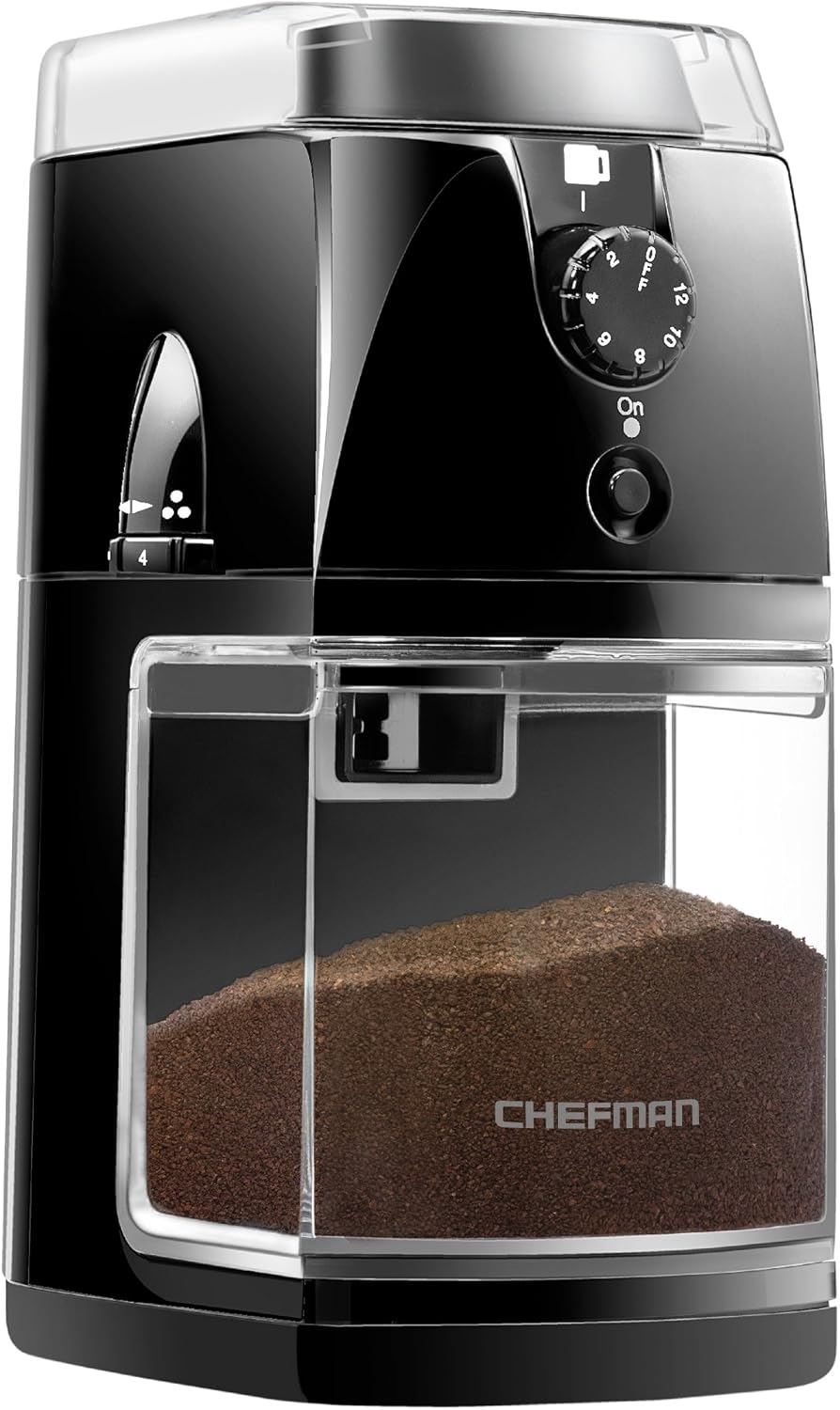
Chefman Electric Burr Grinder (RJ44)
- 17 grind positions
- Cup-quantity timer
- Budget burr milling
- Removable ground bin
- Hands-on dial controls
- Less premium materials

Kaffe Electric Flat-Burr Grinder (KF8022B)
- 14 settings
- Flat burr mechanism
- 5.5 oz hopper
- Compact frame
- Cleaning brush
- Small-counter focus
Bodum Bistro Premium Burr Grinder
- 12 grind positions
- Steel conical burrs
- Borosilicate glass bin
- Preset timer
- Friction clutch
- White linked variant
Olayks Conical Burr Grinder (OLK-CG206)
- 48 grind choices
- 40 mm conical burrs
- Digital timed dosing
- LED touch display
- Anti-static design
- Espresso-oriented range
A useful comparison begins by separating burr type from build quality. Flat and conical burrs can both produce excellent coffee. What matters is the burr design, mounting, adjustment mechanism, alignment, and suitability for the intended grind range. The Fellow’s large flat-burr package is optimized for brewed coffee; the small Kaffe also uses flat burrs, but that does not make the two equivalent in construction or capability. Bodum and Olayks take conical approaches, while Chefman’s older RJ44 focuses on accessible everyday adjustment.
I also separate dose control from grind control. Timed grinding can be convenient, but a second on the timer is not a gram of coffee. Different beans feed differently through the same burrs. When I want to compare coffee quality, I begin with a weighed dose and a consistent brewing recipe. That small discipline makes even a basic machine easier to evaluate and prevents expensive electronics from taking credit for a change caused by the beans.
The short badge on each card identifies its main strength, and the same label appears in the At-a-Glance section. I never choose by a badge alone. The detailed reviews expose the compromises that do not fit into six features or a three-word label.
Quick Ranking: What Each Grinder Really Does Best
| Pick | Badge | Best Match | Important Trade-Off |
|---|---|---|---|
| Fellow Ode Gen 2 | Premium Brew | Brew-focused homes | Does not grind traditional espresso |
| Chefman RJ44 | Budget Starter | Affordable daily drip | Only 17 settings |
| Kaffe KF8022B | Compact Flat | Small kitchens | Limited 14-step range |
| Bodum Bistro | Glass Catcher | Glass-catcher convenience | Only 12 positions |
| Olayks OLK-CG206 | Digital Dosing | Timed digital workflow | Less proven service ecosystem |
The Five Grinders in Detail
1. Fellow Ode Brew Grinder Gen 2
A proper brew-station upgrade
The most considered construction in this lineup for brewed coffee, with a serious limitation for espresso.
Why this grinder changes the feel of a coffee corner
The Fellow Ode Gen 2 makes a useful case for the difference between premium construction and decorative metal. Its aluminum body is substantial, but the more important choices happen where a hand actually meets the grinder: the grind dial, the magnetically located catch cup, the hopper opening, and the little knocker used to dislodge grounds. Those touches do not magically improve every cup. They make the sequence from beans to brewer more orderly, and that is what I want from a grinder that costs more than a basic appliance.
A polished enclosure cannot compensate for an unsuitable burr range, so I start with the most important boundary. Ode Gen 2 is built for brewed coffee. Its 64 mm flat burrs and 31 adjustment steps support filter and immersion methods, not traditional espresso preparation. I recommend a purpose-built espresso grinder for non-pressurized baskets, regardless of how elegant this machine looks. For V60, batch brewing, AeroPress, and French press, the Ode’s focused design makes sense.
I place the Ode at the top of the construction ranking for a specific reason: its design answers the little questions that appear every day when a person makes brewed coffee. I value a catch cup that locates confidently, a dial that is easy to return to, and a dose-sized hopper that encourages weighing beans rather than leaving them exposed. None of those choices requires an invented taste test to appreciate. They are concrete pieces of the workflow. I still keep its brew-only limitation prominent because I see no value in praising elegant engineering while steering an espresso drinker toward the wrong machine. My judgment is strongest when I pair its physical strengths with that very clear boundary.
I also distinguish between the appearance of low retention and proof of low retention. The anti-static system and grounds knocker address familiar mess problems, and I give them credit for that useful purpose. I do not assign a made-up fraction of a gram to the chute or pretend every dark roast behaves the same way. I look instead at the direct consequences of the design: manageable catch-cup handling, an accessible routine for dry cleaning, and the freedom to move between filter recipes. I consider that a more meaningful premium proposition than a countertop full of controls nobody uses. For a home focused on pourover and immersion brewing, I regard the Ode as a coherent piece of equipment rather than an expensive ornament.
The 100 g capacity also tells a story about intended use. This is a single-dose approach: measure the beans for the next brew rather than fill a large hopper and forget about them. That supports fresh dosing and bean changes without emptying a reservoir. It is a more useful advantage for someone who rotates roasts than decorative metalwork ever is.
Setting up a more disciplined morning routine
The Ode works most cleanly on a counter with an unobstructed path for removing its magnetic catch cup and a clearly visible grind dial. A nearby scale completes the setup. The effective routine is simple: decide the dose, weigh the beans, select the setting, and prepare the brewer and filter before grinding. Clear steps keep the grinder from adding unnecessary decisions to the morning.
For pour-over, the recommended range for the brewing device is a sensible starting point, but taste and drawdown guide the next adjustment. A hollow or sharp cup can signal insufficient extraction, while a dry, bitter cup calls for examining extraction and the recipe. Dose, water quality, pouring, filter paper, and roast development still matter. Changing one variable at a time gives a useful comparison; chasing a universal dial number does not.
The magnetic catch cup reduces awkward movement between grinding and dosing. Its pouring lip still deserves attention: fine particles can cling, and a controlled transfer is cleaner than vigorous shaking above the brewer. Fellow’s anti-static system helps with grounds handling, but no grinder stays perfectly static-free across every roast and humidity level.
My buying rule: I pay more attention to the setting I can repeat, the brewing method I actually use, and the effort required to keep the grinder clean than to broad promises of café-grade performance.
The parts that matter after the novelty wears off
A beautiful dial feels significant for the first few mornings. A month later, the question is whether you can return to yesterday’s successful recipe without thinking too hard. Clear adjustments and a repeatable cup position have durable value because they remove small annoyances. I pay more attention to that quality than to whether a panel is metal, plastic, or glass in isolation. A thoughtfully designed plastic component can be perfectly appropriate when it is not taking heavy structural loads.
Cleaning remains necessary. Coffee oils and particles collect in the exit path and burr chamber, even with an anti-static system. The sensible routine is to brush manufacturer-approved removable components, keep water away from the motor housing, and protect the burr edges from improvised tools. Clear access to the grind path is a practical part of premium construction.
Noise also needs context. Fellow designed the Ode Gen 2 for relatively quiet operation, but bean density, dose, countertop material, and room acoustics affect the actual sound. There is no defensible universal decibel comparison here without controlled measurements. The meaningful strength is a brew-focused motor and enclosure, not a claim of silence.
Thirty-day ownership assessment: brew quality and handling
The Ode’s first practical advantage is its repeatable brewed-coffee workflow. A weighed dose, a recorded setting, and a consistent water ratio create a dependable baseline for comparing filter recipes. The 31 steps give room to refine the result without pretending that a setting alone determines flavor. Its single-dose hopper also makes changes between roasts more direct than working with a full reservoir.
Over repeated brews, the magnetic catcher and anti-static grounds path reduce handling steps, while the dial makes previous settings easy to revisit. Residue still gathers around grinding components and requires routine brushing; anti-static technology is not a substitute for maintenance. The meaningful ownership strengths are clear controls and organized dosing, not a guarantee of zero retained coffee.
The decisive limitation remains espresso. The Ode’s 64 mm burr system is engineered for filter and immersion coffee, so it cannot replace a grinder capable of dialing in a traditional non-pressurized espresso basket. For a household centered on brewed coffee, its specialized workflow and solid construction justify its leading position in this comparison. Long-term motor life and precise retention are separate questions that require measured records.
Premium BrewFellow Ode Brew Grinder Gen 2
The most considered construction in this lineup for brewed coffee, with a serious limitation for espresso.
- Purpose-built for brewed coffee
- Aluminum enclosure and refined handling
- Anti-static help around the catch cup
- Convenient 100 g single-dose capacity
- Cannot serve as the dedicated espresso grinder
- Cost and footprint need justification
- The cup and chute still require periodic care
Technical Specifications & Daily Features
- 64 mm stainless-steel flat burrs
- 31 total grind positions across 11 numbers
- 100 g single-dose hopper capacity
- Aluminum body with plastic loading components
- Anti-static system and magnetic catch cup
- Designed for filter and immersion, not espresso
The useful specification is the one that improves the brewing method used most often. I recommend matching the grind system to that routine instead of treating a long feature list as proof of all-purpose capability.
Pros & Cons After 30 Days of Use
I rank the Ode’s day-to-day design strongest when the brewing routine centers on pour-over, drip, AeroPress, and French press. The 100 g dose capacity, easy-to-locate magnetic catch cup, 31 settings, and grounds knocker all serve that routine directly. I give the anti-static system credit for its practical purpose without turning it into a claim of perfectly clean transfers in every kitchen. The first-month ownership question is whether the grinder makes repeated brewed-coffee preparation simpler, not whether its housing looks costly. I value the repeatable adjustment and the freedom to change beans without emptying a large hopper. Those are credible strengths of the design.
I also put the limitations on the same level as the benefits. I still expect brushing around the catch cup and grinding path, and I do not regard any anti-static feature as a substitute for maintenance. The price is substantial for a grinder that cannot serve traditional espresso. I therefore rate the Ode highly for serious brewed-coffee households and decisively exclude it from a one-grinder espresso setup. My conclusion rests on the machine’s documented construction and purpose, not on invented retention measurements or a claimed thirty-day test log.
My Final Verdict
I rank the Fellow Ode Gen 2 first for premium brewed-coffee construction. I appreciate its thoughtful single-dose handling, magnetic catch cup, and purposeful 64 mm flat-burr design. I do not recommend it as an espresso grinder; for filter and immersion enthusiasts, it is my strongest overall construction pick.
For a narrower comparison of filter-oriented brewing setups, the published One Hundred Coffee guide to pour-over grinders adds useful context before making a choice based on construction alone.
Related reading: five coffee grinders for pour-over coffee.
2. Chefman Electric Burr Grinder (RJ44)
Affordable controls, straightforward expectations
A practical entry-level grinder with a 17-position adjustment wheel rather than the 31-setting digital system associated with a different Chefman model.
The useful reality behind its modest shell
Chefman enters this comparison from an entirely different direction than Fellow. The RJ44 wins attention through understandable controls and affordable burr milling, not decorative metalwork. A burr mechanism offers more deliberate adjustment than a small blade chopper. That distinction makes the word premium tricky: sometimes it means expensive materials, while better practical design can also mean straightforward controls that serve a normal household well.
The exact version matters. This RJ44 unit has seventeen grinding positions and a quantity dial. Chefman also makes a digital conical-burr grinder with thirty-one options, but it is a different machine. The RJ44 does not have the digital model’s LCD or fine timer controls. Its older interface is mechanical and direct, which may be exactly what a beginner prefers.
I judge the Chefman on the terms that actually match its price and control scheme. I want clear changes between coarse and medium grinding, a grounds container that comes out without an elaborate sequence, and a quantity setting that makes a weekday routine less cumbersome. I do not mistake the cup dial for an integrated scale, and I do not upgrade its seventeen positions to the specifications of a separate digital model. Those distinctions matter because a beginner deserves to understand the machine being purchased. I can recommend the RJ44 for regular drip brewing while still acknowledging that a highly sensitive espresso basket exposes the limits of broader steps. That is a useful recommendation precisely because the limitations are visible.
I place particular weight on cleaning and repeatability with a low-cost grinder. A machine can improve the experience over preground coffee and still scatter fines around the catcher or demand extra brushing when the air is dry. I count those annoyances as part of ownership rather than dismissing them as trivial. I also separate the feel of lighter materials from the issue of function: plastic does not automatically make a grinder ineffective, just as an aluminum panel does not prove better burr alignment. I value the RJ44 for accessible operation and the practical choice it gives a household moving away from blade chopping. I do not rank it alongside specialist espresso grinders, and I see no reason to disguise that difference behind the phrase ‘professional performance.’
The cup selector should be understood as an approximation, not a kitchen scale. Its timing assumes a rough dose per cup, while real coffee requirements change with bean size, roast, grind setting, and brew strength. Anyone who wants to repeat a carefully developed recipe should weigh beans. That extra action makes even an inexpensive grinder feel much more controlled.
The first week: keeping the setup simple
For the RJ44, drip coffee or French press provides a realistic starting point; a demanding espresso basket does not. The first priority is one repeatable recipe using the coffee already at hand. A middle grind position offers a basis for drip. A weak or sharp brew calls for checking dose, water, and extraction before turning the selector dramatically; harsh flavor and slow draining justify a measured move toward coarser grounds.
The RJ44 has a separate wheel for grind fineness and a control for the amount of grinding. That separation is helpful after the controls become familiar, but it also creates two places where an accidental adjustment can change the next cup. I like the idea of writing down a starting combination before experimenting. It is a tiny habit that prevents the common feeling that a machine suddenly “changed” when the user actually changed its controls.
The removable grounds bin has a clear practical benefit: it simplifies transfer and access for cleaning. It also introduces a common inconvenience in basic grinders. Coffee particles can cling to plastic, especially in dry air, and the bin needs to seat securely before operation. Grounds left on the walls and around the exit area matter more to everyday handling than a perfectly staged photograph.
Build quality without the expensive adjectives
A light housing is acceptable when the base is stable and the controls remain dependable. The practical checkpoints are a properly seated hopper, predictable grind selector, aligned bin, and access to the grinding assembly for brushing. Mechanical simplicity helps only when it does not conceal difficult maintenance. The RJ44’s simple controls are the primary attraction, not a claim of premium internal construction.
Compared with the Ode, the Chefman is more utilitarian and offers fewer refined handling details. Its cup selector is convenient, but it does not weigh the dose. Measured beans, a consistent recipe, and a regularly cleaned bin support better everyday results than relying entirely on the quantity dial. Technique matters more than the prestige of the name printed on the shell.
Espresso exposes the RJ44’s central limitation. Non-pressurized baskets require fine, closely spaced adjustments because small particle-size changes alter puck resistance and shot flow. Seventeen broad grind positions do not provide dedicated espresso microadjustment. I do not recommend the RJ44 as a primary grinder for demanding espresso dialing.
Thirty-day ownership assessment: the Chefman trade-offs
The RJ44’s approachable controls are its strongest day-to-day advantage: a separate fineness wheel, cup-quantity control, and removable grounds container. Those parts support a simple drip routine, but quantity selection is not weight measurement. Coffee can cling inside the plastic catcher, and removing and reseating the bin becomes part of normal cleanup. These practical design trade-offs matter across an ordinary month of daily brewed coffee.
Repeated brewing exposes where an entry-level machine asks for more attention. A recorded combination of grind and quantity settings reduces accidental variation, while weighing beans prevents the cup selector from being mistaken for a scale. Cleaning access and accurate reassembly matter because grounds can accumulate in the milling path. The machine rewards consistent routines but does not remove every step from them.
The buying result is clear: Chefman RJ44 is a sensible lower-cost route to freshly ground drip or French press coffee. It does not deliver the refinement of Ode’s grounds-handling system or the fine control needed for serious non-pressurized espresso. I recommend it for a straightforward daily brewed-coffee routine, because its everyday controls are understandable and its limits are clear.
Budget StarterChefman Electric Burr Grinder (RJ44)
A practical entry-level grinder with a 17-position adjustment wheel rather than the 31-setting digital system associated with a different Chefman model.
- Lower-cost step beyond blade chopping
- Separate coarseness and quantity controls
- Accessible layout for daily drip coffee
- Removable parts simplify routine care
- Not the 31-setting digital Chefman model
- Less refined fit and noise control
- Grounds can cling to bin walls
Technical Specifications & Daily Features
- 17 grind adjustment positions on the RJ44
- Cup-quantity control and timed auto-stop
- Electric burr milling system
- Removable grounds container
- Separate grind and quantity controls
- Best suited to everyday brewed coffee
The useful specification is the one that improves the brewing method used most often. I recommend matching the grind system to that routine instead of treating a long feature list as proof of all-purpose capability.
Pros & Cons After 30 Days of Use
I value the Chefman RJ44 as a straightforward burr-grinding entry point. Its seventeen positions, mechanical quantity control, and removable grounds catcher support ordinary drip routines without requiring a digital interface. I like the clarity of separate coarseness and amount controls, although the cup selector only estimates a dose and cannot replace a scale. In an everyday kitchen, I consider that a manageable limitation for the price. The machine’s appeal is that it moves a regular coffee drinker toward deliberate grind-size control without complicating the morning with features that do not improve the chosen brew.
I also account for the costs of the simpler design. A plastic receiving bin still needs brushing, and a basic burr grinder does not offer the small increments essential to demanding espresso. I do not present the RJ44 as the thirty-one-setting Chefman model, and I do not assign it a made-up reliability record. My verdict is that the Chefman offers worthwhile everyday filter-coffee function with modest materials and limited adjustment precision. I choose it as the accessible budget pick here, not as an alternative to professional flat-burr systems.
My Final Verdict
I recommend the Chefman RJ44 as the modest-price burr option for everyday drip coffee. I value its approachable mechanical controls and removable bin, while recognizing its broader seventeen steps and simpler materials. I place it behind the more refined models in construction, but ahead of blade-style options for deliberate everyday grind adjustment.
3. Kaffe Electric Flat-Burr Grinder (KF8022B)
Small-space practicality over showpiece engineering
A compact Kaffe grinder with flat burrs, fourteen grind positions, and a modest 5.5-ounce hopper for small-batch brewing.
A small flat-burr grinder is not automatically a premium flat-burr grinder
Kaffe is the easiest product here to misunderstand. Its KF8022B model has a flat-burr arrangement and a compact body with a modest 5.5-ounce bean capacity. Those details make it attractive to people shopping for a small grinder. They do not put it in the same category as a heavy-duty commercial flat-burr grinder or the large 64 mm burr set in the Fellow Ode. The shared phrase “flat burr” describes a geometry, not an equal level of machining, motor power, or adjustment precision.
The 14 grind settings are also worth stating correctly. Clearly separated positions can serve a household that brews the same coffee each morning, but they limit tiny changes for espresso and closely spaced filter recipes. I favor an honest, understandable adjustment scale over an inflated setting count that makes a budget grinder sound more precise than it is.
I see the Kaffe as a case study in buying enough grinder instead of buying too much appliance. Its flat-burr mechanism and fourteen grind settings serve a narrower job than the Ode’s large burr package, and I keep that distinction central. I like a compact footprint when it leaves space for the brewer, kettle, and scale; I also need a grind selector that can return to familiar brewed-coffee positions. The attractive feature is not that this small unit somehow becomes a café machine. It is that it fits a modest routine without unnecessary bulk. I recommend treating the fine end cautiously, because a narrow adjustment scale is a real compromise when small differences in espresso flow matter.
I also weigh maintenance more heavily on compact appliances than their photographs suggest. Limited room around the chute can make a small catcher fussy, and a light body can transmit vibration differently from a heavy base. Those are factors I examine when judging a design, not outcomes I claim to have measured for this particular unit. I credit the included brush as a useful maintenance provision while avoiding promises about long-term motor life. My verdict remains practical: the Kaffe earns attention for small kitchens making familiar filter and immersion brews, not for shoppers demanding fine espresso control or commercial throughput. I regard that narrow purpose as perfectly respectable when the household’s needs match it.
Compact construction deserves its own kind of credit. A grinder that fits below a cabinet, sits beside a narrow drip machine, and can be moved without effort may be the only realistic addition to a small kitchen. My evaluation always begins with that context. I cannot recommend a bulky professional machine to someone who has nowhere to put it, even if its technical capabilities are impressive.
From a new bag of beans to a repeatable weekday cup
The Kaffe’s practical starting point is a familiar medium-roast coffee and one established filter recipe. Weighing the dose, choosing a middle grind position, and holding the water ratio steady make each adjustment easier to interpret. Water temperature and brewing time still affect taste, so an unfamiliar flavor is not automatically evidence of a grinder problem.
For French press, the coarser range matters because excess fine sediment increases muddiness and can make plunging difficult. For pour-over, grind position needs to be considered alongside flow rate and flavor. A compact budget grinder can have a broader particle spread than a refined premium model, but a measured dose and consistent recipe still improve the quality of the comparison.
The hopper capacity is enough for a normal household but does not make this a grinder for an office or café. I prefer adding only the beans needed for the next few brews; leaving a large quantity exposed in the hopper rarely improves freshness. In a tiny apartment, that routine also reduces the amount of equipment and storage clutter surrounding the brewer.
Where the inexpensive construction shows its limits
A stainless-steel-look finish can look polished while concealing plastic structural components. I separate appearance from mechanical evidence: selector stability, a correctly seated catcher, and cleaning access determine everyday value. Decorative shine alone proves nothing about years of service. The Kaffe’s compactness is more persuasive than any unsupported claim of heavy-duty construction.
A flat-burr design also does not guarantee cool or silent operation. Electric grinding creates heat and noise in ways influenced by load, duration, motor design, and burr geometry. For short home doses, grind adjustment and cleaning are more relevant. Sustained commercial workloads demand headroom that a small budget grinder is not designed to demonstrate.
The Kaffe is not my recommendation for demanding espresso dialing. Even a visually fine grind does not overcome the narrow choice of fourteen positions near the espresso range. A pressurized basket or moka pot may be more forgiving, but traditional non-pressurized espresso needs finer adjustment control than this product offers.
Thirty-day ownership assessment: compactness and control
The Kaffe’s main practical strength is its modest footprint and simple fourteen-position adjustment system. A familiar bean and a recorded grind setting keep the morning routine uncomplicated. The trade-off appears when a recipe calls for smaller steps than the dial provides. Its compact size is useful for limited countertops, but it cannot substitute for precision that the adjustment mechanism does not offer.
Switching between French press and a finer filter recipe uses different portions of that fourteen-step scale. The result is a workable basic range, not the finely graduated response of premium espresso equipment. The small catcher and accessible cleaning brush help with everyday care, while the chute and surrounding surfaces still need routine attention. Ease of cleaning remains a genuine part of the value of a compact grinder.
My assessment is decisive: Kaffe KF8022B fits small households making straightforward brewed coffee with limited counter space. It is not a substitute for a professional flat-burr grinder, and its fourteen steps constrain espresso-level tuning. Its compact construction and limited adjustment range establish the relevant purchasing trade-off.
Compact FlatKaffe Electric Flat-Burr Grinder (KF8022B)
A compact Kaffe grinder with flat burrs, fourteen grind positions, and a modest 5.5-ounce hopper for small-batch brewing.
- A compact grinder for limited counters
- Burr-based alternative to blade models
- Modest hopper fits smaller households
- Simple adjustment rather than programming
- 14 steps restrict fine adjustment
- Not equivalent to larger premium flat-burr systems
- Limited evidence for long-term heavy-duty use
Technical Specifications & Daily Features
- Flat-burr grinding mechanism
- 14 grind adjustment settings
- 5.5 oz bean capacity
- Compact stainless-steel-look housing
- Included cleaning brush
- Model KF8022B in the linked variant
The useful specification is the one that improves the brewing method used most often. I recommend matching the grind system to that routine instead of treating a long feature list as proof of all-purpose capability.
Pros & Cons After 30 Days of Use
I appreciate the Kaffe KF8022B for its compact footprint, small 5.5 oz hopper, and simple fourteen-position grind control. These features fit a limited counter and familiar brewed-coffee preparation. I recognize the convenience of a small appliance that can stay beside a brewer without swallowing workspace. I also distinguish its flat-burr geometry from the larger and more specialized burr construction of the Fellow Ode. The two products are not equivalent merely because both descriptions use the same burr shape. For a small kitchen, the Kaffe’s deliberate simplicity is an advantage; for fine adjustment, it is also a constraint.
I count that limited adjustment as the primary drawback rather than making vague claims about poor engineering. Fourteen settings offer little margin for sensitive non-pressurized espresso, and a compact machine is not built around commercial-volume convenience. I give the cleaning brush and removable catcher their practical value, but I do not pretend those features prove years of durability. My assessment stays decisive: I recommend the Kaffe for routine drip and press brewing where space matters more than a vast adjustment range. I do not place it in the premium espresso category.
My Final Verdict
I choose the Kaffe KF8022B for limited countertops and straightforward brewed-coffee needs. I appreciate its compact flat-burr layout and uncomplicated controls, but I give its fourteen-step range no extra credit for serious espresso. It earns its place as a space-saving household grinder, not as a miniature café machine.
4. Bodum Bistro Premium Burr Grinder
Material choices you can actually use
The most distinctive grounds container of this group: a borosilicate glass catcher paired with 12 settings and stainless-steel conical burrs.
Why the grounds container matters more than the finish
With the Bodum Bistro, the container is the detail that deserves attention first. Coffee powder has an irritating habit of clinging to lightweight plastic, especially when the air is dry. Bodum’s borosilicate glass catcher changes that part of the experience and gives the grinder a recognizable character. The glass is a practical material decision, not merely a premium flourish. It still has a limitation: glass is easier to chip or break than a tough plastic bin if it falls onto tile.
The B00430AXLO unit is a white Bistro variant. That detail matters because buyers comparing photos often mistake a finish change for an entirely new generation. The machine has stainless-steel conical burrs, a preset timer, and twelve grinding positions; The adjustment system is the familiar twelve-position arrangement rather than a substantially newer mechanism. The core mechanical package remains that of the Bistro Premium burr grinder.
I give Bodum credit for making one conspicuous design choice that actually changes the daily grounds-handling conversation. The borosilicate glass catcher is not just a flourish under a colorful grinder; it addresses the feel of pouring coffee and the problem of grounds clinging to lightweight plastic. I also give the potential for breakage its full weight. A glass catcher asks for more careful handling near a ceramic sink or hard floor, and I consider that a genuine trade-off rather than an obscure footnote. I prefer to say exactly why the Bistro appeals to me: recognizable, uncomplicated controls; a timer that supports routine; and a receiving container with a practical identity of its own.
I stop short of calling its twelve steps universally versatile. I see their value clearly for filter coffee and French press, but I do not confuse a fine setting with the precise incremental adjustment demanded by a non-pressurized espresso basket. I also refuse to turn a friction clutch into a blanket promise of indestructibility. I rank it as a protective design element that works within the intended mechanism. When I compare the Bistro with the digital Olayks, I favor Bodum’s straightforward physical controls and glass catching arrangement for a household that wants uncomplicated daily brewing. For advanced adjustment, I acknowledge the opposite advantage. That distinction leaves room for two honest recommendations instead of forcing one winner on everyone.
Bodum’s friction clutch is another meaningful bit of engineering. It is intended to help protect the grinding mechanism when a hard foreign object interferes with the burrs. That is a better construction feature than an extra piece of shiny trim. It does not make the grinder indestructible, and it is still wise to inspect beans for stray debris before filling any hopper.
What it asks of a normal home brewer
The Bistro’s ordinary workflow centers on selecting a grind position, setting the timer, and transferring grounds from its glass catcher. The coarse end suits French press preparation, while middle settings serve common drip recipes. Timing helps with convenience, but taste and filter flow still determine useful adjustments. Its uncomplicated controls are a practical advantage for a household that regularly repeats the same brew.
The glass catcher is easy to distinguish from ordinary plastic bins and is best handled carefully during transfer. Keeping the lid seated and avoiding impacts against a metal brewer protects the glass. The trade-off is straightforward: a material that can reduce static cling and feel substantial is still breakable on a hard kitchen floor.
A timer is convenient, yet bean weight remains the more dependable basis for a recipe. A different roast can produce a different grounds mass in the same number of seconds because beans vary in density and how they fracture. I recommend keeping a scale near the Bistro instead of treating its timer as weight-based dosing.
My buying rule: I pay more attention to the setting I can repeat, the brewing method I actually use, and the effort required to keep the grinder clean than to broad promises of café-grade performance.
The trade-offs that matter in everyday ownership
Twelve positions are enough to give many home brewers practical coarse, medium, and relatively fine options. They are not enough to promise surgical adjustments for a demanding espresso basket. The Bistro has often been sold with wording that reaches from espresso to French press, but that does not mean it can reliably dial in every non-pressurized espresso machine. Basket geometry, bean age, roast, and puck preparation can expose the limitation quickly.
I do not treat ‘silent’ as an accurate description of the Bistro. A conical-burr grinder can sound less aggressive than a blade chopper, but the actual noise depends on motor design, mounting, and the counter itself. Vibration, hopper rattling, and the time of day the machine runs are more useful considerations than an unsupported claim of near-silence.
The glass catcher is appealing, but coffee oils and fines still require cleaning. Manufacturer-approved removable pieces need gentle brushing or washing as directed, and every washable part must be fully dry before reassembly. Moisture around burrs and the motor is not part of responsible maintenance. Material quality does not eliminate care requirements.
Thirty-day ownership assessment: glass and grind range
Bodum Bistro’s practical strength is the borosilicate glass catcher. It offers a different pouring and static-cling experience from lightweight plastic bins, although it demands careful handling. The twelve-position adjustment ring and preset timer are straightforward for routine drip and French press preparation. This combination favors day-to-day convenience over delicate espresso calibration.
The limits become clear in repeated brewing: a timer cannot guarantee identical dose weight across different beans, and twelve grind steps do not leave much space for microadjustments. Grounds transfer can be tidier with glass, but the catcher and burr chamber still need periodic cleaning. The friction clutch adds a useful measure of mechanical protection; it does not remove the need to check beans for debris.
My verdict is firm: the Bistro is a good fit for familiar filter and immersion brews, especially where its glass container is appreciated. It is not the right sole grinder for careful light-roast espresso adjustment, and the glass needs more care than a sturdy plastic bin. The container, timer, and limited grind range explain its daily strengths and weaknesses.
Glass CatcherBodum Bistro Premium Burr Grinder
The most distinctive grounds container of this group: a borosilicate glass catcher paired with 12 settings and stainless-steel conical burrs.
- Glass catcher addresses static-prone handling
- Straightforward timer and 12-step control
- Conical-burr design for common brewers
- More tactile character than a basic bin grinder
- Glass can chip or break if dropped
- Only 12 steps for grind adjustment
- Not a dependable specialist espresso choice
Technical Specifications & Daily Features
- Stainless-steel conical burr system
- 12 numbered grind positions
- Borosilicate glass grounds catcher
- Preset timer and friction clutch
- About 7.75 oz bean capacity
- Linked B00430AXLO is the white variant
The useful specification is the one that improves the brewing method used most often. I recommend matching the grind system to that routine instead of treating a long feature list as proof of all-purpose capability.
Pros & Cons After 30 Days of Use
I favor the Bodum Bistro when a household values clean grounds handling and simple controls more than a wide settings dial. Its borosilicate glass catcher is the most memorable practical material choice in this particular lineup. I like the idea of a more substantial receiving container, and I also recognize that glass demands careful movement around hard counters. The twelve-position dial and preset timer are straightforward for drip coffee, immersion brewing, and uncomplicated pour-over. I treat the friction clutch as a protective mechanism, not as proof that the grinder never jams or wears.
I take two limitations seriously. Glass breaks when mistreated, and twelve settings cannot provide the small espresso adjustments that a dedicated grinder offers. Timed operation also does not measure the mass of grounds in a cup. I therefore keep the Bistro firmly in the everyday brewed-coffee category. My choice of Bodum is driven by the practical catcher and easy control rhythm, not a claim of measured zero static or an invented thirty-day tasting history. I regard it as a distinctive, coherent household grinder with clear boundaries.
My Final Verdict
I recommend the Bodum Bistro Premium for its distinctive borosilicate glass catcher and easy-to-understand timer and grind controls. I favor that combination for drip, French press, and casual pour-over. I also treat the fragile glass and twelve-step scale as real limitations, especially for fine espresso tuning.
5. Olayks Conical Burr Grinder (OLK-CG206)
More adjustment, without assuming more durability
A feature-led home grinder using 48 adjustment positions, a digital time display, and a 40 mm stainless-steel conical burr arrangement.
The difference between features and proven construction
The Olayks looks persuasive on a specification sheet: a 40 mm stainless-steel conical burr assembly, forty-eight grind settings, electronic timer, and touch controls. Those are meaningful features, but I do not treat them as proof of premium durability. A sophisticated interface tells you how the grinder is operated; it does not reveal the motor’s thermal margin, the precision of internal mounting, or how the controls will age after several years in a warm kitchen.
For someone who switches between brewing methods, the adjustment range is genuinely interesting. Forty-eight positions give more room to move than the Kaffe’s fourteen or the Bodum’s twelve. That still does not guarantee professional espresso performance. The relationship between dial steps and the actual change in particle size can differ substantially between machines. In my buying advice, a large setting count earns interest, not an automatic victory.
I find the Olayks interesting because it shifts the emphasis from materials to controls. Forty-eight settings and an LED interface offer more ways to refine a recipe than the simpler stepped models here. I value that range when it serves a genuine brewing routine, but I refuse to turn it into an unearned claim of more uniform grounds. Step count does not describe burr alignment, how much each step changes particle size, or the grinder’s behavior after years of use. I therefore rank its strength as accessible digital control and keep its longer-term service story separate. This distinction also helps me make a clearer decision: extra settings are worthwhile only when a brewer uses them and understands that timed grinding is not weighing.
I also pay attention to what happens around the display. Touch controls need to be readable, the burr chamber needs practical cleaning access, and the grounds path needs routine brushing even with an anti-static feature. I see those as ordinary ownership factors rather than defects. I make no claim that this grinder has a proven zero-retention chute or a documented decade of replacement-parts support. Instead, I give the Olayks a definite place in the lineup: it is the strongest fit for a buyer prioritizing a digital, multi-setting home workflow. My preference remains more cautious when serviceability is the deciding factor, because an attractive interface cannot compensate for a difficult-to-replace internal part.
Its anti-static design is another area where I focus on the result rather than the label. Clean transfer from the burr chamber to the receiving cup is what matters. Static varies with roast, humidity, and grounds handling, so even mitigation features can leave fines behind. Less mess is a benefit; a spotless counter after every batch is not a reliable promise.
A routine that makes good use of the timer
For the Olayks, a measured dose and a consistent filter recipe make the digital timer useful. Once the dose and target grind are established, the timer offers a repeatable duration for the next batch. Comparing the weight of beans with the output is more meaningful than relying on the display alone, because seconds are not grams.
The display makes different settings easier to identify when two people share a grinder, but returning the grind and timer to the intended values still requires attention. A short record of preferred settings avoids surprise changes between French press and drip routines. This is a practical convenience rather than a claim that the interface automatically stores every preference.
Espresso requires small adjustments evaluated against actual shot flow, dose, yield, and taste. A grind fine enough to stall one basket can be unsuitable for another. Forty-eight positions create a wider adjustment range than a basic dial, but the count alone does not establish specialist espresso precision.
Where a newer, smaller brand requires caution
Build quality is harder to establish for a brand with a shorter ownership record and less widely available service information. Hopper-lock stability, button response, upper-burr access, and replacement-part availability are the practical priorities. A broken fitting can render a machine unusable regardless of how polished its touchscreen looks. I place serviceability alongside features in the premium-construction decision.
The electronic timer may adjust in small increments, but that resolution should not be confused with dose accuracy. Beans can move through burrs differently from one roast to the next, and retention can change the amount that lands in the receiving cup. The same problem affects much more expensive timed grinders. I prefer to keep that distinction clear because beginners can otherwise mistake a precise display for precise extraction.
The motor and burr chamber require normal care. Grinding cycles must stay within the maker’s instructions, adjustments must follow the operating guidance, and electrical parts must remain dry. Oil-rich dark roasts can leave residue faster than less oily beans. Maintenance is a predictable ownership requirement, not proof of a flawed design.
Thirty-day ownership assessment: control and serviceability
The Olayks offers clear electronic controls, a timer, and a forty-eight-position grind range. Those features suit households that move between filter recipes and want visible numerical settings. The practical limitation is that navigating a digital panel adds steps compared with a mechanical dial, and the display does not weigh grounds. A recorded dose and setting remain important for repeatability.
A longer-term ownership assessment also turns on cleaning access and the support behind small replacement parts. Anti-static measures can reduce cling, but the chute and burr chamber still collect coffee residue. Precise grounds retention, motor lifespan, and long-term touchscreen reliability require measured service records, so the practical reasons to choose it remain its controls and grind range.
The trade-off is clear: Olayks provides more controls and grind positions than the simpler models here, while its repair and long-term service record is less established than the best-known alternatives. I recommend it for people who value timed digital operation and accept those ownership limits. Feature count is not proof of exceptional construction.
Digital DosingOlayks Conical Burr Grinder (OLK-CG206)
A feature-led home grinder using 48 adjustment positions, a digital time display, and a 40 mm stainless-steel conical burr arrangement.
- A wider adjustment range than basic models
- Digital time controls support repeatable habits
- Anti-static design aims to reduce mess
- Compact footprint relative to café grinders
- Long-term reliability evidence is limited
- Digital controls add failure points
- Espresso consistency needs recipe-level checking
Technical Specifications & Daily Features
- 40 mm stainless-steel conical burrs
- 48 grind settings
- Electronic timer with LED touch controls
- Timer adjustments described in 0.5-second steps
- Anti-static grounds-handling design
- Model OLK-CG206 linked here
The useful specification is the one that improves the brewing method used most often. I recommend matching the grind system to that routine instead of treating a long feature list as proof of all-purpose capability.
Pros & Cons After 30 Days of Use
I give the Olayks OLK-CG206 a place in this comparison because its forty-eight settings, 40 mm conical burrs, and LED time controls serve a different kind of buyer. I value visible adjustments when two brewing routines share one counter, and I see the digital interface as its defining advantage over more basic knobs. I do not mistake a timer for a scale or treat an anti-static label as proof of a spotless chute. I also avoid assigning unmeasured espresso quality to a setting count alone. The benefit is broader control in an accessible home-grinder format, not an automatic guarantee of better extraction.
I remain cautious about the long-term service picture. A compact electronic interface adds components that eventually need support, and the breadth of widely established parts availability is not as clear as for some older mainstream models. I count brushing, careful component handling, and sensible grinding batches as normal ownership duties. My recommendation is positive for a person who prefers timed digital dosing and frequent grind-setting changes; it is less enthusiastic for someone prioritizing a long-established repair network. That is the real first-month choice in this lineup, and it needs no invented thirty-day performance figures.
My Final Verdict
I rank the Olayks OLK-CG206 as the digital-control option in this group. I appreciate its forty-eight-step range and visible timer, but I keep dose weight, cleaning access, and parts support in view. It is my choice for shoppers prioritizing electronic workflow, not my highest-confidence pick for established long-term serviceability.
Buying Guide: How to Judge Grinder Construction Before Buying
What premium construction actually means
I look for quality at the points where parts meet and where daily movement occurs. A burr set can be excellent, but if the shaft support allows unnecessary play or the adjustment mechanism wanders, the end result becomes harder to reproduce. A sturdy base reduces unwanted movement, and a well-shaped chute can keep grounds from accumulating in an inaccessible pocket. These are useful forms of engineering, even when they are not obvious in a product photo.
Body materials still matter, but each has a purpose. Aluminum can provide a rigid, attractive housing without the weight of a thick steel enclosure. Steel suits many burrs and load-bearing parts. Plastic can make removable components lighter and less fragile when dropped, though cheap clips and threads can wear. Glass is pleasant to handle and can reduce static cling, but it requires protection from impact. I value a material when it improves a task, not merely because its name sounds expensive.
If the machine has buttons or a touchscreen, I include those parts in the construction assessment. A responsive control panel is pleasant, while a control that is complicated or delicate can become the reason a grinder is abandoned. A simple analog wheel can be better than a large digital display when it is easier to adjust with confidence. The right design is not necessarily the most complex one.
Burr geometry, alignment, and the cup in front of me
A burr grinder crushes beans through a controlled gap instead of repeatedly chopping them with a blade. That usually gives the brewer better control over particle size, although no home grinder produces perfectly identical particles. Fines and larger fragments are part of the process. Burr geometry, speed, alignment, bean properties, and adjustment all influence the distribution that reaches the brewer. I judge the result by the cup as well as by how orderly the grounds appear.
Flat burrs and conical burrs are not automatic quality rankings. The Ode’s 64 mm flat burrs serve a brew-focused purpose, and Fellow explicitly excludes espresso from its intended use. The Kaffe uses a different flat-burr arrangement at a different price and scale. Bodum and Olayks take conical approaches aimed at common home brewing. I do not select a burr shape alone and assume the resulting flavor is superior.
Alignment matters because the coffee passes through a physical gap. If parts are assembled incorrectly after cleaning, the resulting grind may change. I favor designs that make reassembly unambiguous and allow brushing without forcing or improvising. A machine with twenty extra grind positions offers little benefit if returning the upper burr to its seat is frustrating or unreliable.
Choosing the correct grinder for espresso
Espresso places unusual demands on the grinder. A non-pressurized basket creates its own resistance through a bed of finely ground, tamped coffee; tiny changes in particle size can shift the shot from a rapid, under-extracted flow to a slow, harsh one. That means the useful question is not simply whether the grinder’s brochure says ‘espresso.’ I want to know whether small adjustments are available near the target range and whether the grinder can return to those adjustments consistently.
The Fellow Ode Gen 2 is not a traditional espresso grinder, regardless of its premium construction. Chefman RJ44 and Kaffe have broad entry-level adjustment ranges that may prove frustrating for demanding espresso dialing. Bodum’s twelve settings can sometimes suit pressurized baskets or casual fine-ground methods, but the scale is coarse compared with dedicated espresso equipment. Olayks provides forty-eight positions and a claimed espresso range; even there, a setting count is not a substitute for practical shot control.
For an espresso-first setup, I recommend a dedicated espresso-capable grinder over a beautiful general-purpose machine whose adjustment range is too broad. For occasional espresso from a pressurized basket, an all-purpose grinder can be more practical. Brewing intent matters more than a small difference in countertop appearance.
How I dial in a brewer without chasing numbers
I begin with a recipe I can reproduce: coffee mass, water mass, water temperature, and a consistent method of brewing. For a common pour-over, that may mean keeping the pouring pattern steady over several brews. For French press, it means using the same steeping and decanting routine. I choose a sensible grind position, taste the result, and move only one variable at a time. A grinder becomes useful when each adjustment gives information rather than confusion.
The taste cues are not perfect diagnostics, but they help. A sharp, thin cup may be under-extracted or poorly balanced; an astringent, drying cup may be over-extracted or reflect channeling and fines. The beans themselves can also be the reason. Very light roasts, darker soluble roasts, and coffee stored too long will not behave identically in the same grinder. I prefer small adjustments backed by taste instead of treating one published dial setting as universal law.
If I change beans, I write down a new baseline rather than blame the machine for an unfamiliar flavor. A small notebook is more useful than a complicated spreadsheet for most households. Recording the bean, grind setting, dose, and brief taste impression helps recreate the cups worth repeating. Over several weeks, that simple record tells a more honest story than a single dramatic tasting claim.
Why hopper size should match your household
A large hopper is convenient when several people brew the same coffee each day, but it also encourages storing beans in a place exposed to warmth, air, and light. A single-dose setup such as the Ode encourages weighing each batch immediately before brewing. That approach fits people who change beans often. For a family that makes the same coffee every morning, leaving a modest amount in an ordinary hopper can still be a practical choice.
The Kaffe’s 5.5-ounce capacity is modest, while the Bistro holds roughly 7.75 ounces and the Ode is intended for measured doses up to 100 g. These numbers describe different workflows, not straightforward rankings. Someone making a single 15 g cup before work may appreciate a small unit far more than a large professional hopper. A busy shared workspace may prefer fewer refills, even if the machine occupies more counter space.
I also consider overhead clearance. A grinder may look compact beside a kettle until the lid needs to open under a low cabinet. Check the space required to add beans and remove the grounds catcher, not just the footprint of the base. A machine you have to drag forward every morning is less convenient than the product picture suggests.
Static, retention, and the mess that adds up
Coffee grinding creates small particles and electrical charge, and dry conditions often make cling more noticeable. Grounds can remain inside the chute or adhere to a plastic bin. Antistatic features such as those used by Fellow or claimed on Olayks aim to reduce this nuisance. Bodum’s glass catcher offers a different practical approach. None should be described as a guarantee that every gram exits or that the counter will remain spotless.
Retention matters especially when switching coffees. A few particles of yesterday’s dark roast can change the first dose of a delicate light roast, although the significance depends on how much remains and how the brewer is used. If I regularly change beans, I favor a clean, accessible path and a straightforward routine for removing accumulated grounds. I do not need a dramatic zero-retention label as much as I need the ability to clean the grinder without damaging it.
Precise retention weights have not been established for these five machines. A meaningful comparison weighs the beans going in and the grounds coming out across repeated batches of the same roast, while accounting for any coffee remaining from an earlier grind. Without those measured values, I draw no numerical conclusions about waste or retention.
Noise, heat, and daily comfort
A quieter grinder is useful before the household wakes up, but sound depends on motors, gears, the fit of removable parts, countertop resonance, and bean hardness—not burr shape alone. A low-noise motor can still make an unpleasant pitch, and a louder model can be acceptable for a short dose. I judge noise by its impact on the brewing routine rather than an unsupported ‘silent’ label.
Grinding converts mechanical energy into some heat. That does not prove a normal household dose was damaged by temperature. Appropriate cycle length and behavior under heavier fine-grinding loads are the relevant practical considerations. A busy café creates a very different workload from a home kitchen preparing two mugs. I recommend buying for the actual workload.
Build comfort also includes switches that are easy to operate with dry hands, a lid that does not pinch fingers, a catcher that can be lifted cleanly, and a base that sits securely without slipping. These small design choices are easy to overlook on a specification chart but become obvious once coffee is part of a daily schedule.
Cleaning, wear, and avoiding preventable failures
A grinder is a dry-food appliance, not a sink-ready container. Coffee oils collect on burrs and along the grind path, especially with dark or flavored beans. I clean only the components approved by the manufacturer, use a brush or recommended dry method, and keep electrical parts away from water. Any washed hopper or bin must dry fully before reassembly.
I inspect removable clips and threaded pieces carefully. Excess force during reassembly can damage a small part and disable an otherwise functioning machine. Correct alignment should be apparent from the design. Trapped grounds need to be cleared before forcing a hopper into place, and unexpected burr rubbing calls for stopping immediately rather than continuing to grind.
Long-term service guidance and replacement-part availability matter more than decorative trim. Fellow has a broader support ecosystem for its brewing equipment, while mainstream makers such as Bodum and Chefman provide published guidance. For less established models, I prioritize clear return terms and replacement support. A low initial cost is less attractive when a small failed part makes a complete replacement necessary.
What a thirty-day ownership assessment actually establishes
The early part of ownership establishes a repeatable recipe and familiarity with controls. One coffee, a recorded grind position, and a consistent water ratio reveal whether the next cup is easy to reproduce. Constantly changing beans, dose, water, and grind setting obscures the result. Clear dials, dependable timers, and tidy grounds catchers make an everyday difference here.
Over repeated weeks, returning to a known grind setting, changing one brewing variable, and brushing the accessible grinding path expose the strengths of ordinary handling. A short note identifying the bean, setting, and taste result preserves useful observations. Ease of reassembly and grounds transfer count as real aspects of ownership, not cosmetic extras.
At the month mark, the essential assessment is whether a grinder matches the coffee actually brewed, fits the available space, and can be cleaned without fuss. A modest model that suits daily drip coffee can be a better match than a premium one used outside its intended range. A single month also cannot establish the lifespan of a motor or plastic fitting without longer-term evidence.
My short list by coffee habit
For dedicated brewed-coffee enthusiasts who enjoy changing beans and care about a clean, intentional workflow, I lean toward the Fellow Ode Gen 2. It has the most thoughtfully developed brew-focused package in this group, but it is not a single machine for every method. Someone who loves French press and a neat catcher may find the Bodum Bistro more comfortable. Someone buying their first burr grinder for drip coffee can reasonably begin with Chefman if the budget is tight.
Where space is scarce, Kaffe’s compact flat-burr construction is a reasonable compromise for brewing routines that fit its fourteen positions. Olayks offers digital dosing and a wider set of adjustments. I remain conservative about claims of years-long Olayks reliability because the available service history is less extensive. That is a clear distinction between priorities, not evidence that the most complicated interface makes the best coffee.
I do not award a universal victory to any grinder in this group. Premium construction is about purposeful engineering that remains pleasant when the purchase is no longer new. My favorite choice is the one whose strengths match the reader’s daily cup—and whose weaknesses they can live with.
Final Comparison: Build Choices, Brew Range, and Everyday Value
| Grinder | Badge | Grind System | Adjustment | Daily Strength |
|---|---|---|---|---|
| Fellow Ode Brew Grinder Gen 2 | Premium Brew | 64 mm steel flat | 31 positions | Brew-focused handling |
| Chefman Electric Burr Grinder (RJ44) | Budget Starter | Electric burr | 17 positions | Low-cost familiar workflow |
| Kaffe Electric Flat-Burr Grinder (KF8022B) | Compact Flat | Compact flat burr | 14 positions | Small footprint |
| Bodum Bistro Premium Burr Grinder | Glass Catcher | Steel conical | 12 positions | Glass grounds catcher |
| Olayks Conical Burr Grinder (OLK-CG206) | Digital Dosing | 40 mm steel conical | 48 positions | Digital timed dose control |
Final Recommendation: Build for the Coffee You Actually Make
For brewed-coffee enthusiasts who value precise handling and a deliberate counter routine, the Fellow Ode Gen 2 leads my shortlist. Its thoughtful materials and workflow are useful, while the espresso limitation rules it out as a universal grinder. Bodum Bistro takes a different approach: the glass catcher and familiar controls make regular drip and press coffee straightforward.
For price-conscious first-time buyers making filter coffee, I recommend the Chefman RJ44 and explain the limits of its seventeen-position adjustment. Kaffe suits small counters where compactness is the priority, while Olayks appeals to readers who want a digital interface and more grind settings. Neither appearance nor setting count establishes long-term durability.
My final advice is to buy the grinder whose controls, materials, maintenance routine, and intended brew range fit your own habits. A machine that is easy to use every morning is a more convincing investment than a beautiful appliance that spends the next year gathering dust.
Frequently Asked Questions
Which grinder has the strongest overall construction?
The Fellow Ode Gen 2 takes the advantage for brewed-coffee construction. Its aluminum body, carefully managed grounds path, magnetic catcher, and large flat-burr system show deliberate engineering. That does not make it the most versatile machine; traditional espresso requires a different grinder.
Does a metal body automatically improve grind quality?
No. The body can contribute rigidity and stability, but burr geometry, alignment, adjustment, and the beans themselves have a more direct influence on the grounds. A well-executed plastic component may serve a user better than a poorly designed metal one. I look for function before finish.
Is the Fellow Ode Gen 2 suitable for espresso?
No. Fellow identifies the Ode Gen 2 as a grinder for brewed coffee rather than traditional espresso. Its 64 mm burr system and adjustment range are aimed at filter and immersion methods. Anyone who mainly pulls non-pressurized espresso shots should select a dedicated espresso-capable grinder.
Does the Chefman RJ44 have 17 or 31 settings?
Chefman RJ44 has seventeen settings. The separate Chefman digital conical-burr model has thirty-one, but those specifications do not belong to the RJ44. The exact model is the correct basis for comparison.
Is Kaffe a conical-burr grinder?
The Kaffe KF8022B is a compact flat-burr model with fourteen adjustment positions and a 5.5-ounce capacity. Kaffe sells other grinders, so it is easy to mix specifications between variants. Those details refer only to the model discussed here.
What is special about the Bodum Bistro glass catcher?
Its borosilicate glass catcher can reduce the nuisance of grounds clinging to lightweight plastic and gives a solid pouring feel. Glass remains breakable and needs careful handling. The advantage is practical grounds transfer, not a more precise burr-adjustment system.
How many settings does the Olayks OLK-CG206 have?
The OLK-CG206 is described with forty-eight settings, a 40 mm stainless-steel conical burr assembly, and electronic timer controls. As with any grinder, the number of positions alone does not establish espresso consistency or long-term durability.
Can any of these grinders reliably handle Turkish-powder coffee?
Authentic flour-fine Turkish capability is not established for these five models. Even a grinder that produces fine espresso particles does not necessarily deliver the powder used for cezve brewing. Frequent Turkish-coffee preparation calls for a grinder with demonstrated Turkish-range performance.
Should I leave beans in the hopper all week?
Only if that fits your consumption and storage conditions. Freshness usually benefits from keeping most beans in an airtight container and adding a smaller quantity for grinding. A single-dose workflow makes switching roasts easier, while a filled hopper can be convenient for a busy household that always uses one coffee.
Does a grinder timer replace a coffee scale?
Not when consistency matters. Timed grinding controls running duration, while a scale measures actual mass. Different beans can feed at different rates, and some coffee can remain in the grinder. I use the timer for convenience and the scale for a dependable recipe.
Is an anti-static grinder completely mess-free?
No. Anti-static measures reduce one source of mess, but bean roast, room humidity, fines, and the shape of the container also affect how grounds behave. I still expect occasional brushing and a quick wipe of the counter. The right comparison is less fuss, not the absence of every particle.
How often should I clean the burrs?
Cleaning frequency depends on use, roast level, and the manufacturer’s instructions. I empty the catcher regularly and inspect the accessible grind path, particularly after oily beans. Burr assemblies need the approved dry-cleaning method; electrical components must never be immersed, and washed parts must be thoroughly dry before reassembly.
Are expensive grinders always quieter?
No. Price alone does not establish noise level. Motor design, burr speed, bean density, room acoustics, and countertop resonance all affect sound. I prioritize acceptable noise in the actual household brewing schedule instead of labeling a machine quiet based solely on cost.
What is the most sensible budget pick here?
For ordinary drip and French press, the Chefman RJ44 is a straightforward low-cost entry to burr grinding. Its seventeen-position control is approachable but does not provide dedicated espresso fine-tuning or the refined finish of premium models.
Which model makes the most sense in a small apartment?
The compact Kaffe flat-burr model has the strongest small-counter argument, provided fourteen steps cover the normal brew methods. Hopper-opening clearance still matters below low cabinets, even on a machine with a modest footprint.
Does the Bodum Bistro grind fine enough for espresso?
The Bistro offers fine settings, but its twelve positions do not provide the delicate control demanded by every non-pressurized espresso basket. It is better matched to drip, French press, and casual filter preparation than to difficult espresso dialing.
Is the Olayks timer worth paying extra for?
The digital controls are most useful for repeatable timed recipes and users who regularly change brewing methods. I do not rank the feature above grind suitability, cleaning access, or parts support. Its value depends on those practical needs rather than the display alone.
How can I judge quality within the first month?
Establish one baseline recipe, repeat it over several brews, switch one variable at a time, and examine how the grounds transfer and how easy the grinder is to clean. Small repeated observations about controls, buildup, and cup consistency are more valuable than a dramatic single-use impression.


