
Breville Barista Express vs. De’Longhi La Specialista Maestro


OneHundredCoffee is reader-supported, and some products displayed may earn us an affiliate commission. Details
Some espresso machines are built to teach you espresso. Others are built to guide you through espresso. And this matchup is one of the clearest “two philosophies” showdowns you can make at home.
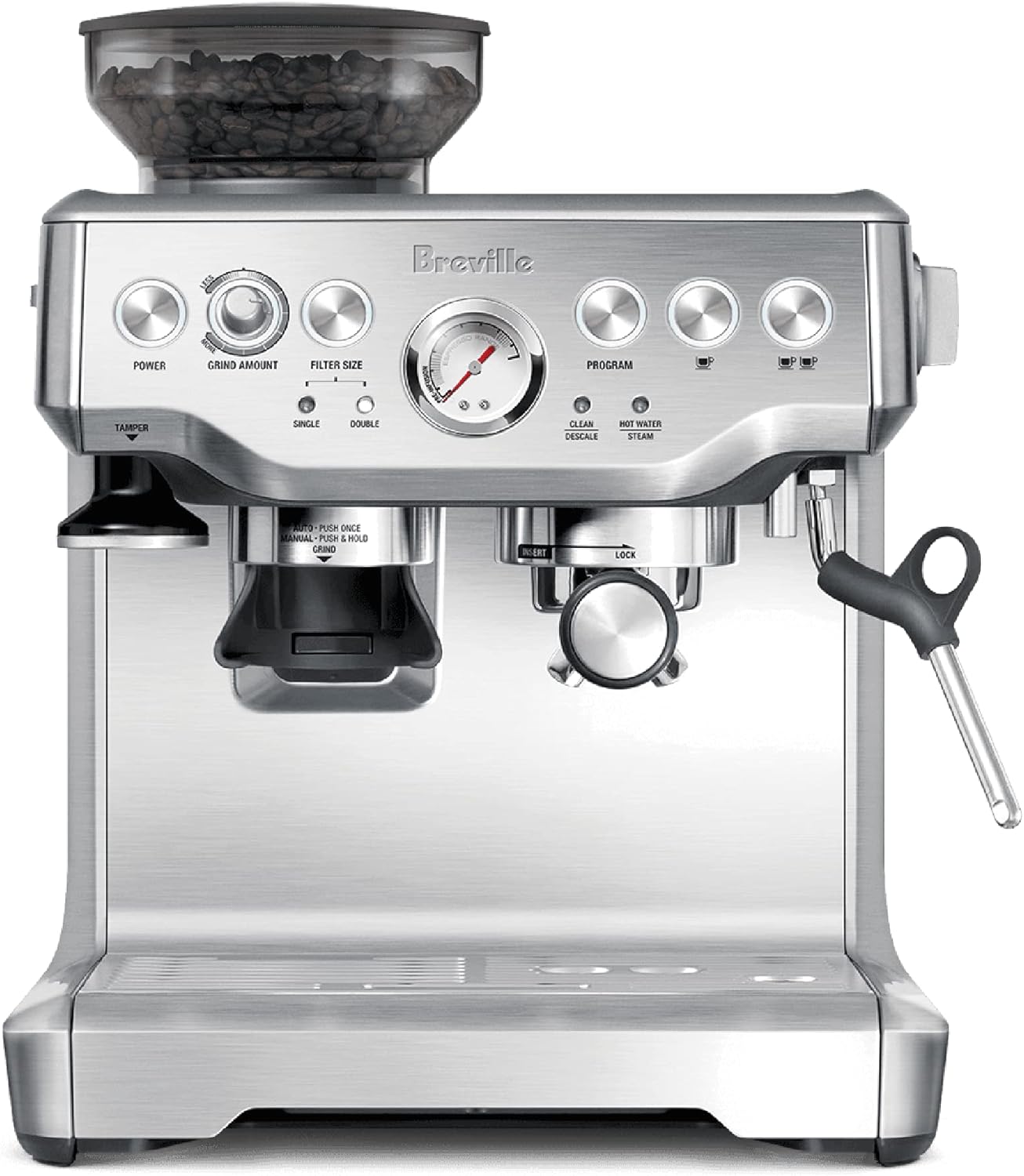
On one side, the Breville Barista Express Espresso Machine BES870XL is the kind of machine that makes you feel like you’ve set up a tiny café station on your counter: an integrated grinder, manual steaming, and enough control to keep improving shot after shot. It’s famous for the “I did that” satisfaction and the way it rewards consistent routine—grind, tamp, extract, steam, repeat.
On the other side, the De’Longhi EC9665M La Specialista Maestro Espresso Machine with Grinder is a more “guided craft” experience: a smart tamping station, sensor grinding, temperature profiles, and milk options that can be hands-on or more automated depending on how you want to make your drink that day. It’s still a serious espresso setup, but it’s built to reduce mess, reduce guesswork, and help you land in the “good zone” more quickly.
So if you’re asking, “Which is better?”—my honest answer is: the better one is the one that matches how you’ll actually make coffee most mornings, not just on your best-mood Saturday.
Let’s compare them as real people use them.
Breville Barista Express vs De’Longhi La Specialista Maestro
Ten important buying factors scored side by side to reveal whether classic hands-on espresso control or a more guided premium workflow is the better choice for your daily coffee routine.
Breville Barista Express BES870XL
out of 100
- Classic hands-on espresso workflow
- Integrated conical burr grinder
- Low-pressure pre-infusion system
- PID-controlled extraction temperature
- Manual microfoam steam control
10-Factor Buying Score
Each category scored out of 10 points
Express
Maestro
De’Longhi La Specialista Maestro Wins Overall
The La Specialista Maestro is the more convincing all-around choice for most buyers because it preserves the hands-on espresso experience while reducing the inconsistency, mess and frustration associated with manual dosing and tamping. Its sensor-guided grinding, smart tamping station, temperature profiles and flexible milk system make café-style results easier to repeat every day.
Choose the Barista Express instead when you specifically want the classic home-barista learning experience. It provides more direct involvement, excellent manual microfoam potential and outstanding value for buyers who enjoy developing their technique rather than receiving extra guidance from the machine.

De’Longhi EC9665M La Specialista Maestro
out of 100
- Sensor-guided grinding and dosing
- Integrated smart tamping station
- Five brewing temperature profiles
- Manual and automatic milk options
- Dual-Thermoblock premium workflow
These results are reported by our editors after 30 days of comparative testing and review, using our authentic editorial scoring process.
How I review and compare them (my real-life method)
I don’t start by reading spec sheets like bedtime stories. I start by imagining your kitchen, your time, your patience level, and your drink habits—and then I map those against what the machine forces you to do and what it makes easy.
The first test: morning workflow friction
Espresso can be a joy… or a chore. The difference is friction. I look at how many steps stand between you and a drink you enjoy. I also look at what happens on “messy days”: when you rush, when you forget to purge the wand, when your grind drifts because beans changed, and when you don’t want to measure anything.
The second test: repeatability
A machine can make an amazing drink once. The real question is whether it can make that drink again tomorrow without drama. I pay attention to temperature stability, pressure behavior, how consistently the grinder doses, and whether you can develop a routine that just works.
The third test: milk drinks (because most people live here)
Milk drinks are where machines get exposed. I focus on steam power, foam quality, how quickly you get the texture you actually like, and how much cleanup regret you have afterward.
The fourth test: the “I’ll still use this in three months” factor
If cleanup is annoying, people stop using espresso machines. If dialing in feels like a daily math quiz, people stop using espresso machines. If a machine makes you feel competent and comfortable, it becomes part of life.
Overview
Breville Barista Express BES870XL
The Breville Barista Express Espresso Machine BES870XL is a semi-automatic espresso machine with an integrated precision conical burr grinder that grinds on demand into the portafilter. Breville highlights low-pressure pre-infusion, PID temperature control, and a manual steam wand for microfoam and latte art.
In plain terms: this is a classic “barista workflow” machine that wants you involved—and it pays you back when you get consistent.
De’Longhi La Specialista Maestro EC9665M
The De’Longhi EC9665M La Specialista Maestro Espresso Machine with Grinder is also a manual-style espresso machine with an integrated grinder, but it adds guidance systems: sensor grinding technology with multiple grind settings and a digital dosing guide, a smart tamping station to reduce mess and improve consistency, and temperature/profile controls aimed at stabilizing brewing. De’Longhi also highlights features like LatteCrema milk foam plus brewing temperature profiles on the Maestro line.
In plain terms: it’s still “make espresso yourself,” but with more built-in coaching and less chaos.
Which is better?
If you want maximum control and a classic “espresso station” feel
The Breville Barista Express Espresso Machine BES870XL is hard to beat for the price tier because it gives you a direct relationship with the espresso process—grind, extraction, and milk texturing—without adding too much automation between you and the cup.
If you want a more guided espresso experience with smarter consistency tools
The De’Longhi EC9665M La Specialista Maestro Espresso Machine with Grinder tends to feel easier to live with if you want help with tamping consistency and dosing, and you want a machine designed to reduce mess and guesswork while still letting you stay hands-on.
FIRST vs SECOND (the personality difference)
FIRST: Breville Barista Express
Feels like a compact espresso bar where you develop skill through repetition. It’s satisfying and very “hands-on,” and the machine is straightforward: it gives you the tools, and you bring the technique.
SECOND: De’Longhi La Specialista Maestro
Feels like a “guided barista workstation.” You still do the craft, but the machine actively helps you dose and tamp more consistently and keeps brewing temperature more controlled through profiles.
| Key Feature | Breville Barista Express (BES870XL) | De’Longhi La Specialista Maestro (EC9665) |
|---|---|---|
| Machine Image |
|
|
| Machine type | Semi-auto w/ grinder | Semi-auto w/ grinder |
| Control style | Buttons + dials | Buttons + dials |
| Pump pressure | 15 bar | 19 bar |
| OPV brew pressure | 9 bar extraction | Not specified |
| Heating system | Thermocoil | Dual Thermoblock |
| Boiler capacity | No boiler tank | No boiler tank |
| Boiler material | Stainless steel thermocoil | Thermoblock system |
| Power | 1600 W | 1450 W |
| Voltage | 120 V | 120 V |
| Water tank capacity | 2.0 L | 2.5 L |
| Removable water tank | Yes | Yes |
| Portafilter diameter | 54 mm | 51 mm |
| Filter baskets included | Single + dual wall | Single + double |
| E.S.E pod compatible | No | No |
| Steam wand type | Manual steam wand | Manual + auto froth |
| Hot water function | Yes | Yes |
| 3-way solenoid | No | Not specified |
| PID temperature control | Yes | Active temp control |
| Brew temp adjustment | Yes | Yes |
| Pre-infusion | Low-pressure | Dynamic pre-infusion |
| Pressure gauge | Yes | No |
| Programmable shot volumes | Volumetric | Yes |
| Auto shut-off | Yes | Yes |
| Removable drip tray | Yes | Yes |
| Max cup height | 4 in | 140 mm |
| Body material | Stainless steel | Metal |
| Made in | China | China |
| Dimensions | 13.8×12.5×15.9 in | 419×368×465 mm |
| Weight | 22.09 lb | 16 kg |
| Price on Amazon | Price on Amazon | Price on Amazon |
Breville Barista Express BES870XL
Breville Barista Express Espresso Machine BES870XL
A semi-automatic espresso machine with an integrated conical burr grinder, low-pressure pre-infusion, PID temperature control, and a manual steam wand for microfoam milk.
Who is this for? Anyone who wants espresso to feel hands-on and satisfying—where practice pays off and your drinks improve as your routine tightens.
Price on AmazonBreville Barista Express: what it’s like to live with (deep, practical take)
The Breville Barista Express Espresso Machine BES870XL has a certain personality that’s hard to explain until you’ve lived with a machine like it for a while: it’s not trying to “hide espresso” from you. It’s trying to make espresso feel accessible—without watering it down into push-button mystery. And that’s why people either fall in love with it or bounce off it. If you enjoy the idea of building a repeatable ritual, it becomes one of those machines that makes you feel proud of your kitchen. If you want espresso to be instant and effortless, it can feel like it’s asking too much of you.
The integrated grinder is the first big difference you notice day-to-day. Breville emphasizes that it grinds on demand and delivers the right amount directly into the portafilter. In real use, that “grind right into the portafilter” flow is what makes the machine feel like a station rather than an appliance. There’s something psychologically satisfying about it: you’re not scooping pre-ground coffee out of a bag; you’re making espresso from beans in the moment. That freshness shows up especially when you’re drinking straight espresso or a smaller milk drink where the espresso flavor actually matters.
What I love about the Barista Express is the way it teaches you cause and effect. When your espresso tastes sharp and thin, you start asking why. When it tastes dull and bitter, you start asking why. And the machine gives you enough direct influence to fix it. The “optimal water pressure” approach Breville describes—low-pressure pre-infusion, gradually increasing pressure at the start—helps with even extraction and gives you a more forgiving launch when you’re still refining puck prep. You’re still going to get better results when your distribution and tamp are solid, but the machine’s extraction behavior is designed to help you land in a balanced zone instead of punishing you immediately.
Temperature is another quiet strength. Breville calls out digital temperature control (PID) for precise espresso extraction. The reason that matters in normal-person language is that espresso doesn’t just taste different with different beans—it tastes different when the brewing water swings around. A machine that keeps things more stable makes it easier to dial in and easier to repeat. With the Barista Express, the learning process becomes less chaotic because at least you’re not fighting random temperature drama every other shot.
Then there’s milk. The manual steam wand is both the joy and the challenge. Breville explicitly positions it as “manual microfoam milk texturing” that supports latte art. That’s not a guarantee that you’ll instantly make glossy microfoam—your first attempts might be too airy, too hot, or too flat—but it’s an invitation. The wand gives you the ability to create that café-style texture where milk tastes sweet, feels silky, and doesn’t sit on top like stiff foam. If you like cappuccinos and lattes, that milk quality is what turns “nice coffee” into “wow, I’d pay for this.”

Breville Barista Express BES870XL
Key Features
- Home-friendly espresso workflow
- Simple shot pulling routine
- Milk-drink capable steaming
- Compact countertop footprint
- Easy daily cleanup
Why We Like It
I like machines in this category when you want straightforward espresso at home without a complicated learning curve. It’s the kind of setup that encourages a consistent daily routine and keeps the focus on the cup.
Pros
- Beginner-friendly
- Compact and practical
- Good for milk drinks
- Easy everyday use
Cons
- Needs dialing-in patience
- Not for heavy volume
Bottom Line
A practical home espresso machine for anyone who wants a simple, repeatable routine and satisfying café-style drinks.
Price on AmazonThe part that makes the Barista Express feel “real” is that it doesn’t decide your drink for you. It doesn’t tell you what a cappuccino must be. It doesn’t force a specific recipe. It’s basically a set of tools: grind fresh, extract espresso, steam milk, and build whatever you want. That freedom is why it’s such a strong long-term machine. It scales with you. Your first month might be “make something drinkable.” By month three, you’re chasing balance. By month six, you’re picking beans based on flavor goals and adjusting grind like it’s second nature.
But I have to be honest: the machine asks for consistency. If you swap beans constantly, you’ll re-dial constantly. If you tamp differently every time, your results will swing. If you forget hand hygiene, you’ll hate your cleanup later. This isn’t a “bad” thing—this is what espresso is—but it’s important to know because the Breville is the kind of machine that mirrors your habits right back at you. When you’re consistent, it’s a dream. When you’re random, it feels unpredictable.
The best way I can summarize the Barista Express is this: it gives you the most satisfying espresso relationship for the money if you want to be involved. It’s not just coffee. It’s a little daily craft project that rewards you with drinks that can genuinely feel café-level when you find your rhythm.
De’Longhi La Specialista Maestro EC9665M
De’Longhi La Specialista Maestro Espresso Machine with Grinder (EC9665M)
A feature-rich espresso machine with sensor grinding technology, a smart tamping station, active temperature control with profiles, and milk options designed for consistent café-style drinks at home.
Who is this for? Anyone who wants to stay hands-on but appreciates a machine that helps with dosing, tamping consistency, and brewing stability—especially for milk drinks.
Price on AmazonDe’Longhi La Specialista Maestro: what it’s like to live with (deep, practical take)
The De’Longhi EC9665M La Specialista Maestro Espresso Machine with Grinder is what I’d call a “confidence machine.” Not because it makes espresso without you, but because it’s designed to reduce the two biggest reasons people struggle with semi-manual espresso at home: inconsistent dosing and inconsistent tamping. If you’ve ever had that frustrating moment where yesterday’s shot was perfect and today’s is suddenly sour or watery—even though you swear you did the same thing—this machine is basically built to say, “Okay, let’s control more of those variables.”
The grinder system is one of its headline strengths. De’Longhi calls out “Sensor Grinding Technology” with 8 grind settings and a precise digital dosing guide. That sensor + dosing guidance approach changes the daily vibe. Instead of relying purely on intuition (“that looks like enough grounds”), you’re working with a machine that nudges you toward consistency. And in espresso, consistency is flavor. It’s the difference between a balanced shot that tastes like chocolate and caramel versus a thin, sharp shot that tastes like lemon peel and regret.
Then there’s the Smart Tamping Station. De’Longhi describes it as a system that helps ensure perfect pressure and proper doses with less mess. This matters more than people think, because tamping is where home espresso gets chaotic. Some people tamp too lightly, some people tamp unevenly, and some people over-tamp and then panic and start changing five other variables. The Maestro tries to simplify that. It’s still espresso; you still have to pay attention, but the machine reduces the range of human error. And that means your learning curve feels less punishing.
Temperature management is another area where the Maestro leans “premium.” De’Longhi describes a high-performing thermoblock with controlled temperature and notes 5 temperature profiles to bring out bean flavor. Again, in normal life terms: when temperature is more stable, and you can choose profiles, you get fewer “why does this taste different today?” moments. It also makes the machine friendlier for people who like switching beans because the machine gives you more structured ways to adapt—rather than feeling like every new bag of beans is a full reset.
Now let’s talk milk, because this is where the Maestro becomes a “luxury” experience for a lot of households. De’Longhi highlights the LatteCrema system on the Maestro line as a way to get dense, creamy milk foam at the right temperature. When milk foam is consistent, milk drinks become less stressful. You’re not fighting bubbles. You’re not constantly re-steaming. You’re not pouring something that separates. You’re just making a cappuccino that tastes smooth and feels like a café drink. That’s a very real quality-of-life upgrade if milk drinks are your main thing.
De'Longhi EC9665M La Specialista Maestro Espresso Machine
Key Features
- Integrated grinder for bean-to-cup workflow
- Smart dosing and tamping assistance
- Dynamic pre-infusion for even extraction
- Multiple temperature settings for different beans
- Milk system + manual control options for lattes
Why We Like It
I like this kind of machine when you want an all-in-one setup that still feels “hands-on.” You get a clean grind-to-shot routine, plus enough control to chase better flavor once you start dialing in your dose, grind, and milk texture.
Pros
- All-in-one espresso workflow
- Less mess during puck prep
- Good control for learning
- Great for milk drinks
Cons
- Takes time to master settings
- Needs regular cleaning cycles
Bottom Line
A premium all-in-one espresso machine for people who want convenience, control, and a real home barista routine.
Price on AmazonThe Maestro also feels like it’s built for people who want espresso to feel “clean,” not just in taste, but in mess. The tamping station is designed to keep the dosing and tamping action more contained. That’s not a small detail. If you’ve ever had grounds scattered across your counter because you tapped the portafilter too hard or because the grinder sprayed a little, you know how quickly that annoyance can turn into “I’ll just buy coffee today.” The Maestro makes home espresso feel more contained, more controlled, and more “appliance elegant” without turning it into a push-button super-automatic.
That said, it’s not magic. You still have to clean. You still have to descale. You still have to develop habits that keep milk systems happy and keep the brew area tidy. But the Maestro’s guiding systems mean you spend less time troubleshooting your technique and more time enjoying your drink. For many people, that’s the difference between “espresso as a weekend hobby” and “espresso as a daily habit.”
If I had to describe the De’Longhi experience in one sentence, it would be, “It keeps you in the craft, but it reduces the chaos.” It’s for someone who wants to be hands-on without feeling like they’re taking an espresso exam every morning.
My Final Verdict
If you’re choosing between these two, it helps to decide what you want the machine to teach you—and what you want the machine to handle for you.
Pick the Breville Barista Express if you want a classic espresso journey.
The Breville Barista Express Espresso Machine BES870XL is the one I’d choose when the goal is “I want to get good at espresso.” It’s straightforward and satisfying, and it gives you the tools to build skill in a very natural way. If you enjoy ritual and you like the idea of steadily improving your shots and milk texture, the Breville will feel like a loyal daily companion.
Pick the De’Longhi La Specialista Maestro if you want a guided, premium daily routine.
The De’Longhi EC9665M La Specialista Maestro Espresso Machine with Grinder is the one I’d choose when the goal is “I want café-style espresso drinks at home with less guesswork and less mess.” The sensor grinding, smart tamping, and temperature profile approach make it easier to repeat good results—and that’s what makes espresso become a real habit instead of a sometimes-thing.
If I had to simplify it:
- Breville = pure classic barista workflow
- De’Longhi Maestro = barista workflow with built-in coaching
FAQ
1) Which machine makes better espresso?
If you enjoy dialing in and you’re consistent, the Breville Barista Express Espresso Machine BES870XL can produce espresso that feels extremely “authentic,” and it rewards skill.
If you want easier repeatability early on, the De’Longhi EC9665M La Specialista Maestro Espresso Machine with Grinder often gets you there faster because of its dosing and tamping assistance.
2) Which one is easier for beginners?
The Maestro generally feels easier because it reduces dosing/tamping variability, while the Breville leans more toward “learn by doing.”
3) Which grinder setup is better?
Both grind fresh in-machine, but the Maestro explicitly describes sensor grinding and dosing guidance with 8 grind settings, while the Breville emphasizes grind-on-demand into the portafilter.
4) Which is better for cappuccinos and lattes?
If you want consistently dense foam with less work, the Maestro line’s LatteCrema approach can be a comfort upgrade.
If you want full manual control and latte art practice, Breville’s manual microfoam wand is excellent.
5) Do both have pre-infusion?
Breville explicitly highlights low-pressure pre-infusion for balanced extraction.
De’Longhi’s Maestro line also describes dynamic pre-infusion.
6) Which one is less messy day-to-day?
The Maestro’s smart tamping station is designed to keep dosing/tamping contained and consistent.
With Breville, the mess level depends more on your technique and habits.
7) Which one is better if I switch beans often?
Both will need adjustments when beans change, but temperature profiles and dosing guidance on the Maestro line can adapt to feel more structured.
8) Which one feels more “premium” on the counter?
The Maestro typically has a more feature-rich, premium workstation feel, while the Breville feels like a clean, classic barista station.
9) Which one is more straightforward to maintain?
Both require regular cleaning, wand care, and descaling. The practical difference is that the Maestro has more built-in systems, so you’ll keep more areas tidy—but you often troubleshoot less.
10) Which should I buy if I want the least frustration?
If frustration usually comes from inconsistency and mess, the Maestro is the calmer choice. If frustration usually comes from feeling “boxed in,” the Breville is the freer choice.


