
How to Roast Coffee More Consistently


OneHundredCoffee is reader-supported, and some products displayed may earn us an affiliate commission. Details
If you roast coffee at home long enough, you eventually run into the same frustrating moment: one batch tastes sweet, balanced, and full of life, and then the next batch—using what feels like the same routine—comes out dull, grassy, baked, or weirdly harsh. That is usually the point where home roasting stops feeling cute and starts feeling serious. And honestly, I think that is a good thing. Because consistent roasting is not about becoming robotic. It is about learning which few variables actually matter enough to repeat on purpose. As we touched on before in our article about How to Adjust a Roast Profile for Weather Changes, the difference between random success and reliable success is usually not talent. It is repeatability.
The good news is that coffee roasting is not magic. Even at home, consistency tends to come from the same small group of habits over and over again: keeping batch size steady, controlling how aggressively heat is applied, paying attention to bean movement and airflow, cooling quickly, and writing down what happened instead of trusting your memory. Sweet Maria’s home-roasting guidance notes that roast times vary depending on method and batch size, with smaller batches often landing around 10 minutes and larger ones stretching closer to 16 minutes, which already tells you something important: the roast is never just “heat plus time.” Capacity and heat transfer change the whole shape of the roast.
How to Roast Coffee More Consistently
| Image | Product | Features | Price |
|---|---|---|---|
|
Best Profile Control

|
Heat and fan control
|
Price on Amazon | |
|
Best Starter Bundle

|
Roaster plus scale
|
Price on Amazon | |
|
Best Compact Roaster
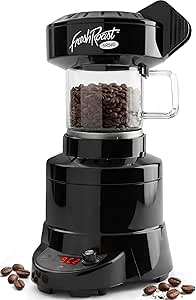
|
Smaller controlled batches
|
Price on Amazon | |
|
Best Cooling Bundle

|
Roaster and cooler
|
Price on Amazon | |
|
Best Budget Air

|
Adjustable timer control
|
Price on Amazon | |
|
Best Drum Control

|
Program-friendly drum roasting
|
Price on Amazon | |
|
Best Fast Cooling

|
Stops roast carryover
|
Price on Amazon | |
|
Best Batch Tracking

|
0.1g timed weighing
|
Price on Amazon | |
|
Best Temp Checks

|
Surface temperature readings
|
Price on Amazon | |
|
Best Roast Notes

|
Manual profile tracking
|
Price on Amazon |
Why do home coffee roasts become inconsistent so easily?
What makes home roasting tricky is that the bean itself is changing while you roast it. Moisture leaves, color changes, aromas evolve, internal pressure builds, and the coffee starts moving through very distinct stages. So if one roast starts a little hotter, or gets slightly less airflow, or reaches first crack later than expected, the whole result can drift farther than you think. Sweet Maria’s first-crack guidance describes first crack as a distinct heat-driven reaction and places it around 390°F and above, while Scott Rao’s writing on development-time ratio argues that what happens after first crack is especially important for cup quality. In other words, once your roast timing shifts before first crack, the ending often shifts too.
In real life, inconsistency usually comes from one of these causes:
- changing the batch size without realizing how much it changes momentum
- roasting too aggressively early, then trying to “save” the batch later
- uneven bean movement or weak airflow
- dropping the coffee too late because the first crack sounded softer than usual
- cooling too slowly, which quietly keeps roasting the beans after you thought you were done
- not logging anything, so every roast feels like guesswork
That last one is bigger than it sounds. I know a lot of home roasters who are absolutely convinced they are repeating the same roast every time, but if you ask for their actual charge weight, turning point feel, first-crack timing, drop point, ambient conditions, and cooling method, it all gets very fuzzy very quickly.
The first real secret: keep your batch size boringly stable.
If I had to pick one habit that makes the biggest difference for home-roast consistency, it would be this: stop changing the batch size all the time.
That sounds almost too simple, but it matters because the bean mass changes how much heat your roaster has to move, how quickly the roast responds, how much airflow reaches each bean, and how the roast behaves near first crack. Mill City notes that decreasing batch size effectively increases process heat per pound and changes airflow behavior, which is one reason a roast can suddenly feel more aggressive when you load less coffee than usual. Perfect Daily Grind also points out that batch size affects thermal behavior and roast control in meaningful ways.
So if your air roaster says it can roast 170–226 g, do not do 150 g one day, 220 g the next, and 180 g the day after, and then wonder why first crack is all over the place. Pick a batch size that your machine handles well and stick to it for at least several roasts.
A practical batch-size rule I like
- Start somewhere around the middle of your roaster’s comfortable range.
- Roast the same coffee at the same weight at least 3 to 5 times.
- Change only one thing at a time after that.
If you use a home roaster like the Fresh Roast SR800, it is built for 6–8 oz batches with variable heat and fan control, which is useful precisely because you can keep those variables tighter once you settle on a repeatable load.
Heat application: consistency is usually about smoother heat, not more heat.

A lot of home-roast inconsistency starts with impatience. You want movement, color, smell, and progress, so you push the roast too hard early. The beans race toward color, but the inside lags. Then later, the roast feels oddly stalled, and you either stretch it too long and bake it or push it too hard and scorch the outside.
I have learned the hard way that a steady roast is usually better than an exciting one. CoffeeNavigated’s roasting basics emphasize that heat has to travel from the surface into the core of the bean, and that is such a useful way to think about consistency. If the outside is always being shocked faster than the inside can catch up, you end up with less even development. A slower, more controlled rise early on often gives you more room later when you actually need it.
That does not mean roast everything slowly forever. It means the roast should feel deliberate rather than panicked.
Signs you are applying heat too aggressively early
- patchy color development
- scorching or tipping
- The first crack arrives earlier than usual and feels messy
- Smoke ramps up before the roast smells sweet
- The final cup tastes sharp outside and underdeveloped inside
Signs the roast is too slow overall
- flat aroma
- dull, papery cup
- baked sweetness instead of lively sweetness
- long roast time without much structure
- Coffee tastes brown but is not truly developed
This is why people talk so much about “rate of rise” and momentum. Even if you are not using a highly instrumented setup, you can still think in those terms: is the roast moving with control or lurching?
First crack is not just a landmark. It is a decision point.
Home roasters often obsess over first crack as if hearing it is the whole game. It is not. Hearing first crack matters, yes, but what matters even more is what you do around first crack.
Sweet Maria’s first-crack resources describe first crack as a clearly audible event and distinguish it from second crack, which is a different stage entirely. Scott Rao, writing about development-time ratio, says he generally prefers a DTR around 20%–25% for many roast levels between the end of the first crack and the start of the second crack. That does not mean every home roast must chase a mathematical target, but it does mean your post-crack development should not be random.
This is where a lot of inconsistency sneaks in:
- One day, you drop the roast 45 seconds after the first crack starts
- Another day, you wait 1 minute and 30 seconds
- Another day, you panic because the crack is quieter and let it run too dark
Those are not small changes. They are flavor-defining changes.
A better approach
Instead of treating first crack like a finish line, treat it like the moment where your roast plan becomes more precise:
- Did the first crack start earlier or later than your target?
- Was it loud and active or soft and scattered?
- Did the roast still have momentum, or did it feel like it flattened?
- How long after the crack started did you drop?
- What did that choice taste like in the cup?
That last question matters most. Consistency is not just repeating numbers. It is repeating a flavor outcome.
Airflow and bean movement are more important than beginners expect.

If your beans are not moving well, your roast is already less even. That is true in air roasters, drum roasters, and improvised setups alike.
Good bean movement helps the coffee roast more evenly by exposing more surface area consistently and reducing hot spots. If airflow is poor or the bed is too heavy for the roaster, parts of the batch can get more heat than others. Mill City specifically ties batch size to airflow and effective heat transfer, which is one reason consistency can drift when your load is too large or too small for the machine’s sweet spot.
This is one reason I think people should spend less time chasing abstract roast theory and more time literally watching the beans. Ask:
- Are they moving evenly?
- Is one side of the chamber behaving differently?
- Is chaff building up and affecting airflow?
- Is the fan setting actually giving you stable circulation?
If the beans look lazy, crowded, or uneven, the cup often confirms it later.
Cooling quickly is not optional if you want consistent roast levels.
This one gets overlooked all the time. People focus so hard on the roast itself that they forget the beans do not magically stop cooking the second they leave the chamber.
Multiple roasting guides emphasize rapid cooling to stop carryover roasting. Coffee Bean Corral says beans should be cooled as quickly as possible after roasting, and Sweet Maria’s broader home-roasting materials also treat cooling as part of the process rather than an afterthought.
This matters because two batches that look the same at drop can finish differently if one cools fast and the other sits hot for another 90 seconds. That extra retained heat can deepen the roast more than you think.
Fast cooling helps you by:
- locking in the roast level you intended
- Reducing baked or flat carryover character
- making roast comparisons more honest
- improving batch-to-batch repeatability
A dedicated bean cooler can help here. Product listings for cooling trays commonly highlight fast cooling specifically to prevent over-roasting, such as this electric coffee bean cooler. Even a simple metal colander and vigorous stirring can work, but speed matters.
Keep notes, even if they are ugly notes.
I know, I know. Nobody gets into coffee roasting because they secretly want paperwork. But if you want more consistency, a roast log changes everything.
Perfect Daily Grind’s guide to roasting consistency recommends roasting the same profile back-to-back and minimizing changing conditions, which only really works if you are recording what happened. Otherwise, every roast becomes a vague memory, and your adjustments are based on mood rather than evidence.
You do not need a fancy software setup to start. A notebook is enough.
What I would log every single time
| Variable | What to write down |
|---|---|
| Coffee | origin, process, density feel, moisture feel if known |
| Batch size | exact weight |
| Roaster setup | heat/fan settings, preheat if applicable |
| Time markers | yellowing, browning, first crack start, drop |
| Roast observations | bean movement, smoke, aroma changes, crack character |
| Cooling | method and approximate cooling time |
| Rest and brew result | When you tasted it, what did it taste like? |
That final line is where the real learning happens. A roast log without taste notes is only half useful. You need to connect the process to flavor.
Consistency is easier when you roast the same coffee several times in a row.

This is one of those boring truths that nobody wants to hear because buying new green coffee is fun. But if you keep changing coffees, you keep changing the problem.
Different coffees behave differently based on density, moisture, process, and size. A washed, high-grown coffee can take heat differently from a softer, natural Brazil. CoffeeNavigated notes that lower-density coffees can burn more easily, while higher-density coffees may tolerate higher preheat and more aggressive input. That means “the same profile” is not always the same profile across coffees.
So if your actual goal is consistency, spend a little time roasting one coffee repeatedly instead of hopping between four origins every weekend.
What usually happens is this:
- Roast 1 teaches you about coffee
- Roast 2 starts to show the pattern
- Roast 3 is where you begin to trust your decisions
- Roast 4 and 5 are where consistency becomes visible
That is when home roasting starts feeling less random and more like a craft.
Resting the coffee matters more than impatient people want it to.
Fresh-roasted coffee can smell incredible right away, but that does not mean it is at its best the same day. Older introductory roasting guides often recommend giving beans around 24 hours to off-gas before brewing, and many coffees improve beyond that depending on roast level and brewing method.
Why does this matter for consistency? Because if you taste one roast 12 hours after roasting and another at 4 days, you are not comparing like with like. You are comparing different stages of rest.
My simple rest rule
- For filter brewing: start tasting around 24–72 hours
- For espresso: often better after a few more days
- Always compare roasts at the same rest age when you are judging consistency.
That alone can save you from “fixing” a roast that was actually fine.
A simple home-roasting framework that improves consistency fast

If your roasting has felt scattered, here is the framework I would use for the next five batches.
Step 1: Lock the coffee.
Use the same green coffee for all five batches.
Step 2: Lock the batch size.
Do not change it.
Step 3: Lock the cooling method.
Same tray, same stirring, same timing.
Step 4: Build a target structure.
Something like
- yellowing at roughly a similar point
- first crack within a repeatable time window
- similar development time after the first crack
Step 5: Only change one variable.
Maybe a little less heat before yellowing, or a slightly earlier drop, but not five changes at once.
That sounds unglamorous, but it works. Consistency is mostly about removing noise.
Gear that can genuinely help
You do not need to turn your kitchen into a lab, but a few tools can make roasting repetition much easier.
A controllable home roaster, such as the Fresh Roast SR800, gives you variable heat and fan control with a clearly stated 6–8 oz roasting range, which is exactly the kind of practical control that helps once you are trying to repeat results rather than merely roast anything at all.
For cooling, a dedicated tray like this coffee bean cooler can shorten cooling time significantly, which helps stop post-drop carryover roasting.
And for evaluating your results later, a reliable grinder matters too. Something like the Baratza Encore is not a roasting tool directly, but it helps you taste your roasts more honestly because wildly inconsistent grinding can blur the difference between a roast problem and a brew problem.
The mindset shift that helps most
The biggest mental change for more consistent roasting is this: stop asking, “How do I make this roast exciting?” and start asking, “How do I make this roast repeatable?”
That does not mean boring coffee. It means disciplined coffee. Once you can reliably repeat a decent roast, then you can push it lighter, deeper, sweeter, or faster with confidence. But if you cannot repeat your baseline, every experiment becomes noise.
That is why so many people improve the moment they slow down and standardize:
- same coffee
- same batch
- same preheat
- same cooling
- same note-taking
- same tasting window
It is not glamorous, but it is how better roasting sneaks up on you.
FAQ
What is the biggest cause of inconsistent home coffee roasting?
Usually changing too many variables at once—especially batch size, heat input, and drop point. Batch size changes heat transfer and airflow more than many home roasters expect.
How important is the first crack for roast consistency?
Very important, but not as a standalone event. What matters is when it starts, how the roast behaves around it, and how long you develop the coffee after it begins. Sweet Maria’s and Scott Rao’s guidance both point to first crack as a major structural point in the roast.
Should I roast the same coffee multiple times before changing anything?
Yes. Repeating the same coffee several times removes a lot of noise and helps you understand whether your process is stable before you start making bigger adjustments.
Why do my roasts look good but taste flat?
That is often a sign of a roast that moved too slowly overall, cooled too slowly after dropping, or was tasted at an inconsistent rest point. Rapid cooling and consistent tasting windows help a lot.
Do I really need a roast log?
If you want consistency, yes. It does not need to be fancy, but you need some way to connect roast events with cup results. Otherwise, every batch becomes a guess.
How long should I rest home-roasted coffee?
A common starting point is at least 24 hours, with some coffees improving after several days, depending on roast level and brew method.
Final thoughts
If I had to boil the whole thing down, I would say this: more consistent roasting comes from respecting the roast as a process, not a performance. You do not need to roast with more swagger. You need fewer surprises.
Keep the batch size stable. Apply heat more smoothly. Watch bean movement. Listen carefully at first crack. Cool fast. Taste at the same restaurant. Write things down. Do that for a handful of batches in a row, and your roasting starts feeling less like luck and more like understanding.
And that, to me, is when home roasting becomes deeply satisfying—because the coffee in the cup starts tasting like something you actually meant to do.


