
8 Best Vintage Style Coffee Grinders (Top Picks)


OneHundredCoffee is reader-supported, and some products displayed may earn us an affiliate commission. Details
A vintage-style coffee grinder can make a kitchen feel more personal before the first bean is ground. Wooden drawers, hand-polished metal, old-fashioned cranks, and warm copper finishes recall a time when making coffee was an obvious, physical ritual. The catch is that a beautiful mill is not necessarily a useful one. I look for a grinding mechanism that genuinely adjusts, a receiver that is easy to empty, and enough practicality to make the manual routine enjoyable after its novelty has passed. A grinder can be a handsome object and still disappoint if it leaves large fragments in one corner of the cup and powder in another.
These eight grinders represent different traditions. The Zassenhaus Brasilia and Montevideo focus on woodwork and hardened steel. Peugeot's Nostalgie brings historical French design into a working box mill. Kalita's KH-3 carries the familiar character of a Japanese hand-grinding tool. Hario uses an old-fashioned glass canister with ceramic burrs. La Cafetière goes in a copper-finish direction with a clip-top storage vessel. A tall brass Sözen-style mill looks toward Turkish coffee, while Gourmia offers the classic box silhouette for a more modest budget. They do not deserve identical praise, because their grinding mechanisms, adjustment systems, and storage designs solve different problems.
My Three Vintage Coffee Grinder Picks

Zassenhaus Brasilia Beechwood Coffee Mill
- Beechwood cabinet and polished metal accents
- Hardened forged-steel grinding mechanism
- Adjustable grind control below the crank
- Front pull-out grounds drawer
- About 50 g bean-hopper capacity
- Approx. 12.5 × 12 × 20 cm
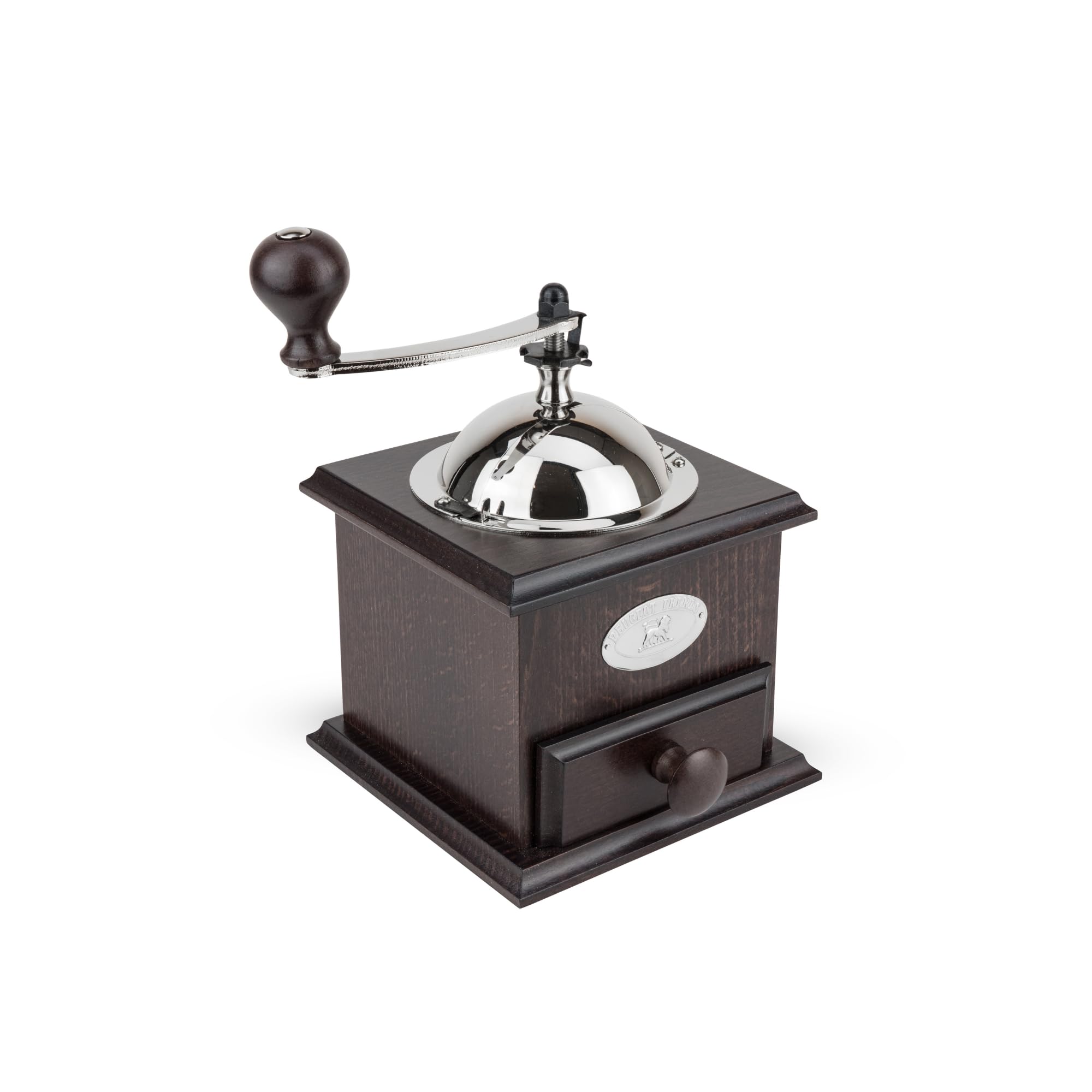
Peugeot Nostalgie Manual Coffee Grinder
- Peugeot Nostalgie model 841-1
- Walnut-stained beechwood finish
- Steel burr-style coffee mechanism
- Adjustment wheel beneath handle
- Traditional slide-out grounds drawer
- Approximately 21 cm tall

Zassenhaus Montevideo Walnut and Pear Coffee Mill
- Contrasting walnut-and-pear wood body
- Forged and hardened steel burr mechanism
- Continuous fine-to-coarse adjustment
- Up to 50 g bean capacity
- Compact 10 × 10 cm base
- About 18.5 cm tall
The best choice depends on the cup as much as the room. French press and most filter brewing allow a little more adjustment tolerance than a demanding non-pressurized espresso basket. Turkish coffee asks for an even finer, powder-like result. A mill that looks antique can sometimes meet part of those requirements, but no appearance, price, or famous brand name guarantees that every grind size is equally consistent. I pay particular attention to what each mechanism is actually intended to do, while keeping the ownership details—drawer cleaning, wood care, crank comfort, and safe adjustment—at the center of the recommendation.
There is also an important distinction between a vintage-style grinder and a genuine antique. Everything here is presented as a usable modern retail product or model, not a nineteenth-century collectible with a documented provenance. That is an advantage for everyday buyers: they can choose an attractive design for coffee preparation without having to restore an unknown old mechanism. The rankings favor real utility alongside the look. For most homes, the Zassenhaus Brasilia offers the strongest balance; the other picks deserve their places for specific materials, brewing methods, and collection styles.
8 Best Vintage-Style Coffee Grinders — At a Glance
These eight mills all use a manual crank, but their grinding mechanisms and grounds receivers are different. Each row highlights six details that matter when choosing a traditional look for real brewing.
Zassenhaus Brasilia Beechwood Coffee Mill
- Beechwood cabinet and polished metal accents
- Hardened forged-steel grinding mechanism
- Adjustable grind control below the crank
- Front pull-out grounds drawer
- About 50 g bean-hopper capacity
- Approx. 12.5 × 12 × 20 cm
Peugeot Nostalgie Manual Coffee Grinder
- Peugeot Nostalgie model 841-1
- Walnut-stained beechwood finish
- Steel burr-style coffee mechanism
- Adjustment wheel beneath handle
- Traditional slide-out grounds drawer
- Approximately 21 cm tall
Zassenhaus Montevideo Walnut and Pear Coffee Mill
- Contrasting walnut-and-pear wood body
- Forged and hardened steel burr mechanism
- Continuous fine-to-coarse adjustment
- Up to 50 g bean capacity
- Compact 10 × 10 cm base
- About 18.5 cm tall

Hario Canister Ceramic Coffee Mill
- Hario Canister model CMHN-4
- Adjustable ceramic burr mechanism
- Glass grounds-storage jar
- 120 g ground-coffee jar capacity
- Cork and latch-style traditional details
- Silicone anti-slip base cover

Kalita KH-3 Classic Hand Coffee Mill
- Kalita KH-3 hand coffee mill
- Cast-iron grinding cutter
- Rubberwood body components
- Approximately 35 g bean hopper
- Approximately 55 g grounds receiver
- Approx. 170 × 85 × 210 mm body
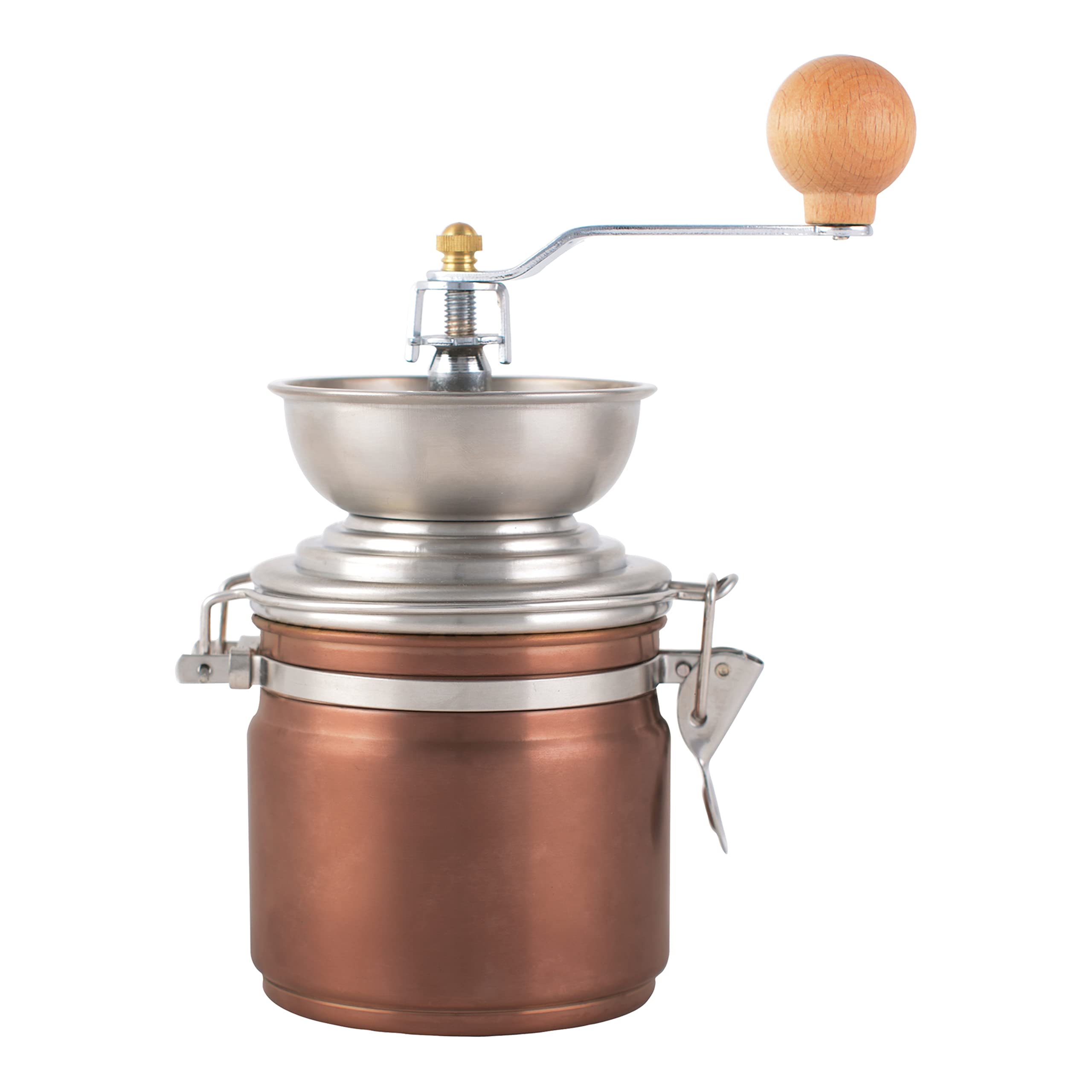
La Cafetière Copper-Finish Manual Coffee Grinder
- Warm copper finish on steel
- Manual crank with wood knob
- Three grind setting choices
- Built-in grounds-storage canister
- Clip-top lid and silicone seal
- Decorative gift-ready presentation
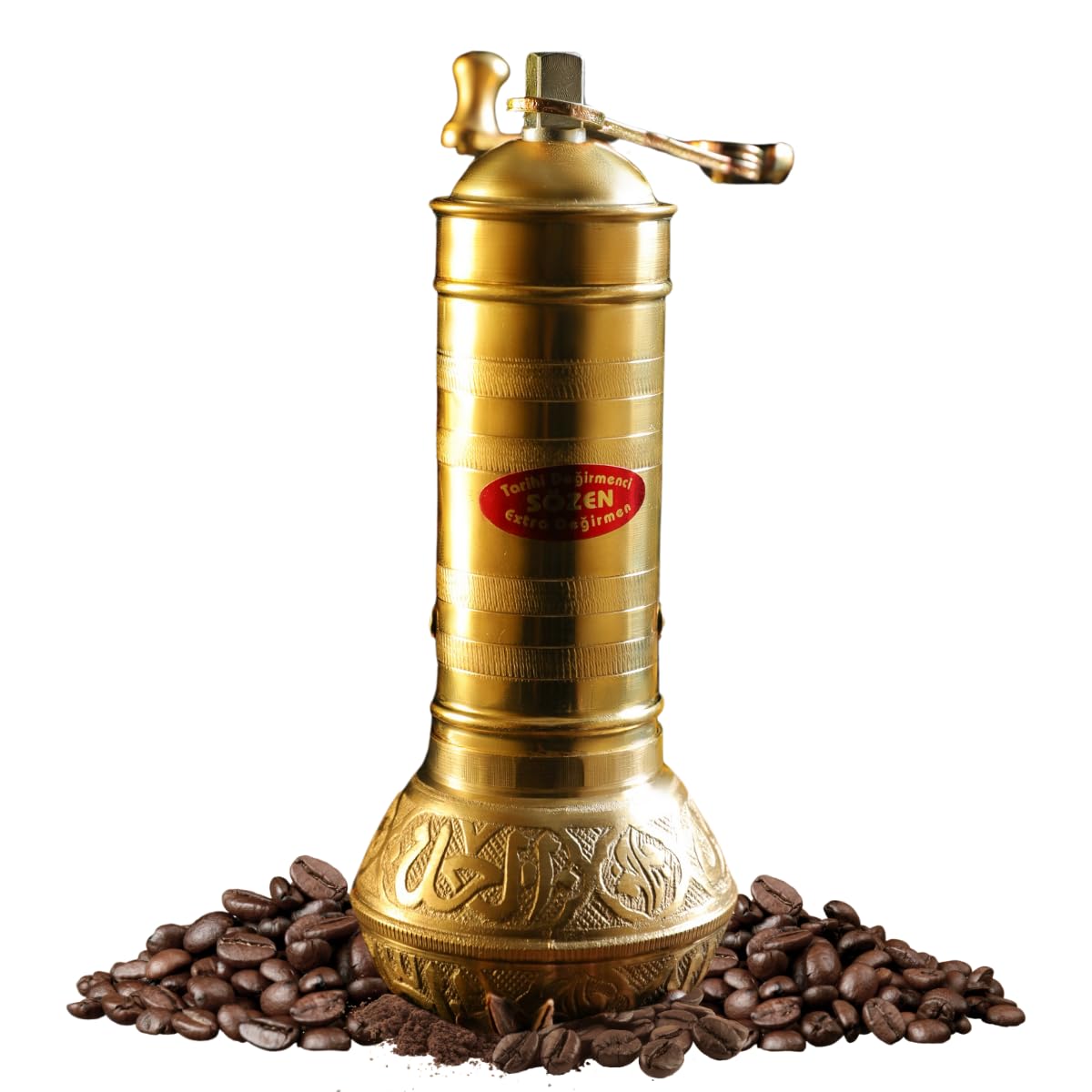
Ottoman Inspirations Sözen-Style Brass Turkish Coffee Mill
- Traditional brass outer body
- Approximately 7.6-inch height
- Hand-cranked metal grinding core
- Turkish coffee use case
- Slim upright travel-friendly shape
- Decorative gold-tone presentation

Gourmia GCG9310 Artisanal Wooden Coffee Grinder
- Gourmia GCG9310 manual hand mill
- Pinewood cabinet with metal accents
- Ceramic grinding core
- Coarse-to-fine cog-nut adjustment
- Front pull-out grounds drawer
- Approx. 11.5 × 11.5 × 17.5 cm
An old-fashioned mill asks more of its owner than a push-button appliance, and that is part of its appeal. The real trade-off is not simply manual versus electric. It is whether the time spent adjusting, turning, emptying, and brushing the grinder feels worthwhile for the coffee you make. The details below separate a cabinet worth using from a good-looking accessory that will sit untouched on a shelf.
I also keep capacity labels separate. A bean hopper tells me how much whole coffee can enter the grinder, whereas a receiving drawer or jar tells me how much finished coffee can collect before emptying. Hario's 120-gram figure, for example, applies to its grounds canister. A large receiver does not make hand grinding quicker, and a small receiving drawer does not mean the burr mechanism itself is defective.
Quick Ranking: Vintage Character Versus Everyday Function
| Rank | Grinder | Main mechanism | Most useful feature | Trade-off |
|---|---|---|---|---|
| 1 | Zassenhaus Brasilia Beechwood Coffee Mill | Forged steel | Adjustable grind control below the crank | Manual grinding takes time and a steady surface |
| 2 | Peugeot Nostalgie Manual Coffee Grinder | Steel burr mechanism | Steel burr-style coffee mechanism | Premium pricing emphasizes heritage and finish |
| 3 | Zassenhaus Montevideo Walnut and Pear Coffee Mill | Forged steel | Continuous fine-to-coarse adjustment | High purchase cost for hand grinding |
| 4 | Hario Canister Ceramic Coffee Mill | Ceramic burrs | Glass grounds-storage jar | Glass needs protection from impact |
| 5 | Kalita KH-3 Classic Hand Coffee Mill | Cast-iron cutter | Rubberwood body components | Iron mechanism needs careful moisture protection |
| 6 | La Cafetière Copper-Finish Manual Coffee Grinder | 3-position manual | Three grind setting choices | Copper finish is not a solid copper body |
| 7 | Ottoman Inspirations Sözen-Style Brass Turkish Coffee Mill | Steel conical / Turkish style | Hand-cranked metal grinding core | Fine hand grinding demands effort |
| 8 | Gourmia GCG9310 Artisanal Wooden Coffee Grinder | Ceramic core | Ceramic grinding core | Open top allows beans to scatter if overloaded |
What Makes a Vintage Coffee Grinder Worth Using?
Old-world design is easy to recognize. Useful grind control takes more attention. A proper mill must take whole beans through its cutting mechanism in a repeatable way, let the owner choose an appropriate range for a brew, and collect finished grounds without creating a frustrating cleanup routine. The cabinet or canister matters because it controls how the owner interacts with coffee every morning. A heavy wooden mill is a delight when its handle turns freely on a stable surface, but an awkward choice for travel. A brass tube is elegant beside a cezve, yet less convenient when preparing a large batch for guests.
The most important buying distinction is not the difference between wood and metal. It is the match between the grinding mechanism and the drink. Pour-over and French press give a traditional adjustable mill plenty of room to work. Non-pressurized espresso and powder-fine Turkish coffee ask much more of the fine end of the adjustment. I favor mills that describe their mechanisms and controls clearly over dramatic promises about perfect extraction. A coffee setup should be allowed to be beautiful without claiming precision that has not been established.
Eight Detailed Vintage Coffee Grinder Reviews
1. Zassenhaus Brasilia Beechwood Coffee Mill
The Brasilia is the most balanced purchase here because it looks like a classic coffee mill and still takes grinding seriously. A traditional beechwood box mill with a hardened-steel grinding mechanism, a front grounds drawer, and unusually useful coarse-to-fine control for a heritage-style design.
A wooden mill that still earns its countertop space
The Brasilia has the reassuring silhouette of an old kitchen coffee mill: a square beechwood cabinet, a metal hopper above it, a side-facing crank, and a small drawer below. That arrangement is not merely decoration. Whole beans pass through a hardened-steel mechanism and collect beneath it, so the cabinet itself becomes part of the workflow. I prefer that honest mechanical layout to a novelty grinder whose vintage styling hides a poor or inaccessible cutting system. The drawback is equally clear: a rigid box is less convenient to pack than a slim cylindrical hand grinder.
Where the adjustable steel mechanism helps
A control beneath the crank changes the grind, making the Brasilia useful beyond one narrow recipe. The practical range is its appeal. Medium and medium-coarse settings suit many pour-over and French press routines, while finer settings are available for experimentation. I do not treat the finest stop as proof that every non-pressurized espresso machine can be dialed in precisely. Espresso needs small repeatable changes near its fine end, and an old-fashioned hand mill can run out of convenient adjustment there. For ordinary filter coffee, the balance is much more convincing.
The drawer is useful, but not maintenance-free
The little front drawer makes the ritual attractive: beans go into the top, the handle turns, and fresh grounds appear in a wooden compartment. It also creates an overlooked cleaning point. Coffee dust gathers along the drawer edges and behind the opening, especially with darker, oilier roasts. A small dry brush and occasional thorough wipe matter. I keep the cabinet out of standing water, remove grounds promptly, and avoid letting coffee oils age inside the wood. That routine protects both the appearance of the mill and the flavor of the next batch.
Zassenhaus Brasilia Beechwood Coffee Mill
A traditional beechwood box mill with a hardened-steel grinding mechanism, a front grounds drawer, and unusually useful coarse-to-fine control for a heritage-style design.
- A real steel mill rather than a decorative prop
- Accessible adjustment supports filter and press coffee
- Classic drawer makes grounds collection simple
- Sturdy countertop presentation with natural wood
- Manual grinding takes time and a steady surface
- Small wooden drawer retains dust and oils
- No calibrated espresso microsteps
- Wood and mechanism require dry, careful care
Technical Specifications & Daily Features
- Product identification: Brasilia natural beechwood, 040005 / M040005
- Manual hand-crank grinder with hardened forged-steel mechanism
- Natural beechwood cabinet with metal grinding head
- Fine-to-coarse adjustment using an under-handle control
- Front wooden grounds-collection drawer
- Bean-hopper capacity: approximately 50 g
- Overall size: approximately 12.5 × 12 × 20 cm
- No motor, battery, dose timer, or electronic scale
Pros & Cons After 30 Days of Use
The first-month ownership priorities are consistent knob settings, a clean drawer, and a manageable crank routine. A reference coffee and a fixed dose make the adjustment easier to learn. Grind changes become useful when they improve the cup rather than simply making the knob turn farther.
Over the same period, wood care and grounds retention deserve attention. Coffee left in the drawer develops stale aromas, and fine dust can settle along the cabinet seams. The mill is most satisfying when it stays dry, gets brushed regularly, and is used for brewing styles that do not require hairline espresso adjustments.
My Final Verdict
My top vintage-style choice is Zassenhaus Brasilia. The forged-steel mechanism, adjustable crank, and beechwood box give the design genuine purpose. Choose it for daily filter coffee, classic presentation, and a slower ritual; look elsewhere for fast batches or specialist espresso micro-adjustment.
Grind quality versus old-world expectations
Steel burr geometry provides a much better foundation for intentional grinding than a blade that chops randomly. That does not mean a box-style mill automatically matches a modern high-precision espresso grinder. Particle size varies with the adjustment, bean density, and condition of the mechanism. The smarter approach is to choose one coffee, record the knob position, and compare the finished cup after changing a single variable. A grinder with a handsome cabinet still has to deliver the coarseness the recipe requires. The Brasilia earns its recommendation by offering meaningful adjustment in a durable traditional form.
Capacity, crank effort, and everyday fit
The roughly 50-gram bean reservoir accommodates a normal household brewing dose without turning this into a commercial machine. Several cups can be prepared, although a large group still requires patience and repeated turning. The box deserves a firm counter surface; rocking it while grinding wastes effort and makes the process feel less controlled. A cloth underneath can help protect delicate finishes without allowing the cabinet to slide. I see it as a grinder for someone who appreciates five deliberate minutes of coffee preparation, not a substitute for push-button convenience during a crowded morning.
Why this is my first choice
The strongest argument for the Brasilia is the way its look and function support each other. It belongs visually in a vintage or farmhouse kitchen, yet the steel grinding mechanism and adjustable control give it a job after the novelty has worn off. Its limitations are familiar to manual box mills: no exact dosing scale, no programmable setting, no instant large-batch workflow, and grounds that must be brushed from a drawer. Those compromises feel reasonable in exchange for the materials and simple mechanics. It is the clearest all-round choice in this vintage-style shortlist.
2. Peugeot Nostalgie Manual Coffee Grinder
Peugeot makes the strongest case for buying a working piece of coffee-making heritage rather than another appliance. An elegant walnut-stained beechwood mill with an adjustable steel coffee mechanism, a collecting drawer, and the unmistakable shape of a historical Peugeot design.
A classic form with a purpose
The Nostalgie looks like the coffee mills that gave old kitchens their character: a box-shaped body, a metal turning arm, a closed upper compartment, and a little drawer waiting below. Peugeot brings that style into an actively usable grinder rather than a museum ornament. Its walnut look comes from stained beechwood, an important material distinction for anyone who cares about furniture finishes. I especially like the enclosed presentation for an open shelf or a thoughtfully arranged coffee station. Its visual strength is immediate; its practical worth rests on the steel grinding mechanism inside.
Adjusting the grind under the handle
The adjustment wheel beneath the crank is less theatrical than a polished control panel, but it is the part that changes the coffee. A finer setting works toward espresso-style preparation, while a coarser position is more natural for French press and other immersion methods. Those labels are broad starting points. Traditional espresso in a non-pressurized basket can demand a narrow adjustment step that is difficult to reproduce on a decorative cabinet-style grinder. I regard the Nostalgie as a capable adjustable manual mill, not a guaranteed substitute for a specialized modern espresso grinder.
What its wooden drawer changes
Fresh grounds drop into a small collection drawer, making it easy to transfer coffee directly to a dripper, brewer, or measuring vessel. That drawer has charm but also a maintenance requirement. Powder clings to corners, and a little coffee may remain behind after each session. A regular dry brush reduces stale residue and helps keep darker roasted oils from building up. The cabinet should not be rinsed like a removable stainless grounds cup. The reward for this careful routine is a tactile brewing method that remains pleasant long after a decorative purchase has lost its novelty.
Peugeot Nostalgie Manual Coffee Grinder
An elegant walnut-stained beechwood mill with an adjustable steel coffee mechanism, a collecting drawer, and the unmistakable shape of a historical Peugeot design.
- Distinctive historical Peugeot cabinet design
- Solid wood body and dedicated steel mechanism
- Simple mechanical adjustment, no electronics
- A strong gift choice for vintage-coffee enthusiasts
- Premium pricing emphasizes heritage and finish
- Drawer requires frequent grounds cleanup
- No numbered fine-grind reference scale
- Slower than powered grinding for groups
Technical Specifications & Daily Features
- Peugeot Nostalgie, walnut-stained beechwood, SKU 841-1
- Manual steel coffee grinding mechanism
- Dark walnut-look finish over beechwood; not solid walnut
- Adjustable grind wheel located beneath the crank handle
- Front drawer for freshly ground coffee
- Approximately 21 cm / 8.25 inches in height
- Wooden square-style cabinet with metal crank
- No motor, electronic timer, or integrated weighing system
Pros & Cons After 30 Days of Use
In the first month, the meaningful questions concern whether the adjustment wheel remains easy to return to, whether the drawer empties cleanly, and whether the hand crank still fits the household's morning pace. Those are practical ownership measures, not invented shot-timing results.
Frequent dry brushing and careful treatment of the beechwood finish protect the mill's appearance. Espresso-oriented buyers should also assess the available fine adjustment early; a rich historical finish cannot compensate for a grinder that does not match the precision their basket needs.
My Final Verdict
Peugeot Nostalgie is the heritage pick. Its authentic box-mill layout, steel mechanism, and walnut-stained beechwood make it a compelling working centerpiece. It carries a premium and demands routine drawer cleaning, so I favor it for craft-minded filter coffee drinkers and thoughtful gifts rather than speed-first espresso setups.
Premium design does not mean automatic consistency
This grinder earns part of its price through a recognizable historic design and substantial materials. Neither feature eliminates the importance of dial positioning, stable bean dosing, or burr condition. I reserve claims of perfect particle uniformity for controlled measurements, not visual impressions of wood and metal. A regular home brewer can still get useful results by working with one repeatable setting for a chosen coffee. The sensible way to judge the purchase is whether the ritual and finished cup suit everyday life, not whether the grinder has a famous logo alone.
Handling, care, and longevity
A box mill is happiest on a clear, dry surface where the crank can turn without hitting a wall or nearby mug. Its wood finish deserves a soft cloth rather than soaking, and the drawer needs attention after oily coffees. The grinding mechanism should be maintained in line with its instructions; random household oils and water are poor cleaning shortcuts. The important positive is that the design does not depend on a touch screen or programmable memory. In a kitchen built around durable hand tools, that mechanical simplicity carries real appeal.
When the extra cost makes sense
The Nostalgie is not a practical choice for everyone. A compact modern hand grinder may fit a suitcase better, and an electric burr grinder gets through family-size doses with far less effort. But a person furnishing a vintage-style kitchen, choosing a memorable coffee gift, or collecting functional heritage tools has different priorities. For that buyer, the Peugeot is a standout: a working steel mill housed in a cabinet that actually contributes to the atmosphere of the room. Its limitations are part of the buying decision, not details to hide.
3. Zassenhaus Montevideo Walnut and Pear Coffee Mill
The Montevideo turns distinctive woodwork into the reason to choose a functioning premium hand mill. A compact premium hand mill built from contrasting walnut and pear wood, with a forged-steel adjustable mechanism and a 50-gram bean chamber.
Why the contrasting wood matters
The Montevideo takes a different visual route from the familiar plain wooden box. Walnut and pear create warm contrasting tones, giving the grinder the appearance of a small piece of crafted furniture. That makes it appealing in a kitchen where the coffee equipment remains on display. The look is not a printed imitation of wood grain; it is part of the cabinet's actual material story. For me, this is the most attractive alternative when the Brasilia feels too simple and the Peugeot too traditional. It is decorative, but its forged-steel mill gives it a practical identity.
The 50-gram hopper is useful but not limitless
A fifty-gram bean capacity is generous for a single manual coffee dose and sufficient for many two-person filter routines. It does not make the Montevideo as effortless as an electric grinder when serving a large group. The crank still has to do all the work, and a household preparing several large French presses may notice the time required. I recommend thinking in grams rather than advertised cup counts. A measured thirty-gram dose can serve a familiar recipe; an arbitrary 'four cups' description may represent something quite different from the mugs on a table.
How to approach the adjustment
A knurled control provides fine-to-coarse adjustment rather than a digital selector. That freedom is useful when the same owner alternates between immersion and paper-filter brewing. The trade-off is remembering where a favorite position sits. A small written reference works better than relying on visual guesses when changing beans. Even with an adjustable steel burr, a non-pressurized espresso basket may demand finer repeatability than a heritage hand grinder offers. I see the Montevideo as a stylish multi-brew mill first, with espresso suitability dependent on the actual machine and basket.
Zassenhaus Montevideo Walnut and Pear Coffee Mill
A compact premium hand mill built from contrasting walnut and pear wood, with a forged-steel adjustable mechanism and a 50-gram bean chamber.
- Distinctive two-tone real-wood construction
- Forged steel grinding assembly
- Useful 50 g hopper for household batches
- Small square footprint for shelves and counters
- High purchase cost for hand grinding
- No electronic dosing or grind numbers
- Wood needs a dry, careful cleaning routine
- Not an ultralight grinder for travel
Technical Specifications & Daily Features
- Zassenhaus Montevideo walnut/pear, model 040234 / M040234
- Manual crank with hardened forged-steel grinding mechanism
- Walnut and pear wood body with metal components
- Continuously adjustable grind setting under the handle
- Bean-hopper capacity approximately 50 g
- Cabinet footprint 10 × 10 cm; height approximately 18.5 cm
- Coffee grounds collect in a lower wooden compartment
- Designed for home manual coffee preparation; no electrical connection
Pros & Cons After 30 Days of Use
First-month attention belongs to grip comfort, reference-setting repeatability, and the condition of the wooden grounds compartment. The adjustable mechanism has the range to be useful, but keeping a consistent brew is much easier when the dose and starting setting are recorded.
The finish and collection area reward regular light cleaning. I see no reason to equate premium woodwork with measured espresso precision; the meaningful test of fit is whether the grinder covers the owner's actual recipes without making cleanup or manual effort feel excessive.
My Final Verdict
The Montevideo is the premium woodwork pick: distinctive walnut and pear, a forged-steel adjustable mill, and enough bean capacity for normal household brewing. It is best for owners who value a beautiful functional countertop object. For rapid service or detailed espresso dialing, its craftsmanship does not remove the practical limits of manual box mills.
Cleanliness around a finely fitted wood cabinet
Coffee grounds have a habit of migrating into seams, corners, and collection compartments. The Montevideo's attractive finish makes it important to keep that residue under control rather than let it collect for weeks. Empty the grounds promptly and use dry brushing for accessible surfaces. The wood does not belong in a sink. Avoid household detergents or oils near the grinding mechanism unless the care instructions permit them. The simpler and more consistent the cleanup routine, the more likely a manual mill will remain a pleasant daily choice instead of becoming a decorative shelf object.
The line between collectible style and practical brewing
This is not a novelty trinket. Its forged-steel grinding mechanism is an essential part of the design, and the cabinet dimensions are compact enough for a real coffee station. But it is also not an invisible, ultramodern dosing tool. A wooden box mill occupies a particular space, requires a deliberate cranking action, and disperses some grounds dust around the drawer. Those limitations are acceptable when the owner enjoys the process. The buyer seeking fast repeat shots and precise digital doses needs a different category of equipment.
The buyer I see choosing it
I put the Montevideo near the top for people who genuinely want woodwork to be part of their coffee equipment. It suits a warm minimalist kitchen just as well as a classic farmhouse room. More important, its steel mechanism and adjustment mean it can prepare fresh grounds instead of merely looking authentic. The higher price only makes sense if the contrast of walnut and pear is a feature the owner will keep appreciating. Anyone indifferent to the appearance can choose a more utilitarian grinder and use the saving elsewhere in the brew setup.
4. Hario Canister Ceramic Coffee Mill
Hario has the most practical grounds-catching arrangement in this group, especially when a drawer would be too fiddly. A rustic glass-and-metal hand mill with ceramic burrs and a sealable lower canister that holds up to 120 g of already-ground coffee.
A glass jar gives the vintage look a job
The Canister resembles a small old-fashioned pantry jar fitted with a coffee mill on top. That is its strongest design choice. Grounds fall into a separate glass container instead of a narrow wooden drawer, and the jar can be closed after grinding. I like the fact that the collecting vessel is visible: it makes the amount of ground coffee easy to inspect and the transfer more controlled. It also changes the cleaning routine. Glass is convenient to wipe, but it is breakable and deserves careful handling beside a heavy crank and metal grinding parts.
Understanding the 120-gram claim
The canister holds approximately 120 grams of ground coffee. That is not the amount of whole beans the grinding chamber accepts in one load. Confusing those two capacities creates unrealistic expectations about batch speed. A larger receiving jar is handy because it allows several small grinding rounds without an immediate overflow. It does not make hand grinding faster. For the best aroma, the coffee is still worth brewing soon after grinding rather than treating the canister as a long-term substitute for storing whole beans in a suitable sealed container.
Ceramic grinding and coarse-brew usefulness
The Hario uses an adjustable ceramic burr mechanism. Ceramic is not a blade grinder in disguise, and it can produce useful settings for immersion and paper-filter coffee. It is not automatically a high-resolution espresso system, however. Small older-style ceramic mills can show more unevenness at their coarser positions than dedicated modern burr designs. The sensible path is to make a repeatable French press or pour-over, note the setting, and change only one variable when flavor needs adjustment. The grinder is most compelling for classic home brewing rather than rapid precision espresso.
Hario Canister Ceramic Coffee Mill
A rustic glass-and-metal hand mill with ceramic burrs and a sealable lower canister that holds up to 120 g of already-ground coffee.
- Storage jar is more functional than a tiny drawer
- Ceramic burr does not rely on rotating blades
- Vintage apothecary-jar visual character
- Silicone base improves tabletop stability
- Glass needs protection from impact
- 120 g is storage volume, not single grind dose
- Ceramic burr is not a specialist espresso guarantee
- Ground coffee is better used fresh than stored long term
Technical Specifications & Daily Features
- Hario Canister Coffee Mill, article number CMHN-4
- Manual grinder with adjustable ceramic burrs
- Lower collection canister made from soda-lime glass
- Ground-coffee container capacity: approximately 120 g
- Width 208 mm, depth 105 mm, height 215 mm
- Steel, wood, silicone, polypropylene, and cork components
- Silicone anti-slip base cover
- The 120 g figure measures grounds storage, not the upper hopper
Pros & Cons After 30 Days of Use
During the first month, the central ownership details are stability during cranking, ease of emptying the jar, and how quickly fines collect around the ceramic grinding assembly. The glass should remain protected from knocks and temperature shocks.
The 120-gram grounds canister makes several small batches convenient, but freshly grinding only what is needed is still the better flavor routine. I favor this model when a removable receiving jar matters more than high-end espresso adjustment.
My Final Verdict
Hario Canister CMHN-4 is the best vintage-style choice for a functional glass grounds jar. Its ceramic burrs and non-slip base support a pleasant manual filter-coffee routine. The glass needs care, and the 120 g rating belongs to the storage jar—not the bean hopper. It is not the specialist espresso option.
Stability from the silicone foot
A hand grinder must stay put while the crank turns. Hario addresses this with a silicone base cover, a modest detail that matters on a smooth kitchen counter. A stable jar makes it easier to keep the grinding motion deliberate instead of chasing the whole device around a tabletop. Even so, the handle requires clear space, and the glass body should not be squeezed or struck against other appliances. A dry, level surface works better than an uneven wooden cutting board. That care keeps the vintage appearance from becoming a source of unnecessary breakage.
Cleaning the canister and grinder separately
The lower glass jar, metal mechanism, and cork components do not have identical cleaning needs. A jar can be emptied and wiped as directed, while the grinder itself requires careful burr access and suitable brushing. The assembly should not be dropped in water as though every piece were a dishwasher-safe utensil. Coffee oil accumulates most noticeably around the collecting chamber and the places where powder escapes the burrs. Regular cleaning keeps the attractive glass from showing a permanent brown film and prevents yesterday's grounds from mixing into a fresh roast.
Who benefits from a jar rather than a box mill
I see the Canister as a strong match for people who like vintage glassware, drink mainly filter coffee, and want a more convenient receiver than the small pull-out drawer on traditional wooden mills. The 120-gram container offers flexibility when grinding in stages, but it comes with the weight and fragility of glass. Hario is more useful in a stationary home setup than a backpack. Compared with the wooden Zassenhaus and Peugeot models, its biggest distinction is not higher grind precision; it is a different, more visible way of collecting and temporarily holding the coffee.
5. Kalita KH-3 Classic Hand Coffee Mill
Kalita KH-3 appeals to people who want an unmistakably traditional Japanese hand mill and a practical small-batch routine. A Japanese classic with a wooden body, cast-iron cutting mechanism, traditional crank, and separate capacities for beans and collected grounds.
A classic that belongs beside a dripper
Kalita's KH-3 carries the visual language of the Japanese coffee shop: a wood-and-metal body, a hand crank, and a compact old-style grinding assembly. It looks at home beside a Kalita dripper, a glass server, and a small scale without feeling like an imitation antique. The mill is most attractive to a brewer who enjoys setting up a deliberate morning filter routine. Its character comes from the mixture of materials, not from exaggerated claims that cast iron automatically produces a sweeter cup than every other grinder.
The different bean and grounds capacities
The bean hopper holds roughly 35 grams, while the collection compartment holds around 55 grams of already-ground coffee. Those two numbers serve different purposes. A thirty-gram dose suits many medium-size pour-over recipes and stays within the hopper's general working capacity. A larger batch may need refilling even if the receiver has room for more coffee. The distinction matters because shoppers often see a single number and assume it represents every part of the machine. In practice, the hopper controls how often beans must be added; the receiving compartment controls when grounds need to be transferred.
Cast iron changes maintenance expectations
The cutter's iron construction gives the KH-3 a very different material profile from ceramic-burr Hario models. Iron needs to be protected from prolonged moisture, so the cleaning routine should favor appropriate brushing rather than a casual soak in a sink. Coffee oils and fines still build up as with any grinder. I also avoid using the mill for strongly flavored spices when the main purpose is fresh coffee. Its old-fashioned appeal is strongest when the mechanism stays clean, dry, and able to move smoothly without corrosion or compacted residue.
Kalita KH-3 Classic Hand Coffee Mill
A Japanese classic with a wooden body, cast-iron cutting mechanism, traditional crank, and separate capacities for beans and collected grounds.
- Recognizable Japanese classic coffee-mill design
- Solid metal cutting mechanism
- 35 g is practical for several common recipes
- Warm wood appearance suits coffee-bar decor
- Iron mechanism needs careful moisture protection
- Hand grinding is slower for large batches
- A large hopper cannot remove crank effort
- Not a calibrated espresso grinder
Technical Specifications & Daily Features
- Kalita Coffee Mill KH-3, model/article 42077
- Manual hand-crank grinder
- Cast-iron grinding cutter with wood body components
- Hopper: approximately 35 g whole coffee beans
- Grounds collection capacity: approximately 55 g
- Approximate dimensions 170 × 85 × 210 mm
- Designed for manual household coffee preparation
- Not dishwasher safe; avoid soaking metal cutting parts
Pros & Cons After 30 Days of Use
Initial ownership attention centers on protecting the iron cutting parts from moisture and learning a repeatable grind for one familiar coffee. The 35 g hopper is enough for many everyday cups, but its capacity should not be confused with the larger grounds receiver.
As coffee oils collect, regular dry maintenance becomes important. This mill is most useful when the owner enjoys the crank and cares for the materials, not when the goal is to grind many large batches as quickly as possible.
My Final Verdict
Kalita KH-3 is my Japanese-classic pick. Its wood body and cast-iron cutter give it a distinctive character, while the 35 g hopper handles many normal manual brews. Choose it for a measured pour-over habit and visual heritage; maintain the iron carefully and avoid assuming espresso-specialist precision.
Grind control for real brewing
A manual cutting system can support a useful household range, but the ideal setting changes with the coffee and brew method. For a filter recipe, consistency in beans, dose, and pouring usually matters more than chasing an exact numerical grind position. The KH-3 is not the place to promise effortless professional espresso dialing. It is far better matched to a patient brewer making pour-over, drip-style, or immersion coffee and adjusting the mill from taste. That keeps the vintage experience enjoyable rather than forcing equipment into a role outside its natural strengths.
Crank space and counter stability
At about 21 centimeters high, the KH-3 has a manageable countertop presence. Its crank still needs enough clearance for a complete turn, and the body needs to remain secure during grinding. Trying to operate a traditional mill from an unstable counter edge makes the routine clumsy. A protected, level surface works best. I like this model in a dedicated coffee corner rather than an overcrowded kitchen drawer, particularly because the wood and iron finish contribute to the visual setting when the grinder is not in use.
Who gets the most out of the KH-3
A Kalita-focused home coffee setup is its natural habitat. The KH-3 suits people who value familiar manual brewing tools, appreciate Japanese coffee design, and normally prepare one or two measured servings at a time. The limitation is not that it cannot grind coffee—it can—but that manual effort, iron care, and adjustment accuracy have to match the user's goals. I rank it as a distinctive design choice rather than the overall winner, because the Zassenhaus mills offer a broader combination of cabinet craftsmanship and documented adjustment detail.
6. La Cafetière Copper-Finish Manual Coffee Grinder
La Cafetière is the styling pick for copper kitchens, but the three-position dial imposes a real brewing limit. A copper-colored stainless-steel hand mill with a wooden crank knob, three grind choices, and a clip-top storage canister with a silicone seal.
Copper warmth without a solid-copper claim
The attraction is immediate: a warm copper-colored body, a traditional hand crank, and a jar-like lower section that looks more decorative than an ordinary modern coffee grinder. The finish is applied to stainless steel; buyers should not mistake the color for a solid copper construction. In the right kitchen, that distinction matters less visually than the way the piece coordinates with copper kettles, brass handles, and warm wood shelving. I like its presentation as a gift, but a useful coffee grinder still has to be judged by the range of grounds it can produce.
Three grind settings are a meaningful restriction
This grinder has three adjustment choices. That is straightforward for someone who makes one forgiving brew most days and dislikes complicated controls. It is much less accommodating when switching between a finicky espresso basket and a carefully tuned pour-over. There may be no position between two settings when the cup is nearly right. I see this as a functional vintage-style grinder for casual brewing, not as a precision tool. A simple control can be a benefit when simplicity is the goal, but it should never be confused with unlimited grind resolution.
The clip-top lower canister
Grounds fall into an integrated vessel with a clip-top lid and silicone seal. This changes the daily experience compared with a small wooden drawer: the receiving section can be closed rather than leaving an open compartment on the counter. It also makes the mill distinctive among the eight choices. I still favor keeping beans whole until close to brewing time, because grinding increases exposed surface area and stale aromas develop more quickly. The seal is a useful convenience for short intervals, not a promise that stored grounds remain as fresh as newly ground beans indefinitely.
La Cafetière Copper-Finish Manual Coffee Grinder
A copper-colored stainless-steel hand mill with a wooden crank knob, three grind choices, and a clip-top storage canister with a silicone seal.
- Distinctive warm copper look
- Storage container has a secure closing mechanism
- Simple three-position control is approachable
- An appealing presentation gift
- Copper finish is not a solid copper body
- Only three grind choices limit fine tuning
- Hand-wash-only care
- Sealed jar does not replace whole-bean storage
Technical Specifications & Daily Features
- La Cafetière copper-finish manual coffee grinder
- Stainless-steel body with copper-colored finish
- Hand crank with wooden knob
- Three adjustable grind positions
- Built-in grounds storage with clip-top closure
- Silicone seal for the storage container
- Hand wash only
- No motor, digital display, or grind-by-weight dosing
Pros & Cons After 30 Days of Use
The first-month ownership priorities are how naturally the three settings fit the owner's usual brew, whether the clip-top canister empties cleanly, and how easily the copper finish can be maintained without harsh cleaning products.
The strongest practical advantage is tidy short-term grounds collection. The limiting factor is grind resolution: no extra ownership time creates the intermediate settings absent from the design. I recommend it for simple daily preparation and presentation, not exact espresso tuning.
My Final Verdict
La Cafetière is the best copper-finish pick, especially for a gift or a warm vintage kitchen. The steel body, wooden knob, and clip-top jar make a coherent design. Three grind choices and hand-wash care limit its flexibility, so it belongs with casual filter brewing rather than precision espresso.
Handling the crank and emptying the container
The wooden knob is a comfortable traditional touch, and the tall narrow form is easier to fit into some coffee stations than a wide box mill. Turning the crank remains the price of having no power cord. For a small dose, that ritual can be welcome; for repeated large batches, it becomes more demanding. Coffee dust around the latch, seal, and base needs attention. Care is especially simple when grounds are transferred soon after grinding and the vessel is cleaned without allowing water to linger around the mechanism.
Care instructions deserve to be followed
This model is intended for hand washing, not a dishwasher cycle. That matters because buyers often assume stainless steel can be treated like every other metal kitchen utensil. Here, the wooden knob, clip-top assembly, and grinding mechanism are part of one tool with different moisture requirements. Gentle cleaning and complete drying help protect the finish and keep the seal useful. The same principle applies to the coffee itself: a clean grinder preserves the distinction between the current roast and residues from a previous, oily batch.
A gift that should match the recipient
La Cafetière has genuine decorative appeal and a more unusual collection system than many low-cost manual mills. I see it working well for an occasional coffee drinker who loves copper tones and prepares coffee in a forgiving brewer. It is a weaker gift for a dedicated espresso hobbyist who expects tiny micro-adjustments and measured dose-to-dose consistency. The design succeeds when its simplicity is intentional. That is a better reason to choose it than vague promises of laboratory-level grinding precision from a three-position control.
7. Ottoman Inspirations Sözen-Style Brass Turkish Coffee Mill
The brass Sözen-style mill is the only selection whose traditional shape directly evokes Turkish coffee preparation. A slim, engraved-looking brass hand mill intended for very fine Turkish-style coffee, using a steel conical grinding mechanism and a detachable crank.
A different kind of vintage aesthetic
Most grinders in this roundup evoke European kitchen furniture. The Ottoman Inspirations mill draws on an older Turkish coffee tradition instead: a slim upright brass body, a top-mounted crank, and compact proportions. Its narrow form is an appealing alternative to a square wooden box. That history-oriented look makes it particularly appropriate beside a cezve and small demitasse cups. I distinguish the decorative style from verified provenance, however. A brass-colored Turkish-style mill should not automatically be described as an antique or as made by a particular workshop unless that origin is established for the exact item.
Why Turkish fineness is a different assignment
Turkish coffee is brewed with grounds that remain in the drink. The target is extremely fine—often softer than an ordinary espresso grind—so an appealing wide hopper or a large drawer is not the central requirement. The grinding mechanism must work at the fine end without being forced into damaging contact. A traditional steel conical mill is an appropriate design direction for that task, but the exact particle distribution still depends on the mechanism and the beans. I avoid promising that every hand-ground dose will match a specialist electric Turkish mill without measurements.
Small batches suit a brass hand mill
The cylindrical body makes sense for individual cups and travel, not for rapidly preparing a large café batch. Extremely fine hand grinding takes more turning and can feel tiring when many servings are needed. A measured dose for a small cezve is a much better match. The crank should engage securely, and the mill deserves a steady grip during operation. It is especially appealing in a coffee ritual where preparing the beans is part of the experience rather than a task to finish in the fewest seconds possible.
Ottoman Inspirations Sözen-Style Brass Turkish Coffee Mill
A slim, engraved-looking brass hand mill intended for very fine Turkish-style coffee, using a steel conical grinding mechanism and a detachable crank.
- Genuine Ottoman-style visual character
- Narrow footprint packs more easily than wood box mills
- Turkish-style fineness is the intended task
- No outlet, battery, or electronic controls
- Fine hand grinding demands effort
- Exact maker/origin claims need care
- Small batches are more natural than large service
- Brass requires finish-safe maintenance
Technical Specifications & Daily Features
- Ottoman Inspirations / Sözen-style manual brass coffee mill
- Supplied variant: approximately 7.6 inches tall
- Brass outer body with gold-tone finish
- Manual crank and metal conical grinding mechanism
- Designed around Turkish-style fine coffee preparation
- Slim upright rather than tabletop wooden-box form
- No digital dosing or motor
- Capacity, factory provenance, and burr alloy not independently established for this ASIN
Pros & Cons After 30 Days of Use
The first-month priorities are safe fine adjustment, steady handle engagement, manageable dose size, and a clean outlet where powder can accumulate. Turkish grounds are much finer than standard filter coffee, so the recipient and mechanism need regular attention.
The most telling ownership trade-off is effort. A slim brass mill is attractive and well matched to a small cezve, yet repeated ultra-fine grinding for a large group can become tiring. It is a specialty-style choice rather than the easiest universal household grinder.
My Final Verdict
The Ottoman Inspirations brass mill earns the Turkish-style badge for its slim traditional design and fine-coffee purpose. It is best for small cezve doses and people who enjoy manual preparation. I do not attribute unverified workshop origins or promise measured powder uniformity for this particular ASIN.
Adjusting fineness without damaging the mill
A manual Turkish-style mill often uses an adjustment that changes the relationship between the grinding surfaces. That adjustment should remain within the mechanism's intended range. There is no benefit in forcing parts together until they scrape merely to chase a powder-fine description. If the finished grounds remain gritty, the relevant question is whether the exact grinder and coffee combination can achieve the desired texture safely. Grind settings from unrelated brands cannot be transferred directly, even when two devices have an almost identical brass silhouette.
Cleaning brass and the coffee path
Brass develops a different patina from lacquered wood or stainless steel. The outer finish should be cleaned with methods appropriate to that surface, and harsh household polishes should stay away from food-contact parts unless explicitly approved. Coffee powder also packs into narrow channels, so gentle brushing and careful dry handling are important. A slim upright grinder needs proper drying after any manufacturer-permitted washing of detachable parts. I keep spice residues separate from coffee whenever possible, because strong aromas can linger inside a small grinding chamber.
Best buyer and biggest caveat
The buyer I see appreciating this mill is a Turkish coffee drinker who values the traditional ritual, wants a compact brass display piece, and prepares modest amounts at a time. It is not the easiest option for making a family French press every morning. Its strongest category fit is Turkish-style brewing, not a promise that it outperforms the wooden Zassenhaus and Peugeot mills across every method. The exact origin and material specifications also deserve care: marketing language about handmade construction should not become an unsupported claim of verified workshop craftsmanship.
8. Gourmia GCG9310 Artisanal Wooden Coffee Grinder
Gourmia supplies the vintage box-mill look at a different level of refinement from the premium European models. A pinewood-and-metal decorative hand mill with a ceramic grinding core, adjustable cog nut, open bean hopper, and small collecting drawer.
The affordable look of a traditional mill
Gourmia's GCG9310 is the style-first option in this comparison. A square wooden cabinet supports a metal hopper and a turning crank, with a small drawer underneath. It resembles an old coffee mill without the premium materials and price positioning of the Zassenhaus and Peugeot models. That is a legitimate reason to consider it: not every kitchen needs a collector-grade piece. The question is whether a modest grinder still performs enough real grinding to justify its counter space. With an adjustable ceramic core, the Gourmia is more than a static ornament, though it carries predictable budget trade-offs.
An open hopper requires some care
The exposed upper hopper is part of the vintage charm, but it also means beans can move around as the handle turns. Keeping the dose modest makes the routine tidier than filling the opening to its limit. A large batch is less convenient than it appears because the small collecting drawer fills before the grinder becomes an efficient bulk-milling system. I see it as a single-cup or small-batch grinder for occasional use. That scale fits a relaxed manual morning better than a busy household trying to prepare several drinks before leaving home.
What the ceramic adjustment can accomplish
A cog nut changes the grinding mechanism's setting from coarser to finer. That provides a meaningful degree of control for filter or immersion coffee, even if it does not make the machine a modern espresso specialist. Ceramics are not automatically more uniform than every steel burr; the stability and geometry of the full assembly matter just as much. I prefer starting with a familiar brew and making a single small adjustment after tasting. Buyers should avoid the temptation to treat a broad coarse-to-extra-fine claim as proof of finely calibrated espresso control.
Gourmia GCG9310 Artisanal Wooden Coffee Grinder
A pinewood-and-metal decorative hand mill with a ceramic grinding core, adjustable cog nut, open bean hopper, and small collecting drawer.
- Strong vintage visual appeal on a modest budget
- Real adjustable ceramic grinding core
- Small wooden collection drawer
- Compact enough for a decorative coffee shelf
- Open top allows beans to scatter if overloaded
- Small drawer needs frequent emptying
- Finer grinding can be quite slow
- Older model may have inconsistent availability
Technical Specifications & Daily Features
- Gourmia GCG9310 artisanal manual coffee grinder
- Pinewood-style body with metal/iron assembly
- Ceramic grinding core
- Adjustable cog nut for coarse-to-fine changes
- Open hopper with hand crank
- Front pull-out collecting drawer
- Approximate body size 11.5 × 11.5 × 17.5 cm
- Older model; current retail availability may be limited
Pros & Cons After 30 Days of Use
The first-month concerns are whether the ceramic adjustment stays easy to use, whether the open hopper creates unwanted scatter, and how often the little drawer needs emptying. Those details shape satisfaction more than the novelty of a wooden cabinet.
For occasional filter coffee, the routine can remain appealing. Daily espresso-style fine grinding is a tougher match because effort increases and the mechanism does not offer the precise adjustment of specialist mills. The value case depends on accepting that distinction.
My Final Verdict
Gourmia GCG9310 is the affordable vintage-look option. It combines a pinewood-style box, metal crank, ceramic core, and collecting drawer, but slower fine grinding and an open hopper limit convenience. Buy it for occasional coffee and decorative charm, not expert espresso precision.
The small drawer and grounds transfer
A traditional drawer is charming until coffee dust collects around its edges. The Gourmia has the same basic maintenance task as the costlier box mills, but its receiving space is especially limited. Grounds are best transferred promptly to a weighed brewer, followed by a light brush around the drawer opening. The wooden body should be kept dry and away from a splashing sink. For anyone who wants to grind spices too, I favor separate equipment, because cinnamon or cumin odors can linger and alter the next coffee batch.
Speed, hand effort, and expectations
The smallest adjustments are not necessarily the easiest to use. Fine grinding increases effort and can turn a small dose into a prolonged crank session. That is not a defect unique to Gourmia; it is the trade-off of a compact manual system. The difference is that a budget grinder may feel less refined than a more expensive model with a carefully supported shaft and premium machining. I recommend buying it with realistic expectations about pace, rather than expecting it to match an electric burr grinder or a substantial specialist hand mill.
A decorative grinder that has a real audience
I like the GCG9310 most as an entry point for someone furnishing a vintage coffee corner, preparing occasional drip or press coffee, or choosing a playful gift. Its style is easy to appreciate, while the ceramic mechanism gives it a practical purpose. A serious daily espresso user should spend more of the budget on grind precision than on an antique-style cabinet. The Gourmia's strongest promise is modest and credible: traditional looks, hands-on grinding, and simple coffee preparation when speed and ultra-fine consistency are not the priority.
Buying Guide: How to Choose the Best Vintage-Style Coffee Grinder
1. Start with the brewing method, not the appearance
Vintage-style mills often advertise an enormous range from coarse French press to very fine espresso. The visual style does not establish how many useful adjustments exist within that range. For a French press, I start with coarse-to-medium-coarse grounds and refine the result from taste and sediment. For pour-over, I need a repeatable medium region with a sensible response when I move the adjustment. Espresso with a non-pressurized basket is less forgiving: tiny changes can alter flow dramatically. Turkish coffee is a different challenge again, because the powder remains in the cup. A mill intended for everyday filter brewing should not be promoted as a guaranteed precision espresso or Turkish specialist just because its finest setting looks impressive.
2. Understand the difference between steel and ceramic mechanisms
Steel and ceramic are both legitimate grinding materials. The Zassenhaus and Peugeot mills use steel mechanisms, while the Hario Canister and Gourmia rely on ceramic cores. The Kalita uses an iron cutting assembly. None of these words guarantees better flavor on its own. Burr geometry, support, alignment, wear, and adjustment matter. Ceramic does not rust like iron, but it still needs sensible handling. Steel benefits from appropriate maintenance, while cast iron requires particular care around moisture. I prioritize a correctly identified mechanism over a blanket claim that one material always produces sweeter or cleaner coffee.
3. Do not confuse adjustable with espresso-precise
An adjustment wheel can change the grind without offering a fine series of repeatable espresso positions. That distinction is crucial if a conventional espresso basket is the main brewer. I find an adjustable vintage mill appealing for drip and press coffee because those methods offer room for thoughtful tuning. Traditional espresso can expose a gap between two useful fine settings. A grinder advertised as extra-fine may still be inadequate for one particular basket and roast. For serious espresso, an appropriately designed modern hand grinder or dedicated electric burr grinder is often a better investment than the most beautiful wooden box.
4. Choose the collection system carefully
The box mills use little drawers, the Hario has a glass jar, and La Cafetière has a clip-top container. These designs affect the routine more than their marketing descriptions suggest. A drawer is charming but traps coffee dust around its corners. A glass jar is easy to inspect but can break if knocked. A clip-top canister keeps grounds contained temporarily, yet a seal does not stop all aroma loss once beans have been ground. I prefer transferring finished grounds promptly into the brewer and cleaning the receiver frequently. When the collection method suits the way the kitchen is used, the grinder is far more likely to stay in service.
5. Measure real doses instead of cup-count claims
A normal filter recipe might use twenty grams of beans for one large mug, or thirty grams for a medium-size brew shared between two people. That is more useful information than a claim that a mill makes an unspecified number of cups. Zassenhaus gives a roughly fifty-gram hopper for both the Brasilia and Montevideo. Kalita's KH-3 has a smaller thirty-five-gram bean hopper and a separate fifty-five-gram grounds capacity. Hario's large 120-gram figure refers to finished coffee in the lower canister. I use these capacities to decide whether a recipe requires refilling, not to infer grinding speed or output uniformity.
6. Know what the crank effort really involves
Hand grinding trades electricity for human effort. That trade can feel relaxing when preparing one pour-over; it feels different when grinding several large doses before breakfast. Coarse settings are not always effortless, and very fine grinding can require more force and patience. A mill with a substantial cabinet may feel stable if it stands on a secure surface, while a slim brass grinder may be easier to carry. There is no universal best shape. Consider the grip, crank clearance, dose size, and how often the grinder will be used. If speed is the priority, choosing a vintage-looking grinder for its appearance alone can create daily frustration.
7. Treat wood as a real material
Wooden cabinets reward gentle care. They do not belong under a running tap, and detergent should not be allowed to soak into a drawer or finish. Coffee oils and dust can gradually change the smell inside a mill, so frequent dry brushing is more useful than ignoring residue for months. Avoid placing the grinder beside a steaming kettle or a sink that splashes its body. The walnut-and-pear Montevideo and walnut-stained-beechwood Peugeot deserve particular attention because the visible finish is a major reason to buy them. Good care protects the appearance without requiring elaborate restoration techniques.
8. Prevent moisture problems in metal mechanisms
An iron or steel cutter is not made better by soaking. The safe cleaning method depends on the exact design, but a dry brush and manufacturer-approved access are often the starting points. Kalita's iron mechanism makes moisture protection especially important. Brass surfaces can develop a patina, while copper-colored finishes can be damaged by inappropriate abrasives. I avoid applying general kitchen polish to food-contact grinding parts. I also avoid grinding rice or other household materials for cleaning unless the exact instructions approve it. Preserving a vintage look requires the same practical discipline as preserving the coffee itself: keep the mechanism dry, clean, and free of stale residue.
9. Do not buy a decorative mill solely for Turkish coffee
Turkish coffee is prepared with grounds that remain in the cup. A coarse grind produces unpleasant grainy sediment, and ordinary espresso grounds may still be too large. The slim brass Sözen-style grinder is the only one here built around that traditional visual and brewing purpose, yet even a Turkish-oriented description does not prove measured powder uniformity. I favor using the intended fine range carefully and checking the actual texture. If a mill does not reach an acceptable result without forcing parts together, a specialist Turkish grinder is the better answer. A beautiful European wooden cabinet is not automatically the right tool for this much finer brew.
10. Vintage-style is not the same as antique authenticity
A new grinder styled after older mills is often the safer daily choice: the mechanism is designed for modern use, and there is no unknown rust, missing tooth, or questionable repair hiding inside an heirloom. But its appearance does not establish a date of manufacture or country of origin. The Peugeot and Zassenhaus models draw on long-standing brand traditions; the Gourmia borrows the visual language of classic wooden mills; the brass grinder evokes Ottoman-style design. I avoid presenting these different histories as interchangeable. A genuine antique collector should examine provenance separately from a buyer who simply wants attractive, functioning coffee equipment.
11. Account for availability and changing retail variants
Older or specialty designs can be harder to find consistently than mainstream electric grinders. Product names, finishes, and dimensions may differ between stores, even when the overall photograph looks familiar. I recommend paying attention to the model number on the actual item, the finish, the grounds receiver, and whether it has the expected steel or ceramic mechanism. An older Gourmia GCG9310 is especially dependent on remaining inventory and third-party sellers. A wood stain may also vary naturally across individual cabinets. No single price or stock claim stays accurate indefinitely, so the long-term value comes from choosing a model that genuinely suits your brewing style.
12. Decide whether the appearance deserves the premium
The most expensive choice is not automatically the most enjoyable one. A Peugeot Nostalgie or Zassenhaus Montevideo brings materials and craftsmanship that a more affordable replica cannot reproduce exactly. The cost may be justified for someone who values the appearance every day. A Hario Canister offers a different kind of satisfaction through a visible glass jar and recognizable utility. La Cafetière emphasizes copper-tone styling, but has only three grinding positions. Gourmia emphasizes the classic wooden cabinet at a lower level of refinement. My decision rule is simple: pay extra for appearance when it complements an appropriate grinding mechanism, not as a substitute for one.
For extra help with the difference between a French press grind and finer coffee preparation, the French press grind-size guide gives a useful brewing reference. The key is still to adjust a familiar recipe, not to transfer a setting number from one brand to another.
A Practical Starting Recipe for a Traditional Hand Mill
I start a vintage-mill routine with a simple twenty-gram filter dose and about 300 grams of water. The coffee is measured before grinding, and the mill is set to an ordinary medium-coarse point appropriate for the brewer. With a paper dripper, I wet the grounds evenly, give the bloom time to develop, and pour in controlled stages. Around a 1:15 coffee-to-water ratio is a useful starting point, not an obligatory formula. The finished cup decides whether the mill should move a little finer or coarser next time.
For a French press, a slightly coarser starting point and a consistent steep give the grinder another useful benchmark. I do not compare these recipes by matching the same knob angle on two different mills. Every mechanism uses a different adjustment geometry. The better comparison is whether each mill makes the intended cup without excessive sludge, watery extraction, or unpredictable variation. A scale and one short tasting note are enough to make manual coffee grinding feel much more controllable.
Common Vintage-Grinder Problems and Practical Solutions
The crank is harder to turn than expected
Very fine settings, dense beans, an overloaded hopper, or a poorly seated mechanism can increase resistance. Stop if the grinder jams, clear the obstruction according to its care instructions, and avoid forcing the handle. A smaller dose and a coarser intended setting often make ordinary brewing more comfortable.
Coffee tastes uneven even though the grind looks fine
A mix of larger particles and fine dust can affect extraction, but the brew ratio, water, and technique also matter. Keep one bean and recipe steady while moving the adjustment in small, sensible increments. Avoid treating visual fineness as proof of espresso suitability.
Coffee dust keeps collecting in the drawer
Traditional wooden drawers have corners and seams that trap grounds. Empty promptly and use a small dry brush along the drawer edges and the opening behind it. Do not rinse the entire wooden cabinet under a tap.
The grounds jar is convenient but the coffee goes stale
Ground coffee loses aroma more quickly than whole beans. The Hario and La Cafetière containers are useful for collecting or short intervals of storage, not a replacement for grinding shortly before brewing.
The grinder no longer adjusts smoothly
Grounds and coffee oils can accumulate around the adjustment mechanism. Follow the actual model instructions for cleaning and reassembly, avoid force or unapproved lubrication, and make adjustments only with the mill in a safe condition.
A vintage mill cannot make a satisfactory espresso shot
Many vintage-style grinders provide broad adjustment without the tiny repeatable changes necessary for a single-wall espresso basket. A specialist espresso grinder is the more reliable tool. Do not force a heritage mill beyond its intended stops to chase a narrow shot time.
Final Comparison: Vintage Design, Mechanisms, and Brewing Fit
| Grinder | Look | Grind mechanism | Best fit | Price on Amazon |
|---|---|---|---|---|
| Zassenhaus Brasilia Beechwood Coffee Mill | Natural beechwood box | Forged steel | Home filter + classic style | Price on Amazon |
| Peugeot Nostalgie Manual Coffee Grinder | Walnut-stained beechwood | Steel burr mechanism | Heritage gift + filter brewing | Price on Amazon |
| Zassenhaus Montevideo Walnut and Pear Coffee Mill | Walnut-and-pear cabinet | Forged steel | Premium wood display | Price on Amazon |
| Hario Canister Ceramic Coffee Mill | Glass canister | Ceramic burrs | Grounds jar + filter | Price on Amazon |
| Kalita KH-3 Classic Hand Coffee Mill | Japanese wood and iron | Cast-iron cutter | Small-batch pour-over | Price on Amazon |
| La Cafetière Copper-Finish Manual Coffee Grinder | Copper-finish steel | 3-position manual | Casual brewing + copper decor | Price on Amazon |
| Ottoman Inspirations Sözen-Style Brass Turkish Coffee Mill | Ottoman-style brass | Steel conical / Turkish style | Small Turkish-style doses | Price on Amazon |
| Gourmia GCG9310 Artisanal Wooden Coffee Grinder | Pinewood-style box | Ceramic core | Budget vintage styling | Price on Amazon |
My Final Recommendation
My overall choice is the Zassenhaus Brasilia. It gives me what I most want from a vintage-style coffee grinder: a genuine adjustable steel mechanism, a classic beechwood cabinet, and a grounds drawer that has a real job. The appearance supports a sensible manual filter-coffee routine rather than competing with it. For someone who wants a more distinctive wooden piece, the Zassenhaus Montevideo has beautiful walnut-and-pear contrast. When the purchase is about historical elegance as much as coffee, the Peugeot Nostalgie makes a compelling gift or permanent countertop centerpiece.
My practical alternative is the Hario Canister. Its glass jar changes collection and short-term storage in a useful way, even though I still prefer grinding immediately before brewing. The Kalita KH-3 suits a traditional Japanese coffee corner. La Cafetière is for a copper-finish kitchen where three straightforward grind choices are enough. The brass Sözen-style mill is a specialty choice for small Turkish-style servings, while Gourmia GCG9310 provides the wooden box look for occasional budget-friendly use.
No one needs to treat all eight mills as equal espresso instruments. The point of choosing a vintage-style grinder is to enjoy the physical ritual while still respecting the coffee. When the mechanism, dose, and brewing method suit the owner, an old-world crank and a freshly ground cup make a very satisfying pair.
Frequently Asked Questions About Vintage-Style Coffee Grinders
What is the best vintage-style coffee grinder overall?
Zassenhaus Brasilia is my overall selection because it combines a beechwood cabinet, genuine adjustable steel grinding mechanism, and classic pull-out grounds drawer. Peugeot and Montevideo offer different premium material priorities.
Are vintage-style grinders as good as modern burr grinders?
They can be very satisfying for manual filter brewing, but the best modern specialist grinders often offer more predictable espresso adjustment, faster grinding, and simpler single-dose handling. Vintage styling is not a performance specification.
Is a new vintage-style grinder a genuine antique?
No. These are modern or retail models designed with traditional visual features. An original antique needs separate evidence of age, provenance, condition, and suitability for food use.
Does the Zassenhaus Brasilia use real burrs?
The Brasilia 040005 uses a hardened forged-steel grinding mechanism, not a spinning blade. Its grind setting changes mechanically below the crank.
How much coffee does the Zassenhaus Brasilia hold?
The Brasilia natural-beech configuration has an approximately 50 g whole-bean capacity. Its collection drawer is a separate compartment.
What is special about the Zassenhaus Montevideo?
The Montevideo 040234 combines walnut and pear wood with a hardened forged-steel adjustable mechanism and an approximately 50 g bean chamber.
Is the Peugeot Nostalgie made from solid walnut?
The Nostalgie 841-1 is walnut-stained beechwood, not solid walnut. It has a steel grinding mechanism and a front grounds drawer.
How do I adjust the Peugeot Nostalgie grind?
The Nostalgie has an adjustment wheel beneath the crank handle. Finer and coarser positions suit different brewing methods; record a favorite reference position for repeatability.
Is the Kalita KH-3 entirely made from cast iron?
No. It uses a cast-iron grinding cutter together with a wooden body and other components. The cutting material should not be confused with the whole housing.
How much coffee fits in the Kalita KH-3?
Its hopper is approximately 35 g for whole beans, while the collecting compartment is approximately 55 g for ground coffee.
Does the Hario Canister hold 120 g of coffee beans?
The 120 g capacity refers to its lower grounds-storage canister. It does not establish a 120 g whole-bean batch capacity in the upper grinding section.
Does the Hario CMHN-4 use ceramic or steel burrs?
Hario CMHN-4 uses ceramic burrs. Its frame contains steel components and its receiver is a separate glass canister.
Can I store fresh coffee in the Hario jar?
The canister is designed to collect and hold grounds, but whole beans generally keep their aroma longer than ground coffee. Grinding shortly before brewing remains the better routine.
Does La Cafetière copper grinder have many settings?
No. The copper-finish La Cafetière model has three grind setting choices, which is simple for casual brewing but limiting for fine espresso adjustment.
Is the La Cafetière grinder solid copper?
Its warm copper look is a finish on a stainless-steel body. The finish should not be described as a solid copper construction.
Can the La Cafetière grinder go in a dishwasher?
No. The copper-finish grinder is intended for hand washing. Protect the wood knob and mechanical parts, and let any cleaned components dry fully.
Is Gourmia GCG9310 a functioning grinder?
Yes. The GCG9310 has a manual crank and adjustable ceramic grinding core with a small collection drawer. Its budget design is more suitable for casual than specialist espresso use.
Does the Gourmia GCG9310 have a closed hopper?
Its traditional upper hopper is open. Avoid overfilling and use a modest dose to reduce scattering during manual grinding.
Is the Sözen-style brass grinder suitable for Turkish coffee?
The slim brass mill is presented for Turkish-style fine grinding. Actual powder uniformity depends on the exact mechanism and coffee; never force the burrs past their intended adjustment.
Is the brass Ottoman Inspirations mill guaranteed to be antique?
No. It is a modern retail manual grinder in a traditional style. A historical age, workshop origin, or antique provenance should not be assumed from its appearance.
What grind should I use for French press?
Coarse to medium-coarse is a sensible starting point. Taste and sediment determine whether a slightly finer or coarser position works better for your roast and steeping method.
Can one of these mills grind for espresso?
Some can grind finely, but a conventional non-pressurized espresso basket often demands more adjustment precision than a vintage-style mill offers. Avoid treating a fine setting as a guaranteed espresso dial-in.
Are steel or ceramic burrs better for vintage coffee mills?
Both can work. Geometry, alignment, materials, and maintenance matter more than a universal steel-versus-ceramic claim. Iron cutters especially require attention to moisture.
How should I clean a wooden coffee grinder?
Empty the grounds, brush accessible corners, protect the finish from water, and follow the specific instructions for the grinding assembly. Never soak a wooden cabinet.
Can I grind spices in a vintage coffee mill?
Some mechanisms can process dry spices, but strong aromas linger and may affect later coffee. A dedicated spice grinder is preferable when flavor consistency matters.
Why do grounds cling to the drawer?
Coffee dust, static, and oils gather on seams and inside corners. Empty the drawer soon after grinding and brush it regularly to minimize stale residue.
Do vintage mills need electricity?
All eight selections here use a manual crank. No outlet or battery is required, although the owner supplies the physical effort.
Which vintage-style grinder makes the nicest gift?
Peugeot Nostalgie suits a heritage-focused recipient, Zassenhaus Montevideo highlights woodwork, and La Cafetière stands out for warm copper styling. Match the brew method as carefully as the appearance.
Which one should a serious espresso hobbyist choose?
A dedicated modern espresso hand grinder or electric burr grinder is generally the safer choice when small, repeatable fine adjustments are essential. Vintage-style mills make more sense as filter-focused or specialty alternatives.
How long does manually grinding coffee take?
Grinding time depends on dose, bean density, mechanism, and chosen fineness. These older-style mills are best bought for a deliberate ritual, not a guaranteed number of seconds per dose.


