
5 Best Easy-to-Clean Coffee Grinders


One Hundred Coffee is reader-supported, and some products displayed may earn us an affiliate commission. Details
Some grinders scatter coffee across the counter; others hide a surprising amount of stale powder beneath their burrs. Neither problem shows up in a glossy product photo. For an easy-to-clean grinder, I care about the journey from grinding to pouring to clearing the last fine particles. A catcher that lifts out smoothly, an accessible burr, and a realistic washing routine all affect whether a machine feels effortless after its novelty fades. The best cleaning feature is the one that makes the next coffee easier without interfering with the cup I’m trying to brew.
This is not a contest between five identical burr grinders. OXO and KRUPS use burrs and give the brewer repeatable settings; Hamilton Beach and Mr. Coffee use blades, exchanging grind uniformity for a simpler removable chamber. The older Cuisinart DBM-8 has familiar detachable components but a discontinued-model question that a new shopper cannot ignore. I rank these machines by two separate standards: how comfortably they can be kept clean and whether their grinding mechanism suits the coffee being made. That distinction is more useful than a blanket promise of spotless operation.
My Three Grinder Picks for Easier Cleaning
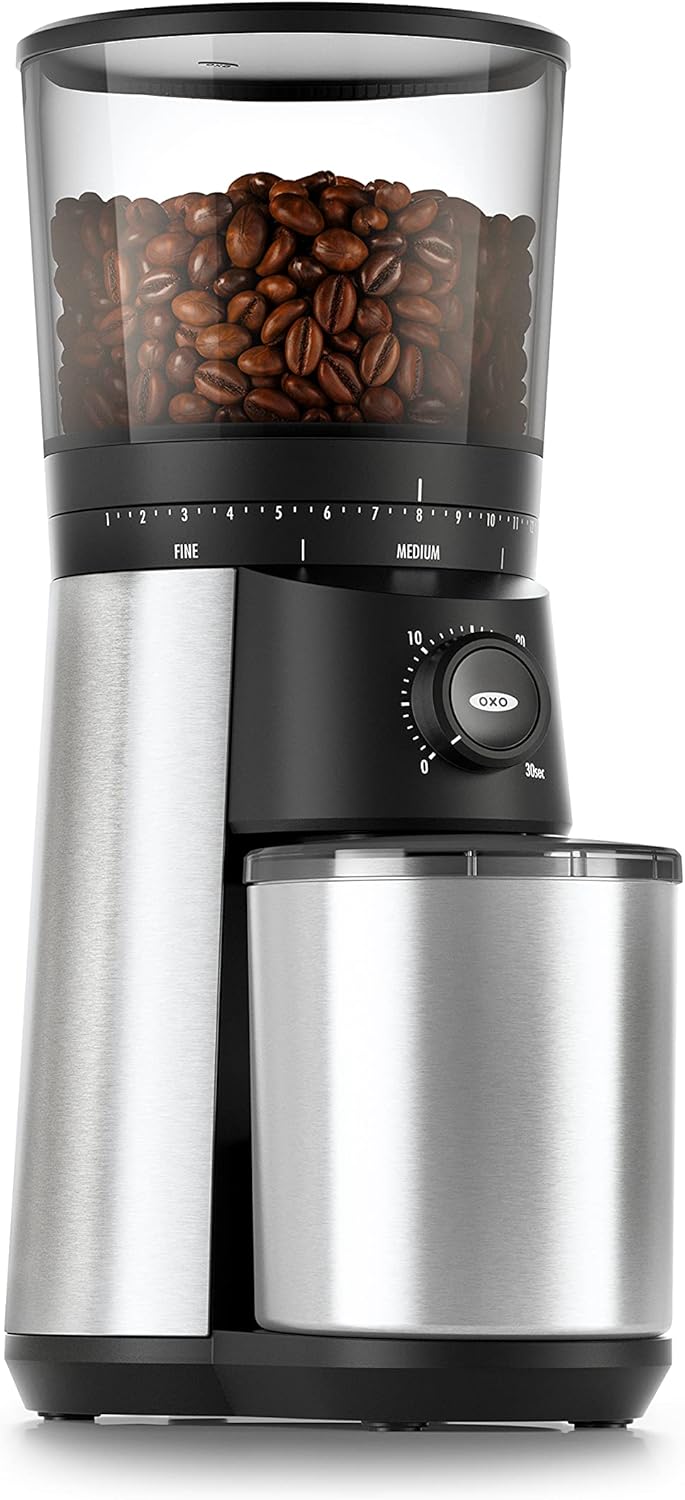
OXO Brew Conical Burr Coffee Grinder
- Removable upper burr
- Reduced grounds cling
- 15 settings plus microsteps
- 12 oz bean hopper
- Simple timed operation

Hamilton Beach Fresh Grind 80335R
- Removable grinding cup
- Dishwasher-safe removable steel cup
- Good for short doses
- Straightforward push control
- Hidden cord storage

KRUPS GX450 Flat Burr Coffee Grinder
- 18 flat-burr settings
- Removable bean hopper
- Slide-out grounds chamber
- 2–20 cup selection
- Brush access for residue
For my own daily filter-coffee setup, I give the OXO the edge: its removable upper burr and static-fighting catcher tackle two of the places where cleanup becomes irritating. If I cared most about washing a cup immediately after grinding, I choose Hamilton Beach instead. KRUPS is the middle ground for a household that wants the control of an adjustable flat-burr grinder along with a hopper and grounds chamber that can be taken off for routine attention.
The Mr. Coffee Multi-Grind offers a clever chamber-cleaning system, while the Cuisinart DBM-8 is a familiar burr-mill choice with a separate grounds collector. Neither is a universal winner. In particular, a removable container is not a license to rinse the electrical base or grind chamber internals indiscriminately. The cleaning instructions for each appliance matter as much as the removable parts themselves.
Best Easy-to-Clean Coffee Grinders — At a Glance
This comparison looks at the surfaces that collect coffee, how the owner can access them, and what each machine gives up in exchange for easier maintenance. The six short points beneath every grinder are intended to make the differences clear without turning a minor cleaning task into a major specification hunt.
OXO Brew Conical Burr Coffee Grinder
- 15 main settings plus microsettings
- Steel conical burrs
- Removable upper burr for brushing
- 12 oz bean hopper
- Static-fighting grounds container
- One-touch timer remembers duration
Hamilton Beach Fresh Grind 80335R
- Removable steel grinding cup
- Dishwasher-safe removable steel cup
- Stainless-steel rotating blades
- Up to 12 cups of coffee
- Compact household design
- Concealed cord storage
KRUPS GX450 Flat Burr Coffee Grinder
- GX450 / GX450DU0 model
- 18 grind positions
- Flat metal burr grinding
- 2–20 cup auto-stop selector
- Removable hopper and bin
- Cleaning brush supplied

Mr. Coffee Multi-Grind BVMC-PBG77
- Actual model BVMC-PBG77
- Five grind-control selections
- Stainless-steel blade motor
- Removable grinding chamber
- Twist-style chamber cleaning
- 4–12 cup selector with auto-stop

Cuisinart Supreme Grind DBM-8
- Original DBM-8 discontinued
- 18 selectable grind positions
- Removable 8 oz bean hopper
- Lift-out grounds chamber
- 4–18 cup slide selector
- Scoop and brush supplied
Quick Ranking: Which Grinder Cleans Up with the Least Fuss?
| Grinder | Where it excels | Grinding type | Cleaning trade-off |
|---|---|---|---|
| OXO Brew Conical Burr Coffee Grinder | Best balanced cleaning and brewing routine | Conical burr | Burrs must remain dry and be brushed |
| Hamilton Beach Fresh Grind 80335R | Fastest cleanup of a removable chamber | Blade | Blade grind is less even |
| KRUPS GX450 Flat Burr Coffee Grinder | Accessible hopper and grounds-bin maintenance | Flat burr | Grind chute needs periodic brushing |
| Mr. Coffee Multi-Grind BVMC-PBG77 | Twist-to-clear grounds inside a removable chamber | Blade | Blade chamber still requires careful handling |
| Cuisinart Supreme Grind DBM-8 | Traditional detachable hopper and grounds chamber | Burr mill | Discontinued original model |
What Actually Makes a Coffee Grinder Easy to Clean?
I separate grinder cleaning into three jobs: emptying the coffee after each brew, brushing away dry residue before it becomes stale, and occasionally washing the components that the manufacturer explicitly approves for water. These jobs overlap, but they are not interchangeable. A machine with a dishwasher-safe cup may still leave a broad mix of fine and coarse coffee particles, while a burr grinder can make an excellent brew yet require extra care around its cutting surfaces.
I also resist the assumption that an anti-static coating eliminates all cleanup. Humidity, bean roast, grind size, and the receiver material can all affect how much coffee clings to the bin. The best outcome is a design that keeps spills small and lets me clear the remaining grounds without reaching into unsafe moving parts. That is the standard I apply to these five models.
Five Detailed Easy-to-Clean Coffee Grinder Reviews
1. OXO Brew Conical Burr Coffee Grinder
For everyday ground coffee, the OXO Brew makes the strongest argument in this group because the part I am most likely to brush—the upper burr—is accessible without dismantling the entire machine. That feature matters more to me than another shiny control panel. Coffee fragments collect where beans are broken, travel along the chute, and settle into the receiving cup. When I can lift the upper burr and reach that path with a small brush, basic maintenance becomes something I can do on a Tuesday instead of postponing for a month.
It is not the fastest machine to wash from top to bottom. In fact, none of its components belong in a dishwasher, and the burr chamber should never be flooded with water. Its appeal is a different kind of convenience: a sensible separation between parts I can hand-wash and parts I must brush dry. Combine that with the metal grounds container designed to reduce static, and it looks like a grinder that can be kept orderly without sacrificing an adjustable burr mechanism.
OXO Brew Conical Burr Coffee Grinder
My preferred all-rounder because its removable upper burr, twist-off bean hopper, and static-fighting grounds container make regular care straightforward without surrendering useful grind control.
- Upper burr lifts out for dry brushing
- Hopper and receiver can be washed separately
- Static-fighting catcher contains more of the mess
- Useful adjustments across filter and immersion methods
- Burrs and grinder interior must stay dry
- No parts are dishwasher safe
- Some fines can still lodge in the chute
- Not a precision grinder for every espresso basket
Technical Specifications & Daily Features
- Stainless-steel conical burr set
- 15 major grind positions with additional microsettings
- Bean hopper capacity 12 oz / 3/4 lb
- One-touch timed grinding; remembers selected duration
- Upper burr removable; lower burr stays installed
- Hopper, grounds container and lids hand-wash separately; dry fully
- Do not place any part of the grinder in a dishwasher
- Nominal dimensions approximately 6.8 × 11.8 × 14.8 inches
I select it for an owner who wants genuinely controllable daily coffee and a reasonably accessible cleaning path. The convenience is in the removable upper burr and easy grounds handling, not in a claim that the interior never needs brushing.
Pros & Cons After 30 Days of Use
The OXO’s everyday advantage is access: a lift-out upper burr, a hopper that can be removed without emptying every bean, and a receiving container designed to reduce cling. I see three recurring ownership tasks: brush the accessible burr and chute after powder accumulates; keep the hopper and collection bin dry after hand-washing; and make sure the upper burr locks properly on reassembly. The nonremovable lower burr remains a dry-brush job, not a sink job. This is the strongest combination of brewing control and manageable maintenance here, but it still leaves some grounds in the grinding path. A person who wants everything to go straight into the dishwasher is shopping for a different type of grinder.
My Final Verdict
My overall recommendation is OXO for someone brewing filter coffee often and unwilling to sacrifice a controlled burr adjustment for an easier-to-wash blade cup. Its removable upper burr makes maintenance genuinely more accessible; the metal receiver helps keep transfers orderly. It is not dishwasher-safe, zero-retention, or a guaranteed specialist espresso grinder. For everyday drip, pour-over, and immersion coffee, that is an acceptable and clearly defined trade-off.
The removable upper burr is its real maintenance advantage
The OXO grinder uses stainless-steel conical burrs, and only the upper burr is designed to lift out for cleaning. I unplug the machine, empty the hopper, run it briefly with the empty hopper as the instructions advise to clear some residue, and then remove the hopper. After any remaining beans have been cleared from the burr area, the upper burr handle can be lifted, turned counterclockwise, and pulled up. That sequence gives access to a section of the mechanism that remains hidden on many cheaper appliances.
Once the upper burr is out, I use a soft, small-bristle brush on the removable burr, fixed lower burr, and grind chute. Dry brushing is not glamorous, but it avoids damaging the equipment with water or cleaners not intended for the mechanism. Reassembly is just as important as removal: the tabs must align, the burr must turn into place, and a gentle pull on the handle should confirm it is locked before beans are added again. I never use grinding noise to diagnose whether a loose burr was installed correctly.
A cleaner grounds transfer is not the same as zero static
The stainless-steel grounds container has a static-fighting design. That does not mean every grind will fall into the brewer without a stray particle, especially in dry air or with certain roasts. What it offers is a way to reduce one of the daily annoyances of a burr mill: coffee adhering to the receiver walls and scattering when the container is tipped. I prefer a meaningful reduction in cling than a fanciful promise that static cannot occur.
The hopper also incorporates a trap-door arrangement for removing it without spilling the full load of beans. That is useful when changing coffees or clearing the burr chamber. I still avoid leaving a large amount of beans in a bright, warm kitchen for weeks. The twelve-ounce capacity gives flexibility for several brews, but freshness and cleaning become easier when I keep the working quantity modest and store the remaining beans in a sealed container.
Hand-washable parts and the dishwasher rule
There is an important distinction between removing a part and placing it in a dishwasher. The OXO instructions specifically tell owners not to put any of the grinder components into a dishwasher. I can wash the hopper, its lid, the grounds container, and the relevant lids with warm water and mild soap, then rinse and dry them completely. I cannot wash the inside of the burr chamber with water; that area should be brushed.
This is why I call it easy to maintain rather than dishwasher safe. A person who dislikes cleaning removable containers by hand might prefer the Hamilton Beach for that narrow reason. A person who wants the better control of burr grinding can accept the extra hand-wash step. When the machine is reassembled, damp parts can encourage residue buildup, so a completely dry hopper and receiver are part of responsible maintenance, not an optional flourish.
Grind size, timed dosing, and the everyday countertop
Fifteen main settings, with additional micro-adjustments, cover the familiar path from relatively fine coffee toward coarser filter and immersion brewing. The timer remembers a previous duration, which cuts repeated setup. It is still a timer, not a weighing scale. Changing the beans or the grind size can change how many grams emerge during the same number of seconds; I measure a dose when consistency matters rather than rely on a fixed time to guarantee a fixed mass.
For pour-over and drip, I like the ability to make one modest grind adjustment and see what happens to the cup. For French press, a coarser range is available. I do not promise that its finest position will satisfy every non-pressurized espresso basket. The more important question for a buyer reading about easy cleaning is whether the machine keeps that control after months of use; brushing the burr path and clearing stale fines are part of protecting its performance.
OXO: maintenance that becomes part of the brew routine
The OXO stands out because upper-burr access avoids the frustration of wondering what is trapped deep inside the grinder. The maintenance sequence is clear: run the empty machine only as instructed, unplug, release the hopper, lift out the upper burr, and brush the grinding surfaces and chute. The lower burr stays in place. After reassembly, the upper burr needs to lock securely before beans are added.
The longer-term question is not whether the grinder stays perfectly spotless. It is whether that dry-brush routine is straightforward enough to prevent stale residue from collecting. For daily filter coffee, I consider the balance worthwhile: adjustable burr grinding, a manageable catcher, and maintenance access that does not require a full teardown. Someone intent on putting every part into the dishwasher should choose a different design.
2. Hamilton Beach Fresh Grind 80335R
The appeal of the Hamilton Beach Fresh Grind starts with a simple physical action: lifting its grinding chamber away from the motor unit. If a reader’s biggest complaint is tipping a whole electric grinder upside down to get coffee out, that is an immediate improvement. The removable stainless-steel cup gives the owner a separate place to pour, wipe, and clean, rather than requiring constant maneuvering around the power cord and body of the appliance.
I make it my choice for the easiest approved washing routine in this group, but not for the most controlled grind. This is a blade grinder. Beans get struck by spinning blades rather than passing between burrs set at a fixed gap. It can supply fresh coffee for an everyday drip machine, but the particle sizes will be less predictable than those from a well-adjusted burr mill. The machine is easiest to understand when cleaning convenience and grinding precision are considered separately.
Hamilton Beach Fresh Grind 80335R
The practical answer for someone who wants a small electric grinder and regards a washable grinding cup as more important than precision burr adjustment.
- Removable chamber separates coffee from the motor body
- Removable grinding bowl is dishwasher safe
- Wide opening simplifies transferring grounds
- Small footprint makes storage easy
- Blade chopping gives mixed particle sizes
- No calibrated coarse-to-fine burr dial
- Cleaning the cup does not clean the motor body
- Dishwasher washing requires full drying before reassembly
Technical Specifications & Daily Features
- Stainless-steel blade grinding mechanism, not burrs
- Removable grinding chamber and lid
- Stainless-steel grinding chamber dishwasher safe; check lid instructions for the exact variant
- Up to 12-cup brewing capacity; coffee amount varies with brew strength
- Button-controlled grind; stop when texture is acceptable
- Concealed cord storage
- Powered base should never be immersed or put in the dishwasher
For housekeeping convenience, this is my strongest recommendation. I do not buy it to chase laboratory-like uniformity; I buy it to remove the messy cup, empty it without wrestling the appliance, and wash an approved part safely.
Pros & Cons After 30 Days of Use
The Hamilton Beach has the simplest legitimate washing advantage: its stainless-steel grinding bowl lifts off the motor and is approved for the dishwasher. The owner still needs to respect the blade edges, check the exact lid-care instructions, and dry the chamber thoroughly before putting it back. There is no burr chamber or long internal chute to brush, which simplifies housekeeping. The cost of that simplicity is a less uniform grind: pulse duration cannot create the same repeatable burr gap as a numbered burr selector. The bowl’s easy removal is the reason to buy it, not a promise of precision extraction.
My Final Verdict
Choose the Hamilton Beach Fresh Grind when a dishwasher-safe removable bowl matters more than precise grind-size control. Its compact body and uncomplicated push-to-grind routine make it especially attractive for an occasional drip-coffee household. I do not recommend it as the first choice for someone who regularly fine-tunes pour-over or espresso, because washing convenience cannot compensate for the limitations of blade grinding.
A detachable chamber changes how coffee reaches the brewer
The steel grinding cup can be taken out, tipped toward a paper filter or brewer, and returned after cleaning. That makes sense for kitchens where grounds otherwise spill behind a machine every morning. I prefer transferring from a removable cup because I can see whether residue is stuck to the walls or tucked around the blades. It gives me a chance to clear what remains without lifting an entire plugged-in appliance over the counter.
The cup can also be emptied away from the electrical base. That reduces the temptation to brush the motor housing while the appliance is still attached to an outlet. I always stop the motor completely, unplug when removing or cleaning parts as directed, and respect the sharp blades. A removable chamber is convenient, but its blade edge still deserves care during cleaning and handling.
What dishwasher safe actually means for this model
Hamilton Beach identifies the removable stainless-steel grinding chamber as dishwasher safe. Check the care directions for the exact lid variant before machine-washing the lid. That is a genuinely useful difference from the burr models here. If I want an approved machine-washable piece after grinding an oily dark roast, the removable cup and lid are the pieces I can wash. The motor base does not belong in the sink or dishwasher, and I do not interpret the word dishwasher-safe as applying to the whole appliance.
I remove the vessel as directed, empty it, and clean it with the method the owner prefers. I then dry every part thoroughly before reassembly. When washing any component with blades, I avoid casually reaching inside the chamber to wipe it with bare fingers. A soft brush, careful rinsing, and safe handling work better than turning a simple maintenance task into an injury risk.
Where the simplicity meets the limits of blade grinding
The Hamilton Beach is suited to someone making a few ordinary cups without trying to reproduce a laboratory-measured coffee recipe. Its small design, up-to-twelve-cup advertised capacity, and hidden cord storage make it less obtrusive than a countertop burr mill. For a rushed kitchen, the reduced storage burden can matter as much as the washing routine itself. It also explains why a blade grinder remains appealing despite its uneven grind distribution.
But the trade-off is real. Holding the switch longer does not correspond to one predictable step finer. Some pieces are hit repeatedly while others move away from the blade; the result can contain dust and large fragments together. For French press, too many fines can create sludge. For pour-over, a broader range of sizes can make extraction harder to tune. I do not describe this appliance as a substitute for a precision flat-burr machine simply because it cleans faster.
Cleaning between coffee and other uses
Any grinder used for more than one food should have its care and intended-use instructions checked carefully. The removable cup makes cleaning easier, but strong aromas and oils can linger around blades and seals. If coffee taste matters and the appliance permits multiple uses, a dedicated coffee vessel can be an advantage. Personally, I prefer to keep the grinder in a coffee-only routine rather than discover that yesterday’s seasoning has found its way into the next morning’s brew.
Hidden cord storage reduces clutter after the machine has dried. I do not wind up a damp appliance and place it immediately inside a closed cupboard. A dry grinding cup, wiped exterior, and tidy cord make storage easier without trapping unpleasant smells. Those are mundane benefits, but they are exactly what a reader searching for easy cleaning is usually trying to improve.
Hamilton Beach: dishwasher convenience with a clear brewing compromise
The removable bowl remains the reason to buy the Fresh Grind, even once the novelty of taking it to the sink has passed. A compact appliance with a simple button, a cup that lifts away from the motor, and no separate burr chute is an easy fit for a small kitchen. Just keep the sharp blades in mind during cleaning and confirm the specific lid-care directions rather than assuming every removable part has identical dishwasher approval.
I favor it for someone who grinds modest portions for everyday drip coffee and sees cleanup as the main obstacle to using fresh beans. The decisive drawback is size consistency, not housekeeping. When adjusting an AeroPress or pour-over recipe precisely is a daily priority, a good burr grinder offers more meaningful control.
3. KRUPS GX450 Flat Burr Coffee Grinder
The KRUPS GX450 offers a different version of low-maintenance grinding: familiar dial controls paired with a hopper and grounds bin that can be removed. This is the grinder for someone who finds blade chopping too approximate but does not want to spend the morning disassembling an elaborate espresso workstation. Eighteen grind positions provide understandable steps for drip, filter, and coarser methods, while a two-to-twenty-cup selector gives a simple starting point for routine quantities.
KRUPS has made several grinders with similar names, but the GX450 stands apart from the older GX500050. Its eighteen grind steps, two-to-twenty-cup selector, and removable collection parts are the relevant features. I pay attention to the exact controls and care routine rather than assuming all grinders with the same brand badge share interchangeable components.
KRUPS GX450 Flat Burr Coffee Grinder
An 18-position flat-burr grinder with a removable bean hopper and grounds receiver, useful for people who like familiar dial controls but want more particle-size control than a blade machine.
- Removable hopper makes bean changes easier
- Grounds container separates from powered base
- Flat burr system provides controlled adjustments
- 2–20 cup selector supports shared households
- Burr chamber still needs careful dry brushing
- Flat burrs are not automatically low retention
- Static can affect container transfer
- Cup selection does not weigh a precise dose
Technical Specifications & Daily Features
- GX450 / GX450DU0 flat-burr model
- 18 selectable grind positions
- Flat metal burr mechanism
- 2–20 cup grinding-size selector with auto-stop
- Removable bean hopper and separate grind chamber
- Cleaning brush and one-touch operation
- 120 V North American home-electric design
- Approx. 9.53 × 5.63 × 12.48 inches for identified GX450 variant
The GX450 earns its place by combining adjustable burr grinding with components that are easier to empty. Its eighteen grind positions and two-to-twenty-cup selector distinguish it from earlier KRUPS designs; those are practical controls for a family making coffee at home.
Pros & Cons After 30 Days of Use
KRUPS GX450 keeps the mess in two places a home owner can understand: the detachable bean hopper and the separate grounds receiver. Removing those parts helps with refilling, changing beans, and ordinary countertop cleaning. The flat-burr chamber and chute still require periodic dry brushing. A 2–20-cup selector makes batch preparation quick but does not measure grams, and neither the cup count nor the eighteen grind settings establishes zero retention. This is the practical middle option when a household wants repeatable burr grinding with fewer electronic controls. Care remains manageable without suggesting the burr assembly belongs under running water.
My Final Verdict
KRUPS GX450 earns its place for households that need an adjustable flat-burr grinder with readily removable large components. It offers a better-defined grind range than either blade model, and its dial-based setup suits drip, press, and filter coffee. OXO has the edge for direct upper-burr cleaning access; Hamilton Beach is easier when dishwasher cleaning is the highest priority. The KRUPS wins when the owner wants balanced, familiar burr grinding and uncomplicated container maintenance.
Removing the hopper without scattering a bag of beans
Large hoppers are useful until I want to switch roasts or brush the burr area. On the GX450, the hopper can be removed, making access and emptying more manageable than on a permanently attached chamber. I first run down or remove the remaining beans following the machine’s directions, then unplug it before handling internal parts. Coffee beans caught in a burr adjustment mechanism can make a piece feel stiff; forcing it is not the answer.
I use the removable hopper primarily as a maintenance aid, not an invitation to store weeks of beans above the motor. If the morning dose is thirty grams, it rarely makes sense to fill the hopper and leave the coffee exposed indefinitely. Keeping the remainder sealed protects aroma and also makes deep cleaning less awkward: a nearly empty hopper is easier to remove, inspect, and reinstall properly.
Flat burrs need dry care, even when the bins come off
The GX450 uses flat metal burrs. That is a useful mechanism for repeatable adjustment, but coffee dust and oils still collect where the beans are ground and expelled. I keep a dedicated brush near the machine and use it on accessible dry surfaces as directed. If a grounds bin is removable and wash-safe, I clean it separately from the electrical and burr assembly, then dry it completely before replacing it.
The distinction is important because “removable hopper” and “wash the whole grinder” are very different statements. No powered grinder should be placed under a tap. Metal burrs should not be rinsed casually, and no one should reach into a running burr assembly. The best cleaning routine is uncomplicated but deliberate: power off, unplug, disassemble only designated parts, brush, and reassemble without forcing the adjustment mechanism.
Eighteen settings and what they do for everyday coffee
A stepped dial is valuable when I am trying to correct a cup. If my filter coffee draws down too slowly, I may shift slightly coarser while leaving the recipe unchanged. If a French press cup tastes thin, I can make a careful finer adjustment. The dial gives me a physical point of reference that a blade grinder cannot offer. That is a meaningful advantage for someone who brews the same coffee most mornings.
I do not equate an eighteen-setting range with precision espresso capability. Grind spacing and burr geometry determine whether the exact fine range suits an espresso basket, and the 2–20 cup selector is an estimate of output rather than a scale. For daily drip coffee, the combination is much easier to live with: reasonable adjustment, automatic stopping, and a grounds container I can remove without hauling the whole appliance across the counter.
Static, chute residue, and a genuinely clean counter
A plastic grounds receiver can attract fines, particularly in a dry room. Some static is normal, and I do not promise that a removable chamber prevents it. A practical routine is to let the grinding settle, tap or gently shake the receiver as appropriate, then pour without rushing. Brushing the outlet afterward can stop stale fragments building up over several days. If the grinder leaves a little residue, I look for a manageable routine before treating it as a defect.
I also keep the counter beneath the unit dry and wipe the exterior with a soft cloth. Tiny spills tend to accumulate behind grinders, where coffee dust mixes with moisture and becomes sticky. Moving the appliance occasionally and cleaning underneath is part of maintaining a pleasant kitchen. A grinder can have an accessible hopper and still require ordinary housekeeping; easy cleaning means the design does not resist those chores.
KRUPS: the overlooked work at the grind outlet
The GX450’s detachable hopper and bin reduce the need to tip a large electrical appliance across the counter. The flat-burr pathway still holds some fines, especially after oily beans or frequent changes in grind size, so a soft brush deserves a permanent place near the machine. The eighteen settings and cup dial remain easy to operate, but the latter is an estimated quantity, not a gram measurement.
For a busy drip-coffee household, this mix of accessible containers and physical controls feels well judged. I put OXO first for upper-burr access, KRUPS next for straightforward removable-part maintenance, and the blade alternatives in a separate category for people who value washing above grind uniformity.
4. Mr. Coffee Multi-Grind BVMC-PBG77
The Mr. Coffee Multi-Grind is most interesting because it tries to solve the part of blade grinding that can be surprisingly frustrating: coffee dust sticking to the chamber walls. Rather than merely telling the owner to tap the cup repeatedly, this model includes a chamber-cleaning mechanism that twists to help clear grounds from the interior. If I were buying for someone who values convenience above fine-grind accuracy, that small mechanical addition would make more sense to me than another decorative setting.
This is the BVMC-PBG77 Multi-Grind, a different model from the older IDS77-RB. It uses stainless-steel blades, offers five grind settings, and combines a four-to-twelve-cup selector with automatic shutoff. None of those features turns the blade into a burr set. The practical value is an easy-to-understand, self-contained grinding chamber that can be removed and cleaned without treating the motor body like a washing bowl.
Mr. Coffee Multi-Grind BVMC-PBG77
An unusual budget blade option with a dedicated chamber-cleaning mechanism. Its standout benefit is pushing loose grounds off the chamber walls before pouring, not the precision of its blade cut.
- Chamber cleaning system helps dislodge clinging grounds
- Removable vessel is easier to empty and wash
- Automatic shutoff avoids prolonged accidental running
- Lid safety switch adds a useful safeguard
- Five settings do not create controlled burr sizes
- Burr-level uniformity is not available
- Washing instructions apply to removable coffee container
- More moving controls than a very basic blade grinder
Technical Specifications & Daily Features
- Actual model BVMC-PBG77 / Mr. Coffee Multi-Grind
- Stainless-steel blade grinder (not a burr mill)
- Five grind settings for relatively fine to coarse results
- 4–12 cup selector
- Removable grinding chamber with twist-to-clean system
- Lid-activated safety switch and automatic stop
- Dimensions approximately 4.4 × 4.4 × 8.5 inches
- Wash removable coffee container with soap and water; wipe motor exterior
I see this as a cleanup-oriented appliance for someone who likes blade simplicity but dislikes tapping a fixed steel chamber repeatedly over a filter basket. Its twist-to-clear design matters; its five nominal settings should not be mistaken for five calibrated burr gaps.
Pros & Cons After 30 Days of Use
Mr. Coffee’s BVMC-PBG77 tackles a specific blade-grinder annoyance: residue that clings around the removable chamber. Its twist-style cleaning mechanism helps move loose grounds off the wall before transfer. That cuts down on repeated tapping, but it does not remove oily films, replace regular washing, or make blade output as uniform as burr grinding. The lid safety interlock, automatic stop, and 4–12-cup setting add sensible convenience. Owners still need to stop the blades, unplug for cleaning, and dry the removable coffee cup completely before reassembly. The mechanism is worthwhile for a simple brew routine, not specialist grind control.
My Final Verdict
I recommend the Mr. Coffee Multi-Grind to buyers who prefer a blade grinder but want help clearing a messy chamber. Its five selections organize grinding time and operation; they are not five calibrated burr gaps. Choose it for the twisting chamber cleaner and straightforward automatic cycle. For precise pour-over dialing-in, the OXO or KRUPS is the sounder purchase; for a clearly approved dishwasher-safe bowl, Hamilton Beach has the stronger case.
The twist-to-clean chamber solves a specific annoyance
Blade grinders often leave a thin ring of coffee around the cup wall, especially when the grounds are fine and oily. The Multi-Grind has a mechanism intended to clear some of that buildup with a twisting motion. I can understand why a person who prepares coffee before work would appreciate it. Instead of repeatedly tipping and shaking the whole unit, there is a designated action designed to bring loose grounds back toward the removable chamber’s bottom.
I use it the way the instructions show, with the machine stopped, and then remove the chamber for emptying. It is not a substitute for periodically washing the coffee container. Oils and fine dust can still cling, and a mechanism intended to move dry residue does not sterilize the surfaces. The benefit is reducing an everyday transfer chore; it does not make the machine maintenance-free.
Washing the removable coffee container without harming the motor
Mr. Coffee’s care guidance separates the removable coffee container, which can be washed with soap and water, from the exterior of the electrical machine, which is wiped clean. That is the distinction I keep firmly in mind. A blade chamber may be removable, but the motor body and controls still need protection from water. I wait for the blades to stop completely, unplug as directed, and handle any sharp internal components with care.
After washing, complete drying matters before the chamber is reinstalled. Trapped water or soap residue is not something I want in tomorrow’s coffee. I also clean the lid gasket and accessible crevices as the manual describes. A clean chamber should smell neutral when empty. If it still smells strongly of old dark roast after normal cleaning, that is a sign to inspect the approved removable pieces rather than spray a liquid cleaner down into the electrical base.
Five nominal settings do not equal burr precision
The five selections on this model help organize the grinder’s operation around different textures, but its rotating blades still strike coffee unevenly. A range of setting labels can make the interface feel more advanced, yet it does not create the controlled burr gap that drives particle-size adjustment in a true burr mill. I am cautious about using the word consistent without defining what is consistent: operation can be repeatable even when the particles vary widely in size.
For a basic drip brewer, this may be an acceptable compromise. For a fine-tuned pour-over recipe, large and small particles can extract at different rates and make the result harder to dial in. I choose this grinder for the convenience of its chamber, safety features, and automatic operation, not for specialized espresso fineness. If the user’s coffee hobby expands, a burr grinder can be a more meaningful next purchase than replacing one blade appliance with another.
Safety switch, auto-stop, and what they mean in practice
The lid-activated safety switch requires the lid to be secured before grinding. That is a welcome household feature because it reduces the chance of exposed blades spinning when someone has not assembled the chamber correctly. The automatic stop can also keep a batch from running unnecessarily. Neither feature means the blades are safe to touch immediately after pressing a button, so I still wait for the machine to stop fully before opening the container.
The four-to-twelve-cup setting is a convenient quantity estimate, not a promise of a measured number of grams. If a recipe depends on precise dosing, I weigh beans before grinding. I also be realistic about what the machine calls a cup: coffee-maker cup markings do not always correspond to a large household mug. A little scale and a clean collection chamber can make even an inexpensive blade setup more predictable.
Mr. Coffee: where its twist cleaner genuinely helps
The twist-to-clear mechanism is most valuable when fine, dry grounds are clinging to the cup wall. It makes the transfer step less awkward, but old oils still call for washing the removable vessel and drying it properly. The lid-interlock and automatic stop are reassuring operating features, though neither changes the fact that the internal cutter is a blade.
I see this grinder earning a place in a compact kitchen where a familiar drip machine is the main brewer and the owner wants a small appliance with a tidy way of emptying it. Once a person begins adjusting grind texture carefully from cup to cup, the five blade settings reach their limitations quickly.
5. Cuisinart Supreme Grind DBM-8
The Cuisinart DBM-8 belongs to the era when a simple burr mill with a sliding cup selector was an appealing upgrade from an inexpensive blade grinder. Its strengths remain understandable: eighteen selectable positions, a removable hopper, a removable grounds chamber, and a scoop with a cleaning brush. The components can be reached without treating the appliance like an intricate espresso machine. For someone who already owns one, there is still a sensible way to keep it useful.
What changes the buying recommendation is its discontinued status. Cuisinart identifies the original DBM-8 as discontinued, although a related DBM-8P1 listing exists. The distinction matters because dimensions, availability, and replacement parts may not carry over exactly between versions. If the original DBM-8 is still available through a seller, the buyer should pay attention to condition, warranty eligibility, and access to replacement parts as well as to the advertised cleaning conveniences.
Cuisinart Supreme Grind DBM-8
A long-running 18-position burr mill whose removable hopper, separate grounds chamber, and included brush can keep maintenance uncomplicated. The original DBM-8 is now a discontinued version, which deserves attention if buying remaining inventory.
- Hopper and ground-coffee chamber lift out
- Included brush reaches loose residue
- Clear grind positions aid consistent filter brewing
- Large collection chamber helps multi-cup use
- Original DBM-8 has been discontinued
- Static and retained fines still need attention
- No claim that burrs are dishwasher-safe
- Wide grind range is not precision espresso adjustment
Technical Specifications & Daily Features
- Original Cuisinart DBM-8 Supreme Grind Automatic Burr Mill
- 18-position grind selector
- 8 oz removable bean hopper
- Removable grounds chamber rated for coffee for up to 32 cups
- 4–18 cup portion selection and automatic shutoff
- Scoop/cleaning brush included
- Approx. 6 × 7.13 × 10.75 inches for original DBM-8
- Original model designated discontinued; later DBM-8P1 is a separate listing
The DBM-8 remains worth discussing when someone owns one already or finds a suitably priced unit with a trustworthy seller. I put parts availability and condition on the checklist rather than describe this original model as a newly released grinder.
Pros & Cons After 30 Days of Use
The original DBM-8 has an easy-to-understand cleaning sequence: empty the removable hopper, remove and brush the grounds chamber, then clear accessible chute residue with the included tool. Those familiar parts remain useful for an owner who already has a functioning machine. Its discontinued status changes the economics for a new buyer, however. A cracked collector or missing hopper piece can be more troublesome than normal burr maintenance, and replacement availability varies by component. It is not sensible to overlook that risk merely because the eighteen-position dial and large chamber are familiar. I see it as an upkeep-friendly legacy design, not the first new-machine recommendation.
My Final Verdict
For existing owners, keep a working Cuisinart DBM-8 clean and use it while it serves the coffee routine well. The hopper and grounds chamber are practical, and the cup slider remains uncomplicated. For a new purchase, the original model’s discontinued status and parts availability are significant drawbacks. OXO and KRUPS provide more compelling current choices for a buyer who wants both cleaning access and burr adjustment.
The hopper and grounds chamber are the easy parts
The DBM-8 has a removable eight-ounce bean hopper and a grounds chamber designed to hold coffee for multiple servings. That makes emptying easier than in an appliance whose grinding vessel is fixed beside the motor. I pour off the remaining beans, remove the hopper and collector as instructed, and wipe away loose grounds before they spread across the work surface. When the parts are dry and seated properly, everyday use should remain straightforward.
The removable grounds chamber is especially useful for batch grinding, but I avoid leaving pre-ground coffee in it for days just because it can hold enough for many cups. Aroma deteriorates after grinding, and residue from an old batch can affect the next. I prefer emptying the bin after brewing, brushing out loose particles, and returning it clean and dry. That is an inexpensive habit that does more for flavor than a decorative storage claim.
Brushing versus rinsing the internal mechanism
The included scoop and brush encourage the simplest kind of maintenance: removing dry coffee grounds from accessible surfaces. I use the brush around the grind path as directed, taking care not to force the burr assembly apart. The top of a grinder can contain small crevices where fines accumulate even when the big parts are removable. Cleaning those areas regularly helps prevent stale coffee oils and packed dust from becoming a bigger job later.
The powered grinder should not go under running water. Neither should a burr surface be rinsed unless the relevant model instructions expressly approve that operation. A lot of incorrect cleaning advice begins with the statement that a component is detachable and then jumps straight to washing everything. For the DBM-8, I follow the original maintenance directions, separate removable containers from the electrical mechanism, and keep all reassembled parts completely dry.
Eighteen settings, cup selection, and the illusion of perfect precision
The grinder’s eighteen positions and four-to-eighteen-cup slide selector make it possible to return to a familiar household routine. That is useful for daily drip coffee, especially when more than one person uses the appliance. It also means a person can make gradual adjustments rather than rely on blade-chopping time alone. Still, a cup selector does not measure the exact mass of coffee that has left the chute.
Grind consistency on an entry-level burr mill can be adequate for many filter methods without becoming a substitute for a specialist espresso grinder. Fines and static can remain a nuisance, especially around the collection bin. I prefer to acknowledge that issue and keep a small cleaning brush within reach. In a real household, being willing to wipe the receiver and brush the outlet matters more than pretending the machine produces a perfectly clean, perfectly uniform stream every time.
The discontinued-model issue belongs in the buying decision
The most practical question for someone buying an older DBM-8 is not whether its original design ever worked. It is whether the particular unit is in sound condition and whether likely wear items remain available. Hoppers, collector lids, and other plastic parts can be lost, cracked, or damaged after years of use. If a seller offers a remaining unit, I inspect the included components and check support before assuming that the low purchase price represents a bargain.
An owner who already has the machine may sensibly keep it going with modest maintenance and appropriate replacement pieces. A new buyer has more choices. If the prices are close, I compare the related newer Cuisinart offering and the OXO or KRUPS models before choosing an old-stock DBM-8. The purpose of this article is to help someone maintain a grinder with less inconvenience, not to turn a discontinued product into a default current recommendation.
Cuisinart: maintain a working grinder, assess new purchases carefully
A functioning DBM-8 can still handle an everyday drip-coffee schedule. The lift-out grounds bin, removable hopper, and brush cover the most visible residue. Keep the outlet clear, avoid washing burr components unless the specific manual permits it, and check that the collector and hopper pieces still fit securely.
The important buying distinction is between continuing to use a machine already on the counter and paying current money for an original discontinued model. I favor keeping an existing unit in good condition; I prefer OXO or KRUPS for a new burr-grinder purchase unless the older Cuisinart is priced and supported convincingly.
Buying Guide: How to Choose a Coffee Grinder That Is Actually Easy to Clean
A good cleaning routine begins with the type of grinder, not the marketing description of its finish. I look at the mechanism first, then the parts that can be taken off, then the tool access required for safe maintenance. Burr grinders and blade grinders present different cleaning chores. For burrs, the difficult area is usually the grinding path and chute. For blade appliances, the main challenge is getting coffee from around sharp blades and off the cup walls without splashing liquid near the motor.
I also pay attention to whether the receiver has sharp internal corners, whether the lid leaves grounds stranded along its rim, and whether the machine must be lifted every time I want to empty it. Those details are rarely the headline specification, yet they are the ones that define how pleasant the grinder feels after the fiftieth cup. An easily cleaned container does not mean the entire machine has no retained coffee; a brush and responsible daily habits remain important.
Removable upper burr versus removable grinding cup
The OXO illustrates why an upper burr that comes out matters: it exposes a grinding surface and part of the path where dry fines settle. I can brush those parts, inspect them, and reassemble the grinder without treating the motor unit as a container to be washed. The KRUPS and Cuisinart instead emphasize removable hopper and grounds-chamber access; those pieces simplify emptying, but the burr region still needs whatever brushing procedure the individual manual describes.
The Hamilton Beach and Mr. Coffee are blade grinders with removable cups. Their great advantage is being able to take the coffee vessel away from the powered base and wash it when the directions allow. They cannot provide the same mechanically controlled particle-size adjustment as an actual burr mill. I never recommend a blade grinder to a demanding pour-over enthusiast solely because the cup is more convenient to clean. The right compromise starts with the coffee being brewed.
Dishwasher-safe claims require exact model identification
Hamilton Beach specifically permits dishwasher cleaning of the removable grinding chamber and lid on the 80335R. That is a strong convenience for a family that prefers using its dishwasher. OXO, however, specifies no dishwasher cleaning for any part of its conical burr grinder. That difference can be decisive if cleaning convenience is the reason for buying. Both can be accurately called manageable to maintain; only one has the approved machine-washable parts discussed here.
I do not copy care instructions from a newer variant onto an older one simply because the names look alike. Even within one manufacturer, similar models may have different cups, seals, burr mechanisms, and safety requirements. Before washing a removable hopper or vessel, I check which exact part the instructions identify and whether it is permitted in water or a dishwasher. The powered body remains out of both, regardless of the product’s marketing claims about easy cleaning.
How to clean burrs without damaging them
For a burr grinder, my basic routine is dry and careful: stop the motor, unplug, clear remaining beans, remove only the components intended for user access, and brush accessible grinding surfaces with a small soft brush. If the manual recommends running the grinder briefly with an empty hopper before disassembly, that is a separate powered step performed before unplugging and opening the mechanism. I never mix the two steps or put fingers into a running grind chamber.
Burrs can be precise cutting components. Using water, abrasive tools, or a metal pick in the wrong place can encourage corrosion or damage edges. I do not pour rice or cleaning powder through every machine as a universal maintenance trick; a product’s manual should control what can safely be ground through it. Any part that is approved for washing should be thoroughly dry before it goes back near coffee beans or electric contacts.
Why static makes a clean grinder feel messy
Static occurs when coffee grounds and contact surfaces exchange electric charge during grinding and transfer. It can make grounds cling to plastic bins, jump onto the surrounding counter, or hang under the chute. A stainless-steel static-fighting receiver, such as the OXO’s, can reduce this annoyance, but room humidity, coffee roast, and grind size still play a part. I do not promise a spotless counter after every dose.
A practical sequence is to allow the grounds to settle briefly, pour slowly, and tap the container gently if that is appropriate for the design. Brushing the chute after the last brew of the day prevents loose coffee from building up into a stubborn crust. If I use very dark beans, Darker roasts can leave more oily residue and plan to clean more often. A static-control feature helps, but it never replaces ordinary maintenance.
Why low retention is not a synonym for easy cleaning
Low retention refers to how much ground coffee stays inside the grinder rather than reaching the collection vessel. A narrow, short path can help, but grinder geometry, bean feed, grind size, and static all affect the result. A model advertised as low retention is not necessarily simple to disassemble, and a machine with a removable cup may be easy to wash while still leaving particles under the blade. I prefer a design with accessible surfaces over an unexplained promise of zero grams remaining.
For a person who changes beans frequently, old grounds can also affect flavor. I make sure the chute is easy to brush and avoid overloading the hopper with one roast when another roast is planned for tomorrow. A grinder whose bin can be removed cleanly and whose burr path can be reached safely may be a better daily tool than a more complicated low-retention concept that requires special equipment for normal cleaning.
How much cleaning does a daily grinder need?
After each use, I empty the grounds receiver and clear obvious loose coffee from its rim. Every few sessions, I brush the chute and any safe, exposed areas where fines gather. Less frequently, depending on the volume and roast, I follow the manual’s full cleaning procedure for the hopper, approved wash-safe container, and removable burr components. Oily dark roasts may require more frequent attention than dry-looking light roasts.
I do not prescribe an exact universal cleaning interval because a person grinding fifty grams a day creates different wear and residue from a café producing many kilograms. The test is whether the grinder smells fresh, the outlet stays clear, the adjustable parts move properly, and the coffee is not being contaminated by stale buildup. Cleaning should be regular enough that a small brush remains sufficient for most days.
Which grinders are best for dark, oily beans?
Dark roasts often leave more visible oils on contact surfaces. I consider removable bins particularly helpful because those parts can be emptied and cleaned without complicated disassembly. Hamilton Beach’s washable chamber provides straightforward access to oily residue around its blade, but the blade mechanism still produces less controlled grind sizes. In a burr grinder, dry brushing around the burrs becomes especially valuable after oily beans, and any washed containers must be thoroughly dried before reuse.
I do not assume a powerful motor makes a machine immune to oily deposits. If the chute begins to clog or the grounds stick heavily, more frequent cleaning and smaller batches may be more effective than simply increasing the operating time. Manufacturer-approved cleaning methods are essential, particularly on machines where the burrs cannot be fully removed by the user.
Removable parts do not mean all parts belong in the sink
A hopper or chamber may be designed to come out so the user can empty coffee, repair a jam, or access a burr—not necessarily to be submerged in water. I read the care instructions literally. If the instructions say to brush a component, I brush it. If they permit soap and water for a separate container, I wash and dry it. If they permit the dishwasher, I use that convenience for those particular pieces only.
The motorized base, power cord, and electrical contacts must stay dry. Moisture entering the grind chamber may damage burrs or cause coffee residue to cake into a sticky mass. I do not use compressed air in a way that drives coffee deeper into the housing, nor do I insert metal utensils into an energized device. Safe cleaning takes a little thought but avoids creating a far bigger repair problem.
A cleaning brush is an inexpensive accessory worth keeping
I like a soft, narrow brush that reaches the chute opening and can dislodge dry fines around the burr area. It should be reserved for coffee equipment rather than used on greasy kitchen surfaces, where it may pick up detergent residue or odors. If a machine includes a scoop and brush, as the Cuisinart does, that can reduce the need for another purchase. I still care more about access than whether the brush was included in the carton.
I store the brush within reach of the grinder so that clearing loose residue feels as normal as rinsing a measuring spoon. That tiny convenience makes maintenance more likely to happen. A person who must open a distant cupboard, find tools, and dismantle a large appliance for every cleanup will often postpone it. The best routine is the one that fits the normal movement of the kitchen.
How to compare grind quality and cleaning convenience fairly
A burr grinder has an obvious advantage when the drinker wants to repeat a chosen texture. The gap between grinding surfaces can be adjusted and returned to, whereas a blade grinder changes texture by the duration and pattern of repeated impacts. But burr equipment can also contain more internal surfaces that collect residue, so it may require a brush. Neither characteristic automatically makes one type better for every household.
I decide first whether the intended brewing method really demands repeatable size adjustment. Pour-over and espresso experiments usually benefit more from burr control; an occasional large automatic drip pot can tolerate a simpler machine. Then I rank cleaning features among the grinders that meet that quality requirement. Choosing a convenient mechanism that cannot support the coffee a person likes is not a useful saving.
Timer controls cannot guarantee identical grams every day
Several grinders here use a cup selector or timed operation. Those controls make the workflow simpler, but they do not weigh the ground coffee. Grinding throughput varies with bean density, age, roast level, grind adjustment, and residual coffee inside the machine. A cup setting that works for a dark roast may deliver a different mass with a denser light roast. That is normal mechanical behavior rather than evidence that cleaning has failed.
I use a scale when the recipe depends on consistency. I also check whether coffee is accumulating in the chute; a partly obstructed path can affect output. A well-maintained grinder often makes a timed routine more predictable, but there is no honest reason to promise a dose accurate to a tenth of a gram without measured test data.
Small kitchens need an easy storage routine too
An appliance can be easy to clean but awkward to put away. I look at whether the hopper makes it too tall for an overhead cabinet, whether the grounds bin can be removed without a spill, and whether the cord remains tangled around other tools. Hamilton Beach and Mr. Coffee appeal to people who want a compact machine that can be emptied and stored. The OXO and KRUPS deserve permanent counter space when someone uses burr grinding regularly.
Keeping the grinder away from stovetop heat and sink splashes protects both beans and electronics. I leave room behind the appliance for brushing and avoid pushing a motorized housing into a damp corner. The machine should not be so hard to move that the counter underneath remains uncleaned. A few inches of clearance can make an otherwise ordinary design more pleasant to own.
How I choose between these five without overthinking it
For the person who values both grind adjustment and simple daily housekeeping, I give OXO first place because of its upper-burr access and static-fighting receiver. For the person whose priority is washing a removable cup, Hamilton Beach deserves a strong look. The KRUPS GX450 sits between them in a useful way: more controllable than a blade grinder, with removable large components, but requiring dry burr maintenance as part of the bargain.
Mr. Coffee offers a distinctive twist-to-clean chamber in a budget blade design; that is a sensible convenience rather than a reason to describe it as a burr grinder. The Cuisinart DBM-8 remains relevant for owners and for buyers who knowingly consider a discontinued model, but I compare current alternatives before paying much for it. Cleaning should support the coffee routine, not become the reason a brewer buys the wrong tool.
The first 30 days: a practical ownership checklist
In the opening week, I use one familiar coffee and observe how much residue remains after grinding and pouring. I establish a dry-brush habit for burr equipment or the approved cup-washing sequence for a blade model. That creates a baseline without changing beans, dose, and brewing methods every morning. The aim is learning what normal cleanup looks like.
By weeks two and three, I inspect static buildup, check that removable pieces latch correctly, and assess whether the chute becomes harder to clear with oily roasts. In week four, I ask whether I still enjoy the grinder on busy mornings. A product with impressive features loses much of its value when cleaning is so inconvenient that the owner avoids doing it. The goal is dependable brewing and a reasonably tidy kitchen, not an invented perfect score.
Final Comparison: Cleaning Convenience Against Grind Control
| Grinder | Removable component | Cleaning method | Best fit | Price |
|---|---|---|---|---|
| OXO Brew Conical Burr Coffee Grinder | Upper burr, hopper, receiver | Brush burrs; hand-wash containers | Best balanced cleaning and brewing routine | Price on Amazon |
| Hamilton Beach Fresh Grind 80335R | Grinding cup and lid | Approved parts dishwasher safe | Fastest cleanup of a removable chamber | Price on Amazon |
| KRUPS GX450 Flat Burr Coffee Grinder | Bean hopper, grounds receiver | Remove, empty and dry-brush | Accessible hopper and grounds-bin maintenance | Price on Amazon |
| Mr. Coffee Multi-Grind BVMC-PBG77 | Blade chamber | Twist to clear; wash removable cup | Twist-to-clear grounds inside a removable chamber | Price on Amazon |
| Cuisinart Supreme Grind DBM-8 | Hopper, grounds chamber | Brush chute; clean removable collectors | Traditional detachable hopper and grounds chamber | Price on Amazon |
My Final Recommendation
If I were replacing an aging grinder for daily pour-over or drip coffee and wanted to simplify cleanup without abandoning grind control, I choose the OXO Brew. Being able to remove the upper burr, brush the chute, and empty a static-fighting receiver gives me a routine I can live with. I do not put the burrs into water, and I hand-wash only the removable hopper, grounds container, and lids as instructed. Cleanable is not the same as dishwasher safe.
For the household that wants the simplest genuinely washable grinding cup, Hamilton Beach Fresh Grind is the obvious alternative here. Its blade mechanism will not offer the OXO’s adjustment consistency, so the choice hinges on the brew method. KRUPS GX450 gives burr control with removable parts, Mr. Coffee offers a particularly clever chamber-clearing design, and Cuisinart’s discontinued original DBM-8 is still relevant for owners who already have it. I care most about the grinder a person can keep clean on a workday, not the one with the longest claim printed on the box.
Frequently Asked Questions About Easy-to-Clean Coffee Grinders
Which coffee grinder is easiest to clean overall?
For someone who also values grind consistency, my preferred all-rounder here is the OXO Brew because its upper burr can be removed for brushing and its grounds receiver is designed to reduce static. For the easiest machine-washable chamber, Hamilton Beach 80335R has the advantage.
Can I put the OXO Brew grinder in the dishwasher?
No. Its instructions say not to put any part of the grinder in a dishwasher. Hand-wash the approved hopper, grounds container, and lids; dry them thoroughly. Clean the burrs and grind chute using a brush rather than water.
Is the Hamilton Beach 80335R grinding cup dishwasher safe?
Hamilton Beach identifies the removable stainless-steel bowl as dishwasher safe. Follow the matching model’s lid-care directions before placing the lid in a dishwasher. The motor base must not go in the dishwasher or be immersed in water, and the chamber must be dry before it is reassembled.
Does Hamilton Beach 80335R have burrs?
No. It is an electric blade grinder with a removable steel grinding chamber. It is convenient to wash, but it does not have the controlled burr gap that makes precise grind-size adjustment possible.
Is the Mr. Coffee Multi-Grind the same as IDS77-RB?
No. The Mr. Coffee Multi-Grind here is the BVMC-PBG77. It has five grind selections, a 4–12 cup selector, stainless-steel blades, and a twist-style chamber-cleaning system.
How does the Mr. Coffee chamber-cleaning system work?
It uses a twisting action to help move clinging grounds off the inside walls of the removable chamber. I follow the appliance instructions, stop grinding before handling it, and still wash the removable container when coffee oils build up.
Does the KRUPS GX450 have twelve grind settings?
No. The GX450 linked here has eighteen settings and a two-to-twenty-cup selection range. Those figures should not be confused with other KRUPS grinders that have different controls and model numbers.
Why is the original Cuisinart DBM-8 labeled discontinued?
Cuisinart lists the original DBM-8 as a discontinued product. A related DBM-8P1 is listed separately, but it should not be silently substituted for the model linked in this comparison.
Is it safe to wash coffee grinder burrs with water?
Do not assume so. Many burr grinders instruct owners to brush the burrs dry and keep the grinding interior away from water. Follow the specific model manual, because removable does not automatically mean rinse-safe.
Do all removable grinding containers go in the dishwasher?
No. Some removable containers may be hand-washed, while others are approved for dishwashers. The removable grinding bowl on the Hamilton Beach is dishwasher safe; the OXO grinder components are not.
What is the difference between a removable upper burr and a removable hopper?
A removable hopper holds whole beans and helps with refilling and access. A removable upper burr exposes part of the actual grinding mechanism for dry brushing. These are different maintenance benefits and should not be treated as interchangeable.
Does anti-static design eliminate coffee grounds on the counter?
It can reduce cling and spilling, but it cannot promise a perfectly clean counter. Bean roast, room humidity, grind size, and the materials of the receiver all affect static. Some dry brushing and wiping remain normal.
How often should I clean a coffee grinder?
Empty the grounds container after use and clear obvious loose residue regularly. Brush the grind chute and accessible burr areas as needed, then perform the manual-approved deeper cleaning when oils and buildup appear. More frequent use or oily beans may justify shorter intervals.
Can I use a wet sponge inside an electric burr grinder?
I avoid wet-cleaning the burr interior unless the manual specifically authorizes it. Use a dry brush for the burr chamber, keep powered parts unplugged during care, and clean approved removable containers separately.
Can a blade grinder make a good French press coffee?
It can make drinkable coffee, but its mixed fine and coarse particles make texture less repeatable and can add sediment. A burr grinder is usually easier to tune for immersion brewing if cup consistency matters.
Do coffee grinders with timers weigh the coffee?
Not necessarily. A timer measures how long the motor runs, while a scale measures coffee mass. Grind throughput changes with beans and settings, so weigh the beans or output when a precise recipe matters.
Why does my grinder smell of stale coffee after cleaning?
Oils and trapped fines may remain in the chute, under an accessible burr, or around a blade cup. Follow the approved deeper-cleaning procedure and check that every washed part is fully dry. Avoid adding unapproved liquids to a powered grinder.
Does a removable grounds bin mean the grinder has low retention?
No. The grounds bin may be easy to empty while fine particles still remain in the grind path. Low retention and easy access are related buying considerations, but neither guarantees the other.
Should I use rice to clean coffee grinder burrs?
I do not treat uncooked rice as a universal cleaning agent. It may not be recommended for the mechanism and could damage some grinders. Use methods and cleaning materials permitted by the maker.
Which grinder is better for oily dark-roast beans?
I favor a model that lets the owner clear oily residue regularly and safely. The OXO offers accessible upper-burr brushing, while Hamilton Beach offers a washable blade cup. Choose based on the brew-method requirements as well as the care instructions.
Can I immerse the grinding motor body in water?
No. Keep the electrical base, controls, plug, and motor housing out of sinks and dishwashers. Only wash components specifically authorized by the manufacturer, and dry them thoroughly before use.
Is the OXO grinder a good choice for espresso?
It has fine grind settings, but I do not guarantee sufficient precision for every traditional non-pressurized espresso basket. I recommend it most strongly for accessible burr maintenance and versatile everyday filter brewing.
Does the KRUPS GX450 have a built-in scale?
No. Its cup selector controls an approximate grinding quantity and automatically stops the motor. It does not replace a coffee scale for measuring the exact weight of a dose.
What should I check when buying a discontinued grinder?
I confirm the exact model, seller condition, included components, warranty terms, and availability of replacement hoppers or collection bins. Those considerations are especially important for the original discontinued Cuisinart DBM-8.
Which is best for a tiny apartment kitchen?
Hamilton Beach and Mr. Coffee offer compact chamber-based designs, while the OXO is better for daily burr-grinding control if the counter can accommodate it. I prioritize safe storage, cord management, and easy access for cleanup.
What is the fastest way to keep my grinder clean after every brew?
Empty the grounds receiver, remove loose dust from accessible safe areas with a dry brush, and wipe the surrounding counter. Wash an approved removable chamber when residue builds up. Do not disassemble an energized appliance or rush drying before reassembly.


