
5 Best Coffee Grinders with Built-In Timers


OneHundredCoffee is reader-supported, and some products displayed may earn us an affiliate commission. Details
A built-in grinder timer earns its place when it stops turning morning coffee into a guessing game. Once I have a grind setting and a dose that suit my brewer, repeating the same running interval is useful: the kettle can heat while the grinder finishes, and nobody has to hold a button down while counting. A timer is not essential for good coffee, but it can turn a fussy routine into something dependable. The choice starts with what the control actually does. OXO uses a straightforward dial that remembers its position, Chefman adds a digital countdown, Smeg uses drink-oriented presets, and KitchenAid adjusts grinding time through Smart Dosing. The fifth machine, LONKION, is a cup-selector grinder with automatic stopping rather than a programmable seconds timer.
These are distinct ways of automating a grinder, and none should be confused with grinding by weight. Ten seconds with a dense light roast can deliver a different amount from ten seconds with a brittle dark roast. A change in grind fineness can also change throughput. That matters most with espresso and small single-cup recipes, where a gram can affect the final drink. I judge the controls by whether they make a good dose easier to repeat, whether the adjustment range suits the intended brewer, and whether the grinder is simple enough to clean and recalibrate when the beans change. A bright countdown is pleasant; a balanced cup and a workable daily routine are the reason to buy.
Editor’s Picks: Three Timed Grinders Worth Shortlisting
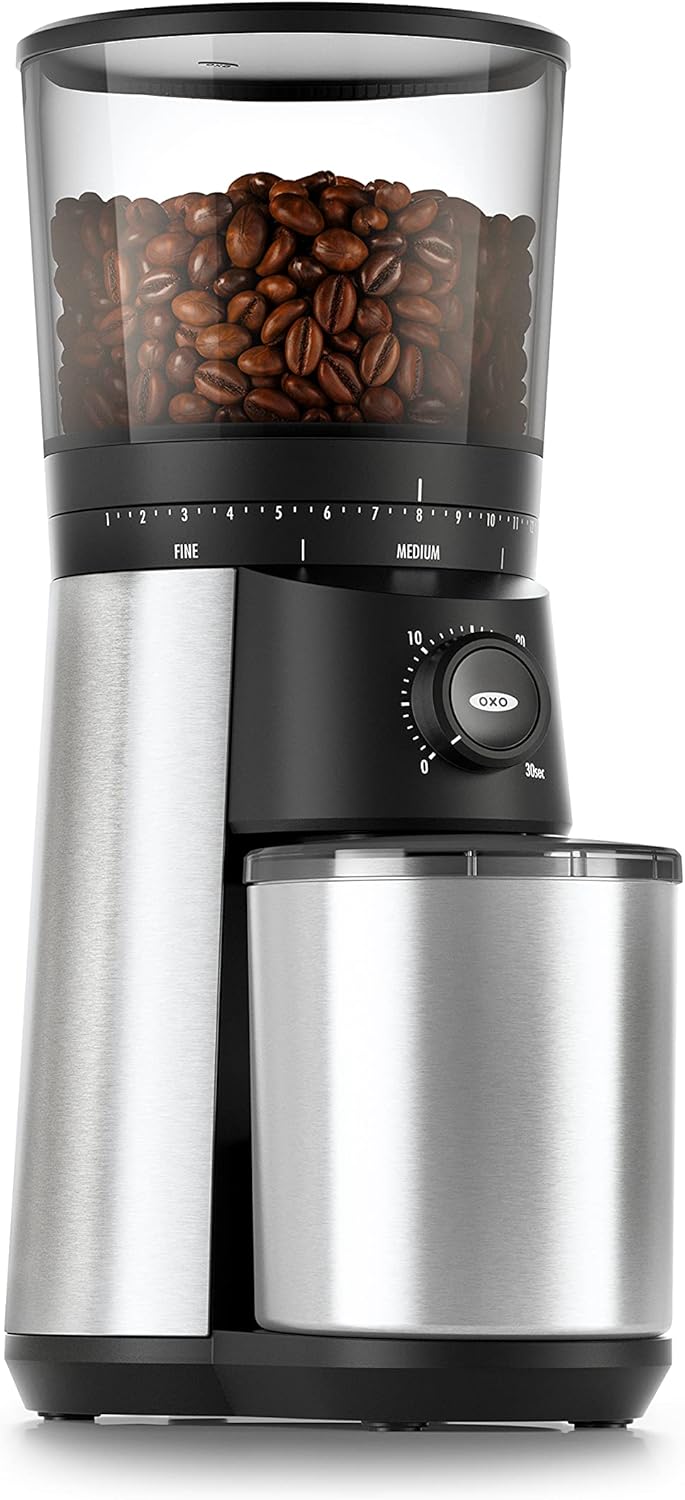
OXO Brew Conical Burr Coffee Grinder
- 15 main grind settings
- Intermediate microsettings
- 0–30-second front dial
- Remembers previous duration
- 12 oz UV-tinted hopper
- Static-fighting metal catcher

KitchenAid KCG8433BM Burr Coffee Grinder
- 70 grind settings
- Automatic Smart Dosing
- Stainless conical burrs
- Removable bean hopper
- Portafilter holder included
- Multi-brewer preparation

Chefman Conical Burr Precision Grinder with Digital Control
- 31 grind settings
- Digital countdown display
- One-touch operation
- 9.7 oz bean hopper
- Removable upper burr
- Grounds receiver and brush
I tend to start with the brewing method rather than the timer specification. A digital countdown is genuinely useful when you want to repeat an interval, but a well-marked analog dial can be quicker to operate. A sophisticated automatic dose feature makes more sense when the household switches between espresso and filter coffee. If the grinder has only a cup selector and stops itself, that is convenient too, although it should not be mistaken for a second-by-second programmable timer.
There is another distinction I always make: grind size determines the extraction behavior, while grind duration mostly determines how much coffee gets delivered. They interact because a finer setting often changes the rate of output. Think of grind-size adjustment and timed dosing as two separate controls that deserve separate attention. You can make excellent coffee without either being electronic, but keeping a steady routine gets easier when both are understandable.
At a Glance: Best Coffee Grinders with Built-In Timers
Five grinders compared by their timing controls and automatic-stop functions.
OXO Brew Conical Burr Coffee Grinder
- 15 numbered grind positions
- Extra intermediate adjustments
- One-touch timer with memory
- 12 oz bean hopper
- Static-fighting metal catcher
- Brew-first, uncluttered controls
Chefman Conical Burr Precision Grinder with Digital Control
- 31 grind positions
- Digital one-touch panel
- Countdown-style timed grinding
- 9.7 oz bean hopper
- Grounds container and brush
- Fine-to-coarse brew range

Smeg CGF01 Retro-Style Coffee Grinder
- 30 grind levels
- Single/double espresso functions
- Filter-coffee portion selections
- Preset duration customization
- Die-cast aluminum body
- Red CGF01 finish
KitchenAid KCG8433BM Burr Coffee Grinder
- 70 grind settings
- Automatic Smart Dosing
- Stainless conical burrs
- Anti-static design
- Removable hopper
- Portafilter-holder accessory

LONKION CBG-8002 Electric Burr Coffee Grinder
- 28 grind settings
- Flat metal burr system
- 2–12-cup selector
- Automatic cycle stop
- Compact base
- Cleaning brush included
Quick Ranking: Timer Function, Grind Range, and Best Fit
| Rank | Grinder | Timing control | Grind settings | Price |
|---|---|---|---|---|
| 1 | OXO Brew | 0–30-second dial; push to start; previous setting retained | 15 main settings + microsettings | Price on Amazon |
| 2 | KitchenAid KCG8433BM | Automatic Smart Dosing adjusts grind duration | 70 adjustment settings | Price on Amazon |
| 3 | Chefman Digital | Digital timed cycle with one-touch controls | 31 grind positions | Price on Amazon |
| 4 | Smeg CGF01 | Preset espresso/filter quantities; some functions customizable | 30 adjustment levels | Price on Amazon |
| 5 | LONKION CBG-8002 | 2–12 cup selector with automatic stop; no digital seconds control | 28 numbered grind settings | Price on Amazon |
1. OXO Brew Conical Burr Coffee Grinder
If my morning cup were the only reason to buy a timed grinder, this OXO would be the first one I consider. The front dial does exactly what a familiar daily routine needs: I can choose how long it runs, press once, and return to brewing. There is no menu to learn, no complicated profile to maintain, and no requirement to pay for a screen simply to make fresh grounds. That restraint is the appeal, especially when most of my coffee is brewed through a paper filter rather than a pressurized espresso basket.
A timer that removes a step—not the need for a scale
OXO’s front dial sets a grinding interval of up to 30 seconds and stays at the previous setting. I think of that as a time saver, not a promise that exactly 18 grams will emerge every morning. Beans change in density and how freely they feed into the burrs; a coarser selection can also change the flow. For the first few mornings, I grind a normal portion into a small container, weigh the output, and adjust the dial until the dose lands close to the amount I want. Once it is close, the timer becomes especially convenient for regular repeat brews. If a precise recipe matters, I still check the grams.
The most useful settings are usually in the middle
Fifteen main grind positions with micro-adjustments cover a meaningful range for most filter-based coffee. The medium region is where I begin for an everyday drip brewer or cone. Going coarse helps immersion brews; moving finer can shorten a pour-over drawdown or increase resistance through an AeroPress filter. The important thing is to preserve your previous setting, change one variable, and taste before moving further. Espresso marketing can be misleading here: a setting marked fine does not make this the first grinder I choose for a demanding, non-pressurized espresso machine.
Maintenance is part of the convenience equation
A large 12-ounce hopper is handy when several people drink the same beans, yet I do not fill it to the brim if I rotate coffees every other day. A smaller portion minimizes the beans left waiting above the burrs. The hopper has a trap-door design for removal and the grounds container uses metal to help combat static, but neither feature removes the need to brush coffee oils and particles from the grinding path. A quick weekly exterior wipe and regular dry brushing do more for a tidy station than any display feature.
How I settle into the first month
During week one, my priority would be the relationship between one grind setting, one bean, and one timed output. In week two, I pay attention to how the grounds pour from the collector and whether the same setting still works after a bean change. By week three, the goal would be to stop fiddling: keep a workable baseline for daily coffee and only change it when the cup asks for a change. At the end of the month, I judge the OXO by whether it reduced small daily decisions, not by whether it could replace a laboratory scale.
Where this grinder makes less sense
For someone chasing espresso extraction in seconds, the OXO’s wide-purpose burr geometry and broad adjustment range may not offer the precision they want. An enthusiast who single-doses every coffee and weighs every gram may also wonder why they paid for a large hopper. In those situations, other grinder designs can be more suitable. For drip, French press, and mixed filter routines, though, a retained timer setting can be genuinely useful rather than ornamental.
The three places I want the OXO to stay predictable
The key question is not whether the dial looks accurate. I concentrate on three separate points in the workflow: the hopper feeds without interruption, the timer completes the chosen interval, and the receiving container gives up the grounds cleanly. A clogged exit can make the timer appear unreliable even when the electronic control is behaving properly. The UV-tinted hopper also helps shield beans from light, but it does not make a warm countertop a good long-term storage location. I keep the main supply sealed and use the hopper for active brewing.
A different roast can require both a grind change and a shorter or longer run. Recording the dial position beside the successful coffee dose is more useful than pretending every bean exits at one universal grams-per-second rate. This is particularly relevant when moving from a medium roast in a drip machine to a dense light roast in an AeroPress. I treat the timer as the last convenience added to a recipe, after the grind and dose have been chosen.
Who gets the most value from a remembered dial
A shared kitchen with one favorite bean can benefit from the OXO immediately. Once the household settles on a useful setting, pressing the control is faster than programming another machine each morning. The strongest match is a filter brewer who prioritizes consistency without wanting a display. A household alternating between several beans still gains something, but it needs a habit of recalibrating time and clearing retained coffee between changes.
The trade-off becomes obvious with espresso. A front timer cannot rescue a shot when adjacent burr positions do not give the pressure and flow the basket needs. The OXO is not a bad grinder for lacking specialist espresso adjustment; it simply has a different brief. Keeping that brief in view makes its relaxed user experience a strength rather than an excuse to overpromise.
What works well
- Timer retains a familiar daily duration
- Simple one-touch operation
- Good adjustment range for filter brews
- 12-ounce hopper fits household use
Trade-offs to expect
- Time is not weight-based dosing
- No digital readout
- Not an espresso specialist
OXO Brew Conical Burr Coffee Grinder
- Grinding system: Stainless steel conical burrs
- Grind range: 15 main settings + microsettings
- Dosing and timer: 0–30-second dial; push to start; previous setting retained
- Bean capacity: 12 oz bean hopper
- Best match: Pour-over, drip, AeroPress, French press
The simplest recurring daily timing routine. Watch for: No integrated weighing; not a dedicated espresso grinder.
Technical Specifications & Daily Features
A 12 oz UV-tinted hopper feeds stainless steel conical burrs. Fifteen numbered settings have additional microsettings; a front timing dial covers up to 30 seconds and remembers the selected interval. The grounds container is metal and intended to reduce static. The grind path, burrs, and catcher need regular dry cleaning.
Pros & Cons After 30 Days of Use
The OXO’s core ownership advantage is mechanical simplicity. A dial that stays at its previous duration asks less of a busy kitchen than a sequence of screen presses. Its twelve-ounce, UV-tinted hopper makes sense for a shared bag of coffee, while the removable upper burr and static-fighting metal catcher make the ordinary maintenance routine accessible. Neither design feature guarantees a spotless chute: fine particles still need brushing, and the collector must be emptied rather than used for storage.
During the first month, the meaningful checks are output weight at one grind setting, the effect of changing beans, and whether coffee remains around the grounds outlet. The timer saves work after the owner calibrates it; the scale reveals whether that calibration still holds. The ownership trade-off is easier to understand through accessible cleaning and steady dose checks than through an unexplained retention number. The OXO is the simplest repeatable timing workflow in this group, though a dedicated espresso station benefits from smaller fine-end adjustments.
My Final Verdict
OXO is my first recommendation for everyday drip, AeroPress, pour-over, and French press brewing when the buyer specifically wants a straightforward built-in timer. Its 15 main settings plus microsteps are easy to understand, and the remembered dial position reduces repeated setup. The metal catcher and lift-out upper burr are meaningful conveniences, not claims of zero static or maintenance-free grinding.
Choose a dedicated espresso grinder instead when fine shot control is the main goal. For home filter coffee, this is the model whose timer is most likely to disappear into a comfortable routine—and that is a genuine advantage.
2. Chefman Conical Burr Precision Grinder with Digital Control
There is a particular kind of coffee drinker who does not want another expensive gadget but does want to stop holding down a grinder switch and counting in their head. The Chefman fits that space. Its digital control is more explicit than OXO’s dial, and the 31-position adjustment invites experimentation with more than one brewing method. I see it as a useful choice for a buyer who is learning what grind size and timed dosing really mean before committing to a high-priced espresso grinder.
A digital display is helpful only when the coffee improves
The advantage here is the ability to see and repeat a chosen grind duration rather than reconstruct it each day by feel. That becomes particularly handy when you prepare a weekday drip pot with one coffee and a weekend French press with another. I record the two successful combinations—grind size and cycle time—rather than assuming one saved number works equally well for every roast. Coffee density, bean size, burr seasoning, and the amount left in the hopper all have more influence on the weight than the screen suggests.
Thirty-one settings: flexibility with a practical ceiling
The numbered range gives this model more stepping stones than many basic burr grinders. That is pleasant for learning: if a V60 stalls, move a little coarser; if an AeroPress tastes thin after a short steep, move a little finer. Yet 31 positions are not the same as the tiny stepless movements a demanding espresso basket may need. A grind may be fine in appearance and still prove difficult to dial precisely for a particular roast and espresso machine. I view espresso compatibility as something to evaluate with the exact basket, not as a guaranteed result.
A small grounds bin can be an advantage
The hopper holds roughly 9.7 ounces of beans, while the quantity the machine can grind in one session is more limited. That is sensible for daily cups: a relatively small grounds container encourages emptying after each dose. The trade-off emerges when grinding for a party or a large cold brew concentrate. Plan multiple runs, allow the unit to work within its intended cycle limits, and avoid packing the chute with grounds. I also keep the included brush near the coffee station so cleaning is a twenty-second habit instead of a neglected weekend project.
The month-one learning curve
In the first few days I establish a starting grind for my most-used brewer, set a short repeatable timed cycle, then weigh three outputs. Variation is normal; it tells me how closely time approximates my target dose. After a week, I note which adjustment numbers correspond to medium and coarse on the beans I actually drink. After three weeks, the bigger test is whether the display still simplifies the morning or whether I am constantly changing presets. A new bag of beans is the perfect opportunity to revisit the dose rather than blaming the controls when extraction changes.
What would make me choose something else
If I were preparing several consecutive espresso shots, I want to know more about retention, speed, and adjustment granularity than the presence of a countdown display. The Chefman is also less compelling if I mostly buy pre-ground coffee or brew once a month. Its value lies in its accessible pairing of burr grinding and digital stopping, and buyers should not confuse the two with built-in weighing or automatic recipe correction.
The grind-map matters more than the countdown
Chefman gives a useful way to build a short map of successful settings. Its documented ranges separate coarse cold-brew or press preparation from the medium area useful for drip, and finer regions intended for espresso-style work. That organization is only a starting point: the beans, filter, and brewing recipe determine whether the cup needs a change. Instead of exploring all thirty-one numbers at once, I recommend keeping two reference points—one for the usual filter coffee and another for an occasional coarser brew.
A digital countdown can make repeated grinding feel exact, but exact seconds are not exact extraction. If a pour-over begins drawing down too slowly after a fine adjustment, the grind itself needs attention; shortening the timer merely changes the dose. Separating those two controls is the habit that makes a timed grinder genuinely useful instead of confusing.
Where the smaller collector changes the routine
The bean hopper and the grounds receiver serve different purposes. A hopper near 9.7 ounces can hold enough beans for several mornings, but the collector still needs to be emptied before it reaches the rim. Grinding a large cold-brew batch in repeated small cycles may be less convenient than using a bigger machine intended for bulk work. Normal daily portions, however, benefit from the modest collection container because there is little reason to leave ground coffee sitting in it.
Cleanup is part of deciding whether a digital interface is worth having. Fine particles cling around collection edges regardless of whether a display is present. A brush, an unplugged machine, and attention to the accessible upper burr are far more important than the appearance of the front panel. Owners who keep that routine simple are more likely to enjoy the added electronic convenience.
What works well
- 31 adjustment positions
- Visible digital timing
- Conical burr system
- Good everyday workflow for learning
Trade-offs to expect
- No weighing function
- Digital setting is not a guaranteed dose
- Large-batch grinding is less convenient
Chefman Conical Burr Precision Grinder with Digital Control
- Grinding system: Conical burr grinding mechanism
- Grind range: 31 grind positions
- Dosing and timer: Digital timed cycle with one-touch controls
- Bean capacity: 9.7 oz bean hopper
- Best match: Beginner espresso-style experimentation and daily filter coffee
A clear digital step up without a premium interface. Watch for: Timer controls time, not grams; modest grounds-batch capacity.
Technical Specifications & Daily Features
The 31-position digital Chefman is a conical-burr model with a roughly 9.7 oz bean hopper, a grounds bin, and a cleaning brush. Its digital one-touch control governs timed grinding. This model should not be confused with Chefman’s older 17-setting analog burr mill.
Pros & Cons After 30 Days of Use
Chefman’s digital panel gives visible feedback that an analog dial cannot. Thirty-one stepped grind positions offer useful room for experimenting across common brew methods, and the grounds receiver keeps doses separated from the hopper. The upper burr is accessible for care. The digital countdown is still a measure of running time: changing beans, roast level, and grind position affects how much coffee is actually collected.
The first-month ownership questions concern panel readability, the number of settings genuinely used, and the ease of keeping the burr area and collector free of stale fines. A buyer preparing several different filter recipes gains more from the display than someone who brews one identical pot. The machine is an appealing introduction to timed burr grinding, but its thirty-one steps and timer do not establish specialist espresso uniformity or integrated weighing.
My Final Verdict
Chefman earns the value position for a buyer who wants a visible digital countdown, a clear grind dial, and enough range to learn several recipes without paying for premium drink programs. Its 31 settings and 9.7-ounce hopper cover a sensible everyday role. I favor it for a first serious grinder paired with a scale, not for a promise of absolute dose precision.
The right expectation is a capable learning tool with digital stopping and a routine cleaning requirement. For high-volume batches or fine espresso dialing, the limitations matter more than the display.
3. Smeg CGF01 Retro-Style Coffee Grinder
The Smeg is the model I do not hide in a cabinet. A red CGF01 looks at home beside a matching kettle or espresso machine, and that visual confidence is part of the product’s appeal. Still, a handsome case is only useful to me when the grinder feels intuitive at seven in the morning. Here the practical story is not an LCD or a phone app; it is a combination of grind-size adjustment, portion functions, and customizable grinding duration that can take some button presses out of regular brewing.
What the preset system actually does
The CGF01 has single and double espresso functions as well as portion options for filter-style brewing, plus a manual operating mode. A selected dispensing function runs for a preset interval; supported espresso and filter group settings can be customized by holding and releasing the start control. I like that approach for routines built around a familiar vessel. I do not describe the machine as having three freely programmable timer memories for espresso, moka, and pour-over, though. Those independent recipe memories are not what the controls provide. Instead, it offers grouped preset quantities with adjustment options.
Thirty levels are useful, but the method determines the sweet spot
Conical stainless steel burrs with 30 grind levels make it easier to switch among drip, moka pot, and general espresso-style grinding than a grinder with only a coarse/fine switch. The separate dosing function means I can choose how much to grind without physically counting turns. Yet when changing from a fine espresso-oriented setting to a coarse filter setting, I recheck the output weight. A program saved with a different coffee or grind texture cannot know that the beans now move through the burrs at another rate.
The material choices and the everyday mess
A die-cast aluminum housing gives the CGF01 a reassuring presence, but the portions of the workflow that matter after the honeymoon are the catcher, support, removable upper grinding components, and surfaces where fine particles can collect. Smeg supplies a grounds container for filter brewing and hardware for dispensing into an espresso filter holder. The coffee station should be arranged so that the container or holder fits without awkward handling. Keeping the exit chute and surrounding area clean matters more than whether the grinder photographs beautifully.
Thirty days of living with a preset grinder
The first week would be about separating grind selection from dose programming: I refine the grind for one preparation, then tune the corresponding portion. In the second week, I check how consistently the grounds flow into my container and whether any static makes transfer untidy. A month later, I care most about whether my saved portions remain convenient after changing coffee. If a new bag consistently produces a different mass in the same interval, it is reasonable to make a small correction rather than treating the machine as inaccurate.
The enthusiast compromise
I appreciate the polished metal body and the versatility of the controls. I am less persuaded that anyone who cares only about the best grind per dollar should pay extra for the sculpted aesthetic. The grinder is also less approachable than OXO’s single timer dial for someone who wants one cup of filter coffee and nothing more. Its value is unusually dependent on how much the owner enjoys the physical object, not just the grounds it produces.
Preset portions need their own recipe notes
The CGF01 organizes dispensing around the selected coffee style. That can feel natural when one user doses into a filter holder and another uses the supplied grounds container. It is still important to write down the grind lever position that works for each preparation. The coffee amount is influenced by how long the mechanism runs and how the beans feed; a saved portion does not recognize automatically that the hopper now contains a different roast.
For espresso, a single and double function can speed up familiar preparation after calibration. For filter coffee, the portion selector gives a related convenience. Those are genuinely different from a device where the user assigns any duration to any named recipe. I rank the CGF01 for what its controls actually support, and I treat weighing a dose as a normal part of dialing in a new bean.
Cleaning a statement grinder still counts
The red case looks great beside a matching kettle, but stray coffee dust is just as visible on an expensive grinder as on a budget machine. The hopper, catch cup, support pieces, and dispensing area should all be easy to reach in the space available. I recommend leaving clearance around the machine instead of packing it tightly between appliances just because the photographs look tidy.
Its conical burr system and removable grinding components call for the same basic respect as other burr machines. Use the care instructions for the exact model; keep powered internals dry and reassemble components correctly. The long-term advantage of premium styling is enjoying the object every day, not exemption from the ordinary upkeep coffee requires.
What works well
- Thoughtful preset modes
- 30 grind-size adjustments
- Stainless conical burrs
- Durable-feeling die-cast housing
Trade-offs to expect
- Premium price includes styling
- Functions are not independent recipe banks
- Calibration needed across bean changes
Smeg CGF01 Retro-Style Coffee Grinder
- Grinding system: Stainless steel conical burrs
- Grind range: 30 adjustment levels
- Dosing and timer: Preset espresso/filter quantities; some functions customizable
- Bean capacity: 350 g bean hopper
- Best match: Espresso-style brewing, moka pot, filter coffee, design-conscious kitchens
Preset convenience with a distinctive, premium countertop presence. Watch for: No independent three-recipe digital timer bank.
Technical Specifications & Daily Features
The red U.S. CGF01RDUS variant uses stainless conical burrs, 30 settings, a die-cast aluminum housing, a hopper of around 350 g, and automatic preset quantity functions for espresso and filter-style brewing, plus manual mode. The machine does not have a touchscreen or a gram-reading scale.
Pros & Cons After 30 Days of Use
Smeg CGF01 combines a 30-position stainless conical burr system with portion functions for espresso and filter-style coffee. The die-cast housing is substantial and the red finish is part of the reason to buy it. The ownership distinction is programming: supported dispensing quantities can be customized, but this is not a machine with three freely assignable, independent digital timer profiles for arbitrary brewers.
Long-term satisfaction depends on how often the owner moves among the supported modes, whether the receiving cup or portafilter fits the usual routine, and whether customization remains manageable when a new bag of coffee arrives. Careful cleaning around the dispensing path remains essential. The Smeg brings an attractive and coherent countertop workflow; it is not the cheapest route to a repeated interval or an integrated gram scale.
My Final Verdict
Smeg CGF01 is the design-led pick, with real grinding controls behind its retro appearance. Its thirty settings, conical burrs, and espresso/filter portion functions make sense beside a coordinated coffee station. The premium makes more sense when the owner values the machine as a visible kitchen appliance and uses the presets regularly.
For a one-cup filter routine where a simple timer does the job, OXO is easier to justify. Smeg wins on its combination of appearance and modes, not on an unsupported claim of more accurate grounds weight.
4. KitchenAid KCG8433BM Burr Coffee Grinder
KitchenAid takes a different route from a simple timer dial. Instead of asking you to select only the number of seconds, its Smart Dosing system adjusts grinding duration around the chosen brewing selection. For the right person, that approach feels more like a coffee-machine workflow and less like a separate accessory. I find it most interesting for households where a drip brewer and an espresso machine share the counter, because grind size and serving quantity often change together.
Smart Dosing is a useful shortcut, not a coffee scale
The machine’s automatic system is intended to produce an appropriate amount of grounds for a selected drink. It does that by adjusting grind time; it does not weigh beans leaving the grinding chamber. That difference is not academic. Dose requirements change with the size of a basket, the coffee used, and the brewer’s recipe. I start with KitchenAid’s selected program, weigh what arrives, and move to a manual adjustment if the recipe needs it. It is a convenient foundation for daily brewing rather than a guarantee that every dose is exactly the same number of grams.
Seventy grind positions invite a more systematic routine
A wide adjustment range gives more choice between coarse cold brew and finer espresso preparation than the basic 15-position machines in this group. It is particularly appealing when one person in the household prepares immersion coffee and another experiments with finer settings. I keep a small note of each successful setting. The grinder itself cannot know which bean roast I am using or whether a lighter roast needs a different extraction approach. Having 70 choices is valuable only when I am disciplined about remembering which ones work.
The removable hopper earns its place
One of my least favorite grinder jobs is emptying beans to switch coffees. KitchenAid’s removable hopper makes that transition less awkward than trying to pour beans around an installed hopper or tipping a powered base. It still pays to keep the unit stable and follow the removal procedure. A detachable hopper should make bean changes and cleaning more pleasant, not encourage careless handling around the burrs.
How the first month would reveal its fit
I give this grinder two regular routines: perhaps a morning pour-over and a weekend espresso. In the first few days, I establish the relevant grind ranges and compare the Smart Dosing output with my usual scale. By the second week, I test whether switching the selected brew style leads to a less fussy setup. Over the third week, I assess whether the anti-static design reduces the annoyance of transferring coffee. By week four, I am looking for saved effort—fewer repetitive adjustments, not a promise of scientifically exact dosing.
Why I do not rank it on precision alone
The machine has features I like: steel conical burrs, 70 settings, auto-adjusted grinding time, and accessories intended to bridge filter and espresso use. But the presence of more settings does not automatically mean a better cup than a simpler grinder tuned carefully. It also costs more in space and user attention than a minimal one-button model. The best buyer will be someone who will actually use several brewing modes and take the time to learn the system.
Smart Dosing works best when the brew method is chosen first
KitchenAid’s automatic approach begins with the intended drink rather than an arbitrary timer number. That is attractive for a household that already thinks in terms of espresso, drip, and press preparation. The machine can choose a duration based on the selected settings, reducing a small calculation before every brew. The useful qualification is that its dose is still an estimate. I set the brewing recipe in grams, use the automated choice as a starting point, and make a manual correction when the grounds do not meet the target.
This is where the extra complexity can earn its place. On a morning when one person makes a large filter coffee and another makes a smaller, finer preparation, the grinder offers a more guided route between tasks than a simple dial. That advantage fades if the household never changes methods, so I reserve this recommendation for buyers who will actually use the different brewing selections.
Seventy settings offer freedom with a learning cost
A wide burr adjustment range helps a grinder cover dramatically different textures, but the relationship between steps and extraction still needs to be learned. Moving from a coarse immersion setting to a finer espresso region requires more than pressing a dose icon; the grind adjustment and recipe need separate attention. I recommend recording a useful starting point for each method. That takes a few lines in a notebook and avoids hunting for yesterday’s number when the kitchen is busy.
The removable hopper is useful for switching beans without tipping the entire powered appliance. It also makes routine dry-brush maintenance more approachable. Owners should follow the machine’s removal and cleaning instructions carefully, particularly when the adjustment is near its fine end. Smart automation is most satisfying when the manual parts of the routine remain understandable.
What works well
- 70-position adjustment range
- Automatic dose-time assistance
- Removable bean hopper
- Multi-method versatility
Trade-offs to expect
- No integrated weighing scale
- More settings mean more decisions
- Dose time is not measured ground-coffee weight
KitchenAid KCG8433BM Burr Coffee Grinder
- Grinding system: Commercial-grade stainless conical burrs
- Grind range: 70 adjustment settings
- Dosing and timer: Automatic Smart Dosing adjusts grind duration
- Bean capacity: Removable bean hopper (capacity varies by configuration)
- Best match: Multi-brewer households; espresso and filter flexibility
A broader grind range with more automated dose selection. Watch for: Automatic Smart Dosing is not a built-in gram scale.
Technical Specifications & Daily Features
KitchenAid KCG8433BM has 70 grind settings, stainless-steel conical burrs, anti-static technology, a removable hopper, and Automatic Smart Dosing. Its system varies grinding time with the selected preparation. It is not an Acaia-style weight-sensing grinder, and the original claim of a 0.1-second user adjustment resolution was not established for this exact variant.
Pros & Cons After 30 Days of Use
KitchenAid’s KCG8433BM offers the greatest stated adjustment count here at seventy, together with Automatic Smart Dosing that selects grinding duration around the brew program. Stainless conical burrs, an anti-static system, and a removable hopper support a genuinely multi-method home station. The system estimates dose by controlling time, not by weighing ground coffee in real time.
Over an ordinary month, the decisive ownership questions are how easily two brewers can share the grinder, whether manual correction is straightforward when the beans change, and whether the chute and hopper remain simple to clean. The broad adjustment range is useful only when the owner takes advantage of it. It is the most capable automatic-dose workflow in the selection, but the owner still needs a scale for precise recipes and patience when learning where each brew falls in the seventy-step range.
My Final Verdict
KitchenAid is my strongest recommendation for a household that regularly changes among espresso-oriented, filter, and coarse immersion preparation and wants assisted dose-time selection. The seventy settings and Smart Dosing support a broader routine than the bare analog timer models. Its removable hopper also helps when several coffees share the counter.
I do not recommend it as a substitute for a grind-by-weight grinder. The Smart Dosing label refers to automatic grinding-time adjustments. Buyers who understand that difference can make excellent use of the convenience instead of expecting grams accurate to a fraction.
5. LONKION CBG-8002 Electric Burr Coffee Grinder
The LONKION is the outlier in this roundup, and I prefer to explain that plainly than pretend it has a hidden digital feature. Instead of programming an exact number of seconds, you use a 2–12-cup selection and the grinder stops its cycle automatically. That is a form of hands-free portion control, but it is not the same experience as the OXO, Chefman, or more elaborate dose-control models. For some beginners, the simpler arrangement may be all they need.
A cup selector suits a different coffee personality
If you make the same pot of drip coffee most mornings and think in cups rather than grams, the LONKION’s volume-style selector can remove a little guesswork. The dial sets the intended serving quantity, and the grinder stops when the programmed cycle finishes. What it does not let you do is precisely choose a twelve-second grind, save multiple timer profiles, or weigh the resulting coffee. I adjust a familiar setting to taste and use a kitchen scale occasionally to see whether the cup selections align with my recipe.
The correct burr description matters
This model has 28 grind settings and a flat metal burr head. It is a flat-burr grinder, not a 30-setting conical-burr machine. A flat burr is not automatically superior in this budget context; alignment, construction, and adjustment quality matter far more. I concentrate on how well it grinds at medium and medium-coarse settings rather than on an impressive-sounding part name.
A small hopper changes the batch strategy
The documentation for this configuration places the bean capacity around three ounces. That is quite different from a grinder with a huge stored supply of beans. For everyday cups, it can actually encourage a fresher habit: load what you need and empty the grounds bin promptly. For large gatherings or cold brew concentrate, however, several runs may be needed. I allow the motor to rest as required by the instructions and avoid running continuous batches in a hurry.
What I monitor in its first month
Early on, I start with a typical drip grind and compare the output from the two-cup and four-cup selections to my normal dose. The next week I check whether switching from filter coffee to French press gives a grind coarse enough to brew cleanly without excessive sediment. After several weeks, I inspect the collection area and remove stray coffee dust. By the end of the month, this grinder either has a comfortable role as a simple daily appliance, or its limited control is the reason to move up to a true timer model.
Why the fifth spot is still useful
I do not present this machine as a direct competitor to premium timed-dosing grinders. Its merit is economic and practical: a small budget appliance with burr grinding, marked settings, and automatic stop. If your recipe depends on precise grams and seconds, it is the wrong tool for that expectation. If your goal is simply to stop a motor at roughly the amount needed for morning coffee, it may be entirely adequate.
A cup dial is a shortcut, not a dosing standard
The LONKION’s two-to-twelve-cup dial can help a household that repeatedly makes roughly the same size pot. Cup-count labels, however, are based on the appliance’s own assumptions about serving quantity. A large mug, a 150-milliliter coffee-maker cup, and a concentrate for cold brew all have different dose needs. I recommend weighing the output from two frequently used dial positions once, then treating those as practical approximations rather than universal measurements.
The distinction becomes more important when moving coarser for French press. Bean throughput can change with the burr setting, so the same cup selection can produce a different mass. A timer with adjustable seconds offers finer direct control; this model automates stopping with fewer decisions. It is a different product proposition, and for some beginners the simpler proposition is the right one.
Budget burr grinding has a natural batch limit
The compact hopper encourages loading only the quantity needed for the next brew, which can help with freshness. It also means grinding for several people or making a concentrated cold-brew batch takes more planning. A small home motor should be operated within the instructions for continuous grinding and cooling; repeated back-to-back cycles are not automatically appropriate. That matters more to real ownership than a broad promise of commercial power.
For a drip brewer, I start with a middle grind and adjust against the cup. For a press, I use a coarser region and pay attention to sediment. The flat-burr design provides an adjustable grinding mechanism, but the actual flavor still depends on beans, water ratio, and brewing technique. The best reason to select this grinder is basic burr control plus automatic stopping, not timer precision it does not have.
What works well
- Accessible cup selector
- 28 grind positions
- Automatic shutoff after selected cycle
- Small countertop footprint
Trade-offs to expect
- No adjustable seconds timer
- Cup amounts are approximate, not weighed
- Limited batch capacity
LONKION CBG-8002 Electric Burr Coffee Grinder
- Grinding system: Flat metal burr grinding head
- Grind range: 28 numbered grind settings
- Dosing and timer: 2–12 cup selector with automatic stop; no digital seconds control
- Bean capacity: Approx. 3 oz bean capacity in product documentation
- Best match: Budget households using drip and press brewing
Simple cup-based stopping without a digital interface. Watch for: Not a true second-by-second timer; fewer small-batch options.
Technical Specifications & Daily Features
The LONKION CBG-8002 configuration has 28 grind positions, a flat metal burr system, a 2–12-cup selector with automatic stopping, approximately 3 oz bean capacity, and an included brush. The cup selector estimates a portion and should not be described as a digital grind timer.
Pros & Cons After 30 Days of Use
LONKION’s CBG-8002 is the functional outlier: the 2–12-cup dial determines an automatic stopping cycle, while the user selects among 28 grind settings. That removes the need to stand beside the switch, but it does not offer the directly adjustable seconds control of OXO or the digital countdown of Chefman. Its small bean capacity suits modest doses and becomes an inconvenience for a large cold-brew batch.
The practical ownership issues are straightforward: the cup selector is an estimate rather than grams, the grind setting still determines extraction, and the grounds bin and grinding path still require regular care. Automatic stopping is a useful budget convenience, but anyone buying specifically for programmable timing will miss the control. Its role is simple daily drip or press brewing, not precise timed dosing for an espresso recipe.
My Final Verdict
LONKION is the budget auto-stop option, not a full-featured built-in timer recommendation. The 28 settings and 2–12-cup selector can make ordinary household coffee less fussy for someone who thinks in servings. I like the practical simplicity of that arrangement within its limits.
Buy OXO or Chefman instead when setting and repeating a defined number of seconds is the reason for shopping. A cup selector that stops the motor is useful, but labeling it as a programmable timer misrepresents what the owner can control.
Buying Guide: How to Choose a Timed Coffee Grinder
The timer can be consistent while the coffee is not
Mechanical repetition is not the same as cup quality. A grinder can stop at exactly the intended moment and still produce an uneven dose if the hopper feeds irregularly or old coffee blocks the exit. The timer is therefore one of three things I monitor: the burr position sets the grind, the motor duration determines the intended running interval, and the final coffee mass tells me how much reached the brewer. Treating all three as separate controls makes troubleshooting considerably easier.
Consider a pour-over that starts out tasting balanced but becomes noticeably stronger after a hopper refill. Before changing grind size, I compare the new dose against the original recipe. A difference of several grams may be enough to explain the change; turning the grind dial first could make extraction harder to understand. A scale turns that apparent mystery into a manageable correction.
Three daily situations that call for a different timer strategy
One brewer, one bag: A remembered analog dial often makes the most sense. Calibrate it, keep the hopper clean, and use the same recipe until the beans change. Two people, two brew styles: A machine with clear digital or drink-oriented controls becomes more useful because switching between doses is part of daily life. Occasional drip brewing on a tight budget: A cup-selector auto-stop can be entirely adequate, although it provides less direct control over seconds.
These routines explain why a seemingly simpler appliance can outrank a feature-rich grinder for one buyer while losing for another. The extra interface matters only when it removes a repeated task. I do not pay for program complexity as a substitute for an appropriate burr range, clean dose transfer, or an understandable maintenance procedure.
Where a scale should sit in a timer-based workflow
I keep the scale beside the brewer rather than treating it as a separate laboratory step. For a measured single dose, beans can be weighed before grinding; for a hopper-fed grinder, the collection cup can be weighed afterward. If the collected mass is outside the desired range, I change the running interval without necessarily moving the burr adjustment. Once the ground coffee dose is right, I return to taste and brew time to decide whether the grind itself needs a correction.
That sequence prevents a common mistake: using grinding duration to repair an extraction problem when it only changes dose. Good timed grinding is a repeatable part of the recipe, not the entire recipe. That remains true for an analog dial, a digital countdown, a drink preset, and an automated Smart Dosing system.
Start with what the timer can actually control
A timer measures running time. A cup selector estimates a portion. A grind-by-weight grinder monitors the mass of coffee being delivered. Those are three different jobs, and the labels sometimes blur them. If I want to prepare a 300 ml pour-over with roughly 18 g of grounds, a seconds dial can be convenient after I work out a normal output rate. For an espresso basket where a gram or two can change the recipe noticeably, I prefer to weigh the actual grounds before deciding the dose is right. The best timer is the one that matches how closely you need to control coffee mass, not necessarily the one that has the brightest display.
Consider the household, too. A grinder shared by people who all drink the same drip blend can make excellent use of one fixed timer. If one person prepares espresso and another makes French press, a recipe-oriented program or easily adjusted front dial becomes much more helpful. When I change from medium to coarse, I do not expect a previously calibrated number of seconds to maintain identical mass; I revisit that number.
Analog, digital, and automatic-dose interfaces
An analog dial is fast to understand. The OXO is a clear example: turn the front control, push to start, and let the motor stop. That can be a better everyday experience than hunting through a menu. A digital panel, like the Chefman’s, gives more explicit feedback and suits a reader who prefers visible selections. The Smeg works differently again: its preset portions are geared toward common espresso and filter workflows, with supported programs customizable. KitchenAid’s Smart Dosing system decides a suitable duration around the selected preparation, bringing automation one level higher. None of these descriptions makes one interface inherently more precise in grams.
A cup-count dial such as LONKION’s is the simplest form of automatic stopping in this group. It is useful if you think in household servings rather than weight, but it lacks the adjustable seconds that a timer-focused buyer may want. I do not pay extra for a feature I am unlikely to use. Conversely, if the morning routine demands several portion sizes, a cheap selector that offers limited choices may become inconvenient surprisingly quickly.
Why burr type and grind adjustment matter more than a stopwatch
Time is only half the grinder story. Uneven particle size creates different extraction rates in the same brew. If a grind has large fragments and considerable fine dust, it is more difficult to get a balanced cup even when exactly the right quantity enters the brewer. This is why I favor good burr adjustment before counting digital features. Conical and flat burrs can both make excellent coffee; the specific geometry, alignment, and grinder construction matter more than either label alone.
For espresso, tiny changes can have large effects on shot time. For French press, coarse adjustment and resistance to excess fines often matter more. A good all-round grinder should let me move back to a familiar filter setting without guesswork. If my main brewer is a simple drip machine, I do not need dozens of exotic microsteps to enjoy fresh grinding. I do need a consistent middle range and a clear way to adjust it when a different roast arrives.
Calibrate a timer in five minutes
I begin with a dose target and a normal grind size, not a random number on the clock. Suppose the recipe uses 20 g for a pour-over. I choose a medium grind, start with a conservative interval, then weigh the coffee that emerged. If it produced 16 g, I add time in small steps. If it produced 23 g, I shorten the interval. I repeat once to learn how stable the output is with those beans. The goal is to reach a useful repeatable approximation, not to prove that the grinder is a weighing instrument.
The same process works when switching from a bright light roast to a darker blend. I write down the successful settings in my phone or a notebook if the grinder has no recipe memory. This saves more morning time than constantly improvising. For espresso, I still prefer weighing the ground coffee, because accurate dose weight and grind setting work together. A timer gets the workflow moving; the scale confirms where I landed.
Know what happens when you change beans
A bag of coffee is not interchangeable with every other bag. Bean density, roast level, and surface oils influence how the beans feed and how the ground coffee collects. A dark roast may move through the burrs at a different rate from a dense light roast. That can make yesterday’s ten-second dose heavier or lighter today.
I like to empty the hopper before making a substantial bean change, especially if the new coffee calls for a very different grind. Running a little coffee at the new setting helps clear the transition material and gives the grinder a chance to settle at its new rate. I then weigh one fresh dose. This simple habit makes the supposed mystery of changing timer output much less frustrating.
Hopper size and real household use
A 12-ounce hopper sounds attractive until I realize I usually grind just 18 grams at a time. A large hopper is not a requirement for quality; it is a storage convenience for someone who brews several servings using the same beans. If I switch coffees frequently, smaller batches can be more manageable and may keep more beans in a closed bag. A smaller grinder such as the LONKION also becomes less practical if the goal is to grind a large quantity of cold brew at once.
Look closely at how the grounds catcher fits, whether beans can be removed without spilling, and whether the machine leaves grounds around the chute. A plastic container may attract static in dry weather, while a metal catcher or anti-static design may reduce the problem without eliminating it. Ease of transfer has a real impact on whether a precise coffee routine remains enjoyable.
Maintenance changes repeatability
Burr grinders work with oily organic material every day. Fine powder and coffee oils gradually collect on accessible surfaces, sometimes affecting flow or allowing stale grounds to enter the next dose. The sensible routine is straightforward: unplug the grinder, remove only parts the instructions identify as removable, brush the burr entrance and collection path with an appropriate dry brush, and wipe the grounds container as the grinder’s care instructions permit. I avoid rinsing the motor body or applying water directly to burr assemblies not designed for it.
If I notice a familiar timer producing unusually little coffee, I check for old grounds, a nearly empty hopper, a changed adjustment, or an incorrectly seated component before assuming the electronics failed. Regular cleaning makes timing more useful because the flow of coffee is less likely to be obstructed by buildup.
What to expect from an espresso-capable timed grinder
A grinder can carry an espresso icon, a fine setting, and a timer without meeting every espresso machine’s needs. Non-pressurized espresso baskets can demand very small adjustment changes, stable dose delivery, and low enough retention to keep each shot similar. An all-purpose grinder with broad steps can make that work harder. My buying advice is to consider the exact brewer. Someone using a pressurized basket or occasionally making moka pot coffee may be happy with a wide-purpose model. Someone preparing multiple precise shots every day may benefit from a specialized espresso grinder even if it has fewer headline features.
Timed dosing has another limitation here: when grind size changes, the flow rate through the burrs can change, too. The timer should be rechecked during espresso dialing-in rather than treated as the constant part of a changing recipe.
Counter space, styling, and the forgotten details
Measure the height below the kitchen cabinets and the reach of the lid before buying. A grinder can look compact on a screen yet become annoying if you must pull it forward every time you refill the hopper. I also check where the power switch sits and whether the display is easy to see from a normal standing position. The Smeg is designed to be noticed; the OXO is easier to forget until it is needed. Neither design philosophy is inherently better.
I also consider whether the burrs can be accessed for cleaning, whether the collection cup has a secure fit, whether a portafilter adapter is included when required, and how loud the grinding cycle feels in a quiet household. Price should follow those daily-use choices, not lead them. A grinder that makes coffee less troublesome is a better investment than a sophisticated feature you stop using after the first week.
A Practical 30-Day Routine for Getting Consistent Coffee
Days 1–3: Build one repeatable recipe. Choose one bag of beans and the brewer you use most often. Select the grind setting based on the brewing method, choose an initial timed interval, then weigh the grounds that come out. Write down the grind setting, timer setting, coffee mass, and brew outcome. Resist the urge to change several variables at once; otherwise it becomes difficult to tell which adjustment helped.
Days 4–10: Refine the timer against the cup. A grinder that delivers a similar quantity of coffee at the same setting is useful, but the real goal is a cup that tastes balanced. If the brew is harsh or slow, adjust the grind and then recalibrate the timer if the output changes. If the brew is watery, revisit the dose and extraction rather than automatically increasing the grinding time.
Days 11–20: Check ordinary maintenance. Brush the burr entry, keep the exit chute clear, empty the collector, and follow the grinder’s recommended cleaning intervals. If the machine has presets, try another preparation and record a separate starting point. This is a good time to see whether the grinder’s convenience survives two weeks of real kitchen routines.
Days 21–30: Change one coffee, then decide. Introduce a new roast and observe how the original timed interval performs. Recalibrate briefly, settle into the new recipe, and ask whether the machine has actually reduced friction. A reliable grinder does not need to take the measurement out of coffee entirely; it simply needs to make the normal steps easier and more repeatable.
Troubleshooting: When the Timer Is Repeatable but the Dose Is Not
The same time produces different weights
First look for a change in beans, grind size, bean level, or coffee buildup. A running-time control does not measure mass. Weigh several outputs at the current setting and use an average as a practical baseline. If output varies dramatically, clean the accessible grinding path and confirm everything is correctly installed.
Grounds spray out or cling to the container
Static is common in dry rooms and varies with roast, humidity, and grinder design. Let the grounds settle briefly before removing the collector, then keep the chute and container clean. Follow the specific manufacturer’s cleaning instructions, particularly around electrical components. Anti-static features can reduce annoyance but rarely abolish it entirely.
A timer program feels too short after changing grind size
A finer or coarser setting can change the amount of coffee dispensed during a fixed interval. Keep the successful grind size for the brew, then recalibrate the duration. Trying to compensate for too little output by changing the grind size alone risks moving the extraction away from where it tasted best.
The grinder stops unexpectedly
Check the hopper seating, grounds-container position, selected cycle length, bean supply, and whether a safety or thermal-protection feature activated. Unplug the machine before examining removable components. If it keeps stopping under normal loads after cooling and cleaning, follow the manufacturer troubleshooting procedure rather than repeatedly forcing operation.
Espresso tastes different even when the timer number is unchanged
Dose mass is only one variable. The roast, freshness, grinder retention, puck preparation, tamping, temperature, and shot yield all affect extraction. I weigh the grounds and beverage output, note the extraction time, and then move one variable at a time. A digital timer is a convenience feature, not an espresso quality sensor.
A cup-selector grinder dispenses less than expected
Cup labels are estimates based on assumed serving sizes and coffee quantities. They are not universal gram measurements. Weigh the output from each practical cup selection and decide which one best matches your recipe. For finer control than the dial can provide, a true adjustable-timer grinder may be the more appropriate purchase.
Final Comparison: Five Different Ways to Stop Grinding
| Grinder | Adjustment | Stop/control style | Best use | Trade-off | Product |
|---|---|---|---|---|---|
| OXO Brew | 15 main settings + microsettings | 0–30-second dial; push to start; previous setting retained | Pour-over, drip, AeroPress, French press | No integrated weighing; not a dedicated espresso grinder | Price on Amazon |
| Chefman Digital | 31 grind positions | Digital timed cycle with one-touch controls | Beginner espresso-style experimentation and daily filter coffee | Timer controls time, not grams; modest grounds-batch capacity | Price on Amazon |
| Smeg CGF01 | 30 adjustment levels | Preset espresso/filter quantities; some functions customizable | Espresso-style brewing, moka pot, filter coffee, design-conscious kitchens | No independent three-recipe digital timer bank | Price on Amazon |
| KitchenAid KCG8433BM | 70 adjustment settings | Automatic Smart Dosing adjusts grind duration | Multi-brewer households; espresso and filter flexibility | Automatic Smart Dosing is not a built-in gram scale | Price on Amazon |
| LONKION CBG-8002 | 28 numbered grind settings | 2–12 cup selector with automatic stop; no digital seconds control | Budget households using drip and press brewing | Not a true second-by-second timer; fewer small-batch options | Price on Amazon |
My Final Recommendation: Buy for Your Morning, Not the Display
I choose the OXO Brew Conical Burr Grinder for a typical household focused on drip, pour-over, AeroPress, and French press. Its timer is uncomplicated, its 15 settings and intermediate steps are approachable, and the controls encourage repeating a good recipe rather than endlessly navigating features. That is the sort of everyday convenience I find easiest to recommend.
The KitchenAid KCG8433BM has a stronger argument for a household regularly moving between finer and coarser methods, because its 70-setting range and Smart Dosing system support a broader workflow. For a lower-cost digital interface, Chefman remains an appealing option as long as expectations for grind-by-time are realistic. The Smeg CGF01 stands apart for its distinctive build and preset portion controls; its premium aesthetic is a legitimate reason to consider it, but not a reason to expect better gram precision.
Finally, the LONKION belongs here as a budget auto-stop alternative rather than a fully programmable timer grinder. It will suit someone who wants a straightforward portion selector, not someone who needs to set exact seconds. None of these choices eliminates the value of a small coffee scale. The winning combination, in my view, is a grinder that makes the workflow comfortable and enough measurement to keep the cup tasting the way you like it.
Frequently Asked Questions
Does a built-in timer guarantee exactly the same amount of coffee?
No. It repeats grinding time, not the mass delivered. Bean density, roast level, feed rate, grind adjustment, and retained grounds can all change how many grams emerge. Calibrate your usual timer interval with a scale and recheck it when beans change.
Which grinder in this roundup has the simplest timer?
The OXO Brew uses a front timing dial and a push-to-start control that holds the previous selected interval. It is straightforward for a household that repeats one filter-coffee preparation most days.
Is the KitchenAid KCG8433BM a grind-by-weight grinder?
No. Its Automatic Smart Dosing system varies grind time in response to the drink selection. It is useful automation, but it does not read the actual gram weight of the grounds coming out.
Can Chefman grind beans for both pour-over and espresso?
The 31-position adjustment spans fine and coarse uses. It is a flexible starter grinder, although the exact fineness and adjustment resolution required by a non-pressurized espresso basket may call for a specialist machine.
Does the Smeg CGF01 have three independent programmable timers?
No. It provides preset dispensing modes for espresso and filter-style portions, supported customization of some settings, and manual grinding. It is not a three-slot universal seconds-based recipe memory.
Is the LONKION grinder a digital timer model?
No. The CBG-8002 configuration uses a 2–12-cup selector and automatic stopping. That reduces manual monitoring but is not the same as setting an exact grinding duration in seconds.
What is the difference between a cup selector and a timer?
A timer sets duration. A cup selector asks you to choose an approximate serving count and stops according to the machine’s portion program. Neither measures output grams unless the grinder also contains an actual weighing system.
Do I still need a coffee scale with a timed grinder?
A scale is worthwhile when you want a reproducible brewing recipe. You may not need to weigh every routine cup once a setting is calibrated, but it helps when a new bag of beans behaves differently.
Should I change grind setting or timer time when coffee tastes bitter?
Taste points first to extraction: grind size, water temperature, brew time, ratio, and agitation can all matter. Adjust the grind to improve extraction, then check the new timer output so the dose remains close to your intended amount.
Can a 15-setting grinder make great pour-over?
Yes. Fifteen useful positions plus micro-adjustments can cover many filter brewing styles. Clean burrs, a sensible dose, and appropriate brewing technique matter more than a dramatic adjustment count.
Why do timed doses differ after switching to dark-roast beans?
Dark roasts often have different density and surface characteristics from lighter coffees. They can feed and grind differently, changing the mass delivered during the same interval.
Can I use these grinders for Turkish coffee?
Do not assume so. Very fine, powder-like Turkish grinding calls for a particular burr design and reliable fine-end performance. A grinder being labeled suitable for espresso does not automatically establish its suitability for cezve preparation.
Which is easiest to clean?
The easiest grinder for you is the one whose hopper, accessible burr components, chute, and collector you can maintain without a complicated routine. OXO and KitchenAid have approachable removable-hopper designs; always follow each model’s instructions.
Is a digital touchscreen necessary for accurate dosing?
No. Accuracy depends on how the grinder dispenses coffee and whether mass is measured. A simple analog timer can be very useful, and a digital display can still produce weight variation from one dose to the next.
Will the timer remember a setting after power is disconnected?
Behavior varies by model and control system. An analog dial physically stays where you left it, whereas electronic programs depend on the machine’s design. Do not assume saved settings survive a power interruption without consulting the manual.
Which model is best for an espresso-focused household?
KitchenAid’s broader 70-setting adjustment range may be appealing in a mixed-brewing household. Dedicated espresso enthusiasts should also consider grind-resolution needs, retention, basket type, and shot workflow rather than buying on timer functionality alone.
Can I grind a large batch for cold brew with a timer?
Often, yes, but check the hopper, container, and motor duty-cycle limits. Large cold brew batches may require several runs, particularly with a smaller model. Let the machine cool as directed rather than extending a cycle beyond its intended limit.
Should the hopper stay full all week?
It is more convenient for households using one bean, but beans generally keep better when stored appropriately in a sealed, cool, dry container. If you switch coffees often, load smaller amounts and replenish as needed.
What should I do when a timer stops but no grounds come out?
Unplug the grinder, then check that beans are present, parts are seated, and the accessible chute is not obstructed. Follow the instructions for clearing jams; do not probe a powered grinder.
Is the Smeg grinder worth the additional price?
It can be for someone who values its metal-bodied construction, distinctive design, and preset operating routine. If your sole priority is the most grind control per dollar, a plainer grinder may make more financial sense.
What grind size works for AeroPress with a timed grinder?
A medium-fine range is a common starting point for many AeroPress recipes, but steep length, agitation, paper versus metal filter, and coffee roast change what works. Use the recipe first, taste, then refine the grind.
How often should I recalibrate my timer?
After a change of beans, roast level, or grind size, and whenever the machine seems to dispense an unusually different amount. Regular cleaning also helps keep the grinding path clear.
Are 70 settings always better than 15?
No. The wider range provides flexibility, but build quality, burr performance, adjustment spacing, and your brewing method decide usefulness. Someone making only drip coffee may be perfectly happy with fewer settings.
What is the best first purchase to pair with a timed grinder?
A compact digital scale is the most useful companion. It lets you calibrate the timer and keep the recipe consistent even when bean characteristics vary.


