
Best Coffee Grinders with Built-In Scale: Precise Daily Picks


OneHundredCoffee is reader-supported, and some products displayed may earn us an affiliate commission. Details
A coffee grinder with a built-in scale should do more than display a number. It should help a real person repeat a favorite coffee recipe without first hunting for a scoop, second-guessing a timer or wasting beans. The improvement is especially noticeable when several people share a kitchen: a 20 g dose is a useful instruction, while “two generous spoonfuls” is not.
Yet the phrase “grinder with a scale” now describes several different products. Some machines genuinely weigh ground coffee as they operate. Others connect to a removable scale. A premium coffee system may weigh beans and brewed coffee while handling the entire pour-over. A bundled grinder and independent digital scale is useful, but it is not built-in weighing. And a regular timer-based burr grinder can support measured coffee without containing a scale at all.
That difference determines how much work the machine takes off your hands. With a grind-by-weight grinder, you normally specify a gram target and let it stop at the selected output. With a separate scale, you can weigh beans and use the same instrument for water or espresso yield, but you must control the grinder yourself. Neither method automatically fixes poor grind adjustment or neglected cleaning.
I have kept the five original selections in this article, including the two clearly labeled alternatives that do not contain a scale. Greater Goods is the simplest true integrated weighing option, MOKKOM has a removable Bluetooth-connected scale, xBloom Studio integrates grinding, weighing and brewing, Gemilai pairs a grinder with a separate scale, and OXO is a no-scale burr grinder that works well in a weighed workflow. The distinctions are as important as the rankings.
My comparisons focus on useful controls, the physical arrangement of the scale, capacity, cleaning, brewer compatibility and real-world limitations. Product specifications are checked against manufacturer information and available product documentation; I do not substitute imagined personal test results for evidence. If your main priority is non-pressurized espresso, grind resolution deserves as much attention as dosing accuracy.
My Three Picks for Coffee Grinding by Weight
I would start with these three because each addresses the weighing question directly, but in a different way. The first is a conventional grinder with a dosing scale, the second has a detachable paired scale, and the third is a complete brewing appliance. Their prices and use cases are not interchangeable.
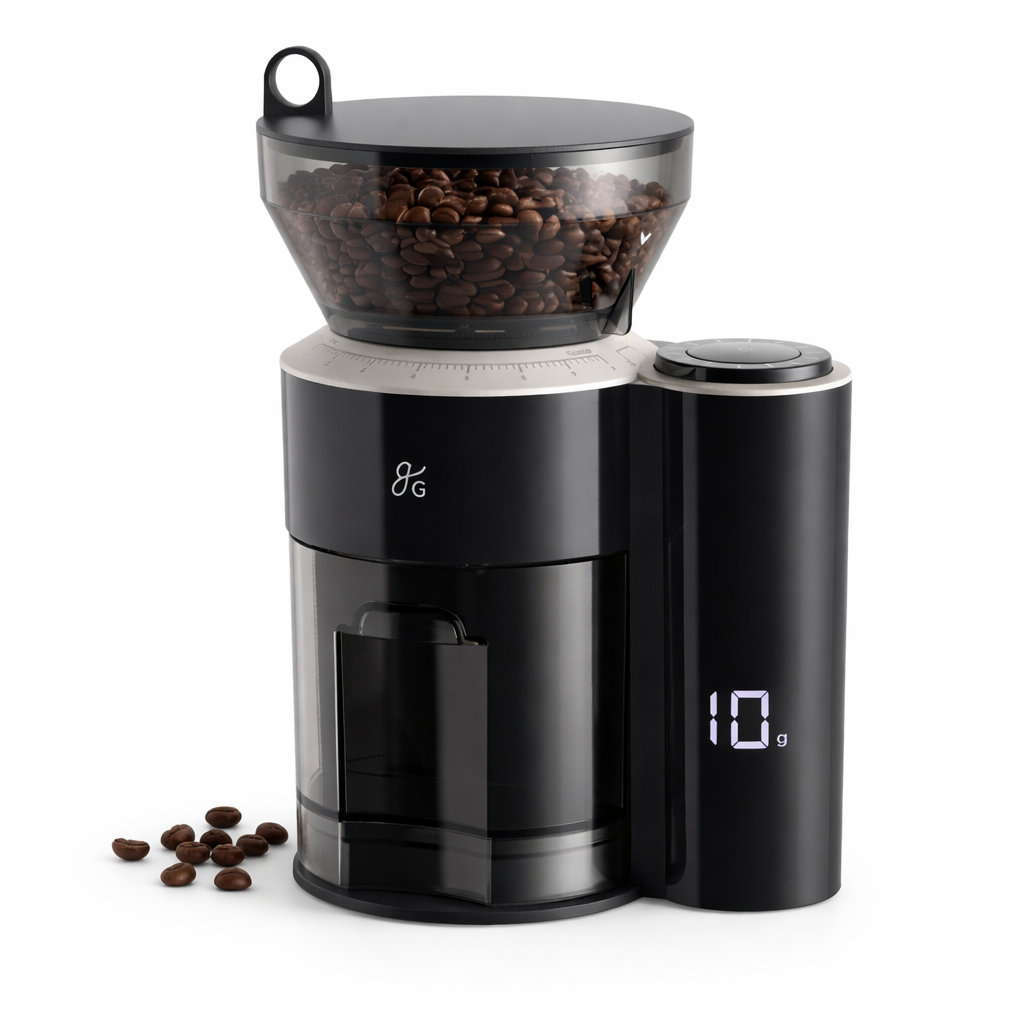
Greater Goods Morning Groove Burr Coffee Grinder with Built-In Scale
Integrated scale
- Built-in gram-based dosing scale
- Eight indexed grind positions
- Approximately 200 g hopper
- Up to 60 g in grounds cup
- Stainless-steel burr mechanism
- 120 V US configuration
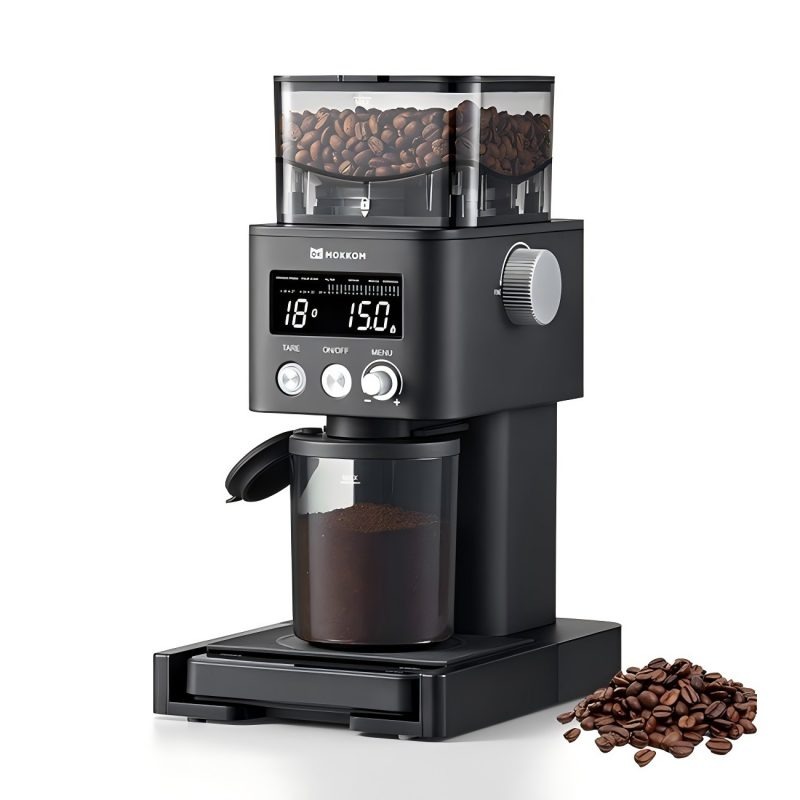
MOKKOM CG020 Coffee Grinder with Removable Bluetooth Coffee Scale
Removable connected scale
- Removable Bluetooth-paired scale
- 31 stepped grind positions
- Cup, time, ounce and gram modes
- 150 g bean hopper (reported)
- Portafilter cradles included
- Anti-static design and tare timer
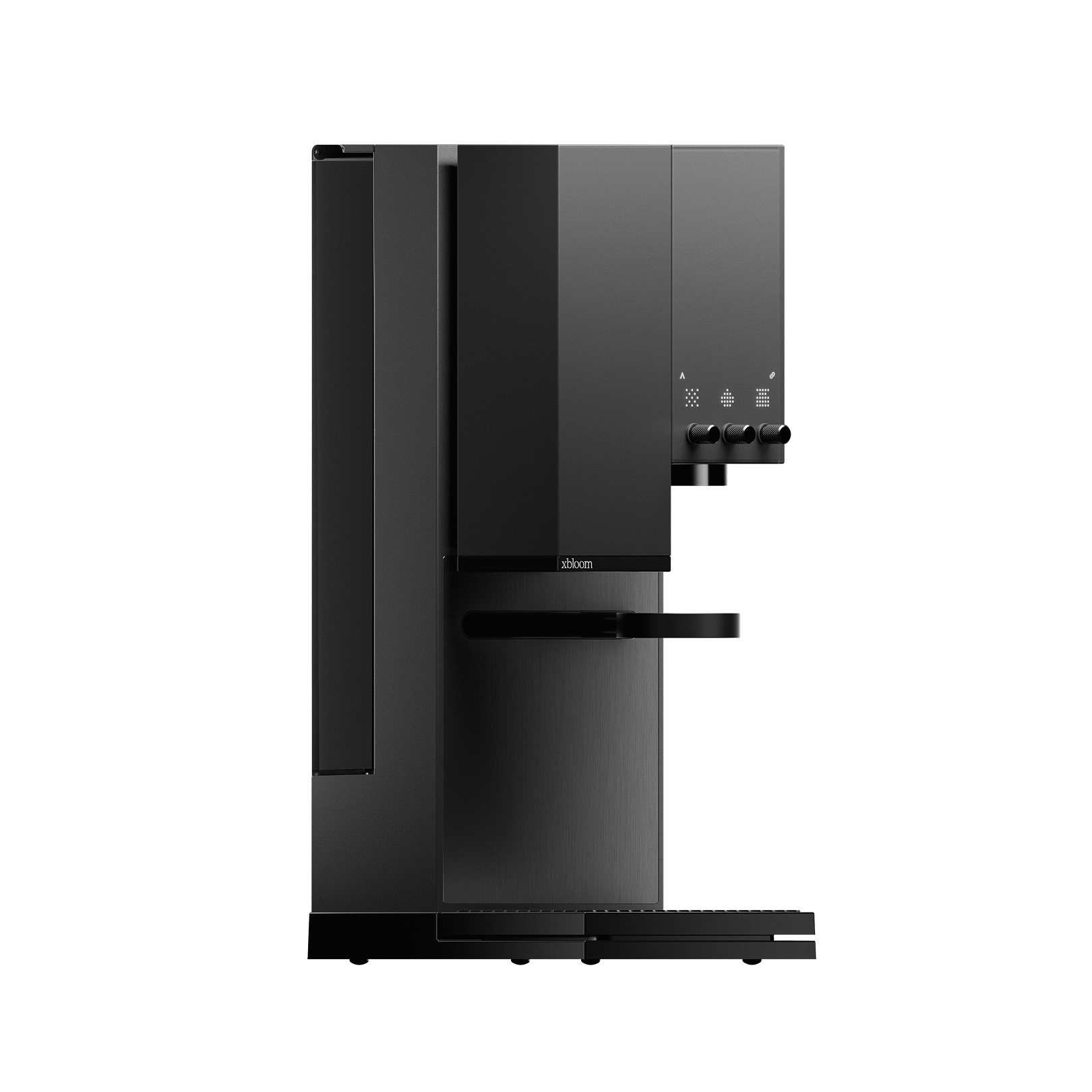
xBloom Studio Coffee Machine with Integrated Grinder and Scale
Full coffee system
- Integrated grinder, brewer and scale
- 80 grinder adjustment positions
- Autopilot, Copilot, Free Solo
- App-connected brewing recipes
- 48 mm conical burrs (US listing)
- USA model requires 110–130 V
For most drip and French press households, Greater Goods provides the simplest answer. MOKKOM suits people who want the scale to travel from grinder to brewer. xBloom is the premium all-in-one alternative. The Gemilai and OXO appear further down because they use separate weighing rather than weighing inside the grinder.
Best Coffee Grinders with Built-In Scales — At a Glance
Read the scale type before the grind-setting count. A machine with 60 adjustments but no integrated weighing is not the same proposition as an 8-setting grinder that actually stops at a gram target.
Greater Goods Morning Groove Burr Coffee Grinder with Built-In Scale
- Built-in gram-based dosing scale
- Eight indexed grind positions
- Approximately 200 g hopper
- Up to 60 g in grounds cup
- Stainless-steel burr mechanism
- 120 V US configuration
MOKKOM CG020 Coffee Grinder with Removable Bluetooth Coffee Scale
- Removable Bluetooth-paired scale
- 31 stepped grind positions
- Cup, time, ounce and gram modes
- 150 g bean hopper (reported)
- Portafilter cradles included
- Anti-static design and tare timer
xBloom Studio Coffee Machine with Integrated Grinder and Scale
- Integrated grinder, brewer and scale
- 80 grinder adjustment positions
- Autopilot, Copilot, Free Solo
- App-connected brewing recipes
- 48 mm conical burrs (US listing)
- USA model requires 110–130 V

Gemilai G9010B Electric Conical Burr Grinder and Digital Coffee Scale Bundle
- Separate included digital scale
- 38 mm stainless-steel conical burr
- 60-position grind adjustment
- Smart timer and manual modes
- Single-dose-oriented workflow
- Scale supports 0.1 g resolution

OXO Brew Conical Burr Coffee Grinder
- No weighing scale in grinder
- 15 main grind settings
- Additional in-between positions
- 12 oz UV-tinted bean hopper
- One-touch remembered timer
- Stainless-steel conical burrs
Quick Ranking: What the Scale Actually Does
| Original selection | Weighing arrangement | Grind by weight? | Best use | Main compromise |
|---|---|---|---|---|
| Greater Goods | Integrated dosing scale | Yes: grinder weighs dose | Drip, French press, everyday filter | Only eight grind adjustments |
| MOKKOM CG020 | Removable Bluetooth scale | Yes: paired gram dosing | Multi-brew and flexible scale use | Scale charging and connectivity |
| xBloom Studio | Grinder + scale + brewer | Yes: integrated system | Automated pour-over | Premium complete appliance |
| Gemilai G9010B Bundle | Separate digital scale | No automatic weight stop | Manual ratios and single dosing | Scale is a different device |
| OXO Brew | Separate scale required | No: timed grinder only | Budget-friendly measured brewing | Does not include a scale |
Five Detailed Grinder-and-Scale Reviews
1. Greater Goods Morning Groove Burr Coffee Grinder with Built-In Scale
Everyday weighing without a separate coffee gadget. The clearest true grind-by-weight option for a home filter-coffee routine. It prioritizes simple measured doses over highly granular espresso adjustment.
Why the weighing function is the reason to buy it
Greater Goods is the most direct answer to the question in this guide: can a regular home coffee grinder measure the amount it produces, rather than merely running for a fixed time? The Morning Groove is built around a gram-based dosing mode. For a weekday coffee drinker, the advantage is not more buttons. It is the ability to begin with the same mass of freshly ground coffee instead of an inconsistent number of scoops.
The design favors normal counter use. Beans sit in a UV-tinted hopper, ground coffee drops into the container, and the weight display provides a clear target. I would choose it for a kitchen where people make a pot in the morning or a French press after dinner, especially if different household members share the same grinder. Everyone can return to a written dose instead of asking how full the scoop ought to be.
Eight adjustment steps: easy to understand, not espresso-micro
The eight-position selector spans several brewing categories, which makes it easy for a beginner to find a first setting for drip, AeroPress, French press, and cold brew. That simplicity comes with a limit. A conventional non-pressurized espresso basket can react dramatically to a small change in grind, and eight broad steps may leave a frustrating gap between two settings. I would not present this as a precision espresso substitute merely because the scale can measure an 18 g dose.
Filter coffee is more forgiving. When a pour-over drains too slowly, moving one position coarser is a reasonable starting experiment. When French press tastes thin despite a consistent steep time, a measured increase in coffee weight can be tested without simultaneously changing three other variables. The scale and simple dial work best when they help a user think methodically.
Capacity and the reality of larger brews
A 200 g hopper provides enough beans for several ordinary brews, but the ground container is a different measurement: its rated maximum is around 60 g. That distinction matters for cold brew. A large concentrate recipe might require several grinding rounds, and a built-in scale cannot remove that physical capacity limit. For a typical drip pot or two-person French press, the basket has a more convenient capacity.
A sensible routine is to brush out accumulated coffee, keep the collection area clean and avoid leaving the machine on a rocking counter while it weighs. The grounds container is the part the manufacturer identifies as dishwasher-safe; that does not give permission to rinse the motor base or steel burr assembly. The weighing area is a tool, and it needs to remain dry and free from debris.
Where it belongs in a measured coffee routine
I would pair this grinder with a simple 1:16 filter-coffee baseline: 20 g of coffee for 320 g of water, adjusted for taste. The grinder handles the coffee dose, while a separate brewing scale or measured kettle handles the water. Its value is clear when those measurements become part of an easy household ritual rather than an exercise in collecting accessories.
If you are moving toward espresso-first equipment, choose your basket before choosing your grinder. A pressurized basket can be relatively tolerant; a traditional single-wall basket usually is not. The right purchase is the grinder that can produce the necessary particle size as well as measure the mass, and the Morning Groove is more convincing as a filter-and-immersion specialist.
Greater Goods Morning Groove Burr Coffee Grinder with Built-In Scale
The clearest true grind-by-weight option for a home filter-coffee routine. It prioritizes simple measured doses over highly granular espresso adjustment.
- Weighed dosing helps remove scoop-to-scoop guesswork
- Simple controls suit routine drip and immersion brewing
- Compact hopper-fed layout for shared kitchens
- Integrated scale avoids an additional dosing platform
- Eight steps may be too widely spaced for non-pressurized espresso
- Grounds cup capacity limits very large cold-brew batches
- Weighing mechanism needs a stable, level counter
- US voltage version is not automatically travel-compatible
Technical Specifications & Daily Features
- Model 0459, Morning Groove burr coffee grinder
- Built-in weighing function for gram-based dosing
- Eight grind settings, illustrated by brew-method guide
- Approximately 200 g (7 oz) bean hopper
- Grounds basket holds up to approximately 60 g
- Manufacturer describes minimum dose around 5 g
- Stainless-steel burrs; removable hopper and grounds basket
- 120 V configuration: verify voltage before use internationally
Use the settings as a starting point, not a guarantee that an unrelated brewer or coffee will perform identically.
Pros & Cons After 30 Days of Use
These are practical first-month ownership checkpoints, not a claim that I personally operated this particular machine for 30 days. A useful ownership review records consistency of the measured dose, cleaning effort, stability of adjustment, and whether the workflow still feels manageable after the novelty wears off.
For this model, pay particular attention to: eight steps may be too widely spaced for non-pressurized espresso, grounds cup capacity limits very large cold-brew batches, weighing mechanism needs a stable, level counter. Keep the grinder clean and use the same coffee, dose and recipe when comparing changes.
My Final Verdict
The clearest true grind-by-weight option for a home filter-coffee routine. It prioritizes simple measured doses over highly granular espresso adjustment.
Best for: integrated scale workflows that match the stated brewing use case.
The right decision is not simply the grinder with the longest feature list. For this selection, decide whether you need weighing inside the machine, a detachable scale, or an all-in-one brewing system. Verify the exact model and included accessories before ordering.
2. MOKKOM CG020 Coffee Grinder with Removable Bluetooth Coffee Scale
A grinder whose scale can leave the machine. The most flexible dosing arrangement here: the scale works with the grinder for weighed output and can also serve separate brewing tasks.
The removable-scale concept changes the purchase equation
MOKKOM takes a different route from a permanently installed dosing scale. The CG020 uses a scale that is part of the grinder workflow while seated and connected, then can be detached for ordinary weighing tasks. This is the feature that can make it genuinely useful to a pour-over brewer: the same tool that helps measure ground coffee can also weigh a brewer or track a pouring sequence.
I would recommend this format to someone who dislikes unnecessary objects but appreciates more than one brewing method. You still need a separate kettle and brewer, of course. Yet you may not need to buy and store a second coffee scale immediately. The trade-off is that removable electronics need a charged battery, a clean sensor surface and a small amount of attention to pairing.
Thirty-one steps and four ways to dose
The grinder provides 31 numbered steps and dosing choices by grams, ounces, time or nominal cups. Gram mode is the one I would emphasize in this article. A cup count is a convenience estimate, not a universal coffee mass. A timer is repeatable only so long as the rate at which beans grind stays similar. Weighing the actual output is the more direct choice when reproducibility matters.
Thirty-one settings make changing between drip, pour-over and coarser brewing fairly manageable. That is not the same as promising that every espresso machine will dial in perfectly. If a 58 mm non-pressurized basket needs a change smaller than one step, the user may still have to adjust coffee dose, yield or roast. The included portafilter support is a workflow feature, not proof of unlimited espresso range.
Static control and real-world cleanup
Anti-static design helps keep grounds from clinging to the chute and container, which is especially welcome when using weighed dosing. If grounds remain stuck upstream, a scale can measure what enters the cup but cannot tell you how much coffee is still retained in the machine. A quick brush and sensible cleaning schedule remain important, even with clever electronics.
The manufacturer provides removable upper-burr access for maintenance, and the scale should be treated like a piece of electronic measuring equipment. Keep its charging contacts clean and dry; do not immerse it. Before assuming the scale is broken, check that it has power, that the grinder is seated on a stable surface and that the paired mode is operating as intended.
How I would use it for a flexible coffee corner
For a morning V60, I would weigh 18–20 g of grounds in gram mode, remove the scale if desired, and use it beneath the brewer while pouring water. For French press, I would select a coarser setting, record the dose and water, and compare the result without making random changes. For espresso, I would weigh the grind but still weigh the beverage leaving the basket, because a 18 g input does not itself define a good shot.
The MOKKOM makes sense for a user who wants measurement to follow the whole process rather than sit permanently under the grinder. If you only make one batch of automatic drip coffee each day, a simpler fixed-scale model may be a better match. If you enjoy changing brewing styles, the flexibility becomes the reason to consider its extra complexity.
MOKKOM CG020 Coffee Grinder with Removable Bluetooth Coffee Scale
The most flexible dosing arrangement here: the scale works with the grinder for weighed output and can also serve separate brewing tasks.
- Removable scale works beyond grinding alone
- Real-time paired weight tracking supports dosing
- Wider adjustment range than very basic burr models
- Portafilter cradles make the espresso workflow more practical
- Scale pairing and charging add setup steps
- 31 steps do not guarantee espresso microprecision
- Bluetooth components deserve careful dry cleaning
- Multiple modes create a small learning curve
Technical Specifications & Daily Features
- CG020 electric conical-burr grinder with removable coffee scale
- Scale Bluetooth-pairs when placed on the grinder base
- 31 indexed grind settings
- Four dosing approaches: cups, time, ounces, and grams
- Reported hopper capacity approximately 150 g
- Reported ground cup capacity approximately 120 g
- Includes scale with tare/timer and USB charging
- Includes 50–53 mm and 58 mm portafilter cradles
Use the settings as a starting point, not a guarantee that an unrelated brewer or coffee will perform identically.
Pros & Cons After 30 Days of Use
These are practical first-month ownership checkpoints, not a claim that I personally operated this particular machine for 30 days. A useful ownership review records consistency of the measured dose, cleaning effort, stability of adjustment, and whether the workflow still feels manageable after the novelty wears off.
For this model, pay particular attention to: scale pairing and charging add setup steps, 31 steps do not guarantee espresso microprecision, bluetooth components deserve careful dry cleaning. Keep the grinder clean and use the same coffee, dose and recipe when comparing changes.
My Final Verdict
The most flexible dosing arrangement here: the scale works with the grinder for weighed output and can also serve separate brewing tasks.
Best for: removable connected scale workflows that match the stated brewing use case.
The right decision is not simply the grinder with the longest feature list. For this selection, decide whether you need weighing inside the machine, a detachable scale, or an all-in-one brewing system. Verify the exact model and included accessories before ordering.
3. xBloom Studio Coffee Machine with Integrated Grinder and Scale
One integrated process instead of three separate tools. A different class of purchase: guided grinding, weighing and automated pour-over-style brewing in one countertop system.
Why the xBloom is not simply another grinder
The xBloom Studio belongs in the comparison because it includes weighing and grinding, but it is not a conventional countertop burr grinder. It is a complete pour-over-style coffee system that adds automated water delivery and recipe control. That makes the decision more like choosing a coffee machine than choosing a small accessory for an existing dripper.
This difference matters because the scale is only one part of its appeal. In a manual setup, the user must decide how to add hot water, how quickly to pour, how much to bloom and when to stop. The Studio aims to make those variables reproducible along with the dose. For someone who loves experimenting with recipes but needs a dependable weekday cup, that can be a compelling combination.
Three operating styles for different levels of attention
Autopilot is the convenience-oriented route: let the machine follow a recipe. Copilot is for a brewer who wants more guided involvement and app-supported adjustments. Free Solo is intended for people who want a greater degree of control over separate parts of the process. These names describe user workflows; they should not be confused with three kinds of grinder burr or three independent brewing machines.
The 80 settings offer a broad grinding adjustment range, but the system is not an espresso machine. I would not buy it to pull a traditional pressurized shot or to replace a portafilter grinder. It excels when someone wants clean, repeatable filter-style coffee and values a thoughtful, linked grinding-and-brewing sequence.
Who gains from the integrated scale
In a manually built coffee station, a scale helps measure coffee, water and final brew weight. In an automated machine, these measurements can also help guide the process. It is easier to recreate a favorite result when the grind size, dose, temperature and water pattern are captured within one workflow rather than written on three sticky notes.
A second user in the household can benefit too. Instead of rebuilding an enthusiast’s technique from memory, they can start from a saved recipe and then tweak it. The downside is that an integrated system creates more dependence on one machine. If you enjoy replacing components gradually, a separate burr grinder plus a standalone scale offers greater modularity.
Cost, power and counter space before purchase
The xBloom Studio is a substantial appliance with a premium purchase price. It requires a stable surface, room for its working height and an appropriate mains connection. The cited US product variant uses American mains voltage; a plug-shape adapter is not a voltage transformer. People buying from abroad must confirm the voltage of the exact machine, rather than rely on international photographs or the brand name alone.
For a new kitchen where someone wants an elegant, unified coffee experience, the expense may be easier to justify. For a person already satisfied with a separate hand grinder, dripper, kettle and scale, the appeal is mostly automation and convenience. Neither approach is inherently more authentic; the best equipment is the setup that actually helps you prepare better coffee on busy mornings.
xBloom Studio Coffee Machine with Integrated Grinder and Scale
A different class of purchase: guided grinding, weighing and automated pour-over-style brewing in one countertop system.
- Integrates three coffee steps in one machine
- Useful automation for repeatable specialty-style brewing
- Recipe controls extend beyond coffee dose alone
- Strong fit for a new modern coffee station
- Premium appliance rather than a simple grinder
- Takes greater counter space and requires power
- Its US model is not compatible with 230 V by plug adapter alone
- Owners of a full manual brewing kit may not need it
Technical Specifications & Daily Features
- Integrated grinder, high-precision scale and automated brewer
- 48 mm stainless-steel conical burr system (manufacturer-derived product specification)
- 80 grind adjustment positions on Studio family
- Three user workflows: Autopilot, Copilot and Free Solo
- App-supported recipe management and pour guidance
- US configuration lists 110–130 V supply: inspect exact variant
- Designed primarily around pour-over / filter-style brewing
- Not a standalone espresso shot-pulling machine
Use the settings as a starting point, not a guarantee that an unrelated brewer or coffee will perform identically.
Pros & Cons After 30 Days of Use
These are practical first-month ownership checkpoints, not a claim that I personally operated this particular machine for 30 days. A useful ownership review records consistency of the measured dose, cleaning effort, stability of adjustment, and whether the workflow still feels manageable after the novelty wears off.
For this model, pay particular attention to: premium appliance rather than a simple grinder, takes greater counter space and requires power, its us model is not compatible with 230 v by plug adapter alone. Keep the grinder clean and use the same coffee, dose and recipe when comparing changes.
My Final Verdict
A different class of purchase: guided grinding, weighing and automated pour-over-style brewing in one countertop system.
Best for: full coffee system workflows that match the stated brewing use case.
The right decision is not simply the grinder with the longest feature list. For this selection, decide whether you need weighing inside the machine, a detachable scale, or an all-in-one brewing system. Verify the exact model and included accessories before ordering.
4. Gemilai G9010B Electric Conical Burr Grinder and Digital Coffee Scale Bundle
Two flexible tools instead of weighing inside one machine. A grinder-plus-scale bundle for people who want measurement flexibility, not a grinder with weighing built into its chassis.
Why a bundle belongs as a clearly labeled alternative
A Gemilai grinder paired with a digital coffee scale helps solve the same basic problem as a built-in-scale grinder: stop guessing how much coffee you use. The mechanism is different, however. The standalone scale does not automatically cause the grinder to stop at a target gram weight. You measure the beans or the grounds yourself, then use the grinder controls to produce the dose.
I think this is a valuable distinction for buyers because it changes the routine. A scale integrated beneath a grinder is quicker for repeated doses. A separate scale is better for weighing a pour-over brewer, checking water additions or monitoring beverage yield during espresso. A bundled pair can be a thoughtful choice for someone who wants to learn coffee ratios instead of relying on a single automated button.
How the G9010B grinder fits a measured workflow
The documented G9010B grinder uses a 38 mm stainless conical burr and 60 adjustment positions. This gives more potential fine-step resolution than the simplest 8-position home machines. Still, a number printed on the adjustment ring is not a guarantee of perfect espresso compatibility; the actual spacing and burr geometry are what matter. I would use the available range thoughtfully, not assume the finest mark always produces the best shot.
The grinder is oriented toward smaller measured doses rather than leaving a huge quantity of beans exposed in an oversized hopper. That is useful for rotating between two coffees or switching brew styles. A measured 18 g dose becomes a simple task: weigh the beans, grind, and use the scale again if necessary to confirm retained grounds have not altered the output.
What the separate scale adds
A 0.1 g-resolution scale is more informative than counting nominal cups. For pour-over, I would use it to weigh 20 g of beans and then track a 320 g water target, with a timer to follow brew progress. For espresso, I would use it to check the dose going into the basket and the beverage coming out. Those measurements do not guarantee extraction quality, but they make troubleshooting possible.
The separate format also means the scale can be moved away from the grinder. That is useful where counter space shifts during brewing. On the other hand, a portable scale must be kept charged and level, and it needs protection from spills. A bundle saves shopping effort only if both items are appropriate for your routine.
The right buyer for this combination
I would consider the Gemilai if I were building a small manual brew setup with a dedicated dosing habit. It is less compelling for someone who expects the grinder to automatically grind to exactly 22 g without any weighing step. That buyer should look first at a genuine scale-integrated or removable-paired product.
Before purchasing, inspect the selected package contents. Some retailers sell related G9010B grinders separately, and a photograph of a scale near a grinder does not always establish that the scale ships in every variant. Keep the verified bundle identity aligned with the purchase choice, especially if color or region options vary.
Gemilai G9010B Electric Conical Burr Grinder and Digital Coffee Scale Bundle
A grinder-plus-scale bundle for people who want measurement flexibility, not a grinder with weighing built into its chassis.
- External scale can follow the whole brew
- Fine-step adjustment suits experimentation
- Single-dose workflow encourages measuring inputs
- Simple way to acquire two complementary tools
- Not a true integrated grind-by-weight machine
- Requires additional counter space and steps
- Timer does not itself measure ground output
- Bundle components and colors should be checked per variant
Technical Specifications & Daily Features
- Gemilai G9010B grinder and separately supplied digital scale bundle
- 38 mm SUS420 stainless-steel conical burrs per listed manual
- 60-step adjustment ring / grind-scale positions
- Nominal 80 g bean hopper on single-dose configuration
- Grinder supports timed and manual operation
- Digital scale supports 0.1 g resolution with 2 kg range
- Scale includes timer, tare and USB-C charging
- Confirm bundle contents and included scale with selected Amazon variant
Use the settings as a starting point, not a guarantee that an unrelated brewer or coffee will perform identically.
Pros & Cons After 30 Days of Use
These are practical first-month ownership checkpoints, not a claim that I personally operated this particular machine for 30 days. A useful ownership review records consistency of the measured dose, cleaning effort, stability of adjustment, and whether the workflow still feels manageable after the novelty wears off.
For this model, pay particular attention to: not a true integrated grind-by-weight machine, requires additional counter space and steps, timer does not itself measure ground output. Keep the grinder clean and use the same coffee, dose and recipe when comparing changes.
My Final Verdict
A grinder-plus-scale bundle for people who want measurement flexibility, not a grinder with weighing built into its chassis.
Best for: external bundled scale workflows that match the stated brewing use case.
The right decision is not simply the grinder with the longest feature list. For this selection, decide whether a separate scale and a familiar burr grinder better fit your daily recipe. Verify the exact model and included accessories before ordering.
5. OXO Brew Conical Burr Coffee Grinder
The important outlier: simple grinding, external weighing. A reliable measured-coffee alternative when you already have a scale or prefer weighing beans independently. It does not itself stop by gram weight.
Why it appears in this comparison at all
The OXO Brew is the only original pick here that neither contains a scale nor includes one as part of its basic grinder. It therefore should never be presented as a built-in-scale grinder. I am keeping it as a clearly labeled alternative because the source article selected it for a measured coffee routine, and many readers may be happier pairing a familiar burr grinder with a scale they already own.
That route is not a compromise in coffee quality by definition. You can weigh a dose on a separate 0.1 g scale, grind it and brew very well. The difference is what the machine automates. The OXO does not watch a built-in load cell and stop at 20 g; its motor runs for a selected interval. Your external scale supplies the weight measurement.
Everyday burr grinding with a remembered timer
The OXO design is appealing because it avoids complex menus. Choose a grind position, set the timer, and press to start. The machine remembers the most recently selected time, so making a consistent weekday filter batch feels manageable. Stainless conical burrs are better suited to adjustable filter coffee than a blade chopper, while the static-fighting grounds container aims to limit mess.
No timer can guarantee the same mass if different beans feed at different rates. A dense roast at a finer setting may produce less coffee in the same number of seconds than a softer bean at a coarse setting. If you care about grams, weigh the output occasionally or weigh the beans first when single dosing. It is a small habit that prevents overconfidence in the timer.
Filter coffee is its natural home
For drip, AeroPress, V60 and French press, the grinder’s adjustment system is broad enough for most ordinary recipes. I would start with a familiar medium setting for paper-filter brewing, then make small corrections based on drawdown and taste. With a French press, going coarser may help reduce sediment, although the quality of the filtering screen and pouring technique also matter.
Traditional espresso is a more exacting request. The OXO may be usable with forgiving pressurized baskets, but I would not choose it ahead of a true espresso grinder for fine adjustments on a non-pressurized basket. The presence or absence of a separate scale cannot overcome inadequate grind resolution.
The practical setup I would recommend
Pair this OXO with one affordable 0.1 g coffee scale. Weigh 20 g of beans for a simple pour-over, grind at a recorded setting, then use the scale under your brewer to pour 320 g of water. If you make a pot of drip instead, measure coffee by grams and use the brewer’s actual water volume, not the arbitrary “cup” labels on a machine.
This is the most straightforward recommendation for a buyer who already owns a scale. Do not buy a supposedly built-in weighing feature twice. But if your main goal is pressing one button and letting the grinder stop at a gram target, Greater Goods and MOKKOM are much closer to what you are asking for.
OXO Brew Conical Burr Coffee Grinder
A reliable measured-coffee alternative when you already have a scale or prefer weighing beans independently. It does not itself stop by gram weight.
- Easy daily grinder with familiar controls
- Burr mechanism for filter and immersion brewing
- Large hopper helps when several people brew
- Can be paired with whichever coffee scale you prefer
- No built-in scale or weight-stop feature
- Timer-based output changes with bean and grind
- Less suitable for precise non-pressurized espresso
- Separate scale increases total setup steps
Technical Specifications & Daily Features
- OXO Brew Conical Burr Coffee Grinder (model 8717000)
- Stainless-steel conical burrs
- 15 main grind settings plus intermediate positions
- Timer-based one-touch grinding; recalls last timing selection
- Approximately 12 oz (340 g) bean hopper
- UV-tinted bean hopper and static-fighting grounds container
- 120 V North American configuration
- Requires a separate scale for gram-based dosing
Use the settings as a starting point, not a guarantee that an unrelated brewer or coffee will perform identically.
Pros & Cons After 30 Days of Use
These are practical first-month ownership checkpoints, not a claim that I personally operated this particular machine for 30 days. A useful ownership review records consistency of the measured dose, cleaning effort, stability of adjustment, and whether the workflow still feels manageable after the novelty wears off.
For this model, pay particular attention to: no built-in scale or weight-stop feature, timer-based output changes with bean and grind, less suitable for precise non-pressurized espresso. Keep the grinder clean and use the same coffee, dose and recipe when comparing changes.
My Final Verdict
A reliable measured-coffee alternative when you already have a scale or prefer weighing beans independently. It does not itself stop by gram weight.
Best for: no integrated scale workflows that match the stated brewing use case.
The right decision is not simply the grinder with the longest feature list. For this selection, decide whether a separate scale and a familiar burr grinder better fit your daily recipe. Verify the exact model and included accessories before ordering.
Buying Guide: What Matters in a Coffee Grinder with a Scale
True grind-by-weight versus time-based dosing
A true grind-by-weight grinder uses a weighing mechanism to decide when the output has reached its target. A timed grinder simply runs the motor for a chosen interval. A time setting can be practical, but the mass produced will change as beans, grind size, hopper level and burr condition change. When an advertised product says “automatic dosing,” find out whether it measures actual grams or merely predicts a dose from time.
For repeatable coffee, the goal is to change as few variables as possible. Write down the dose, grind position, coffee-to-water ratio and brew time. Then make only one adjustment when the taste is not what you want. A scale makes this process easier to interpret; it does not magically produce flavor on its own.
Decide whether you want the scale to detach
A fixed grinder scale saves movement and counter space. A removable model can also sit under a pour-over dripper or mug, which may reduce the number of tools you need. The downside is another battery, charging lead or pairing process. Before buying, check whether the detachable scale controls the grinder while seated, how it tared, and whether it continues to work independently if Bluetooth is unavailable.
An ordinary separate scale is the most flexible and easiest to replace. It can follow you across brewers and often costs less than upgrading to a connected grinder. The cost in convenience is that the grinder does not necessarily stop at the intended mass automatically.
Scale resolution is not the same as dose accuracy
A display that changes in 0.1 g increments is a statement about resolution, not an automatic guarantee of perfect dosing accuracy. Calibration, vibration, static, retention and where the coffee lands can affect readings. Some grinder motors stop with a little coffee already moving through the chute, so a target weight and final cup weight need not always be identical. Check how the device behaves with a clean container and a level surface.
For pour-over, a tenth of a gram is convenient but consistency matters more than obsessively correcting every final decimal. For espresso, small dose differences matter more because the basket and puck depth are sensitive. At the same time, a perfect 18.0 g dose does not solve a burr adjustment range that is too coarse for the desired shot.
Burrs and grind adjustment still determine the use case
Stainless-steel conical burrs can be a sensible everyday choice, and flat burrs can be excellent in other grinders. Burr shape alone does not define grind quality. The important questions are alignment, range, adjustment increment, retention and how stable the settings feel. A machine with eight steps may be quite adequate for drip coffee; a single-wall espresso basket may demand much finer correction between two positions.
The Greater Goods is strongest on straightforward measured filter coffee. MOKKOM provides a wider adjustment system and a removable scale, while the xBloom is optimized for its own pour-over workflow. Gemilai offers a separate grinder and scale to build a manual routine. OXO is practical for filter coffee if you already have a scale, but do not purchase it expecting an internal weighing platform.
Hopper size versus ground-coffee output capacity
The amount of beans held above the burrs and the amount of ground coffee that fits below them are different capacities. A grinder with a 200 g hopper may collect substantially less than 200 g at a time. This is especially important for cold brew, where a single recipe can require many tens of grams of coffee. If a large dose will not fit in the bin, plan to grind in two measured batches rather than overfill the device.
If you switch between different beans regularly, a smaller, single-dose-oriented grinder may be more helpful than a huge hopper. Hoppers reduce daily handling but can keep beans exposed to air and heat. The best choice depends on how often you change coffee and how much you brew per session.
Cleaning a grinder that contains electronics
Grounds around the scale platform, display or charging contacts can interfere with smooth operation. Use the model’s recommended dry brush, wipe the exterior carefully and follow the instructions for removing the upper burr. Do not treat a removable scale like a dishwasher-safe cup. Electronics and unprotected burr parts generally should not be immersed in water.
I would check weekly whether the collection cup seats squarely, the scale taring function works properly and the chute is accumulating old coffee. Those small habits prevent the most common annoyance with measured workflows: the display looks precise, but coffee is clinging everywhere except where it should be weighed.
Electrical compatibility and international purchases
Several US-market grinders and the US xBloom configuration are intended for 110–130 V power. A plug adapter changes pin geometry, not voltage. If you live in a 220–240 V country or are buying a US model for international travel, check the exact model plate and electrical specification before connecting it. The same named product may be sold in different regional configurations.
How much money should you put into the scale feature?
If you already own a capable burr grinder, a good separate scale may be the cheapest and most flexible way to improve consistency. If you are replacing a grinder anyway and predominantly make drip coffee, paying extra for measured stop-by-weight can simplify the morning. If you want automatic specialty pour-over in one appliance, xBloom is a much larger purchase. I would not pay premium-machine money merely to avoid keeping a small scale in a drawer.
Sample Coffee Ratios: A Useful Starting Point
| Brew style | Coffee dose | Water | Starting ratio | Adjustment note |
|---|---|---|---|---|
| V60 or filter pour-over | 20 g coffee | 320 g water | 1:16 | Start medium-fine; adjust by drawdown |
| Drip coffee maker | 30 g coffee | 480 g water | 1:16 | Use a consistent grind setting and reservoir measure |
| French press | 30 g coffee | 450 g water | 1:15 | Coarse grind; judge steep and decanting |
| AeroPress (one example) | 16 g coffee | 240 g water | 1:15 | Medium-fine; follow brewer recipe |
| Cold brew concentrate (example) | 75 g coffee | 375 g water | 1:5 | Coarse; dilute after extraction to taste |
These ratios are starting examples rather than universal prescriptions. Taste your coffee and change either dose, grind or water deliberately. The strength you enjoy can differ substantially from another person’s preferred cup.
Best Choices by Brewing Method
Best for everyday drip coffee: Greater Goods
For a straightforward pot of drip coffee, I favor the simplicity of the Greater Goods. The grinder measures the coffee directly, the adjustment system is approachable, and the dose can be repeated without a separate weighing ritual. It is especially sensible when the household makes similar quantities of coffee on most days.
Best for pour-over and changing brewers: MOKKOM
The MOKKOM earns its place when you want the scale to serve more than one function. Weigh the output while connected, then move the scale to the dripper or serving vessel when a recipe calls for it. The larger adjustment range also gives you more room to refine multiple filter brewing styles.
Best all-in-one automated pour-over: xBloom Studio
The xBloom Studio makes the strongest case for people setting up a new modern coffee bar. It combines coffee grinding, dose measurement and guided water delivery. The trade-off is cost, machine size and reduced modularity compared with separate equipment.
Best for learning manual ratios: Gemilai Bundle
The Gemilai pairing helps teach the relationship between coffee mass, water and brew time. It is not a true integrated-scale grinder; that independence is precisely what some learners will appreciate. You can move the scale to any brewer without asking the grinder to remain part of the brew.
Best if you already own a coffee scale: OXO Brew
The OXO may be the most rational choice for someone who already owns a reliable scale. It provides familiar burr grinding for drip, pour-over and French press, while the existing scale handles dosing. Buying it should be a deliberate no-built-in-scale decision, never a misunderstanding about the product name.
Final Comparison: Which Weighing Arrangement Should You Buy?
| Original selection | Weighing arrangement | Grind by weight? | Best use | Main compromise |
|---|---|---|---|---|
| Greater Goods | Integrated dosing scale | Yes: grinder weighs dose | Drip, French press, everyday filter | Only eight grind adjustments |
| MOKKOM CG020 | Removable Bluetooth scale | Yes: paired gram dosing | Multi-brew and flexible scale use | Scale charging and connectivity |
| xBloom Studio | Grinder + scale + brewer | Yes: integrated system | Automated pour-over | Premium complete appliance |
| Gemilai G9010B Bundle | Separate digital scale | No automatic weight stop | Manual ratios and single dosing | Scale is a different device |
| OXO Brew | Separate scale required | No: timed grinder only | Budget-friendly measured brewing | Does not include a scale |
Frequently Asked Questions: Coffee Grinders with Built-In Scales
What is a coffee grinder with a built-in scale?
A true built-in-scale grinder incorporates weighing into its dosing mechanism. Some versions measure coffee in a receiving cup and stop at the target mass; others use a removable scale that communicates with the grinder. A normal timer-based grinder with a separate scale is different.
Is grind-by-weight more accurate than timed grinding?
It directly measures the amount delivered, so it is generally less sensitive to changing grind speed. Final accuracy still depends on calibration, tare, retained coffee, vibration and whether the cup is correctly positioned.
Does the Greater Goods Morning Groove actually weigh coffee?
Yes. The manufacturer lists gram mode and an integrated weighing arrangement. Its grinder has eight grind positions, a roughly 200 g bean hopper and a separate ground-container capacity of about 60 g.
Can the MOKKOM scale be used away from the grinder?
The CG020 is designed around a removable, rechargeable scale with tare and timer capabilities. Its scale connects to the grinder when seated, and the removable format supports additional weighing tasks as described in product documentation.
Is xBloom Studio a grinder or a coffee machine?
It is a coffee system combining a grinder, weighing and pour-over-style brewing. It should be compared with complete automated coffee setups, not only with standalone grinders.
Does Gemilai G9010B automatically stop by weight?
The bundle includes a separate digital scale. It is useful for measuring beans and brewing water, but that is not the same as an internally connected grind-to-weight stop function. Follow the selected package instructions.
Does the OXO Brew Conical Burr Grinder have a built-in scale?
No. The OXO model discussed here uses timed grinding and requires a separate scale if you want to measure coffee in grams.
Do I still need a separate scale with a built-in-scale grinder?
Possibly. A grinder scale measures the dose, but many users also like a scale under the pour-over brewer or espresso cup to track water and beverage yield. A removable-scale design can cover more than one task.
Is a 0.1 g display enough for espresso?
A 0.1 g display is convenient for dosing, but it does not guarantee that the grinder can create precise espresso particles. Burr design and fine adjustment remain crucial.
Can these grinders make coffee for French press?
Several can support coarse brewing. Choose a suitable burr range, weigh the dose, and adjust steeping and pouring to control fines and sediment. Espresso-only adjustments are not necessary for French press.
What is the best grinder with a scale for drip coffee?
Within this original five-product group, Greater Goods is the straightforward integrated-scale option for daily drip dosing. Its adjustment range is simpler than more specialized espresso grinders.
What is the best for pour-over?
MOKKOM is useful when you want a removable scale for brewing as well as dosing. xBloom Studio is better suited to someone who wants automated pour-over in one appliance.
Are grinders with a built-in scale worth their cost?
They can be if you repeat the same recipe frequently and value one-button weighed dosing. If you already own a good grinder, a separate scale may be a more economical way to gain the same measurement habit.
How do I know whether “smart dosing” means weight?
Read the specifications for gram mode, a scale, load-cell measurement or an explicit grind-by-weight stop feature. A programmable timer or cup selector alone is not proof of weighing.
What happens if coffee sticks inside the chute?
The scale measures what reaches the collection area. Retained coffee may cause the measured output to differ from beans introduced into the hopper. Regular brushing and suitable maintenance help.
Should I weigh beans or finished grounds?
Both approaches can work. Weighing beans is useful for single dosing; measuring finished grounds checks the mass that actually reaches the brewer. If retention is significant, the two numbers can differ.
Can I use a grinder scale for cold brew?
Yes, but check the receiving-cup capacity. Large recipes may require multiple weighed batches even when the hopper has plenty of beans.
Can I put a removable Bluetooth coffee scale in water?
Do not immerse electronic scales. Follow the manual’s cleaning instructions, keep charging contacts dry, and use a soft cloth to clean grounds from the surface.
Are all US grinders safe on 220–240 V outlets?
No. A plug adapter does not convert electrical voltage. Always check the rating plate and purchase the correct regional version where available.
What is a good starting dose for pour-over?
A convenient baseline is 20 g coffee to 320 g water, a 1:16 ratio. Record grind setting and time and adjust according to the roast, brewer, and your own taste.
Can a grinder with a scale produce true espresso?
Some can, but the scale feature alone tells you little about espresso grind quality. A non-pressurized basket requires sufficiently fine and granular grind adjustments, plus good puck preparation.
Which one would I buy first?
For the narrow goal of built-in weighed dosing and ordinary home filter coffee, I would start with Greater Goods. For a detachable scale, MOKKOM; for an automated brewer, xBloom Studio.
My Final Verdict
The best coffee grinder with a built-in scale is not automatically the machine with the most electronics. It is the one that makes the kind of coffee you actually brew easier to reproduce. I would begin with a clear answer to one question: do you need the grinder to stop at a gram target, or do you simply want to measure coffee more carefully?
Greater Goods offers the simplest true integrated weighing workflow for ordinary filter coffee. MOKKOM offers more flexibility by pairing with a detachable scale. xBloom makes sense when you want the brewing machine to coordinate grinding and weighing as one experience. The Gemilai bundle and OXO are useful alternatives, but neither should be sold to a reader as a traditional built-in-scale grinder.
Whichever route you choose, keep your first recipe simple, measure it carefully, write down the grind setting, and taste the result. That habit is where the improvement begins—not in a longer feature sheet.


