
Can You Drink Coffee on SSRIs? The Clear Rules for Sertraline, Fluoxetine & More


Understanding The Interaction: Coffee and Caffeine with SSRI Antidepressants
The health information on One Hundred Coffee is provided for general educational and informational purposes only and is not medical advice, diagnosis, or treatment. Coffee and caffeine can affect people differently and may interact with medications or certain medical conditions. Always speak with a qualified healthcare professional about your individual health, medication use, caffeine intake, or any symptoms or concerns.
If you’re on an SSRI, you’ve probably already built a daily rhythm that helps your brain feel steadier. For a lot of us, coffee is stitched right into that rhythm—not as a “stimulant decision,” but as a tiny comfort ritual that makes mornings warmer and tasks feel more doable. So the real question usually isn’t “can I drink coffee on an SSRI?” It’s “how do I keep my cup and my medication working together—so I feel calm, clear, and functional?”
Because coffee isn’t just caffeine. It’s a whole little chemistry set: organic acids that can affect stomach comfort, aromatic compounds that influence how “awake” you feel, and polyphenols that can make the cup feel bright and satisfying—or sharp and edgy—depending on how you brew it and when you drink it. SSRIs—like fluoxetine, sertraline, citalopram, escitalopram, paroxetine, fluvoxamine (and the SSRI-like vilazodone)—work quietly in the background by supporting steadier serotonin signaling over time. Most people can absolutely enjoy coffee on these meds, but the “sweet spot” usually comes from three things: dose, timing, and how gentle your cup is.
Start with small, friendly adjustments (the kind you’ll actually keep)
If you’re the type who gets jitters or a racing heart from coffee—especially when you drink it fast on an empty stomach—don’t fight your body. Just move coffee to either before or after breakfast. That one change often takes a cup from “too intense” to “perfectly fine” without touching your medication schedule at all. If you want a super simple breakfast-friendly setup that stays smooth and consistent, a low-fuss brewer like the Cuisinart DCC-3200P1 Perfectemp Coffee Maker makes it easier to keep portions reasonable and predictable (which matters a lot when you’re trying to avoid caffeine highs and lows).
If reflux is your main issue—burning, throat irritation, or that “coffee sits wrong” feeling—your brew style matters more than most people expect. Paper-filtered drip and pour-over tend to feel gentler than unfiltered methods. A flat-bottom dripper like the Kalita Wave 185 Stainless Steel Dripper paired with Kalita Wave 185 Filters is a quiet upgrade for a cleaner, less heavy cup. And when you’re stabilizing your routine, keep add-ins simple—sometimes it’s not the coffee itself, but a big sugar hit or heavy dairy that nudges reflux and makes anxiety feel louder.
If sleep is precious (it always is), treat your afternoon like a “caffeine boundary.” An SSRI can sometimes make sleep feel lighter early on, and coffee can amplify that if it drifts too late. Keeping the last fully caffeinated cup in the early afternoon is one of those boring little habits that pays off in a big way. Then, if you still want the comfort of a warm mug later, reach for a decaf that actually tastes satisfying instead of sad. A smooth option like Verena Street Coffee Decaf (Swiss Water Process) can keep the ritual intact without tugging at bedtime.
Bean choice matters (especially if you’re anxiety-prone)
Some people on SSRIs notice they become more sensitive to caffeine, especially if anxiety was part of the original picture. If that’s you, don’t assume the only answer is “quit coffee.” Often it’s just “change the style.” Low-acid and half-caff choices can keep the cozy feeling while trimming the sharp edge. A mellow, low-acid bean like Puroast Low Acid Coffee (House Blend) can be a helpful switch if reflux or stomach sensitivity is part of your day. And if you want “some caffeine, but not the full ride,” a half-caff like Death Wish Coffee Half Caff can be a middle lane for people who don’t want to feel over-stimulated.
Consistency is the calmest kind of caffeine.
Your nervous system tends to like steady patterns more than big swings—especially when you’re also adapting to an SSRI (or adjusting dose). One day of no caffeine followed by a “make up for it” triple coffee day can feel like emotional whiplash: jittery, restless, sometimes even a little blue the next morning. A steady, modest amount at a similar time each day is often kinder than extremes. If you like keeping things repeatable without overthinking, using a simple scale and timer can help you avoid accidentally brewing stronger cups than you intended. The Greater Goods Digital Coffee Scale with Timer is an easy tool for keeping your “normal cup” actually normal.
And don’t forget the simplest stabilizer: water. Coffee plus SSRI adjustment plus dehydration can feel like anxiety when it’s really just “my body is dry and cranky.” Matching each cup with water is a quiet upgrade, especially if you tend to sip coffee and forget everything else. A bottle like the Nalgene Wide Mouth 32oz Water Bottle makes it ridiculously easy to keep hydration in the background.
Pay attention to how your specific SSRI feels with coffee. Some people feel totally fine with a regular cup; others do better with smaller mugs or gentler roasts. If you use a brand that’s naturally bold or darker, sip slower and consider a half-caff on high-stress days. If your stomach pushes back, switch brewers (paper-filtered vs. unfiltered) or drop the cup size. Your goal is simple: let the SSRI do its quiet, reliable work while coffee stays a daily pleasure that supports, not sabotages, your routine.
Below is a quick, practical table for common SSRIs and the SSRI-like vilazodone. Use this as a calm starting point and then personalize based on your own signals (and your clinician’s advice).
Moreover, caffeine can also interfere with the metabolism of SSRIs in the liver. Caffeine is primarily broken down by an enzyme called cytochrome P450 1A2 (CYP1A2), which is also involved in metabolizing certain SSRIs, including fluvoxamine and fluoxetine. Concurrent consumption of caffeine and these specific SSRIs can lead to slower elimination of both substances from the body, potentially increasing their concentrations and prolonging their effects.

Who is this for?
- People dealing with occasional tension or stress
- Those seeking smooth sleep and mood support
- Anyone needing focus and calm during the day
- Individuals sensitive to caffeine or stimulants
- People looking for magnesium + L-Theanine blend
This interaction may result in a higher risk of adverse effects associated with either substance. It is worth noting that not all antidepressants interact with caffeine to the same extent. Other SSRIs like sertraline or escitalopram have a minimal impact on CYP1A2 enzymes, making their interaction with caffeine less significant. However, it is always advisable to consult a healthcare professional before consuming coffee or other caffeinated beverages while taking any antidepressant medication.
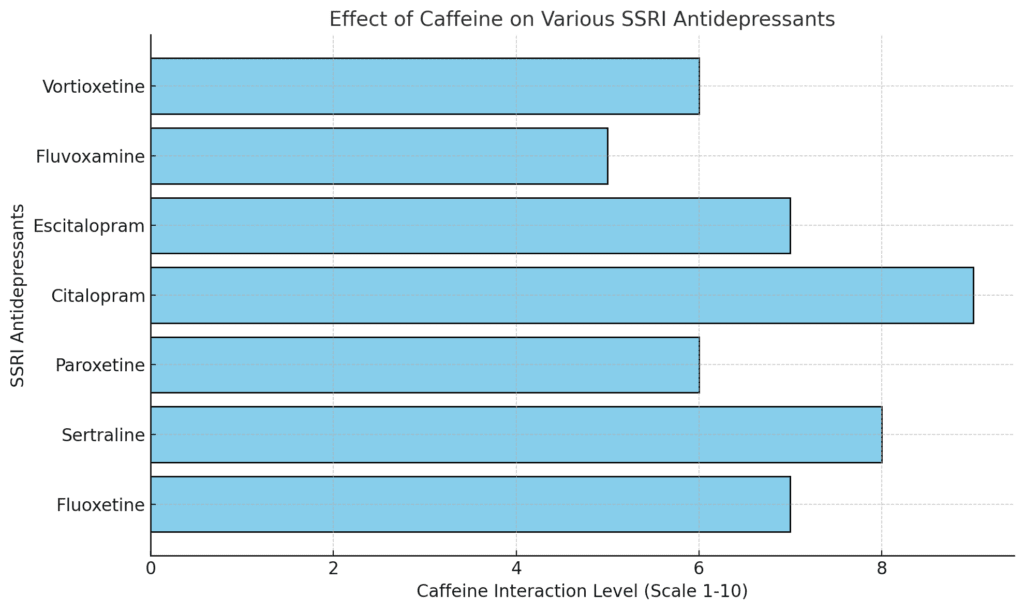
Here is a horizontal bar chart illustrating the hypothetical effects of caffeine on various SSRI antidepressants. The x-axis represents the level of caffeine interaction (on a scale from 1 to 10), and the y-axis lists the different SSRIs.
In conclusion, understanding the interaction between caffeine and SSRIs is essential for individuals using these substances concurrently. The excessive stimulation of serotonin receptors or delayed metabolism can result from combining coffee and certain antidepressants, potentially leading to unwanted side effects.
Coffee and Citalopram
Citalopram—best known under brand names like Celexa®, Cipramil®, and Cipram®—is a classic SSRI used for major depression and anxiety-related disorders. If you take citalopram and also cherish your morning coffee, you’re in the very common “SSRI plus caffeine” club and probably wondering how much these two actually talk to each other.
Pharmacologically, citalopram is broken down in the liver by several enzymes (mainly CYP2C19, CYP3A4,4 and CYP2D6) and is considered a weak inhibitor of CYP1A2, the enzyme that also handles most of your caffeine. DrugBank notes that the metabolism of caffeine can be decreased when combined with citalopram, suggesting that caffeine may hang around in the body a bit longer. This doesn’t mean an immediate emergency if you drink a latte, but it does help explain why some people feel unusually wired or notice palpitations, tremors, or insomnia once they start Celexa without changing their coffee habits.
On the flip side, citalopram itself can bring nausea, sweating, tremor, mood, and sleep disturbance—symptoms that can be amplified by extra caffeine. If your baseline anxiety runs high, several strong coffees layered on top of an activating SSRI can make your nervous system feel a bit like it’s stuck in fifth gear.
There’s also the mood piece. For many people, a single small coffee can actually lift mood, sharpen focus, and boost motivation, which fits nicely with what citalopram is trying to do. But high doses of caffeine are well known to worsen panic, irritability, and rumination in sensitive individuals. Reviews of caffeine–antidepressant interactions highlight that, while moderate caffeine may enhance antidepressant effects via adenosine and dopamine pathways, heavy intake can increase jitteriness and sleep problems enough for some people to abandon their medication altogether.
So what’s a coffee-loving Celexa user to do? In real life, most clinicians are comfortable with:
- Moderate, consistent caffeine—for example, one or two small cups of coffee, ideally before early afternoon.
- Avoiding sudden swings from “none” to “five espressos,” which are more likely to expose any subtle metabolic interaction.
- Watching for patterns: do palpitations, tremor, or middle-of-the-night wake-ups appear on days you drink more than usual?
If you ever feel chest pain, severe anxiety, or manic-like energy, that’s medical-review territory regardless of the cause. Otherwise, with citalopram, the focus is less on strict prohibition and more on finding a balanced caffeine level that supports your mood without overstimulating your system.
Coffee and Escitalopram
Escitalopram—the “cleaner,” single-isomer cousin of citalopram—is sold as Lexapro®, Cipralex®, and many generics worldwide. It’s one of the most commonly prescribed antidepressants for depression and generalized anxiety disorder.
Interaction checkers like Drugs.com and SingleCare consistently report no formal drug–drug interaction between caffeine and escitalopram, meaning coffee doesn’t dramatically change Lexapro’s blood levels or vice versa. But “no formal interaction” doesn’t necessarily equal “no effect at all” in day-to-day life.
Escitalopram is metabolized mainly by CYP2C19, CYP3A4, and CYP2D6. Caffeine is handled primarily by CYP1A2; the main routes through the liver don’t collide. That’s why most pharmacokinetic studies, including animal work, describe the interaction as pharmacodynamic rather than metabolic: caffeine may boost the antidepressant-like behaviour of escitalopram in experimental models without altering drug levels. One study even found a slight drop in escitalopram levels with chronic caffeine in rats, alongside higher caffeine levels, but the clinical significance in humans remains uncertain.
For real-world patients, the bigger story is symptoms. Escitalopram can cause both sedation and insomnia, plus gastrointestinal upset and early-treatment nervousness. Meanwhile, caffeine is a gut stimulant and a central nervous system stimulant. GoodRx and other consumer resources note that, while coffee doesn’t directly interact with Lexapro, large amounts may worsen anxiety, shakiness, or stomach upset, particularly in the first weeks of treatment.
Practically, many people on Lexapro find a “sweet spot” such as:
- One small coffee in the morning, when a bit of alertness is welcome.
- Little or no caffeine after lunch, to protect sleep and avoid evening agitation.
- Pausing to reassess coffee intake if they notice a spike in panic, racing thoughts, or IBS-style symptoms after starting escitalopram.
If you’re the kind of person whose anxiety already shoots up with minimal caffeine, Lexapro is a good time to experiment with half-caf, smaller mugs, or switching some cups to herbal tea. And if you feel unusually flat or sleepy on the medication, a modest, well-timed coffee can be part of your coping toolkit—as long as you and your prescriber are on the same page.
Coffee and Fluoxetine
Fluoxetine—world-famous as Prozac®, and also sold as Sarafem® and many generics—has one of the longest half-lives among SSRIs and is a potent inhibitor of CYP2D6 and CYP2C19. That long half-life is why missed doses are more forgiving, but it also means interactions can build gradually.
Caffeine doesn’t rely on CYP2D6, but pharmacology databases note that fluoxetine’s metabolism can be decreased when combined with caffeine, and that caffeine metabolism may also be slowed. In other words, each substance may linger a bit longer in the body when they co-exist, though this effect is typically modest at everyday doses.
What feels less modest is the combined stimulation. Prozac can be somewhat activating—people describe more mental energy, but also sometimes nervousness or insomnia, especially at the start. Add several strong coffees on top of that, and you can easily overshoot into jitteriness, palpitations, or racing thoughts. Articles on caffeine–antidepressant interactions warn that some patients attribute these amplified side effects to the antidepressant alone and stop treatment, when dialing back coffee could have solved half the problem.
Interestingly, animal research has shown that low–to–moderate doses of caffeine can enhance the antidepressant-like effect of fluoxetine without increasing blood levels, likely via adenosine and dopamine pathways. That may partly reflect what people report in real life: one morning coffee on Prozac can bring a gentle lift and improve motivation, particularly for those struggling with fatigue.
Brands like Prozac®, Prozac Weekly®, Sarafem®, Fluox®, and generics all share these interaction patterns.
To live comfortably with both fluoxetine and coffee:
- Start small with caffeine when you begin or increase Prozac—maybe half your usual amount—and slowly work back up if you feel well.
- Prioritise sleep: Prozac already has a reputation for insomnia in some users; afternoon and evening coffees often tip the balance unfavourably.
- Keep an eye on symptoms like tremor, persistent nausea, or agitation. If these flare on heavy coffee days, you’ve learned something very useful about your personal threshold.
In short, a modest amount of coffee is usually compatible with fluoxetine, but this is one SSRI where “extra-strong plus extra-large” coffees can more easily push you into the uncomfortable zone.
Coffee and Fluvoxamine
Fluvoxamine—often branded as Luvox® or Faverin®—is an SSRI particularly known for treating obsessive-compulsive disorder, although it’s also used for depression and anxiety. What makes fluvoxamine stand out in a caffeine conversation is its enzyme profile: it is a potent inhibitor of CYP1A2, the main pathway your body uses to break down caffeine.
Multiple clinical studies have documented a dramatic fluvoxamine–caffeine interaction. When 100 mg of fluvoxamine was given with caffeine, caffeine’s clearance fell by about 80%, and its half-life stretched from roughly 5 hours to more than 30 hours. That means a cup of coffee that would normally be mostly out of your system by bedtime can still be buzzing around in your bloodstream the next day.
What does that look like in real life? People on Luvox who keep drinking their usual coffee sometimes find that they suddenly:
- Feel wired “over-caffeinated” after just one or two cups.
- Have new or worse palpitations, insomnia, headache, chest pain, or stomach upset.
- Notice that even small amounts of caffeine later in the day wreck their sleep.
Because fluvoxamine also modestly inhibits other enzymes, some data suggest a two-way street: high caffeine may slightly modify fluvoxamine metabolism as well, but the clinically important piece is overwhelmingly the huge slowing of caffeine breakdown.
If you’re on Luvox, this is the SSRI where clinicians are most likely to say, “Let’s seriously rethink your caffeine.” That doesn’t always require total abstinence, but it usually means:
- Cutting back sharply—many people feel best with one small morning coffee or switching to tea/decaf.
- Avoiding energy drinks and large specialty coffees that pack in very high caffeine doses.
- Paying attention to sleep; if you’re lying awake with a pounding heart at 2 a.m., consider whether that 4 p.m. cappuccino is still in your bloodstream thanks to fluvoxamine.
The upside: when you do reduce caffeine on Luvox, many of those awful “side effects”—anxious jitteriness, constant stomach churning, racing thoughts—often calm down substantially.
Coffee and Paroxetine
Paroxetine, known as Paxil®, Seroxat®, Aropax®, Pexeva®, Brisdelle®, and others, is another SSRI workhorse for depression, anxiety disorders, PT, SD, and more. It is one of the most potent CYP2D6 inhibitors, and like other SSRIs, it can modestly influence other enzymes.
Caffeine, again, lives mostly in the CYP1A2 world—but emerging pharmacology reviews suggest that caffeine may increase paroxetine concentrations slightly and vice versa, although data are less robust than for fluvoxamine. More importantly, paroxetine is already one of the more sedating and anticholinergic SSRIs, with notable side effects such as drowsiness, dry mouth, weight gain, and sexual dysfunction.
That combination leads many real-world users into a familiar pattern:
- Morning: feel groggy, foggy, and slow on Paxil. Coffee becomes essential just to feel awake.
- Afternoon: energy dips again → second or third coffee.
- Night: wired brain, poor sleep → dose of paroxetine feels necessary not just for mood but for shutting off thoughts.
Add in the fact that both paroxetine and high caffeine intake are linked to GI upset and increased sweating, and it’s easy to see how this loop can become uncomfortable.
So while there’s no high-profile black-box warning about “no coffee on Paxil,” it makes sense to:
- Anchor caffeine early in the day. One or two modest coffees before noon are usually easier for the nervous system to handle than all-day sipping.
- Watch for signs of overstimulation—restlessness, agitation, panic episodes—that may reflect too much combined serotonergic and adenosine-blocking drive.
- Consider lowering caffeine if you’re experiencing severe night sweats or insomnia; sometimes it’s the coffee plus Paxil, not Paxil alone.
For some people with prominent fatigue or hypersomnia, a carefully planned coffee routine can actually make paroxetine more tolerable and keep them engaged with treatment. The key is being honest—with yourself and your prescriber—about how much caffeine is really in the picture.
Coffee and Sertraline
Sertraline—marketed as Zoloft®, Lustral, and many generics—is one of the world’s most prescribed SSRIs. It’s widely used for depression, anxiety disorders, PTSD, and OCD, and is generally considered middle-of-the-road in terms of activation versus sedation.
Good news for coffee lovers: major interaction checkers consistently state that no direct drug–drug interaction has been identified between sertraline and caffeine. GoodRx and SingleCare echo that message, but with an important nuance—caffeine can still make certain Zoloft side effects worse, especially GI symptoms and anxiety.
Sertraline is metabolized primarily by CYP2B6, CYP2C19, and CYP2D6 and is only a weak inhibitor of these pathways at standard doses. It doesn’t meaningfully inhibit CYP1A2, so the liver doesn’t get particularly confused by caffeine plus Zoloft.
Instead, the interaction is physiological:
- Sertraline can cause nausea, loose stools, and stomach upset, especially early on. Caffeine is also a known gut stimulant. Put them together, and some people feel like their digestive tract is on a rollercoaster.
- Zoloft may initially heighten nervous energy or insomnia before mood stabilises. Heavy coffee intake, particularly later in the day, can compound this.
So if you’re on sertraline and love coffee, think about a strategy like:
- Take Zoloft with breakfast, then have a small-to-moderate coffee soon af,ter, so both hit your system with some food on board.
- If gut symptoms are strong, try limiting caffeine for the first few weeks, then reintroduce slowly once your body has adapted to the medication.
- Be mindful of your anxiety threshold: for some people, one coffee is perfect; for others already prone to palpitations or panic, half-caf or decaf can be surprisingly kind.
Most people on sertraline can keep enjoying their coffee—just with a bit more attention to timing and quantity than before.
Coffee and Vilazodone
Vilazodone, sold as Viibryd®, sits at the intersection of SSRIs and serotonin-1A partial agonists. It’s used mainly for major depressive disorder and is often marketed as a medication that might cause fewer sexual side effects, though head-to-head trials show mixed results.
From a coffee perspective, Viibryd brings two big talking points:
- It must be taken with food. Clinical pharmacology data show that vilazodone’s bioavailability drops substantially without a meal; prescribing information is very clear that doses should be taken with food to achieve reliable blood levels. Coffee alone does not count as that meal.
- It is not known to have a direct metabolic interaction with caffeine. Drugs.com lists no interaction between caffeine and vilazodone, and GoodRx notes that the combination is generally considered safe from a drug–drug standpoint.
However, Viibryd has a reputation for gastrointestinal side effects—especially nausea and diarrhea—when people first start it or increase the dose. GoodRx explicitly cautions that caffeine may worsen these GI symptoms, suggesting that cutting back or spacing coffee and Viibryd apart by a few hours can make early treatment smoother.
If you’re starting vilazodone and also love your coffee:
- Take Viibryd with a real meal—for example, breakfast containing at least 300–400 calories. Then you can enjoy a modest coffee afterwards if your stomach tolerates it.
- If you’re hit with strong nausea or loose stools, try reducing caffeine temporarily; once your gut has adapted to vilazodone, you may be able to add coffee back in gradually.
- Remember that both vilazodone and caffeine can influence sleep and anxiety, so late-day coffees may not be your friend, especially early in treatment.
Handled thoughtfully, coffee and Viibryd can usually coexist—but this is one antidepressant where listening to your gut (literally) is especially important.
Research Findings On The Combination Of Coffee And SSRIs
Beyond individual case reports, what does the broader science actually say about coffee + SSRIs? A 2025 pharmacology review specifically examined caffeine’s interactions with major antidepressant classes, including SSRIs, looking at both pharmacokinetic (blood-level) and pharmacodynamic (effect-level) interactions.
A few key themes emerge:
- Fluvoxamine is the standout. Multiple human studies show that co-administering fluvoxamine with caffeine can cut caffeine clearance by around 80% and extend its half-life from about 5 hours to over 30 hours, due to potent CYP1A2 inhibition.
- Other SSRIs can modestly influence caffeine metabolism (and occasionally vice versa), but typically to a much smaller degree. Citalopram is classed as a weak CYP1A2 inhibitor, and databases note that it may decrease caffeine metabolism; fluoxetine and paroxetine primarily inhibit CYP2D6/2C19 rather than caffeine’s main pathway.
- Animal studies suggest pharmacodynamic synergy: low–moderate doses of caffeine (equivalent to modest human coffee intake) enhanced the antidepressant-like activity of fluoxetine and escitalopram in behavioural tests, without raising their concentrations in blood or brain tissue.
- A separate experimental study with escitalopram and chronic caffeine found increased caffeine levels and decreased escitalopram levels in serum, reminding us that long-term interactions can be more complex than single-dose studies suggest.
Clinically, observational, and review articles highlight more subtle but important real-world issues:
- Patients on antidepressants who drink a lot of coffee may experience more insomnia, agitation, and GI upset, which can be misattributed solely to the medication and lead to premature discontinuation.
- Moderate caffeine intake (often defined as up to 400 mg per day, around four small cups of coffee) is generally considered safe for healthy adults, but reviews from institutions such as Harvard stress that coffee can alter how many medicines are absorbed, distributed, and metabolized, and that individual sensitivity varies widely.
In practical terms, the research doesn’t say “SSRIs and coffee are a bad idea.” Instead, it says something more nuanced:
- Dose and timing matter. Morning coffee is very different from energy drinks all afternoon and evening.
- Drug choice matters. Fluvoxamine (and, to a lesser degree, citalopram and fluoxetine) has more potential to alter caffeine handling than sertraline or escitalopram.
- Your body matters. Genetics, liver function, smoking status, and baseline anxiety all shape how you experience the combination.
For clinicians, this evidence is increasingly a prompt to ask not just which antidepressant a person is on, but also how many coffees they drink, and when—because the combination can be the difference between “this SSRI suits me” and “I had to stop; the side effects were unbearable.”
Personal Experiences: Stories From Individuals Who Drink Coffee With SSRI
Numbers and enzyme names are useful—but most people mainly want to know, “What does this feel like in real life?” While every person is different, certain patterns show up again and again in stories from people taking SSRIs who also love their coffee.
The anxious over-caffeinated starter.
Sara starts sertraline (Zoloft®) for panic disorder. She’s a three-latte-a-day person already. The first week, she notices her heart pounding more, her hands shaking at work, and a sense that her thoughts are racing. Interaction checkers reassure her there’s “no interaction,” but an article from GoodRx also mentions that caffeine can worsen sertraline-related gut upset and anxiety. When she trims her intake to a single morning latte, her stomach calms, sleep improves, and she suddenly realizes the medication is helping more than she thought.
The sleepy morning-coffee loyalist.
James has been on paroxetine (Paxil®) for years. Without his morning filter coffee, he feels like he’s moving through molasses. Reading up, he finds that Paxil is indeed one of the more sedating SSRIs and that caffeine doesn’t have a dramatic pharmacokinetic interaction with it, though high doses can worsen anxiety. Together with his GP, he keeps one medium coffee at 8 a.m., cuts out afternoon cups, and focuses on walking after work instead of relying on caffeine to stay awake. His energy is still not perfect, but his sleep and mood both improve.
The fluvoxamine “two-sips-is-too-much” discovery.
Maria switches to fluvoxamine (Luvox®) for OCD. Within days, she feels wildly overstimulated after her usual cappuccino—shaky, nauseated, awake half the night. Later, she learns that fluvoxamine can increase caffeine’s half-life sixfold by blocking CYP1A2. With her psychiatrist’s support, she switches to decaf with the occasional half-caff treat, and the “mystery side effects” largely vanish. Her OCD symptoms keep improving.
The vilazodone GI puzzle.
Omar starts vilazodone (Viibryd®) and experiences intense nausea and loose stools, especially on mornings when he downs a large iced coffee en route to work. GoodRx notes that caffeine may worsen Viibryd-related nausea and that the drug should be taken with food. He experiments: Viibryd right after a decent breakfast, then a smaller, slower coffee an hour later. The GI issues become manageable, and he’s able to stay on a medication that’s finally easing his depression.
Across these and countless other stories, a few emotional themes repeat:
- People often blame the SSRI alone for side effects that are actually a combination of the drug and heavy caffeine. Reducing coffee sometimes reveals that the medication is more tolerable than they thought.
- Others feel guilty or “non-compliant” for wanting to keep their morning coffee ritual. When they finally bring it up, many clinicians are reassuring: it’s rarely an all-or-nothing choice, more about finding the right amount and timing.
- Many describe a sense of empowerment when they realise that small lifestyle tweaks—one fewer espresso, switching to decaf after lunch, pairing meds with food—can dramatically change how their SSRI feels.
If you recognise yourself in any of these vignettes, the takeaway isn’t that you must quit coffee or cling to it at all costs. It’s that your daily cup is a real, active part of your treatment environment, not a neutral background detail. Being curious about how coffee and your SSRI interact in your body—and talking openly to your healthcare team about what you notice—is one of the simplest, most human ways to fine-tune your mental-health plan.
Can Coffee Weaken Your SSRI? — FAQ
Covers SSRIs such as sertraline, fluoxetine, citalopram, escitalopram, paroxetine, and fluvoxamine. Educational only—follow your prescriber’s guidance.
1) Does coffee weaken the effect of SSRIs?
No—coffee doesn’t directly “turn off” SSRIs. The main issues are caffeine side effects (anxiety, insomnia, palpitations) that can mimic or aggravate the symptoms SSRIs are treating.
2) Which SSRIs are included here?
Sertraline, fluoxetine, citalopram, escitalopram, paroxetine, and fluvoxamine. Most guidance below applies to the class, with a special note for fluvoxamine.
3) What’s special about fluvoxamine and caffeine?
Fluvoxamine can slow caffeine metabolism, making caffeine effects stronger and longer. Many patients do better limiting caffeine substantially or switching to decaf while on fluvoxamine.
4) How much caffeine is reasonable while on an SSRI?
Many feel best at 100–200 mg/day (about 1–2 small cups). Sensitive patients—or those on fluvoxamine—may prefer half-caf or decaf. Keep intake consistent day to day.
5) Can caffeine worsen anxiety or panic while on SSRIs?
Yes—caffeine can increase restlessness, jitteriness, and panic symptoms. If anxiety is your main target, reduce caffeine and avoid energy drinks.
6) What timing works best with my SSRI dose?
Keep coffee away from bedtime by 8–10 hours to protect sleep. If morning coffee worsens nausea with your dose, leave a 1–2 hour buffer or take the SSRI with a small snack as instructed.
7) Could coffee cause insomnia that makes my mood worse?
Yes. Poor sleep can blunt antidepressant progress. Keep caffeine earlier in the day, reduce total amount, or switch to decaf if sleep suffers.
8) Does coffee raise blood pressure or heart rate on SSRIs?
Caffeine can briefly increase heart rate and BP. If you notice palpitations, dizziness, or headaches, scale back and discuss with your clinician.
9) Is decaf better while adjusting to an SSRI?
Often, yes. During the first few weeks—when side effects are most noticeable—decaf helps minimize jitter and sleep disruption while you stabilize on the medication.
10) Any difference between espresso and drip for SSRI users?
Total caffeine matters more than brew type. A large drip can contain more caffeine than a single shot. Choose what you tolerate best at a steady dose.
11) Can coffee worsen SSRI-related nausea or GI upset?
It can. Try smaller, cooler cups, avoid empty-stomach coffee, or switch to gentler brews. Many tolerate coffee better after breakfast.
12) I feel emotionally flat—could caffeine help or hurt?
Small, consistent amounts may lift alertness, but too much can worsen anxiety and sleep. If emotional blunting persists, discuss with your prescriber—dose or agent changes may help.
13) Are there QT concerns with caffeine and citalopram?
Citalopram has dose-dependent QT risk. Caffeine isn’t known to prolong QT, but avoid excess stimulants if you have cardiac risk factors and follow dosing limits.
14) What about mixing coffee with other stimulants while on SSRIs?
Be cautious with decongestants or energy drinks—stacking stimulants can spike anxiety and heart rate. Keep it simple and steady.
15) Does milk or food with coffee change anything?
Food may ease nausea in some users. There’s no specific interaction between milk and SSRIs—choose what helps you tolerate both coffee and medication.
16) I’m tapering off an SSRI—any caffeine tips?
Keep caffeine stable and modest. During taper, the nervous system can be sensitive—avoid swings in caffeine that may trigger jitter or insomnia.
17) Can coffee impact sexual side effects from SSRIs?
No evidence that coffee reverses SSRI-related sexual side effects. Discuss options (dose timing, agent changes) with your clinician.
18) Headaches on SSRIs—will coffee help or hurt?
Small amounts may ease some headaches, but excess can trigger them. Track patterns and keep hydration up. Seek care for severe or sudden headaches.
19) How do I know if coffee is a problem for me on an SSRI?
Test a consistent routine for a week, then trial a lower-caffeine or decaf week. Compare anxiety, sleep, heart rate, and mood. Choose the pattern that supports your treatment goals.
20) Quick rules of thumb to keep it safe and effective?
- Keep caffeine modest and consistent; earlier in the day.
- Watch for anxiety, palpitations, or insomnia; scale back if they appear.
- Be extra cautious with fluvoxamine—consider decaf.
- Avoid stacking stimulants (energy drinks, decongestants) without advice.
- Report persistent side effects or mood changes to your prescriber.
Tip: Stability wins—steady habits make SSRI effects clearer and more predictable.
Disclaimer: Informational only; not a substitute for personalized medical advice. Always follow your prescriber’s instructions.


