
Best Coffee Grinders for Single-Origin Coffee Beans


The first time I open a fresh bag of single-origin coffee, the most useful question is not whether it promises jasmine, caramel or blackberry. It is how to brew it consistently enough to recognize what the beans actually offer. A grinder has a direct role in that process. When particle sizes vary unpredictably, one pour-over can taste sour and thin while the next becomes bitter and slow, even with the same dose. A controllable burr grinder does not guarantee an extraordinary cup, but it gives me a clear adjustment to make when the flavor needs work.
Single-origin is not a synonym for expensive, light-roasted, or automatically superior. It simply identifies coffee sourced from a particular origin rather than a deliberate blend; the label can describe countries, regions, estates or lots. The best grinder for a bright washed Kenya may be the very same machine used for a rich natural Brazil. The difference comes from learning an appropriate setting for the particular coffee and brewing method, then returning to it reliably.
This comparison includes three adjustable electric burr grinders and two budget blade options. They serve very different purposes. Breville offers a broad, familiar control system. MOKKOM brings a detachable weight scale into the workflow. SHARDOR provides a useful burr range with an electronic timer. The two Proctor Silex machines keep costs and daily controls simpler but cannot reproduce a calibrated burr setting. My ranking rewards useful adjustment and honest ownership fit rather than treating all five as equal precision equipment.
My Three Single-Origin Grinder Picks

Breville Smart Grinder Pro — Black Stainless
- 60 external grind settings
- Stainless conical burr system
- 0.2-second timed adjustments
- LCD grind and dose controls
- Portafilter and container use
- Adjustable upper burr calibration
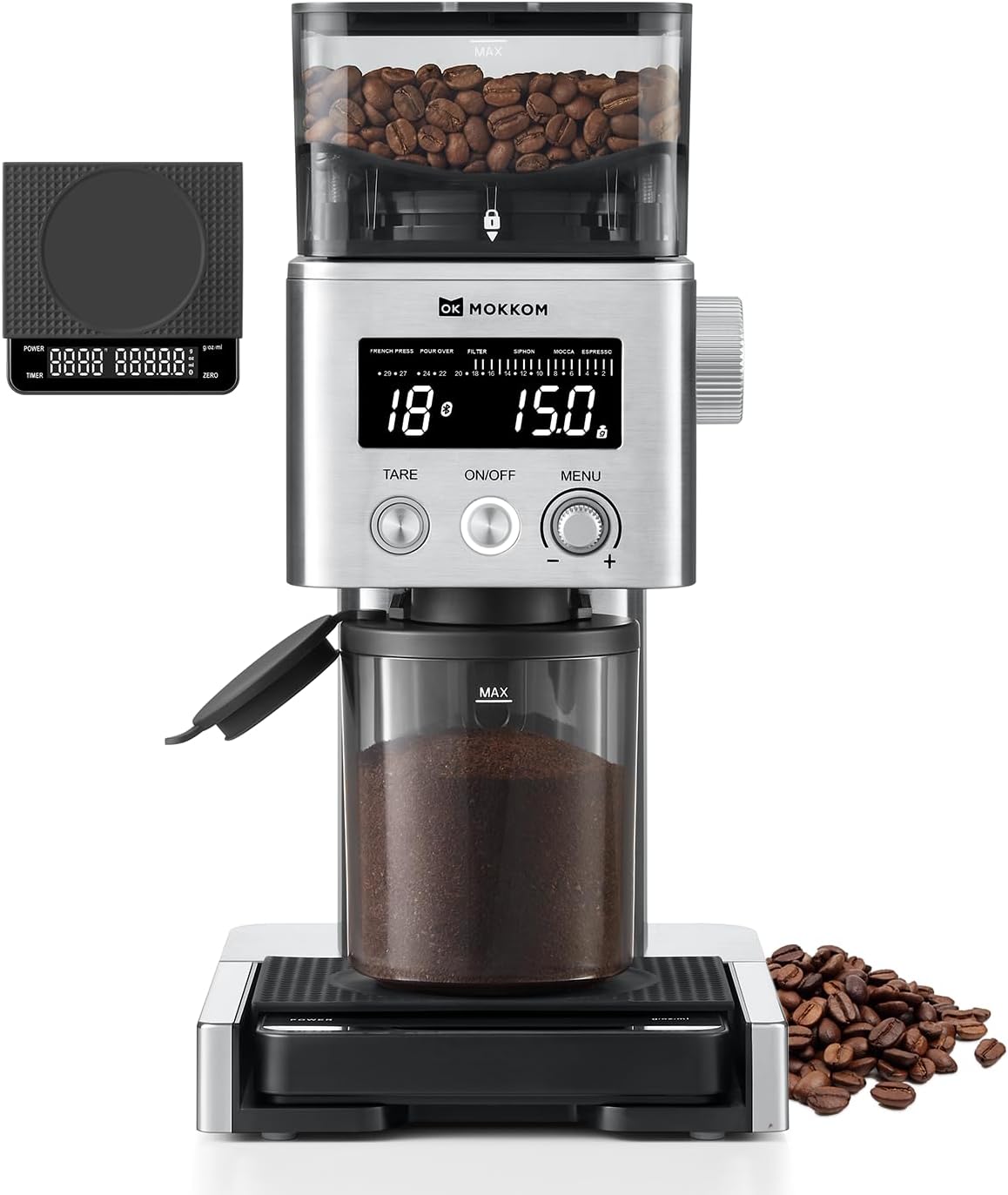
MOKKOM CG020 Coffee Grinder with Removable Bluetooth Scale
- 31 marked grind positions
- Removable rechargeable scale
- Bluetooth grinder-scale pairing
- Time, cups, ounce and gram modes
- Anti-static grounds handling
- 50–53 mm and 58 mm cradles

SHARDOR CG026 Precision Electronic Conical Burr Grinder
- 51 marked grind settings
- Conical burr mechanism
- Precision electronic timer
- Stainless grounds container
- Approx. 12.5 oz hopper
- Countertop AC-powered design
For a household that moves between espresso and filter coffee, I rank Breville first. The clear display and sixty external grind positions make adjustment easy to describe and repeat. MOKKOM earns a different place: a detachable, Bluetooth-paired scale puts the real dose on the counter instead of leaving it as a guess. SHARDOR is the straightforward burr pick for someone who needs a well-marked dial and timed convenience but has no interest in integrated weighing.
A budget blade grinder still has a role. Some readers brew a casual French press, have limited storage, or simply want freshly ground beans at the lowest practical cost. The standard Proctor Silex option fits that purpose; the separate Sound Shield model adds noise-conscious design and easier bowl handling. Neither should be marketed as a precision substitute for a burr grinder, especially when clarity from delicate single-origin beans is the main goal.
Best Coffee Grinders for Single-Origin Beans — At a Glance
The six facts in each row focus on controls and real daily use rather than speculative taste scores. The most important difference is mechanical: burr grinders use a chosen grinding gap, while blade grinders depend heavily on the time the blades strike the beans.
Breville Smart Grinder Pro — Black Stainless
- 60 external grind settings
- Stainless conical burr system
- 0.2-second timed adjustments
- LCD grind and dose controls
- Portafilter and container use
- Adjustable upper burr calibration
MOKKOM CG020 Coffee Grinder with Removable Bluetooth Scale
- 31 marked grind positions
- Removable rechargeable scale
- Bluetooth grinder-scale pairing
- Time, cups, ounce and gram modes
- Anti-static grounds handling
- 50–53 mm and 58 mm cradles
SHARDOR CG026 Precision Electronic Conical Burr Grinder
- 51 marked grind settings
- Conical burr mechanism
- Precision electronic timer
- Stainless grounds container
- Approx. 12.5 oz hopper
- Countertop AC-powered design

Proctor Silex Electric Blade Grinder — Compact Basic Version
- Compact countertop footprint
- Stainless-steel blade approach
- Short-run pulse operation
- No numbered burr adjustment
- Simple small-batch workflow
- Original product variant retained

Proctor Silex Sound Shield Coffee Grinder — Model 80402
- Sound Shield lid enclosure
- Stainless-steel blade grinder
- Removable dishwasher-safe bowl
- Up to 12 cups by maker measure
- Press-lid start and release stop
- Hidden power cord storage
Quick Ranking: Grind Control, Dosing and Everyday Fit
| Rank | Grinder | Mechanism | Best use | Main caution |
|---|---|---|---|---|
| 1 | Breville Smart Grinder Pro — Black Stainless | Conical burr, 60 positions | Best multi-method grinder | Timed dosing is not weighing |
| 2 | MOKKOM CG020 Coffee Grinder with Removable Bluetooth Scale | Conical burr, 31 positions | Best integrated weight feedback | More electronic modes to manage |
| 3 | SHARDOR CG026 Precision Electronic Conical Burr Grinder | Conical burr, 51 positions | Best straightforward burr value | Retains some grounds; timer only |
| 4 | Proctor Silex Sound Shield Coffee Grinder — Model 80402 | Blade, Sound Shield housing | Best quieter blade option | Limited size repeatability |
| 5 | Proctor Silex Electric Blade Grinder — Compact Basic Version | Blade, compact basic style | Best basic budget entry | Variant-specific claims need care |
What Changes When I Grind a New Single-Origin Coffee
Coffee extraction is shaped by the contact between water and particles, not by an advertised country name. A finer grind increases the surface area available to the brew and often slows the movement of water through a paper filter. A coarser grind usually reduces resistance. Either can help or hurt, depending on roast, dose, filter, brewer and water temperature. This is why I keep a simple recipe constant before touching the grinder dial.
A light washed coffee can feel bright and energetic, but that does not mean its best setting must always be finer. A natural coffee may bring striking fruit aromas, yet those aromas are properties of the beans and fermentation rather than the burr material. Grinder choice is about predictable size adjustments, sensible retention management and consistent dosing, not manufacturing a predetermined tasting note.
I use one practical hierarchy: first weigh the coffee, then keep water and brewing technique stable, then adjust grind in small steps. A useful grinder makes the third step easy. A blade machine can still make coffee, but because no fixed burr gap exists, it makes controlled comparisons more difficult. This distinction becomes especially valuable when a rare bag is small and every unsuccessful dose feels expensive.
Five Detailed Coffee Grinder Reviews
1. Breville Smart Grinder Pro: Best for Dialing In Different Origins
The Breville Smart Grinder Pro appeals to me because its interface is straightforward enough for ordinary mornings while offering adjustment room for demanding recipes. This matters when I brew a washed single-origin as espresso in the morning and switch to a longer V60 at lunch. A remembered reference setting is useful only when the grinder makes it easy to find again.
There is no need to assume that sixty steps create perfect extraction. They provide a repeatable adjustment path. The real strength is combining that path with a timer that is easy to read, a set of accessories for different brewing methods, and a counter-friendly way to alternate between a portafilter and grounds container.
Why the controls matter more than the screen
A grinder earns its place on my counter when a dial change produces a useful, repeatable brewing decision. Breville makes that process approachable. Sixty visible positions span fine espresso preparation through coarser filter brewing, while the LCD keeps the selected settings in view. That is valuable when a Kenya brewed as V60 needs a different grind from the same dose of a medium-roast Colombian.
The display is not a sensor reading the finished coffee. It communicates the chosen adjustment and grind duration. I like that separation because it encourages sensible record-keeping: note the bean, brew method, dose, grind number and taste, then change one variable. A grinder with fewer steps may be perfectly adequate, but this Breville makes frequent comparisons easier to organize.
An espresso-to-filter workflow with real trade-offs
The portafilter cradle is useful for households that alternate espresso and pour-over. Espresso requires small grind adjustments because flow through a packed puck can change quickly. Filter brewing is more tolerant, although a few clicks can still affect drawdown and flavor. The external scale provides a practical common language for both tasks.
There is a trade-off to switching frequently: particles from the previous setting can remain in the grind path. I keep that issue in view when changing from a dark espresso roast to a delicate washed coffee. A little retained material does not ruin a brew automatically, but regularly changing beans means checking the chute and accepting the occasional cleaning or small purge.
Timed doses need a scale to be honest
Dosing IQ changes time in 0.2-second steps. That is a meaningful interface feature, particularly when the same hopper coffee is ground every morning. Still, seconds do not equal grams. Changes in burr gap, roast development, hopper level and bean size can shift the amount exiting during one timed cycle.
For a 20-gram V60, I weigh the grounds before brewing rather than assume that the same screen number always means 20 grams. The timer saves repeated button operations; the scale protects my recipe. The combination works well because the two controls solve separate problems instead of pretending to be interchangeable.
What single-origin flavor can and cannot reveal
A carefully chosen grind helps a clean washed coffee express sweetness and acidity without becoming thin or astringent. It does not produce citrus, flowers or stone fruit on command. Those characteristics come from the beans, roast and extraction. My assessment of this grinder focuses on whether its settings permit deliberate adjustments, not on assigning a universal flavor signature to steel conical burrs.
The most useful tasting comparison is controlled: two brews from the same bag, identical water and dose, with a modest grind change. If the finer cup improves sweetness but lengthens drawdown too much, a position between the two may be the better answer. That is the kind of adjustment resolution that makes this grinder useful for origin-focused brewing.
Handling, cleanup and counter space
Breville includes accessories that support more than one brewing station, but the unit is a proper countertop appliance rather than a compact travel mill. Height is worth measuring below wall cabinets. The hopper should not become long-term bean storage simply because it accommodates a generous quantity.
I keep the accessible burr area and grounds path free of stale fragments with a dry brush and follow the care instructions for removing the upper burr. Electrical components remain dry. A quick wipe of the receiving cup after dark, oily beans helps keep the following lighter roast from picking up unwanted old-coffee aromas.
Where it falls short
This is not an ideal choice for a person who changes single-origin bags for every cup and demands extremely low retention. A dedicated single-dose grinder makes that workflow more direct. Nor does the external setting count guarantee that every espresso roast will dial in perfectly with every basket and machine.
Its better audience is a home brewer who wants a sturdy everyday interface for a repeatable handful of beans across two or three methods. For that reader, the broad marked range and clear dosing controls are more meaningful than technical claims about particle-size distributions that have not been independently measured here.
Breville Smart Grinder Pro — Black Stainless
My strongest all-round pick for switching between single-origin espresso and filter recipes. Sixty grind positions, 0.2-second dosing adjustments, and a legible screen keep small changes understandable.
- Settings are easy to return to when switching beans
- Dosing IQ timer supports a repeatable preparation routine
- Convenient choice for espresso and filter households
- Portafilter cradles and grounds container add flexibility
- The timer controls seconds, not grams
- Some grounds remain in the chute between coffees
- Tall for small kitchen cabinets
- Not a zero-retention dedicated single-dose grinder
Technical Specifications & Daily Features
- BCG820 Smart Grinder Pro family, black stainless finish
- 60 marked external grind positions
- Stainless-steel conical burr mechanism
- Digital time adjustments of 0.2 second
- LCD displays settings and dose information
- Portafilter cradle accessories and grounds container
- Approximately 8.5 × 6.3 × 15.3 inches (W × D × H)
- US retail configuration: check voltage and bundle before purchase
My strongest all-round pick for switching between single-origin espresso and filter recipes. Sixty grind positions, 0.2-second dosing adjustments, and a legible screen keep small changes understandable.
Pros & Cons After 30 Days of Use
For the Breville, the first-month ownership priorities are returning to saved settings, checking dose weight after grind changes and keeping old grounds from moving into the next coffee. Its advantage emerges from an easy-to-read control system. The main friction is retention when several beans are rotated rapidly.
An owner benefits from recording a baseline setting for each brewer and brushing accessible surfaces after oily roasts. This model supports routine variety; it does not remove the need for a scale or guarantee identical particle distributions across different coffees.
My Final Verdict
Breville is my best overall choice for a household moving regularly between espresso and filter brews. Sixty visible positions, a useful display and a configurable timer make a wide range of single-origin recipes easier to manage. A separate scale and periodic cleaning still matter, but the control system earns its place.
2. MOKKOM CG020: A Scale-Centered Single-Origin Workflow
The MOKKOM CG020 asks a different question: what if weighing were part of the grinder instead of a separate step? The detachable scale communicates with the machine over Bluetooth and supports gram-based dosing. For single-origin coffee, where small changes in dose can disguise the effect of grind adjustments, that is a genuinely useful design choice.
I rank it behind Breville overall because a sophisticated scale does not replace the need for a useful burr adjustment system or a reliable cleaning routine. Its appeal is to the person who already keeps brewing notes, weighs ingredients and wants fewer independent pieces of equipment on the counter.
A scale changes the questions worth asking
MOKKOM stands out because its removable scale makes coffee mass part of the grinder workflow. That is especially helpful for single-origin brewing. If yesterday’s Ethiopia tastes noticeably different today, the first check is whether the dose and water remained the same. A gram measurement is more informative than a vague estimate of how full the grounds container looks.
The CG020 includes a Bluetooth connection between the grinder and the detachable scale. That connection supports weight-based operation. I do not treat it as evidence of an external smartphone app with permanent tasting notes or automatic bean-specific recipe profiles. The practical advantage is closer to home: it provides integrated weight feedback that makes a repeatable dose easier to manage.
Thirty-one settings versus infinite claims
The mechanical adjustment offers thirty-one marked positions. That is enough scope for experimenting with many espresso, drip and press recipes, though each step is still a defined increment rather than a truly stepless movement. What matters is whether neighboring settings yield a helpful distinction for the particular brewing method.
For a washed medium roast on a flat-bottom brewer, I begin in a middle grind region and move carefully based on flow and taste. If drawdown becomes sluggish while the cup grows dry, a small step coarser can be more useful than changing the coffee itself. The scale helps preserve the other major variable: dose.
Four modes do different jobs
The grinder offers time, cup-count, ounce and gram modes. That range is convenient, but the menu labels must be understood. Cup mode is an approximation based on a serving convention; it is not a universal coffee dose. Timed mode controls duration. Weight modes rely on the scale being correctly placed, charged and tared.
When moving between a large French press and a small V60, I prefer a measured dose because it makes the brewing ratio clear. The scale also removes uncertainty when using different roast levels. Even a sophisticated device needs occasional checking that grounds are falling where the sensor expects and that the container has not been bumped during grinding.
The right role for connectivity
Bluetooth is useful here because the scale can be separated for other coffee tasks, then paired with the grinder. That reduces the need for an additional independent scale on the counter. It also introduces another component to charge and protect from moisture. I consider that a reasonable exchange for someone who already thinks in grams.
I avoid promises that connectivity alone improves particle consistency. A scale measures mass, not uniformity or extraction. The burrs and grind setting control the size range, and the brewing method determines how that distribution behaves. Treating each instrument according to what it actually measures produces more reliable single-origin recipes.
Retention and cleaning without shortcuts
Fine particles can collect around a grinder’s chute even when an anti-static design reduces mess. With light, aromatic coffees, residue from a previous dark roast becomes more noticeable when switching beans. A brief dry brush around the removable upper burr and outlet is a practical maintenance habit, especially after frequent setting changes.
The detachable weighing device deserves its own care routine. I keep the charging connection and electronics dry and wipe the weighing surface gently rather than immersing it. Grounds bins and hopper parts are handled according to their specific instructions. Anti-static is a reduction in scatter, not a guarantee of spotless counters.
Who benefits and who gets frustrated
A person who appreciates numbers, repeatability and an organized espresso or filter station can make good use of this grinder. The removable scale is the distinguishing feature, and I rank it for that reason. I also like that the instrument can serve as an ordinary coffee scale away from the grinder.
Someone who simply wants to grind a single AeroPress dose quickly may find the menu modes unnecessary. More electronics create more points to check when something does not start or the measurement seems wrong. The smart choice is not automatically the one with the longest feature list; it is the one whose workflow makes the intended daily brew easier.
MOKKOM CG020 Coffee Grinder with Removable Bluetooth Scale
The useful choice for someone who wants weight feedback built into the preparation station. Its removable Bluetooth-connected scale works with the grinder, while 31 settings cover common brewing methods.
- Detachable scale helps keep recipe weight central
- Multiple dose modes suit different daily routines
- 31 steps cover a useful range of brewing methods
- Burr and hopper areas are accessible for maintenance
- Bluetooth is between scale and grinder, not confirmed recipe-logging app
- Scale accuracy still depends on proper setup and tare
- More settings and modes to learn than simple grinders
- Removable scale needs charging and care
Technical Specifications & Daily Features
- MOKKOM CG020 configuration, ASIN B0DLG3N57P
- 31 marked grind positions
- Electric conical steel burr system
- Removable Bluetooth-paired coffee scale with tare
- Time, cups, ounces and grams dose modes
- Coffee hopper approximately 150 g
- 50–53 mm and 58 mm portafilter supports included in the documented package
- Anti-static design; removable upper burr and grounds cup
The useful choice for someone who wants weight feedback built into the preparation station. Its removable Bluetooth-connected scale works with the grinder, while 31 settings cover common brewing methods.
Pros & Cons After 30 Days of Use
The CG020 adds one maintenance question to the usual grinder routine: is the detachable scale charged, placed correctly and tared? Its first-month strength lies in making weight-based dosing easier to repeat. That benefit becomes less pronounced when the scale is left uncharged or the modes are changed without understanding their units.
After several weeks of switching origins, the useful checks are whether the scale remains easy to use, whether grounds collect around the chute and how reliably the burr dial returns to a familiar filter setting. A Bluetooth link is a convenience, not a substitute for checking the actual coffee weight.
My Final Verdict
MOKKOM is my leading weight-centered option. Its detachable Bluetooth-paired scale and multiple dose modes keep gram measurements close to the grinder. It is worth choosing for that workflow, not for unverified smartphone recipe storage or claims of measured particle uniformity.
3. SHARDOR CG026: The Value-Focused Burr Grinder
SHARDOR CG026 occupies the practical center of the list. It has fifty-one marked conical-burr positions and an electronic timer, which is enough information to build a repeatable filter routine without learning an integrated scale interface. The stainless collection container also makes it familiar to anyone who has used an everyday electric grinder.
A single-origin coffee can change as the bag ages. That makes an adjustment dial more useful than a decorative preset. Rather than chasing an abstract promise of perfect grounds, I focus on whether the machine lets a brewer revisit a previous number and make a controlled change when the next cup tastes different.
Why I prefer it to a budget blade grinder
For single-origin beans, the ability to return to a chosen grind size matters. SHARDOR CG026 offers fifty-one mechanical positions instead of relying on how long a blade happens to spin. That makes it easier to compare a carefully processed Colombian with a naturally processed Ethiopian without starting from zero each time.
This is not proof that every particle is identical, and it should not be described as laboratory precision. The genuine advantage is control over the burr gap. For most filter brewers, that control creates a more understandable route from a muddy or weak cup toward one with balanced extraction.
A wide dial helps when coffees change
Beans from different farms and roast batches do not share a universal best setting. Density, solubility and freshness all affect extraction. Fifty-one marked points give room to work across an ordinary drip brewer, a cone dripper, AeroPress and immersion coffee while maintaining a written reference for each.
I focus on small, purposeful changes. If a floral washed coffee tastes sharp at a given ratio, the next test may be one or two positions finer. If a heavily developed roast tastes harsh and the filter drains slowly, slightly coarser grinding may help. A repeatable dial makes the change meaningful.
An electronic timer is not a weight sensor
The timer is an operational convenience. It can reproduce a motor run duration once a routine is familiar. Yet two batches run for ten seconds need not weigh the same if grind setting, bean size or hopper level changes. That difference matters more with small single-origin doses than it appears on a digital display.
A separate scale remains part of my basic kit. Once the weight is correct, the grinder’s timer helps reduce button presses on regular mornings. I find that a clearer benefit than implying that an accurate clock creates accurate gram portions automatically.
A hopper can be too convenient
A roomy hopper is useful when one bag of coffee is used every day. For a rotating collection of small single-origin lots, the same capacity can become a disadvantage. Leaving several coffees mixed in the hopper makes it difficult to know what is actually being brewed. Old fragments in the chute can also alter the first dose after a change.
Instead, I measure the beans I need and store the rest sealed, away from kitchen heat. The grinder does not become a zero-retention machine simply because I use it in single-dose fashion, but smaller hopper loads and careful cleaning reduce unnecessary mixing.
Maintenance and counter practicality
The stainless grounds container helps transfer coffee without depending on a flimsy paper cup. Fine static-charged material can still cling to the outlet, particularly during dry weather. A brush and quick wipe make more sense than expecting the appliance to remain clean indefinitely.
It is a full electric countertop grinder. I check its height against overhead cabinets and keep the motor housing away from water. A proper dry cleaning routine is worthwhile when different origins are rotated because stale fragments are easier to notice in a delicate lighter-roast cup.
Who gets the strongest value
The CG026 is an attractive middle ground for someone who wants a marked conical-burr adjustment system and electronic controls but does not need MOKKOM’s integrated weighing. It fits the daily pour-over or drip drinker especially well when consistent grind selection is the main concern.
The trade-off is less specialization. Enthusiasts focused on very low retention or tightly demanding espresso adjustments may want a purpose-built setup. For everyday single-origin exploration, however, a broad marked dial, fresh beans and a kitchen scale can be a more sensible investment than chasing another display.
SHARDOR CG026 Precision Electronic Conical Burr Grinder
A more traditional electric burr choice: 51 marked settings, an electronic timer and a stainless grounds container give single-origin filter brewers a useful adjustment range without integrated weighing.
- Wide external adjustment range for different coffees
- Timed routine supports day-to-day convenience
- Burr grinder rather than blade chopper
- Stainless container and accessible cleaning points
- Timer does not automatically weigh the finished grounds
- Large hopper is unnecessary for rapid bean rotation
- Not a measured low-retention single-doser
- Needs a counter outlet and regular cleaning
Technical Specifications & Daily Features
- SHARDOR CG026, ASIN B0DRVDN15C
- 51 marked conical-burr grind settings
- Precision electronic timer
- Stainless steel grounds collection container
- Approximately 12.5 oz bean capacity
- Approximately 7.95 × 5 × 13.6 inches
- US configuration: 120 V; confirm the exact variation
- Upper grinder area requires periodic dry cleaning
A more traditional electric burr choice: 51 marked settings, an electronic timer and a stainless grounds container give single-origin filter brewers a useful adjustment range without integrated weighing.
Pros & Cons After 30 Days of Use
The SHARDOR makes a straightforward first-month checklist possible: find the usual filter setting, weigh finished doses from the same timed cycle, then inspect the grounds path after changing beans. Fifty-one positions give room to refine extraction without relying on an app or complex menu.
The drawback is that a full hopper and time-only operation can hide changes in dose. The most dependable routine uses a separate scale, smaller bean quantities and regular dry brushing. Those simple habits are central to its long-term value.
My Final Verdict
SHARDOR CG026 is the most straightforward burr value in this group. Fifty-one settings and timed operation make it a meaningful step above blade chopping for daily filter coffee. It is best paired with a separate scale, modest hopper loads and a regular cleaning routine.
4. Proctor Silex Basic Electric Grinder: A Budget Starting Point
The basic Proctor Silex entry is here for people who are beginning with a limited budget. It can grind fresh whole beans without needing to learn an elaborate interface. That convenience matters, but I keep its blade mechanism separate from the three burr grinders above. It is not simply the same technology at a lower price.
A blade grinder offers no repeatable burr gap. Grounds circulate through a spinning blade, so the outcome contains a spread of particle sizes. This can still be acceptable for forgiving brews, particularly when the main alternative is stale pre-ground coffee, but it makes fine adjustments for a delicate single-origin more difficult.
When the cheapest route still has a place
Single-origin coffee does not require expensive gear for every reader. A basic electric grinder offers the straightforward benefit of grinding beans shortly before brewing instead of relying on an old bag of pre-ground coffee. That is meaningful when budget is tight, storage is limited, or the brewer uses immersion methods that are comparatively forgiving.
The distinction I keep clear is that this Proctor Silex entry uses a blade-style workflow rather than an adjustable burr gap. It cannot promise the same grind-size repeatability as Breville, MOKKOM or SHARDOR. I treat it as a starter or backup, not a rival for the precise brewing decisions made possible by a marked burr dial.
Why the uneven particles matter
A rapidly spinning blade strikes beans as they circulate. Smaller fragments may be struck repeatedly while larger pieces remain near the edge or bottom of the chamber. The result can include fine dust mixed with relatively coarse pieces. In a paper-filter pour-over, that spread may slow drawdown while leaving some larger fragments under-extracted.
Immersion brewing can be more forgiving because the coffee and water remain together during extraction. Even so, the mixed distribution makes it harder to learn whether a sour or muddy cup came from beans, ratio or particle size. The right expectation is convenience and freshness, not precise flavor separation.
A reasonable routine for one small brew
I begin with a small weighed bean portion, follow the specified lid-lock requirements and use brief grinding intervals rather than prolonged unattended operation. I do not recommend shaking a running electric grinder or bypassing its safety mechanism. Once the blade has stopped completely, the grounds can be inspected and transferred.
Using the same dose and similar processing time helps make the results somewhat more consistent, but timing a blade does not create a calibrated particle-size setting. For someone moving between a dark roast and a bright washed coffee, that limitation is likely to be felt sooner than for a drinker who uses the same beans in a simple press each day.
Cleaning and the product-variant question
The original selection is a Proctor Silex electric grinder, but its specific model details are less clearly established than the separately documented Sound Shield 80402 below. I do not assume the two share a removable bowl, dishwasher approval or acoustic enclosure. Those properties are model-specific, not universal features of the brand.
For any powered blade unit, the safe baseline is to unplug before cleaning, wait until the blade stops, and wipe or brush accessible areas in accordance with the instructions. The electrical housing remains dry. A cleaner bowl also prevents strongly roasted oils from transferring to the next origin.
The upgrade threshold
The most persuasive reason to upgrade is not social status or the number of settings on a screen. It is the frustration of an inconsistent cup that cannot be corrected in small, deliberate steps. When an Ethiopian V60 remains alternately thin and clogged despite stable water and dose, a burr grinder gives the user a more precise variable to adjust.
For casual cold coffee or immersion, this basic machine still has a role. I rank it as a budget-first option while making its limitations visible, so a reader who spends more time exploring delicate origins can prioritize a burr grinder from the start.
Proctor Silex Electric Blade Grinder — Compact Basic Version
The budget entry for grinding small everyday batches without a burr adjustment dial. Blade chopping makes flavor tuning less repeatable, particularly for delicate single-origin pour-over coffee.
- Simple concept for a first electric grinder
- Compact enough for limited counter space
- Fresh grinding is possible at a low entry cost
- Can serve less demanding immersion methods
- Blade output contains mixed particle sizes
- Cannot return to an exact grind-gap setting
- Poor fit for demanding espresso or clarity-focused pour-over
- Specific variant and care permissions need checking
Technical Specifications & Daily Features
- Original ASIN B0DY47LX6G retained
- Proctor Silex electric blade-grinder category
- No mechanically indexed burr settings
- Short grind cycles rather than motorized burr gap control
- Suitable only for the maker’s indicated bean and dose limits
- Do not assume the bowl is removable or dishwasher-safe
- Check the exact variant before relying on a special lid feature
- Keep the powered housing dry and follow its actual care instructions
The budget entry for grinding small everyday batches without a burr adjustment dial. Blade chopping makes flavor tuning less repeatable, particularly for delicate single-origin pour-over coffee.
Pros & Cons After 30 Days of Use
A first month with a basic blade grinder reveals the limits of controlling particle size by time alone. The useful ownership benefits are a compact footprint and a simple on-off routine. The loss is the ability to revisit a deliberate size setting for each single-origin bean.
Cleaning the bowl carefully and using measured quantities keep the process orderly. The specific model and washing permissions should be checked before treating a basic Proctor Silex as equivalent to the separate Sound Shield 80402.
My Final Verdict
The basic Proctor Silex remains a starter or occasional-use machine. It offers simple access to freshly ground coffee but lacks a reproducible grind-gap setting. For delicate origins brewed with paper filters, I favor saving for an adjustable burr grinder.
5. Proctor Silex Sound Shield 80402: Quieter Morning Grinding
The Sound Shield 80402 deserves its own place because it is not merely the basic Proctor Silex with a different badge. The sound-dampening outer housing and detachable dishwasher-safe bowl change the ownership experience. Those details are meaningful for an early riser in a shared kitchen, even if the blade mechanism remains limited for grind precision.
I do not call it the quietest grinder in this comparison without measurements under equal conditions. Its more defensible claim is that the manufacturer designed it to reduce noise relative to selected blade units. For the right household, that is a clear advantage. It does not change how blade-ground coffee behaves in a V60 or espresso basket.
What the Sound Shield changes
Grinding noise is a genuine quality-of-life concern in a small apartment or shared kitchen. The Proctor Silex 80402 surrounds its blade-grinding operation with a Sound Shield arrangement intended to reduce the sound compared with other blade grinders from the manufacturer’s broader brand group. That is a useful design aim, especially when a household starts work at different hours.
The feature does not establish that the machine is quieter than every other grinder in this comparison. Without comparable measurements, I do not attach a decibel ranking. Its advantage is an explicitly noise-conscious housing, not an imaginary laboratory result.
A removable bowl matters more than it sounds
Blade grinders often make transferring grounds awkward. Here the bowl can be removed, carried to the brewer and cleaned separately. The manufacturer allows this specific bowl to go in a dishwasher. That can make the little daily inconveniences less annoying, particularly when a user grinds one batch after another.
The motor base is a different matter and must stay away from immersion or running water. A detachable, washable bowl does not make the whole machine dishwasher-safe. I also dry the parts completely before putting them back into a powered assembly. These ordinary habits matter more than dramatic cleaning promises.
Single-origin coffee deserves realistic expectations
This is still a blade machine. The coffee contains a mix of finer and larger fragments because there is no indexed burr gap to control how pieces leave the chamber. That mixed output may be acceptable for a simple immersion recipe, but a distinctive, delicately processed coffee can lose some clarity when fines slow a filter and larger fragments lag in extraction.
The benefit of this Sound Shield is not superior particle uniformity. It is a lower-friction household routine for someone whose chief complaints are noise, pouring and cleaning. In that context the grinder has a credible reason to exist even when the burr products are better tools for precision brewing.
Operating safely and consistently
The lid operates the grinder: pressing starts the cycle, releasing stops it. I make sure the assembled lid is seated properly, work with sensible bean quantities and never reach inside until the blades stop. Short, controlled sessions avoid asking a small appliance to do continuous work beyond its operating instructions.
A small scale remains useful for single-origin brewing. Weighing the beans before grinding makes the coffee-to-water ratio clear even when the particle distribution cannot be controlled as tightly. It also makes comparison with a future burr grinder more informative.
A niche recommendation, not the main winner
Someone who prefers a simple morning press and dislikes harsh kitchen noises can find this design appealing. The detachable bowl and cord storage reduce common sources of clutter. It also makes a sensible backup when a more elaborate grinder is unavailable.
For regular washed Ethiopian pour-over or tight espresso control, the blade mechanism remains the limiting factor. I rank it separately from the basic Proctor Silex because its noise enclosure and removable bowl are meaningful ownership differences, not because it magically handles finer single-origin detail.
Proctor Silex Sound Shield Coffee Grinder — Model 80402
A distinct sound-dampened blade grinder for noise-sensitive kitchens. Its removable dishwasher-safe bowl and simple press-to-grind controls favor convenience, not the tight particle control prized by clarity-focused brewers.
- Sound Shield design helps reduce grinding noise
- Bowl removes for easier pouring and cleaning
- Compact interface with few steps to learn
- A sensible convenience option for immersion brews
- Blade chopping cannot reproduce a burr setting
- Not proven to be the quietest among all grinders
- No uniform-fines guarantee for delicate filter coffee
- Noise design does not improve grind precision
Technical Specifications & Daily Features
- Proctor Silex Sound Shield model 80402, ASIN B09C2FPQXQ
- Electric stainless-steel blade mechanism
- Sound Shield enclosure; maker describes reduced noise against select blade models
- Removable grinding bowl rated dishwasher-safe
- Up to 12 cups per manufacturer coffee-serving convention
- Press outer lid to operate; release to stop
- Hidden cord storage; three-year limited warranty
- Approx. 7.3 × 4.5 × 4.5 inches (H × W × D)
A distinct sound-dampened blade grinder for noise-sensitive kitchens. Its removable dishwasher-safe bowl and simple press-to-grind controls favor convenience, not the tight particle control prized by clarity-focused brewers.
Pros & Cons After 30 Days of Use
The 80402 has a clear first-month advantage in bowl handling and noise-conscious design. Its removable dishwasher-safe bowl reduces the cleanup burden for daily use, while the shield helps address the sharp sound associated with basic blade grinders.
The limitation remains grind-size repeatability. Neither an acoustic enclosure nor a removable bowl converts a blade grinder into a burr mill. For delicate paper-filter coffee, it is a convenience choice rather than a precision upgrade.
My Final Verdict
Proctor Silex Sound Shield 80402 earns a specific recommendation for a quieter blade-grinding routine and easier bowl cleaning. Its advantages are household convenience rather than grind precision. Regular single-origin pour-over drinkers still have stronger reasons to choose a burr grinder.
Buying Guide: How I Choose a Grinder for Single-Origin Coffee
Start with your usual brewer, not a promised tasting note
A grinder for single-origin coffee is not one universal category. A V60 drinker needs useful filter-range steps and sensible fines management. An espresso drinker needs sufficient fine adjustment for puck resistance. A French press owner benefits from reliable coarse choices without requiring an intimidating control panel. Choosing for the main brewer avoids paying for the wrong capability.
I consider how often the grinder must move between methods. Breville offers a broad interface for mixed households, while MOKKOM emphasizes measured dosing. SHARDOR is a practical filter-centered choice. The blade grinders belong to less demanding brewing habits rather than espresso-focused precision.
Understand what burrs do that blades do not
Burr systems guide the beans through an adjustable gap, allowing a repeatable control over the intended grind size. The resulting particles are not perfectly identical, but the mechanism provides a consistent direction for adjustment. If a brew drains too slowly, a small movement coarser becomes an informed choice rather than an experiment with random chopping time.
A blade grinder changes the distribution by repeated impacts. Fine fragments remain mixed with much larger ones, which can make filter flow and extraction harder to interpret. A blade is not automatically unusable, but it is a compromise when the aim is to notice subtle differences between origins rather than simply prepare an everyday cup.
Grind-size steps are meaningful only inside a recipe
One grinder's setting twenty is not equal to another grinder's setting twenty. External dial numbers are reference marks, not standardized particle measurements. A useful setting is the one that gives a balanced cup at a controlled ratio, water temperature and brew method. If changing the grind, I leave other variables alone until the result is clear.
For washed coffees, too fine a grind can increase resistance and produce dryness; too coarse may leave sharpness and thin body. For natural coffees, process-derived fruit notes can be strong, but excessive fines still create unwanted heaviness. Roast and process do not establish a single correct number for every bean.
Measure coffee and water in grams
When the grinder output varies by even a small amount, the brew ratio changes. That is why I treat a scale as essential for learning a new single-origin coffee. For a 300-gram V60, a 20-gram dose gives a 1:15 starting ratio. The exact best ratio varies, but a known ratio makes the next adjustment meaningful.
Breville and SHARDOR offer time controls, while MOKKOM adds weight feedback. The screen on a timed grinder reports motor operation, not guaranteed coffee mass. Weighing the result protects comparisons between fresh beans, different roast densities and a hopper that becomes emptier during the week.
Watch retention when changing from one origin to another
A grinder that holds onto old coffee can introduce a small amount of yesterday's dark roast into today's delicate washed lot. That is especially relevant for readers who buy several 100–250 gram bags and switch daily. A short grind path and accessible chute reduce the inconvenience, while dry brushing or an appropriate purge helps when aromas are noticeably different.
I do not treat a low-retention label as a promise of zero particles left behind. The actual amount changes with grinding conditions, cleaning and use. A routine that limits stale material is more helpful than a slogan, particularly if the grinder is shared among household members with different beans.
Do not confuse integrated weighing with recipe software
MOKKOM’s detachable scale is designed to communicate with the grinder by Bluetooth and support weight-related modes. That is enough to be useful. It does not automatically establish cloud storage, a mobile tasting journal or saved profiles for every coffee. For detailed recipe notes, a simple notebook or independent app remains an easy solution.
The physical scale also needs to be charged, tared and placed securely. Any weight-based system can produce misleading readings when the container moves or touches surrounding surfaces. Understanding those conditions prevents the kind of false confidence that makes a digital number seem more authoritative than the coffee in the cup.
Be cautious with static and water hacks
Static makes freshly ground coffee cling to a catch cup and scatter around the chute. Anti-static designs may help, but the result varies with room humidity, beans and container material. Gentle tapping, a clean receptacle and periodic brushing are broadly useful habits.
A tiny water mist on beans is sometimes suggested as a workaround, but not every electrical appliance has the same moisture guidance. I keep liquids out of grinder interiors and follow the specific instructions instead of treating internet shortcuts as universal safety advice.
Choose an achievable cleaning schedule
Grinders accumulate coffee oils, chaff and fine particles. A dark roast can leave more visible residue, while fine grinding can push particles into seams. I prefer machines with accessible burr or receiver parts because a short, regular brush-out is more realistic than an elaborate monthly teardown.
Blade grinders need care around the sharp chamber and electrical base. The Sound Shield 80402 has a dishwasher-safe removable bowl; that permission does not automatically apply to the basic Proctor Silex. For the burr machines, remove only the components identified in the model's care instructions and keep the motor housing dry.
Check actual kitchen fit and electrical requirements
A tall hopper can collide with overhead cabinets, and a wide receiver can make the counter feel crowded. Breville is a fairly tall appliance, SHARDOR and MOKKOM also need dedicated space, and the Proctor Silex blade machines are more compact. I measure height with enough clearance to add beans and remove the hopper before deciding.
Electrical ratings matter when buying in another region. A product intended for 120-volt US outlets is not made compatible with 220–240 volts by a simple plug-shape adapter. Confirm the exact variant, frequency and local safety requirements before bringing an imported grinder into service.
Let bean freshness guide hopper habits
A large hopper makes sense for a single coffee used daily. For someone tasting multiple single-origin bags, it can become a place where old and new beans mingle. I store the bulk coffee sealed and measure only what is needed for the current recipe whenever practical.
Freshness is not a binary on-off switch. A coffee changes gradually after roasting and opening. Small setting corrections through the bag are normal. The goal is a stable routine, not the impossible promise that a grinder can make every aging bean taste identical.
Make a sensible upgrade decision
The first upgrade from pre-ground coffee can be a simple grinder and scale. The next meaningful upgrade is usually more controllable particle size, not a brighter display. If a blade grinder prevents repeatable V60 cups despite careful pouring, moving to an adjustable burr machine is a substantial step.
If a reliable burr grinder already supports your brewer, spending more may not help as much as fixing water quality, using an appropriate filter, or refining the pour. I recommend upgrading only when a specific daily limitation is understood: poor fine adjustments, troublesome retention, messy dosing or an inconvenient workflow.
Three Starting Recipes for Comparing Single-Origin Coffees
Recipes help isolate the grinder’s contribution. I keep each baseline simple and change one factor at a time. These are starting points rather than guaranteed settings, because beans, water, filters and brewing equipment vary.
V60 or cone pour-over — bright washed coffee
- Coffee: 20 g; water: 300 g; ratio 1:15.
- Begin with a medium-fine filter grind and water suited to the roast.
- Use a modest initial wetting pour followed by a controlled main pour.
- If the cup is thin and sharp, try slightly finer; if dry and sluggish, try coarser.
A repeatable grind number is especially useful when the bag develops over several days. Keep the same filter and pouring routine while finding the sweet spot.
Flat-bottom dripper — rounded, balanced cup
- Coffee: 18 g; water: 300 g; ratio about 1:16.7.
- Begin around a medium filter setting.
- Keep agitation gentle and total pouring method consistent.
- Adjust one dial step at a time while recording sweetness and finish.
A flat-bottom brewer can be forgiving, but mixed particles from a blade grinder may still affect flow and clarity. Record the grind setting when the cup becomes reliably enjoyable.
French press — fuller immersion texture
- Coffee: 30 g; water: 500 g; ratio about 1:16.7.
- Start medium-coarse rather than automatically selecting the extreme coarse end.
- Maintain a repeatable steeping and decanting method.
- If too weak, assess dose and move finer; if gritty, improve settling and pouring.
A French press allows some fine sediment through its metal filter. A good burr grinder helps make grind adjustments deliberate, but gentle handling also affects the cup.
Troubleshooting Single-Origin Coffee Without Blaming the Beans
The coffee tastes sour and hollow
Check the ratio and water temperature before buying another grinder. If those are stable, a small move finer or a longer contact time can improve extraction. A light roast may naturally have lively acidity; the aim is sweetness alongside it, not eliminating it entirely.
The pour-over slows to a crawl
Excessively fine grounds or substantial fines can clog a paper filter. Move the burr setting slightly coarser and avoid unnecessarily vigorous agitation. Blade-ground coffee is harder to correct because the particle spread is not controlled by a marked burr gap.
The second cup tastes unlike the first
Weigh the coffee and water. Check whether the grind setting, bean supply or timer mode changed. Then examine grounds left in the receiver or chute. Repeating one consistent method is more informative than changing grind, water and ratio simultaneously.
The cup feels muddy even with a light roast
Muddiness can come from fines, high agitation or a brewing method with incomplete filtration. Use a clean paper filter when appropriate, pour more gently, and consider coarser adjustment. A finer grind is not always the solution to a weak-flavored brew.
The scale reading changes unexpectedly
Check the tare, battery level, container placement and whether anything touches the weighing surface. For the MOKKOM, confirm the detachable scale is properly paired when using weight-related modes. A separate scale can help identify whether the issue is placement rather than the grinder.
The counter collects grounds after every dose
Static, dry air and coffee residue all contribute. Seat the catch cup carefully, brush the outlet with the device off, and avoid unapproved moisture tricks. Small maintenance habits improve the routine even when the grinder advertises anti-static features.
Final Comparison: Which Grinder Fits Each Single-Origin Routine
| Grinder | Controls | Best owner | Trade-off | Price |
|---|---|---|---|---|
| Breville Smart Grinder Pro — Black Stainless | 60 external grind settings | Espresso and filter households | Timed, non-weight dosing and grounds retention | Price on Amazon |
| MOKKOM CG020 Coffee Grinder with Removable Bluetooth Scale | 31 marked grind positions | Brewers who prioritize measured doses | Extra electronics; no verified app recipe library | Price on Amazon |
| SHARDOR CG026 Precision Electronic Conical Burr Grinder | 51 marked grind settings | Filter drinkers seeking burr value | Separate scale still needed | Price on Amazon |
| Proctor Silex Electric Blade Grinder — Compact Basic Version | Compact countertop footprint | Very tight budgets and occasional use | Uncontrolled blade grind distribution | Price on Amazon |
| Proctor Silex Sound Shield Coffee Grinder — Model 80402 | Sound Shield lid enclosure | Quiet-oriented simple households | Sound shield does not add grind control | Price on Amazon |
My Final Recommendation
For most readers exploring single-origin coffee through espresso and pour-over, I choose the Breville Smart Grinder Pro. It brings the most approachable combination of visible grind adjustment, timing controls and mixed-brewer accessories in this five-product group. A small scale beside it keeps the dose honest, and brushing out old material matters when beans change.
MOKKOM earns second place for the brewer who values integrated weighing. Its Bluetooth connection is between the detachable scale and grinder; that feature is useful without inventing a smartphone recipe library. SHARDOR CG026 is my practical burr recommendation for someone whose priority is marked adjustment and a straightforward filter routine. The basic Proctor Silex and the separate Sound Shield 80402 offer cheaper, simpler blade-grinding paths, but neither provides a reproducible grind-size dial.
Single-origin coffee deserves thoughtful brewing rather than exaggerated equipment promises. I begin with fresh beans, a known dose, good water and a sensible reference grind. Once those are stable, the grinder should help explain the cup, not distract from it. The best purchase is the one that gives control over the variables that actually matter for your brewer.
Frequently Asked Questions About Single-Origin Coffee Grinders
Is a burr grinder necessary for single-origin coffee?
It is not mandatory, but it is the better tool for deliberate adjustment. A burr grinder provides a repeatable size setting, which makes filter and espresso recipes easier to refine than a blade grinder does.
Which of these five is the best overall?
I rank the Breville Smart Grinder Pro first for mixed espresso and filter use. Its sixty positions and clear timing interface offer more flexibility than the two blade machines while remaining approachable.
Does single-origin coffee need a finer grind than blends?
No. Origin labels do not determine grind size. Roast, bean density, brewer, ratio and extraction target are more useful starting points than whether the coffee is a blend or from one lot.
How many settings does the Breville Smart Grinder Pro have?
The Smart Grinder Pro uses sixty external grind settings, plus internal upper-burr calibration on the relevant configuration. Its Dosing IQ timer adjusts in 0.2-second increments.
Can Breville grind for both espresso and pour-over?
Its broad adjustment range and accessories support both methods. Espresso needs careful dialing; filter recipes also benefit from deliberate settings and weighed doses.
Does the Breville timer dispense a precise number of grams?
No. The timer measures how long the motor runs. Actual dose weight can change with beans, hopper level and grind size, so use a scale when repeating recipes.
Does MOKKOM save coffee recipes to a smartphone app?
The documented CG020 feature is a detachable scale that pairs with the grinder over Bluetooth. A separate mobile recipe library is not established for this configuration.
How many grind settings are on the MOKKOM CG020?
The CG020 has thirty-one marked grind settings and multiple dose modes, including time, cups, ounces and grams. The detachable scale supplies weight feedback.
Does the removable MOKKOM scale need power?
Yes. Its scale is an electronic accessory and needs to be charged and tared correctly. Keep it dry and ensure it rests on a stable surface during weighing.
Which SHARDOR model is included here?
The grinder is the SHARDOR CG026, with fifty-one marked settings and an electronic timer. It is a conical-burr grinder rather than a blade chopper.
Is SHARDOR better for pour-over than a blade grinder?
Its marked conical-burr adjustment gives more control over the intended grind size. That generally makes filter brewing easier to repeat and troubleshoot than relying on blade run time.
Which grinder is best for a small budget?
The basic Proctor Silex is the budget-first choice in this group, but it compromises grind control. For frequent pour-over, an adjustable burr grinder is the more useful long-term step.
Are both Proctor Silex selections the same model?
No. The Sound Shield is specifically model 80402. The other entry is a separate original basic product selection and should not automatically be assumed to have the same lid or washable bowl.
What does Sound Shield change on the Proctor Silex 80402?
Its outer enclosure is intended to reduce grinding noise compared with selected blade models. The blade grinding mechanism remains less precise than an adjustable burr system.
Is the Sound Shield removable bowl dishwasher-safe?
Yes, the manufacturer specifies that the removable bowl on model 80402 is dishwasher-safe. The powered base and other electrical parts must never be immersed.
Can a blade grinder make a good French press?
It can produce an enjoyable immersion cup, especially with fresh beans and a careful ratio. The mixed particle sizes can still create extra sludge and make adjustments harder to repeat.
Which grind setting works for a washed Ethiopian V60?
There is no universal setting across grinders or beans. Start in the filter range, keep water and dose stable, then adjust according to sweetness, clarity and drawdown.
Should I grind light-roast single-origin beans finer?
Not automatically. Some light roasts benefit from finer grinding to increase extraction, but filter clogging and unpleasant dryness can occur. Taste and brewing behavior remain the best guides.
How do I reduce bitterness in a single-origin pour-over?
Check roast character, water temperature, ratio and agitation. A slightly coarser grind can help when extraction is excessive, but do not change every variable at once.
Why does my single-origin coffee taste sour?
The coffee may be under-extracted, overly dilute or naturally high in bright acidity. Check dose and water, then consider a modest grind adjustment finer while keeping the rest of the recipe steady.
Do flat burrs always make clearer coffee than conical burrs?
No. Burr geometry is only part of grind distribution. Alignment, burr profile, bean properties and brewing technique matter, so broad flavor guarantees based on shape alone are unreliable.
What is coffee-grinder retention?
Retention is coffee that remains inside the grinding path after a dose. It matters when changing beans because fragments from the previous coffee can mix into the next cup.
How often should I clean a grinder used for several origins?
Brush out accessible residue regularly, especially when changing between oily and light roasts. A deeper clean follows the exact product manual; do not assume the burrs or electrical base can be washed.
How much coffee should I weigh for a single-origin V60?
Twenty grams of coffee and three hundred grams of water is a useful 1:15 starting ratio. Adjust concentration and extraction after tasting rather than treating the initial recipe as a fixed rule.
Is MOKKOM’s integrated scale better than a separate scale?
It can simplify an integrated weight-based workflow. A good separate scale works just as well for recording coffee-to-water ratios, and is easier to replace independently if electronics fail.
Are any of these grinders meant for travel?
The two compact blade options are easier to store, but they require mains power and sacrifice size control. None of these is a purpose-built ultralight manual travel grinder.
Can I use these US electric grinders with 220–240 V outlets?
Only when the exact appliance rating and safe conversion requirements permit it. A physical plug adapter does not convert voltage, so check local electrical compatibility before use.
What should I upgrade first: beans, grinder or brewer?
Start by solving the biggest weakness in the current routine. Fresh beans and a consistent ratio matter greatly; if a blade grinder prevents meaningful grind adjustments, an adjustable burr model can be the most useful equipment upgrade.


