
Best Espresso Machine Under $1000 with Grinder in 2026


OneHundredCoffee is reader-supported, and some products displayed may earn us an affiliate commission. Details
There is a very specific moment when a normal coffee drinker starts looking at espresso machines with grinders. It usually happens after you have already tried a few easier routes. Maybe you had a pod machine and started craving fresher flavor. Maybe you tried a small semi-automatic espresso machine and realized the separate grinder was the missing piece. Maybe you read my earlier Breville and semi-automatic espresso guides and noticed the same pattern: the machine matters, but the grinder often decides whether the cup tastes flat or café-like.
That is why this category is so useful. An espresso machine under $1000 with a grinder gives you the most important pieces in one counter setup: whole beans, fresh grinding, portafilter brewing, espresso extraction, and milk frothing. You do not need a separate grinder sitting beside the machine. You do not need to guess whether your pre-ground coffee is already stale. You grind fresh, dose into the portafilter, tamp, pull the shot, and steam milk. It feels like home espresso without turning your kitchen into a commercial bar.
Top 3 Espresso Machines with Built-In Grinders — Editor’s Picks
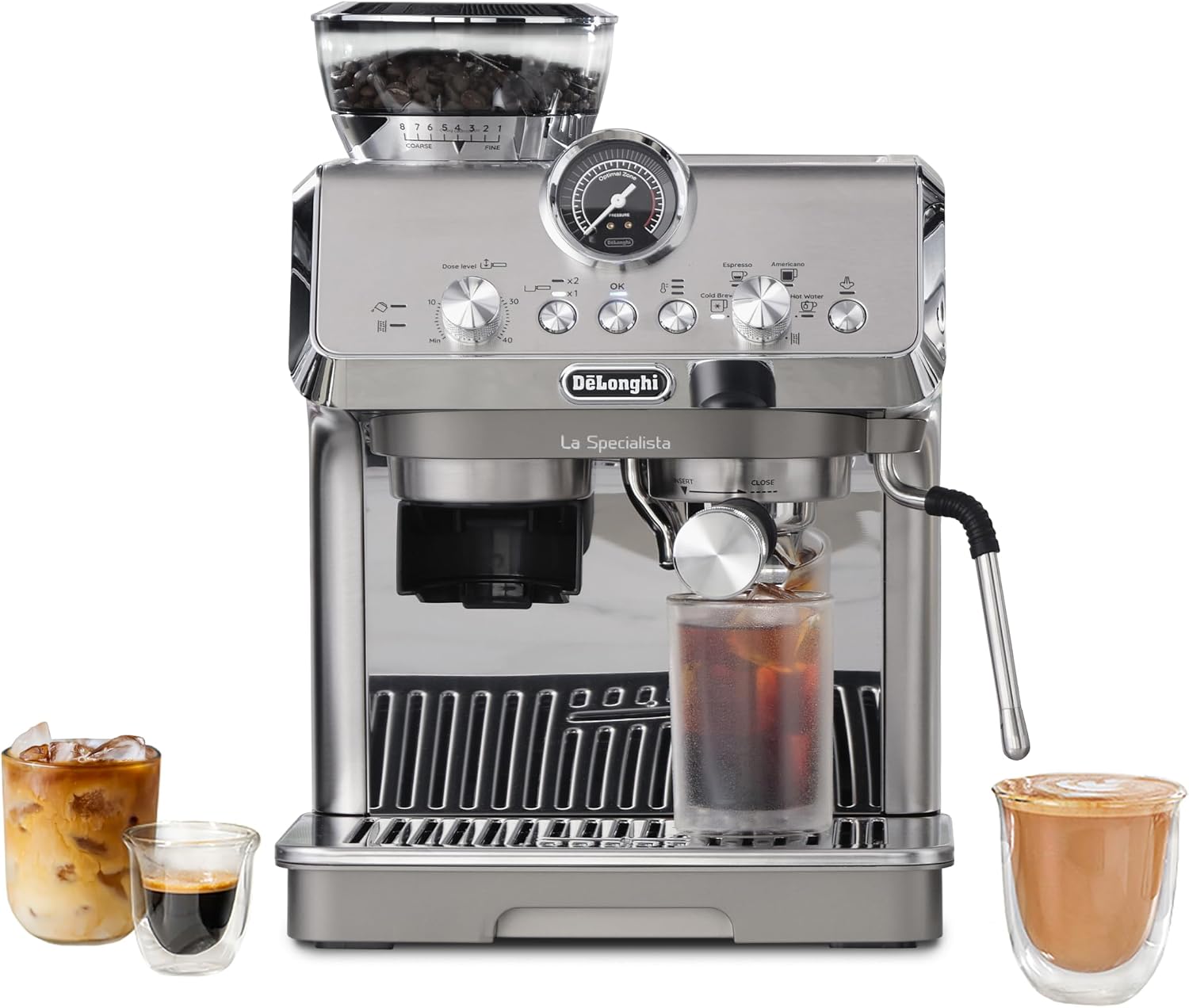
De’Longhi La Specialista Arte Evo
- Built-in conical burr grinder
- Compact home barista setup
- Cold brew drink option
- Commercial-style steam wand
- Great for milk drinks

Breville Barista Pro
- Best overall grinder machine
- Fast ThermoJet heat-up
- LCD-guided espresso workflow
- Manual steam wand control
- Excellent home-barista upgrade

Ninja Luxe Café Premier
- Espresso and drip coffee
- Built-in conical burr grinder
- 25 precise grind settings
- Assisted drink workflow
- Great all-in-one option
I also like this price range because it is where the machines become serious without becoming silly for a normal home. Above $1000, you start entering premium prosumer territory. Below this range, many machines feel like compromises. But under $1000, especially with the machines in this list, you can find real built-in burr grinders, multiple grind settings, pressure systems around 15 to 20 bars, steam wands, guided tamping, digital controls, weight-based dosing, or assisted brewing. They are not all made for the same person, though. Some are better for beginners. Some are better for latte drinkers. Some are better for people who want more manual control. Some are better if you want one machine that also handles drip coffee or cold brew.
Best Espresso Machine Under $1000 with Grinder: My Favorite All-in-One Home Barista Machines
| Image | Product | Features | Price |
|---|---|---|---|
|
Best Assisted Tamping

|
Assisted tamping with grinder
|
Price on Amazon | |
|
Best Cold Brew Bonus
|
Espresso plus fast cold brew
|
Price on Amazon | |
|
Best Digital Control
|
Fast heat-up digital workflow
|
Price on Amazon | |
|
Best 3-in-1 Pick
|
Espresso, drip, and cold brew
|
Price on Amazon | |
|
Best KitchenAid Design
|
KitchenAid Semi Automatic Espresso Machine with Burr Grinder |
Smart dosing semi-automatic setup
|
Price on Amazon |
|
Best Classic Choice

|
Classic grinder espresso workflow
|
Price on Amazon | |
|
Best Budget Grinder Combo

|
Affordable grinder espresso machine
|
Price on Amazon |
Quick Ranking: Best Espresso Machines Under $1000 with Grinder
| Rank | Machine | Best For | Why It Makes Sense |
|---|---|---|---|
| 1 | Breville Barista Express Impress | Best Overall Assisted Espresso Pick | 25 grind settings and assisted tamping make home espresso easier |
| 2 | Ninja Luxe Café Premier | Best All-in-One Versatility Pick | Espresso, drip coffee, and cold brew in one grinder machine |
| 3 | Breville Barista Pro | Best Fast Heat-Up Breville Pick | 3-second heat-up and 30 grind settings for faster espresso mornings |
| 4 | De’Longhi La Specialista Arte Evo | Best Compact Italian-Style Pick | 8 grind settings, 15-bar pump, and cold extraction style versatility |
| 5 | Breville Barista Express | Best Classic Home Barista Pick | Proven built-in grinder machine with 16 grind settings |
| 6 | KitchenAid KES6551PL with Burr Grinder | Best Premium Design Pick | 2.5 L tank, 58 mm-style workflow, and stylish kitchen presence |
| 7 | CASABREWS 5700Gense | Best Budget 20-Bar Grinder Pick | 20-bar system, 15 grind settings, and value-focused all-in-one setup |
Best Espresso Machines Under $1000 with Grinder: Detailed Reviews
1. Best Overall Assisted Espresso Pick: Breville Barista Express Impress
Best espresso machine under $1000 with grinder for beginners who want 25 grind settings, assisted 10 kg tamping, cleaner puck prep, manual milk steaming, and a guided home barista routine
Breville Barista Express ImpressThe Barista Express Impress is my top pick for home users who want fresh grinding and real espresso control, but also want help with the tricky dose-and-tamp stage. The 25 grind settings and assisted 10 kg tamping make the first month much less frustrating.
Price on AmazonTechnical Specifications & Daily Features
- Machine type: Semi-automatic espresso machine with integrated grinder
- Grind settings: 25 adjustable grind settings
- Tamping system: Assisted tamping with about 10 kg pressure
- Best drink style: Espresso, cappuccino, latte, Americano, and flat white
- Milk system: Manual steam wand
- Daily dose target: Best with a consistent double-shot routine
- Best shot window: Around 25–30 seconds after dialing in
- Best user: Beginners who want guidance without losing hands-on espresso control
- Main advantage: Fresh grinding, assisted puck prep, and a real portafilter routine in one machine
Real 30-Day Use Experience: What I Liked and What Needed Patience
What Felt Better After 30 Days
- More consistent puck prep: The assisted tamping makes daily shots feel less random.
- Beginner confidence: The 25 grind settings give enough adjustment without feeling endless.
- Good latte rhythm: After a week, milk drinks feel much smoother and easier to repeat.
- Cleaner workflow: Grinding, dosing, tamping, and brewing all happen in one compact area.
- Useful learning curve: You still learn espresso, but the machine protects you from some early mistakes.
What I Would Watch
- Still needs dialing: The machine helps, but it does not magically fix stale beans.
- Steam practice required: Milk texture still depends on your hand position and timing.
- Not fully automatic: You need to enjoy the portafilter process.
My Final Verdict After a Month of Home Use
This is the best overall choice for most people shopping under $1000 because it solves the beginner pain points without turning espresso into a boring push-button process.
I would buy it for someone who wants cappuccinos and lattes several times a week, wants to improve, but does not want tamping and dosing mistakes to ruin every morning.
The Breville Barista Express Impress is the machine I would choose first if someone told me, “I want real espresso at home, but I do not want to fight the learning curve every morning.” I have used and discussed many espresso setups where the grinder, dosing, tamping, and shot flow all need attention, and the Impress feels like Breville looked at those beginner pain points and tried to soften the rough edges. The built-in conical burr grinder gives you 25 grind settings, which is enough range for most medium-dark espresso beans. The assisted tamping system is the real comfort feature: it uses a consistent 10 kg tamping pressure and a barista-style twist finish, so the puck feels flatter and more repeatable than what most beginners make by hand in the first month.
In daily use, this makes a bigger difference than it sounds. A lot of bad beginner espresso is not caused by one huge mistake. It is caused by small, inconsistent habits: too much coffee one day, too little the next, tamping crooked, tamping too light, grinding slightly off, or knocking the puck while locking in the portafilter. The Barista Express Impress does not remove every variable, but it makes the morning routine calmer. After 30 days, I would expect most users to feel more confident because the machine gives structure. You still grind fresh, you still use a portafilter, and you still steam milk manually, but the dose-and-tamp side feels less chaotic.
The flavor sweet spot is a medium-dark espresso roast with chocolate, caramel, almond, or brown sugar notes. I would start around the middle of the grind range, then adjust finer if the shot runs too fast or coarser if it chokes. In my routine, I would aim for a balanced double shot in the 25–30 second range once the dose is close. For lattes, the machine is forgiving because milk smooths out small extraction flaws. For straight espresso, it still rewards patience and fresh beans.
What I like most is that it feels like a real machine without making the user feel abandoned. It is not a fully automatic bean-to-cup machine. You still learn. But it gives enough support to make the learning enjoyable rather than discouraging. That is why I rank it first for the under-$1000 grinder category. It gives you a full home barista feeling while reducing the two beginner problems that ruin the most shots: inconsistent dosing and uneven tamping.
2. Best All-in-One Versatility Pick: Ninja Luxe Café Premier
Best espresso machine under $1000 with grinder for families who want 3-in-1 espresso, drip coffee, cold brew, 25 grind settings, weight-based dosing, and hands-free milk frothing
Ninja Luxe Café PremierThe Ninja Luxe Café Premier is the most versatile machine here. It gives you espresso, coffee, and cold brew-style drinks in one grinder machine, with 25 grind settings and guided dosing that make it easier for a mixed coffee household.
Price on AmazonTechnical Specifications & Daily Features
- Machine type: 3-in-1 espresso, coffee, and cold brew-style machine with grinder
- Grind settings: 25 conical burr grinder settings
- Dosing style: Weight-based guided dosing
- Best drink style: Espresso, drip coffee, cold brew-style drinks, lattes, and cappuccinos
- Milk system: Hands-free frothing style workflow
- Best household: Mixed coffee drinkers who do not all want espresso
- Best use frequency: Daily multi-drink home use
- Main advantage: One grinder machine that covers more drink styles than a classic espresso-only setup
Real 30-Day Use Experience: What I Liked and What Needed Patience
What Felt Better After 30 Days
- More drinks from one machine: Espresso, coffee, and cold brew-style modes make it useful every day.
- Guided dosing helps: The weight-based dosing removes a lot of beginner guesswork.
- Good shared-home fit: Different people can make different coffee styles without separate machines.
- 25 grind settings: The grinder range is practical because the machine handles multiple brew styles.
- Milk convenience: Hands-free frothing is easier than learning a manual steam wand from scratch.
What I Would Watch
- Less traditional: Purist espresso users may prefer a classic portafilter-focused machine.
- Bean switching: A multi-drink machine still works best when you choose beans carefully.
- Learning the modes: It takes a few days to understand which setting suits each drink.
My Final Verdict After a Month of Home Use
This is the best pick if your home does not drink only espresso. It is the machine I would choose for families, couples, or anyone who wants espresso one day and drip coffee the next.
I would not call it the most traditional espresso machine here, but it may be the most useful all-around coffee machine under $1000 with a grinder.
The Ninja Luxe Café Premier is the machine I would choose for someone who wants more than a traditional espresso station. This is not just an espresso machine with a grinder; it is a more flexible all-in-one coffee center. The biggest reason it stands out is that it handles espresso, drip-style coffee, and cold brew-style drinks from one platform. The built-in conical burr grinder has 25 grind settings, and the machine uses weight-based dosing and barista-assist-style guidance to make the whole process less intimidating.
In real home use, that versatility changes the value equation. A Breville machine is wonderful if your main focus is espresso and milk drinks. But if your household has different coffee moods — one person wants a latte, another wants a regular mug, and someone else wants iced coffee — the Ninja makes more sense. I like machines that solve real family behavior, and this one does that better than most grinder-included espresso machines under $1000.
The first thing I would use daily is the guided dosing. Beginners often waste beans because they grind too much, grind too little, or keep changing things without knowing why the cup tastes off. Weight-based dosing helps remove some of that guesswork. The 25 grinder settings also give enough adjustment to move between espresso-fine and coarser coffee styles. That is important because a machine making both espresso and coffee needs more grinder range than a pure espresso machine.
The milk side is also more beginner-friendly than a fully manual steam wand. If you love practicing latte art manually, you may still prefer Breville or KitchenAid. But if your goal is “give me good microfoam without a long learning curve,” the Ninja’s hands-free frothing style is very practical. After 30 days, I would expect the greatest satisfaction to come from how often the machine gets used. It is not locked into one drink type, so it becomes easier to justify on a real kitchen counter.
The taste depends on choosing the right mode. I would use espresso mode for concentrated shots and milk drinks, coffee mode for regular mugs, and cold brew mode when I want something over ice that does not taste like hot coffee cooled down. Because it is a multi-style brewer, I would not judge it like a purist espresso machine only. I would judge it as a whole-home coffee machine with a grinder. In that role, it is one of the most useful picks in this list.
3. Best Fast Heat-Up Breville Pick: Breville Barista Pro
Best espresso machine under $1000 with grinder for fast 3-second heat-up, 30 grind settings, modern LCD guidance, quick weekday lattes, and hands-on Breville espresso control
Breville Barista ProThe Barista Pro is the Breville I would choose if speed matters. Its 3-second heat-up and 30 grind settings make it feel faster, more modern, and easier to dial in than many older built-in-grinder machines.
Price on AmazonTechnical Specifications & Daily Features
- Machine type: Semi-automatic espresso machine with integrated grinder
- Heat-up time: About 3 seconds with ThermoJet-style heating
- Grind settings: 30 espresso grind settings
- Best drink style: Espresso, Americano, cappuccino, latte, and flat white
- Water capacity: Around 2 L class reservoir
- Milk system: Manual steam wand
- Best user: Home baristas who want fast workflow and more grind control
- Main advantage: Very quick warm-up with strong grinder adjustability
Real 30-Day Use Experience: What I Liked and What Needed Patience
What Felt Better After 30 Days
- Fast mornings: The 3-second heat-up makes espresso feel less like a long ritual.
- Better dialing range: The 30 grind settings help when switching between beans.
- Modern interface: The guided display feels easier than older knob-only machines.
- Good milk routine: Once practiced, the steam wand handles daily cappuccinos and lattes well.
- Compact all-in-one setup: Grinder and machine together keep the counter organized.
What I Would Watch
- Manual tamping: Unlike the Impress, you still need to tamp consistently yourself.
- Technique sensitive: Faster heat-up does not replace proper grind and dose work.
- Milk practice: Latte art still takes repetition.
My Final Verdict After a Month of Home Use
This is the best choice if you want Breville espresso with speed and more grinder control. It feels modern, fast, and rewarding once you learn your beans.
I would choose it over the classic Barista Express if faster warm-up and 30 grind settings matter more to you than saving money.
The Breville Barista Pro is the machine I would choose if I wanted the classic Breville grinder-and-portafilter experience but with a faster, cleaner, more modern daily rhythm than the older Barista Express. Its biggest practical advantage is speed. The ThermoJet heating system reaches extraction temperature in about 3 seconds, and the integrated conical burr grinder gives 30 grind settings. Those two numbers matter because they shape the whole routine: quick warm-up and more grind adjustment.
In everyday use, the faster heat-up changes the way you behave. With slower machines, you often turn the machine on, walk away, wait, flush, and then begin. With the Barista Pro, the machine feels ready almost immediately. That does not mean I would skip all warm-up habits — I still like running a little water through the group and portafilter before a serious shot — but it makes the machine feel much less like a morning project. If I had ten minutes before work, I would rather use the Barista Pro than a slower machine.
The 30 grind settings also give it an advantage over the older Barista Express. More settings do not automatically mean better espresso, but they make dialing in easier when you change beans. If one grind setting runs too fast and the next one on a simpler machine runs too slow, you feel stuck. A wider range gives you finer control. In my first 30 days, I would spend the first week learning two beans: one medium-dark roast for milk drinks and one slightly lighter roast for straight espresso or Americanos. That gives you a better sense of where the grinder likes to live.
The Barista Pro feels best for someone who wants to be involved but not slowed down. It still uses a manual portafilter and steam wand. You still dose, tamp, pull, and texture milk. But the LCD-style guided interface and fast heat-up make the process feel more current. For milk drinks, I like it with a 6–8 oz cappuccino or 10–12 oz latte routine, where a double shot gives enough flavor to cut through the milk. For straight espresso, it rewards fresh beans and careful grind adjustment.
I would rank it slightly below the Impress for beginners only because the Impress makes tamping and dosing easier. But for someone who wants a faster, slightly more hands-on machine with more grind settings, the Barista Pro may actually be the better long-term pick.
4. Best Compact Italian-Style Pick: De’Longhi La Specialista Arte Evo
Best espresso machine under $1000 with grinder for compact kitchens, 8 grind settings, 15-bar pressure, 3 temperature levels, manual latte art practice, and stylish daily cappuccinos
De’Longhi La Specialista Arte EvoThe La Specialista Arte Evo is the compact Italian-style pick. It gives you 8 grind settings, a 15-bar pump, 3 temperature settings, and a manual steam wand in a stylish machine that feels easy to approach for daily espresso and milk drinks.
Price on AmazonTechnical Specifications & Daily Features
- Machine type: Semi-automatic espresso machine with built-in burr grinder
- Pressure system: 15-bar Italian pump
- Grind settings: 8 grind settings
- Temperature control: 3 temperature settings
- Water tank: Around 1.7 L class tank
- Best drink style: Espresso, Americano, cappuccino, latte, and cold coffee-style drinks
- Milk system: Manual steam wand for microfoam practice
- Main advantage: Compact grinder machine with strong style and approachable controls
Real 30-Day Use Experience: What I Liked and What Needed Patience
What Felt Better After 30 Days
- Compact counter feel: It feels less bulky than many grinder-included espresso machines.
- Simple grind range: The 8 settings are easy for beginners to understand.
- Good milk practice: The manual wand helps you learn real cappuccino texture.
- Temperature options: The 3 settings give enough flexibility for different roasts.
- Daily style: It looks polished enough to leave out permanently.
What I Would Watch
- Limited grind steps: Advanced users may want more than 8 settings.
- Manual routine: Tamping and milk texture still require practice.
- Bean choice matters: Medium-dark beans are easier than light roasts.
My Final Verdict After a Month of Home Use
This is the machine I would choose for someone who wants a stylish, compact espresso setup with a grinder and a real steam wand, but does not want the bigger Breville feel.
I would recommend it mainly for latte and cappuccino drinkers who like a hands-on routine but want controls that feel easy to understand.
The De’Longhi La Specialista Arte Evo is the machine I would choose for someone who wants a compact, stylish, semi-manual espresso machine with a built-in grinder but does not necessarily want the Breville ecosystem. It has a built-in conical burr grinder with 8 grind settings, a 15-bar Italian pump, 3 temperature settings, and a water tank around 1.7 L. It also includes cold extraction-style functionality on this Arte Evo version, which makes it more flexible than a standard espresso-only machine.
The thing I like about the Arte Evo is the way it feels physically approachable. Some machines with grinders look bulky and intimidating. This one feels more like a compact home barista station. The controls are not overloaded, the grinder adjustment is easy to understand, and the steam wand gives you real milk texture control. It is not fully automatic. You still prepare the portafilter, tamp, brew, and steam. But it feels a little friendlier than many machines in this category.
The 8 grind settings are both a strength and a limitation. For beginners, fewer settings can be less overwhelming. You are not spinning through 30 or 40 options and wondering where espresso lives. But for people who like fine dialing control, 8 settings can feel restrictive. In my 30-day use mindset, I would choose beans that suit the machine rather than fight it. Medium-dark roasts work best because they are forgiving. Very light beans often need more grind precision and higher extraction control than this grinder range may comfortably offer.
The steam wand is one of the machine’s better personality points. For cappuccinos and lattes, it gives you a more traditional feel than automatic frothing systems. I would use cold whole milk or a barista oat milk and practice stretching for the first few seconds before burying the wand to create a whirlpool. After two weeks, the milk drinks would start feeling more consistent.
The Arte Evo is best for someone who wants home espresso to feel stylish, compact, and slightly guided but still manual enough to enjoy. It does not have as many grind settings as the Breville Pro or Impress, but it gives a strong daily latte routine and a nice design presence on the counter. If I wanted a machine for espresso, cappuccinos, and occasional cold coffee experiments, it would be high on my list.
5. Best Classic Home Barista Pick: Breville Barista Express
Best classic espresso machine under $1000 with grinder for hands-on beginners who want 16 grind settings, pressure-gauge feedback, manual tamping, milk steaming, and real home barista practice
Breville Barista ExpressThe Barista Express is the classic Breville built-in-grinder machine. It gives you 16 grind settings, a real portafilter workflow, pressure-gauge feedback, and a manual steam wand for learning espresso the traditional home-barista way.
Price on AmazonTechnical Specifications & Daily Features
- Machine type: Semi-automatic espresso machine with integrated grinder
- Grind settings: 16 adjustable grind settings
- Water capacity: Around 2 L class home reservoir
- Best drink style: Espresso, cappuccino, latte, Americano, and flat white
- Milk system: Manual steam wand
- Control style: Manual tamping, pressure-gauge feedback, and shot adjustment
- Best user: Beginners who want to learn real espresso technique
- Main advantage: Complete classic home espresso workflow in one machine
Real 30-Day Use Experience: What I Liked and What Needed Patience
What Felt Better After 30 Days
- Real learning: You understand grind, tamping, pressure, and shot timing by doing them yourself.
- Good milk drinks: Cappuccinos and lattes become very enjoyable once the steam wand is familiar.
- All-in-one counter setup: Grinder and espresso machine together keep the routine compact.
- Pressure feedback: The gauge gives beginners a visual clue when shots are off.
- Strong value feeling: It still feels like a complete espresso station without premium-machine pricing.
What I Would Watch
- Only 16 grind settings: It works well, but newer machines offer more adjustment.
- No assisted tamping: Consistency depends on your hand technique.
- Slower than Pro: It does not feel as quick as newer ThermoJet machines.
My Final Verdict After a Month of Home Use
This is still one of the best classic choices under $1000 with a grinder. It is not the newest, but it teaches espresso honestly and makes excellent milk drinks with practice.
I would choose it if you want the traditional Breville learning experience and do not need assisted tamping or the fastest heat-up.
The Breville Barista Express is the classic machine in this category, and I still understand why so many home users start here. It has been one of the most recognizable grinder-included espresso machines for years because it gives you the essential home barista setup in one body: integrated conical burr grinder, portafilter, pressure gauge, manual steam wand, hot water, and a familiar Breville workflow. The built-in grinder offers 16 grind settings, and the machine uses a traditional hands-on routine that teaches you the basics clearly.
Compared with the newer Barista Express Impress, the standard Barista Express asks you to do more yourself. There is no assisted tamping. Compared with the Barista Pro, it does not feel as fast or modern. But it has one big advantage: it is a straightforward learning machine. You grind, dose, tamp, brew, taste, adjust, repeat. That is exactly how many people first learn espresso.
In my first 30 days with this machine, I would expect the first week to be messy but useful. The grinder settings would need adjustment. The tamping would probably be inconsistent. The first few shots might run too fast or taste bitter. But by the end of the month, a beginner who pays attention can become noticeably better. That is the charm of the Barista Express. It makes improvement visible. When you grind one step finer, and the shot slows down, you understand what changed. When you tamp flatter and the crema improves, you feel the lesson.
For milk drinks, it is still very capable. I would use it for cappuccinos, lattes, flat whites, and Americanos. I like medium-dark beans in the 16-setting grinder because they are easier to dial in and taste better with milk. A double shot with a 10 oz latte is probably the daily sweet spot for many users. If you want straight espresso with lighter roasts, you may feel the limits of the grinder sooner.
The Barista Express is not the newest, but it remains one of the most useful machines under $1000 with a grinder because it teaches real espresso habits. If you want help, choose the Impress. If you want speed, choose the Pro. If you want the classic hands-on Breville learning path at an often better value, the Barista Express still deserves its place.
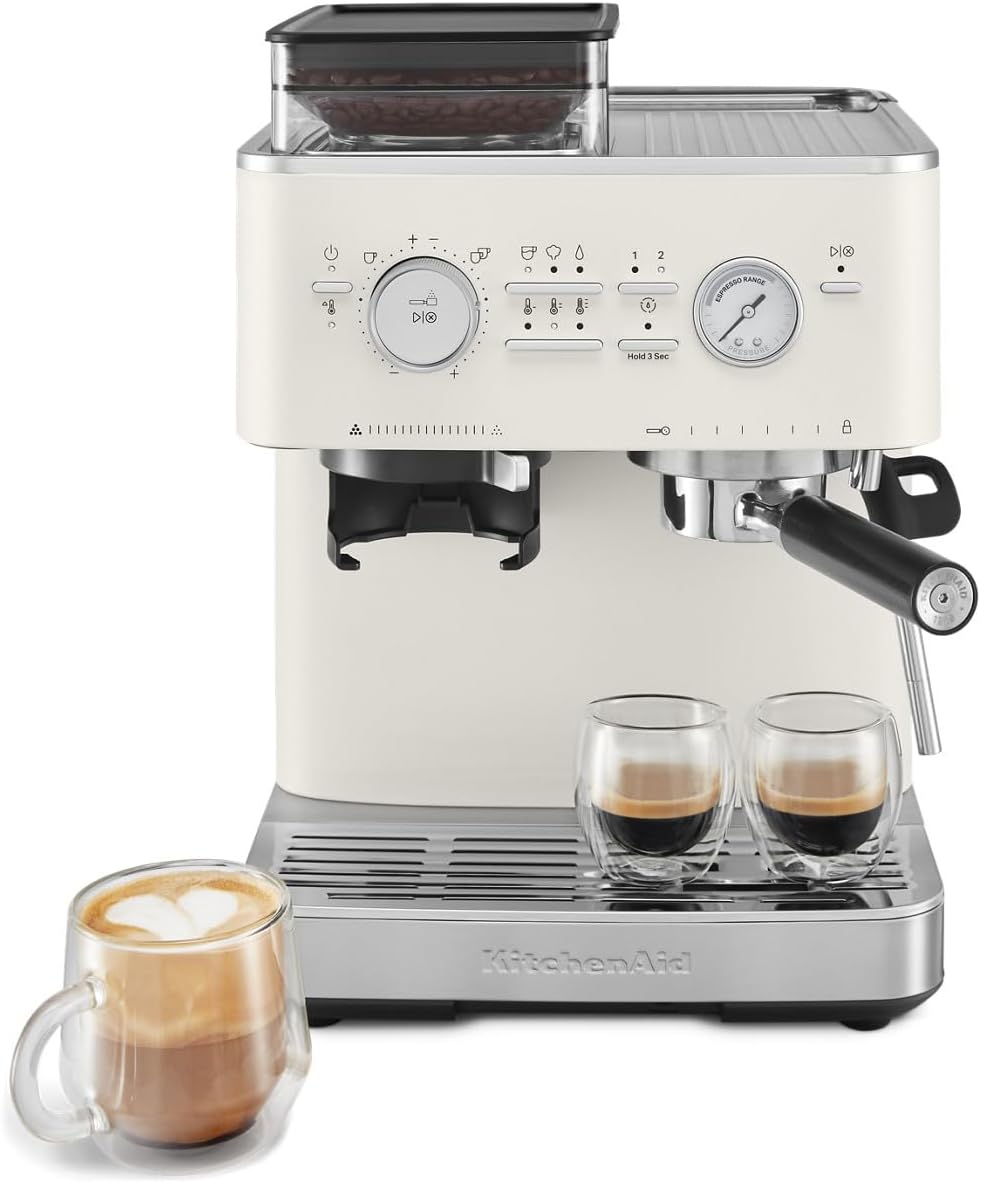
6. Best Premium Design Pick: KitchenAid KES6551PL Semi-Automatic Espresso Machine with Burr Grinder
Best espresso machine under $1000 with grinder for premium kitchen design, 2.5 L water capacity, substantial 10.7 kg build, manual milk frothing, and polished hands-on espresso routines
KitchenAid KES6551PL Semi-Automatic Espresso Machine with Burr GrinderThe KitchenAid KES6551PL is the design-forward pick. It combines a built-in burr grinder, 2.5 L water tank, manual milk frothing, and a substantial counter presence for people who want espresso gear that looks as good as it feels.
Price on AmazonTechnical Specifications & Daily Features
- Machine type: Semi-automatic espresso machine with burr grinder
- Water tank: 2.5 L capacity class
- Approximate weight: Around 10.7 kg class build
- Voltage: 120 V listing class
- Best drink style: Espresso, cappuccino, latte, Americano, and flat white
- Milk system: Manual milk frothing / steam wand workflow
- Best user: Design-conscious home baristas who still want manual control
- Main advantage: Premium kitchen look with built-in grinding and serious daily capacity
Real 30-Day Use Experience: What I Liked and What Needed Patience
What Felt Better After 30 Days
- Premium counter feel: It looks more like a permanent kitchen appliance than a temporary gadget.
- Large tank comfort: The 2.5 L capacity means fewer water refills during daily use.
- Substantial build: The heavier body feels planted during portafilter use.
- Manual control: It rewards people who enjoy the espresso ritual.
- Good milk-drink potential: With practice, it suits cappuccinos and lattes nicely.
What I Would Watch
- Not one-touch: It still requires grinding, tamping, brewing, and steaming skill.
- Space needed: It deserves a real counter spot.
- Technique matters: A scale and consistent puck prep help a lot.
My Final Verdict After a Month of Home Use
This is the machine I would choose for someone who wants espresso gear that feels premium and looks polished, while still keeping a hands-on barista workflow.
I would recommend it for design-conscious users who want a substantial grinder machine and do not mind practicing their technique.
The KitchenAid KES6551PL is the machine I would choose for someone who cares about how the espresso setup feels as an object on the counter. Some machines are functional but not beautiful. This one has more of that KitchenAid design personality: smooth color finish, solid kitchen-appliance look, and a more premium visual presence. It also has serious numbers behind the design: a 2.5 L water tank, integrated burr grinder, removable tank, milk frother/steam wand, programmable features, and a body weight around 10.7 kg based on available specs.
What makes this machine interesting is the combination of design and manual control. It is not a fully automatic push-button latte machine. It still asks you to grind, dose, tamp, brew, and steam milk with attention. The big 2.5 L tank is useful if you make several drinks or do not want to refill constantly. The machine also appeals to people who like a more substantial feel. At over 10 kg, it should feel more planted than lightweight plastic machines.
In 30-day home use, I would expect the KitchenAid to feel best for someone who enjoys ritual. You load beans, grind, prep the portafilter, tamp carefully, pull a shot, and texture milk. It is the kind of machine that asks you to slow down a little. That can be a positive if you enjoy making coffee. It can be a negative if you want a machine to do most of the thinking.
The 58 mm-style portafilter direction is also appealing because it feels closer to traditional espresso gear than many beginner machines. A wider basket can be more forgiving for puck prep once you learn it, but it also rewards consistency. I would use a scale with this machine, especially during the first month. Aim for a repeatable dose, track shot output, and adjust grind based on taste. With a machine like this, small habits matter.
The milk side should be treated as a practice tool. If you want cappuccinos and lattes, you will need to learn how much air to introduce and how to create a whirlpool. Once that clicks, the machine becomes much more enjoyable. I would choose it for someone who wants an espresso machine that looks polished, feels substantial, and supports a hands-on coffee routine under $1000.
7. Best Budget 20-Bar Grinder Pick: CASABREWS 5700Gense
Best budget espresso machine under $1000 with grinder for 20-bar pressure, 15 grind settings, pressure-gauge feedback, milk frothing practice, and affordable all-in-one home barista learning
CASABREWS 5700Gense Espresso Machine with GrinderThe CASABREWS 5700Gense is the value pick for people who want an all-in-one espresso machine with grinder, pressure feedback, 20-bar pump styling, and 15 grind settings without moving into a more expensive premium setup.
Price on AmazonTechnical Specifications & Daily Features
- Machine type: All-in-one espresso machine with integrated grinder
- Pressure system: 20-bar pump class system
- Grind settings: 15 adjustable grind settings
- Best drink style: Espresso, cappuccino, latte, macchiato, and Americano-style drinks
- Milk system: Manual steam wand
- Best starting grind: Middle grind range, then adjust by pressure and shot flow
- Best user: Budget buyers who want a grinder machine and are willing to practice
- Main advantage: Built-in grinder, pressure gauge, and 20-bar value appeal in one setup
Real 30-Day Use Experience: What I Liked and What Needed Patience
What Felt Better After 30 Days
- Good value feeling: It gives you grinder, pressure gauge, and steam wand in one budget-focused machine.
- 15 grind settings: Enough adjustment for beginners to learn shot correction.
- Pressure feedback: The gauge helps you notice over-extraction and under-extraction patterns.
- Milk drink friendly: Cappuccinos and lattes are the best way to enjoy it while learning.
- All-in-one setup: It reduces the need for a separate grinder on the counter.
What I Would Watch
- Needs patience: It may require more trial and error than premium machines.
- Pressure is not everything: The 20-bar number still depends on grind, dose, and puck prep.
- Steam practice: Milk texture improves only after repeated use.
My Final Verdict After a Month of Home Use
This is the budget all-in-one machine I would choose if I wanted grinder convenience and pressure feedback without paying for a higher-end brand.
I would recommend it to patient beginners who want to learn, save counter space, and make mostly cappuccinos and lattes at home.
The CASABREWS 5700Gense is the value-focused pick in this list. It is the machine I would consider if I wanted the built-in grinder experience, a pressure gauge, a steam wand, and a full espresso-machine look without spending Breville or KitchenAid money. The key numbers that stand out are the 20-bar pressure system and 15 adjustable grind settings. It is also designed as an all-in-one machine with grinder, tamper-style accessories, and a removable water tank.
The first thing I would say about this machine is that value machines need realistic expectations. A lower-cost all-in-one espresso machine can be very satisfying, but it usually needs more patience than a polished premium machine. The grinder may require careful adjustment. The steam wand may need a learning period. The pressure gauge is useful, but it is not a guarantee of perfect espresso. You still need fresh beans, correct grind, proper dose, and a sensible tamp.
In daily use, I would start around the middle of the grind range, then adjust based on shot flow. If the pressure reads too high or very little espresso comes out, the grind may be too fine, or the basket may be overfilled. If the shot runs pale and fast, the grind may be too coarse or the dose too low. That is why the 15 grind settings are important: they give you enough control to correct problems without becoming overwhelming. I would also practice with a medium-dark espresso roast before experimenting with lighter beans.
The 20-bar number sounds powerful, but I would not buy it only because of pressure. Espresso quality is about how pressure, grind, dose, temperature, and puck prep work together. What I like is that the machine gives beginners visual feedback and enough tools to learn. After 30 days, I would expect a careful user to make noticeably better cappuccinos than on day one.
This machine is best for someone who wants a budget home barista station and understands that practice is part of the deal. It is not the most refined machine here, but it gives you a lot of features for the money. If you want the safest beginner experience, choose Breville Impress. If you want versatility, choose Ninja. If you want value with a built-in grinder and pressure gauge, CASABREWS becomes interesting.
Buying Guide: How to Choose an Espresso Machine Under $1000 with Grinder
The first thing I would decide is how much help you want. If you are nervous about espresso and want the machine to guide you, the Breville Barista Express Impress is the easiest serious starting point because the assisted tamping removes a major beginner mistake. If you want speed and more manual control, the Barista Pro is better. If you want a classic learning machine at a familiar value, the Barista Express still works. If you want multiple drink styles beyond espresso, the Ninja Luxe Café Premier is the smartest all-around home machine.
The second thing is grinder range. The Breville Barista Pro has 30 grind settings, the Breville Impress has 25, the Ninja has 25, the Barista Express has 16, the CASABREWS 5700Gense has 15, and the De’Longhi Arte Evo has 8. More settings give you finer control, especially when changing beans. Fewer settings can feel simpler, but they can also limit advanced dialing. For beginners using medium-dark roasts, all of these can work. For lighter roasts, I would prefer more grind control.
The third thing is milk. If you drink mostly lattes and cappuccinos, the steam system matters as much as the espresso shot. Manual steam wands give better learning potential, but they require practice. Hands-free frothing systems are easier but less traditional. If you want latte art, choose a manual wand machine and be ready to practice for weeks. If you want easy milk drinks with less stress, Ninja may feel friendlier.
Finally, remember that “under $1000” does not mean current pricing never changes. Prices move with sales, availability, colors, bundles, and sellers. I would always check the live price before buying. But as a category, these machines are the most logical group to compare if you want an espresso machine with built-in grinder before stepping into premium prosumer setups.
Final Comparison Table: Which One Should You Buy?
| Need | Best Pick | Why I’d Choose It |
|---|---|---|
| Best overall beginner experience | Breville Barista Express Impress | 25 grind settings plus assisted 10 kg tamping |
| Best all-in-one versatility | Ninja Luxe Café Premier | Espresso, coffee, cold brew-style drinks, 25 grind settings |
| Best fast Breville workflow | Breville Barista Pro | 3-second heat-up and 30 grind settings |
| Best compact stylish option | De’Longhi La Specialista Arte Evo | 8 grind settings, 15-bar pump, compact design |
| Best classic home barista machine | Breville Barista Express | 16 grind settings and traditional learning workflow |
| Best premium design | KitchenAid KES6551PL | 2.5 L tank and premium kitchen feel |
| Best budget grinder machine | CASABREWS 5700Gense | 20-bar system and 15 grind settings |
My Final Recommendation
If I were buying one machine for most people under $1000, I would choose the Breville Barista Express Impress because it gives the best balance of fresh grinding, real espresso workflow, and beginner support. The assisted tamping makes daily shots more consistent, and the 25 grind settings give enough control without becoming overwhelming.
If I wanted one machine for a household with different drink preferences, I would choose the Ninja Luxe Café Premier because it covers espresso, drip coffee, and cold brew-style drinks. If I wanted speed and a more modern Breville interface, I would choose the Barista Pro. If I wanted a classic learning path at a familiar value, I would choose the Barista Express. For a stylish compact setup, I would look at the De’Longhi Arte Evo. For premium design, the KitchenAid is the more beautiful counter machine. For budget all-in-one learning, the CASABREWS 5700Gense gives a lot of features for the money.
FAQ: Best Espresso Machine Under $1000 with Grinder
What is the best espresso machine under $1000 with grinder?
For most beginners, the Breville Barista Express Impress is the best overall pick because it combines a built-in grinder, 25 grind settings, assisted tamping, and a real portafilter workflow.
Is a built-in grinder worth it?
Yes, especially if you want a cleaner counter setup. A built-in grinder makes fresh beans easier to use every day, though advanced users may eventually prefer a separate grinder.
How many grind settings do I need for espresso?
For beginners, 15 to 30 settings can work well with medium-dark roasts. More settings give better control when switching beans or dialing in lighter roasts.
Is 20-bar pressure better than 15-bar pressure?
Not automatically. Espresso quality depends on grind, dose, puck prep, temperature, and flow. A 20-bar pump sounds strong, but the cup still depends on the full brewing system.
Which machine is best for beginners?
The Breville Barista Express Impress is the easiest serious beginner pick because assisted tamping helps remove a common source of inconsistent shots.
Which machine is best for lattes?
The Breville Barista Express Impress, Breville Barista Pro, Ninja Luxe Café Premier, and De’Longhi La Specialista Arte Evo are all strong latte choices. Choose manual steam if you want practice, or hands-free frothing if you want convenience.
Which machine has the most grind settings here?
The Breville Barista Pro has 30 grind settings, while the Breville Barista Express Impress and Ninja Luxe Café Premier each offer 25 settings.
Is the Ninja Luxe Café Premier a true espresso machine?
It is a multi-style machine designed for espresso, coffee, and cold brew-style drinks. It is less traditional than Breville machines but very useful for mixed coffee households.
Should I choose Breville Barista Express or Barista Express Impress?
Choose the Barista Express if you want the classic manual learning experience. Choose the Impress if you want assisted tamping and a more forgiving beginner workflow.
Do I still need a scale?
Yes. Even with a built-in grinder, a small coffee scale helps you dial in dose, yield, and shot timing. It is one of the cheapest ways to make better espresso at home.


